Nutritional Factors Affecting Hatchability
Submitted to : Submitted by:
Dr D.NAGALAXMI Dr Gurram Srinivas
Professor & University Head RVD/17-11
Dept. of Animal Nutrition
Hatchability:
The percentage of chicks hatched out of total
number of egg set for incubation.
= no of chicks hatched/no. of egg loaded in
incubatorX100
Measured in two forms
1) Hatchability on total number of egg set – 85-87%
2) Hatchability on number of fertile eggs - 90-95%
Factors that affect hatchability include:
1. Fertility: the capacity to reproduce, is affected by:
• Less fertility in heavy breeds compared to light
breeds
• Sex ratio.
• age of Birds.
• length of time between breedings.
• management practices.
• Too high and low temp
2. Genetics, or genetic makeup of the bird, is
affected by:
• inbreeding
• crossbreeding
• lethal genes
• heritable traits (ex. egg production)
3. Diseases of breeding stock.
4. Egg Selection: Certain physical characteristics
can affect hatchability.
• Egg Size: Extremely large or small eggs do not
hatch well.
• Egg Shape: Unnaturally shaped eggs do not
hatch well.
• Shell quality: Strong shells hatch better than
weak shells.
• Interior quality: Upon candling, better interior
quality eggs tend to hatch better.
5. Handling of fertilized eggs.
• should be handled gently and with care
• kept at about 55-60°F and RH 70-75%
• Never store eggs above 750 F and RH <40%,
these conditions decreases hatchability.
• Position eggs with large end up.
• Don’t store the eggs for more than 10-14 days
of storage.
• 7-10 days storage, hatchability high.
• After 3 weeks 0% hatchability
Nutrition of breeding stock
Amount of Protein, energy, vitamins and minerals in
hen rations.
• A good nutritional status of the parent birds and
balanced supply of nutrients required for normal
development of the embryo
• The consequences to the embryo may be lethal if the
egg contains either inadequate, excessive, or
imbalanced levels of nutrients
Feeding of breeders
• Breeder female feed contains 18 % cp
• 2600 kcal/kg ME
• Calcium -3%
• Available phosphorus- 0.5%
• breeder hen feed is enriched with all micronutrients
like trace minerals and vitamins in order to obtain
high rates of fertility and hatchability.
• Moreover, the breeder feeds must be practically free
from all mycotoxins, because mycotoxins will not
only affect the egg production and health status of the
birds but also fertility and hatchability.
RESTRICTED FEEDING
• Followed during growing period
• broiler breeder grow rapidly
• In general, meat type male – 3 kg
Female - 2.2 kg at 22 weeks of age.
• egg type male 1.75 and female 1.35 kg at 20
weeks of age.
• qualitative or quantitative feed restriction
RESTRICTED FEEDING
1) Quantitative feed restriction:
• In which the amount of feed is reduced below the
normal requirement of birds.
• This can be done on day-to-day basis or skip-a-day
programme or skip-two days in a week programme.
2) Qualitative feed restriction
• In which the quality of the feed is reduced below
the standard requirement of the bird.
• This can be done by including unconventional
feeds or lesser nutrient feed ingredients in place
of high protein or high energy diet.
• Here the quantity of allotment to the bird is not
restricted.
Advantages of feed restriction during
growing period
• saving on feed cost
• The pullets accumulate less fat and produce more
eggs.
• It is easier to identify weaker birds
• Prevent early sexual maturity
• uniformity
Sex separate feeding
• The breeder males must be fed with a low protein diet
having 13-14% protein only because high protein diet
will affect sperm quality as well as semen volume.
Therefore, sex separate feeding of breeder hens and
cocks will be followed.
• In poultry breeder management feed is regulated to
prevent excessive weight gain, which causes poor
quality ejaculate and ovulation and in extreme cases
early Ovarian and testicular regression (Brillard 2007).
• The females will be fed a 18% protein and 3.0 to 3.5%
calcium feed while the cocks with 13-14% protein and
1-1.5% calcium
• (40mg/kg) of vitamin E for males
WATER RESTRICTION
• Birds under restricted feeding program consume
excessive quantities of water to satisfy physical
hunger.
• This will lead to distended crop, sudden death
syndrome and wet litter problem.
• It is advisable to provide water to the birds ½ hr to 1
hr prior to feed delivery.
Nutrient requirement Broiler breeder feed (BIS 2007)
Broiler breeder feed
Chick Grower Layer Male
Moisture (max) 11.0 11.0 11.0 11.0
CP (Min) 20 16 16 15
ME (Kcal/Kg) 2800 2750 2800 2750
EE (Min) 2.5 2.5 2.5 2.5
CF (Max) 7.0 9.0 9.0 9.0
AIA (Max) 4.0 4.0 4.0 4.0
Salt (Max) 0.5 0.5 0.5 0.5
Ca (Min) 1.0 1.0 3.5 1.0
P (Min) 0.7 0.7 0.7 0.7
Pav (Min) 0.45 0.45 0.40 0.40
Lysine (Min) 1.0 0.8 0.85 0.80
Meth (Min) 0.45 0.40 0.45 0.40
Meth + cystine (Min) 0.70 0.70 0.70 0.70
Aflatoxin B1 (ppb) 20 20 20 20
Nutrient requirement for Broiler breeder (BIS 2007)
Broiler breeder feed
Chick Grower Layer Male
Manganese (mg/kg) 100 100 100 100
Iodine (mg/kg) 1.5 1.5 1.5 1.5
Iron (mg/kg) 80 80 80 80
Zinc (mg/kg) 80 80 80 80
Copper (mg/kg) 12 12 12 12
Vitamin A (IU/kg) 12000 12000 15000 12000
Vitamin D3 (IU/kg) 2500 2500 3000 2500
Vitamin E (mg/kg) 20.0 20.0 50.0 20.0
Vitamin K (mg/kg) 2.0 2.0 3.0 2.0
Thiamine (mg/kg) 2.0 2.0 3.0 2.0
Riboflavin (mg/kg) 5.0 5.0 6.0 5.0
Pyridoxine (mg/kg) 5.0 5.0 6.0 5.0
Pantothenic acid (mg/kg) 15.0 15.0 25.0 15.0
Nicotinic acid (mg/kg) 40.0 40.0 50.0 40.0
Biotin (mg/kg) 2.0 2.0 2.0 2.0
Vitamin B12 (mg/kg) 0.025 0.025 0.030 0.025
Folic acid(mg/kg) 3.0 3.0 4.0 3.0
Layer breeder feed (BIS 2007)
Layer breeder feed
Chick Grower Layer Male
Moisture (max) 11.0 11.0 11.0 11.0
CP (Min) 20 16 17 16
ME (Kcal/Kg) 2800 2600 2600 2600
EE (Min) 2.0 2.0 2.0 2.0
CF (Max) 7.0 9.0 9.0 9.0
AIA (Max) 2.5 2.5 2.5 2.5
Salt (Max) 0.5 0.5 0.5 0.5
Ca (Min) 1.0 1.0 3.5 1.0
P (Min) 0.65 0.60 0.60 0.60
Pav (Min) 0.45 0.40 0.40 0.40
Lysine (Min) 0.95 0.70 0.70 0.80
Meth (Min) 0.40 0.40 0.40 0.40
Meth + cystine (Min) 0.70 0.60 0.60 0.60
Aflatoxin B1 (ppb) 20 20 20 20
Nutrient requirement for chicken (BIS 2007)
Layer breeder feed
Chick Grower Layer Male
Manganese (mg/kg) 100 100 100 100
Iodine (mg/kg) 1.5 1.5 1.5 1.5
Iron (mg/kg) 80 80 80 80
Zinc (mg/kg) 80 80 80 80
Copper (mg/kg) 12 12 12 12
Vitamin A (IU/kg) 12000 12000 15000 12000
Vitamin D3 (IU/kg) 2500 2500 3000 2500
Vitamin E (mg/kg) 20.0 20.0 50.0 20.0
Vitamin K (mg/kg) 2.0 2.0 3.0 2.0
Thiamine (mg/kg) 2.0 2.0 3.0 2.0
Riboflavin (mg/kg) 5.0 5.0 6.0 5.0
Pyridoxine (mg/kg) 5.0 5.0 6.0 5.0
Pantothenic acid (mg/kg) 15.0 15.0 25.0 15.0
Nicotinic acid (mg/kg) 40.0 40.0 50.0 40.0
Biotin (mg/kg) 2.0 2.0 2.0 2.0
Vitamin B12 (mg/kg) 0.025 0.025 0.030 0.025
Folic acid(mg/kg) 3.0 3.0 4.0 3.0
Choline (mg/kg) 850.0 850.0 700.0 500.0
Linoleic acid (g/100 g) 1 1 1 1
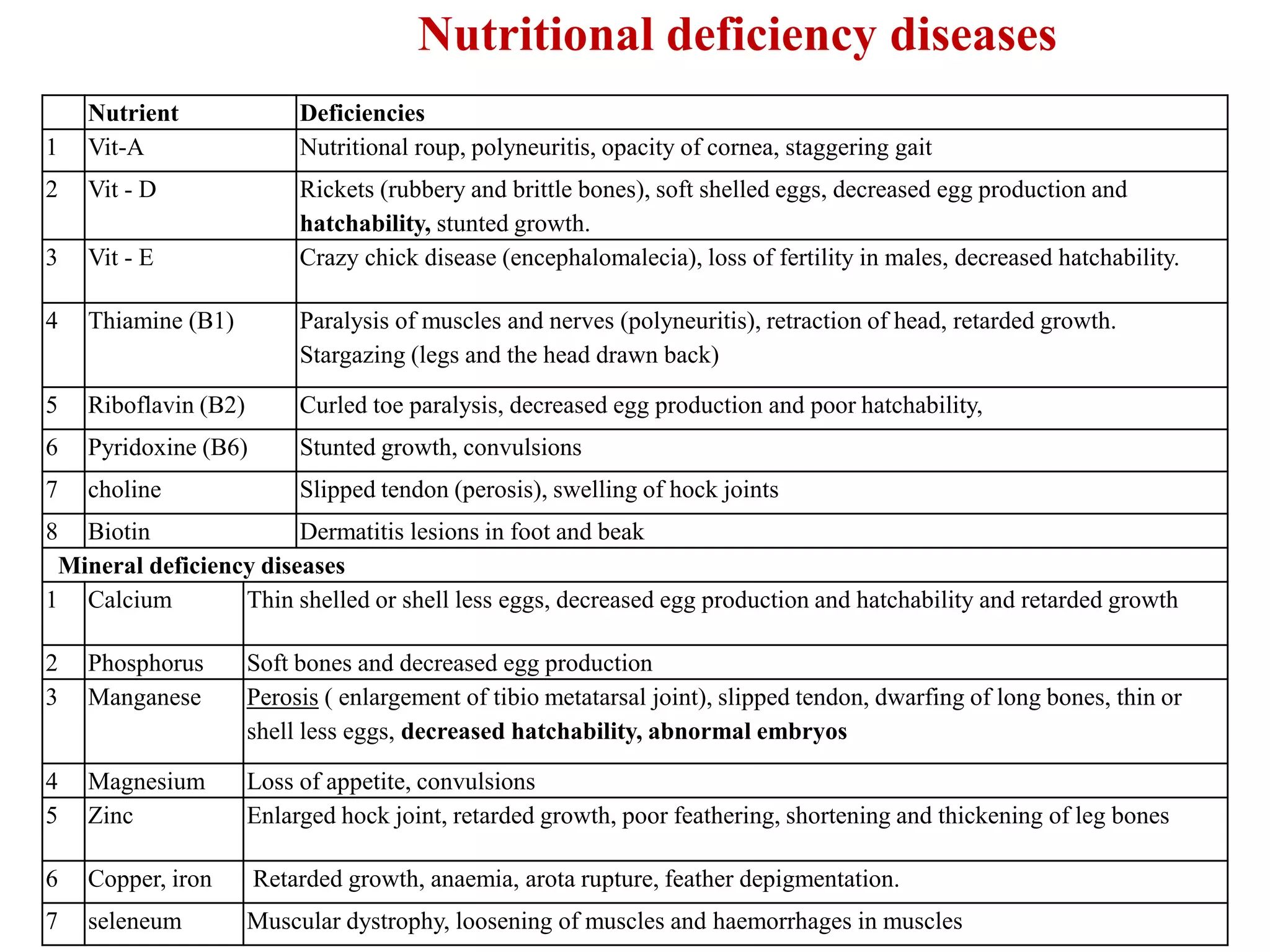
Nutrient Deficiencies
1 Vit-A Nutritional roup, polyneuritis, opacity of cornea, staggering gait
2 Vit - D Rickets (rubbery and brittle bones), soft shelled eggs, decreased egg production and
hatchability, stunted growth.
3 Vit - E Crazy chick disease (encephalomalecia), loss of fertility in males, decreased hatchability.
4 Thiamine (B1) Paralysis of muscles and nerves (polyneuritis), retraction of head, retarded growth.
Stargazing (legs and the head drawn back)
5 Riboflavin (B2) Curled toe paralysis, decreased egg production and poor hatchability,
6 Pyridoxine (B6) Stunted growth, convulsions
7 choline Slipped tendon (perosis), swelling of hock joints
8 Biotin Dermatitis lesions in foot and beak
Mineral deficiency diseases
1 Calcium Thin shelled or shell less eggs, decreased egg production and hatchability and retarded growth
2 Phosphorus Soft bones and decreased egg production
3 Manganese Perosis ( enlargement of tibio metatarsal joint), slipped tendon, dwarfing of long bones, thin or
shell less eggs, decreased hatchability, abnormal embryos
4 Magnesium Loss of appetite, convulsions
5 Zinc Enlarged hock joint, retarded growth, poor feathering, shortening and thickening of leg bones
6 Copper, iron Retarded growth, anaemia, arota rupture, feather depigmentation.
7 seleneum Muscular dystrophy, loosening of muscles and haemorrhages in muscles
Nutritional deficiency diseases
Energy:
• Energy is the first limiting nutrient in breeder formulations.
• Br.Breeder male - 2750 ME (K.cal/Kg) - Min.
Br.Breeder Layer -2800 ME (K.cal/Kg) – Min
Lay .Breeder male & female - 2600 ME (BIS 2007).
• Excess energy intake-negatively affected egg production,
shell quality, fertility and hatchability.
• Higher energy intake -a slight increase in the yolk weight, if
other nutrients are not proportionally increased, general
deficiency develops that affect hatchability.
• Feed restriction improved fertility.
• Breeders fed a low energy-high protein diet tend to produce
eggs with lower hatchability (Leeson and Summers, 1991).
Protein:
• CP Reqt for (BIS 2007)
Broiler Breeder male - 15 %
Broiler Breeder Layer - 16 %
Layer Breeder male - 16 %
Layer Breeder Layer - 17%
• Excess dietary protein increases the requirement of Vitamin A ,
Biotin, Vitamin B12 and Calcium and there by influences the
hatchability of eggs. (Daghir and Shah, 1973; Patel and
McGinnis, 1977).
• Vo et al. (1994) reported higher hatchability in brown-egg
layers fed high protein diets. It is difficult to establish specific
effects of maternal dietary energy intake on hatchability.
• Deficiencies or imbalances of essential amino
acids in the egg are detrimental to embryonic
development.
• An excess of crude protein may reduce fertility
and a low energy to protein ratio in breeder
rations can reduce hatchability.
Fat:
• The fatty acid composition of the maternal diet affects the fatty
acid composition of the yolk, which in turn can affect
hatchability and progeny quality (Vilchez et al., 1990).
• Male dietary supplementation with oil will also result in a
partial remodelling of the phospholipid fatty acid profile of the
spermatozoa.
• Fertilizing ability of chicken semen is improved by dietary
supplementation with long-chain PUFA (Blesbois et al., 1997).
• Adding corn oil, palmitic acid, oleic acid, or linoleic acid to a
basal diet increased hatchability and decreased late embryonic
mortality.
• Palmitic acid facilitates increased yolk mobilization by the
embryo (Vilchez et al., 1992).
Fat:
• The ratio of stearic to oleic acid is important for hatchability, if
the ratio is narrow the hatchability reduced almost to zero, due
to very poor blood and circulatory system formation.
• Polyunsaturated fatty acid (PUFA) is necessary for cell
membrane integrity, immune competence, fertility and
embryonic development
• The linoleic acid is essential in the diet of breeder hens for
normal hatchability of eggs.
• Linoleic acid Reqt for Br.Breeder male & Female and
Lay.Breeder male & Female -1gm/100 kg Min.(BIS 2007)
Contd…
• CLA at 0.55 in the diet caused complete embryonic mortality
in fertile chicken eggs, it narrowed the ratio of unsaturated
fatty acids to saturated fatty acids (Ayidin et al 2001).
• Dietary CLA lead to a lower concentration of mono
unsaturated fatty acid and higher concentration of Saturated
fatty acid (Ayidin & Cook 2004)
Vit -A deficiency
• There will be Decreased hatchability in eggs (Squires and
Naber 1993a and West et al. 1992)
• Embryos may die during the 1st wk of incubation, (West et al.,
1992)
• All-trans-retinoic acid is the biologically active form of
vitamin A for normal cardiovascular development and that it
must be available to the embryo prior to 28 h of incubation for
normal hatching (Dersch and Zile 1993)
• Higher levels of vitamin A (210,000 to 410,000 IU/kg)
decreased egg production, size, and hatchability in laying
hens (March BE, Coates V, Goudie C 1972)
• Signs observed in vitamin A-deficient embryos include an
increased incidence of malpositions , abnormal circulatory
system development.
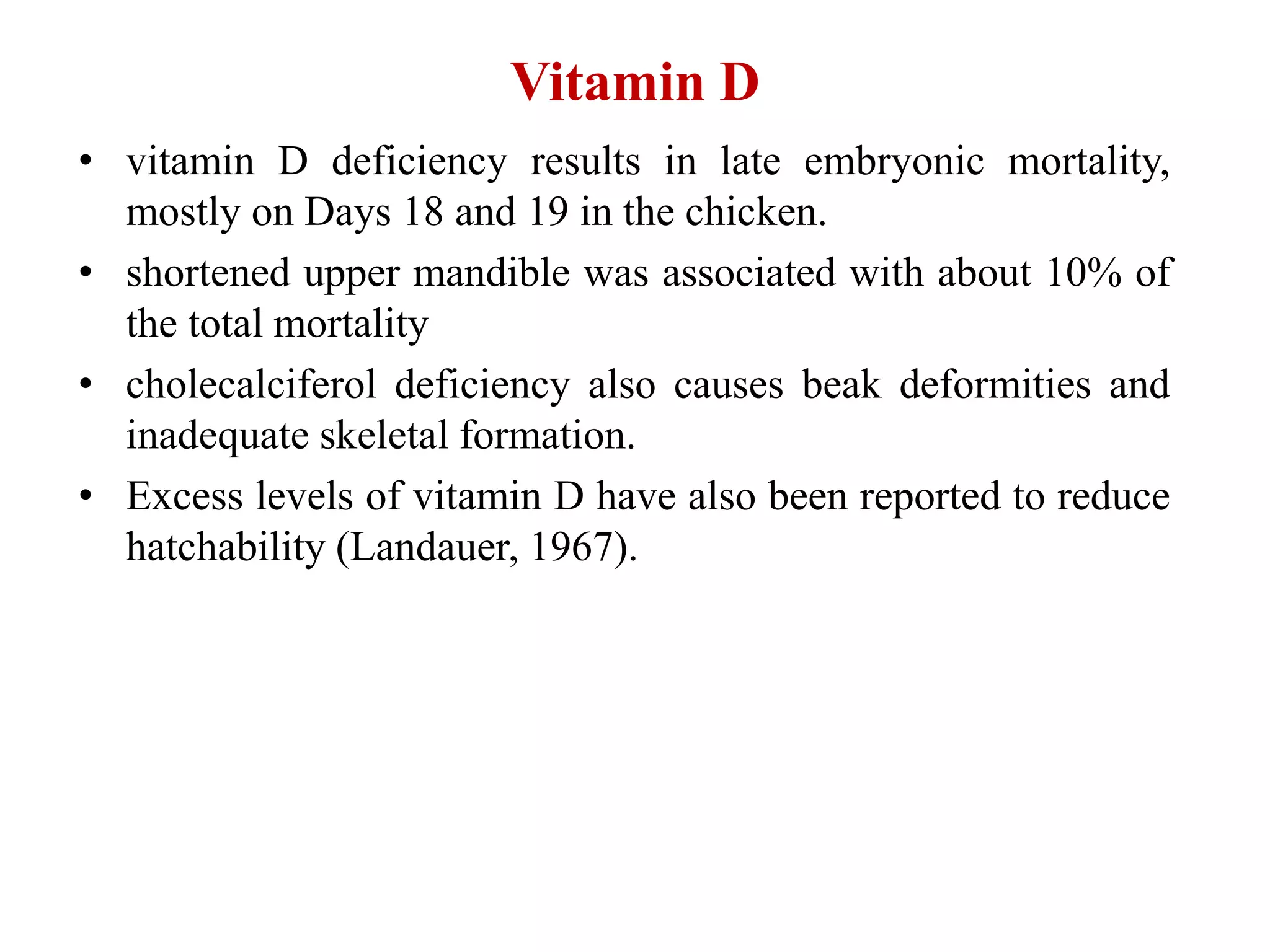
Vitamin D
• vitamin D deficiency results in late embryonic mortality,
mostly on Days 18 and 19 in the chicken.
• shortened upper mandible was associated with about 10% of
the total mortality
• cholecalciferol deficiency also causes beak deformities and
inadequate skeletal formation.
• Excess levels of vitamin D have also been reported to reduce
hatchability (Landauer, 1967).
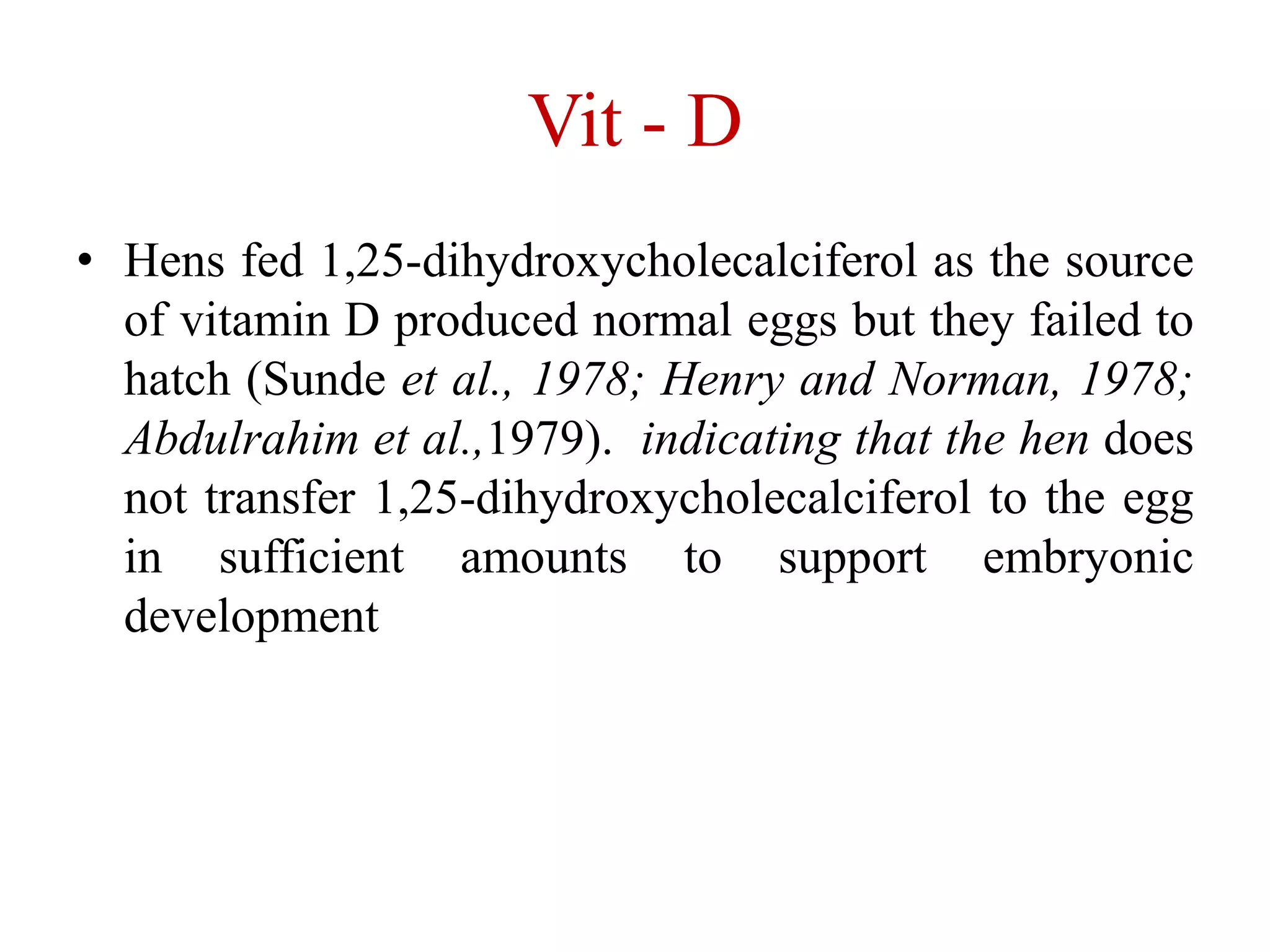
Vit - D
• Hens fed 1,25-dihydroxycholecalciferol as the source
of vitamin D produced normal eggs but they failed to
hatch (Sunde et al., 1978; Henry and Norman, 1978;
Abdulrahim et al.,1979). indicating that the hen does
not transfer 1,25-dihydroxycholecalciferol to the egg
in sufficient amounts to support embryonic
development
Vitamin E
• vitamin E-deficient symptoms in embryo
include cloudy spots in the eyes, blindness,
abnormal vascular system (Exudative
diathesis).
• embryonic mortality- 2 to 5 days.
• supplementation of breeder hen diets has been
reported to result in increased immune
response in the progeny (Haq et al., 1994).
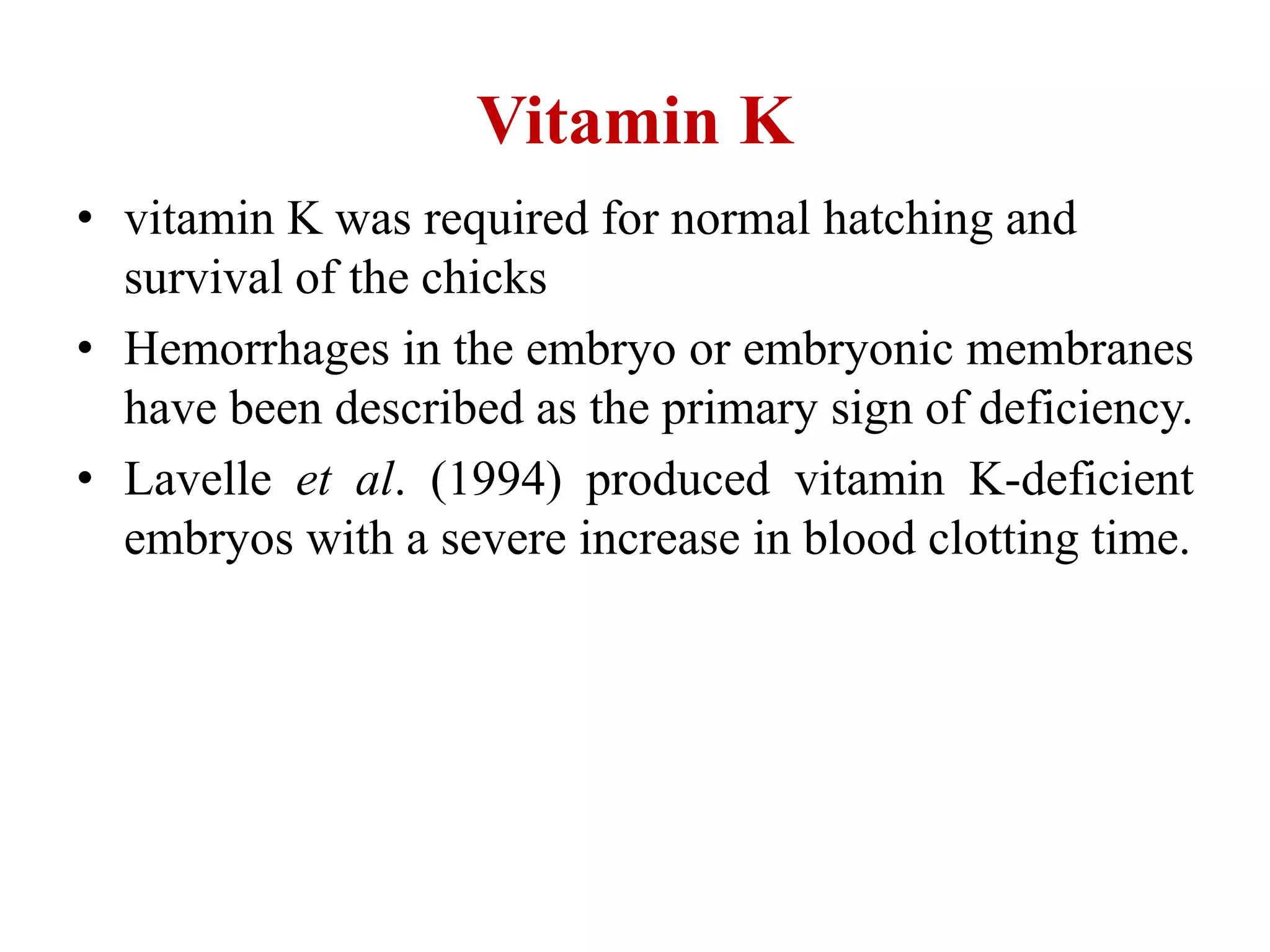
Vitamin K
• vitamin K was required for normal hatching and
survival of the chicks
• Hemorrhages in the embryo or embryonic membranes
have been described as the primary sign of deficiency.
• Lavelle et al. (1994) produced vitamin K-deficient
embryos with a severe increase in blood clotting time.
Riboflavin
• One of the more common nutritional deficiencies affecting
hatchability is that of riboflavin (Leeson et al., 1979a,b).
• Reqt of Riboflavin (Min) in both broiler & Layers (BIS
2007)
Breeder male - 5 mg/kg diet
Breeder Layer - 6 mg/kg diet
• Riboflavin-deficient embryos may show edema, increased
mortality at during incubation, clubbed down, hemorrhages,
dwarfing, micromelia, and anemia
Thiamine
• Thiamine is very plentiful in cereal grains that
are commonly used in poultry diets
• thiamine is necessary for normal embryonic
development and hatchability (Naber et al.,
1954).
• A thiamine deficiency results in polyneuritis
and embryonic mortality.
• Hutt (1961) reported that heavy breeds were
less efficient in the deposition of thiamine into
the egg.
• mortality at early and late at ≥19 days
Pantothenic Acid
• Embryonic mortality peaks have been reported to occur
after 18 d (Gillis et al., 1947),
• A synergistic relationship with vitamin B12 has been
observed (Balloun and Phillips, 1957).
• Subcutaneous Haemorrhages, edema, hydrocephalus, poor
feathering, twisted legs, decreased hatchability, and chicks
with muscular incoordination, swollen hocks
Niacin
• Hypoplasia of skeletal muscles, nervous and vascular
abnormality.
• Briggs et al. (1946) have shown that niacin is required by
the embryo for normal development and hatchability.
• Excesses of nicotinamide have also caused embryonic
mortality and loss of hatchability (Romanoff and Romanoff,
1972).
• mortality at 8-14d.
Biotin
• Biotin has been shown to be necessary for normal
embryonic development and hatchability.
• Increased biotin levels in broiler breeder diets appear
to partially alleviate severe footpad problems in the
progeny
• Mortality of embryos from biotin deficient eggs is
increased during the 1st and 3rd wk of incubation
(Leeson et al., 1979b).
• Signs of biotin-deficient embryos include increased
mortality peaks before 5 d or after 17 d, a
chondrodystrophy or micromelia condition,
shortened bones, and “parrot beak”.
Folic acid
• The breeder hen has a higher requirement of
dietary folic acid for hatchability than for egg
production.
• Embryonic abnormalities shortened bones, beak
defects. Most embryos appeared normal but
died after pipping the air cell.
• Whitehead et al. (1985a) suggested that
prolonged storage of hatching eggs may result
in a folic acid deficiency in the embryos.
• Mortality at > 17d
Vitamin B12:
• Reqt of Vit B 12 (Min) in both broiler & Layers (BIS 2007)
Breeder male - 0.025 mg/kg diet
Breeder Layer - 0.030 mg/kg diet
• Excess levels of B12 resulted in reduced deposition of
riboflavin in the egg yolk
• Embryonic mortality occurred in the 1st wk of incubation.
• Abnormalities include edema around the eyes, poor leg muscle
development, hemorrhages, dwarfing, shortened beak.
Embryonic mortality
• Early embryo deaths may be associated with a deficiency of vitamin
A (failure to develop circulatory system), vitamin E (circulatory
failure), biotin, niacin, pantothenic acid, copper, selenium or thiamin.
Mid-term embryo deaths have been associated with a deficiency of
vitamin B12, riboflavin, phosphorus and zinc.
Mid to late deaths have been associated with a deficiency of vitamin
B12, niacin, pyridoxine, pantothenic acid and riboflavin
Late embryo deaths have been associated with deficiencies of vitamin
B12, vitamin D, vitamin E, vitamin K, pantothenic acid, riboflavin,
folic acid, biotin, calcium, manganese, magnesium, phosphorus, zinc,
iodine and thiamin. Excess selenium could increase the proportion of
late deaths.
Minerals:
• Mineral elements like Ca, P, Mn, Zn, Mg, Fe, Cu, I, Md and Se
essential for embryonic development, their deficiency causes
embryonic mortality and abnormalities.
• Excess of Ca, P, Se depress the hatchability.
Calcium:
• Reqt of Ca% (Min) in both broiler & Layers (BIS 2007)
Breeder male - 1%
Breeder Layer - 3.5%
• Ca important for shell formation
• Poor shells result in excessive egg weight loss accompanied by
increased 1st wk mortality, increased contamination, and embryos
with stunted growth, poor bone development, and increased
mortality at the end of incubation
• Calcium, phosphorus, sodium, potassium, magnesium and chloride
are involved in shell formation.
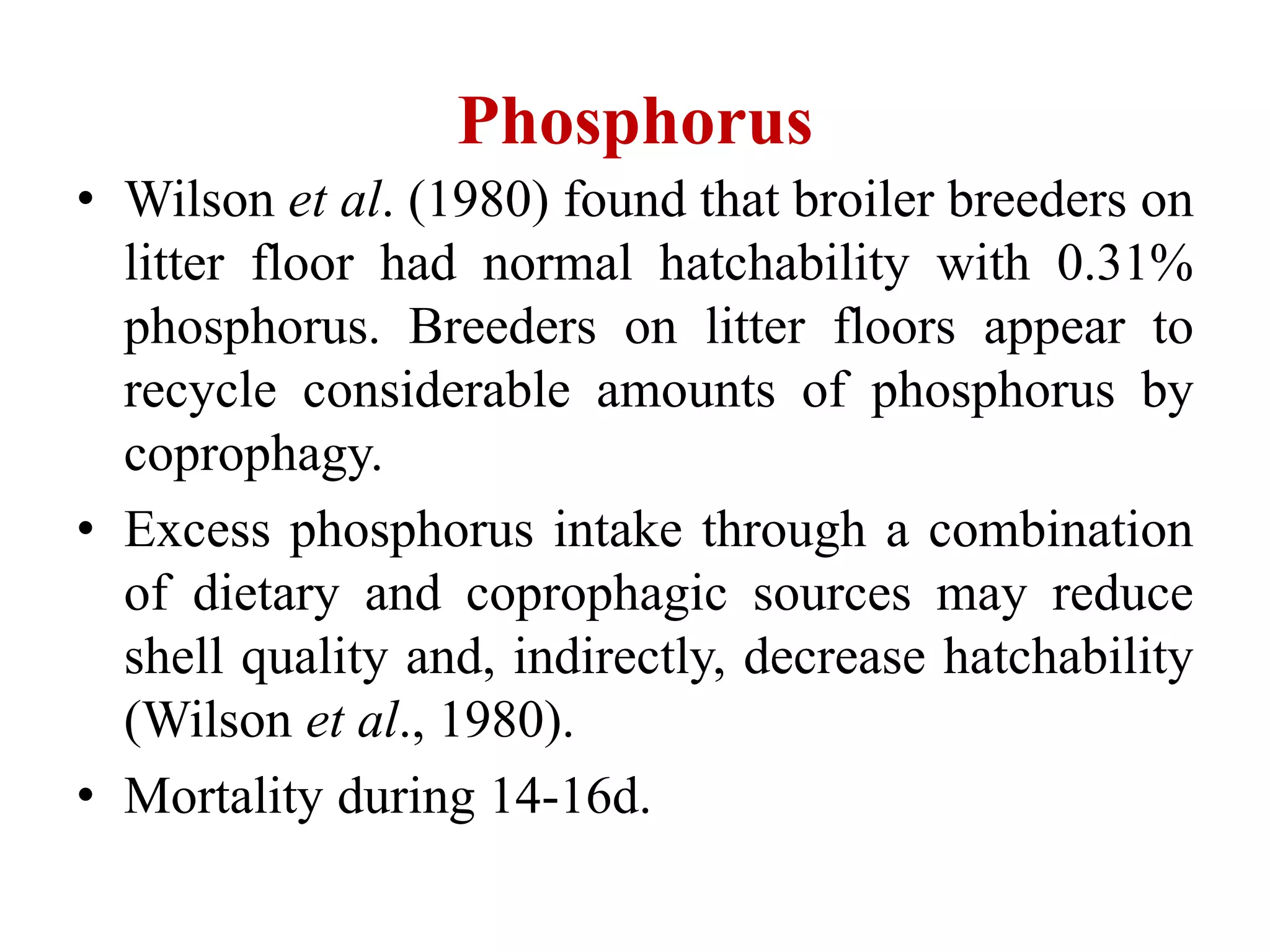
Phosphorus
• Wilson et al. (1980) found that broiler breeders on
litter floor had normal hatchability with 0.31%
phosphorus. Breeders on litter floors appear to
recycle considerable amounts of phosphorus by
coprophagy.
• Excess phosphorus intake through a combination
of dietary and coprophagic sources may reduce
shell quality and, indirectly, decrease hatchability
(Wilson et al., 1980).
• Mortality during 14-16d.
Magnesium
• Nervous Tremors, gasping and convulsion at hatching
Manganese
• A manganese deficiency results in reduced hatchability and
embryonic abnormalities almost identical to those of biotin
deficiencies.
• Ataxia in the form of a tetanic spasm of the opisthotonic type
has been described in manganese-deficient embryos (Caskey
et al., 1944). This ataxia condition commonly referred to as
“stargazer”.
• Mn deficiency causes nutritional Chondro dystrophy
• Parrot beak resulting from a disproportionate shortening of
the lower mandible is also seen
Iodine
• Excess dietary iodine will also cause
hatchability problems, resulting in
embryonic mortality, unhatched pips, and
extended incubation periods (Arrington et
al., 1967).
Selenium
• decreases hatchability when feeding a selenium-deficient diet.
Chicks that hatched were weak and had gizzard muscle
myopathy and legs extended backward and curved upward.
• Abnormalities due to excess selenium include dwarfing, short
or missing lower beak, and shortened bones of the legs and
wings. Supplementation of Organic Se in diets of laying hen
increase hatchability of fertile eggs (Hanafy et al., 2009).
• Organic selenium in layer diets improved the environment of
the sperm storage tubule in hens oviduct allowing the sperm to
live for longer time which increases the fertility (Agate et al.
2009)
Vit E and Selenium
• breeders (47 weeks old) fed zinc-L-selenomethionine and 120
mg vitamin E/kg feed produced heavier eggs and albumen.
Furthermore, hatchability of the eggs of breeders fed 120 mg
vitamin E/kg feed was higher than breeders fed 30 mg vitamin
at 29 weeks (Urso et al., 2015).
• In breeder nutrition, vitamin E, carotenoids and selenium
received most of attention as a way of improving stress
resistance of poultry.
Boron:
• Feeding high levels of boron in the form of boric acid or borax
to broiler breeder hens decreased hatchability but did not affect
egg production (Rossiet al.,1993).
• Males fed high levels of boron had an increased incidence of
abnormal spermatozoa
Chloride:
• Inadequate dietary chloride intake (restricted-fed corn-
soybean diet) resulted in decreased hatchability in broiler
breeders .
Anti nutritional factors:
Gossypol:
• Gossypol has anti fertility effects
• In breeder cock diets gossypol suppresses sperm production by
damaging the germinal epithelium
• It also decreases sperm motility(due to specific mitochondrial
damage in spermatozoa tail) (randel 1992.)
Feed Additives:
• Prebiotic supplementation increased hatchability of eggs and
decreased infertile eggs in 40 wk of age.
• Dead-in shells was reduced during 38-40 wks by prebiotic
supplementation.
• mannan oligosaccharides increase fertility and hatchability in
broiler breeders. (Shashidhara and Devegowda 2003) )
• Probiotic supplementation increased hatchability and
decreased infertile eggs, as well as dead-in shells.
IN OVO FEEDING (IOF)
“INJECTING NUTRIENTS INTO THE AMNION DURING
INCUBATION OF EGG”
 IOFimproves the energy status and gut development of perinatal chick
 Providing feed to the developing embryo which affect the performance of
hatching chicks
Many potential nutrient supplements can be included in the in-ovo feeding
 Carbohydrate
 ß-hydroxy-ß-methylbutyrate (HMB)
 Vitamins and minerals
 Amino acids
Why In-Ovo feeding?
• Depletion of all nutrients during hatching process
• Late access to feed/ fasting
• Immature gastro intestinal tract in chicks
• 2-5% of hatchlings do not survive the critical post
hatch period due to limited body reserves
• Stunted growth in chicks during initial phase i.e
24-48 Hrs post hatch
• Embryonic period & first week represents a larger
portion i.e 45% of the whole life span of the
broiler(Bigot et al., 2003).
IOF
• Uni and Ferket, (2003) invented and patented the
concept of administrating a nutritive solution into the
amniotic fluid.
• Uni and Ferket, (2004), feeding the embryo before
hatch by in ovo administration would be expected to
enhance hatchability, and development of the
digestive tract, and increase body weight and
nutritional status of the hatchling.
• Studies have demonstrated that IOF can enhance
energy status (Foye et al., 2006) And gut maturation
of developing embryos (Tako et al., 2004; Smirnov et
al., 2006).
What and how much to Inject?
•Total quantity to be injected was fixed at 1 to 2 ml.
•done on 7 , 14th & 18th day of incubation
•injected from the broad end of the egg, using “ in-ovo ject”
•the hole will be sealed after injection with hard parafin for
normal hatch of the egg
EFFECT OF AMINO ACID MIXTURE ON
HATCHABILITY AND EMBRYONIC MORTALITY
CRITARIA
GROUPS
HATCHABIL
ITY
(%)
EMBRYONIC
MORTALITY
(%)
DUCKLING WEIGHT
(g/bird)
Control 74 26 45.95±0.27
Amino acids
(0.50 ml)
84 16 55.05±0.40
Distilled water
(0.50 ml)
72 28 47.36±0.40
Amino acids
(0.75 ml)
68 18 52.84±1.02
Distilled water
(0.75ml)
72 28 49.45±0.72
Source :- Khalid and Selim (2011)
Effect of in-ovo injection of nutrients on
egg hatchability
NUTRIENTS Hatchability%
Non-injected (control) 91.66
Distilled water 90.00
Amino acids 93.33
Albumin 93.33
Dextrose 20% 91.66
Dextrose 10% 88.33
Source :- (Eslami et al.2013)
• Bohórquez et al. (2008) observed that in ovo
feeding significantly increased functional
maturity and mucus secretion of goblet cells of
villi of ileum and caeca of turkey poults.
Advantages of In ovo feeding
• In ovo feeding broilers and turkeys has increased hatchling weights by 1%
to 7%.
• Improves digestive capacity
• Increases growth rate and feed efficiency
• Reduces post hatch mortality and morbidity
• Improves immune response to enteric agents
• Reduces incidence of developmental skeletal disorders
• Increases muscle development and breast muscle yield
• Development of critical tissues of the perinatal chick about 2-3 days
• Increased villus dimensions & pancreatic activity for carbohydrate
digestion
• Reduce the cost of production per kg of consumable poultry meat
• Improves bone development
• Advances morphometic development of the intestinal tract and mucin
barrier
• It also enhance the protective function of enteric mucosa
Authors and journal TRT results conclusion
Effect of Dietary
Vitamin A on
Reproductive
Performance
and Immune
Response of Broiler
Breeders, Jianmin
Yuan1., Abdelfatah
Rashad Roshdy1,2.,
Yuming Guo1*,
Yongwei Wang1,
Shuangshuang Guo1,
PLOS ONE |
www.plosone.org
Phase 1: The hens’ diets were
supplemented with 5,000;
10,000; 15,000; 20,000; 25,000;
30,000;
or 35,000 IU/kg vitamin A (retinyl
acetate) in the diet.
Phase 2: The hens’ diets were
supplemented with
5,000; 15,000; 45,000; and
135,000 IU/kg vitamin A (retinyl
acetate).
Excessive supplementation of
vitamin A could decrease liver
function, reproductive
performance, and immune
response of
broiler breeder hens. The
maximum safety tolerable dose of
vitamin A for broiler breeders is
35,000.
Authors and journal TRT results conclusion
Effect of dietary
vitaminC
supplementon
reproductive
performance of aviary
pheasants
S. NOWACZEWSKI,
H. KONTECKA,
Czech J. Anim. Sci.,
50, 2005 (5): 208–212
1. control with out Vit
C
2. 100 mg/kg
3. 200 mg/kg
3. 300 mg/kg vitamin
C, respectively.
Doses of 100 and 200 mg of vitamin C
exerted a positive influence on laying as
well as on egg fertilization and hatchability
indices. It is advisable to use a prophylactic
dose of 100 mg of vitamin C per 1 kg feed
in the feeding of reproductive pheasants
reared in aviaries. In conditions of thermal
stress (high air temperatures), it is
recommended to increase the applied
vitamin C dose to 200 mg/kg feed.
Authors and journal Results conclusion
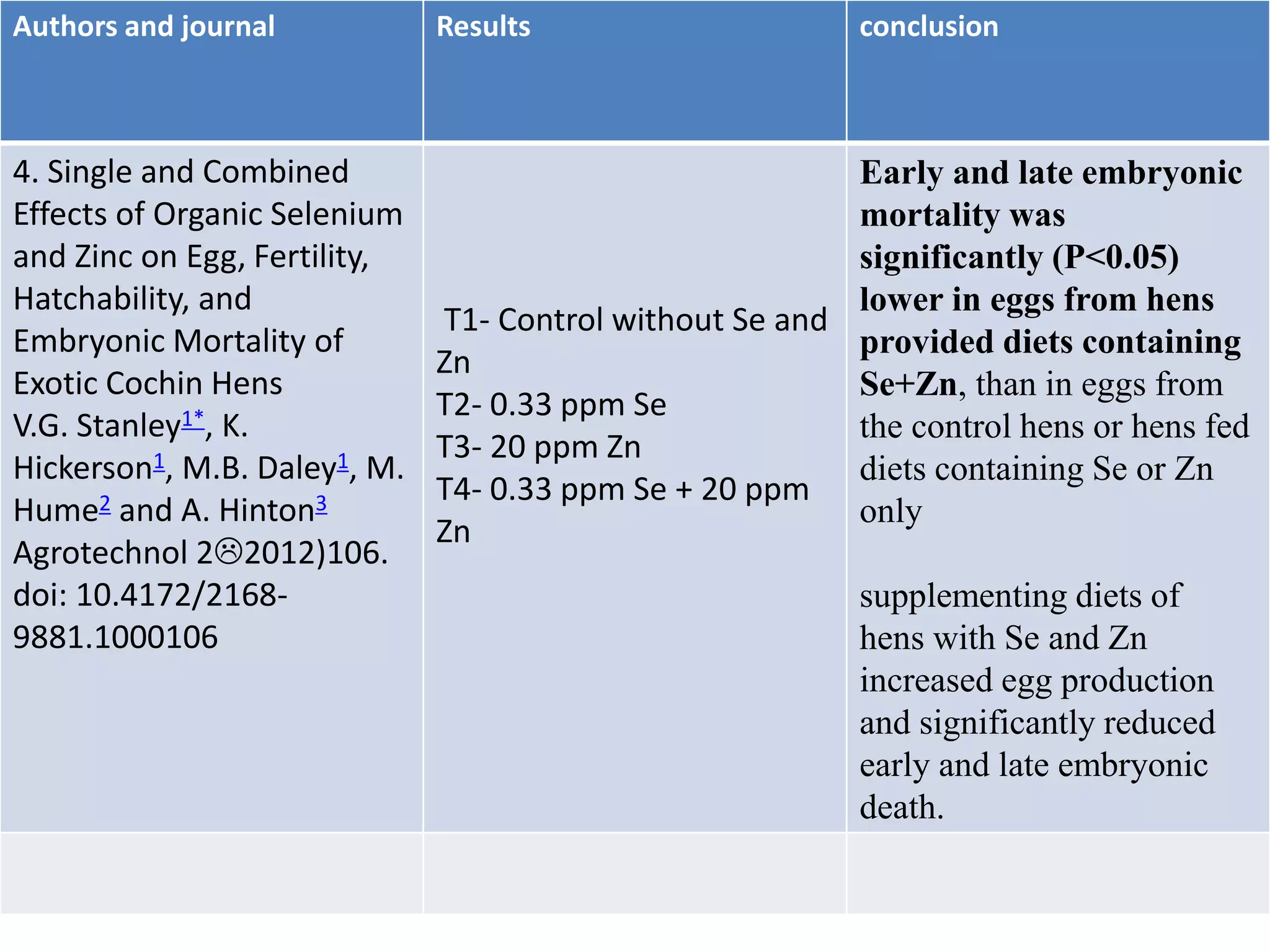
4. Single and Combined
Effects of Organic Selenium
and Zinc on Egg, Fertility,
Hatchability, and
Embryonic Mortality of
Exotic Cochin Hens
V.G. Stanley1*, K.
Hickerson1, M.B. Daley1, M.
Hume2 and A. Hinton3
Agrotechnol 22012)106.
doi: 10.4172/2168-
9881.1000106
T1- Control without Se and
Zn
T2- 0.33 ppm Se
T3- 20 ppm Zn
T4- 0.33 ppm Se + 20 ppm
Zn
Early and late embryonic
mortality was
significantly (P<0.05)
lower in eggs from hens
provided diets containing
Se+Zn, than in eggs from
the control hens or hens fed
diets containing Se or Zn
only
supplementing diets of
hens with Se and Zn
increased egg production
and significantly reduced
early and late embryonic
death.
Authors and journal TRT conclusion
5. Effects of dietary organic or
inorganic manganese, zinc,
copper and chrome
supplementation on the
performance, egg quality and
hatching characteristics of
laying breeder hens
Engin YENİCE1, Cengizhan
MIZRAK2, Meltem
GÜLTEKİN1, Zafer ATİK1,
Muhammet TUNCA1 Ankara
Üniv Vet Fak Derg, 62, 63-68,
2015
two
different trace mineral forms (i
norganic and organic) and
two different levels (80, 60, 5
and 0.15 mg/kg and 40, 30,
2.5 and 0.07 mg/kg of Mn, Zn,
Cu and Cr, respectively)
were tested.
The dietary supplementation of
organic Mn, Zn, Cu and Cr at
high levels (80, 60, 5 and 0.15
mg/kg, respectively) increased
the hatchability of the
fertilised eggs and
hatchability compared to that
of the other groups
organic trace minerals have
greater bioavailability than
their inorganic forms because,
during embryogenesis, the
developing embryo requires
the trace minerals stored in
the yolk to be transferred to
developing tissues
Authors and journal Results conclusion
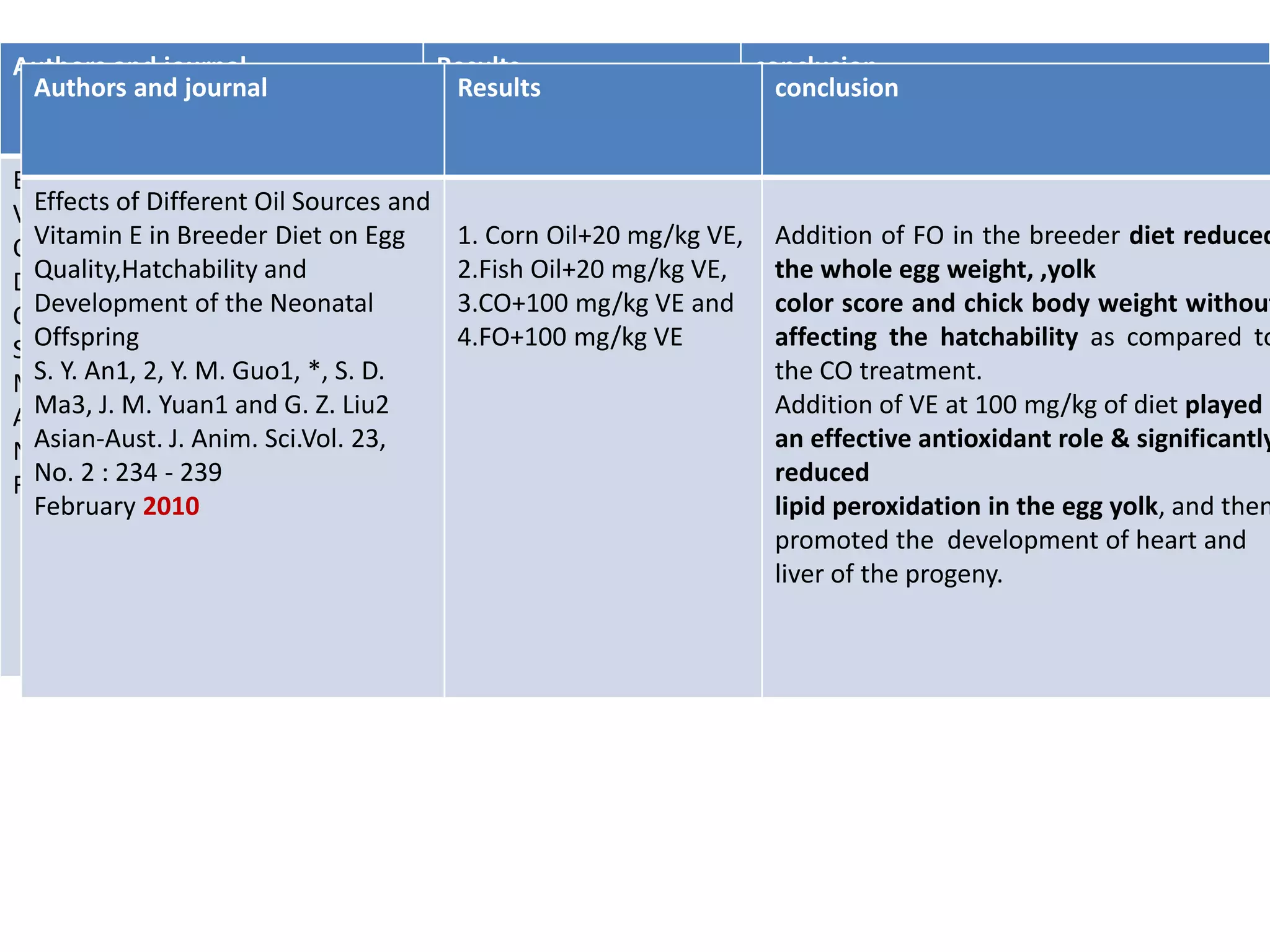
Effects of Different Oil Sources and
Vitamin E in Breeder Diet on Egg
Quality,Hatchability and
Development of the Neonatal
Offspring
S. Y. An1, 2, Y. M. Guo1, *, S. D.
Ma3, J. M. Yuan1 and G. Z. Liu2
Asian-Aust. J. Anim. Sci.Vol. 23,
No. 2 : 234 - 239
February 2010
1. Corn Oil+20 mg/kg VE,
2.Fish Oil+20 mg/kg VE,
3.CO+100 mg/kg VE and
4.FO+100 mg/kg VE
Addition of FO in the breeder diet reduced
the whole egg weight, ,yolk
color score and chick body weight without
affecting the hatchability as compared to
the CO treatment.
Addition of VE at 100 mg/kg of diet played
an effective antioxidant role & significantly
reduced
lipid peroxidation in the egg yolk, and then
promoted the development of heart and
liver of the progeny.
Authors and journal Results conclusion
Effects of Different Oil Sources and
Vitamin E in Breeder Diet on Egg
Quality,Hatchability and
Development of the Neonatal
Offspring
S. Y. An1, 2, Y. M. Guo1, *, S. D.
Ma3, J. M. Yuan1 and G. Z. Liu2
Asian-Aust. J. Anim. Sci.Vol. 23,
No. 2 : 234 - 239
February 2010
1. Corn Oil+20 mg/kg VE,
2.Fish Oil+20 mg/kg VE,
3.CO+100 mg/kg VE and
4.FO+100 mg/kg VE
Addition of FO in the breeder diet reduced
the whole egg weight, ,yolk
color score and chick body weight without
affecting the hatchability as compared to
the CO treatment.
Addition of VE at 100 mg/kg of diet played
an effective antioxidant role & significantly
reduced
lipid peroxidation in the egg yolk, and then
promoted the development of heart and
liver of the progeny.
Authors and journal Results conclusion
The effect of dietary
lipid sources on layer
fertility and
hatchability
O.S. Olubowale1, F.H. de
Witt1#, J.P.C. Greyling1, A.
Hugo2, A.M. Jooste1
& M.B. Raito1 South African
Journal of Animal Science
2014, 44 (Issue 5,
Supplement 1)
The (i) control diet
consisted of a 50:50 blend
of linseed- and fish oil, (ii)
fish oil diet (iii) sunflower
oil diet ((iv) high oleic acid
(HO) sunflower oil diet (v)
tallow diet (saturated fatty
acids).
Inclusion levels of either 1.5% fish oil
+1.5% linseed oil or 3% HO sunflower
could be used in maintaining sperm
motility. Similarly, a high fertility, as well
as an acceptable level of chick hatchability
could be achieved in older birds by feeding
either n-3 (linseed and fish oil) or n-9 (HO
sunflower oil) supplementary lipid sources.
Finally, it can be said that the n-3, n-6
and n-9 n-9 type dietary fatty acids
needs critical consideration, both in
terms of dietary concentration and
ratio in the formulation of breeder
diets in order to limit embryonic
mortalities during incubation.
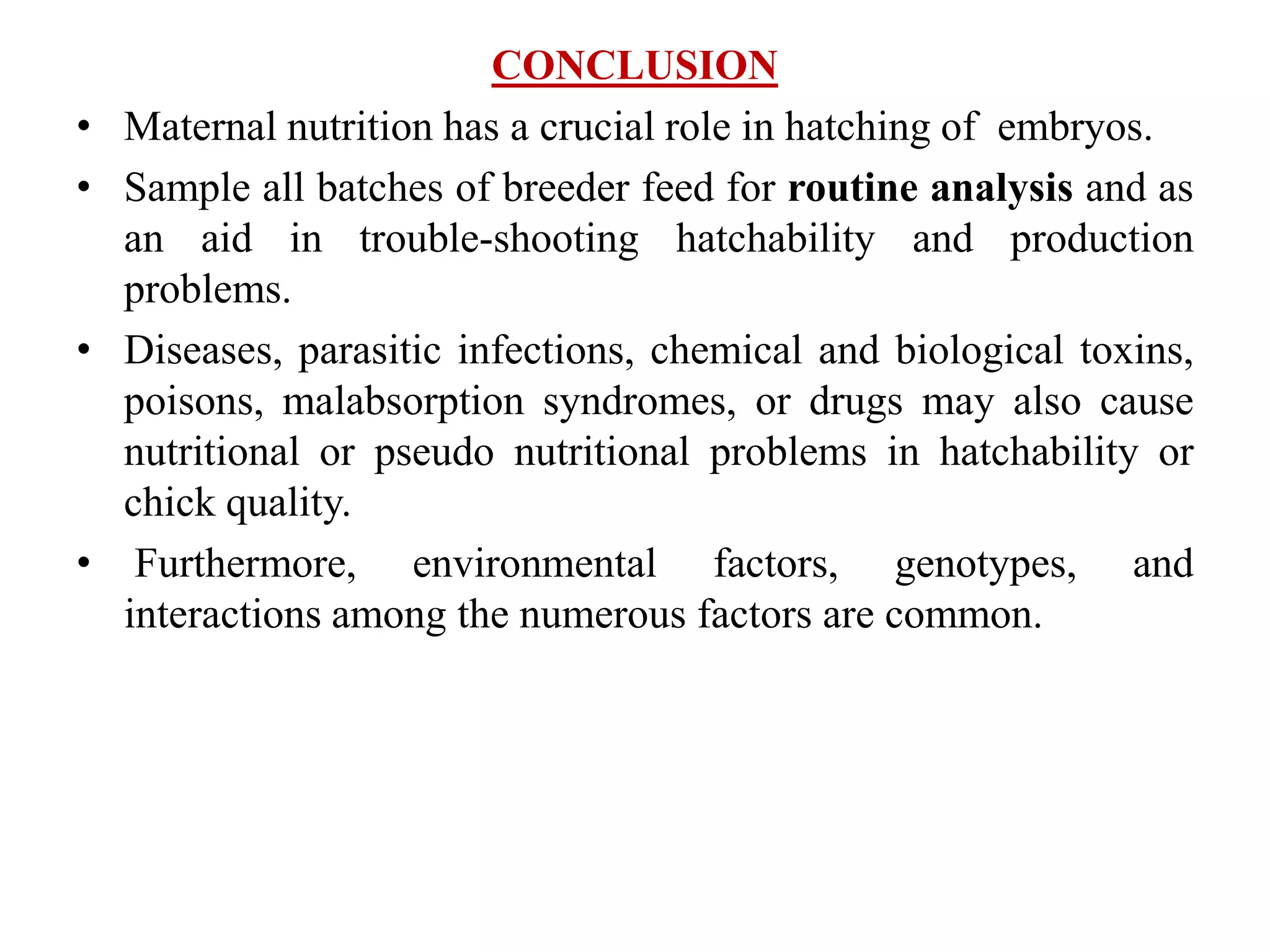
CONCLUSION
• Maternal nutrition has a crucial role in hatching of embryos.
• Sample all batches of breeder feed for routine analysis and as
an aid in trouble-shooting hatchability and production
problems.
• Diseases, parasitic infections, chemical and biological toxins,
poisons, malabsorption syndromes, or drugs may also cause
nutritional or pseudo nutritional problems in hatchability or
chick quality.
• Furthermore, environmental factors, genotypes, and
interactions among the numerous factors are common.
THANK YOU
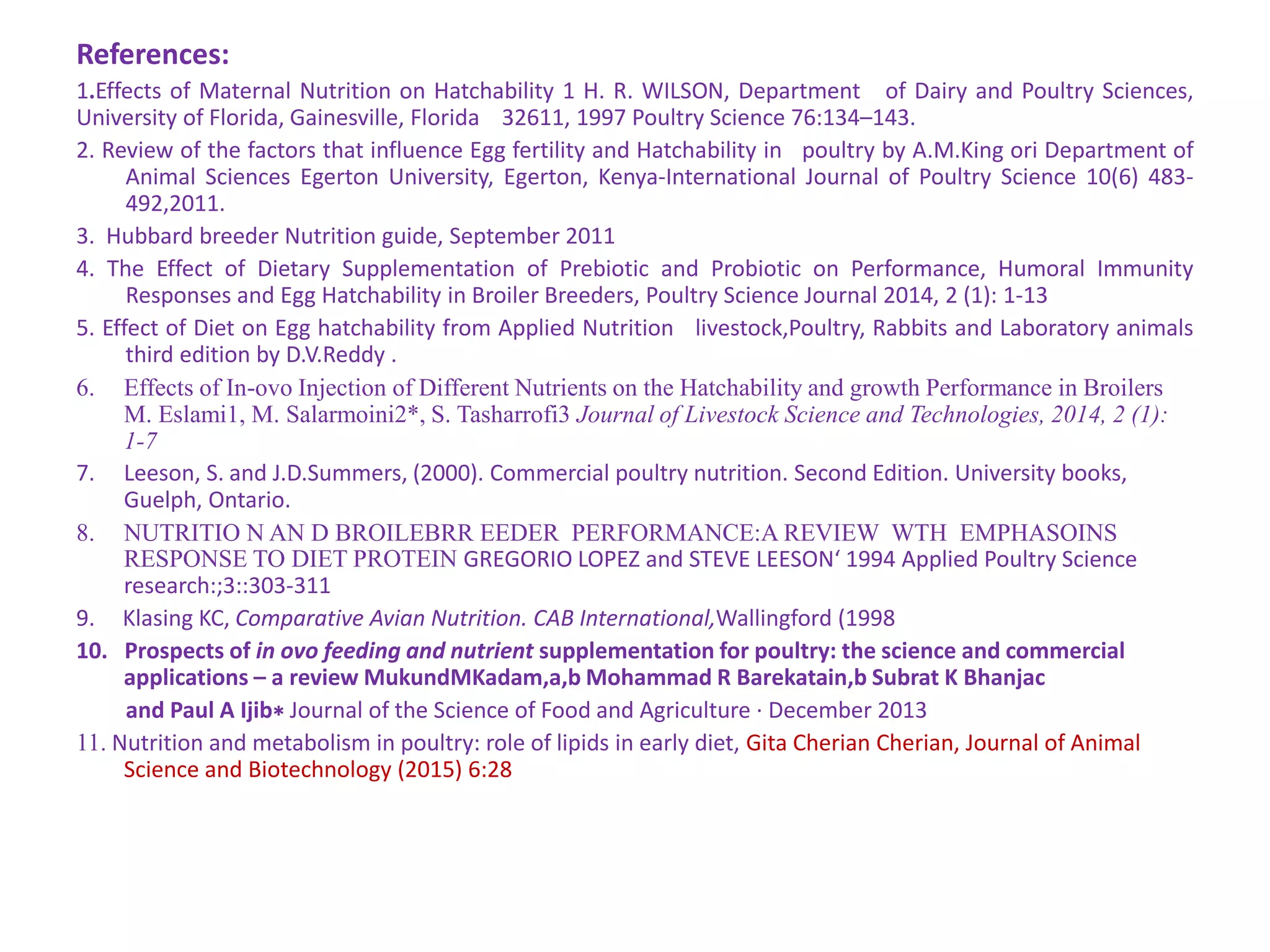
References:
1.Effects of Maternal Nutrition on Hatchability 1 H. R. WILSON, Department of Dairy and Poultry Sciences,
University of Florida, Gainesville, Florida 32611, 1997 Poultry Science 76:134–143.
2. Review of the factors that influence Egg fertility and Hatchability in poultry by A.M.King ori Department of
Animal Sciences Egerton University, Egerton, Kenya-International Journal of Poultry Science 10(6) 483-
492,2011.
3. Hubbard breeder Nutrition guide, September 2011
4. The Effect of Dietary Supplementation of Prebiotic and Probiotic on Performance, Humoral Immunity
Responses and Egg Hatchability in Broiler Breeders, Poultry Science Journal 2014, 2 (1): 1-13
5. Effect of Diet on Egg hatchability from Applied Nutrition livestock,Poultry, Rabbits and Laboratory animals
third edition by D.V.Reddy .
6. Effects of In-ovo Injection of Different Nutrients on the Hatchability and growth Performance in Broilers
M. Eslami1, M. Salarmoini2*, S. Tasharrofi3 Journal of Livestock Science and Technologies, 2014, 2 (1):
1-7
7. Leeson, S. and J.D.Summers, (2000). Commercial poultry nutrition. Second Edition. University books,
Guelph, Ontario.
8. NUTRITIO N AN D BROILEBRR EEDER PERFORMANCE:A REVIEW WTH EMPHASOINS
RESPONSE TO DIET PROTEIN GREGORIO LOPEZ and STEVE LEESON‘ 1994 Applied Poultry Science
research:;3::303-311
9. Klasing KC, Comparative Avian Nutrition. CAB International,Wallingford (1998
10. Prospects of in ovo feeding and nutrient supplementation for poultry: the science and commercial
applications – a review MukundMKadam,a,b Mohammad R Barekatain,b Subrat K Bhanjac
and Paul A Ijib∗ Journal of the Science of Food and Agriculture · December 2013
11. Nutrition and metabolism in poultry: role of lipids in early diet, Gita Cherian Cherian, Journal of Animal
Science and Biotechnology (2015) 6:28

Nutritional Factors Affecting Hatchability

  • 1.
    Nutritional Factors AffectingHatchability Submitted to : Submitted by: Dr D.NAGALAXMI Dr Gurram Srinivas Professor & University Head RVD/17-11 Dept. of Animal Nutrition
  • 2.
    Hatchability: The percentage ofchicks hatched out of total number of egg set for incubation. = no of chicks hatched/no. of egg loaded in incubatorX100 Measured in two forms 1) Hatchability on total number of egg set – 85-87% 2) Hatchability on number of fertile eggs - 90-95%
  • 3.
    Factors that affecthatchability include: 1. Fertility: the capacity to reproduce, is affected by: • Less fertility in heavy breeds compared to light breeds • Sex ratio. • age of Birds. • length of time between breedings. • management practices. • Too high and low temp
  • 4.
    2. Genetics, orgenetic makeup of the bird, is affected by: • inbreeding • crossbreeding • lethal genes • heritable traits (ex. egg production)
  • 5.
    3. Diseases ofbreeding stock. 4. Egg Selection: Certain physical characteristics can affect hatchability. • Egg Size: Extremely large or small eggs do not hatch well. • Egg Shape: Unnaturally shaped eggs do not hatch well. • Shell quality: Strong shells hatch better than weak shells. • Interior quality: Upon candling, better interior quality eggs tend to hatch better.
  • 6.
    5. Handling offertilized eggs. • should be handled gently and with care • kept at about 55-60°F and RH 70-75% • Never store eggs above 750 F and RH <40%, these conditions decreases hatchability. • Position eggs with large end up. • Don’t store the eggs for more than 10-14 days of storage. • 7-10 days storage, hatchability high. • After 3 weeks 0% hatchability
  • 8.
    Nutrition of breedingstock Amount of Protein, energy, vitamins and minerals in hen rations. • A good nutritional status of the parent birds and balanced supply of nutrients required for normal development of the embryo • The consequences to the embryo may be lethal if the egg contains either inadequate, excessive, or imbalanced levels of nutrients
  • 9.
    Feeding of breeders •Breeder female feed contains 18 % cp • 2600 kcal/kg ME • Calcium -3% • Available phosphorus- 0.5% • breeder hen feed is enriched with all micronutrients like trace minerals and vitamins in order to obtain high rates of fertility and hatchability. • Moreover, the breeder feeds must be practically free from all mycotoxins, because mycotoxins will not only affect the egg production and health status of the birds but also fertility and hatchability.
  • 10.
    RESTRICTED FEEDING • Followedduring growing period • broiler breeder grow rapidly • In general, meat type male – 3 kg Female - 2.2 kg at 22 weeks of age. • egg type male 1.75 and female 1.35 kg at 20 weeks of age. • qualitative or quantitative feed restriction
  • 11.
    RESTRICTED FEEDING 1) Quantitativefeed restriction: • In which the amount of feed is reduced below the normal requirement of birds. • This can be done on day-to-day basis or skip-a-day programme or skip-two days in a week programme.
  • 12.
    2) Qualitative feedrestriction • In which the quality of the feed is reduced below the standard requirement of the bird. • This can be done by including unconventional feeds or lesser nutrient feed ingredients in place of high protein or high energy diet. • Here the quantity of allotment to the bird is not restricted.
  • 13.
    Advantages of feedrestriction during growing period • saving on feed cost • The pullets accumulate less fat and produce more eggs. • It is easier to identify weaker birds • Prevent early sexual maturity • uniformity
  • 14.
    Sex separate feeding •The breeder males must be fed with a low protein diet having 13-14% protein only because high protein diet will affect sperm quality as well as semen volume. Therefore, sex separate feeding of breeder hens and cocks will be followed. • In poultry breeder management feed is regulated to prevent excessive weight gain, which causes poor quality ejaculate and ovulation and in extreme cases early Ovarian and testicular regression (Brillard 2007). • The females will be fed a 18% protein and 3.0 to 3.5% calcium feed while the cocks with 13-14% protein and 1-1.5% calcium • (40mg/kg) of vitamin E for males
  • 15.
    WATER RESTRICTION • Birdsunder restricted feeding program consume excessive quantities of water to satisfy physical hunger. • This will lead to distended crop, sudden death syndrome and wet litter problem. • It is advisable to provide water to the birds ½ hr to 1 hr prior to feed delivery.
  • 16.
    Nutrient requirement Broilerbreeder feed (BIS 2007) Broiler breeder feed Chick Grower Layer Male Moisture (max) 11.0 11.0 11.0 11.0 CP (Min) 20 16 16 15 ME (Kcal/Kg) 2800 2750 2800 2750 EE (Min) 2.5 2.5 2.5 2.5 CF (Max) 7.0 9.0 9.0 9.0 AIA (Max) 4.0 4.0 4.0 4.0 Salt (Max) 0.5 0.5 0.5 0.5 Ca (Min) 1.0 1.0 3.5 1.0 P (Min) 0.7 0.7 0.7 0.7 Pav (Min) 0.45 0.45 0.40 0.40 Lysine (Min) 1.0 0.8 0.85 0.80 Meth (Min) 0.45 0.40 0.45 0.40 Meth + cystine (Min) 0.70 0.70 0.70 0.70 Aflatoxin B1 (ppb) 20 20 20 20
  • 17.
    Nutrient requirement forBroiler breeder (BIS 2007) Broiler breeder feed Chick Grower Layer Male Manganese (mg/kg) 100 100 100 100 Iodine (mg/kg) 1.5 1.5 1.5 1.5 Iron (mg/kg) 80 80 80 80 Zinc (mg/kg) 80 80 80 80 Copper (mg/kg) 12 12 12 12 Vitamin A (IU/kg) 12000 12000 15000 12000 Vitamin D3 (IU/kg) 2500 2500 3000 2500 Vitamin E (mg/kg) 20.0 20.0 50.0 20.0 Vitamin K (mg/kg) 2.0 2.0 3.0 2.0 Thiamine (mg/kg) 2.0 2.0 3.0 2.0 Riboflavin (mg/kg) 5.0 5.0 6.0 5.0 Pyridoxine (mg/kg) 5.0 5.0 6.0 5.0 Pantothenic acid (mg/kg) 15.0 15.0 25.0 15.0 Nicotinic acid (mg/kg) 40.0 40.0 50.0 40.0 Biotin (mg/kg) 2.0 2.0 2.0 2.0 Vitamin B12 (mg/kg) 0.025 0.025 0.030 0.025 Folic acid(mg/kg) 3.0 3.0 4.0 3.0
  • 18.
    Layer breeder feed(BIS 2007) Layer breeder feed Chick Grower Layer Male Moisture (max) 11.0 11.0 11.0 11.0 CP (Min) 20 16 17 16 ME (Kcal/Kg) 2800 2600 2600 2600 EE (Min) 2.0 2.0 2.0 2.0 CF (Max) 7.0 9.0 9.0 9.0 AIA (Max) 2.5 2.5 2.5 2.5 Salt (Max) 0.5 0.5 0.5 0.5 Ca (Min) 1.0 1.0 3.5 1.0 P (Min) 0.65 0.60 0.60 0.60 Pav (Min) 0.45 0.40 0.40 0.40 Lysine (Min) 0.95 0.70 0.70 0.80 Meth (Min) 0.40 0.40 0.40 0.40 Meth + cystine (Min) 0.70 0.60 0.60 0.60 Aflatoxin B1 (ppb) 20 20 20 20
  • 19.
    Nutrient requirement forchicken (BIS 2007) Layer breeder feed Chick Grower Layer Male Manganese (mg/kg) 100 100 100 100 Iodine (mg/kg) 1.5 1.5 1.5 1.5 Iron (mg/kg) 80 80 80 80 Zinc (mg/kg) 80 80 80 80 Copper (mg/kg) 12 12 12 12 Vitamin A (IU/kg) 12000 12000 15000 12000 Vitamin D3 (IU/kg) 2500 2500 3000 2500 Vitamin E (mg/kg) 20.0 20.0 50.0 20.0 Vitamin K (mg/kg) 2.0 2.0 3.0 2.0 Thiamine (mg/kg) 2.0 2.0 3.0 2.0 Riboflavin (mg/kg) 5.0 5.0 6.0 5.0 Pyridoxine (mg/kg) 5.0 5.0 6.0 5.0 Pantothenic acid (mg/kg) 15.0 15.0 25.0 15.0 Nicotinic acid (mg/kg) 40.0 40.0 50.0 40.0 Biotin (mg/kg) 2.0 2.0 2.0 2.0 Vitamin B12 (mg/kg) 0.025 0.025 0.030 0.025 Folic acid(mg/kg) 3.0 3.0 4.0 3.0 Choline (mg/kg) 850.0 850.0 700.0 500.0 Linoleic acid (g/100 g) 1 1 1 1
  • 20.
    Nutrient Deficiencies 1 Vit-ANutritional roup, polyneuritis, opacity of cornea, staggering gait 2 Vit - D Rickets (rubbery and brittle bones), soft shelled eggs, decreased egg production and hatchability, stunted growth. 3 Vit - E Crazy chick disease (encephalomalecia), loss of fertility in males, decreased hatchability. 4 Thiamine (B1) Paralysis of muscles and nerves (polyneuritis), retraction of head, retarded growth. Stargazing (legs and the head drawn back) 5 Riboflavin (B2) Curled toe paralysis, decreased egg production and poor hatchability, 6 Pyridoxine (B6) Stunted growth, convulsions 7 choline Slipped tendon (perosis), swelling of hock joints 8 Biotin Dermatitis lesions in foot and beak Mineral deficiency diseases 1 Calcium Thin shelled or shell less eggs, decreased egg production and hatchability and retarded growth 2 Phosphorus Soft bones and decreased egg production 3 Manganese Perosis ( enlargement of tibio metatarsal joint), slipped tendon, dwarfing of long bones, thin or shell less eggs, decreased hatchability, abnormal embryos 4 Magnesium Loss of appetite, convulsions 5 Zinc Enlarged hock joint, retarded growth, poor feathering, shortening and thickening of leg bones 6 Copper, iron Retarded growth, anaemia, arota rupture, feather depigmentation. 7 seleneum Muscular dystrophy, loosening of muscles and haemorrhages in muscles Nutritional deficiency diseases
  • 21.
    Energy: • Energy isthe first limiting nutrient in breeder formulations. • Br.Breeder male - 2750 ME (K.cal/Kg) - Min. Br.Breeder Layer -2800 ME (K.cal/Kg) – Min Lay .Breeder male & female - 2600 ME (BIS 2007). • Excess energy intake-negatively affected egg production, shell quality, fertility and hatchability. • Higher energy intake -a slight increase in the yolk weight, if other nutrients are not proportionally increased, general deficiency develops that affect hatchability. • Feed restriction improved fertility. • Breeders fed a low energy-high protein diet tend to produce eggs with lower hatchability (Leeson and Summers, 1991).
  • 22.
    Protein: • CP Reqtfor (BIS 2007) Broiler Breeder male - 15 % Broiler Breeder Layer - 16 % Layer Breeder male - 16 % Layer Breeder Layer - 17% • Excess dietary protein increases the requirement of Vitamin A , Biotin, Vitamin B12 and Calcium and there by influences the hatchability of eggs. (Daghir and Shah, 1973; Patel and McGinnis, 1977). • Vo et al. (1994) reported higher hatchability in brown-egg layers fed high protein diets. It is difficult to establish specific effects of maternal dietary energy intake on hatchability.
  • 23.
    • Deficiencies orimbalances of essential amino acids in the egg are detrimental to embryonic development. • An excess of crude protein may reduce fertility and a low energy to protein ratio in breeder rations can reduce hatchability.
  • 24.
    Fat: • The fattyacid composition of the maternal diet affects the fatty acid composition of the yolk, which in turn can affect hatchability and progeny quality (Vilchez et al., 1990). • Male dietary supplementation with oil will also result in a partial remodelling of the phospholipid fatty acid profile of the spermatozoa. • Fertilizing ability of chicken semen is improved by dietary supplementation with long-chain PUFA (Blesbois et al., 1997). • Adding corn oil, palmitic acid, oleic acid, or linoleic acid to a basal diet increased hatchability and decreased late embryonic mortality. • Palmitic acid facilitates increased yolk mobilization by the embryo (Vilchez et al., 1992).
  • 25.
    Fat: • The ratioof stearic to oleic acid is important for hatchability, if the ratio is narrow the hatchability reduced almost to zero, due to very poor blood and circulatory system formation. • Polyunsaturated fatty acid (PUFA) is necessary for cell membrane integrity, immune competence, fertility and embryonic development • The linoleic acid is essential in the diet of breeder hens for normal hatchability of eggs. • Linoleic acid Reqt for Br.Breeder male & Female and Lay.Breeder male & Female -1gm/100 kg Min.(BIS 2007)
  • 26.
    Contd… • CLA at0.55 in the diet caused complete embryonic mortality in fertile chicken eggs, it narrowed the ratio of unsaturated fatty acids to saturated fatty acids (Ayidin et al 2001). • Dietary CLA lead to a lower concentration of mono unsaturated fatty acid and higher concentration of Saturated fatty acid (Ayidin & Cook 2004)
  • 27.
    Vit -A deficiency •There will be Decreased hatchability in eggs (Squires and Naber 1993a and West et al. 1992) • Embryos may die during the 1st wk of incubation, (West et al., 1992) • All-trans-retinoic acid is the biologically active form of vitamin A for normal cardiovascular development and that it must be available to the embryo prior to 28 h of incubation for normal hatching (Dersch and Zile 1993) • Higher levels of vitamin A (210,000 to 410,000 IU/kg) decreased egg production, size, and hatchability in laying hens (March BE, Coates V, Goudie C 1972) • Signs observed in vitamin A-deficient embryos include an increased incidence of malpositions , abnormal circulatory system development.
  • 28.
    Vitamin D • vitaminD deficiency results in late embryonic mortality, mostly on Days 18 and 19 in the chicken. • shortened upper mandible was associated with about 10% of the total mortality • cholecalciferol deficiency also causes beak deformities and inadequate skeletal formation. • Excess levels of vitamin D have also been reported to reduce hatchability (Landauer, 1967).
  • 29.
    Vit - D •Hens fed 1,25-dihydroxycholecalciferol as the source of vitamin D produced normal eggs but they failed to hatch (Sunde et al., 1978; Henry and Norman, 1978; Abdulrahim et al.,1979). indicating that the hen does not transfer 1,25-dihydroxycholecalciferol to the egg in sufficient amounts to support embryonic development
  • 30.
    Vitamin E • vitaminE-deficient symptoms in embryo include cloudy spots in the eyes, blindness, abnormal vascular system (Exudative diathesis). • embryonic mortality- 2 to 5 days. • supplementation of breeder hen diets has been reported to result in increased immune response in the progeny (Haq et al., 1994).
  • 31.
    Vitamin K • vitaminK was required for normal hatching and survival of the chicks • Hemorrhages in the embryo or embryonic membranes have been described as the primary sign of deficiency. • Lavelle et al. (1994) produced vitamin K-deficient embryos with a severe increase in blood clotting time.
  • 32.
    Riboflavin • One ofthe more common nutritional deficiencies affecting hatchability is that of riboflavin (Leeson et al., 1979a,b). • Reqt of Riboflavin (Min) in both broiler & Layers (BIS 2007) Breeder male - 5 mg/kg diet Breeder Layer - 6 mg/kg diet • Riboflavin-deficient embryos may show edema, increased mortality at during incubation, clubbed down, hemorrhages, dwarfing, micromelia, and anemia
  • 33.
    Thiamine • Thiamine isvery plentiful in cereal grains that are commonly used in poultry diets • thiamine is necessary for normal embryonic development and hatchability (Naber et al., 1954). • A thiamine deficiency results in polyneuritis and embryonic mortality. • Hutt (1961) reported that heavy breeds were less efficient in the deposition of thiamine into the egg. • mortality at early and late at ≥19 days
  • 34.
    Pantothenic Acid • Embryonicmortality peaks have been reported to occur after 18 d (Gillis et al., 1947), • A synergistic relationship with vitamin B12 has been observed (Balloun and Phillips, 1957). • Subcutaneous Haemorrhages, edema, hydrocephalus, poor feathering, twisted legs, decreased hatchability, and chicks with muscular incoordination, swollen hocks Niacin • Hypoplasia of skeletal muscles, nervous and vascular abnormality. • Briggs et al. (1946) have shown that niacin is required by the embryo for normal development and hatchability. • Excesses of nicotinamide have also caused embryonic mortality and loss of hatchability (Romanoff and Romanoff, 1972). • mortality at 8-14d.
  • 35.
    Biotin • Biotin hasbeen shown to be necessary for normal embryonic development and hatchability. • Increased biotin levels in broiler breeder diets appear to partially alleviate severe footpad problems in the progeny • Mortality of embryos from biotin deficient eggs is increased during the 1st and 3rd wk of incubation (Leeson et al., 1979b). • Signs of biotin-deficient embryos include increased mortality peaks before 5 d or after 17 d, a chondrodystrophy or micromelia condition, shortened bones, and “parrot beak”.
  • 36.
    Folic acid • Thebreeder hen has a higher requirement of dietary folic acid for hatchability than for egg production. • Embryonic abnormalities shortened bones, beak defects. Most embryos appeared normal but died after pipping the air cell. • Whitehead et al. (1985a) suggested that prolonged storage of hatching eggs may result in a folic acid deficiency in the embryos. • Mortality at > 17d
  • 37.
    Vitamin B12: • Reqtof Vit B 12 (Min) in both broiler & Layers (BIS 2007) Breeder male - 0.025 mg/kg diet Breeder Layer - 0.030 mg/kg diet • Excess levels of B12 resulted in reduced deposition of riboflavin in the egg yolk • Embryonic mortality occurred in the 1st wk of incubation. • Abnormalities include edema around the eyes, poor leg muscle development, hemorrhages, dwarfing, shortened beak.
  • 38.
    Embryonic mortality • Earlyembryo deaths may be associated with a deficiency of vitamin A (failure to develop circulatory system), vitamin E (circulatory failure), biotin, niacin, pantothenic acid, copper, selenium or thiamin. Mid-term embryo deaths have been associated with a deficiency of vitamin B12, riboflavin, phosphorus and zinc. Mid to late deaths have been associated with a deficiency of vitamin B12, niacin, pyridoxine, pantothenic acid and riboflavin Late embryo deaths have been associated with deficiencies of vitamin B12, vitamin D, vitamin E, vitamin K, pantothenic acid, riboflavin, folic acid, biotin, calcium, manganese, magnesium, phosphorus, zinc, iodine and thiamin. Excess selenium could increase the proportion of late deaths.
  • 39.
    Minerals: • Mineral elementslike Ca, P, Mn, Zn, Mg, Fe, Cu, I, Md and Se essential for embryonic development, their deficiency causes embryonic mortality and abnormalities. • Excess of Ca, P, Se depress the hatchability. Calcium: • Reqt of Ca% (Min) in both broiler & Layers (BIS 2007) Breeder male - 1% Breeder Layer - 3.5% • Ca important for shell formation • Poor shells result in excessive egg weight loss accompanied by increased 1st wk mortality, increased contamination, and embryos with stunted growth, poor bone development, and increased mortality at the end of incubation • Calcium, phosphorus, sodium, potassium, magnesium and chloride are involved in shell formation.
  • 40.
    Phosphorus • Wilson etal. (1980) found that broiler breeders on litter floor had normal hatchability with 0.31% phosphorus. Breeders on litter floors appear to recycle considerable amounts of phosphorus by coprophagy. • Excess phosphorus intake through a combination of dietary and coprophagic sources may reduce shell quality and, indirectly, decrease hatchability (Wilson et al., 1980). • Mortality during 14-16d.
  • 41.
    Magnesium • Nervous Tremors,gasping and convulsion at hatching Manganese • A manganese deficiency results in reduced hatchability and embryonic abnormalities almost identical to those of biotin deficiencies. • Ataxia in the form of a tetanic spasm of the opisthotonic type has been described in manganese-deficient embryos (Caskey et al., 1944). This ataxia condition commonly referred to as “stargazer”. • Mn deficiency causes nutritional Chondro dystrophy • Parrot beak resulting from a disproportionate shortening of the lower mandible is also seen
  • 42.
    Iodine • Excess dietaryiodine will also cause hatchability problems, resulting in embryonic mortality, unhatched pips, and extended incubation periods (Arrington et al., 1967).
  • 43.
    Selenium • decreases hatchabilitywhen feeding a selenium-deficient diet. Chicks that hatched were weak and had gizzard muscle myopathy and legs extended backward and curved upward. • Abnormalities due to excess selenium include dwarfing, short or missing lower beak, and shortened bones of the legs and wings. Supplementation of Organic Se in diets of laying hen increase hatchability of fertile eggs (Hanafy et al., 2009). • Organic selenium in layer diets improved the environment of the sperm storage tubule in hens oviduct allowing the sperm to live for longer time which increases the fertility (Agate et al. 2009)
  • 44.
    Vit E andSelenium • breeders (47 weeks old) fed zinc-L-selenomethionine and 120 mg vitamin E/kg feed produced heavier eggs and albumen. Furthermore, hatchability of the eggs of breeders fed 120 mg vitamin E/kg feed was higher than breeders fed 30 mg vitamin at 29 weeks (Urso et al., 2015). • In breeder nutrition, vitamin E, carotenoids and selenium received most of attention as a way of improving stress resistance of poultry.
  • 45.
    Boron: • Feeding highlevels of boron in the form of boric acid or borax to broiler breeder hens decreased hatchability but did not affect egg production (Rossiet al.,1993). • Males fed high levels of boron had an increased incidence of abnormal spermatozoa Chloride: • Inadequate dietary chloride intake (restricted-fed corn- soybean diet) resulted in decreased hatchability in broiler breeders .
  • 46.
    Anti nutritional factors: Gossypol: •Gossypol has anti fertility effects • In breeder cock diets gossypol suppresses sperm production by damaging the germinal epithelium • It also decreases sperm motility(due to specific mitochondrial damage in spermatozoa tail) (randel 1992.) Feed Additives: • Prebiotic supplementation increased hatchability of eggs and decreased infertile eggs in 40 wk of age. • Dead-in shells was reduced during 38-40 wks by prebiotic supplementation. • mannan oligosaccharides increase fertility and hatchability in broiler breeders. (Shashidhara and Devegowda 2003) ) • Probiotic supplementation increased hatchability and decreased infertile eggs, as well as dead-in shells.
  • 47.
    IN OVO FEEDING(IOF) “INJECTING NUTRIENTS INTO THE AMNION DURING INCUBATION OF EGG”  IOFimproves the energy status and gut development of perinatal chick  Providing feed to the developing embryo which affect the performance of hatching chicks Many potential nutrient supplements can be included in the in-ovo feeding  Carbohydrate  ß-hydroxy-ß-methylbutyrate (HMB)  Vitamins and minerals  Amino acids
  • 48.
    Why In-Ovo feeding? •Depletion of all nutrients during hatching process • Late access to feed/ fasting • Immature gastro intestinal tract in chicks • 2-5% of hatchlings do not survive the critical post hatch period due to limited body reserves • Stunted growth in chicks during initial phase i.e 24-48 Hrs post hatch • Embryonic period & first week represents a larger portion i.e 45% of the whole life span of the broiler(Bigot et al., 2003).
  • 49.
    IOF • Uni andFerket, (2003) invented and patented the concept of administrating a nutritive solution into the amniotic fluid. • Uni and Ferket, (2004), feeding the embryo before hatch by in ovo administration would be expected to enhance hatchability, and development of the digestive tract, and increase body weight and nutritional status of the hatchling. • Studies have demonstrated that IOF can enhance energy status (Foye et al., 2006) And gut maturation of developing embryos (Tako et al., 2004; Smirnov et al., 2006).
  • 50.
    What and howmuch to Inject? •Total quantity to be injected was fixed at 1 to 2 ml. •done on 7 , 14th & 18th day of incubation •injected from the broad end of the egg, using “ in-ovo ject” •the hole will be sealed after injection with hard parafin for normal hatch of the egg
  • 54.
    EFFECT OF AMINOACID MIXTURE ON HATCHABILITY AND EMBRYONIC MORTALITY CRITARIA GROUPS HATCHABIL ITY (%) EMBRYONIC MORTALITY (%) DUCKLING WEIGHT (g/bird) Control 74 26 45.95±0.27 Amino acids (0.50 ml) 84 16 55.05±0.40 Distilled water (0.50 ml) 72 28 47.36±0.40 Amino acids (0.75 ml) 68 18 52.84±1.02 Distilled water (0.75ml) 72 28 49.45±0.72 Source :- Khalid and Selim (2011)
  • 55.
    Effect of in-ovoinjection of nutrients on egg hatchability NUTRIENTS Hatchability% Non-injected (control) 91.66 Distilled water 90.00 Amino acids 93.33 Albumin 93.33 Dextrose 20% 91.66 Dextrose 10% 88.33 Source :- (Eslami et al.2013)
  • 56.
    • Bohórquez etal. (2008) observed that in ovo feeding significantly increased functional maturity and mucus secretion of goblet cells of villi of ileum and caeca of turkey poults.
  • 57.
    Advantages of Inovo feeding • In ovo feeding broilers and turkeys has increased hatchling weights by 1% to 7%. • Improves digestive capacity • Increases growth rate and feed efficiency • Reduces post hatch mortality and morbidity • Improves immune response to enteric agents • Reduces incidence of developmental skeletal disorders • Increases muscle development and breast muscle yield • Development of critical tissues of the perinatal chick about 2-3 days • Increased villus dimensions & pancreatic activity for carbohydrate digestion • Reduce the cost of production per kg of consumable poultry meat • Improves bone development • Advances morphometic development of the intestinal tract and mucin barrier • It also enhance the protective function of enteric mucosa
  • 58.
    Authors and journalTRT results conclusion Effect of Dietary Vitamin A on Reproductive Performance and Immune Response of Broiler Breeders, Jianmin Yuan1., Abdelfatah Rashad Roshdy1,2., Yuming Guo1*, Yongwei Wang1, Shuangshuang Guo1, PLOS ONE | www.plosone.org Phase 1: The hens’ diets were supplemented with 5,000; 10,000; 15,000; 20,000; 25,000; 30,000; or 35,000 IU/kg vitamin A (retinyl acetate) in the diet. Phase 2: The hens’ diets were supplemented with 5,000; 15,000; 45,000; and 135,000 IU/kg vitamin A (retinyl acetate). Excessive supplementation of vitamin A could decrease liver function, reproductive performance, and immune response of broiler breeder hens. The maximum safety tolerable dose of vitamin A for broiler breeders is 35,000.
  • 59.
    Authors and journalTRT results conclusion Effect of dietary vitaminC supplementon reproductive performance of aviary pheasants S. NOWACZEWSKI, H. KONTECKA, Czech J. Anim. Sci., 50, 2005 (5): 208–212 1. control with out Vit C 2. 100 mg/kg 3. 200 mg/kg 3. 300 mg/kg vitamin C, respectively. Doses of 100 and 200 mg of vitamin C exerted a positive influence on laying as well as on egg fertilization and hatchability indices. It is advisable to use a prophylactic dose of 100 mg of vitamin C per 1 kg feed in the feeding of reproductive pheasants reared in aviaries. In conditions of thermal stress (high air temperatures), it is recommended to increase the applied vitamin C dose to 200 mg/kg feed.
  • 60.
    Authors and journalResults conclusion 4. Single and Combined Effects of Organic Selenium and Zinc on Egg, Fertility, Hatchability, and Embryonic Mortality of Exotic Cochin Hens V.G. Stanley1*, K. Hickerson1, M.B. Daley1, M. Hume2 and A. Hinton3 Agrotechnol 22012)106. doi: 10.4172/2168- 9881.1000106 T1- Control without Se and Zn T2- 0.33 ppm Se T3- 20 ppm Zn T4- 0.33 ppm Se + 20 ppm Zn Early and late embryonic mortality was significantly (P<0.05) lower in eggs from hens provided diets containing Se+Zn, than in eggs from the control hens or hens fed diets containing Se or Zn only supplementing diets of hens with Se and Zn increased egg production and significantly reduced early and late embryonic death.
  • 61.
    Authors and journalTRT conclusion 5. Effects of dietary organic or inorganic manganese, zinc, copper and chrome supplementation on the performance, egg quality and hatching characteristics of laying breeder hens Engin YENİCE1, Cengizhan MIZRAK2, Meltem GÜLTEKİN1, Zafer ATİK1, Muhammet TUNCA1 Ankara Üniv Vet Fak Derg, 62, 63-68, 2015 two different trace mineral forms (i norganic and organic) and two different levels (80, 60, 5 and 0.15 mg/kg and 40, 30, 2.5 and 0.07 mg/kg of Mn, Zn, Cu and Cr, respectively) were tested. The dietary supplementation of organic Mn, Zn, Cu and Cr at high levels (80, 60, 5 and 0.15 mg/kg, respectively) increased the hatchability of the fertilised eggs and hatchability compared to that of the other groups organic trace minerals have greater bioavailability than their inorganic forms because, during embryogenesis, the developing embryo requires the trace minerals stored in the yolk to be transferred to developing tissues
  • 62.
    Authors and journalResults conclusion Effects of Different Oil Sources and Vitamin E in Breeder Diet on Egg Quality,Hatchability and Development of the Neonatal Offspring S. Y. An1, 2, Y. M. Guo1, *, S. D. Ma3, J. M. Yuan1 and G. Z. Liu2 Asian-Aust. J. Anim. Sci.Vol. 23, No. 2 : 234 - 239 February 2010 1. Corn Oil+20 mg/kg VE, 2.Fish Oil+20 mg/kg VE, 3.CO+100 mg/kg VE and 4.FO+100 mg/kg VE Addition of FO in the breeder diet reduced the whole egg weight, ,yolk color score and chick body weight without affecting the hatchability as compared to the CO treatment. Addition of VE at 100 mg/kg of diet played an effective antioxidant role & significantly reduced lipid peroxidation in the egg yolk, and then promoted the development of heart and liver of the progeny. Authors and journal Results conclusion Effects of Different Oil Sources and Vitamin E in Breeder Diet on Egg Quality,Hatchability and Development of the Neonatal Offspring S. Y. An1, 2, Y. M. Guo1, *, S. D. Ma3, J. M. Yuan1 and G. Z. Liu2 Asian-Aust. J. Anim. Sci.Vol. 23, No. 2 : 234 - 239 February 2010 1. Corn Oil+20 mg/kg VE, 2.Fish Oil+20 mg/kg VE, 3.CO+100 mg/kg VE and 4.FO+100 mg/kg VE Addition of FO in the breeder diet reduced the whole egg weight, ,yolk color score and chick body weight without affecting the hatchability as compared to the CO treatment. Addition of VE at 100 mg/kg of diet played an effective antioxidant role & significantly reduced lipid peroxidation in the egg yolk, and then promoted the development of heart and liver of the progeny.
  • 63.
    Authors and journalResults conclusion The effect of dietary lipid sources on layer fertility and hatchability O.S. Olubowale1, F.H. de Witt1#, J.P.C. Greyling1, A. Hugo2, A.M. Jooste1 & M.B. Raito1 South African Journal of Animal Science 2014, 44 (Issue 5, Supplement 1) The (i) control diet consisted of a 50:50 blend of linseed- and fish oil, (ii) fish oil diet (iii) sunflower oil diet ((iv) high oleic acid (HO) sunflower oil diet (v) tallow diet (saturated fatty acids). Inclusion levels of either 1.5% fish oil +1.5% linseed oil or 3% HO sunflower could be used in maintaining sperm motility. Similarly, a high fertility, as well as an acceptable level of chick hatchability could be achieved in older birds by feeding either n-3 (linseed and fish oil) or n-9 (HO sunflower oil) supplementary lipid sources. Finally, it can be said that the n-3, n-6 and n-9 n-9 type dietary fatty acids needs critical consideration, both in terms of dietary concentration and ratio in the formulation of breeder diets in order to limit embryonic mortalities during incubation.
  • 64.
    CONCLUSION • Maternal nutritionhas a crucial role in hatching of embryos. • Sample all batches of breeder feed for routine analysis and as an aid in trouble-shooting hatchability and production problems. • Diseases, parasitic infections, chemical and biological toxins, poisons, malabsorption syndromes, or drugs may also cause nutritional or pseudo nutritional problems in hatchability or chick quality. • Furthermore, environmental factors, genotypes, and interactions among the numerous factors are common.
  • 65.
  • 66.
    References: 1.Effects of MaternalNutrition on Hatchability 1 H. R. WILSON, Department of Dairy and Poultry Sciences, University of Florida, Gainesville, Florida 32611, 1997 Poultry Science 76:134–143. 2. Review of the factors that influence Egg fertility and Hatchability in poultry by A.M.King ori Department of Animal Sciences Egerton University, Egerton, Kenya-International Journal of Poultry Science 10(6) 483- 492,2011. 3. Hubbard breeder Nutrition guide, September 2011 4. The Effect of Dietary Supplementation of Prebiotic and Probiotic on Performance, Humoral Immunity Responses and Egg Hatchability in Broiler Breeders, Poultry Science Journal 2014, 2 (1): 1-13 5. Effect of Diet on Egg hatchability from Applied Nutrition livestock,Poultry, Rabbits and Laboratory animals third edition by D.V.Reddy . 6. Effects of In-ovo Injection of Different Nutrients on the Hatchability and growth Performance in Broilers M. Eslami1, M. Salarmoini2*, S. Tasharrofi3 Journal of Livestock Science and Technologies, 2014, 2 (1): 1-7 7. Leeson, S. and J.D.Summers, (2000). Commercial poultry nutrition. Second Edition. University books, Guelph, Ontario. 8. NUTRITIO N AN D BROILEBRR EEDER PERFORMANCE:A REVIEW WTH EMPHASOINS RESPONSE TO DIET PROTEIN GREGORIO LOPEZ and STEVE LEESON‘ 1994 Applied Poultry Science research:;3::303-311 9. Klasing KC, Comparative Avian Nutrition. CAB International,Wallingford (1998 10. Prospects of in ovo feeding and nutrient supplementation for poultry: the science and commercial applications – a review MukundMKadam,a,b Mohammad R Barekatain,b Subrat K Bhanjac and Paul A Ijib∗ Journal of the Science of Food and Agriculture · December 2013 11. Nutrition and metabolism in poultry: role of lipids in early diet, Gita Cherian Cherian, Journal of Animal Science and Biotechnology (2015) 6:28