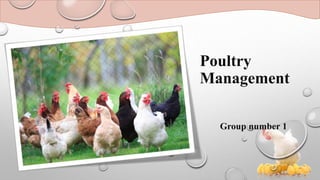
Poultry
Management
Group number 1
Content
• Objective
• Introduction
• Methodology
• Broiler management
• Problems and suggestion
• Conclusion
Objectives
• To get the practical knowledge about poultry management.
• To practice the Broiler management.
• To identify the problem in the poultry and broiler management.
Introduction
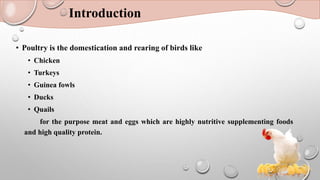
• Poultry is the domestication and rearing of birds like
• Chicken
• Turkeys
• Guinea fowls
• Ducks
• Quails
for the purpose meat and eggs which are highly nutritive supplementing foods
and high quality protein.
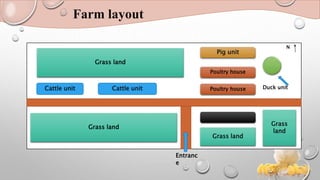
Farm layout
Cattle unit Cattle unit Poultry house
Poultry house
Pig unit
Grass land
Grass land
Grass land
Grass
land
Duck unit
N
Entranc
e
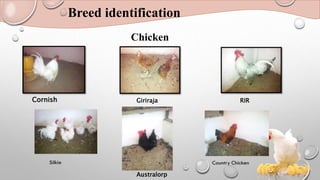
Breed identification
Chicken
Cornish Giriraja RIR
Australorp
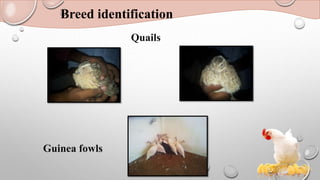
Breed identification
Quails
Guinea fowls
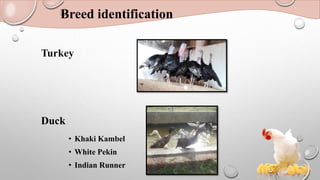
Breed identification
• Khaki Kambel
• White Pekin
• Indian Runner
Turkey
Duck
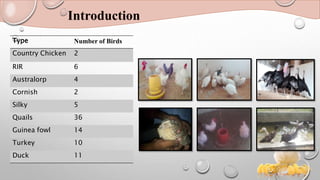
Introduction
Type Number of Birds
Country Chicken 2
RIR 6
Australorp 4
Cornish 2
Silky 5
Quails 36
Guinea fowl 14
Turkey 10
Duck 11
Methodology
• Daily observation & cleaning
• Housing
• Feeding
• Watering
• Weighing
• Egg collection
• Common management practices.
– Debeaking
– Culling
– Feed supplement
– Egg quality parameters
• Special management practices.
Methodology
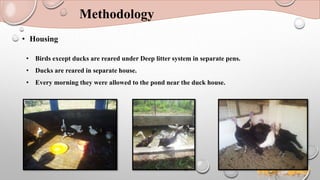
• Housing
• Birds except ducks are reared under Deep litter system in separate pens.
• Ducks are reared in separate house.
• Every morning they were allowed to the pond near the duck house.
Methodology
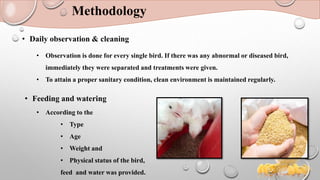
• Feeding and watering
• According to the
• Type
• Age
• Weight and
• Physical status of the bird,
feed and water was provided.
• Daily observation & cleaning
• Observation is done for every single bird. If there was any abnormal or diseased bird,
immediately they were separated and treatments were given.
• To attain a proper sanitary condition, clean environment is maintained regularly.
Methodology
• Feed was mixed with the water specially for the duck.
• Water is provided two times per day according to the number and the size of the bird.
• Litter management
• Paddy husk is used as litter for all type of birds.
• Litter was changed once in two days for the broilers.
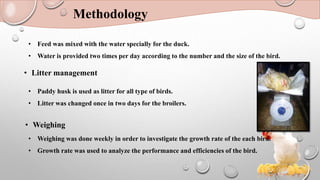
• Weighing
• Weighing was done weekly in order to investigate the growth rate of the each bird.
• Growth rate was used to analyze the performance and efficiencies of the bird.
Methodology
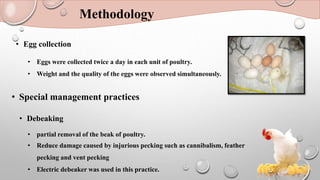
• Egg collection
• Eggs were collected twice a day in each unit of poultry.
• Weight and the quality of the eggs were observed simultaneously.
• Special management practices
• Debeaking
• partial removal of the beak of poultry.
• Reduce damage caused by injurious pecking such as cannibalism, feather
pecking and vent pecking
• Electric debeaker was used in this practice.
Methodology
Removal of the birds from the flock and discarded poultry birds which are inferior in appearance
or production or sick or likely to be sick
Good Hen Poor Hen
Long, Red &Full Comb &
wattles
Dry and scaly
Keen & Sparking Eyes Sunken, Dull, Abnormal
Color
Short, Color less Beak Long Yellow
Shiny and still beautiful
Feather
Rounded, lusterless later fail
fathers
Methodology
Good Hen Poor Hen
Distance from breast born to
pelvic bones
Width 3-4 or more fingers
according to breed
Narrow width 2-3
fingers
Distance Between pelvic borne
Width 3-4 Fingers
Narrow, Width 1-2
fingers
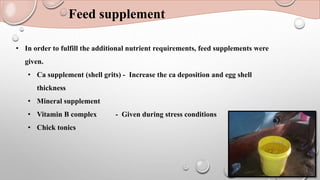
• In order to fulfill the additional nutrient requirements, feed supplements were
given.
• Ca supplement (shell grits) - Increase the ca deposition and egg shell
thickness
• Mineral supplement
• Vitamin B complex - Given during stress conditions
• Chick tonics
Feed supplement
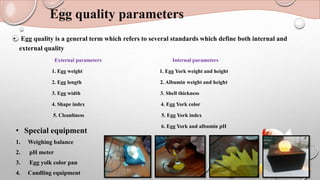
Egg quality parameters
• Egg quality is a general term which refers to several standards which define both internal and
external quality
External parameters Internal parameters
1. Egg weight 1. Egg York weight and height
2. Egg length 2. Albumin weight and height
3. Egg width 3. Shell thickness
4. Shape index 4. Egg York color
5. Cleanliness 5. Egg York index
6. Egg York and albumin pH
• Special equipment
1. Weighing balance
2. pH meter
3. Egg yolk color pan
4. Candling equipment
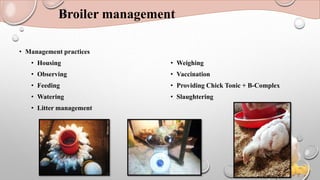
Broiler management
• Management practices
• Housing
• Observing
• Feeding
• Watering
• Litter management
• Weighing
• Vaccination
• Providing Chick Tonic + B-Complex
• Slaughtering
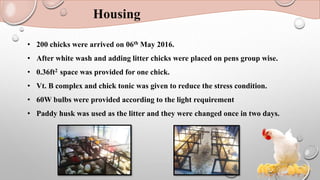
Housing
• 200 chicks were arrived on 06th May 2016.
• After white wash and adding litter chicks were placed on pens group wise.
• 0.36ft2 space was provided for one chick.
• Vt. B complex and chick tonic was given to reduce the stress condition.
• 60W bulbs were provided according to the light requirement
• Paddy husk was used as the litter and they were changed once in two days.
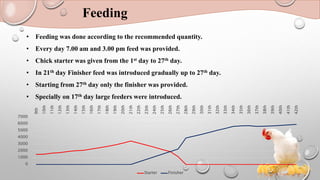
Feeding
0
1000
2000
3000
4000
5000
6000
7000
9th
10th
11th
12th
13th
14th
15th
16th
17th
18th
19th
20th
21th
22th
23th
24th
25th
26th
27th
28th
29th
30th
31th
32th
33th
34th
35th
36th
37th
38th
39th
40th
41th
42th
Starter Finisher
• Feeding was done according to the recommended quantity.
• Every day 7.00 am and 3.00 pm feed was provided.
• Chick starter was given from the 1st day to 27th day.
• In 21th day Finisher feed was introduced gradually up to 27th day.
• Starting from 27th day only the finisher was provided.
• Specially on 17th day large feeders were introduced.
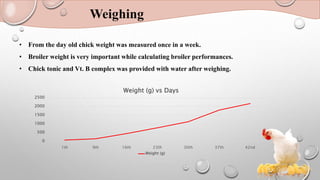
• From the day old chick weight was measured once in a week.
• Broiler weight is very important while calculating broiler performances.
• Chick tonic and Vt. B complex was provided with water after weighing.
Weighing
0
500
1000
1500
2000
2500
1th 9th 16th 23th 30th 37th 42nd
Weight (g) vs Days
Weight (g)
Vaccination
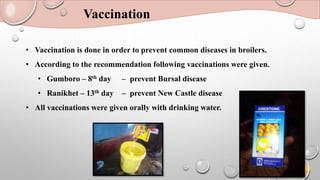
• Vaccination is done in order to prevent common diseases in broilers.
• According to the recommendation following vaccinations were given.
• Gumboro – 8th day – prevent Bursal disease
• Ranikhet – 13th day – prevent New Castle disease
• All vaccinations were given orally with drinking water.
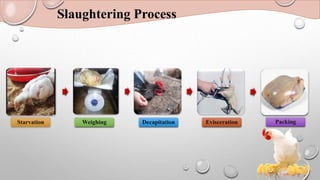
Slaughtering Process
Starvation Weighing Decapitation Evisceration Packing
Results
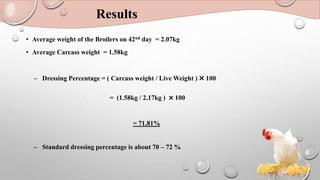
• Average weight of the Broilers on 42nd day = 2.07kg
• Average Carcass weight = 1.58kg
– Dressing Percentage = ( Carcass weight / Live Weight )
˟100
= (1.58kg / 2.17kg )
˟100
= 71.81%
– Standard dressing percentage is about 70 – 72 %
Results
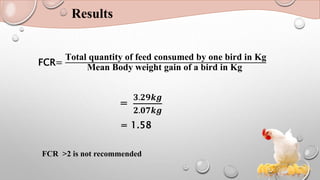
=
𝟑.𝟐𝟗𝒌𝒈
𝟐.𝟎𝟕𝒌𝒈
= 1.58
FCR=
Total quantity of feed consumed by one bird in Kg
Mean Body weight gain of a bird in Kg
FCR >2 is not recommended
Problems & suggestions
• Record keeping should be updated.
• Egg collection details.
• Stock keeping details.
• Improvement of infrastructures.
• Cages
• Cleaning facilities.
• Use poultry manure as a fertilizer for the pasture land.
Conclusion
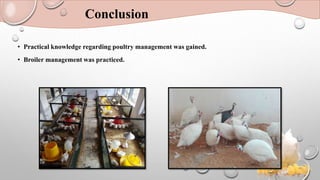
• Practical knowledge regarding poultry management was gained.
• Broiler management was practiced.
Poultry management

Poultry management

  • 1.
  • 2.
    Content • Objective • Introduction •Methodology • Broiler management • Problems and suggestion • Conclusion
  • 3.
    Objectives • To getthe practical knowledge about poultry management. • To practice the Broiler management. • To identify the problem in the poultry and broiler management.
  • 4.
    Introduction • Poultry isthe domestication and rearing of birds like • Chicken • Turkeys • Guinea fowls • Ducks • Quails for the purpose meat and eggs which are highly nutritive supplementing foods and high quality protein.
  • 5.
    Farm layout Cattle unitCattle unit Poultry house Poultry house Pig unit Grass land Grass land Grass land Grass land Duck unit N Entranc e
  • 6.
  • 7.
  • 8.
    Breed identification • KhakiKambel • White Pekin • Indian Runner Turkey Duck
  • 9.
    Introduction Type Number ofBirds Country Chicken 2 RIR 6 Australorp 4 Cornish 2 Silky 5 Quails 36 Guinea fowl 14 Turkey 10 Duck 11
  • 10.
    Methodology • Daily observation& cleaning • Housing • Feeding • Watering • Weighing • Egg collection • Common management practices. – Debeaking – Culling – Feed supplement – Egg quality parameters • Special management practices.
  • 11.
    Methodology • Housing • Birdsexcept ducks are reared under Deep litter system in separate pens. • Ducks are reared in separate house. • Every morning they were allowed to the pond near the duck house.
  • 12.
    Methodology • Feeding andwatering • According to the • Type • Age • Weight and • Physical status of the bird, feed and water was provided. • Daily observation & cleaning • Observation is done for every single bird. If there was any abnormal or diseased bird, immediately they were separated and treatments were given. • To attain a proper sanitary condition, clean environment is maintained regularly.
  • 13.
    Methodology • Feed wasmixed with the water specially for the duck. • Water is provided two times per day according to the number and the size of the bird. • Litter management • Paddy husk is used as litter for all type of birds. • Litter was changed once in two days for the broilers. • Weighing • Weighing was done weekly in order to investigate the growth rate of the each bird. • Growth rate was used to analyze the performance and efficiencies of the bird.
  • 14.
    Methodology • Egg collection •Eggs were collected twice a day in each unit of poultry. • Weight and the quality of the eggs were observed simultaneously. • Special management practices • Debeaking • partial removal of the beak of poultry. • Reduce damage caused by injurious pecking such as cannibalism, feather pecking and vent pecking • Electric debeaker was used in this practice.
  • 15.
    Methodology Removal of thebirds from the flock and discarded poultry birds which are inferior in appearance or production or sick or likely to be sick Good Hen Poor Hen Long, Red &Full Comb & wattles Dry and scaly Keen & Sparking Eyes Sunken, Dull, Abnormal Color Short, Color less Beak Long Yellow Shiny and still beautiful Feather Rounded, lusterless later fail fathers
  • 16.
    Methodology Good Hen PoorHen Distance from breast born to pelvic bones Width 3-4 or more fingers according to breed Narrow width 2-3 fingers Distance Between pelvic borne Width 3-4 Fingers Narrow, Width 1-2 fingers
  • 17.
    • In orderto fulfill the additional nutrient requirements, feed supplements were given. • Ca supplement (shell grits) - Increase the ca deposition and egg shell thickness • Mineral supplement • Vitamin B complex - Given during stress conditions • Chick tonics Feed supplement
  • 18.
    Egg quality parameters •Egg quality is a general term which refers to several standards which define both internal and external quality External parameters Internal parameters 1. Egg weight 1. Egg York weight and height 2. Egg length 2. Albumin weight and height 3. Egg width 3. Shell thickness 4. Shape index 4. Egg York color 5. Cleanliness 5. Egg York index 6. Egg York and albumin pH • Special equipment 1. Weighing balance 2. pH meter 3. Egg yolk color pan 4. Candling equipment
  • 19.
    Broiler management • Managementpractices • Housing • Observing • Feeding • Watering • Litter management • Weighing • Vaccination • Providing Chick Tonic + B-Complex • Slaughtering
  • 20.
    Housing • 200 chickswere arrived on 06th May 2016. • After white wash and adding litter chicks were placed on pens group wise. • 0.36ft2 space was provided for one chick. • Vt. B complex and chick tonic was given to reduce the stress condition. • 60W bulbs were provided according to the light requirement • Paddy husk was used as the litter and they were changed once in two days.
  • 21.
    Feeding 0 1000 2000 3000 4000 5000 6000 7000 9th 10th 11th 12th 13th 14th 15th 16th 17th 18th 19th 20th 21th 22th 23th 24th 25th 26th 27th 28th 29th 30th 31th 32th 33th 34th 35th 36th 37th 38th 39th 40th 41th 42th Starter Finisher • Feedingwas done according to the recommended quantity. • Every day 7.00 am and 3.00 pm feed was provided. • Chick starter was given from the 1st day to 27th day. • In 21th day Finisher feed was introduced gradually up to 27th day. • Starting from 27th day only the finisher was provided. • Specially on 17th day large feeders were introduced.
  • 22.
    • From theday old chick weight was measured once in a week. • Broiler weight is very important while calculating broiler performances. • Chick tonic and Vt. B complex was provided with water after weighing. Weighing 0 500 1000 1500 2000 2500 1th 9th 16th 23th 30th 37th 42nd Weight (g) vs Days Weight (g)
  • 23.
    Vaccination • Vaccination isdone in order to prevent common diseases in broilers. • According to the recommendation following vaccinations were given. • Gumboro – 8th day – prevent Bursal disease • Ranikhet – 13th day – prevent New Castle disease • All vaccinations were given orally with drinking water.
  • 24.
    Slaughtering Process Starvation WeighingDecapitation Evisceration Packing
  • 25.
    Results • Average weightof the Broilers on 42nd day = 2.07kg • Average Carcass weight = 1.58kg – Dressing Percentage = ( Carcass weight / Live Weight ) ˟100 = (1.58kg / 2.17kg ) ˟100 = 71.81% – Standard dressing percentage is about 70 – 72 %
  • 26.
    Results = 𝟑.𝟐𝟗𝒌𝒈 𝟐.𝟎𝟕𝒌𝒈 = 1.58 FCR= Total quantityof feed consumed by one bird in Kg Mean Body weight gain of a bird in Kg FCR >2 is not recommended
  • 27.
    Problems & suggestions •Record keeping should be updated. • Egg collection details. • Stock keeping details. • Improvement of infrastructures. • Cages • Cleaning facilities. • Use poultry manure as a fertilizer for the pasture land.
  • 28.
    Conclusion • Practical knowledgeregarding poultry management was gained. • Broiler management was practiced.