Feeding Management
Feeding management is dealt under
i. Form of feed
ii. Feeding programmes
iii.Econamising feed cost
iv. Reducing feed wastage
v. Feed storage
vi. Feeding chicks
vii. Feeding replacement pullets
viii.Feeding commercial layers
ix.Feeding broilers
x. Feeding breeders
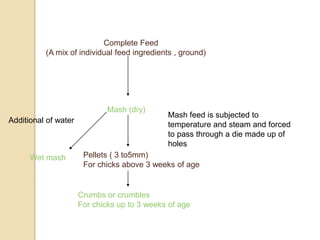
Feed for poultry may be given in the
form of
Mash
Pellets
Crumbles
Complete Feed
(A mix of individual feed ingredients , ground)
Mash (dry)
Additional of water
Wet mash Pellets ( 3 to5mm)
For chicks above 3 weeks of age
Crumbs or crumbles
For chicks up to 3 weeks of age
Mash feed is subjected to
temperature and steam and forced
to pass through a die made up of
holes
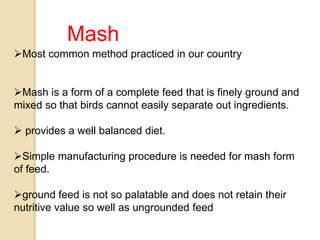
Most common method practiced in our country
Mash is a form of a complete feed that is finely ground and
mixed so that birds cannot easily separate out ingredients.
 provides a well balanced diet.
Simple manufacturing procedure is needed for mash form
of feed.
ground feed is not so palatable and does not retain their
nutritive value so well as ungrounded feed
Mash
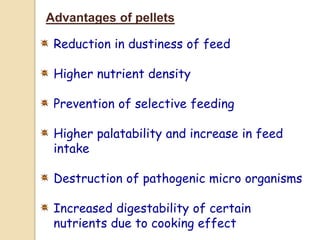
Advantages of pellets
Reduction in dustiness of feed
Higher nutrient density
Prevention of selective feeding
Higher palatability and increase in feed
intake
Destruction of pathogenic micro organisms
Increased digestability of certain
nutrients due to cooking effect
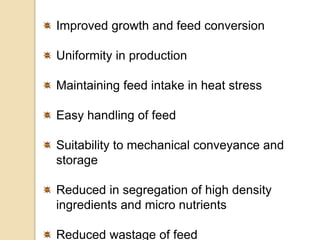
Improved growth and feed conversion
Uniformity in production
Maintaining feed intake in heat stress
Easy handling of feed
Suitability to mechanical conveyance and
storage
Reduced in segregation of high density
ingredients and micro nutrients
Reduced wastage of feed
Disadvantage
s cost of pellets is higher
Destruction of vitamins and certain
feed additives
Susceptibility to mycotoxins if properly
not dried
Increase water intake and wet litter
problem
Increase cannibalism
No further mixing of any ingredient or
additive.
crumbles
 Crushed pellets used to feed younger
birds and these are known as
crumbles
Cafeteria system
 Choice system of feeding buffet type
feeding
 Choice between
 Energy sources
 Protein sources along with vitamins
and minerals
 Calcium in granular form
Sex separate feeding
 As per BIS latest standards, broiler
and layer males fed with low protein
diet having 15 and 16% protein
respectively,
 High protein diet will effect sperm
quality.
 Female broiler and layer breeders—16
&17% CP
 High levels of vit E (40mg/kg) for
males
 The male and female feeds are
offered separate feed hoppers in slat
and deep litter system.
 In cage system can be followed
accurately
 On floor, feed is provided for males in
feeding placed at higher level to which
the female feeders can not reach.
 Males can not reach female feeders
as the partitions of the feeders are
Economizing Feed cost
 Formulating least cost diets to meet
the nutrient requirements
- Specific soft ware programme
 Inclusion of un conventional feed
ingredients
- Less expensive
- Limitations in their inclusion levels
Home feed mixing
1.Procurement of feed ingredients in bulk
at economic rates.
2.Quality evaluation in the laboratory
available with them
3.Formulation of diets by experienced
nutritionist
4.Processing and mixing in the efficient
equipment
5. Quality evaluation of finished product
6. Storage and transport of feed
ingredients and feed in a scientific
manner
( Small farmers are adviced to procure
feed ingredients from reliable feed
manfactures)
Reducing feed wastage
 Formulation of diets to meet the
nutrient requirements
 Proper feed processing
(grinding,mixing)
 Procuring quality feed eqipment
 Placing sufficient No. of feeders
 Proper placement of feeders
 Proper placement of feed in feeders
 Debeaking of chicken
 Control of rodents
Procuring quality feed equipment
Chickens having habit of scratching and billing of
feed out of the feeder.
The feeders either tubular or linear. In both cases,
the design must be to avoid feed wastage.
Proper size of feeders, adequate but not
excessive slope from center to periphery of pan in
tubular feeders.
sufficient and raised lip(450) of the room of
feeders help in prevention of feed wastage from
feeders.
Number of feeders
Sufficient number of feeders ensures
adequate feed intake
 uniform growth
prevents possibly cannibalism
over crowding of chickens near feeder
when feed is placed.
Placement of feeders
Chicken take feed properly when
feeders are distributed uniformly in a
house.
Feeders may be placed at a level height
so that the height of lip of feeder is at the
level of the back of the bird.
This prevents easy billing of feed out of
feeder.
Placement of feed in feeders
Placement of more than one-third feed in feeder
results in wastage.
Feeders may be filled, if necessary, more
frequently.
At least once a week, feeders may be cleaned to
remove caked up feed.
Debeaking of chicken
Debeaking prevents or reduces billing of feed from
feeders.
Control of rodents (rats and mice)
Rats and mice are common in poultry houses. A
pair of rats produces 3-6 litter. With in a year,
about
15, 000 rats can be multiplied from a single pair.
Economical losses to poultry farmers due to
rodents
i. Eat feed: 30g/day/ rat 2-3g/day/mouse
ii. Carrier of diseases
iii.Contaminate feed with feces (40
droppings/rat/day)
Control methods:
Environment control(rat proof)
Chemical control ( use safe
rodenticides regularly)
Trapping/ Hunting of rats
Clean premises
Clean poultry houses, feed godown and
stores
Pet cat in the farm
Feed
storage
Feed from point of manufacture until offered
to birds has to be stored.
During storage, the following effects may
occur.
Moisture pick up from environment
Nutrient destruction
Oxidation of nutrients
Insect infestation
Proper storage involves the following.
Store has to be constructed away from poultry
houses and manure pits
Store has to be rat proof and damp proof
Prevent wild bird entry
Ventilation and light must be adequate
Use disinfectant tub at the entrance of store
 Prevent people working in poultry houses from
entering into the store house
Maintain feed store clean
Fumigate store with potassium
permanganate and formalin.
Fumigate with insecticide
Spray cupper sulphate or any
disinfectant on the empty floors inside the
store.
Store bags of feed or feed ingredients
on wooden or iron pallats instead on floor
directly.
Duration of storage of
feed
Purchase and stock feed for 1-2 weeks during
rainy season and
3-4 weeks during winter and summer seasons.
Fresh feed always better than old one.
Do not use fermented, damp/ wet feed under
any condition.
Never use infected or caked feed.
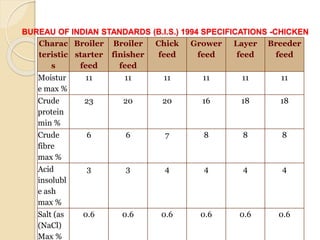
Charac
teristic
s
Broiler
starter
feed
Broiler
finisher
feed
Chick
feed
Grower
feed
Layer
feed
Breeder
feed
Moistur
e max %
11 11 11 11 11 11
Crude
protein
min %
23 20 20 16 18 18
Crude
fibre
max %
6 6 7 8 8 8
Acid
insolubl
e ash
max %
3 3 4 4 4 4
Salt (as
(NaCl)
Max %
0.6 0.6 0.6 0.6 0.6 0.6
BUREAU OF INDIAN STANDARDS (B.I.S.) 1994 SPECIFICATIONS -CHICKEN
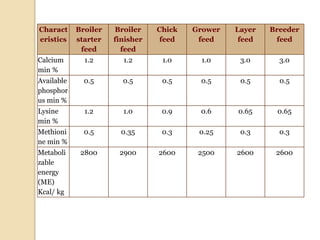
Charact
eristics
Broiler
starter
feed
Broiler
finisher
feed
Chick
feed
Grower
feed
Layer
feed
Breeder
feed
Calcium
min %
1.2 1.2 1.0 1.0 3.0 3.0
Available
phosphor
us min %
0.5 0.5 0.5 0.5 0.5 0.5
Lysine
min %
1.2 1.0 0.9 0.6 0.65 0.65
Methioni
ne min %
0.5 0.35 0.3 0.25 0.3 0.3
Metaboli
zable
energy
(ME)
Kcal/ kg
2800 2900 2600 2500 2600 2600
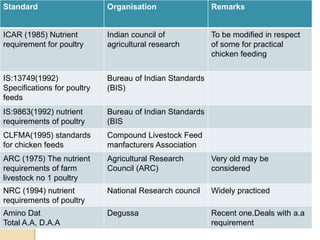
Standard Organisation Remarks
ICAR (1985) Nutrient
requirement for poultry
Indian council of
agricultural research
To be modified in respect
of some for practical
chicken feeding
IS:13749(1992)
Specifications for poultry
feeds
Bureau of Indian Standards
(BIS)
IS:9863(1992) nutrient
requirements of poultry
Bureau of Indian Standards
(BIS
CLFMA(1995) standards
for chicken feeds
Compound Livestock Feed
manfacturers Association
ARC (1975) The nutrient
requirements of farm
livestock no 1 poultry
Agricultural Research
Council (ARC)
Very old may be
considered
NRC (1994) nutrient
requirements of poultry
National Research council Widely practiced
Amino Dat
Total A.A, D.A.A
Degussa Recent one.Deals with a.a
requirement
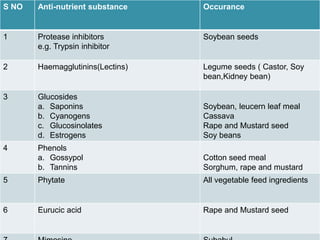
S NO Anti-nutrient substance Occurance
1 Protease inhibitors
e.g. Trypsin inhibitor
Soybean seeds
2 Haemagglutinins(Lectins) Legume seeds ( Castor, Soy
bean,Kidney bean)
3 Glucosides
a. Saponins
b. Cyanogens
c. Glucosinolates
d. Estrogens
Soybean, leucern leaf meal
Cassava
Rape and Mustard seed
Soy beans
4 Phenols
a. Gossypol
b. Tannins
Cotton seed meal
Sorghum, rape and mustard
5 Phytate All vegetable feed ingredients
6 Eurucic acid Rape and Mustard seed
S NO Anti-nutrient substance Occurance
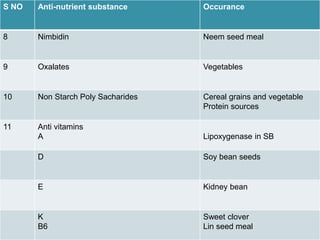
8 Nimbidin Neem seed meal
9 Oxalates Vegetables
10 Non Starch Poly Sacharides Cereal grains and vegetable
Protein sources
11 Anti vitamins
A Lipoxygenase in SB
D Soy bean seeds
E Kidney bean
K
B6
Sweet clover
Lin seed meal

Feeding management

  • 1.
  • 2.
    Feeding management isdealt under i. Form of feed ii. Feeding programmes iii.Econamising feed cost iv. Reducing feed wastage v. Feed storage vi. Feeding chicks vii. Feeding replacement pullets viii.Feeding commercial layers ix.Feeding broilers x. Feeding breeders
  • 3.
    Feed for poultrymay be given in the form of Mash Pellets Crumbles
  • 4.
    Complete Feed (A mixof individual feed ingredients , ground) Mash (dry) Additional of water Wet mash Pellets ( 3 to5mm) For chicks above 3 weeks of age Crumbs or crumbles For chicks up to 3 weeks of age Mash feed is subjected to temperature and steam and forced to pass through a die made up of holes
  • 5.
    Most common methodpracticed in our country Mash is a form of a complete feed that is finely ground and mixed so that birds cannot easily separate out ingredients.  provides a well balanced diet. Simple manufacturing procedure is needed for mash form of feed. ground feed is not so palatable and does not retain their nutritive value so well as ungrounded feed Mash
  • 6.
    Advantages of pellets Reductionin dustiness of feed Higher nutrient density Prevention of selective feeding Higher palatability and increase in feed intake Destruction of pathogenic micro organisms Increased digestability of certain nutrients due to cooking effect
  • 7.
    Improved growth andfeed conversion Uniformity in production Maintaining feed intake in heat stress Easy handling of feed Suitability to mechanical conveyance and storage Reduced in segregation of high density ingredients and micro nutrients Reduced wastage of feed
  • 8.
    Disadvantage s cost ofpellets is higher Destruction of vitamins and certain feed additives Susceptibility to mycotoxins if properly not dried Increase water intake and wet litter problem Increase cannibalism No further mixing of any ingredient or additive.
  • 9.
    crumbles  Crushed pelletsused to feed younger birds and these are known as crumbles
  • 10.
    Cafeteria system  Choicesystem of feeding buffet type feeding  Choice between  Energy sources  Protein sources along with vitamins and minerals  Calcium in granular form
  • 11.
    Sex separate feeding As per BIS latest standards, broiler and layer males fed with low protein diet having 15 and 16% protein respectively,  High protein diet will effect sperm quality.  Female broiler and layer breeders—16 &17% CP  High levels of vit E (40mg/kg) for males
  • 12.
     The maleand female feeds are offered separate feed hoppers in slat and deep litter system.  In cage system can be followed accurately  On floor, feed is provided for males in feeding placed at higher level to which the female feeders can not reach.  Males can not reach female feeders as the partitions of the feeders are
  • 13.
    Economizing Feed cost Formulating least cost diets to meet the nutrient requirements - Specific soft ware programme
  • 14.
     Inclusion ofun conventional feed ingredients - Less expensive - Limitations in their inclusion levels
  • 15.
    Home feed mixing 1.Procurementof feed ingredients in bulk at economic rates. 2.Quality evaluation in the laboratory available with them 3.Formulation of diets by experienced nutritionist 4.Processing and mixing in the efficient equipment
  • 16.
    5. Quality evaluationof finished product 6. Storage and transport of feed ingredients and feed in a scientific manner ( Small farmers are adviced to procure feed ingredients from reliable feed manfactures)
  • 17.
    Reducing feed wastage Formulation of diets to meet the nutrient requirements  Proper feed processing (grinding,mixing)  Procuring quality feed eqipment  Placing sufficient No. of feeders  Proper placement of feeders  Proper placement of feed in feeders  Debeaking of chicken  Control of rodents
  • 18.
    Procuring quality feedequipment Chickens having habit of scratching and billing of feed out of the feeder. The feeders either tubular or linear. In both cases, the design must be to avoid feed wastage. Proper size of feeders, adequate but not excessive slope from center to periphery of pan in tubular feeders. sufficient and raised lip(450) of the room of feeders help in prevention of feed wastage from feeders.
  • 19.
    Number of feeders Sufficientnumber of feeders ensures adequate feed intake  uniform growth prevents possibly cannibalism over crowding of chickens near feeder when feed is placed.
  • 20.
    Placement of feeders Chickentake feed properly when feeders are distributed uniformly in a house. Feeders may be placed at a level height so that the height of lip of feeder is at the level of the back of the bird. This prevents easy billing of feed out of feeder.
  • 21.
    Placement of feedin feeders Placement of more than one-third feed in feeder results in wastage. Feeders may be filled, if necessary, more frequently. At least once a week, feeders may be cleaned to remove caked up feed. Debeaking of chicken Debeaking prevents or reduces billing of feed from feeders.
  • 22.
    Control of rodents(rats and mice) Rats and mice are common in poultry houses. A pair of rats produces 3-6 litter. With in a year, about 15, 000 rats can be multiplied from a single pair. Economical losses to poultry farmers due to rodents i. Eat feed: 30g/day/ rat 2-3g/day/mouse ii. Carrier of diseases iii.Contaminate feed with feces (40 droppings/rat/day)
  • 23.
    Control methods: Environment control(ratproof) Chemical control ( use safe rodenticides regularly) Trapping/ Hunting of rats Clean premises Clean poultry houses, feed godown and stores Pet cat in the farm
  • 24.
    Feed storage Feed from pointof manufacture until offered to birds has to be stored. During storage, the following effects may occur. Moisture pick up from environment Nutrient destruction Oxidation of nutrients Insect infestation
  • 25.
    Proper storage involvesthe following. Store has to be constructed away from poultry houses and manure pits Store has to be rat proof and damp proof Prevent wild bird entry Ventilation and light must be adequate Use disinfectant tub at the entrance of store  Prevent people working in poultry houses from entering into the store house
  • 26.
    Maintain feed storeclean Fumigate store with potassium permanganate and formalin. Fumigate with insecticide Spray cupper sulphate or any disinfectant on the empty floors inside the store. Store bags of feed or feed ingredients on wooden or iron pallats instead on floor directly.
  • 27.
    Duration of storageof feed Purchase and stock feed for 1-2 weeks during rainy season and 3-4 weeks during winter and summer seasons. Fresh feed always better than old one. Do not use fermented, damp/ wet feed under any condition. Never use infected or caked feed.
  • 28.
    Charac teristic s Broiler starter feed Broiler finisher feed Chick feed Grower feed Layer feed Breeder feed Moistur e max % 1111 11 11 11 11 Crude protein min % 23 20 20 16 18 18 Crude fibre max % 6 6 7 8 8 8 Acid insolubl e ash max % 3 3 4 4 4 4 Salt (as (NaCl) Max % 0.6 0.6 0.6 0.6 0.6 0.6 BUREAU OF INDIAN STANDARDS (B.I.S.) 1994 SPECIFICATIONS -CHICKEN
  • 29.
    Charact eristics Broiler starter feed Broiler finisher feed Chick feed Grower feed Layer feed Breeder feed Calcium min % 1.2 1.21.0 1.0 3.0 3.0 Available phosphor us min % 0.5 0.5 0.5 0.5 0.5 0.5 Lysine min % 1.2 1.0 0.9 0.6 0.65 0.65 Methioni ne min % 0.5 0.35 0.3 0.25 0.3 0.3 Metaboli zable energy (ME) Kcal/ kg 2800 2900 2600 2500 2600 2600
  • 30.
    Standard Organisation Remarks ICAR(1985) Nutrient requirement for poultry Indian council of agricultural research To be modified in respect of some for practical chicken feeding IS:13749(1992) Specifications for poultry feeds Bureau of Indian Standards (BIS) IS:9863(1992) nutrient requirements of poultry Bureau of Indian Standards (BIS CLFMA(1995) standards for chicken feeds Compound Livestock Feed manfacturers Association ARC (1975) The nutrient requirements of farm livestock no 1 poultry Agricultural Research Council (ARC) Very old may be considered NRC (1994) nutrient requirements of poultry National Research council Widely practiced Amino Dat Total A.A, D.A.A Degussa Recent one.Deals with a.a requirement
  • 31.
    S NO Anti-nutrientsubstance Occurance 1 Protease inhibitors e.g. Trypsin inhibitor Soybean seeds 2 Haemagglutinins(Lectins) Legume seeds ( Castor, Soy bean,Kidney bean) 3 Glucosides a. Saponins b. Cyanogens c. Glucosinolates d. Estrogens Soybean, leucern leaf meal Cassava Rape and Mustard seed Soy beans 4 Phenols a. Gossypol b. Tannins Cotton seed meal Sorghum, rape and mustard 5 Phytate All vegetable feed ingredients 6 Eurucic acid Rape and Mustard seed
  • 32.
    S NO Anti-nutrientsubstance Occurance 8 Nimbidin Neem seed meal 9 Oxalates Vegetables 10 Non Starch Poly Sacharides Cereal grains and vegetable Protein sources 11 Anti vitamins A Lipoxygenase in SB D Soy bean seeds E Kidney bean K B6 Sweet clover Lin seed meal