CIRCUIT BREAKERS 
PRESENTED BY 
AJAY.S 
11EE02
Content 
 Introduction to Circuit breaker 
 Basic Defination Of Circuit – Breaker 
 Working Principle of Circuit Breaker 
 Types Of Circuit Breakers 
1. Oil Circuit Breakers 
2. Vacuum Circuit Breakers 
3. Air Blast Circuit Breakers 
4. SF6 Circuit Breakers 
5. Miniature Circuit Breakers 
6. Earth Leakage Circuit Breakers 
 Conclusion
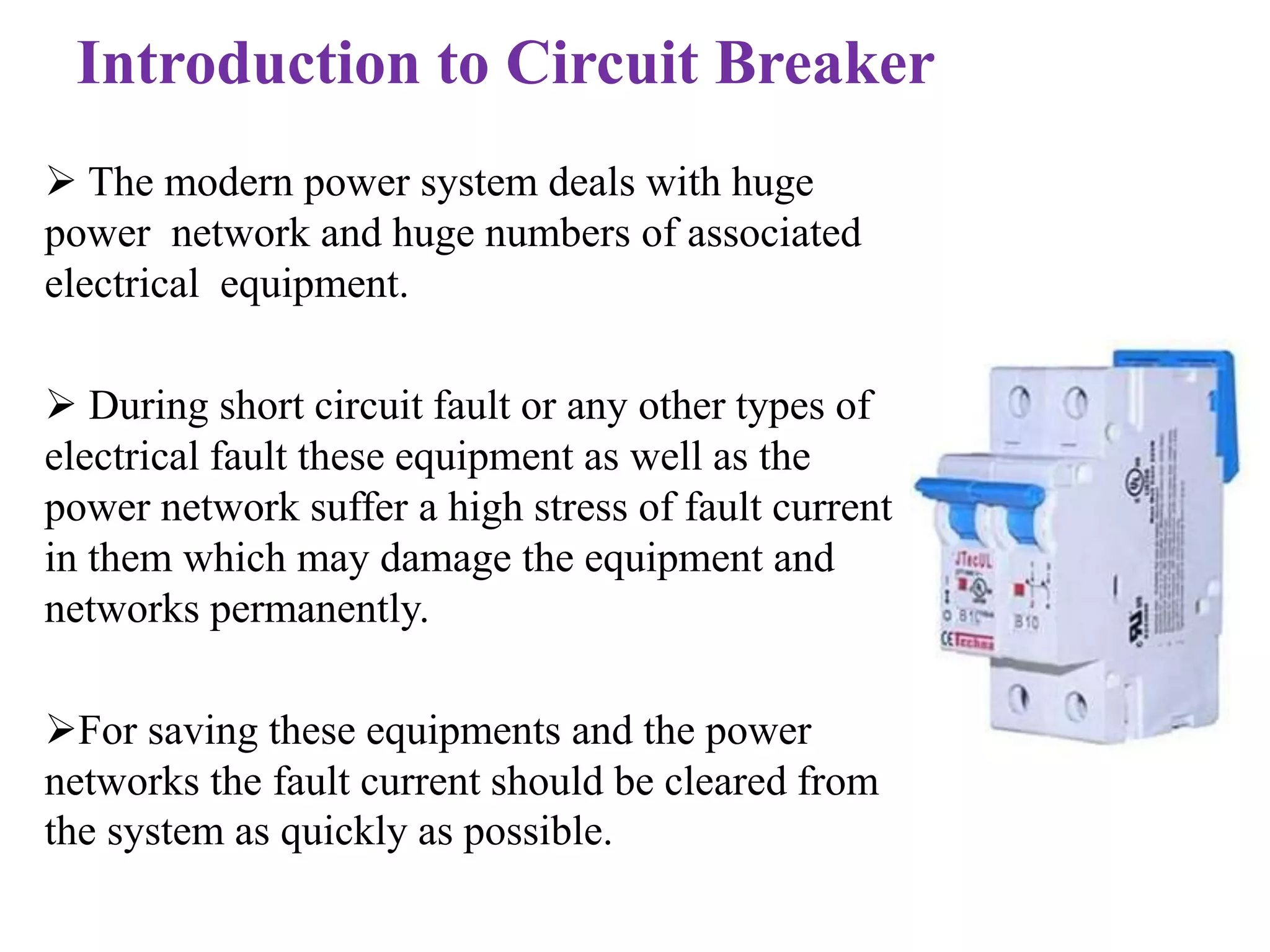
Introduction to Circuit Breaker 
 The modern power system deals with huge 
power network and huge numbers of associated 
electrical equipment. 
 During short circuit fault or any other types of 
electrical fault these equipment as well as the 
power network suffer a high stress of fault current 
in them which may damage the equipment and 
networks permanently. 
For saving these equipments and the power 
networks the fault current should be cleared from 
the system as quickly as possible.
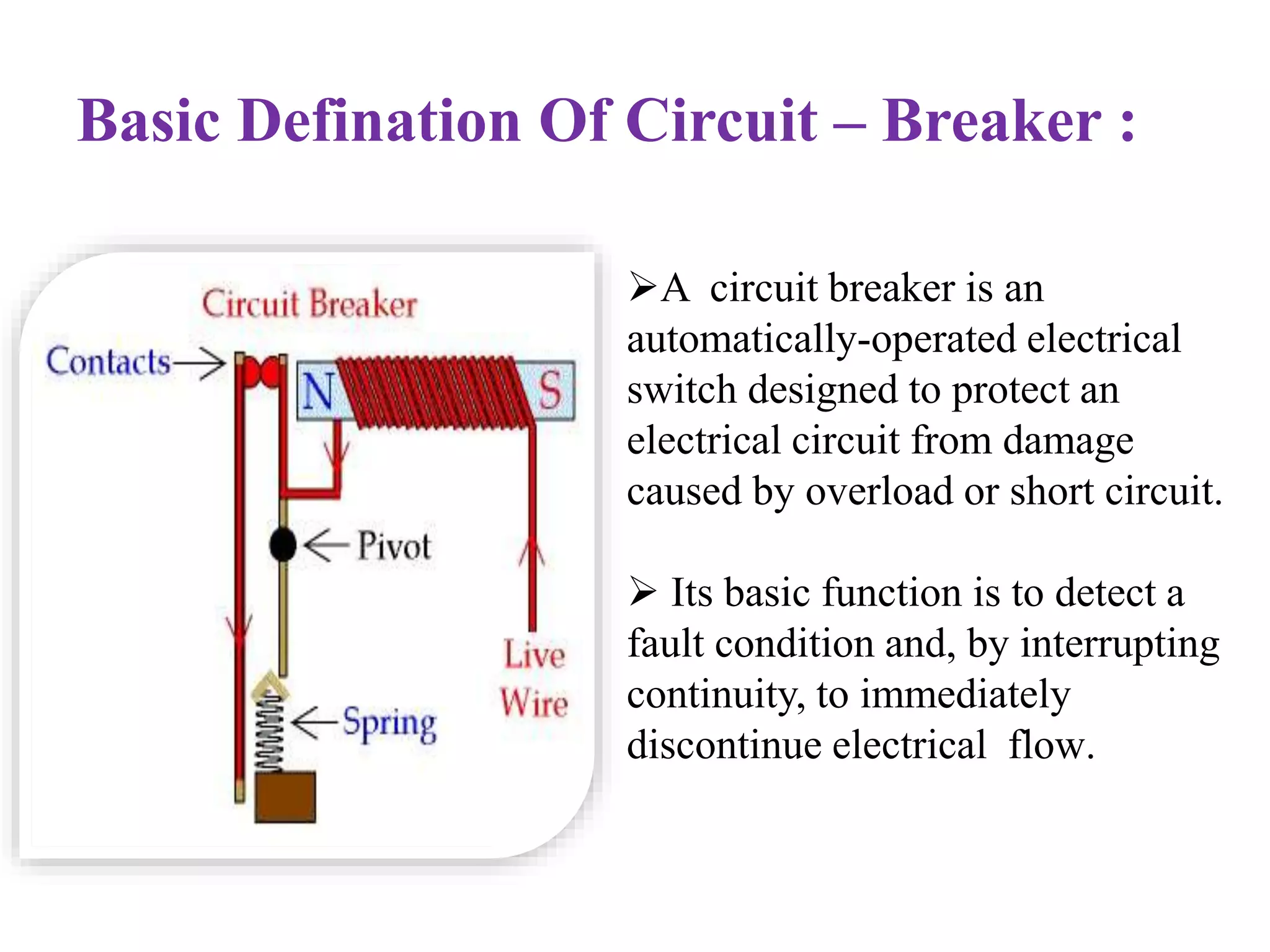
Basic Defination Of Circuit – Breaker : 
. A circuit breaker is an 
automatically-operated electrical 
switch designed to protect an 
electrical circuit from damage 
caused by overload or short circuit. 
 Its basic function is to detect a 
fault condition and, by interrupting 
continuity, to immediately 
discontinue electrical flow.
Working Principle of Circuit Breaker 
• The circuit breaker mainly consists of fixed contacts and 
moving contacts. 
• In normal "on" condition of circuit breaker, these two contacts 
are physically connected to each other due to applied 
mechanical pressure on the moving contacts. 
• The potential energy can be stored in the circuit breaker by 
different ways like by deforming metal spring, by compressed 
air, or by hydrolic pressure. 
• But whatever the source of potential energy, it must be 
released during operation. Release of potential energy makes 
sliding of the moving contact at extremely fast manner.
Types Of Circuit Breakers 
 Oil Circuit Breakers 
 Vacuum Circuit Breakers 
 Air Blast Circuit Breakers 
 SF6 Circuit Breakers 
 Miniature Circuit Breakers 
 Earth Leakage Circuit Breakers
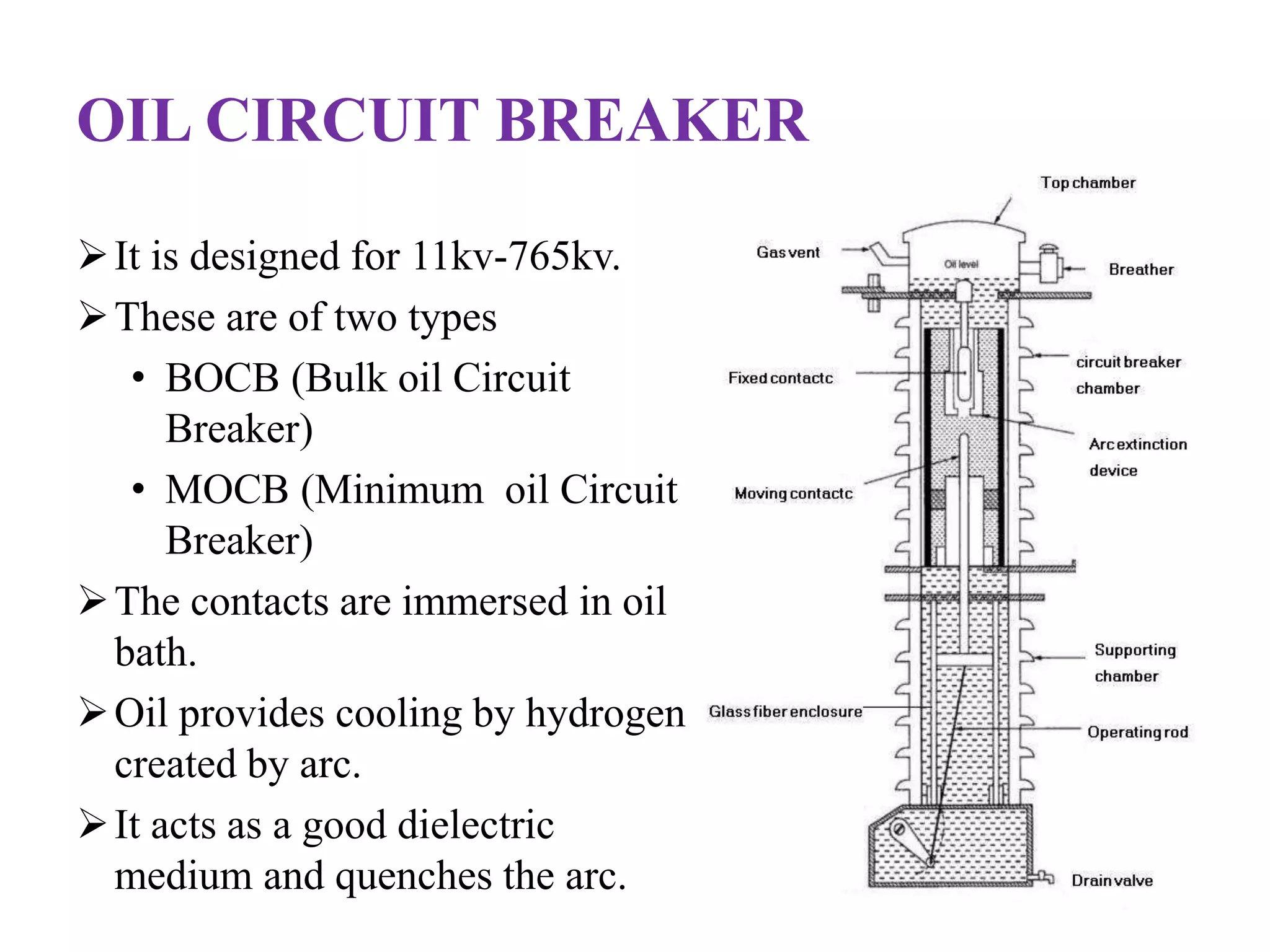
OIL CIRCUIT BREAKER 
 It is designed for 11kv-765kv. 
These are of two types 
• BOCB (Bulk oil Circuit 
Breaker) 
• MOCB (Minimum oil Circuit 
Breaker) 
The contacts are immersed in oil 
bath. 
 Oil provides cooling by hydrogen 
created by arc. 
 It acts as a good dielectric 
medium and quenches the arc.
Advantages: 
 Oil has good dielectric strength. 
 Low cost. 
 Oil is easily available. 
 It has wide range of breaking capability. 
Disadvantages: 
 Slower operation , takes about 20 cycles for arc quenching. 
 It is highly inflammable , so high risk of fire. 
 High maintenance cost.
VACCUM CIRCUIT BREAKER 
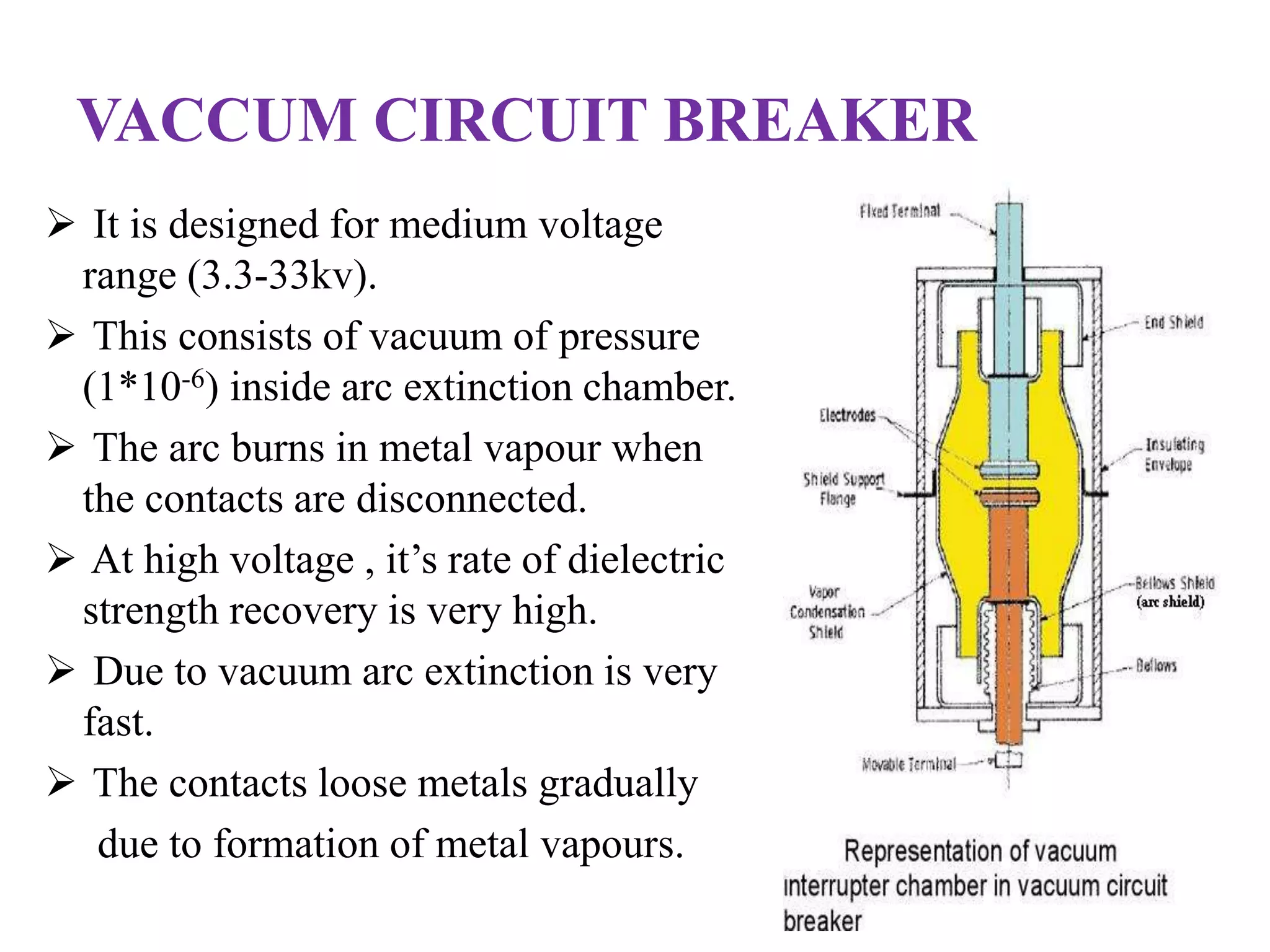
 It is designed for medium voltage 
range (3.3-33kv). 
 This consists of vacuum of pressure 
(1*10-6) inside arc extinction chamber. 
 The arc burns in metal vapour when 
the contacts are disconnected. 
 At high voltage , it’s rate of dielectric 
strength recovery is very high. 
 Due to vacuum arc extinction is very 
fast. 
 The contacts loose metals gradually 
due to formation of metal vapours.
Advantages: 
 Free from arc and fire hazards. 
 Low cost for maintenance & simpler mechanism. 
 Low arcing time & high contact life. 
 Silent and less vibrational operation. 
 Due to vacuum contacts remain free from corrosion. 
 No byproducts formed. 
Disadvantages: 
 High initial cost due to creation of vacuum. 
 Surface of contacts are depleted due to metal vapours. 
 High cost & size required for high voltage breakers.
AIR BLAST CIRCUIT BREAKERS 
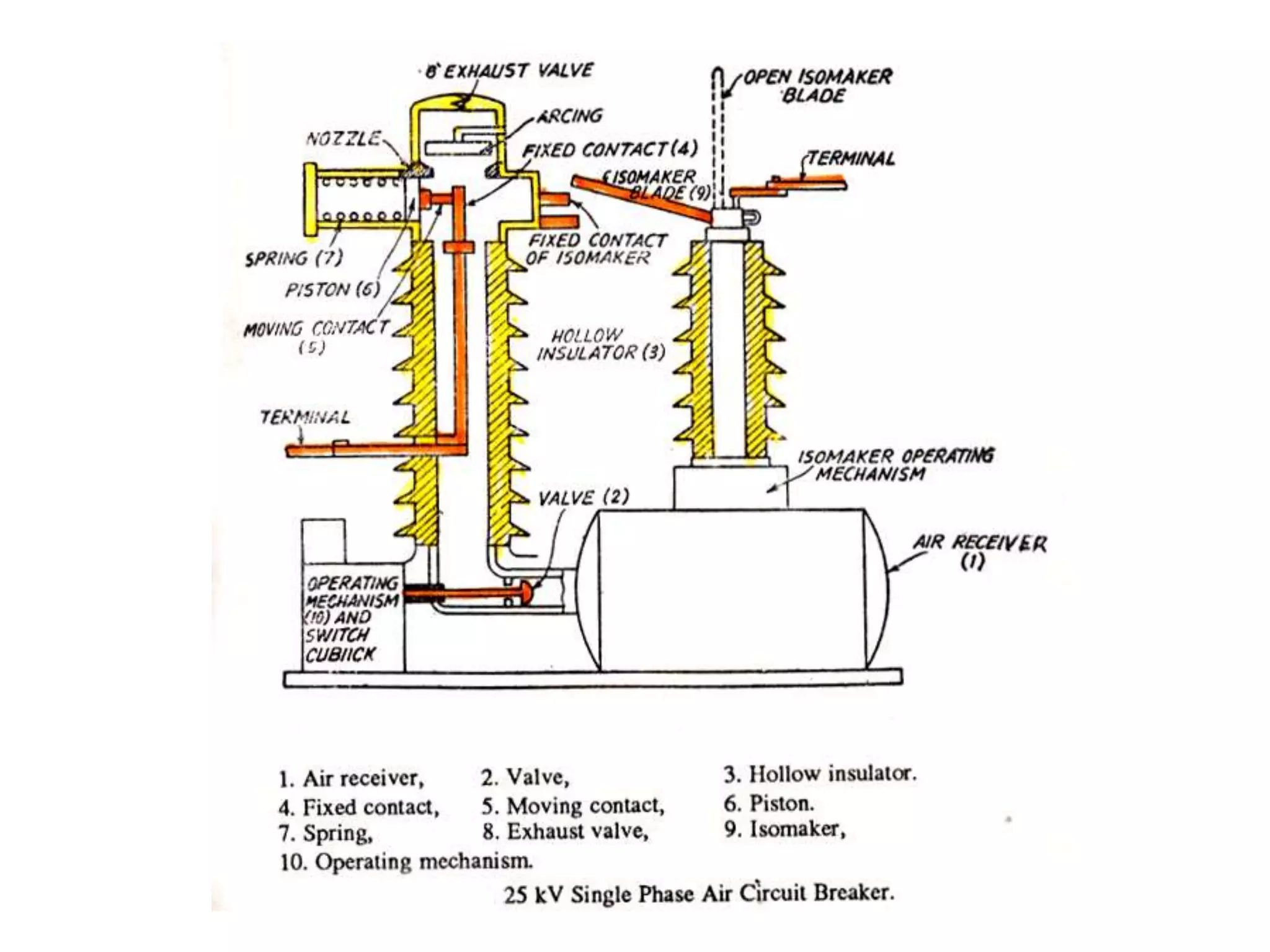
 This operates using high velocity blast of air which quenches 
the arc. 
 It consists of blast valve , blast tube & contacts. 
 Blast valve contains air at high pressure. 
 Blast tube carries the air at high pressure & opens the moving 
contact attached to spring. 
 There is no carbonization of surface as in VCB. 
 Air should be kept clean & dry to operate it properly.
Advantages: 
 High speed operation as compared to OCB. 
 Ability to withstand frequent switching. 
 Facility for high speed reclosure. 
 Less maintenance as compared to OCB. 
Disadvantages: 
 Little moisture content prolongs arcing time. 
 Pressure should be checked frequently for frequent 
operation. 
 Risk of fire hazards due to over voltages. 
 It can’t be used for high voltage operation due to prolonged 
arc quenching.
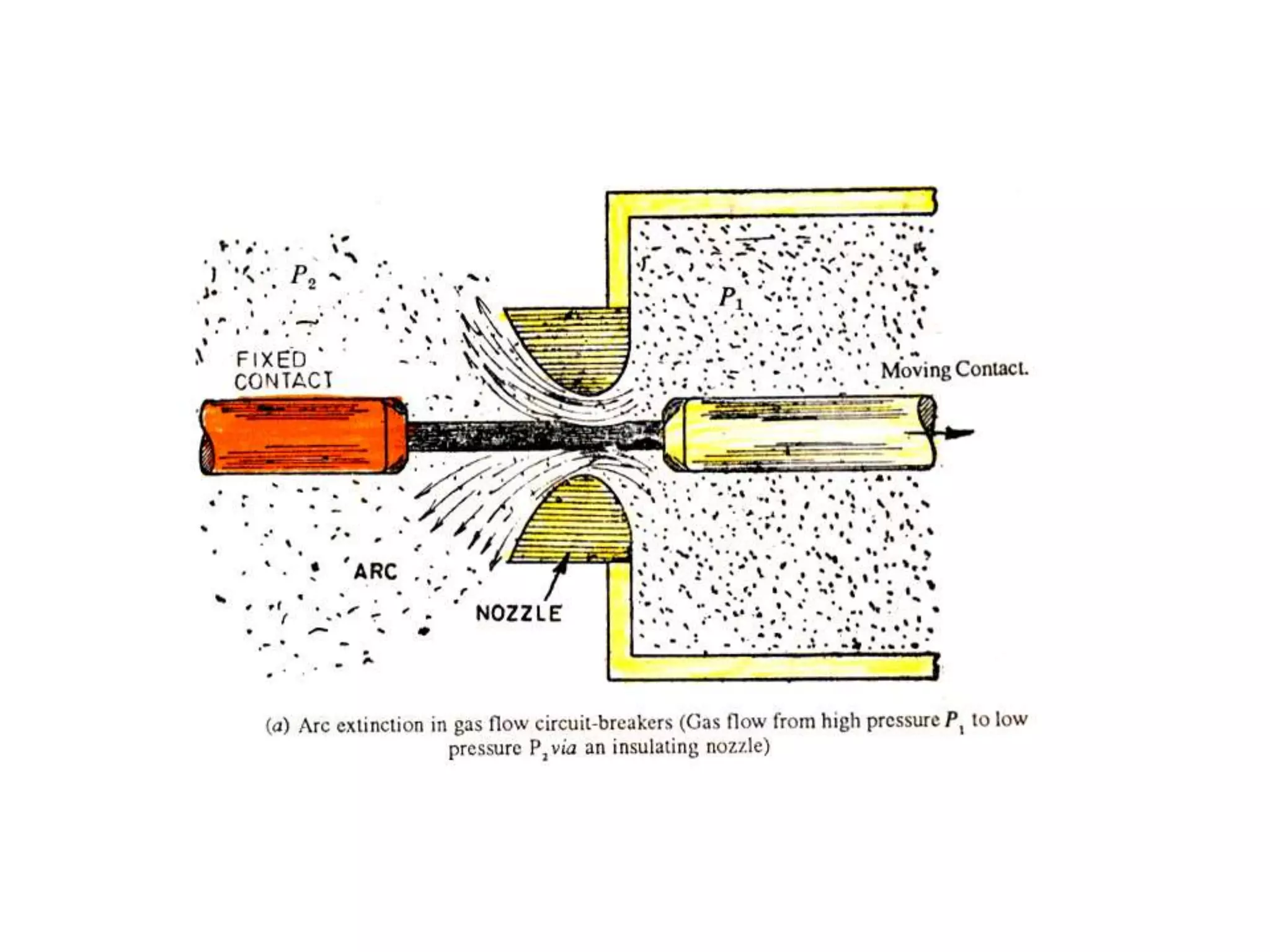
SF6 CIRCUIT BREAKERS 
 It contains an arc interruption chamber containing SF6 gas. 
 In closed position the contacts remain surrounded by SF6 gas 
at a pressure of 2.8 kg/cm2 . 
 During opening high pressure SF6 gas at 14 kg/cm2 from its 
reservoir flows towards the chamber by valve mechanism. 
 SF6 rapidly absorbs the free electrons in the arc path to form 
immobile negative ions to build up high dielectric strength. 
 It also cools the arc and extinguishes it. 
 After operation the valve is closed by the action of a set of 
springs. 
 Absorbent materials are used to absorb the byproducts and 
moisture.
Advantages: 
 Very short arcing period due to superior arc quenching 
property of SF6 . 
 Can interrupt much larger currents as compared to other 
breakers. 
 No risk of fire. 
 Low maintenance, light foundation. 
 No over voltage problem. 
 There are no carbon deposits. 
Disadvantages: 
 SF6 breakers are costly due to high cost of SF6. 
 SF6 gas has to be reconditioned after every operation of the 
breaker, additional equipment is required for this purpose.
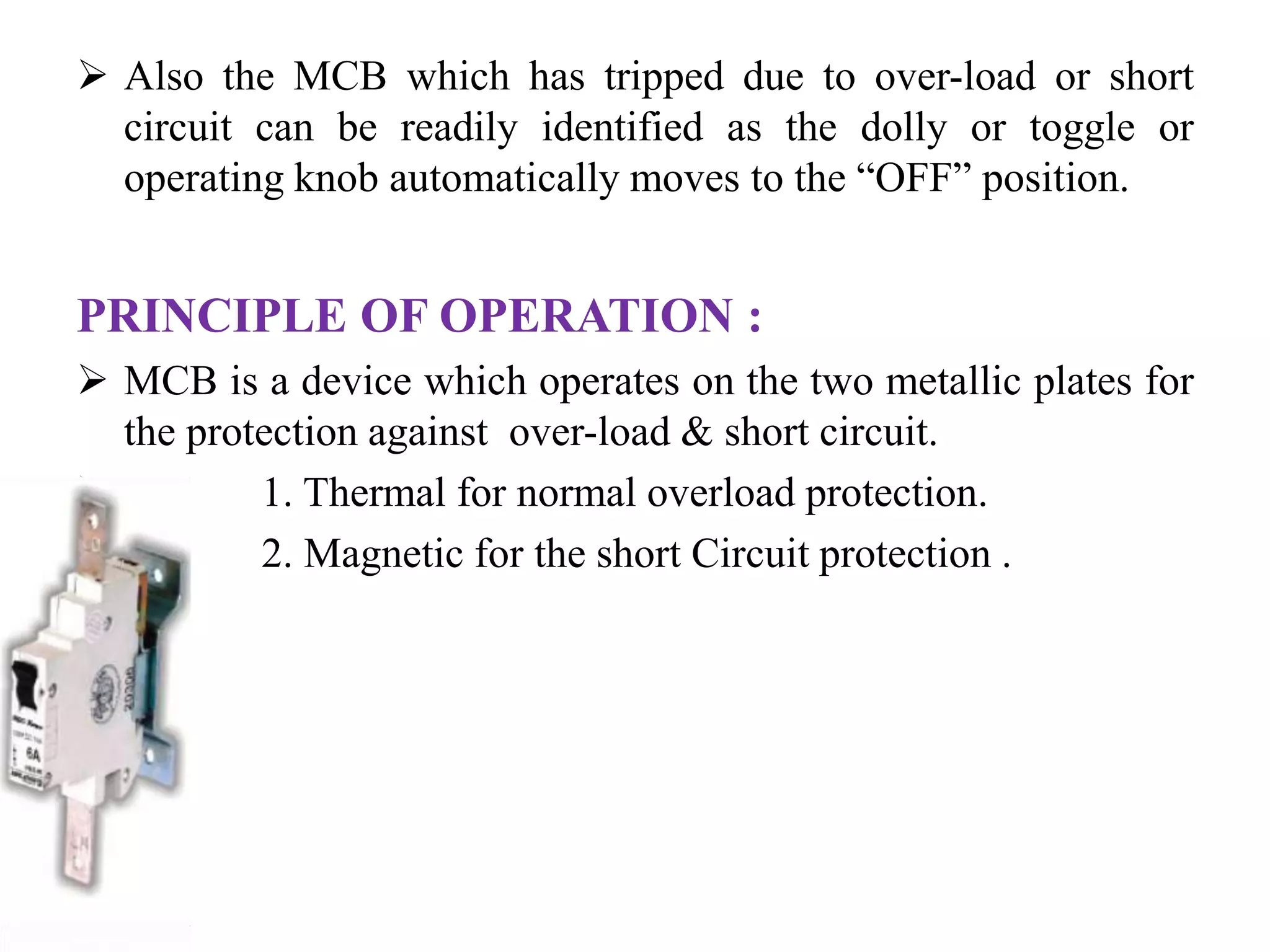
MINIATURE CIRCUIT BREAKER 
 An MCB is an Electromagnetic Device which Operates and 
Disconnects the Circuit when the Current reaches a pre 
determined value. 
 It is most modern substitute for conventional rewireable fuse 
with most accurate & efficient system in over-load & short 
circuit protection. In fact, it provides over-load protection & 
short circuits protection whereas FUSE offers short circuit 
protection only. 
 An MCB will normally operate at 1.25 times it rated current i.e. 
20 A. MCB operates at 25 A compared with 30 A for cartridge 
fuse or 40 A for rewireable type of fuse of the same rating.
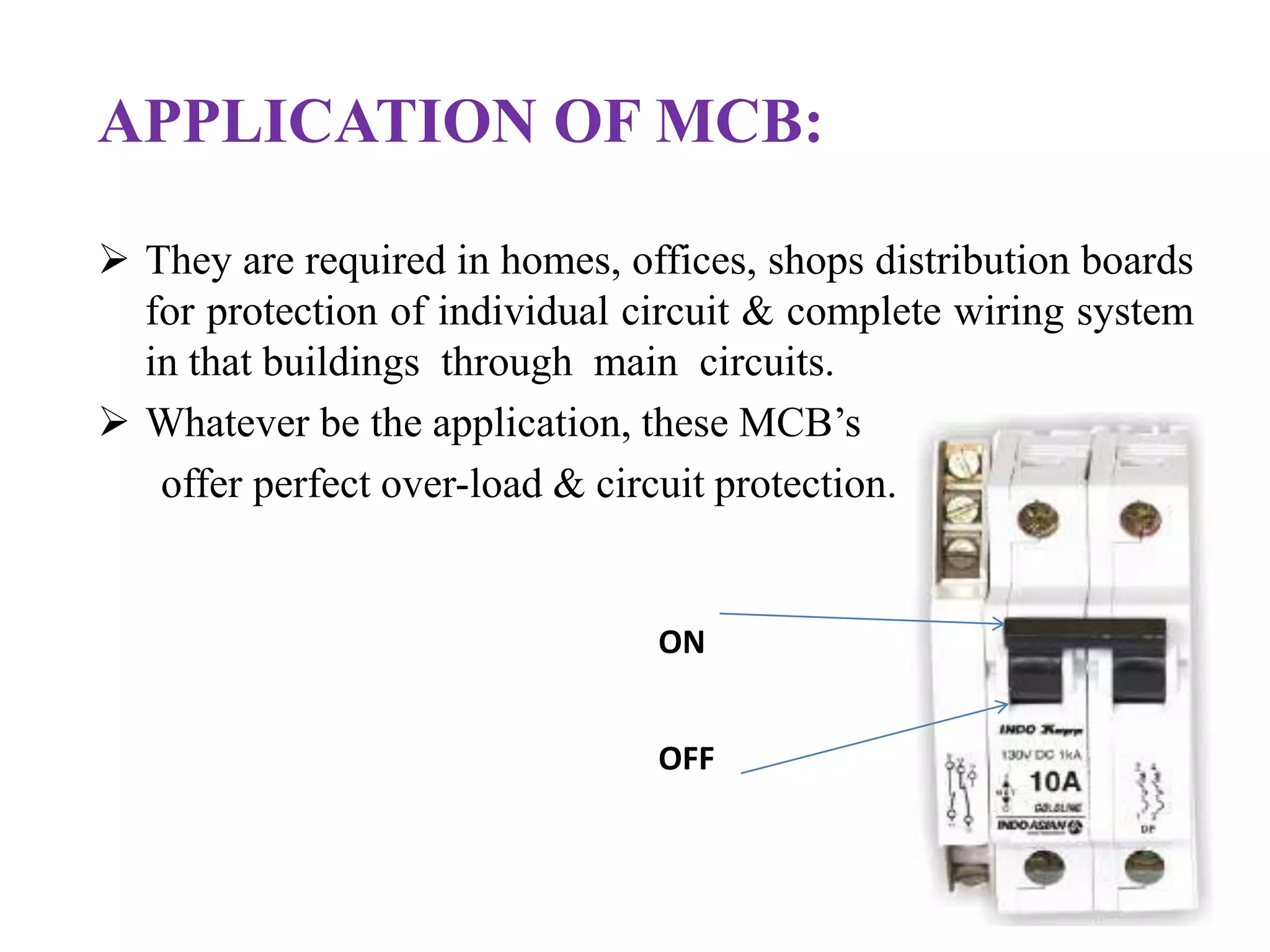
 Also the MCB which has tripped due to over-load or short 
circuit can be readily identified as the dolly or toggle or 
operating knob automatically moves to the “OFF” position. 
PRINCIPLE OF OPERATION : 
 MCB is a device which operates on the two metallic plates for 
the protection against over-load & short circuit. 
 1. Thermal for normal overload protection. 
 2. Magnetic for the short Circuit protection .
 The thermal operation is achieved by metallic strip, which 
defects when heated by any over current flowing through 
it . 
 In doing so release the latch mechanism and causes the 
contacts to open. 
 When short Circuit occurs, the rising energizes the 
solenoid operating plunger to strike the trip lever causing 
immediate release of the latch mechanism
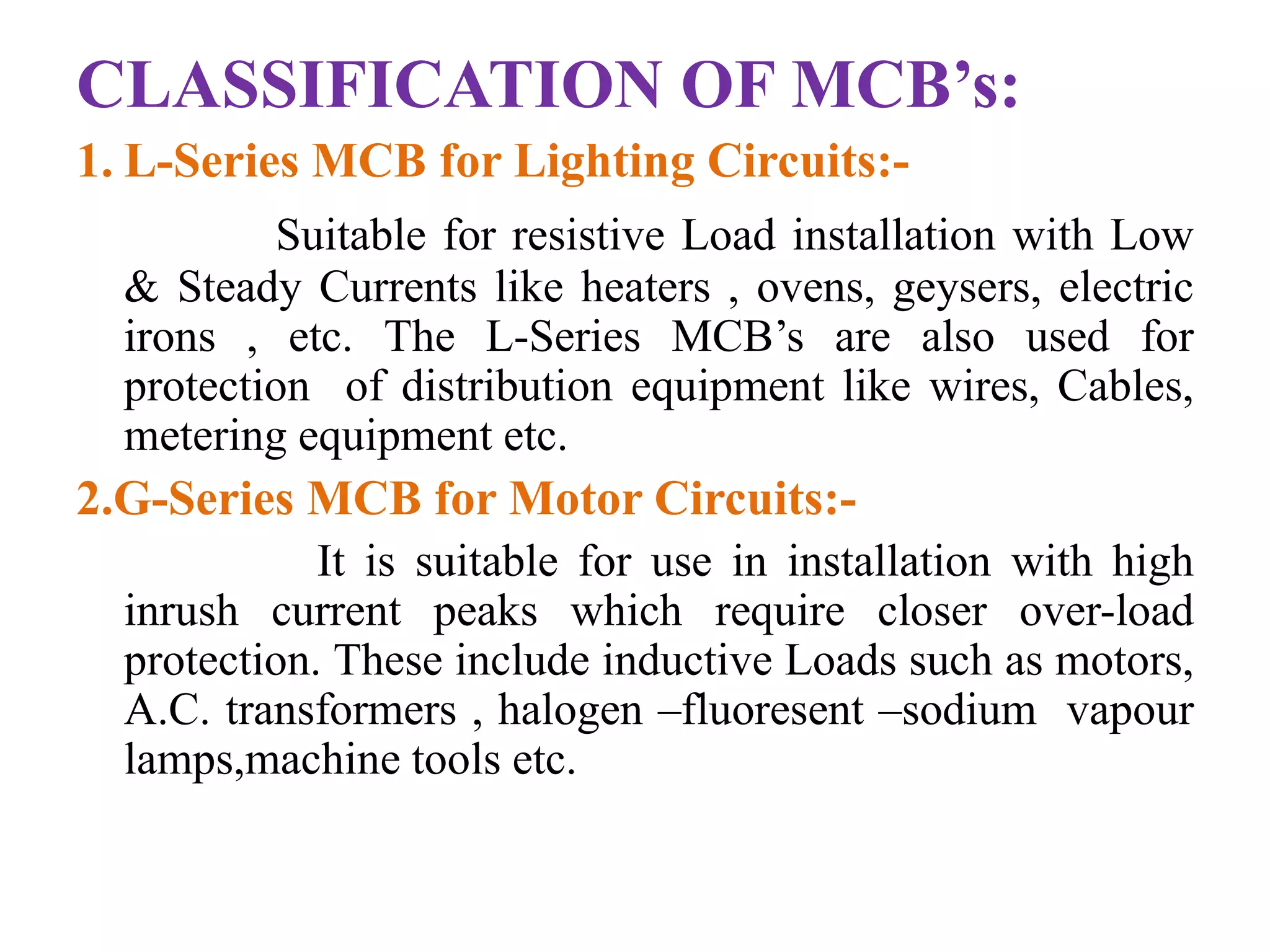
CLASSIFICATION OF MCB’s: 
1. L-Series MCB for Lighting Circuits:- 
Suitable for resistive Load installation with Low 
& Steady Currents like heaters , ovens, geysers, electric 
irons , etc. The L-Series MCB’s are also used for 
protection of distribution equipment like wires, Cables, 
metering equipment etc. 
2.G-Series MCB for Motor Circuits:- 
It is suitable for use in installation with high 
inrush current peaks which require closer over-load 
protection. These include inductive Loads such as motors, 
A.C. transformers , halogen –fluoresent –sodium vapour 
lamps,machine tools etc.
APPLICATION OF MCB: 
 They are required in homes, offices, shops distribution boards 
for protection of individual circuit & complete wiring system 
in that buildings through main circuits. 
 Whatever be the application, these MCB’s 
offer perfect over-load & circuit protection. 
ON 
OFF
EARTH LEAKAGE CIRCUIT 
BREAKER : 
 An Earth Leakage Circuit Breaker is a safety device used in 
electrical installations with high earth impedance to prevent 
Shock. 
 Many electrical installations have a relatively high earth 
impedance. 
These may be due to use of local earth rod to dry ground 
conditions. 
 These installations have a major problem if no ELCB is used. 
During live to earth fault current,two conditions occur. Because 
earth impedance is high,
1. Not enough current exist to trip a fuse or circuit breaker, so 
condition persists uncleared indefinitely . 
2. The high impedance earth can not keep the voltage of all exposed 
CPC connected metalwork to safe voltage all such metalwork 
may rise to close to live conductor voltage. 
TYPES OF ELCB: 
I. Voltage Operated:- 
They Provide a major advance in safety for mains electrical 
supplies with inadequate earth impedance. 
II. Current Operated:- 
They Provide protection against earth leakage, through the 
details & method of operation are different.
PRINCIPLE OF OPERATION: 
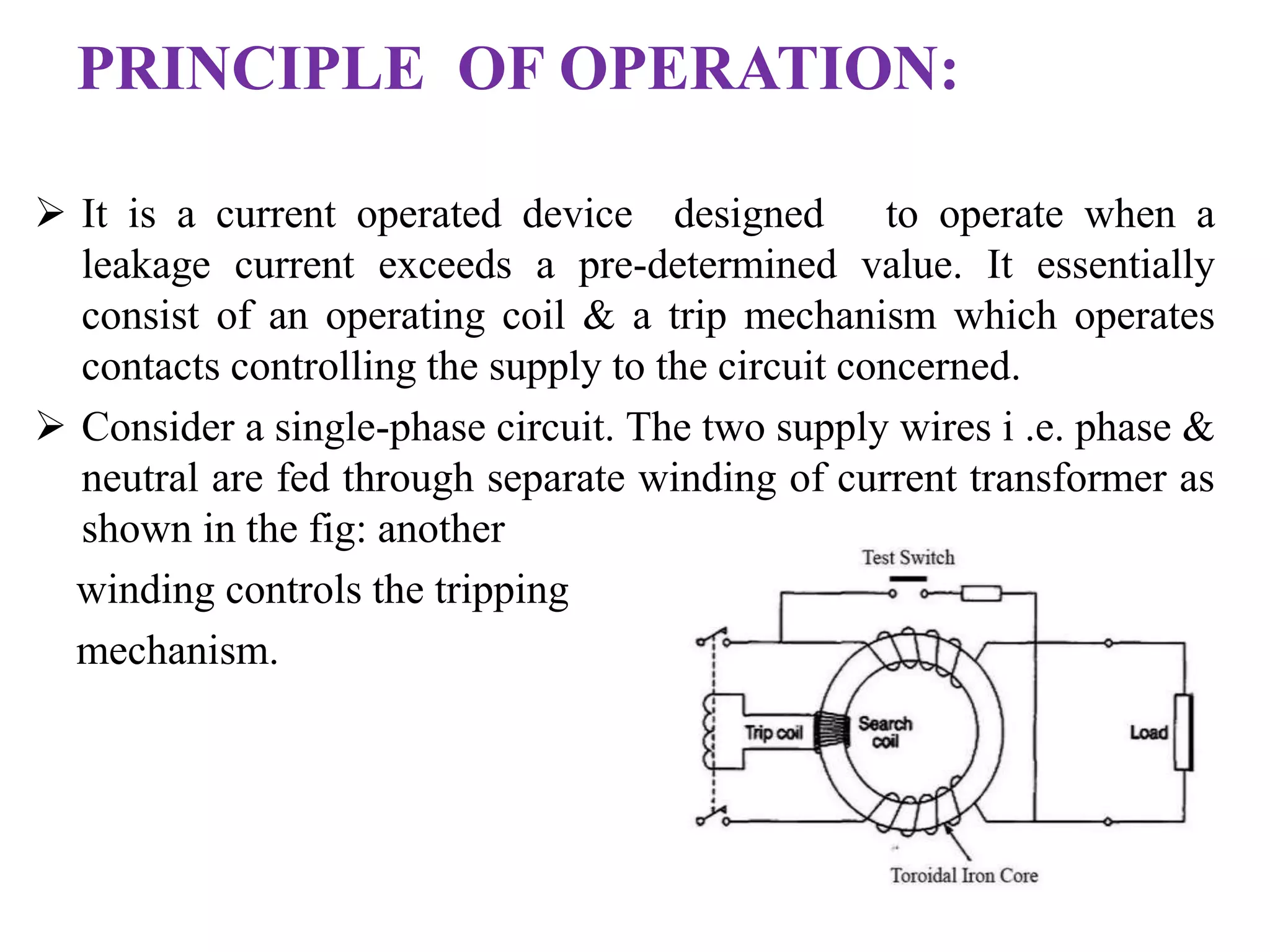
 It is a current operated device designed to operate when a 
leakage current exceeds a pre-determined value. It essentially 
consist of an operating coil & a trip mechanism which operates 
contacts controlling the supply to the circuit concerned. 
 Consider a single-phase circuit. The two supply wires i .e. phase & 
neutral are fed through separate winding of current transformer as 
shown in the fig: another 
winding controls the tripping 
mechanism.
Ip = In 
Therefore, the fluxes linking the phase & neutral conductors 
are equal in magnitude & opposite in direction. Thus, no fluxes 
links with tripping. Winding. 
ADVANTAGES : 
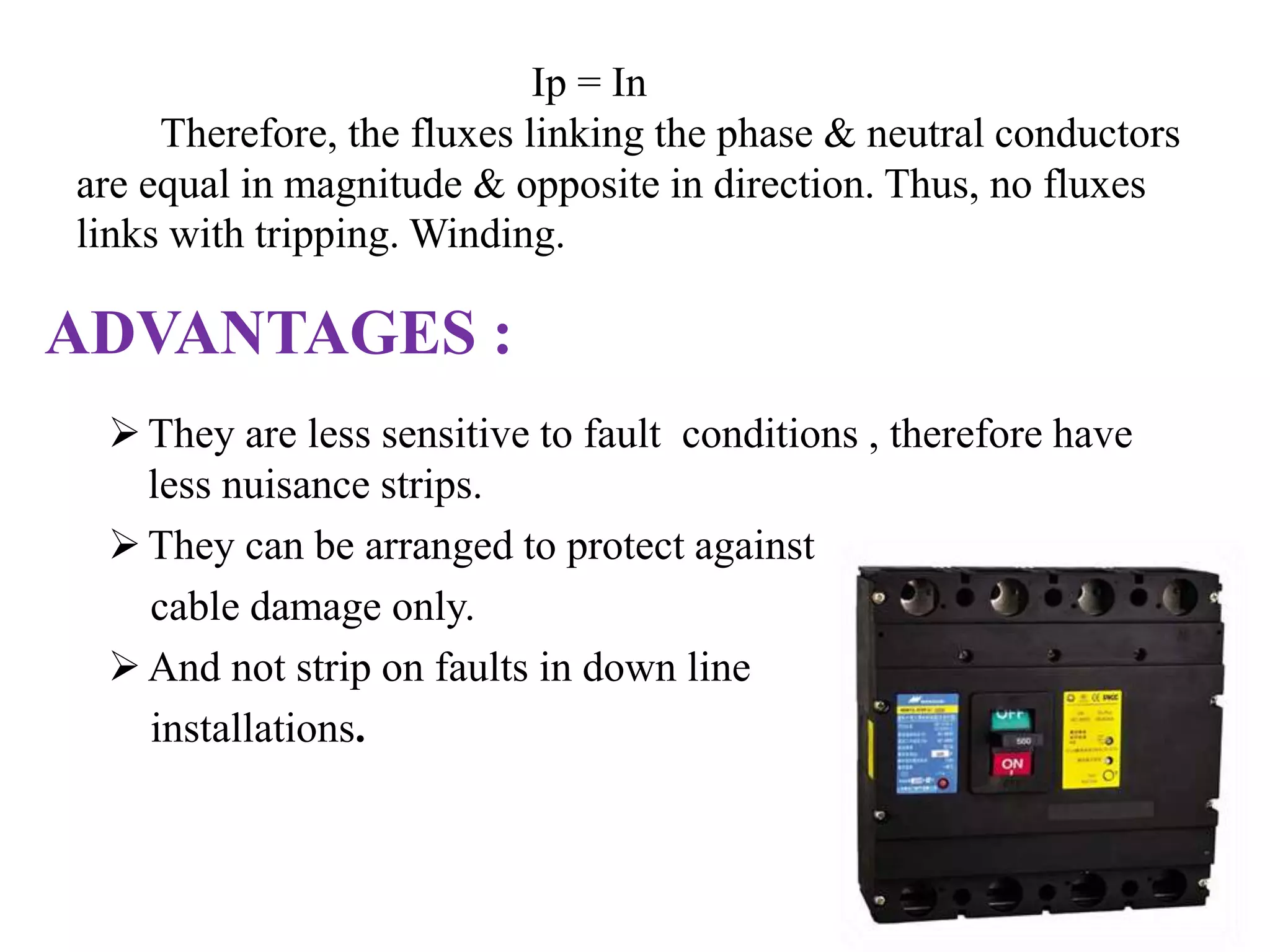
 They are less sensitive to fault conditions , therefore have 
less nuisance strips. 
 They can be arranged to protect against 
cable damage only. 
 And not strip on faults in down line 
installations.
DISADVANTAGES: 
 They do not detect faults that don’t pass current through the 
CPC to the earth rod. 
 They do not allow a single building system to be easily spilt 
into multiple sections with independent fault protection, 
because earthing system are usually bounded to pipe work. 
 ELCBs introduce additional resistance & an additional point of 
failure into earthing systems.
CONCLUSION: 
Therefore, we conclude that circuit breaker is the most essential 
part of the electrical networks as it protects every device from 
damage. It helps us to detect the fault and area affected by it. 
Nowadays vacuum and SF6 circuit breakers are widely used due 
to their reliable and fast operations.
Circuit breakers

Circuit breakers

  • 1.
  • 2.
    Content  Introductionto Circuit breaker  Basic Defination Of Circuit – Breaker  Working Principle of Circuit Breaker  Types Of Circuit Breakers 1. Oil Circuit Breakers 2. Vacuum Circuit Breakers 3. Air Blast Circuit Breakers 4. SF6 Circuit Breakers 5. Miniature Circuit Breakers 6. Earth Leakage Circuit Breakers  Conclusion
  • 3.
    Introduction to CircuitBreaker  The modern power system deals with huge power network and huge numbers of associated electrical equipment.  During short circuit fault or any other types of electrical fault these equipment as well as the power network suffer a high stress of fault current in them which may damage the equipment and networks permanently. For saving these equipments and the power networks the fault current should be cleared from the system as quickly as possible.
  • 4.
    Basic Defination OfCircuit – Breaker : . A circuit breaker is an automatically-operated electrical switch designed to protect an electrical circuit from damage caused by overload or short circuit.  Its basic function is to detect a fault condition and, by interrupting continuity, to immediately discontinue electrical flow.
  • 5.
    Working Principle ofCircuit Breaker • The circuit breaker mainly consists of fixed contacts and moving contacts. • In normal "on" condition of circuit breaker, these two contacts are physically connected to each other due to applied mechanical pressure on the moving contacts. • The potential energy can be stored in the circuit breaker by different ways like by deforming metal spring, by compressed air, or by hydrolic pressure. • But whatever the source of potential energy, it must be released during operation. Release of potential energy makes sliding of the moving contact at extremely fast manner.
  • 6.
    Types Of CircuitBreakers  Oil Circuit Breakers  Vacuum Circuit Breakers  Air Blast Circuit Breakers  SF6 Circuit Breakers  Miniature Circuit Breakers  Earth Leakage Circuit Breakers
  • 7.
    OIL CIRCUIT BREAKER  It is designed for 11kv-765kv. These are of two types • BOCB (Bulk oil Circuit Breaker) • MOCB (Minimum oil Circuit Breaker) The contacts are immersed in oil bath.  Oil provides cooling by hydrogen created by arc.  It acts as a good dielectric medium and quenches the arc.
  • 8.
    Advantages:  Oilhas good dielectric strength.  Low cost.  Oil is easily available.  It has wide range of breaking capability. Disadvantages:  Slower operation , takes about 20 cycles for arc quenching.  It is highly inflammable , so high risk of fire.  High maintenance cost.
  • 9.
    VACCUM CIRCUIT BREAKER  It is designed for medium voltage range (3.3-33kv).  This consists of vacuum of pressure (1*10-6) inside arc extinction chamber.  The arc burns in metal vapour when the contacts are disconnected.  At high voltage , it’s rate of dielectric strength recovery is very high.  Due to vacuum arc extinction is very fast.  The contacts loose metals gradually due to formation of metal vapours.
  • 10.
    Advantages:  Freefrom arc and fire hazards.  Low cost for maintenance & simpler mechanism.  Low arcing time & high contact life.  Silent and less vibrational operation.  Due to vacuum contacts remain free from corrosion.  No byproducts formed. Disadvantages:  High initial cost due to creation of vacuum.  Surface of contacts are depleted due to metal vapours.  High cost & size required for high voltage breakers.
  • 11.
    AIR BLAST CIRCUITBREAKERS  This operates using high velocity blast of air which quenches the arc.  It consists of blast valve , blast tube & contacts.  Blast valve contains air at high pressure.  Blast tube carries the air at high pressure & opens the moving contact attached to spring.  There is no carbonization of surface as in VCB.  Air should be kept clean & dry to operate it properly.
  • 13.
    Advantages:  Highspeed operation as compared to OCB.  Ability to withstand frequent switching.  Facility for high speed reclosure.  Less maintenance as compared to OCB. Disadvantages:  Little moisture content prolongs arcing time.  Pressure should be checked frequently for frequent operation.  Risk of fire hazards due to over voltages.  It can’t be used for high voltage operation due to prolonged arc quenching.
  • 14.
    SF6 CIRCUIT BREAKERS  It contains an arc interruption chamber containing SF6 gas.  In closed position the contacts remain surrounded by SF6 gas at a pressure of 2.8 kg/cm2 .  During opening high pressure SF6 gas at 14 kg/cm2 from its reservoir flows towards the chamber by valve mechanism.  SF6 rapidly absorbs the free electrons in the arc path to form immobile negative ions to build up high dielectric strength.  It also cools the arc and extinguishes it.  After operation the valve is closed by the action of a set of springs.  Absorbent materials are used to absorb the byproducts and moisture.
  • 16.
    Advantages:  Veryshort arcing period due to superior arc quenching property of SF6 .  Can interrupt much larger currents as compared to other breakers.  No risk of fire.  Low maintenance, light foundation.  No over voltage problem.  There are no carbon deposits. Disadvantages:  SF6 breakers are costly due to high cost of SF6.  SF6 gas has to be reconditioned after every operation of the breaker, additional equipment is required for this purpose.
  • 17.
    MINIATURE CIRCUIT BREAKER  An MCB is an Electromagnetic Device which Operates and Disconnects the Circuit when the Current reaches a pre determined value.  It is most modern substitute for conventional rewireable fuse with most accurate & efficient system in over-load & short circuit protection. In fact, it provides over-load protection & short circuits protection whereas FUSE offers short circuit protection only.  An MCB will normally operate at 1.25 times it rated current i.e. 20 A. MCB operates at 25 A compared with 30 A for cartridge fuse or 40 A for rewireable type of fuse of the same rating.
  • 18.
     Also theMCB which has tripped due to over-load or short circuit can be readily identified as the dolly or toggle or operating knob automatically moves to the “OFF” position. PRINCIPLE OF OPERATION :  MCB is a device which operates on the two metallic plates for the protection against over-load & short circuit.  1. Thermal for normal overload protection.  2. Magnetic for the short Circuit protection .
  • 19.
     The thermaloperation is achieved by metallic strip, which defects when heated by any over current flowing through it .  In doing so release the latch mechanism and causes the contacts to open.  When short Circuit occurs, the rising energizes the solenoid operating plunger to strike the trip lever causing immediate release of the latch mechanism
  • 20.
    CLASSIFICATION OF MCB’s: 1. L-Series MCB for Lighting Circuits:- Suitable for resistive Load installation with Low & Steady Currents like heaters , ovens, geysers, electric irons , etc. The L-Series MCB’s are also used for protection of distribution equipment like wires, Cables, metering equipment etc. 2.G-Series MCB for Motor Circuits:- It is suitable for use in installation with high inrush current peaks which require closer over-load protection. These include inductive Loads such as motors, A.C. transformers , halogen –fluoresent –sodium vapour lamps,machine tools etc.
  • 21.
    APPLICATION OF MCB:  They are required in homes, offices, shops distribution boards for protection of individual circuit & complete wiring system in that buildings through main circuits.  Whatever be the application, these MCB’s offer perfect over-load & circuit protection. ON OFF
  • 22.
    EARTH LEAKAGE CIRCUIT BREAKER :  An Earth Leakage Circuit Breaker is a safety device used in electrical installations with high earth impedance to prevent Shock.  Many electrical installations have a relatively high earth impedance. These may be due to use of local earth rod to dry ground conditions.  These installations have a major problem if no ELCB is used. During live to earth fault current,two conditions occur. Because earth impedance is high,
  • 23.
    1. Not enoughcurrent exist to trip a fuse or circuit breaker, so condition persists uncleared indefinitely . 2. The high impedance earth can not keep the voltage of all exposed CPC connected metalwork to safe voltage all such metalwork may rise to close to live conductor voltage. TYPES OF ELCB: I. Voltage Operated:- They Provide a major advance in safety for mains electrical supplies with inadequate earth impedance. II. Current Operated:- They Provide protection against earth leakage, through the details & method of operation are different.
  • 24.
    PRINCIPLE OF OPERATION:  It is a current operated device designed to operate when a leakage current exceeds a pre-determined value. It essentially consist of an operating coil & a trip mechanism which operates contacts controlling the supply to the circuit concerned.  Consider a single-phase circuit. The two supply wires i .e. phase & neutral are fed through separate winding of current transformer as shown in the fig: another winding controls the tripping mechanism.
  • 25.
    Ip = In Therefore, the fluxes linking the phase & neutral conductors are equal in magnitude & opposite in direction. Thus, no fluxes links with tripping. Winding. ADVANTAGES :  They are less sensitive to fault conditions , therefore have less nuisance strips.  They can be arranged to protect against cable damage only.  And not strip on faults in down line installations.
  • 26.
    DISADVANTAGES:  Theydo not detect faults that don’t pass current through the CPC to the earth rod.  They do not allow a single building system to be easily spilt into multiple sections with independent fault protection, because earthing system are usually bounded to pipe work.  ELCBs introduce additional resistance & an additional point of failure into earthing systems.
  • 27.
    CONCLUSION: Therefore, weconclude that circuit breaker is the most essential part of the electrical networks as it protects every device from damage. It helps us to detect the fault and area affected by it. Nowadays vacuum and SF6 circuit breakers are widely used due to their reliable and fast operations.