Components of lt
switchgear
Switch fuse unit (SFU)
Miniature Circuit Breaker(MCB)
Earth Leakage Circuit Breaker(ELCB)
Molded Case Circuit Breaker(MCCB)
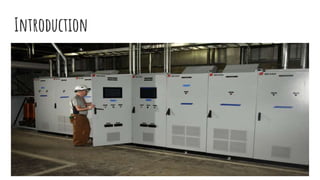
Introduction
Points to be noted
● Definition :The apparatus
used for switching,
controlling and protecting
the electrical circuits and
equipment is known as switch
gear.
Features of switchgear
● Complete reliability
● Certain discrimination
● Quick operation
● Provision for manual control and instruments
Points to be noted
● Rated up-to 1kv
● Terms include
1. Low voltage circuit breaker
2. Switches
3. Off load electrical idolaters
4. HRC fuses
5. Earth leakage circuit breaker
6. Miniature circuit breaker
7. Molded case circuit breaker
Switchgear
● The productive circuit or device must be fast acting and
isolate the faulty part of the circuit immediately.
● It also helps in isolating only the required part of the
circuit without affecting the remaining circuit during
maintenance.
Faults of electrical system
There are three types of faults:
1.Short circuit fault
2.Overload
3.Earth faults
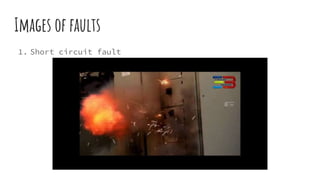
Images of faults
1. Short circuit fault
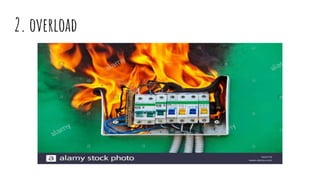
2. overload
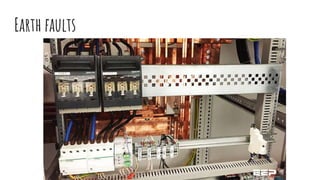
Earth faults
1. short circuit
In this phenomenon, the current is diverted from its is
desired path. Its magnitudes may 10-20 times of rated current
and rate of rise of conductor temperature is very high.
overload
Any increase in the conductor temperature above the
recommended max temperature of associated insulation is
called an overload. If insulation fails it will result in
short circuit.
Earth faults:
Leakage currents, are of a small magnitude in Milli amperes
or a few amperes. Due to small magnitude earth leakage
currents are not detected by overload or short circuit
protective devices.
PROTECTIVE DEVICES:
FUSE: A fuse is a short piece of metal,
inserted in the circuit, which melts when
excessive current flows through it and breaks
the circuit.
(Or)
a safety device consisting of a strip of
wire that melts and breaks an electric
circuit if the current exceeds a safe level.
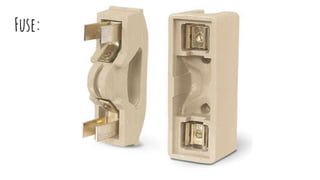
Fuse:
FUSE
The electrical equipments are designed to carry a particular
rated value of currents under normal conditions.
● Under abnormal conditions such as short circuit,
overload, or any fault; the current rises above this
value, damaging the equipment and sometimes resulting in
fire hazard. Fuses come into operation under fault
conditions.
● Under normal conditions it is designed to carry full load
current.
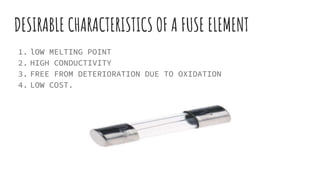
DESIRABLE CHARACTERISTICS OF A FUSE ELEMENT
1. lOW MELTING POINT
2. HIGH CONDUCTIVITY
3. FREE FROM DETERIORATION DUE TO OXIDATION
4. LOW COST.
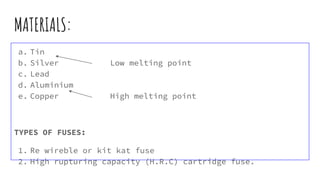
MATERIALS:
a. Tin
b. Silver Low melting point
c. Lead
d. Aluminium
e. Copper High melting point
TYPES OF FUSES:
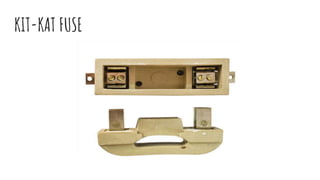
1. Re wireble or kit kat fuse
2. High rupturing capacity (H.R.C) cartridge fuse.
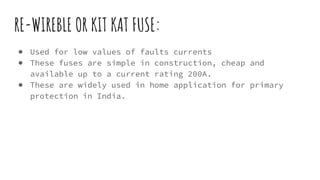
RE-WIREBLE OR KIT KAT FUSE:
● Used for low values of faults currents
● These fuses are simple in construction, cheap and
available up to a current rating 200A.
● These are widely used in home application for primary
protection in India.
KIT-KAT FUSE
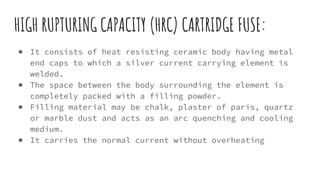
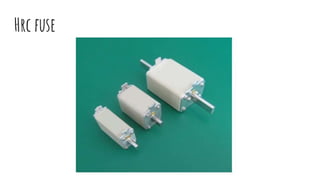
HIGH RUPTURING CAPACITY (HRC) CARTRIDGE FUSE:
● It consists of heat resisting ceramic body having metal
end caps to which a silver current carrying element is
welded.
● The space between the body surrounding the element is
completely packed with a filling powder.
● Filling material may be chalk, plaster of paris, quartz
or marble dust and acts as an arc quenching and cooling
medium.
● It carries the normal current without overheating
hrc
● Under normal loading conditions, the fuse element is at a
temperature below its melting point.
● When a fault occurs, the current increases and the fuse
element melts before the fault current reaches to maximum
● The heat produced in the process vaporizes the melted
silver element.
Hrc fuse
Circuit breaker
It is a switching device which can be operated manually and
automatically to make the circuit or breaker the circuit.
● Can operate in normal and abnormal conditions.
● In normal conditions it acts as a closed switch
● In abnormal conditions it will break
Types of (cb) present in lv switchgear
1.Miniature circuit breaker (MCB)
2.Earth leakage circuit breaker
(ElCB)
3.Molded case circuit breaker (MCCB)
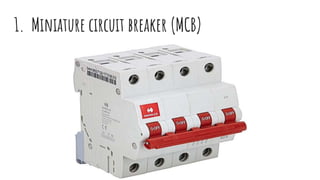
1. Miniature circuit breaker (MCB)
Mcb
● Mcb are electromechanical devices which protect an
electrical circuit from over currents.
● An MCB is a better alternative than fuse, since it does
not require replacement once an overload is detected.
● In simple terms, MCB is a switch which automatically
turns off when the current flowing through it passes the
maximum allowable limit.
● Currently MCB is designed to protect against over current
and over temperature faults.
WORKING PRINCIPLE
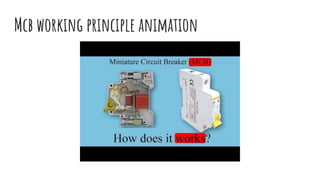
● tHERE ARE TWO CONTACTS - ONE IS FIXED AND
THE OTHER IS MOVED WHEN THE CURRENT EXCEEDS
THE PREDEFINED LIMIT, A SOLENOID FORCE THE
MOVEABLE CONTACT TO OPEN AND THE mcb TURNS
OFF, THEREBY STOPPING THE CURRENT FROM
FLOWING IN THE CIRCUIT.
Mcb working principle animation
Operation of MCB
● If Circuit is overloaded for a long time, the bi -
metallic strip becomes overheated and deformed.
● This deformation of bi-metallic strip causes displacement
of latch point.
● The moving contact of the MCB is so arranged by means of
spring, with the latch point, that a little displacement
of latch causes release of spring and makes the moving
contact to move for opening the MCB.
● The current coil or trip coil is placed in such a manner
that during SC fault, the MMF of that coil causes its
plunger to hit the same latch point and force the latch
to be displaced. Hence, the MCB will open in the same
● Again when operating level of the MCB is operated by
hand, that means when we make the MCB at off position
manually, the same latch point is displaced as a result
moving contact separated from fixed contact is same
manner.
● These are available in single pole, double pole, triple
pole, and four pole versions with neutral ples, if
required.
● The normal current ratings are available from 0.5-63A
with a symmetrical short circuit rupturing capacity of 3-
10KA,at a voltage level of 230/440V.
● MCBs are generally designed to trip within 2.5
milliseconds when an overcurrent fault arises.
● In case of temperature rise or overheating it may take 2
seconds to 2 min for the MCB to trip.
ADVANTAGES OF mcb
● High power applications.
● SC breaking capacity of 10KA
● It is used for switching, overload and short circuit
protection.
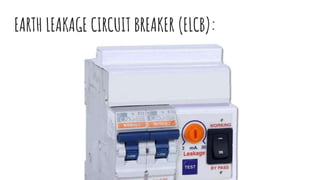
EARTH LEAKAGE CIRCUIT BREAKER (ELCB):
EARTH LEAKAGE CIRCUIT BREAKER
● The operation of ELCB also same like of MCB
● MCB, ELCB etc can protect the human life against electric
shocks or avoid fire due to leakage current.
● An earth leakage circuit breaker (ELCB) is a device used
to directly currents leakaging to earth from an
installation and cut the power.
● There are two types of ELCBS High voltage earth leakage
circuit breaker (Voltage - ELCB) high current earth
leakage circuit breaker (current - ELCB)
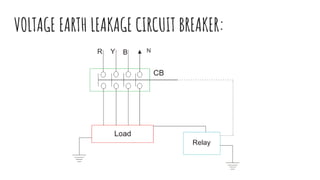
VOLTAGE EARTH LEAKAGE CIRCUIT BREAKER:
● Voltage ELCB is a voltage operated circuit breaker. The
device will function when the current passes through the
ELCB.
● Voltage - ELCB contains relay coil and one end of the
coil is connected to metallic load body and the other end
is connected to ground wire.
● If the voltage of the equipment body raises means by
touching internal insulation failed wires to metal body
of equipment, which could cause the different between
earth and load body voltage and the danger of electric
shock will occurs.
● This voltage difference will produces an electric current
from the load metallic body and passes through the relay
loop to the earth.
● When voltage on the equipment metallic body rises to the
danger level i.e which exceed to 50Vl the following
current through relay loop could move the relay contact
by disconnecting the supply current to avoid from any
danger electric shock.
● The ELCB detects faults currents from line to the earth
wire within the installation is protects.
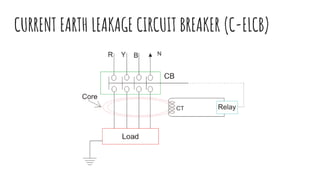
CURRENT EARTH LEAKAGE CIRCUIT BREAKER (C-ELCB)
● Current - ELCB is a current operated circuit breaker
which is a commonly used ELCB.
● Current ELCB consists of 3-winding transformer, which has
two primary and one secondary winding.
● Natural and line wires act as the two primary windings
● A wire wound coil is the secondary winding. The current
through the secondary winding is zero at the balanced
condition.
● In the balanced condition, the flux due to the current
through the phase wire will be neultratralized by the
current through a neutral wire (N)
● When a fault occurs, a small currents will flow to the
ground also. This make an unbalanced between line and
neutral currents and creates an unbalanced magnetic
field.
● This induces a current through the secondary winding,
which is connected to the sensing circuit.
● This will sense the leakage and send signal to the
tripping system and trips the contact.
MOLDED CASE CIRCUIT BREAKER (MCCB)
● Molded case circuit breakers are electromechanical
devices which protect a circuit from overcurrent and
short circuit.
● They provide overcurrent and short circuit protection for
circuits ranging from 63A upto 3000A.
● Their primary functions are to provide a means to
manually open a circuit and automatically open a circuit
under overloaded or short conditions respectively.
● MCCB is an alternative to a fuse, since it does not
require replacement once an overload is detect.
●
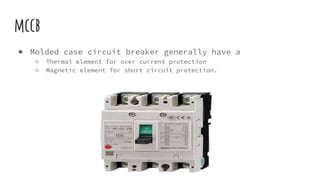
mccb
● Molded case circuit breaker generally have a
○ Thermal element for over current protection
○ Magnetic element for short circuit protection.
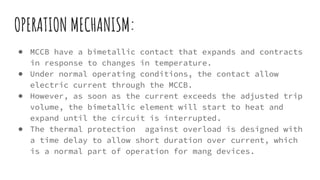
OPERATION MECHANISM:
● MCCB have a bimetallic contact that expands and contracts
in response to changes in temperature.
● Under normal operating conditions, the contact allow
electric current through the MCCB.
● However, as soon as the current exceeds the adjusted trip
volume, the bimetallic element will start to heat and
expand until the circuit is interrupted.
● The thermal protection against overload is designed with
a time delay to allow short duration over current, which
is a normal part of operation for mang devices.
● On the other hand, fault protection is accomplished with
electromagnetic induction, and the response is instant.
● Fault current should, be interrupted immediately,
nomatter if their duration is short or long.
● Whenever a fault occurs, the extremely high current
induces a magnetic field in a solenoid coil located
inside the breaker this magnetic induction trips a
contact and current is interrupted.
Applications:
● Used for very high current ratings
● Industrial application
● Used in heavy duty applications
● Main electric feeder protection
● Capacitor bank protection
● Generator protections
● Welding applications.
● High rating motors.
Thank you
-Presentation by: A Bhavani

Bee presentation

  • 1.
    Components of lt switchgear Switchfuse unit (SFU) Miniature Circuit Breaker(MCB) Earth Leakage Circuit Breaker(ELCB) Molded Case Circuit Breaker(MCCB)
  • 2.
  • 3.
    Points to benoted ● Definition :The apparatus used for switching, controlling and protecting the electrical circuits and equipment is known as switch gear.
  • 4.
    Features of switchgear ●Complete reliability ● Certain discrimination ● Quick operation ● Provision for manual control and instruments
  • 5.
    Points to benoted ● Rated up-to 1kv ● Terms include 1. Low voltage circuit breaker 2. Switches 3. Off load electrical idolaters 4. HRC fuses 5. Earth leakage circuit breaker 6. Miniature circuit breaker 7. Molded case circuit breaker
  • 6.
    Switchgear ● The productivecircuit or device must be fast acting and isolate the faulty part of the circuit immediately. ● It also helps in isolating only the required part of the circuit without affecting the remaining circuit during maintenance.
  • 7.
    Faults of electricalsystem There are three types of faults: 1.Short circuit fault 2.Overload 3.Earth faults
  • 8.
    Images of faults 1.Short circuit fault
  • 9.
  • 10.
  • 11.
    1. short circuit Inthis phenomenon, the current is diverted from its is desired path. Its magnitudes may 10-20 times of rated current and rate of rise of conductor temperature is very high.
  • 12.
    overload Any increase inthe conductor temperature above the recommended max temperature of associated insulation is called an overload. If insulation fails it will result in short circuit.
  • 13.
    Earth faults: Leakage currents,are of a small magnitude in Milli amperes or a few amperes. Due to small magnitude earth leakage currents are not detected by overload or short circuit protective devices.
  • 14.
    PROTECTIVE DEVICES: FUSE: Afuse is a short piece of metal, inserted in the circuit, which melts when excessive current flows through it and breaks the circuit. (Or) a safety device consisting of a strip of wire that melts and breaks an electric circuit if the current exceeds a safe level.
  • 15.
  • 16.
    FUSE The electrical equipmentsare designed to carry a particular rated value of currents under normal conditions. ● Under abnormal conditions such as short circuit, overload, or any fault; the current rises above this value, damaging the equipment and sometimes resulting in fire hazard. Fuses come into operation under fault conditions. ● Under normal conditions it is designed to carry full load current.
  • 17.
    DESIRABLE CHARACTERISTICS OFA FUSE ELEMENT 1. lOW MELTING POINT 2. HIGH CONDUCTIVITY 3. FREE FROM DETERIORATION DUE TO OXIDATION 4. LOW COST.
  • 18.
    MATERIALS: a. Tin b. SilverLow melting point c. Lead d. Aluminium e. Copper High melting point TYPES OF FUSES: 1. Re wireble or kit kat fuse 2. High rupturing capacity (H.R.C) cartridge fuse.
  • 19.
    RE-WIREBLE OR KITKAT FUSE: ● Used for low values of faults currents ● These fuses are simple in construction, cheap and available up to a current rating 200A. ● These are widely used in home application for primary protection in India.
  • 20.
  • 21.
    HIGH RUPTURING CAPACITY(HRC) CARTRIDGE FUSE: ● It consists of heat resisting ceramic body having metal end caps to which a silver current carrying element is welded. ● The space between the body surrounding the element is completely packed with a filling powder. ● Filling material may be chalk, plaster of paris, quartz or marble dust and acts as an arc quenching and cooling medium. ● It carries the normal current without overheating
  • 22.
    hrc ● Under normalloading conditions, the fuse element is at a temperature below its melting point. ● When a fault occurs, the current increases and the fuse element melts before the fault current reaches to maximum ● The heat produced in the process vaporizes the melted silver element.
  • 23.
  • 24.
    Circuit breaker It isa switching device which can be operated manually and automatically to make the circuit or breaker the circuit. ● Can operate in normal and abnormal conditions. ● In normal conditions it acts as a closed switch ● In abnormal conditions it will break
  • 25.
    Types of (cb)present in lv switchgear 1.Miniature circuit breaker (MCB) 2.Earth leakage circuit breaker (ElCB) 3.Molded case circuit breaker (MCCB)
  • 26.
    1. Miniature circuitbreaker (MCB)
  • 27.
    Mcb ● Mcb areelectromechanical devices which protect an electrical circuit from over currents. ● An MCB is a better alternative than fuse, since it does not require replacement once an overload is detected. ● In simple terms, MCB is a switch which automatically turns off when the current flowing through it passes the maximum allowable limit. ● Currently MCB is designed to protect against over current and over temperature faults.
  • 28.
    WORKING PRINCIPLE ● tHEREARE TWO CONTACTS - ONE IS FIXED AND THE OTHER IS MOVED WHEN THE CURRENT EXCEEDS THE PREDEFINED LIMIT, A SOLENOID FORCE THE MOVEABLE CONTACT TO OPEN AND THE mcb TURNS OFF, THEREBY STOPPING THE CURRENT FROM FLOWING IN THE CIRCUIT.
  • 29.
  • 30.
    Operation of MCB ●If Circuit is overloaded for a long time, the bi - metallic strip becomes overheated and deformed. ● This deformation of bi-metallic strip causes displacement of latch point. ● The moving contact of the MCB is so arranged by means of spring, with the latch point, that a little displacement of latch causes release of spring and makes the moving contact to move for opening the MCB. ● The current coil or trip coil is placed in such a manner that during SC fault, the MMF of that coil causes its plunger to hit the same latch point and force the latch to be displaced. Hence, the MCB will open in the same
  • 31.
    ● Again whenoperating level of the MCB is operated by hand, that means when we make the MCB at off position manually, the same latch point is displaced as a result moving contact separated from fixed contact is same manner. ● These are available in single pole, double pole, triple pole, and four pole versions with neutral ples, if required. ● The normal current ratings are available from 0.5-63A with a symmetrical short circuit rupturing capacity of 3- 10KA,at a voltage level of 230/440V.
  • 32.
    ● MCBs aregenerally designed to trip within 2.5 milliseconds when an overcurrent fault arises. ● In case of temperature rise or overheating it may take 2 seconds to 2 min for the MCB to trip.
  • 33.
    ADVANTAGES OF mcb ●High power applications. ● SC breaking capacity of 10KA ● It is used for switching, overload and short circuit protection.
  • 34.
    EARTH LEAKAGE CIRCUITBREAKER (ELCB):
  • 35.
    EARTH LEAKAGE CIRCUITBREAKER ● The operation of ELCB also same like of MCB ● MCB, ELCB etc can protect the human life against electric shocks or avoid fire due to leakage current. ● An earth leakage circuit breaker (ELCB) is a device used to directly currents leakaging to earth from an installation and cut the power. ● There are two types of ELCBS High voltage earth leakage circuit breaker (Voltage - ELCB) high current earth leakage circuit breaker (current - ELCB)
  • 36.
    VOLTAGE EARTH LEAKAGECIRCUIT BREAKER:
  • 37.
    ● Voltage ELCBis a voltage operated circuit breaker. The device will function when the current passes through the ELCB. ● Voltage - ELCB contains relay coil and one end of the coil is connected to metallic load body and the other end is connected to ground wire. ● If the voltage of the equipment body raises means by touching internal insulation failed wires to metal body of equipment, which could cause the different between earth and load body voltage and the danger of electric shock will occurs.
  • 38.
    ● This voltagedifference will produces an electric current from the load metallic body and passes through the relay loop to the earth. ● When voltage on the equipment metallic body rises to the danger level i.e which exceed to 50Vl the following current through relay loop could move the relay contact by disconnecting the supply current to avoid from any danger electric shock. ● The ELCB detects faults currents from line to the earth wire within the installation is protects.
  • 39.
    CURRENT EARTH LEAKAGECIRCUIT BREAKER (C-ELCB)
  • 40.
    ● Current -ELCB is a current operated circuit breaker which is a commonly used ELCB. ● Current ELCB consists of 3-winding transformer, which has two primary and one secondary winding. ● Natural and line wires act as the two primary windings ● A wire wound coil is the secondary winding. The current through the secondary winding is zero at the balanced condition. ● In the balanced condition, the flux due to the current through the phase wire will be neultratralized by the current through a neutral wire (N)
  • 41.
    ● When afault occurs, a small currents will flow to the ground also. This make an unbalanced between line and neutral currents and creates an unbalanced magnetic field. ● This induces a current through the secondary winding, which is connected to the sensing circuit. ● This will sense the leakage and send signal to the tripping system and trips the contact.
  • 42.
    MOLDED CASE CIRCUITBREAKER (MCCB) ● Molded case circuit breakers are electromechanical devices which protect a circuit from overcurrent and short circuit. ● They provide overcurrent and short circuit protection for circuits ranging from 63A upto 3000A. ● Their primary functions are to provide a means to manually open a circuit and automatically open a circuit under overloaded or short conditions respectively. ● MCCB is an alternative to a fuse, since it does not require replacement once an overload is detect. ●
  • 43.
    mccb ● Molded casecircuit breaker generally have a ○ Thermal element for over current protection ○ Magnetic element for short circuit protection.
  • 44.
    OPERATION MECHANISM: ● MCCBhave a bimetallic contact that expands and contracts in response to changes in temperature. ● Under normal operating conditions, the contact allow electric current through the MCCB. ● However, as soon as the current exceeds the adjusted trip volume, the bimetallic element will start to heat and expand until the circuit is interrupted. ● The thermal protection against overload is designed with a time delay to allow short duration over current, which is a normal part of operation for mang devices.
  • 45.
    ● On theother hand, fault protection is accomplished with electromagnetic induction, and the response is instant. ● Fault current should, be interrupted immediately, nomatter if their duration is short or long. ● Whenever a fault occurs, the extremely high current induces a magnetic field in a solenoid coil located inside the breaker this magnetic induction trips a contact and current is interrupted.
  • 46.
    Applications: ● Used forvery high current ratings ● Industrial application ● Used in heavy duty applications ● Main electric feeder protection ● Capacitor bank protection ● Generator protections ● Welding applications. ● High rating motors.
  • 47.