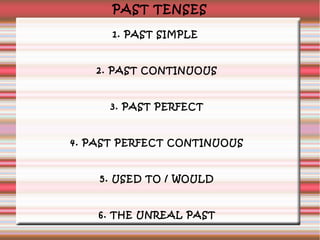
PAST TENSES
1. PAST SIMPLE

2. PAST CONTINUOUS

3. PAST PERFECT

4. PAST PERFECT CONTINUOUS

5. USED TO / WOULD

6. THE UNREAL PAST
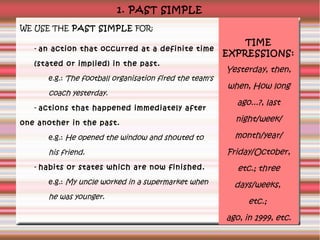
1. PAST SIMPLE
WE USE THE PAST SIMPLE FOR:
- an action that occurred at a definite time
(stated or implied) in the past.
e.g.: The football organisation fired the team's

coach yesterday.
- actions that happened immediately after
one another in the past.
e.g.: He opened the window and shouted to

his friend.
- habits or states which are now finished.
e.g.: My uncle worked in a supermarket when

he was younger.

TIME
EXPRESSIONS:

Yesterday, then,
when, How long
ago...?, last
night/week/
month/year/
Friday/October,
etc.; three
days/weeks,
etc.;
ago, in 1999, etc.
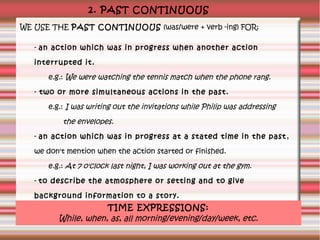
2. PAST CONTINUOUS
WE USE THE PAST CONTINUOUS (was/were + verb -ing) FOR:
- an action which was in progress when another action
interrupted it.
e.g.: We were watching the tennis match when the phone rang.
- two or more simultaneous actions in the past.
e.g.: I was writing out the invitations while Philip was addressing

the envelopes.
- an action which was in progress at a stated time in the past ,
we don't mention when the action started or finished.
e.g.: At 7 o'clock last night, I was working out at the gym.
- to describe the atmosphere or setting and to give
background information to a story.

TIME EXPRESSIONS:
e.g.: A light breeze was blowing and the sun was shining.

While, when, as, all morning/evening/day/week, etc.
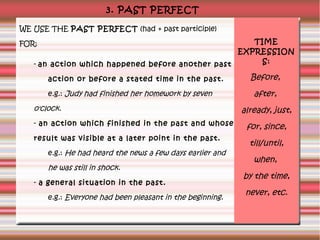
3. PAST PERFECT
WE USE THE PAST PERFECT (had + past participle)
TIME
EXPRESSION
S:
- an action which happened before another past

FOR:

action or before a stated time in the past.
e.g.: Judy had finished her homework by seven

o'clock.
- an action which finished in the past and whose
result was visible at a later point in the past.
e.g.: He had heard the news a few days earlier and

he was still in shock.
- a general situation in the past.
e.g.: Everyone had been pleasant in the beginning.

Before,
after,
already, just,
for, since,
till/until,
when,
by the time,
never, etc.
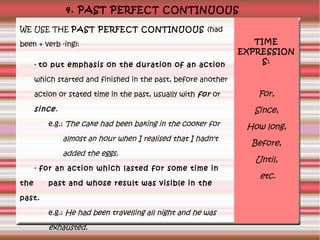
4. PAST PERFECT CONTINUOUS
WE USE THE PAST PERFECT CONTINUOUS (had
been + verb -ing):
- to put emphasis on the duration of an action

TIME
EXPRESSION
S:

which started and finished in the past, before another
action or stated time in the past, usually with for or

since .

Since,

e.g.: The cake had been baking in the cooker for

almost an hour when I realised that I hadn't
added the eggs.
- for an action which lasted for some time in
the

For,

past and whose result was visible in the

past.
e.g.: He had been travelling all night and he was

exhausted.

How long,
Before,
Until,
etc.
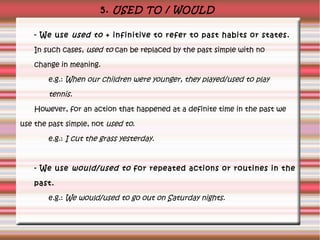
5. USED TO / WOULD
- We use used to + infinitive to refer to past habits or states.
In such cases, used to can be replaced by the past simple with no
change in meaning.
e.g.: When our children were younger, they played/used to play

tennis.
However, for an action that happened at a definite time in the past we
use the past simple, not used to.
e.g.: I cut the grass yesterday.

- We use would/used to for repeated actions or routines in the
past.
e.g.: We would/used to go out on Saturday nights.
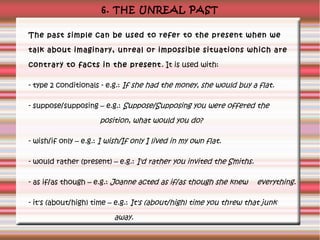
6. THE UNREAL PAST
The past simple can be used to refer to the present when we
talk about imaginary, unreal or impossible situations which are
contrary to facts in the present . It is used with:
- type 2 conditionals - e.g.: If she had the money, she would buy a flat.
- suppose/supposing – e.g.: Suppose/Supposing you were offered the

position, what would you do?
- wish/if only – e.g.: I wish/If only I lived in my own flat.
- would rather (present) – e.g.: I'd rather you invited the Smiths.
- as if/as though – e.g.: Joanne acted as if/as though she knew

everything.

- it's (about/high) time – e.g.: It's (about/high) time you threw that junk

away.
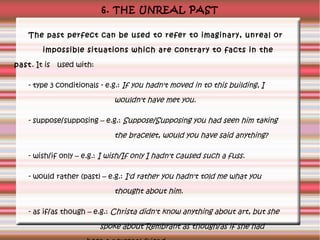
6. THE UNREAL PAST
The past perfect can be used to refer to imaginary, unreal or
impossible situations which are contrary to facts in the
past. It is used with:
- type 3 conditionals - e.g.: If you hadn't moved in to this building, I

wouldn't have met you.
- suppose/supposing – e.g.: Suppose/Supposing you had seen him taking

the bracelet, would you have said anything?
- wish/if only – e.g.: I wish/If only I hadn't caused such a fuss.
- would rather (past) – e.g.: I'd rather you hadn't told me what you

thought about him.
- as if/as though – e.g.: Christa didn't know anything about art, but she

spoke about Rembrant as though/as if she had

Past tenses C1

  • 1.
    PAST TENSES 1. PASTSIMPLE 2. PAST CONTINUOUS 3. PAST PERFECT 4. PAST PERFECT CONTINUOUS 5. USED TO / WOULD 6. THE UNREAL PAST
  • 2.
    1. PAST SIMPLE WEUSE THE PAST SIMPLE FOR: - an action that occurred at a definite time (stated or implied) in the past. e.g.: The football organisation fired the team's coach yesterday. - actions that happened immediately after one another in the past. e.g.: He opened the window and shouted to his friend. - habits or states which are now finished. e.g.: My uncle worked in a supermarket when he was younger. TIME EXPRESSIONS: Yesterday, then, when, How long ago...?, last night/week/ month/year/ Friday/October, etc.; three days/weeks, etc.; ago, in 1999, etc.
  • 3.
    2. PAST CONTINUOUS WEUSE THE PAST CONTINUOUS (was/were + verb -ing) FOR: - an action which was in progress when another action interrupted it. e.g.: We were watching the tennis match when the phone rang. - two or more simultaneous actions in the past. e.g.: I was writing out the invitations while Philip was addressing the envelopes. - an action which was in progress at a stated time in the past , we don't mention when the action started or finished. e.g.: At 7 o'clock last night, I was working out at the gym. - to describe the atmosphere or setting and to give background information to a story. TIME EXPRESSIONS: e.g.: A light breeze was blowing and the sun was shining. While, when, as, all morning/evening/day/week, etc.
  • 4.
    3. PAST PERFECT WEUSE THE PAST PERFECT (had + past participle) TIME EXPRESSION S: - an action which happened before another past FOR: action or before a stated time in the past. e.g.: Judy had finished her homework by seven o'clock. - an action which finished in the past and whose result was visible at a later point in the past. e.g.: He had heard the news a few days earlier and he was still in shock. - a general situation in the past. e.g.: Everyone had been pleasant in the beginning. Before, after, already, just, for, since, till/until, when, by the time, never, etc.
  • 5.
    4. PAST PERFECTCONTINUOUS WE USE THE PAST PERFECT CONTINUOUS (had been + verb -ing): - to put emphasis on the duration of an action TIME EXPRESSION S: which started and finished in the past, before another action or stated time in the past, usually with for or since . Since, e.g.: The cake had been baking in the cooker for almost an hour when I realised that I hadn't added the eggs. - for an action which lasted for some time in the For, past and whose result was visible in the past. e.g.: He had been travelling all night and he was exhausted. How long, Before, Until, etc.
  • 6.
    5. USED TO/ WOULD - We use used to + infinitive to refer to past habits or states. In such cases, used to can be replaced by the past simple with no change in meaning. e.g.: When our children were younger, they played/used to play tennis. However, for an action that happened at a definite time in the past we use the past simple, not used to. e.g.: I cut the grass yesterday. - We use would/used to for repeated actions or routines in the past. e.g.: We would/used to go out on Saturday nights.
  • 7.
    6. THE UNREALPAST The past simple can be used to refer to the present when we talk about imaginary, unreal or impossible situations which are contrary to facts in the present . It is used with: - type 2 conditionals - e.g.: If she had the money, she would buy a flat. - suppose/supposing – e.g.: Suppose/Supposing you were offered the position, what would you do? - wish/if only – e.g.: I wish/If only I lived in my own flat. - would rather (present) – e.g.: I'd rather you invited the Smiths. - as if/as though – e.g.: Joanne acted as if/as though she knew everything. - it's (about/high) time – e.g.: It's (about/high) time you threw that junk away.
  • 8.
    6. THE UNREALPAST The past perfect can be used to refer to imaginary, unreal or impossible situations which are contrary to facts in the past. It is used with: - type 3 conditionals - e.g.: If you hadn't moved in to this building, I wouldn't have met you. - suppose/supposing – e.g.: Suppose/Supposing you had seen him taking the bracelet, would you have said anything? - wish/if only – e.g.: I wish/If only I hadn't caused such a fuss. - would rather (past) – e.g.: I'd rather you hadn't told me what you thought about him. - as if/as though – e.g.: Christa didn't know anything about art, but she spoke about Rembrant as though/as if she had