Simple Present
FORM
[VERB] + s/es en la tercera persona del singular (he/she/it)
Examples:
• You speak English.
• Do you speak English?
• You do not speak English.
Positive Negative Question
• I run.
• You run.
• We run.
• They run.
• He runs.
• She runs.
• It runs.
• I do not run.
• You do not run.
• We do not run.
• They do not run.
• He does not run.
• She does not run.
• It does not run.
• Do I run?
• Do you run?
• Do we run?
• Do they run?
• Does he run?
• Does she run?
• Does it run?
USE 1 Repeated Actions (acciones repetidas)
Usa el Present Simple para expresar la idea de que una acción se repite o es
usual. La acción puede ser un hábito, un hobby, un hecho diario, un hecho
programado o algo que sucede con frecuencia. Puede ser también algo que
una persona con frecuencia olvida o que normalmente no realiza.
Examples:
• I play tennis.
• She does not play tennis.
• Does he play tennis?
• The train leaves every morning at 8 AM.
• The train does not leave at 9 AM.
• When does the train usually leave?
• She always forgets her purse.
• He never forgets his wallet.
• Every twelve months, the Earth circles the Sun.
• Does the Sun circle the Earth?
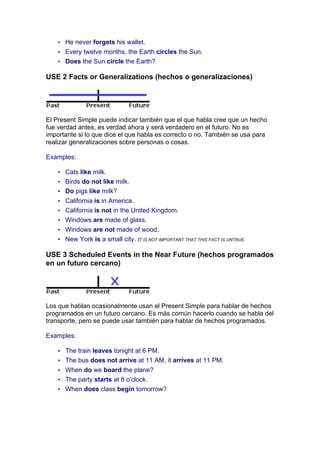
USE 2 Facts or Generalizations (hechos o generalizaciones)
El Present Simple puede indicar también que el que habla cree que un hecho
fue verdad antes, es verdad ahora y será verdadero en el futuro. No es
importante si lo que dice el que habla es correcto o no. También se usa para
realizar generalizaciones sobre personas o cosas.
Examples:
• Cats like milk.
• Birds do not like milk.
• Do pigs like milk?
• California is in America.
• California is not in the United Kingdom.
• Windows are made of glass.
• Windows are not made of wood.
• New York is a small city. IT IS NOT IMPORTANT THAT THIS FACT IS UNTRUE.
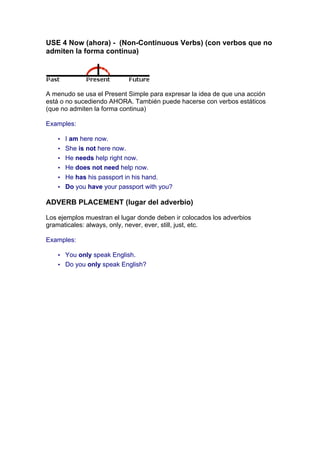
USE 3 Scheduled Events in the Near Future (hechos programados
en un futuro cercano)
Los que hablan ocasionalmente usan el Present Simple para hablar de hechos
programados en un futuro cercano. Es más común hacerlo cuando se habla del
transporte, pero se puede usar también para hablar de hechos programados.
Examples:
• The train leaves tonight at 6 PM.
• The bus does not arrive at 11 AM, it arrives at 11 PM.
• When do we board the plane?
• The party starts at 8 o'clock.
• When does class begin tomorrow?
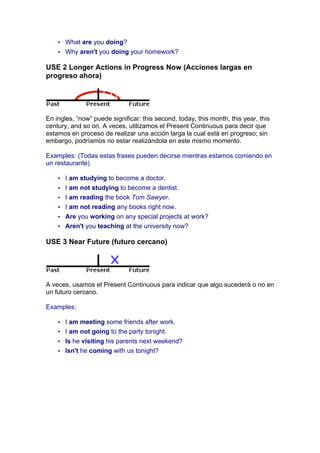
USE 4 Now (ahora) - (Non-Continuous Verbs) (con verbos que no
admiten la forma continua)
A menudo se usa el Present Simple para expresar la idea de que una acción
está o no sucediendo AHORA. También puede hacerse con verbos estáticos
(que no admiten la forma continua)
Examples:
• I am here now.
• She is not here now.
• He needs help right now.
• He does not need help now.
• He has his passport in his hand.
• Do you have your passport with you?
ADVERB PLACEMENT (lugar del adverbio)
Los ejemplos muestran el lugar donde deben ir colocados los adverbios
gramaticales: always, only, never, ever, still, just, etc.
Examples:
• You only speak English.
• Do you only speak English?
Present Continuous
FORM
[am/is/are + verb + ing]
Examples:
• You are watching TV.
• Are you watching TV?
• You are not watching TV.
USE 1 Now (ahora)
Usamos el Present Continuous para expresar la idea de que algo está
sucediendo AHORA, en este preciso momento.
Examples:
• You are learning English now.
• You are not swimming now.
• Are you sleeping?
• I am sitting.
• I am not standing.
• Is he sitting or standing?
• They are reading their books.
• They are not watching television.
Positive Negative Question
• I am speaking.
• You are speaking.
• We are speaking.
• They are speaking.
• He is speaking.
• She is speaking.
• It is speaking.
• I am not speaking.
• You are not speaking.
• We are not speaking.
• They are not
speaking.
• He is not speaking.
• She is not speaking.
• It is not speaking.
• Am I speaking?
• Are you speaking?
• Are we speaking?
• Are they speaking?
• Is he speaking?
• Is she speaking?
• Is it speaking?
• What are you doing?
• Why aren't you doing your homework?
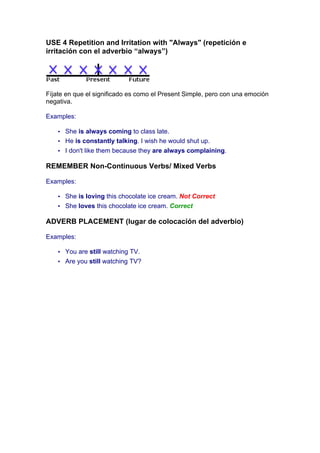
USE 2 Longer Actions in Progress Now (Acciones largas en
progreso ahora)
En ingles, “now” puede significar: this second, today, this month, this year, this
century, and so on. A veces, utilizamos el Present Continuous para decir que
estamos en proceso de realizar una acción larga la cual está en progreso; sin
embargo, podríamos no estar realizándola en este mismo momento.
Examples: (Todas estas frases pueden decirse mientras estamos comiendo en
un restaurante)
• I am studying to become a doctor.
• I am not studying to become a dentist.
• I am reading the book Tom Sawyer.
• I am not reading any books right now.
• Are you working on any special projects at work?
• Aren't you teaching at the university now?
USE 3 Near Future (futuro cercano)
A veces, usamos el Present Continuous para indicar que algo sucederá o no en
un futuro cercano.
Examples:
• I am meeting some friends after work.
• I am not going to the party tonight.
• Is he visiting his parents next weekend?
• Isn't he coming with us tonight?
USE 4 Repetition and Irritation with "Always" (repetición e
irritación con el adverbio “always”)
Fíjate en que el significado es como el Present Simple, pero con una emoción
negativa.
Examples:
• She is always coming to class late.
• He is constantly talking. I wish he would shut up.
• I don't like them because they are always complaining.
REMEMBER Non-Continuous Verbs/ Mixed Verbs
Examples:
• She is loving this chocolate ice cream. Not Correct
• She loves this chocolate ice cream. Correct
ADVERB PLACEMENT (lugar de colocación del adverbio)
Examples:
• You are still watching TV.
• Are you still watching TV?
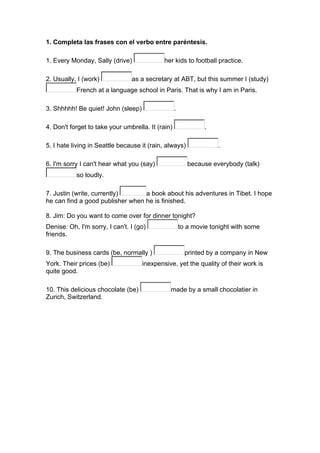
1. Completa las frases con el verbo entre paréntesis.
1. Every Monday, Sally (drive) her kids to football practice.
2. Usually, I (work) as a secretary at ABT, but this summer I (study)
French at a language school in Paris. That is why I am in Paris.
3. Shhhhh! Be quiet! John (sleep) .
4. Don't forget to take your umbrella. It (rain) .
5. I hate living in Seattle because it (rain, always) .
6. I'm sorry I can't hear what you (say) because everybody (talk)
so loudly.
7. Justin (write, currently) a book about his adventures in Tibet. I hope
he can find a good publisher when he is finished.
8. Jim: Do you want to come over for dinner tonight?
Denise: Oh, I'm sorry, I can't. I (go) to a movie tonight with some
friends.
9. The business cards (be, normally ) printed by a company in New
York. Their prices (be) inexpensive, yet the quality of their work is
quite good.
10. This delicious chocolate (be) made by a small chocolatier in
Zurich, Switzerland.
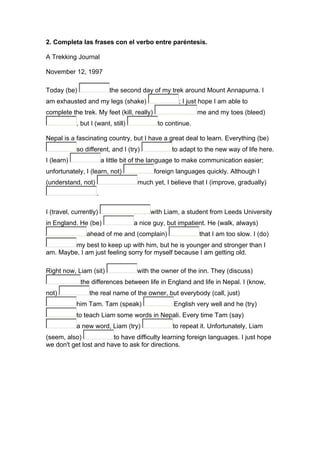
2. Completa las frases con el verbo entre paréntesis.
A Trekking Journal
November 12, 1997
Today (be) the second day of my trek around Mount Annapurna. I
am exhausted and my legs (shake) ; I just hope I am able to
complete the trek. My feet (kill, really) me and my toes (bleed)
, but I (want, still) to continue.
Nepal is a fascinating country, but I have a great deal to learn. Everything (be)
so different, and I (try) to adapt to the new way of life here.
I (learn) a little bit of the language to make communication easier;
unfortunately, I (learn, not) foreign languages quickly. Although I
(understand, not) much yet, I believe that I (improve, gradually)
.
I (travel, currently) with Liam, a student from Leeds University
in England. He (be) a nice guy, but impatient. He (walk, always)
ahead of me and (complain) that I am too slow. I (do)
my best to keep up with him, but he is younger and stronger than I
am. Maybe, I am just feeling sorry for myself because I am getting old.
Right now, Liam (sit) with the owner of the inn. They (discuss)
the differences between life in England and life in Nepal. I (know,
not) the real name of the owner, but everybody (call, just)
him Tam. Tam (speak) English very well and he (try)
to teach Liam some words in Nepali. Every time Tam (say)
a new word, Liam (try) to repeat it. Unfortunately, Liam
(seem, also) to have difficulty learning foreign languages. I just hope
we don't get lost and have to ask for directions.
Stative verbs - Verbos que no suelen utilizarse en la
forma continua
Algunos verbos no se usan en forma continua. Son aquellos que
expresan:
Sentidos / Percepción: feel, hear, see, smell, sound, taste, touch.
Pensamientos / Actividad mental: appear, doubt, imagine, realise,
think, believe, forget, know, remember, understand, consider, guess,
mean.
Emociones: dislike, fear, hate, like, love, need, want, wish.
Relaciones / Posesión: belong to, have, owe, own, possess.
Precios / Medidas: cost, equal, measure, weigh.
I understand the problem now
This house belongs to my parents
En ocasiones, algunos de estos verbos tienen más de un significado y
pueden usarse en la forma continua.
I see you are tired now
(aunque sea "ahora", no se puede poner en forma continua)
I'm seeing the doctor tomorrow
(tengo una cita, voy a visitar al médico)
I think you are right
(cuando think significa "creer" no se puede poner en la forma
continua)
She's thinking of selling her car
(cuando think significa "considerar", sí se puede)
Reglas de ortografía para el presente continuo.
1. Cuando el verbo acaba en “e” normalmente éste cae delante de la
terminación -ing:
make – making; take – taking.
2. Cuando se trata de un verbo monosilábico acabado en una sola vocal
seguida por una consonante, la consonante final se duplica delante de la
terminación -ing:
stop – stopping; sit -sitting; win – winning.
Pero fijaros que cuando hay más de una vocal en el verbo, no duplicamos la
consonante final:
rain – raining
3. Cuando se trata de un verbo bisilábico cuya sílaba tónica es la segunda, la
consonante final se dobla delante de la terminación - ing:
begin – beginning; prefer – preferring.
Pero si la sílaba tónica es la primera no existen modificaciones:
visit – visiting; open – opening
4. No existen modificaciones cuando el verbo acaba en vocal o consonante + y:
play – playing; study – studying
5. Los verbos acabados en -ie cambian este grupo de vocales por una y
delante de la terminación -ing:
die – dying

Simple present.present continuous

  • 1.
    Simple Present FORM [VERB] +s/es en la tercera persona del singular (he/she/it) Examples: • You speak English. • Do you speak English? • You do not speak English. Positive Negative Question • I run. • You run. • We run. • They run. • He runs. • She runs. • It runs. • I do not run. • You do not run. • We do not run. • They do not run. • He does not run. • She does not run. • It does not run. • Do I run? • Do you run? • Do we run? • Do they run? • Does he run? • Does she run? • Does it run? USE 1 Repeated Actions (acciones repetidas) Usa el Present Simple para expresar la idea de que una acción se repite o es usual. La acción puede ser un hábito, un hobby, un hecho diario, un hecho programado o algo que sucede con frecuencia. Puede ser también algo que una persona con frecuencia olvida o que normalmente no realiza. Examples: • I play tennis. • She does not play tennis. • Does he play tennis? • The train leaves every morning at 8 AM. • The train does not leave at 9 AM. • When does the train usually leave? • She always forgets her purse.
  • 2.
    • He neverforgets his wallet. • Every twelve months, the Earth circles the Sun. • Does the Sun circle the Earth? USE 2 Facts or Generalizations (hechos o generalizaciones) El Present Simple puede indicar también que el que habla cree que un hecho fue verdad antes, es verdad ahora y será verdadero en el futuro. No es importante si lo que dice el que habla es correcto o no. También se usa para realizar generalizaciones sobre personas o cosas. Examples: • Cats like milk. • Birds do not like milk. • Do pigs like milk? • California is in America. • California is not in the United Kingdom. • Windows are made of glass. • Windows are not made of wood. • New York is a small city. IT IS NOT IMPORTANT THAT THIS FACT IS UNTRUE. USE 3 Scheduled Events in the Near Future (hechos programados en un futuro cercano) Los que hablan ocasionalmente usan el Present Simple para hablar de hechos programados en un futuro cercano. Es más común hacerlo cuando se habla del transporte, pero se puede usar también para hablar de hechos programados. Examples: • The train leaves tonight at 6 PM. • The bus does not arrive at 11 AM, it arrives at 11 PM. • When do we board the plane? • The party starts at 8 o'clock. • When does class begin tomorrow?
  • 3.
    USE 4 Now(ahora) - (Non-Continuous Verbs) (con verbos que no admiten la forma continua) A menudo se usa el Present Simple para expresar la idea de que una acción está o no sucediendo AHORA. También puede hacerse con verbos estáticos (que no admiten la forma continua) Examples: • I am here now. • She is not here now. • He needs help right now. • He does not need help now. • He has his passport in his hand. • Do you have your passport with you? ADVERB PLACEMENT (lugar del adverbio) Los ejemplos muestran el lugar donde deben ir colocados los adverbios gramaticales: always, only, never, ever, still, just, etc. Examples: • You only speak English. • Do you only speak English?
  • 4.
    Present Continuous FORM [am/is/are +verb + ing] Examples: • You are watching TV. • Are you watching TV? • You are not watching TV. USE 1 Now (ahora) Usamos el Present Continuous para expresar la idea de que algo está sucediendo AHORA, en este preciso momento. Examples: • You are learning English now. • You are not swimming now. • Are you sleeping? • I am sitting. • I am not standing. • Is he sitting or standing? • They are reading their books. • They are not watching television. Positive Negative Question • I am speaking. • You are speaking. • We are speaking. • They are speaking. • He is speaking. • She is speaking. • It is speaking. • I am not speaking. • You are not speaking. • We are not speaking. • They are not speaking. • He is not speaking. • She is not speaking. • It is not speaking. • Am I speaking? • Are you speaking? • Are we speaking? • Are they speaking? • Is he speaking? • Is she speaking? • Is it speaking?
  • 5.
    • What areyou doing? • Why aren't you doing your homework? USE 2 Longer Actions in Progress Now (Acciones largas en progreso ahora) En ingles, “now” puede significar: this second, today, this month, this year, this century, and so on. A veces, utilizamos el Present Continuous para decir que estamos en proceso de realizar una acción larga la cual está en progreso; sin embargo, podríamos no estar realizándola en este mismo momento. Examples: (Todas estas frases pueden decirse mientras estamos comiendo en un restaurante) • I am studying to become a doctor. • I am not studying to become a dentist. • I am reading the book Tom Sawyer. • I am not reading any books right now. • Are you working on any special projects at work? • Aren't you teaching at the university now? USE 3 Near Future (futuro cercano) A veces, usamos el Present Continuous para indicar que algo sucederá o no en un futuro cercano. Examples: • I am meeting some friends after work. • I am not going to the party tonight. • Is he visiting his parents next weekend? • Isn't he coming with us tonight?
  • 6.
    USE 4 Repetitionand Irritation with "Always" (repetición e irritación con el adverbio “always”) Fíjate en que el significado es como el Present Simple, pero con una emoción negativa. Examples: • She is always coming to class late. • He is constantly talking. I wish he would shut up. • I don't like them because they are always complaining. REMEMBER Non-Continuous Verbs/ Mixed Verbs Examples: • She is loving this chocolate ice cream. Not Correct • She loves this chocolate ice cream. Correct ADVERB PLACEMENT (lugar de colocación del adverbio) Examples: • You are still watching TV. • Are you still watching TV?
  • 7.
    1. Completa lasfrases con el verbo entre paréntesis. 1. Every Monday, Sally (drive) her kids to football practice. 2. Usually, I (work) as a secretary at ABT, but this summer I (study) French at a language school in Paris. That is why I am in Paris. 3. Shhhhh! Be quiet! John (sleep) . 4. Don't forget to take your umbrella. It (rain) . 5. I hate living in Seattle because it (rain, always) . 6. I'm sorry I can't hear what you (say) because everybody (talk) so loudly. 7. Justin (write, currently) a book about his adventures in Tibet. I hope he can find a good publisher when he is finished. 8. Jim: Do you want to come over for dinner tonight? Denise: Oh, I'm sorry, I can't. I (go) to a movie tonight with some friends. 9. The business cards (be, normally ) printed by a company in New York. Their prices (be) inexpensive, yet the quality of their work is quite good. 10. This delicious chocolate (be) made by a small chocolatier in Zurich, Switzerland.
  • 8.
    2. Completa lasfrases con el verbo entre paréntesis. A Trekking Journal November 12, 1997 Today (be) the second day of my trek around Mount Annapurna. I am exhausted and my legs (shake) ; I just hope I am able to complete the trek. My feet (kill, really) me and my toes (bleed) , but I (want, still) to continue. Nepal is a fascinating country, but I have a great deal to learn. Everything (be) so different, and I (try) to adapt to the new way of life here. I (learn) a little bit of the language to make communication easier; unfortunately, I (learn, not) foreign languages quickly. Although I (understand, not) much yet, I believe that I (improve, gradually) . I (travel, currently) with Liam, a student from Leeds University in England. He (be) a nice guy, but impatient. He (walk, always) ahead of me and (complain) that I am too slow. I (do) my best to keep up with him, but he is younger and stronger than I am. Maybe, I am just feeling sorry for myself because I am getting old. Right now, Liam (sit) with the owner of the inn. They (discuss) the differences between life in England and life in Nepal. I (know, not) the real name of the owner, but everybody (call, just) him Tam. Tam (speak) English very well and he (try) to teach Liam some words in Nepali. Every time Tam (say) a new word, Liam (try) to repeat it. Unfortunately, Liam (seem, also) to have difficulty learning foreign languages. I just hope we don't get lost and have to ask for directions.
  • 9.
    Stative verbs -Verbos que no suelen utilizarse en la forma continua Algunos verbos no se usan en forma continua. Son aquellos que expresan: Sentidos / Percepción: feel, hear, see, smell, sound, taste, touch. Pensamientos / Actividad mental: appear, doubt, imagine, realise, think, believe, forget, know, remember, understand, consider, guess, mean. Emociones: dislike, fear, hate, like, love, need, want, wish. Relaciones / Posesión: belong to, have, owe, own, possess. Precios / Medidas: cost, equal, measure, weigh. I understand the problem now This house belongs to my parents En ocasiones, algunos de estos verbos tienen más de un significado y pueden usarse en la forma continua. I see you are tired now (aunque sea "ahora", no se puede poner en forma continua) I'm seeing the doctor tomorrow (tengo una cita, voy a visitar al médico) I think you are right (cuando think significa "creer" no se puede poner en la forma continua) She's thinking of selling her car (cuando think significa "considerar", sí se puede)
  • 10.
    Reglas de ortografíapara el presente continuo. 1. Cuando el verbo acaba en “e” normalmente éste cae delante de la terminación -ing: make – making; take – taking. 2. Cuando se trata de un verbo monosilábico acabado en una sola vocal seguida por una consonante, la consonante final se duplica delante de la terminación -ing: stop – stopping; sit -sitting; win – winning. Pero fijaros que cuando hay más de una vocal en el verbo, no duplicamos la consonante final: rain – raining 3. Cuando se trata de un verbo bisilábico cuya sílaba tónica es la segunda, la consonante final se dobla delante de la terminación - ing: begin – beginning; prefer – preferring. Pero si la sílaba tónica es la primera no existen modificaciones: visit – visiting; open – opening 4. No existen modificaciones cuando el verbo acaba en vocal o consonante + y: play – playing; study – studying 5. Los verbos acabados en -ie cambian este grupo de vocales por una y delante de la terminación -ing: die – dying