GERUNDS AND INFINITIVES
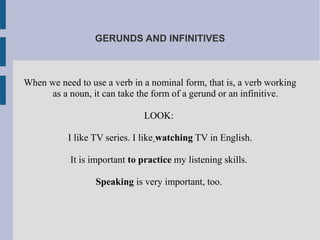
When we need to use a verb in a nominal form, that is, a verb working
as a noun, it can take the form of a gerund or an infinitive.
LOOK:
I like TV series. I like watching TV in English.
It is important to practice my listening skills.
Speaking is very important, too.
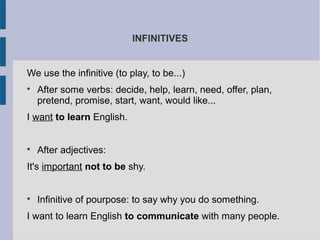
INFINITIVES
We use the infinitive (to play, to be...)

After some verbs: decide, help, learn, need, offer, plan,
pretend, promise, start, want, would like...
I want to learn English.

After adjectives:
It's important not to be shy.

Infinitive of pourpose: to say why you do something.
I want to learn English to communicate with many people.
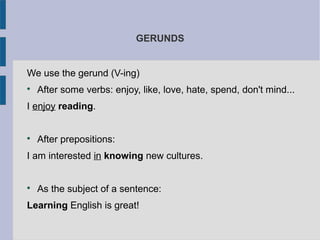
GERUNDS
We use the gerund (V-ing)

After some verbs: enjoy, like, love, hate, spend, don't mind...
I enjoy reading.

After prepositions:
I am interested in knowing new cultures.

As the subject of a sentence:
Learning English is great!
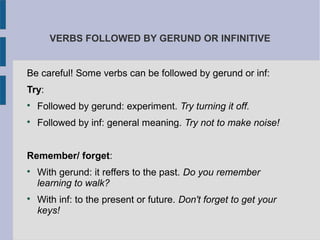
VERBS FOLLOWED BY GERUND OR INFINITIVE
Be careful! Some verbs can be followed by gerund or inf:
Try:

Followed by gerund: experiment. Try turning it off.

Followed by inf: general meaning. Try not to make noise!
Remember/ forget:

With gerund: it reffers to the past. Do you remember
learning to walk?

With inf: to the present or future. Don't forget to get your
keys!
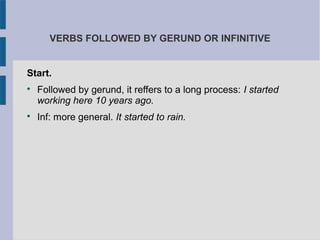
VERBS FOLLOWED BY GERUND OR INFINITIVE
Start.

Followed by gerund, it reffers to a long process: I started
working here 10 years ago.

Inf: more general. It started to rain.
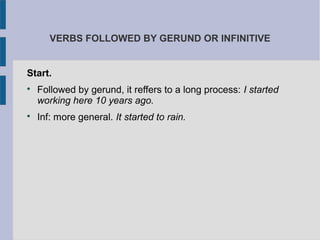
VERBS FOLLOWED BY GERUND OR INFINITIVE
Start.

Followed by gerund, it reffers to a long process: I started
working here 10 years ago.

Inf: more general. It started to rain.

Gerunds and infinitives-pre intermediate

  • 1.
    GERUNDS AND INFINITIVES Whenwe need to use a verb in a nominal form, that is, a verb working as a noun, it can take the form of a gerund or an infinitive. LOOK: I like TV series. I like watching TV in English. It is important to practice my listening skills. Speaking is very important, too.
  • 2.
    INFINITIVES We use theinfinitive (to play, to be...)  After some verbs: decide, help, learn, need, offer, plan, pretend, promise, start, want, would like... I want to learn English.  After adjectives: It's important not to be shy.  Infinitive of pourpose: to say why you do something. I want to learn English to communicate with many people.
  • 3.
    GERUNDS We use thegerund (V-ing)  After some verbs: enjoy, like, love, hate, spend, don't mind... I enjoy reading.  After prepositions: I am interested in knowing new cultures.  As the subject of a sentence: Learning English is great!
  • 4.
    VERBS FOLLOWED BYGERUND OR INFINITIVE Be careful! Some verbs can be followed by gerund or inf: Try:  Followed by gerund: experiment. Try turning it off.  Followed by inf: general meaning. Try not to make noise! Remember/ forget:  With gerund: it reffers to the past. Do you remember learning to walk?  With inf: to the present or future. Don't forget to get your keys!
  • 5.
    VERBS FOLLOWED BYGERUND OR INFINITIVE Start.  Followed by gerund, it reffers to a long process: I started working here 10 years ago.  Inf: more general. It started to rain.
  • 6.
    VERBS FOLLOWED BYGERUND OR INFINITIVE Start.  Followed by gerund, it reffers to a long process: I started working here 10 years ago.  Inf: more general. It started to rain.