INVERSION
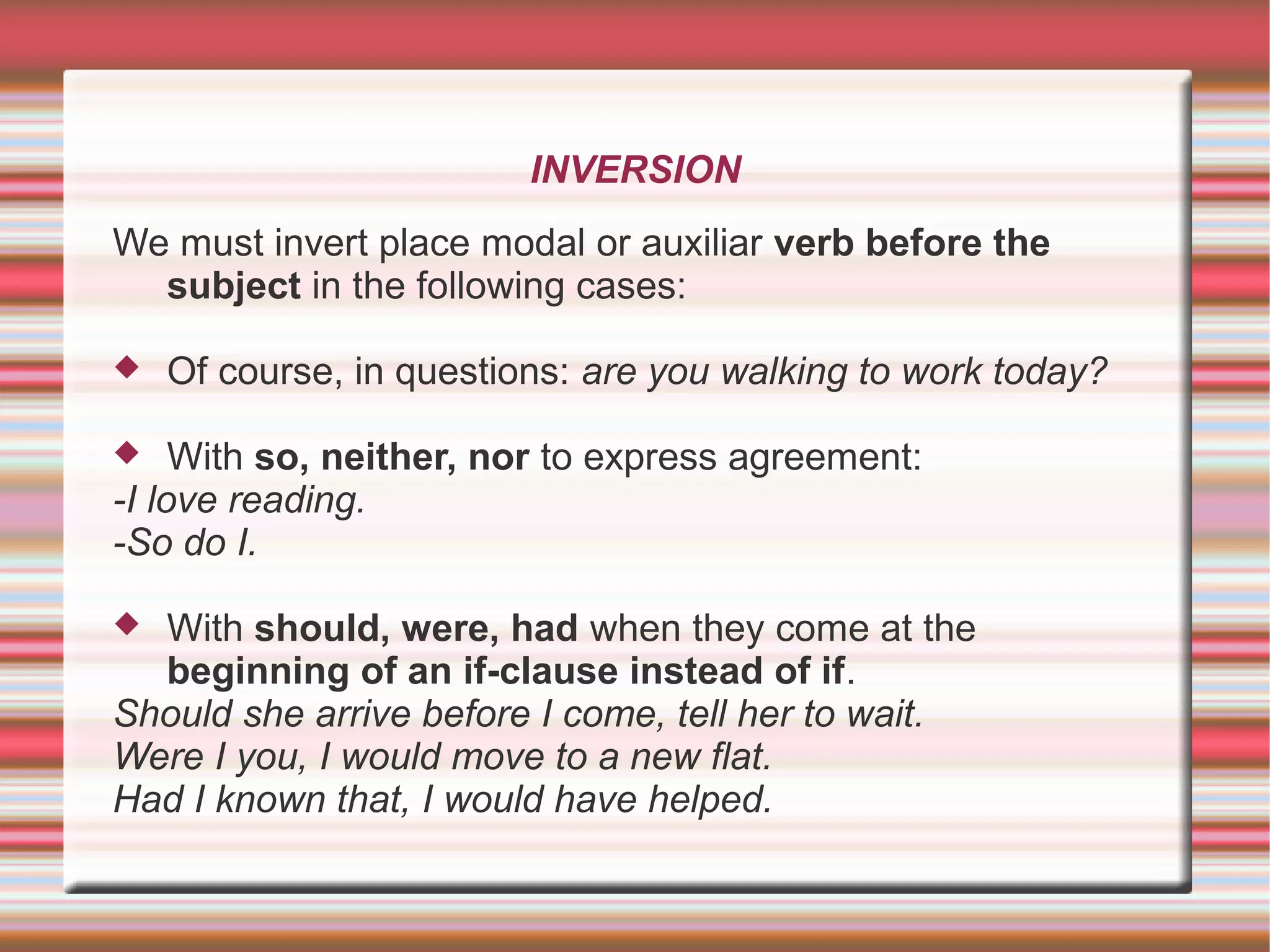
We must invert place modal or auxiliar verb before the
subject in the following cases:
 Of course, in questions: are you walking to work today?
 With so, neither, nor to express agreement:
-I love reading.
-So do I.
 With should, were, had when they come at the
beginning of an if-clause instead of if.
Should she arrive before I come, tell her to wait.
Were I you, I would move to a new flat.
Had I known that, I would have helped.
INVERSION
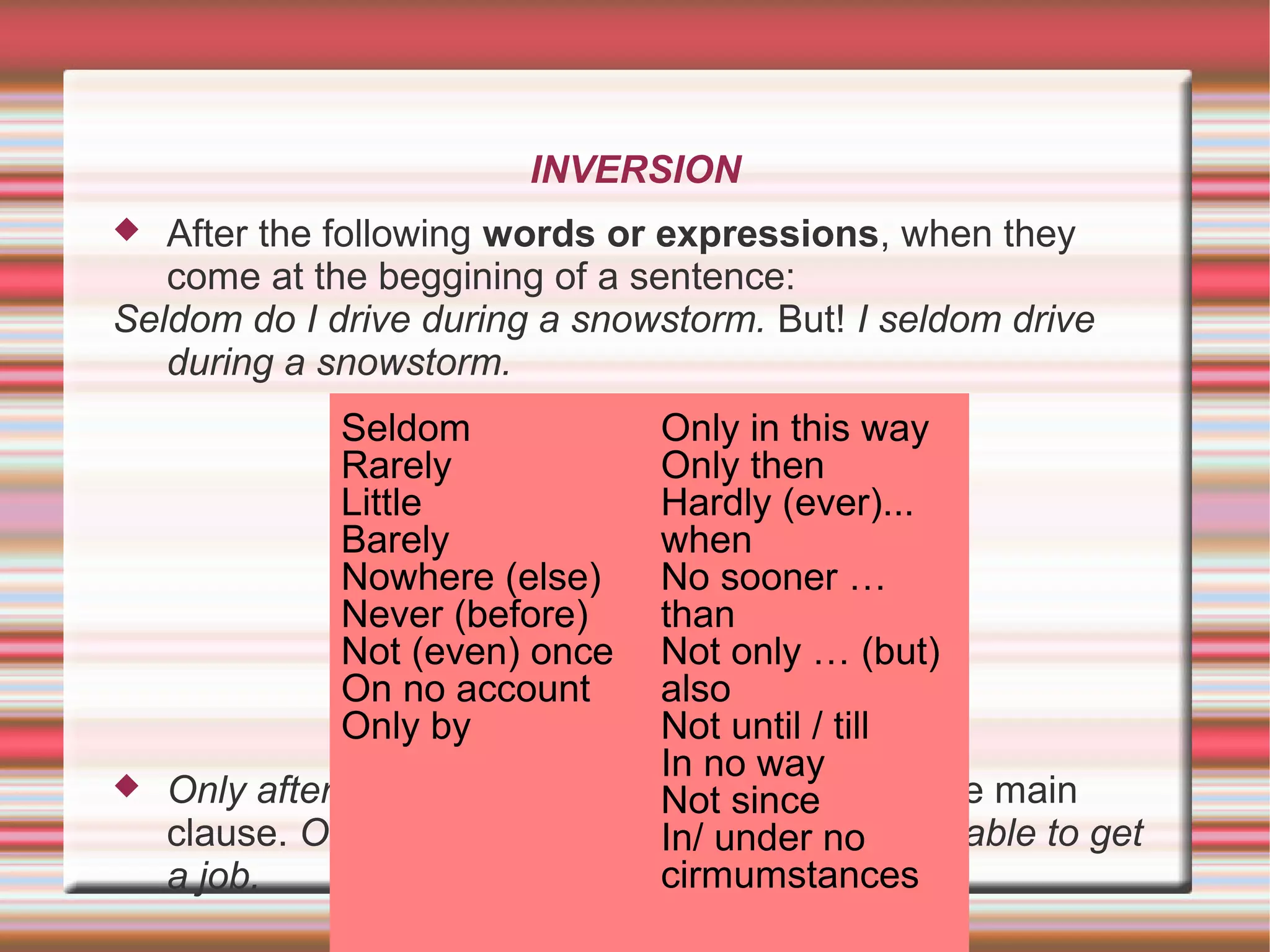
 After the following words or expressions, when they
come at the beggining of a sentence:
Seldom do I drive during a snowstorm. But! I seldom drive
during a snowstorm.
 Only after/ by/ if/ when, not until: inversion in the main
clause. Only after he updated his skills was he able to get
a job.
Seldom
Rarely
Little
Barely
Nowhere (else)
Never (before)
Not (even) once
On no account
Only by
Only in this way
Only then
Hardly (ever)...
when
No sooner …
than
Not only … (but)
also
Not until / till
In no way
Not since
In/ under no
cirmumstances
INVERSION
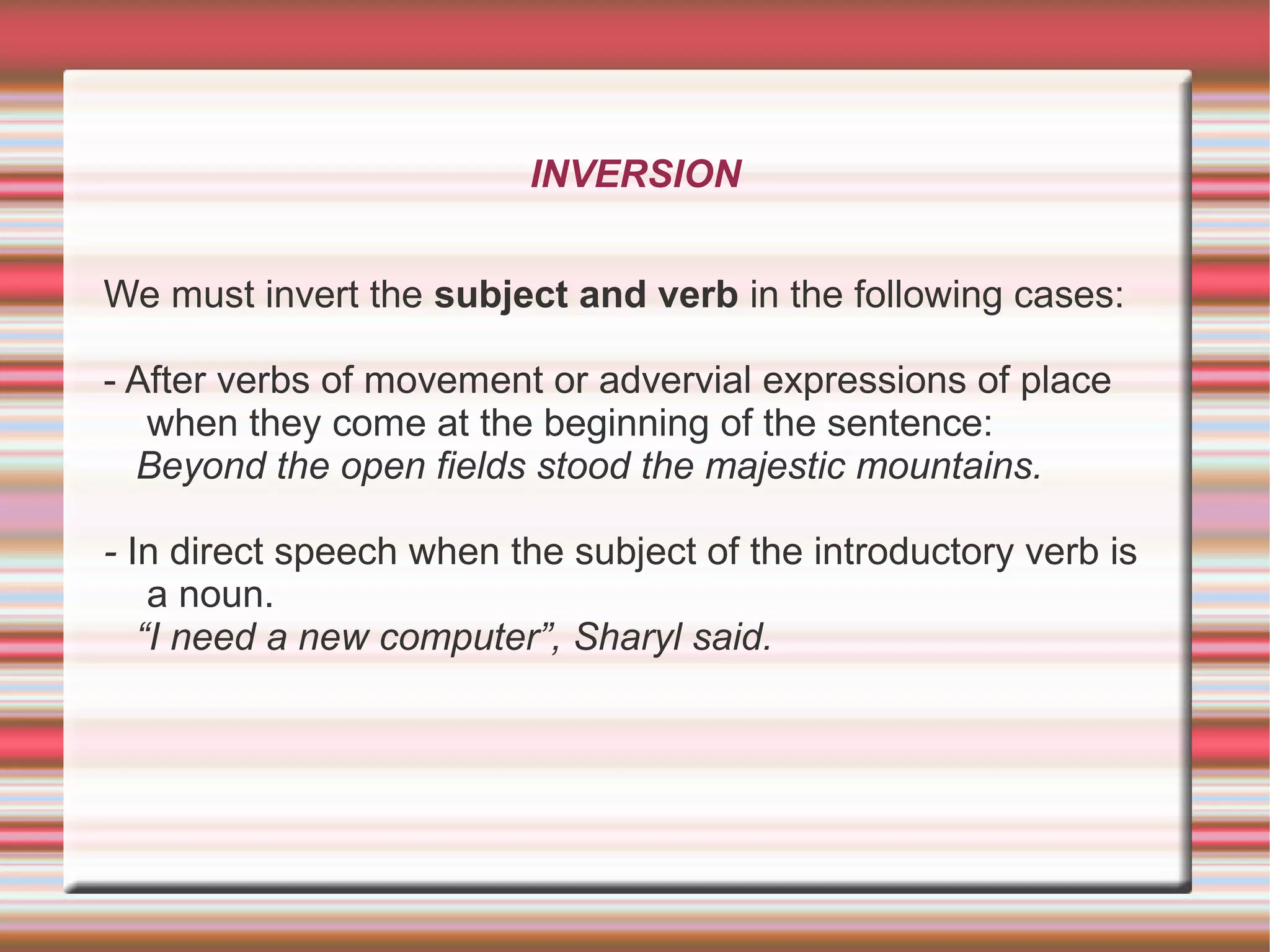
We must invert the subject and verb in the following cases:
- After verbs of movement or advervial expressions of place
when they come at the beginning of the sentence:
Beyond the open fields stood the majestic mountains.
- In direct speech when the subject of the introductory verb is
a noun.
“I need a new computer”, Sharyl said.

Inversion

  • 1.
    INVERSION We must invertplace modal or auxiliar verb before the subject in the following cases:  Of course, in questions: are you walking to work today?  With so, neither, nor to express agreement: -I love reading. -So do I.  With should, were, had when they come at the beginning of an if-clause instead of if. Should she arrive before I come, tell her to wait. Were I you, I would move to a new flat. Had I known that, I would have helped.
  • 2.
    INVERSION  After thefollowing words or expressions, when they come at the beggining of a sentence: Seldom do I drive during a snowstorm. But! I seldom drive during a snowstorm.  Only after/ by/ if/ when, not until: inversion in the main clause. Only after he updated his skills was he able to get a job. Seldom Rarely Little Barely Nowhere (else) Never (before) Not (even) once On no account Only by Only in this way Only then Hardly (ever)... when No sooner … than Not only … (but) also Not until / till In no way Not since In/ under no cirmumstances
  • 3.
    INVERSION We must invertthe subject and verb in the following cases: - After verbs of movement or advervial expressions of place when they come at the beginning of the sentence: Beyond the open fields stood the majestic mountains. - In direct speech when the subject of the introductory verb is a noun. “I need a new computer”, Sharyl said.