Present simple and continuous Again!
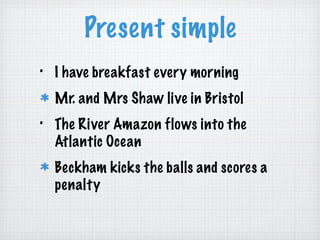
Present simple I have breakfast every morning Mr. and Mrs Shaw live in Bristol The River Amazon flows into the Atlantic Ocean Beckham kicks the balls and scores a penalty
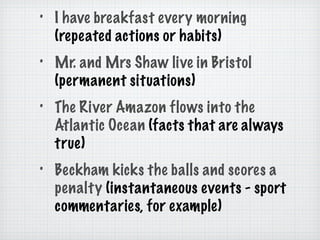
I have breakfast every morning  (repeated actions or habits) Mr. and Mrs Shaw live in Bristol  (permanent situations) The River Amazon flows into the Atlantic Ocean  (facts that are always true) Beckham kicks the balls and scores a penalty  (instantaneous events - sport commentaries, for example)
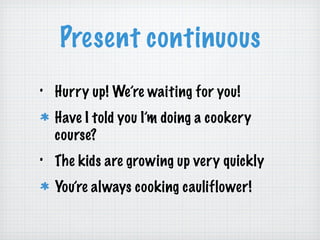
Present continuous Hurry up! We’re waiting for you! Have I told you I’m doing a cookery course? The kids are growing up very quickly You’re always cooking cauliflower!
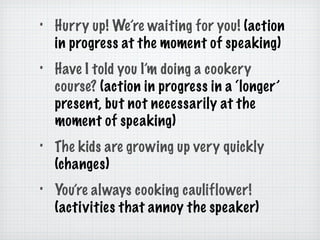
Hurry up! We’re waiting for you!  (action in progress at the moment of speaking) Have I told you I’m doing a cookery course?  (action in progress in a ‘longer’ present, but not necessarily at the moment of speaking) The kids are growing up very quickly  (changes) You’re always cooking cauliflower!  (activities that annoy the speaker)
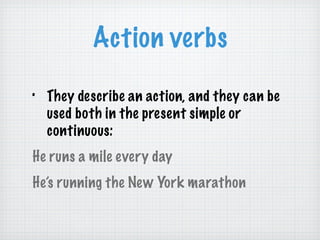
Action verbs They describe an action, and they can be used both in the present simple or continuous: He runs a mile every day He’s running the New York marathon
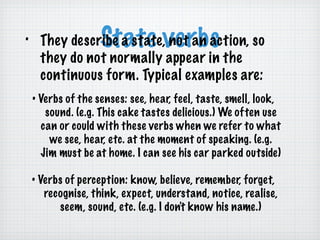
State verbs They describe a state, not an action, so they do not normally appear in the continuous form. Typical examples are: •  Verbs of the senses: see, hear, feel, taste, smell, look, sound. (e.g. This cake tastes delicious.) We often use can or could with these verbs when we refer to what we see, hear, etc. at the moment of speaking. (e.g. Jim must be at home. I can see his car parked outside) •  Verbs of perception: know, believe, remember, forget, recognise, think, expect, understand, notice, realise, seem, sound, etc. (e.g. I don't know his name.)
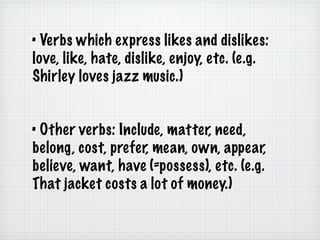
•  Verbs which express likes and dislikes: love, like, hate, dislike, enjoy, etc. (e.g. Shirley loves jazz music.) •  Other verbs: Include, matter, need, belong, cost, prefer, mean, own, appear, believe, want, have (=possess), etc. (e.g. That jacket costs a lot of money.)
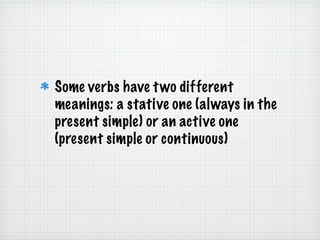
Some verbs have two different meanings: a stative one (always in the present simple) or an active one (present simple or continuous)
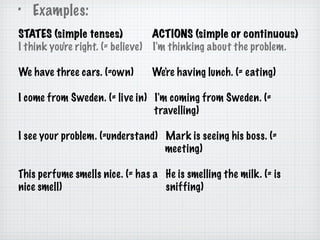
Examples: STATES (simple tenses)  ACTIONS (simple or continuous) I think you're right. (= believe)  I'm thinking about the problem. We have three cars. (=own)  We're having lunch. (= eating)  I come from Sweden. (= live in)  I'm coming from Sweden. (=  travelling)  I see your problem. (=understand)  Mark is seeing his boss. (=  meeting)  This perfume smells nice. (= has a  He is smelling the milk. (= is nice smell)  sniffing)
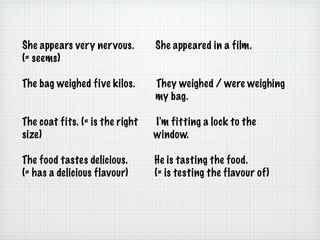
She appears very nervous.  She appeared in a film. (= seems)  The bag weighed five kilos.  They weighed / were weighing  my bag. The coat fits. (= is the right  I'm fitting a lock to the  size)  window. The food tastes delicious.  He is tasting the food. (= has a delicious flavour)  (= is testing the flavour of)

State Action Verbs

  • 1.
    Present simple andcontinuous Again!
  • 2.
    Present simple Ihave breakfast every morning Mr. and Mrs Shaw live in Bristol The River Amazon flows into the Atlantic Ocean Beckham kicks the balls and scores a penalty
  • 3.
    I have breakfastevery morning (repeated actions or habits) Mr. and Mrs Shaw live in Bristol (permanent situations) The River Amazon flows into the Atlantic Ocean (facts that are always true) Beckham kicks the balls and scores a penalty (instantaneous events - sport commentaries, for example)
  • 4.
    Present continuous Hurryup! We’re waiting for you! Have I told you I’m doing a cookery course? The kids are growing up very quickly You’re always cooking cauliflower!
  • 5.
    Hurry up! We’rewaiting for you! (action in progress at the moment of speaking) Have I told you I’m doing a cookery course? (action in progress in a ‘longer’ present, but not necessarily at the moment of speaking) The kids are growing up very quickly (changes) You’re always cooking cauliflower! (activities that annoy the speaker)
  • 6.
    Action verbs Theydescribe an action, and they can be used both in the present simple or continuous: He runs a mile every day He’s running the New York marathon
  • 7.
    State verbs Theydescribe a state, not an action, so they do not normally appear in the continuous form. Typical examples are: • Verbs of the senses: see, hear, feel, taste, smell, look, sound. (e.g. This cake tastes delicious.) We often use can or could with these verbs when we refer to what we see, hear, etc. at the moment of speaking. (e.g. Jim must be at home. I can see his car parked outside) • Verbs of perception: know, believe, remember, forget, recognise, think, expect, understand, notice, realise, seem, sound, etc. (e.g. I don't know his name.)
  • 8.
    • Verbswhich express likes and dislikes: love, like, hate, dislike, enjoy, etc. (e.g. Shirley loves jazz music.) • Other verbs: Include, matter, need, belong, cost, prefer, mean, own, appear, believe, want, have (=possess), etc. (e.g. That jacket costs a lot of money.)
  • 9.
    Some verbs havetwo different meanings: a stative one (always in the present simple) or an active one (present simple or continuous)
  • 10.
    Examples: STATES (simpletenses) ACTIONS (simple or continuous) I think you're right. (= believe) I'm thinking about the problem. We have three cars. (=own) We're having lunch. (= eating) I come from Sweden. (= live in) I'm coming from Sweden. (= travelling) I see your problem. (=understand) Mark is seeing his boss. (= meeting) This perfume smells nice. (= has a He is smelling the milk. (= is nice smell) sniffing)
  • 11.
    She appears verynervous. She appeared in a film. (= seems) The bag weighed five kilos. They weighed / were weighing my bag. The coat fits. (= is the right I'm fitting a lock to the size) window. The food tastes delicious. He is tasting the food. (= has a delicious flavour) (= is testing the flavour of)