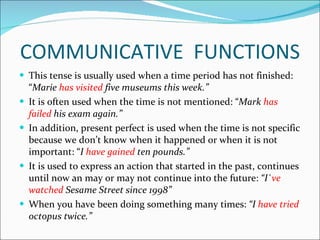
COMMUNICATIVE  FUNCTIONS This tense is usually used when a time period has not finished:  “ Marie  has visited  five museums this week.” It is often used when the time is not mentioned: “ Mark  has failed  his exam again.” In addition, present perfect is used when the time is not specific because we don’t know when it happened or when it is not important: “ I  have gained  ten pounds.” It is used to express an action that started in the past, continues until now an may or may not continue into the future:  “I` ve watched  Sesame Street since 1998” When you have been doing something many times:  “I  have tried  octopus twice.”
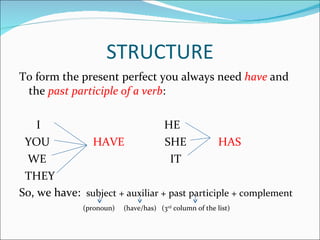
STRUCTURE To form the present perfect you always need  have  and the  past participle of a verb : I  HE YOU  HAVE  SHE  HAS WE  IT THEY So, we have:  subject + auxiliar + past participle + complement (pronoun)  (have/has)  (3 rd  column of the list)
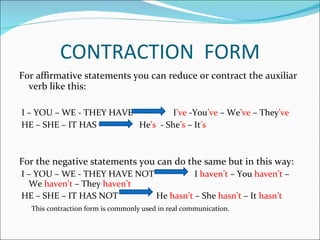
CONTRACTION  FORM For affirmative statements you can reduce or contract the auxiliar verb like this: I – YOU – WE - THEY HAVE  I ’ve  -You ’ve  – We ’ve  – They ’ve HE – SHE – IT HAS  He ’s   - She ’s  – It ’s For the negative statements you can do the same but in this way: I – YOU – WE - THEY HAVE NOT  I  haven’t  – You  haven’t  – We  haven’t  – They  haven’t  HE – SHE – IT HAS NOT  He  hasn’t  – She  hasn’t  – It  hasn’t This contraction form is commonly used in real communication.
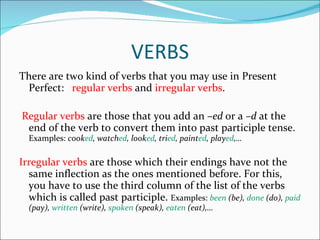
VERBS There are two kind of verbs that you may use in Present Perfect:  regular verbs  and  irregular verbs . Regular verbs  are those that you add an – ed  or a  –d  at the end of the verb to convert them into past participle tense.  Examples:  cook ed , watch ed , look ed , tri ed , paint ed , play ed ,… Irregular verbs  are those which their endings have not the same inflection as the ones mentioned before. For this, you have to use the third column of the list of the verbs which is called past participle.  Examples:  been  (be),  done  (do),  paid  (pay),  written  (write),  spoken  (speak),  eaten  (eat),…
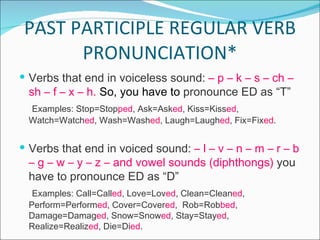
PAST PARTICIPLE REGULAR VERB PRONUNCIATION* Verbs that end in voiceless sound:  – p – k – s – ch – sh – f – x – h.   So, you have to  pronounce ED as “T” Examples: Stop=Stop ped , Ask=Ask ed , Kiss=Kiss ed , Watch=Watch ed , Wash=Wash ed , Laugh=Laugh ed , Fix=Fix ed .  Verbs that end in voiced sound:  – l – v – n – m – r – b – g – w – y – z – and vowel sounds (diphthongs)  you have to pronounce ED as “D” Examples: Call=Call ed , Love=Lov ed , Clean=Clean ed , Perform=Perform ed , Cover=Cover ed ,  Rob=Rob bed , Damage=Damag ed , Snow=Snow ed , Stay=Stay ed , Realize=Realiz ed , Die=Di ed .
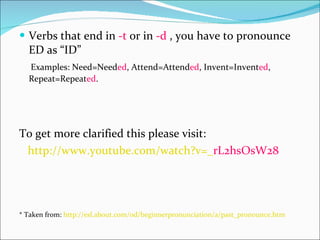
Verbs that end in  -t  or in  -d  , you have to pronounce ED as “ID” Examples: Need=Need ed , Attend=Attend ed , Invent=Invent ed , Repeat=Repeat ed . To get more clarified this please visit:  http :// www.youtube.com / watch?v =_ rL2hsOsW28   * Taken from:  http :// esl.about.com / od / beginnerpronunciation /a/ past_pronounce.htm
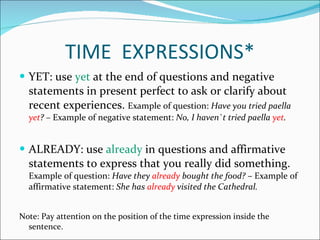
TIME  EXPRESSIONS* YET: use  yet  at the end of questions and negative statements in present perfect to ask or clarify about recent experiences.  Example of question:  Have you tried paella  yet ? –  Example of negative statement:  No, I haven`t tried paella  yet .  ALREADY: use  already  in questions and affirmative statements to express that you really did something.  Example of question:  Have they  already  bought the food?  – Example of affirmative statement:  She has  already  visited the Cathedral. Note: Pay attention on the position of the time expression inside the sentence.
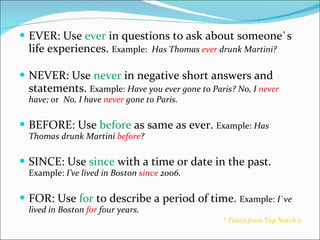
EVER: Use  ever  in questions to ask about someone`s life experiences.  Example:  Has Thomas  ever  drunk Martini? NEVER: Use  never  in negative short answers and statements.  Example:  Have you ever gone to Paris? No, I  never  have;  or  No, I have  never  gone to Paris. BEFORE: Use  before  as same as ever.  Example:  Has Thomas drunk Martini  before ? SINCE: Use  since  with a time or date in the past.  Example:  I’ve lived in Boston  since  2006. FOR: Use  for  to describe a period of time.  Example:  I`ve lived in Boston  for  four years. * Taken from Top Notch 2
EXERCISES Please visit the following webpages to practice Present Perfect Tense: http :// www.ego4u . com /en/ cram -up/ tests / present - perfect -simple-1   http :// www.ego4u . com /en/ cram -up/ tests / present - perfect -simple-2

Present perfect

  • 1.
  • 2.
    COMMUNICATIVE FUNCTIONSThis tense is usually used when a time period has not finished: “ Marie has visited five museums this week.” It is often used when the time is not mentioned: “ Mark has failed his exam again.” In addition, present perfect is used when the time is not specific because we don’t know when it happened or when it is not important: “ I have gained ten pounds.” It is used to express an action that started in the past, continues until now an may or may not continue into the future: “I` ve watched Sesame Street since 1998” When you have been doing something many times: “I have tried octopus twice.”
  • 3.
    STRUCTURE To formthe present perfect you always need have and the past participle of a verb : I HE YOU HAVE SHE HAS WE IT THEY So, we have: subject + auxiliar + past participle + complement (pronoun) (have/has) (3 rd column of the list)
  • 4.
    CONTRACTION FORMFor affirmative statements you can reduce or contract the auxiliar verb like this: I – YOU – WE - THEY HAVE I ’ve -You ’ve – We ’ve – They ’ve HE – SHE – IT HAS He ’s - She ’s – It ’s For the negative statements you can do the same but in this way: I – YOU – WE - THEY HAVE NOT I haven’t – You haven’t – We haven’t – They haven’t HE – SHE – IT HAS NOT He hasn’t – She hasn’t – It hasn’t This contraction form is commonly used in real communication.
  • 5.
    VERBS There aretwo kind of verbs that you may use in Present Perfect: regular verbs and irregular verbs . Regular verbs are those that you add an – ed or a –d at the end of the verb to convert them into past participle tense. Examples: cook ed , watch ed , look ed , tri ed , paint ed , play ed ,… Irregular verbs are those which their endings have not the same inflection as the ones mentioned before. For this, you have to use the third column of the list of the verbs which is called past participle. Examples: been (be), done (do), paid (pay), written (write), spoken (speak), eaten (eat),…
  • 6.
    PAST PARTICIPLE REGULARVERB PRONUNCIATION* Verbs that end in voiceless sound: – p – k – s – ch – sh – f – x – h. So, you have to pronounce ED as “T” Examples: Stop=Stop ped , Ask=Ask ed , Kiss=Kiss ed , Watch=Watch ed , Wash=Wash ed , Laugh=Laugh ed , Fix=Fix ed . Verbs that end in voiced sound: – l – v – n – m – r – b – g – w – y – z – and vowel sounds (diphthongs) you have to pronounce ED as “D” Examples: Call=Call ed , Love=Lov ed , Clean=Clean ed , Perform=Perform ed , Cover=Cover ed , Rob=Rob bed , Damage=Damag ed , Snow=Snow ed , Stay=Stay ed , Realize=Realiz ed , Die=Di ed .
  • 7.
    Verbs that endin -t or in -d , you have to pronounce ED as “ID” Examples: Need=Need ed , Attend=Attend ed , Invent=Invent ed , Repeat=Repeat ed . To get more clarified this please visit: http :// www.youtube.com / watch?v =_ rL2hsOsW28 * Taken from: http :// esl.about.com / od / beginnerpronunciation /a/ past_pronounce.htm
  • 8.
    TIME EXPRESSIONS*YET: use yet at the end of questions and negative statements in present perfect to ask or clarify about recent experiences. Example of question: Have you tried paella yet ? – Example of negative statement: No, I haven`t tried paella yet . ALREADY: use already in questions and affirmative statements to express that you really did something. Example of question: Have they already bought the food? – Example of affirmative statement: She has already visited the Cathedral. Note: Pay attention on the position of the time expression inside the sentence.
  • 9.
    EVER: Use ever in questions to ask about someone`s life experiences. Example: Has Thomas ever drunk Martini? NEVER: Use never in negative short answers and statements. Example: Have you ever gone to Paris? No, I never have; or No, I have never gone to Paris. BEFORE: Use before as same as ever. Example: Has Thomas drunk Martini before ? SINCE: Use since with a time or date in the past. Example: I’ve lived in Boston since 2006. FOR: Use for to describe a period of time. Example: I`ve lived in Boston for four years. * Taken from Top Notch 2
  • 10.
    EXERCISES Please visitthe following webpages to practice Present Perfect Tense: http :// www.ego4u . com /en/ cram -up/ tests / present - perfect -simple-1 http :// www.ego4u . com /en/ cram -up/ tests / present - perfect -simple-2