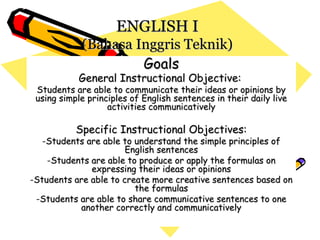
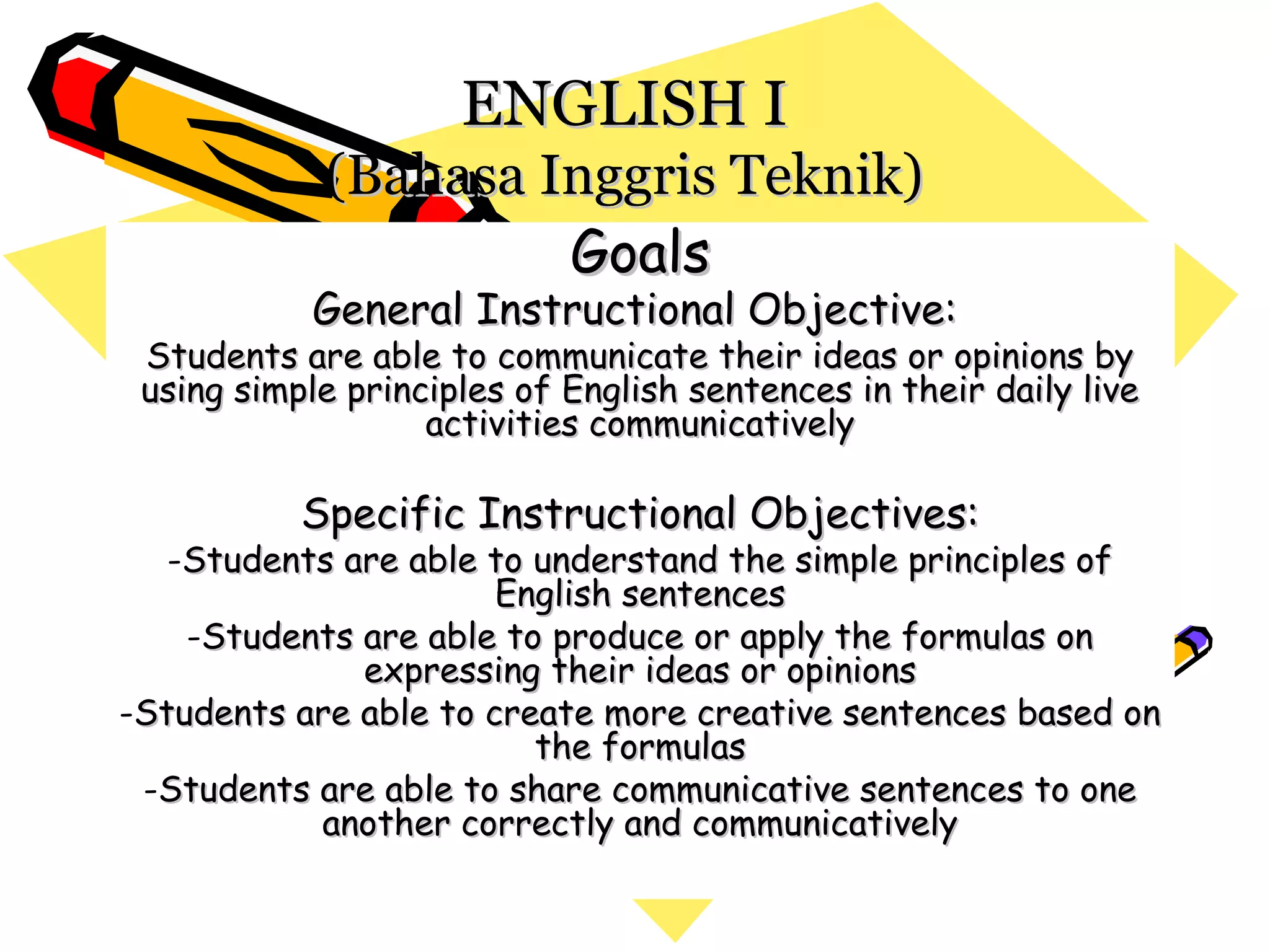
ENGLISH I
            (Bahasa Inggris Teknik)
                     Goals
           General Instructional Objective:
 Students are able to communicate their ideas or opinions by
 using simple principles of English sentences in their daily live
                   activities communicatively

           Specific Instructional Objectives:
   -Students are able to understand the simple principles of
                       English sentences
    -Students are able to produce or apply the formulas on
              expressing their ideas or opinions
-Students are able to create more creative sentences based on
                         the formulas
 -Students are able to share communicative sentences to one
           another correctly and communicatively
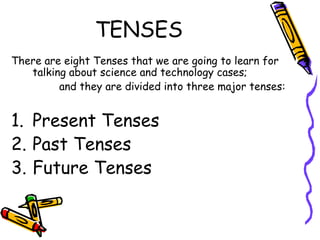
TENSES
There are eight Tenses that we are going to learn for
   talking about science and technology cases;
         and they are divided into three major tenses:


1. Present Tenses
2. Past Tenses
3. Future Tenses
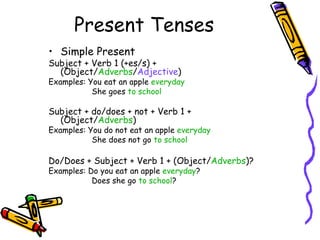
Present Tenses
• Simple Present
Subject + Verb 1 (+es/s) +
  (Object/Adverbs/Adjective)
Examples: You eat an apple everyday
           She goes to school

Subject + do/does + not + Verb 1 +
  (Object/Adverbs)
Examples: You do not eat an apple everyday
           She does not go to school

Do/Does + Subject + Verb 1 + (Object/Adverbs)?
Examples: Do you eat an apple everyday?
           Does she go to school?
Present Tenses
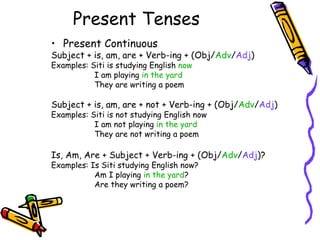
• Present Continuous
Subject + is, am, are + Verb-ing + (Obj/Adv/Adj)
Examples: Siti is studying English now
           I am playing in the yard
           They are writing a poem

Subject + is, am, are + not + Verb-ing + (Obj/Adv/Adj)
Examples: Siti is not studying English now
           I am not playing in the yard
           They are not writing a poem

Is, Am, Are + Subject + Verb-ing + (Obj/Adv/Adj)?
Examples: Is Siti studying English now?
           Am I playing in the yard?
           Are they writing a poem?
Present Tenses
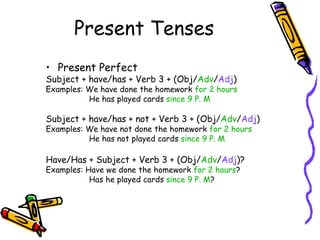
• Present Perfect
Subject + have/has + Verb 3 + (Obj/Adv/Adj)
Examples: We have done the homework for 2 hours
          He has played cards since 9 P. M

Subject + have/has + not + Verb 3 + (Obj/Adv/Adj)
Examples: We have not done the homework for 2 hours
          He has not played cards since 9 P. M

Have/Has + Subject + Verb 3 + (Obj/Adv/Adj)?
Examples: Have we done the homework for 2 hours?
           Has he played cards since 9 P. M?
Usage
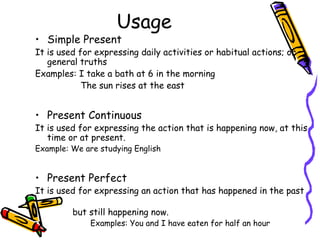
• Simple Present
It is used for expressing daily activities or habitual actions; or
   general truths
Examples: I take a bath at 6 in the morning
            The sun rises at the east


• Present Continuous
It is used for expressing the action that is happening now, at this
   time or at present.
Example: We are studying English


• Present Perfect
It is used for expressing an action that has happened in the past

         but still happening now.
              Examples: You and I have eaten for half an hour
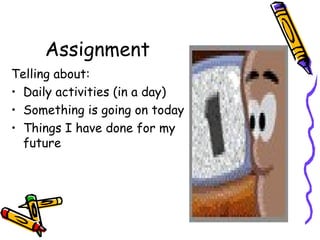
Assignment
Telling about:
• Daily activities (in a day)
• Something is going on today
• Things I have done for my
  future
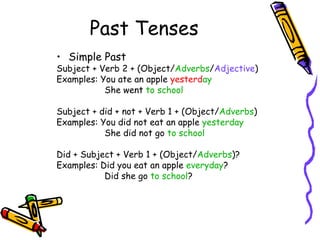
Past Tenses
• Simple Past
Subject + Verb 2 + (Object/Adverbs/Adjective)
Examples: You ate an apple yesterday
           She went to school

Subject + did + not + Verb 1 + (Object/Adverbs)
Examples: You did not eat an apple yesterday
           She did not go to school

Did + Subject + Verb 1 + (Object/Adverbs)?
Examples: Did you eat an apple everyday?
           Did she go to school?
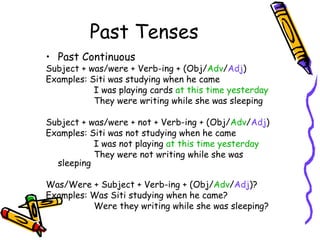
Past Tenses
• Past Continuous
Subject + was/were + Verb-ing + (Obj/Adv/Adj)
Examples: Siti was studying when he came
           I was playing cards at this time yesterday
           They were writing while she was sleeping

Subject + was/were + not + Verb-ing + (Obj/Adv/Adj)
Examples: Siti was not studying when he came
           I was not playing at this time yesterday
           They were not writing while she was
  sleeping

Was/Were + Subject + Verb-ing + (Obj/Adv/Adj)?
Examples: Was Siti studying when he came?
          Were they writing while she was sleeping?
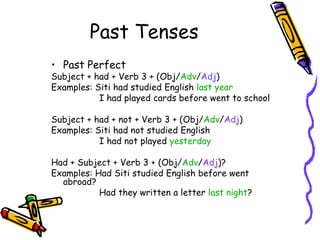
Past Tenses
• Past Perfect
Subject + had + Verb 3 + (Obj/Adv/Adj)
Examples: Siti had studied English last year
           I had played cards before went to school

Subject + had + not + Verb 3 + (Obj/Adv/Adj)
Examples: Siti had not studied English
           I had not played yesterday

Had + Subject + Verb 3 + (Obj/Adv/Adj)?
Examples: Had Siti studied English before went
  abroad?
           Had they written a letter last night?
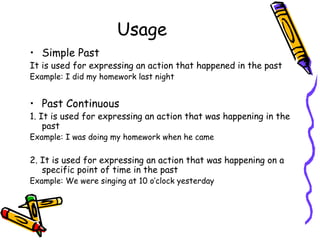
Usage
• Simple Past
It is used for expressing an action that happened in the past
Example: I did my homework last night


• Past Continuous
1. It is used for expressing an action that was happening in the
    past
Example: I was doing my homework when he came

2. It is used for expressing an action that was happening on a
   specific point of time in the past
Example: We were singing at 10 o’clock yesterday
Usage
• Past Continuous
3. It is used for expressing two actions that were happening at the
   same time in the past
Example: He was reading while she was sleeping


• Past Perfect
It is used for expressing an action that had happened and
   completely done in the past
Example: I had done my homework last night
Assignment
Writing about:
• Past time experiences
• My sweetest memory
• My nightmare
Future Tenses
 • Simple Future
 Subject + will/shall + Verb 1 + (Obj/Adv/Adj)
 Examples: They will go to the market tomorrow
            She shall go to the doctor next week


 • Future of Intention
 Subject + to be + going to + Verb 1 + (Obj/Adv/Adj)
 Examples: We are going to do our homework tonight
           John is going to fix the radio later
Usage
• Simple Future
It is used for expressing an action that will happen in the future, but
   it is not really going to be happened according to the meaning of:

Dina has lots of money. She will buy a new house. She will buy some new
   clothes. She will buy a new car. She will go to Bali, etc.
I will fly to Australia two months later


Sapto has a very bad stomached. His friend says that he shall go to the
   doctor, or he shall take some medicines


Will shows: telling plan and something that has been scheduled.
            Shall shows: giving advice or suggestion.
Usage
• Future of Intention
It is used for showing our intention on
  doing something, or
Example: What ever will be,
         I am going to do my homework tonight.

Showing certainty of something that is
  going to be happened and no one can
  prevent it.
Examples: He is going to sneeze
          Those cars are going to crash!
Assignment
• Make a group of three members

• Each member should give a problem,
  and they should give a kind of
  suggestion to solve the problem; or

• Each member should express his/her
  plan on doing some things,

• Finally, they will retell what the
  member will/shall do to each other.
References
• Basic Grammar
• Grammar and Composition
• Grammar in Action

grammar ppt

  • 1.
    ENGLISH I (Bahasa Inggris Teknik) Goals General Instructional Objective: Students are able to communicate their ideas or opinions by using simple principles of English sentences in their daily live activities communicatively Specific Instructional Objectives: -Students are able to understand the simple principles of English sentences -Students are able to produce or apply the formulas on expressing their ideas or opinions -Students are able to create more creative sentences based on the formulas -Students are able to share communicative sentences to one another correctly and communicatively
  • 2.
    TENSES There are eightTenses that we are going to learn for talking about science and technology cases; and they are divided into three major tenses: 1. Present Tenses 2. Past Tenses 3. Future Tenses
  • 3.
    Present Tenses • SimplePresent Subject + Verb 1 (+es/s) + (Object/Adverbs/Adjective) Examples: You eat an apple everyday She goes to school Subject + do/does + not + Verb 1 + (Object/Adverbs) Examples: You do not eat an apple everyday She does not go to school Do/Does + Subject + Verb 1 + (Object/Adverbs)? Examples: Do you eat an apple everyday? Does she go to school?
  • 4.
    Present Tenses • PresentContinuous Subject + is, am, are + Verb-ing + (Obj/Adv/Adj) Examples: Siti is studying English now I am playing in the yard They are writing a poem Subject + is, am, are + not + Verb-ing + (Obj/Adv/Adj) Examples: Siti is not studying English now I am not playing in the yard They are not writing a poem Is, Am, Are + Subject + Verb-ing + (Obj/Adv/Adj)? Examples: Is Siti studying English now? Am I playing in the yard? Are they writing a poem?
  • 5.
    Present Tenses • PresentPerfect Subject + have/has + Verb 3 + (Obj/Adv/Adj) Examples: We have done the homework for 2 hours He has played cards since 9 P. M Subject + have/has + not + Verb 3 + (Obj/Adv/Adj) Examples: We have not done the homework for 2 hours He has not played cards since 9 P. M Have/Has + Subject + Verb 3 + (Obj/Adv/Adj)? Examples: Have we done the homework for 2 hours? Has he played cards since 9 P. M?
  • 6.
    Usage • Simple Present Itis used for expressing daily activities or habitual actions; or general truths Examples: I take a bath at 6 in the morning The sun rises at the east • Present Continuous It is used for expressing the action that is happening now, at this time or at present. Example: We are studying English • Present Perfect It is used for expressing an action that has happened in the past but still happening now. Examples: You and I have eaten for half an hour
  • 7.
    Assignment Telling about: • Dailyactivities (in a day) • Something is going on today • Things I have done for my future
  • 8.
    Past Tenses • SimplePast Subject + Verb 2 + (Object/Adverbs/Adjective) Examples: You ate an apple yesterday She went to school Subject + did + not + Verb 1 + (Object/Adverbs) Examples: You did not eat an apple yesterday She did not go to school Did + Subject + Verb 1 + (Object/Adverbs)? Examples: Did you eat an apple everyday? Did she go to school?
  • 9.
    Past Tenses • PastContinuous Subject + was/were + Verb-ing + (Obj/Adv/Adj) Examples: Siti was studying when he came I was playing cards at this time yesterday They were writing while she was sleeping Subject + was/were + not + Verb-ing + (Obj/Adv/Adj) Examples: Siti was not studying when he came I was not playing at this time yesterday They were not writing while she was sleeping Was/Were + Subject + Verb-ing + (Obj/Adv/Adj)? Examples: Was Siti studying when he came? Were they writing while she was sleeping?
  • 10.
    Past Tenses • PastPerfect Subject + had + Verb 3 + (Obj/Adv/Adj) Examples: Siti had studied English last year I had played cards before went to school Subject + had + not + Verb 3 + (Obj/Adv/Adj) Examples: Siti had not studied English I had not played yesterday Had + Subject + Verb 3 + (Obj/Adv/Adj)? Examples: Had Siti studied English before went abroad? Had they written a letter last night?
  • 11.
    Usage • Simple Past Itis used for expressing an action that happened in the past Example: I did my homework last night • Past Continuous 1. It is used for expressing an action that was happening in the past Example: I was doing my homework when he came 2. It is used for expressing an action that was happening on a specific point of time in the past Example: We were singing at 10 o’clock yesterday
  • 12.
    Usage • Past Continuous 3.It is used for expressing two actions that were happening at the same time in the past Example: He was reading while she was sleeping • Past Perfect It is used for expressing an action that had happened and completely done in the past Example: I had done my homework last night
  • 13.
    Assignment Writing about: • Pasttime experiences • My sweetest memory • My nightmare
  • 14.
    Future Tenses •Simple Future Subject + will/shall + Verb 1 + (Obj/Adv/Adj) Examples: They will go to the market tomorrow She shall go to the doctor next week • Future of Intention Subject + to be + going to + Verb 1 + (Obj/Adv/Adj) Examples: We are going to do our homework tonight John is going to fix the radio later
  • 15.
    Usage • Simple Future Itis used for expressing an action that will happen in the future, but it is not really going to be happened according to the meaning of: Dina has lots of money. She will buy a new house. She will buy some new clothes. She will buy a new car. She will go to Bali, etc. I will fly to Australia two months later Sapto has a very bad stomached. His friend says that he shall go to the doctor, or he shall take some medicines Will shows: telling plan and something that has been scheduled. Shall shows: giving advice or suggestion.
  • 16.
    Usage • Future ofIntention It is used for showing our intention on doing something, or Example: What ever will be, I am going to do my homework tonight. Showing certainty of something that is going to be happened and no one can prevent it. Examples: He is going to sneeze Those cars are going to crash!
  • 17.
    Assignment • Make agroup of three members • Each member should give a problem, and they should give a kind of suggestion to solve the problem; or • Each member should express his/her plan on doing some things, • Finally, they will retell what the member will/shall do to each other.
  • 18.
    References • Basic Grammar •Grammar and Composition • Grammar in Action