PRESENT PERFECT ESTRUCTURA ÚS
AFFIRMATIVE SENTENCES Subject + Verb + (Complements) Regular Verbs: Subject + have/has + Verb-ed + (Compl.) Jennifer has studied Chinese for two years Irregular Verbs: Subject + have/has + 3rd Column + (Compl.) Ronald has chosen the red tie
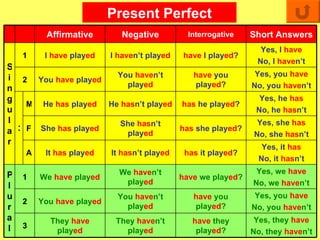
Present Perfect Affirmative I ’ve  play ed You ’ve  play ed He ’s  play ed She ’s  play ed It ’s  play ed We ’ve  play ed You ’ve  play ed They ’ve  play ed SPELLING RULES I  have  play ed You  have  play ed He  has  play ed She  has  play ed It  has  play ed We  have  play ed You  have  play ed They  have  play ed Short Form Long Form A F M 3 2 1 Plural 3 2 1 Singular
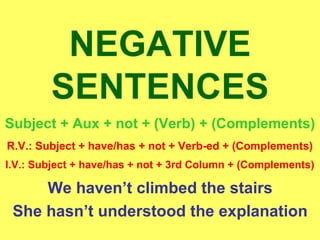
NEGATIVE SENTENCES Subject + Aux + not + (Verb) + (Complements) R.V.: Subject + have/has + not + Verb-ed + (Complements) We haven’t climbed the stairs She hasn’t understood the explanation I.V.: Subject + have/has + not + 3rd Column + (Complements)
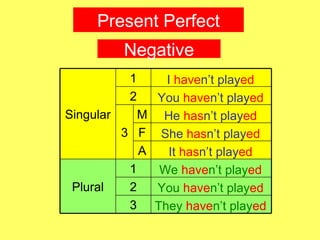
Present Perfect Negative I  have n’t play ed You  have n’t play ed He  has n’t play ed She  has n’t play ed It  has n’t play ed We  have n’t   play ed You  have n’t   play ed They  have n’t   play ed A F M 3 2 1 Plural 3 2 1 Singular
INTERROGATIVE SENTENCES Aux + Subject + (Verb) + (Complements)? R.V.: Have/Has + Subject + Verb-ed + (Complements)? Have John and Michael played football? Has she written the letter? I.V.: Have/Has + Subject + 3rd Column + (Complements)?
Present Perfect Interrogative Have  I play ed ? Have  you play ed ? Has  he play ed ? Has  she play ed  ? Has  it play ed ? Have  we play ed ? Have  you   play ed ? Have  they play ed ? A F M 3 2 1 Plural 3 2 1 Singular
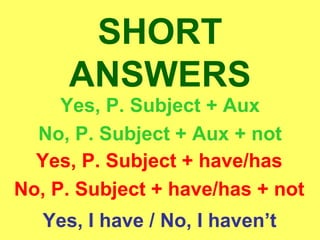
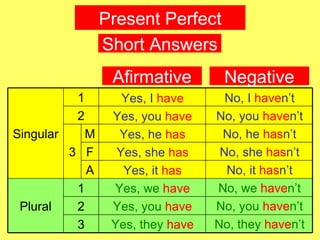
SHORT ANSWERS Yes, P. Subject + Aux No, P. Subject + Aux + not Yes, P. Subject + have/has No, P. Subject + have/has + not Yes, I have / No, I haven’t
Present Perfect Short Answers Yes, I  have Yes, you  have Yes, he  has Yes, she  has Yes, it  has Yes, we  have Yes, you  have Yes, they  have No, I  have n’t No, you  have n’t No, he  has n’t No, she  has n’t No, it  has n’t No, we  have n’t No, you  have n’t No, they  have n’t Afirmative Negative A F M 3 2 1 Plural 3 2 1 Singular
Present Perfect Short Answers Interrogative Negative Affirmative have  they play ed ? have  you play ed ? have  we play ed ? has  it play ed ? has  she play ed ? has  he play ed ? have  you play ed ? have  I play ed ? They  have n’t play ed You  have n’t play ed We  have n’t play ed It  has n’t play ed She  has n’t play ed He  has n’t play ed You  have n’t play ed I  have n’t play ed They  have  play ed You  have  play ed We  have  play ed It  has  play ed She  has  play ed He  has  play ed You  have  play ed I  have  play ed A F M Yes, they  have No, they  have n’t 3 Yes, you  have No, you  have n’t 2 Yes, we  have No, we  have n’t 1 Plural Yes, it  has No, it  has n’t Yes, she  has No, she  has n’t Yes, he  has No, he  has n’t 3 Yes, you  have No, you  have n’t 2 Yes, I  have No, I  have n’t 1 Singular
S'utilitza per a parlar d'accions que van començar en el passat i continuen en el present. Sovint va acompanyat d'expressions com  since  (des de),  for  (fa, des de fa): I  have lived  here  for  two years Visc  ací  des de fa  dos anys Fa  dos anys que  visc  ací Vivo  aquí desde hace dos años Hace dos años que  vivo  aquí PRESENT PERFECT: ÚS
S'utilitza per a parlar d'accions que van ocórrer en el passat però no importa o no sabem exactament quan va ocórrer l'acció. Les conseqüències de la dita acció afecten el present: I  have burnt  my hand, so I won’t be able to take the exam M' he cremat  la mà, així que no podré fer l'examen Me  he quemado  la mano, así que no podré hacer el examen PRESENT PERFECT: ÚS
S'usa per a descriure experiències passades : Have  you ever  tasted  apple pie? She  has  never  been  to Italy Has tastat  alguna vegada la tortada de poma? Ella mai  ha estat  a Itàlia. ¿ Has probado  alguna vez la tarta de manzana? Ella nunca  ha estado  en Italia. PRESENT PERFECT: ÚS
PRESENT PERFECT.   Expressions de Temps X Presente for – fa, des de fa since – des de I  have lived  here  since  1998  I  have lived  here  for  ten years Visc  ací  des de  1998 Visc  ací  des de fa  deu anys Vivo  aquí  desde  1998 Vivo  aquí  desde hace  diez años
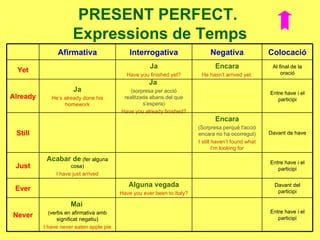
PRESENT PERFECT.  Expressions de Temps Entre have i el participi Mai   (verbs en afirmativa amb significat negatiu) I have never eaten apple pie Never Davant del participi Alguna vegada Have you ever been to Italy? Ever Entre have i el participi Acabar de  (fer alguna cosa) I have just arrived Just Davant de have Encara (Sorpresa perquè l'acció encara no ha ocorregut) I still haven’t found what I’m looking for Still Entre have i el participi Ja   (sorpresa per acció realitzada abans del que s’espera) Have you already finished? Ja He’s already done his homework Already Al final de la oració Encara He hasn’t arrived yet. Ja Have you finished yet? Yet Colocació Negativa Interrogativa Afirmativa
Se utiliza para hablar de acciones que empezaron en el pasado y continúan en el presente. A menudo va acompañado de expresiones como  since  (desde),  for  (hace, desde hace): I  have lived  here  for  two years Visc  ací  des de fa  dos anys Fa  dos anys que  visc  ací Vivo  aquí desde hace dos años Hace dos años que  vivo  aquí PRESENT PERFECT: USO
Se utiliza para hablar de acciones que ocurrieron en el pasado pero no importa o no sabemos exactamente cuándo ocurrió la acción. Las consecuencias de dicha acción afectan al presente: I  have burnt  my hand, so I won’t be able to take the exam M' he cremat  la mà, així que no podré fer l'examen Me  he quemado  la mano, así que no podré hacer el examen PRESENT PERFECT: USO
Se usa para describir experiencias pasadas: Have  you ever  tasted  apple pie? She  has  never  been  to Italy Has tastat  alguna vegada la tortada de poma? Ella mai  ha estat  a Itàlia. ¿ Has probado  alguna vez la tarta de manzana? Ella nunca  ha estado  en Italia. PRESENT PERFECT: USO
PRESENT PERFECT.  Expresiones de Tiempo X Presente For – hace, desde hace Since - desde I  have lived  here  since  1998  I  have lived  here  for  ten years Visc  ací  des de  1998 Visc  ací  des de fa  deu anys Vivo  aquí  desde  1998 Vivo  aquí  desde hace  diez años
PRESENT PERFECT.  Expresiones de Tiempo Entre have y el participio Nunca   (verbos en afirmativa con significado negativo) I have never eaten apple pie Never Delante del participio Alguna vez Have you ever been to Italy? Ever Entre have y el participio Acabar de  (hacer algo) I have just arrived Just Delante de have Todavía (sorpresa porque la acción aún no ha ocurrido) I still haven’t found what I’m looking for Still Entre have y el participio Ya   (sorpresa por acción realizada antes de lo esperado) Have you already finished? Ya He’s already done his homework Already Al final de la oración Aún, todavía He hasn’t arrived yet. Ya Have you finished yet? Yet Colocación Negativa Interrogativa Afirmativa

Present perfect

  • 1.
  • 2.
    AFFIRMATIVE SENTENCES Subject+ Verb + (Complements) Regular Verbs: Subject + have/has + Verb-ed + (Compl.) Jennifer has studied Chinese for two years Irregular Verbs: Subject + have/has + 3rd Column + (Compl.) Ronald has chosen the red tie
  • 3.
    Present Perfect AffirmativeI ’ve play ed You ’ve play ed He ’s play ed She ’s play ed It ’s play ed We ’ve play ed You ’ve play ed They ’ve play ed SPELLING RULES I have play ed You have play ed He has play ed She has play ed It has play ed We have play ed You have play ed They have play ed Short Form Long Form A F M 3 2 1 Plural 3 2 1 Singular
  • 4.
    NEGATIVE SENTENCES Subject+ Aux + not + (Verb) + (Complements) R.V.: Subject + have/has + not + Verb-ed + (Complements) We haven’t climbed the stairs She hasn’t understood the explanation I.V.: Subject + have/has + not + 3rd Column + (Complements)
  • 5.
    Present Perfect NegativeI have n’t play ed You have n’t play ed He has n’t play ed She has n’t play ed It has n’t play ed We have n’t play ed You have n’t play ed They have n’t play ed A F M 3 2 1 Plural 3 2 1 Singular
  • 6.
    INTERROGATIVE SENTENCES Aux+ Subject + (Verb) + (Complements)? R.V.: Have/Has + Subject + Verb-ed + (Complements)? Have John and Michael played football? Has she written the letter? I.V.: Have/Has + Subject + 3rd Column + (Complements)?
  • 7.
    Present Perfect InterrogativeHave I play ed ? Have you play ed ? Has he play ed ? Has she play ed ? Has it play ed ? Have we play ed ? Have you play ed ? Have they play ed ? A F M 3 2 1 Plural 3 2 1 Singular
  • 8.
    SHORT ANSWERS Yes,P. Subject + Aux No, P. Subject + Aux + not Yes, P. Subject + have/has No, P. Subject + have/has + not Yes, I have / No, I haven’t
  • 9.
    Present Perfect ShortAnswers Yes, I have Yes, you have Yes, he has Yes, she has Yes, it has Yes, we have Yes, you have Yes, they have No, I have n’t No, you have n’t No, he has n’t No, she has n’t No, it has n’t No, we have n’t No, you have n’t No, they have n’t Afirmative Negative A F M 3 2 1 Plural 3 2 1 Singular
  • 10.
    Present Perfect ShortAnswers Interrogative Negative Affirmative have they play ed ? have you play ed ? have we play ed ? has it play ed ? has she play ed ? has he play ed ? have you play ed ? have I play ed ? They have n’t play ed You have n’t play ed We have n’t play ed It has n’t play ed She has n’t play ed He has n’t play ed You have n’t play ed I have n’t play ed They have play ed You have play ed We have play ed It has play ed She has play ed He has play ed You have play ed I have play ed A F M Yes, they have No, they have n’t 3 Yes, you have No, you have n’t 2 Yes, we have No, we have n’t 1 Plural Yes, it has No, it has n’t Yes, she has No, she has n’t Yes, he has No, he has n’t 3 Yes, you have No, you have n’t 2 Yes, I have No, I have n’t 1 Singular
  • 11.
    S'utilitza per aparlar d'accions que van començar en el passat i continuen en el present. Sovint va acompanyat d'expressions com since (des de), for (fa, des de fa): I have lived here for two years Visc ací des de fa dos anys Fa dos anys que visc ací Vivo aquí desde hace dos años Hace dos años que vivo aquí PRESENT PERFECT: ÚS
  • 12.
    S'utilitza per aparlar d'accions que van ocórrer en el passat però no importa o no sabem exactament quan va ocórrer l'acció. Les conseqüències de la dita acció afecten el present: I have burnt my hand, so I won’t be able to take the exam M' he cremat la mà, així que no podré fer l'examen Me he quemado la mano, así que no podré hacer el examen PRESENT PERFECT: ÚS
  • 13.
    S'usa per adescriure experiències passades : Have you ever tasted apple pie? She has never been to Italy Has tastat alguna vegada la tortada de poma? Ella mai ha estat a Itàlia. ¿ Has probado alguna vez la tarta de manzana? Ella nunca ha estado en Italia. PRESENT PERFECT: ÚS
  • 14.
    PRESENT PERFECT. Expressions de Temps X Presente for – fa, des de fa since – des de I have lived here since 1998 I have lived here for ten years Visc ací des de 1998 Visc ací des de fa deu anys Vivo aquí desde 1998 Vivo aquí desde hace diez años
  • 15.
    PRESENT PERFECT. Expressions de Temps Entre have i el participi Mai (verbs en afirmativa amb significat negatiu) I have never eaten apple pie Never Davant del participi Alguna vegada Have you ever been to Italy? Ever Entre have i el participi Acabar de (fer alguna cosa) I have just arrived Just Davant de have Encara (Sorpresa perquè l'acció encara no ha ocorregut) I still haven’t found what I’m looking for Still Entre have i el participi Ja (sorpresa per acció realitzada abans del que s’espera) Have you already finished? Ja He’s already done his homework Already Al final de la oració Encara He hasn’t arrived yet. Ja Have you finished yet? Yet Colocació Negativa Interrogativa Afirmativa
  • 16.
    Se utiliza parahablar de acciones que empezaron en el pasado y continúan en el presente. A menudo va acompañado de expresiones como since (desde), for (hace, desde hace): I have lived here for two years Visc ací des de fa dos anys Fa dos anys que visc ací Vivo aquí desde hace dos años Hace dos años que vivo aquí PRESENT PERFECT: USO
  • 17.
    Se utiliza parahablar de acciones que ocurrieron en el pasado pero no importa o no sabemos exactamente cuándo ocurrió la acción. Las consecuencias de dicha acción afectan al presente: I have burnt my hand, so I won’t be able to take the exam M' he cremat la mà, així que no podré fer l'examen Me he quemado la mano, así que no podré hacer el examen PRESENT PERFECT: USO
  • 18.
    Se usa paradescribir experiencias pasadas: Have you ever tasted apple pie? She has never been to Italy Has tastat alguna vegada la tortada de poma? Ella mai ha estat a Itàlia. ¿ Has probado alguna vez la tarta de manzana? Ella nunca ha estado en Italia. PRESENT PERFECT: USO
  • 19.
    PRESENT PERFECT. Expresiones de Tiempo X Presente For – hace, desde hace Since - desde I have lived here since 1998 I have lived here for ten years Visc ací des de 1998 Visc ací des de fa deu anys Vivo aquí desde 1998 Vivo aquí desde hace diez años
  • 20.
    PRESENT PERFECT. Expresiones de Tiempo Entre have y el participio Nunca (verbos en afirmativa con significado negativo) I have never eaten apple pie Never Delante del participio Alguna vez Have you ever been to Italy? Ever Entre have y el participio Acabar de (hacer algo) I have just arrived Just Delante de have Todavía (sorpresa porque la acción aún no ha ocurrido) I still haven’t found what I’m looking for Still Entre have y el participio Ya (sorpresa por acción realizada antes de lo esperado) Have you already finished? Ya He’s already done his homework Already Al final de la oración Aún, todavía He hasn’t arrived yet. Ya Have you finished yet? Yet Colocación Negativa Interrogativa Afirmativa