WORKSHOP
TECHNOLOGY
A.A.N.M. & V.V.R.S.R. POLYTECHNIC,
GUDLAVALLERU, KRISHNA DIST, A.P
▸ NAME : SURYA
▸ DESIGNATION : LECTURER
▸ BRANCH : MECHANICAL ENGINEERING
▸ SUBJECT : ECET
▸ TOPIC : WORKSHOP TECHNOLOGY
▸ SUB TOPIC : CARPENTRY
▸ DURATION : 100 MINUTES
▸ TEACHING AID : PPT
2
TOPICS
3
BASIC WORKSHOP TOOLS AND OPERATIONS OF :-
Carpentry
Fitting
Sheet metal
CARPENTRY
INTRODUCTION:
 Carpentry deals with the processing of wood to obtain desired shapes
and sizes.
 The term Joinery is used to denote the process of joining two wooden
pieces for making doors, windows, cupboards, stairs etc.
 The process dealing with the technique of making wooden-pattern is
called pattern making.
 Thus the carpentry, joinery, and pattern making are generally referred as
wood working.
4
CARPENTRY TOOLS
 In carpentry large numbers of hand tools are used for processing the wood.
They may be classified as
1. Marking and measuring tools
2. Cutting and paring tools
3. Boring tools
4. Striking tools, and
5. Holding tools.
5
Marking and Measuring Tools
▸ Marking is one of the most important features of wood work,
and success of completing a job accurately depends on accuracy
of marking and measuring.
▸ Marking and measuring tools are used in wood work for
marking, measuring and checking the work at various stages
6
MEASURING TOOLS:
▸ The following tools are commonly used for measuring in wood work.
1. Steel rule or Engineer's rule
2. Wooden folding rule
3. Steel tape.
7
MEASURING TOOLS:
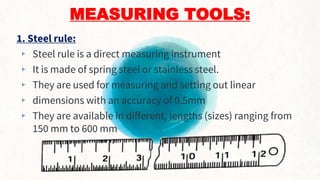
1. Steel rule:
▸ Steel rule is a direct measuring instrument
▸ It is made of spring steel or stainless steel.
▸ They are used for measuring and setting out linear
▸ dimensions with an accuracy of 0.5mm
▸ They are available in different, lengths (sizes) ranging from
150 mm to 600 mm
8
MEASURING TOOLS
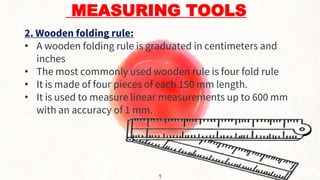
2. Wooden folding rule:
• A wooden folding rule is graduated in centimeters and
inches
• The most commonly used wooden rule is four fold rule
• It is made of four pieces of each 150 mm length.
• It is used to measure linear measurements up to 600 mm
with an accuracy of 1 mm.
9
MEASURING TOOLS:
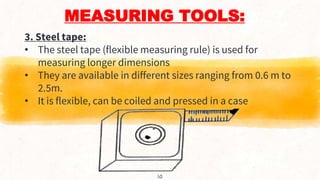
3. Steel tape:
• The steel tape (flexible measuring rule) is used for
measuring longer dimensions
• They are available in different sizes ranging from 0.6 m to
2.5m.
• It is flexible, can be coiled and pressed in a case
10
MARKING TOOLS:
▸ The following tools are used for marking in wood working.
1. Straight edge
2. Try square
3. Marking gauge
4. Divider
5. Marking knife, etc
11
1. Straight edge:
▸ It is a flat piece of steel or wood with perfect straight and
parallel edges
▸ It is used for testing trueness, flatness of surfaces and
straightness of edges
▸ One of its edges is made bevelled
▸ Straight edge is also used for drawing straight lines on job
surface
12
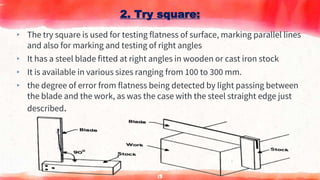
▸ The try square is used for testing flatness of surface, marking parallel lines
and also for marking and testing of right angles
▸ It has a steel blade fitted at right angles in wooden or cast iron stock
▸ It is available in various sizes ranging from 100 to 300 mm.
▸ the degree of error from flatness being detected by light passing between
the blade and the work, as was the case with the steel straight edge just
described.
2. Try square:
13
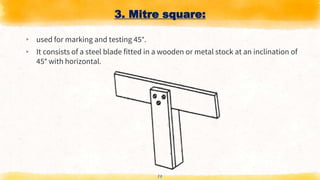
3. Mitre square:
▸ used for marking and testing 45°.
▸ It consists of a steel blade fitted in a wooden or metal stock at an inclination of
45° with horizontal.
14
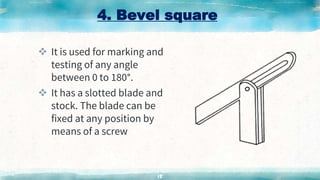
4. Bevel square
 It is used for marking and
testing of any angle
between 0 to 180°.
 It has a slotted blade and
stock. The blade can be
fixed at any position by
means of a screw
15
5. Square: It is used to check trueness of a surface
and angles to an extreme accuracy.
6. Combination square: It is an extremely useful
tool and consists of square, bevel square (or protractor
head), Centre square head and a rule. It is used for
checking angles, trueness of a surface, and for marking
centres on the end of a round job.
16
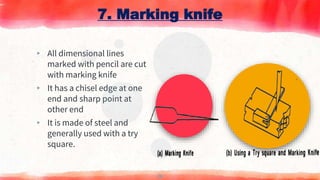
7. Marking knife
▸ All dimensional lines
marked with pencil are cut
with marking knife
▸ It has a chisel edge at one
end and sharp point at
other end
▸ It is made of steel and
generally used with a try
square.
17
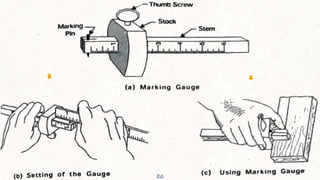
8. Gauges:
18
 Gauges are used for cutting parallel lines at a
given distance from an edge.
 It consists a stem which slides in a stock.
Stock can be secured at any position by a
thumb screw.
(i) Marking gauge:
▸ The marking gauge is commonly used when absolute
accuracy is required.
▸ It has a stem with a sharp pin at one end. It is used to cut line
along the grains and parallel to an edge
▸ The distance can be adjusted by sliding the stock (head) on a
stem.
▸ This can be achieved by thumb screw.
▸ For accurate work with a marking gauge, always check the
setting with the rule
19
20
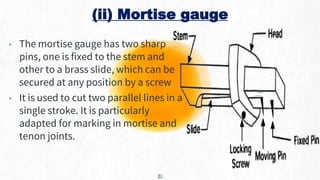
(ii) Mortise gauge
▸ The mortise gauge has two sharp
pins, one is fixed to the stem and
other to a brass slide, which can be
secured at any position by a screw
▸ It is used to cut two parallel lines in a
single stroke. It is particularly
adapted for marking in mortise and
tenon joints.
21
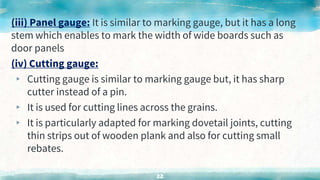
(iii) Panel gauge: It is similar to marking gauge, but it has a long
stem which enables to mark the width of wide boards such as
door panels
(iv) Cutting gauge:
▸ Cutting gauge is similar to marking gauge but, it has sharp
cutter instead of a pin.
▸ It is used for cutting lines across the grains.
▸ It is particularly adapted for marking dovetail joints, cutting
thin strips out of wooden plank and also for cutting small
rebates.
22
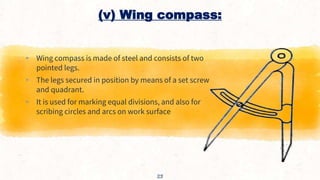
(v) Wing compass:
▸ Wing compass is made of steel and consists of two
pointed legs.
▸ The legs secured in position by means of a set screw
and quadrant.
▸ It is used for marking equal divisions, and also for
scribing circles and arcs on work surface
23
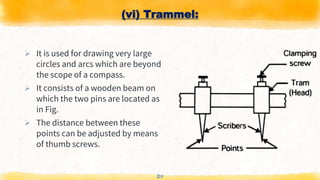
(vi) Trammel:
 It is used for drawing very large
circles and arcs which are beyond
the scope of a compass.
 It consists of a wooden beam on
which the two pins are located as
in Fig.
 The distance between these
points can be adjusted by means
of thumb screws.
24
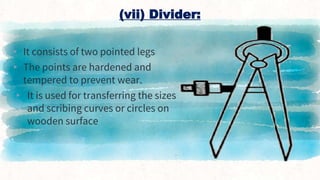
(vii) Divider:
▸ It consists of two pointed legs
▸ The points are hardened and
tempered to prevent wear.
▸ It is used for transferring the sizes
and scribing curves or circles on
wooden surface
.
25
(viii) Calipers:
▸ Calipers are used for measuring the sizes of component.
▸ The size taken by the calipers is read on steel rule.
▸ They are made either with firm joint or spring calipers.
▸ The spring calipers are used most commonly because it
can easily be adjusted to size.
▸ The various types of calipers generally used are outside
caliper, inside caliper and hermaphrodite caliper.
26
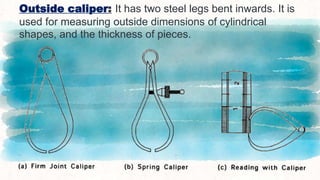
Outside caliper: It has two steel legs bent inwards. It is
used for measuring outside dimensions of cylindrical
shapes, and the thickness of pieces.
27
Inside Caliper: lt is used to measure the diameter of holes
width of key ways or recesses. It's legs are bent outwards
28
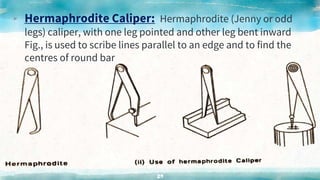
▸ Hermaphrodite Caliper: Hermaphrodite (Jenny or odd
legs) caliper, with one leg pointed and other leg bent inward
Fig., is used to scribe lines parallel to an edge and to find the
centres of round bar
29
(ix) Sprit level: The spirit level is an instrument used for testing
the horizontal levels and also for setting surfaces parallel to the
marking off table.
(x) Plumb bob: It is used for testing the vertical levels
30
Thanks!
Any
questions
?
31
CUTTING AND PARING TOOLS:
▸ Cutting tools are used for cutting timber to approximate
size, cutting excess wood to obtain desired shape and
accuracy.
▸ Paring or planing tools are intended to make smooth and
accurate surface. They include different types of planes.
32
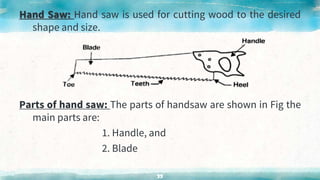
Hand Saw: Hand saw is used for cutting wood to the desired
shape and size.
Parts of hand saw: The parts of handsaw are shown in Fig the
main parts are:
1. Handle, and
2. Blade
33
Handle: Handle is generally made of good quality wood. Blade is made
of tool steel having teeth on the lower edge. The teeth are hardened
and tempered. It is fitted into a wooden handle. The teeth are set
alternately to the right and left of the blade, and its purpose is to make
the width of cut wider than the blade thickness. This allows the blade to
move smoothly across the wood.
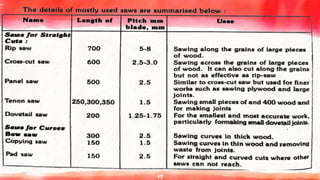
Specification of handsaw: The hand saw is specified by the length of
the blade and pitch of the teeth. The length of blade varies from 600
mm to 700 mm and pitch ranges from 2.5mm to 8 mm.
▸ A saw blade with coarse pitch has bigger teeth and cuts quickly.
Therefore it is used for rough work.
34
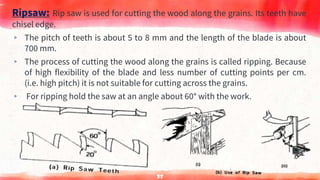
Ripsaw: Rip saw is used for cutting the wood along the grains. Its teeth have
chisel edge.
▸ The pitch of teeth is about 5 to 8 mm and the length of the blade is about
700 mm.
▸ The process of cutting the wood along the grains is called ripping. Because
of high flexibility of the blade and less number of cutting points per cm.
(i.e. high pitch) it is not suitable for cutting across the grains.
▸ For ripping hold the saw at an angle about 60° with the work.
35
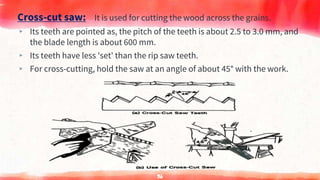
Cross-cut saw: It is used for cutting the wood across the grains.
▸ Its teeth are pointed as, the pitch of the teeth is about 2.5 to 3.0 mm, and
the blade length is about 600 mm.
▸ Its teeth have less 'set' than the rip saw teeth.
▸ For cross-cutting, hold the saw at an angle of about 45° with the work.
36
37
Panel saw: It is similar to cross-cut saw, but used for finer
work.
▸ It has finer blade and it is used for cutting along the grains as
well as across the grains.
▸ The approximate length of blade is 500 mm and pitch is 2 to
2.5 mm.
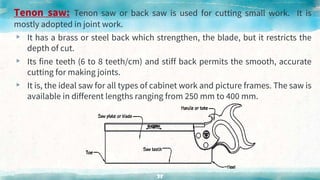
Tenon saw: Tenon saw or back saw is used for cutting small work. It is
mostly adopted in joint work.
▸ It has a brass or steel back which strengthen, the blade, but it restricts the
depth of cut.
▸ Its fine teeth (6 to 8 teeth/cm) and stiff back permits the smooth, accurate
cutting for making joints.
▸ It is, the ideal saw for all types of cabinet work and picture frames. The saw is
available in different lengths ranging from 250 mm to 400 mm.
38
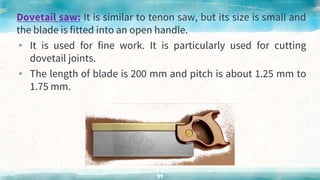
Dovetail saw: It is similar to tenon saw, but its size is small and
the blade is fitted into an open handle.
▸ It is used for fine work. It is particularly used for cutting
dovetail joints.
▸ The length of blade is 200 mm and pitch is about 1.25 mm to
1.75 mm.
39
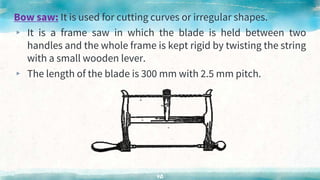
Bow saw: It is used for cutting curves or irregular shapes.
▸ It is a frame saw in which the blade is held between two
handles and the whole frame is kept rigid by twisting the string
with a small wooden lever.
▸ The length of the blade is 300 mm with 2.5 mm pitch.
40
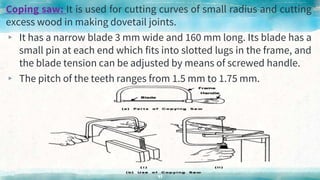
Coping saw: It is used for cutting curves of small radius and cutting
excess wood in making dovetail joints.
▸ It has a narrow blade 3 mm wide and 160 mm long. Its blade has a
small pin at each end which fits into slotted lugs in the frame, and
the blade tension can be adjusted by means of screwed handle.
▸ The pitch of the teeth ranges from 1.5 mm to 1.75 mm.
41
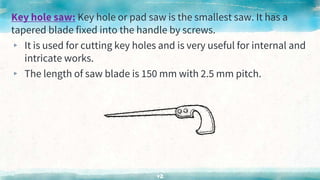
Key hole saw: Key hole or pad saw is the smallest saw. It has a
tapered blade fixed into the handle by screws.
▸ It is used for cutting key holes and is very useful for internal and
intricate works.
▸ The length of saw blade is 150 mm with 2.5 mm pitch.
42
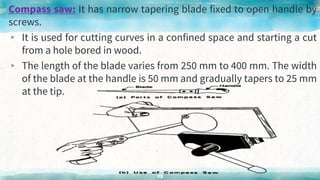
Compass saw: It has narrow tapering blade fixed to open handle by
screws.
▸ It is used for cutting curves in a confined space and starting a cut
from a hole bored in wood.
▸ The length of the blade varies from 250 mm to 400 mm. The width
of the blade at the handle is 50 mm and gradually tapers to 25 mm
at the tip.
43
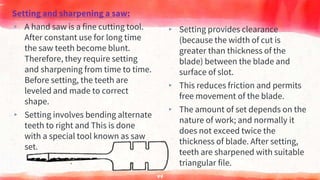
Setting and sharpening a saw:
▸ A hand saw is a fine cutting tool.
After constant use for long time
the saw teeth become blunt.
Therefore, they require setting
and sharpening from time to time.
Before setting, the teeth are
leveled and made to correct
shape.
▸ Setting involves bending alternate
teeth to right and This is done
with a special tool known as saw
set.
▸ Setting provides clearance
(because the width of cut is
greater than thickness of the
blade) between the blade and
surface of slot.
▸ This reduces friction and permits
free movement of the blade.
▸ The amount of set depends on the
nature of work; and normally it
does not exceed twice the
thickness of blade. After setting,
teeth are sharpened with suitable
triangular file.
44
45
CHISELS:
▸ Chisels are used for cutting excess wood for making joints.
They are also used for shaping different profiles in wood
work.
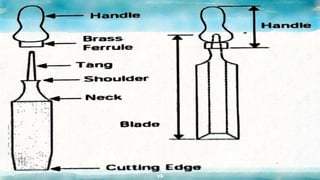
Parts of chisel:
▸ The parts of chisel are shown in Fig.it has the following
main parts.
▸ 1. Handle, and
▸ 2. Blade.
46
47
▸ 1. Handle: It is made of wood. It is fitted with brass collar, called
ferrule. Ferrule increases the strength of the handle.
▸ 2. Blade: Blade is made of tool steel. It comprises tang, shoulder,
neck and cutting edge
▸ 3.Tang:Taper end of the blade, it is fitted into the handle.
▸ 4.Shoulder:Lower end of the tang is called shoulder.
▸ 5.Neck:Shaped portion beneath the shoulder.
▸ 6.Cuttingedge:Sharp edge of the blade which performs cutting.
It is hardened and tempered. The angle of cutting edge is about
25°. Smaller angles are chosen for softer wood, and larger angles
chosen for harder wood. The dull cutting edge is sharpened on an
oil stone.
48
Specification of chisel:
▸ The size of the chisel is mainly specified by the width of the
blade; But usually, the size of chisel is given by the width and
length of the blade.
▸ The size i.e. width of the blade ranges from 3 mm to 50 mm and
length of the blade is about 125 mm.
Types of Chisels:
The following chisels are most commonly used in wood working.
1. Firmer chisel, 4. Mortise chisel,
2. Bevelled edge firmer chisel, 5. Socket chisel,
3. Paring chisel, 6. Gouges.
49
▸ 1. Firmer chisel: The firmer chisel is capable of doing heavy
work and is used for jointing and shaping the wood, with or
without mallet. The chisel blade is made of rectangular section
with bevelled edge. The length of the blade is about 125 mm
and the width of the edge varies from 3 to 50 mm.
50
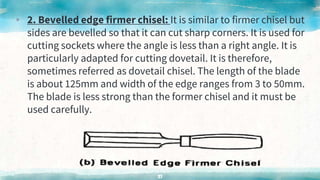
▸ 2. Bevelled edge firmer chisel: It is similar to firmer chisel but
sides are bevelled so that it can cut sharp corners. It is used for
cutting sockets where the angle is less than a right angle. It is
particularly adapted for cutting dovetail. It is therefore,
sometimes referred as dovetail chisel. The length of the blade
is about 125mm and width of the edge ranges from 3 to 50mm.
The blade is less strong than the former chisel and it must be
used carefully.
51
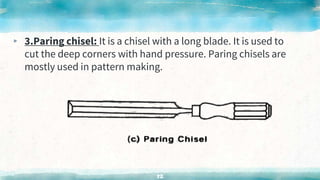
▸ 3.Paring chisel: It is a chisel with a long blade. It is used to
cut the deep corners with hand pressure. Paring chisels are
mostly used in pattern making.
52
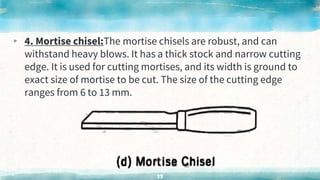
▸ 4. Mortise chisel:The mortise chisels are robust, and can
withstand heavy blows. It has a thick stock and narrow cutting
edge. It is used for cutting mortises, and its width is ground to
exact size of mortise to be cut. The size of the cutting edge
ranges from 6 to 13 mm.
53
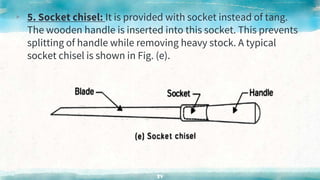
▸ 5. Socket chisel: It is provided with socket instead of tang.
The wooden handle is inserted into this socket. This prevents
splitting of handle while removing heavy stock. A typical
socket chisel is shown in Fig. (e).
54
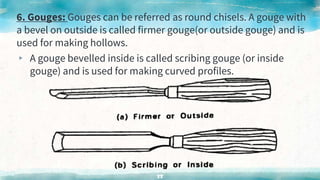
6. Gouges: Gouges can be referred as round chisels. A gouge with
a bevel on outside is called firmer gouge(or outside gouge) and is
used for making hollows.
▸ A gouge bevelled inside is called scribing gouge (or inside
gouge) and is used for making curved profiles.
55
PLANES:
▸ Planes are used for producing flat and smooth surfaces by cutting thin
layers of wood.
Special purpose planes are also available for cutting grooves and rebates.
▸ Parts of a plane: The main parts of a plane are shown in Fig.
These parts are
1. Body or sole,
2. Cutting blade,
3. Handle,
4. Knob, and
5. Other controls (wedge, adjustable screw)
56
57
PLANES
 The cutting blade is made of tool steel and is fitted into the sole or body
of the plane.
 The body may be made of wood or metal.
 The cutting edge of the blade is tempered and ground to a suitable
cutting angle.
 The depth of cutting edge may be adjusted by wedge.
 Handle and knob are made of wood.
 Handle is provided at the back and knob at the front for holding the
plane by both hands during planning.
58
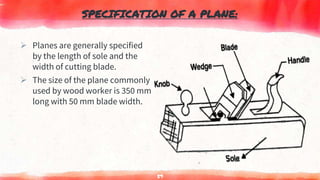
SPECIFICATION OF A PLANE:
 Planes are generally specified
by the length of sole and the
width of cutting blade.
 The size of the plane commonly
used by wood worker is 350 mm
long with 50 mm blade width.
59
TYPES OF PLANES
 The common types of planes used in wood working are :
1. Jack Plane
(a) Wooden jack plane
(b) Metal jack plane
2. Trying Plane
3. Smoothing Plane
4. Rebate Plane
5. Plough Plane
6. Router Plane
7. Spoke shave
8. Special Planes
60
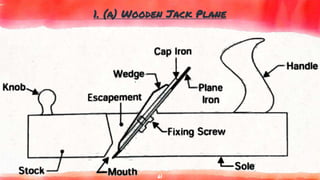
1. (a) Wooden Jack Plane
61
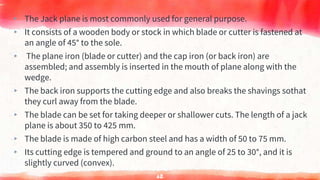
▸ The Jack plane is most commonly used for general purpose.
▸ It consists of a wooden body or stock in which blade or cutter is fastened at
an angle of 45° to the sole.
▸ The plane iron (blade or cutter) and the cap iron (or back iron) are
assembled; and assembly is inserted in the mouth of plane along with the
wedge.
▸ The back iron supports the cutting edge and also breaks the shavings sothat
they curl away from the blade.
▸ The blade can be set for taking deeper or shallower cuts. The length of a jack
plane is about 350 to 425 mm.
▸ The blade is made of high carbon steel and has a width of 50 to 75 mm.
▸ Its cutting edge is tempered and ground to an angle of 25 to 30°, and it is
slightly curved (convex).
62
1. (b) Metal jack plane
63
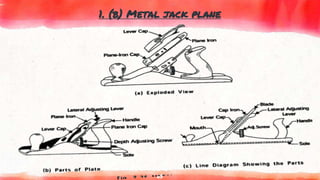
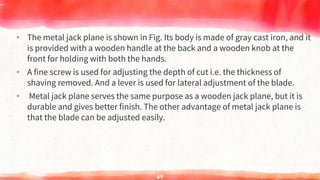
▸ The metal jack plane is shown in Fig. Its body is made of gray cast iron, and it
is provided with a wooden handle at the back and a wooden knob at the
front for holding with both the hands.
▸ A fine screw is used for adjusting the depth of cut i.e. the thickness of
shaving removed. And a lever is used for lateral adjustment of the blade.
▸ Metal jack plane serves the same purpose as a wooden jack plane, but it is
durable and gives better finish. The other advantage of metal jack plane is
that the blade can be adjusted easily.
64
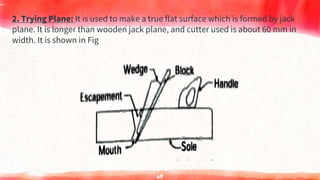
2. Trying Plane: It is used to make a true flat surface which is formed by jack
plane. It is longer than wooden jack plane, and cutter used is about 60 mm in
width. It is shown in Fig
65
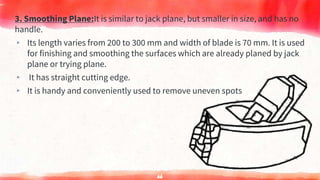
3. Smoothing Plane:It is similar to jack plane, but smaller in size, and has no
handle.
▸ Its length varies from 200 to 300 mm and width of blade is 70 mm. It is used
for finishing and smoothing the surfaces which are already planed by jack
plane or trying plane.
▸ It has straight cutting edge.
▸ It is handy and conveniently used to remove uneven spots
66
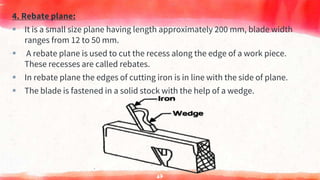
4. Rebate plane:
 It is a small size plane having length approximately 200 mm, blade width
ranges from 12 to 50 mm.
 A rebate plane is used to cut the recess along the edge of a work piece.
These recesses are called rebates.
 In rebate plane the edges of cutting iron is in line with the side of plane.
 The blade is fastened in a solid stock with the help of a wedge.
67
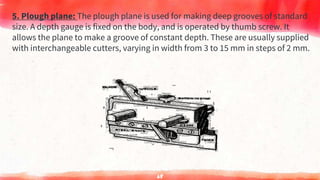
5. Plough plane: The plough plane is used for making deep grooves of standard
size. A depth gauge is fixed on the body, and is operated by thumb screw. It
allows the plane to make a groove of constant depth. These are usually supplied
with interchangeable cutters, varying in width from 3 to 15 mm in steps of 2 mm.
68
6. Router plane: The router plane is used for finishing the grooves to a
constant depth which are formed by chisel or saw
69
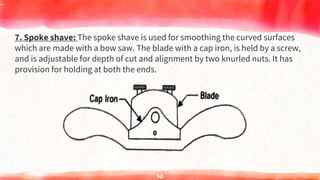
7. Spoke shave: The spoke shave is used for smoothing the curved surfaces
which are made with a bow saw. The blade with a cap iron, is held by a screw,
and is adjustable for depth of cut and alignment by two knurled nuts. It has
provision for holding at both the ends.
70
8 Special planes:In addition to various planes discussed above, the
following special planes are used for specific operation
i. Compass plane,
ii. Bull nose plane,
iii. Block plane,
iv. Moulding plane, and
v. Shoulder plane
71
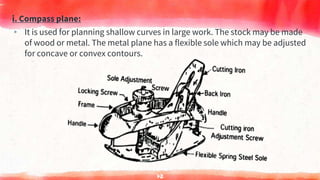
i. Compass plane:
▸ It is used for planning shallow curves in large work. The stock may be made
of wood or metal. The metal plane has a flexible sole which may be adjusted
for concave or convex contours.
72
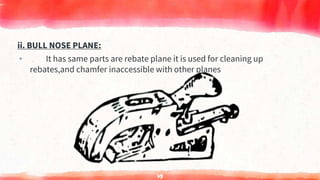
ii. BULL NOSE PLANE:
▸ It has same parts are rebate plane it is used for cleaning up
rebates,and chamfer inaccessible with other planes
73
iii. Block plane:
▸ It is used for finishing mitres and
for planning small chamfers. Its
blade is set at an angle of 20° to
the sole of the plane with the
bevel up.
74
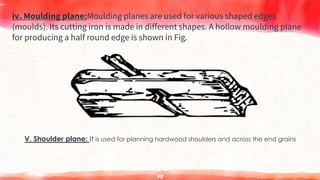
iv. Moulding plane:Moulding planes are used for various shaped edges
(moulds). Its cutting iron is made in different shapes. A hollow moulding plane
for producing a half round edge is shown in Fig.
75
V. Shoulder plane: It is used for planning hardwood shoulders and across the end grains.

WT ECET PPT (SURYA).pptx

  • 1.
  • 2.
    A.A.N.M. & V.V.R.S.R.POLYTECHNIC, GUDLAVALLERU, KRISHNA DIST, A.P ▸ NAME : SURYA ▸ DESIGNATION : LECTURER ▸ BRANCH : MECHANICAL ENGINEERING ▸ SUBJECT : ECET ▸ TOPIC : WORKSHOP TECHNOLOGY ▸ SUB TOPIC : CARPENTRY ▸ DURATION : 100 MINUTES ▸ TEACHING AID : PPT 2
  • 3.
    TOPICS 3 BASIC WORKSHOP TOOLSAND OPERATIONS OF :- Carpentry Fitting Sheet metal
  • 4.
    CARPENTRY INTRODUCTION:  Carpentry dealswith the processing of wood to obtain desired shapes and sizes.  The term Joinery is used to denote the process of joining two wooden pieces for making doors, windows, cupboards, stairs etc.  The process dealing with the technique of making wooden-pattern is called pattern making.  Thus the carpentry, joinery, and pattern making are generally referred as wood working. 4
  • 5.
    CARPENTRY TOOLS  Incarpentry large numbers of hand tools are used for processing the wood. They may be classified as 1. Marking and measuring tools 2. Cutting and paring tools 3. Boring tools 4. Striking tools, and 5. Holding tools. 5
  • 6.
    Marking and MeasuringTools ▸ Marking is one of the most important features of wood work, and success of completing a job accurately depends on accuracy of marking and measuring. ▸ Marking and measuring tools are used in wood work for marking, measuring and checking the work at various stages 6
  • 7.
    MEASURING TOOLS: ▸ Thefollowing tools are commonly used for measuring in wood work. 1. Steel rule or Engineer's rule 2. Wooden folding rule 3. Steel tape. 7
  • 8.
    MEASURING TOOLS: 1. Steelrule: ▸ Steel rule is a direct measuring instrument ▸ It is made of spring steel or stainless steel. ▸ They are used for measuring and setting out linear ▸ dimensions with an accuracy of 0.5mm ▸ They are available in different, lengths (sizes) ranging from 150 mm to 600 mm 8
  • 9.
    MEASURING TOOLS 2. Woodenfolding rule: • A wooden folding rule is graduated in centimeters and inches • The most commonly used wooden rule is four fold rule • It is made of four pieces of each 150 mm length. • It is used to measure linear measurements up to 600 mm with an accuracy of 1 mm. 9
  • 10.
    MEASURING TOOLS: 3. Steeltape: • The steel tape (flexible measuring rule) is used for measuring longer dimensions • They are available in different sizes ranging from 0.6 m to 2.5m. • It is flexible, can be coiled and pressed in a case 10
  • 11.
    MARKING TOOLS: ▸ Thefollowing tools are used for marking in wood working. 1. Straight edge 2. Try square 3. Marking gauge 4. Divider 5. Marking knife, etc 11
  • 12.
    1. Straight edge: ▸It is a flat piece of steel or wood with perfect straight and parallel edges ▸ It is used for testing trueness, flatness of surfaces and straightness of edges ▸ One of its edges is made bevelled ▸ Straight edge is also used for drawing straight lines on job surface 12
  • 13.
    ▸ The trysquare is used for testing flatness of surface, marking parallel lines and also for marking and testing of right angles ▸ It has a steel blade fitted at right angles in wooden or cast iron stock ▸ It is available in various sizes ranging from 100 to 300 mm. ▸ the degree of error from flatness being detected by light passing between the blade and the work, as was the case with the steel straight edge just described. 2. Try square: 13
  • 14.
    3. Mitre square: ▸used for marking and testing 45°. ▸ It consists of a steel blade fitted in a wooden or metal stock at an inclination of 45° with horizontal. 14
  • 15.
    4. Bevel square It is used for marking and testing of any angle between 0 to 180°.  It has a slotted blade and stock. The blade can be fixed at any position by means of a screw 15
  • 16.
    5. Square: Itis used to check trueness of a surface and angles to an extreme accuracy. 6. Combination square: It is an extremely useful tool and consists of square, bevel square (or protractor head), Centre square head and a rule. It is used for checking angles, trueness of a surface, and for marking centres on the end of a round job. 16
  • 17.
    7. Marking knife ▸All dimensional lines marked with pencil are cut with marking knife ▸ It has a chisel edge at one end and sharp point at other end ▸ It is made of steel and generally used with a try square. 17
  • 18.
    8. Gauges: 18  Gaugesare used for cutting parallel lines at a given distance from an edge.  It consists a stem which slides in a stock. Stock can be secured at any position by a thumb screw.
  • 19.
    (i) Marking gauge: ▸The marking gauge is commonly used when absolute accuracy is required. ▸ It has a stem with a sharp pin at one end. It is used to cut line along the grains and parallel to an edge ▸ The distance can be adjusted by sliding the stock (head) on a stem. ▸ This can be achieved by thumb screw. ▸ For accurate work with a marking gauge, always check the setting with the rule 19
  • 20.
  • 21.
    (ii) Mortise gauge ▸The mortise gauge has two sharp pins, one is fixed to the stem and other to a brass slide, which can be secured at any position by a screw ▸ It is used to cut two parallel lines in a single stroke. It is particularly adapted for marking in mortise and tenon joints. 21
  • 22.
    (iii) Panel gauge:It is similar to marking gauge, but it has a long stem which enables to mark the width of wide boards such as door panels (iv) Cutting gauge: ▸ Cutting gauge is similar to marking gauge but, it has sharp cutter instead of a pin. ▸ It is used for cutting lines across the grains. ▸ It is particularly adapted for marking dovetail joints, cutting thin strips out of wooden plank and also for cutting small rebates. 22
  • 23.
    (v) Wing compass: ▸Wing compass is made of steel and consists of two pointed legs. ▸ The legs secured in position by means of a set screw and quadrant. ▸ It is used for marking equal divisions, and also for scribing circles and arcs on work surface 23
  • 24.
    (vi) Trammel:  Itis used for drawing very large circles and arcs which are beyond the scope of a compass.  It consists of a wooden beam on which the two pins are located as in Fig.  The distance between these points can be adjusted by means of thumb screws. 24
  • 25.
    (vii) Divider: ▸ Itconsists of two pointed legs ▸ The points are hardened and tempered to prevent wear. ▸ It is used for transferring the sizes and scribing curves or circles on wooden surface . 25
  • 26.
    (viii) Calipers: ▸ Calipersare used for measuring the sizes of component. ▸ The size taken by the calipers is read on steel rule. ▸ They are made either with firm joint or spring calipers. ▸ The spring calipers are used most commonly because it can easily be adjusted to size. ▸ The various types of calipers generally used are outside caliper, inside caliper and hermaphrodite caliper. 26
  • 27.
    Outside caliper: Ithas two steel legs bent inwards. It is used for measuring outside dimensions of cylindrical shapes, and the thickness of pieces. 27
  • 28.
    Inside Caliper: ltis used to measure the diameter of holes width of key ways or recesses. It's legs are bent outwards 28
  • 29.
    ▸ Hermaphrodite Caliper:Hermaphrodite (Jenny or odd legs) caliper, with one leg pointed and other leg bent inward Fig., is used to scribe lines parallel to an edge and to find the centres of round bar 29
  • 30.
    (ix) Sprit level:The spirit level is an instrument used for testing the horizontal levels and also for setting surfaces parallel to the marking off table. (x) Plumb bob: It is used for testing the vertical levels 30
  • 31.
  • 32.
    CUTTING AND PARINGTOOLS: ▸ Cutting tools are used for cutting timber to approximate size, cutting excess wood to obtain desired shape and accuracy. ▸ Paring or planing tools are intended to make smooth and accurate surface. They include different types of planes. 32
  • 33.
    Hand Saw: Handsaw is used for cutting wood to the desired shape and size. Parts of hand saw: The parts of handsaw are shown in Fig the main parts are: 1. Handle, and 2. Blade 33
  • 34.
    Handle: Handle isgenerally made of good quality wood. Blade is made of tool steel having teeth on the lower edge. The teeth are hardened and tempered. It is fitted into a wooden handle. The teeth are set alternately to the right and left of the blade, and its purpose is to make the width of cut wider than the blade thickness. This allows the blade to move smoothly across the wood. Specification of handsaw: The hand saw is specified by the length of the blade and pitch of the teeth. The length of blade varies from 600 mm to 700 mm and pitch ranges from 2.5mm to 8 mm. ▸ A saw blade with coarse pitch has bigger teeth and cuts quickly. Therefore it is used for rough work. 34
  • 35.
    Ripsaw: Rip sawis used for cutting the wood along the grains. Its teeth have chisel edge. ▸ The pitch of teeth is about 5 to 8 mm and the length of the blade is about 700 mm. ▸ The process of cutting the wood along the grains is called ripping. Because of high flexibility of the blade and less number of cutting points per cm. (i.e. high pitch) it is not suitable for cutting across the grains. ▸ For ripping hold the saw at an angle about 60° with the work. 35
  • 36.
    Cross-cut saw: Itis used for cutting the wood across the grains. ▸ Its teeth are pointed as, the pitch of the teeth is about 2.5 to 3.0 mm, and the blade length is about 600 mm. ▸ Its teeth have less 'set' than the rip saw teeth. ▸ For cross-cutting, hold the saw at an angle of about 45° with the work. 36
  • 37.
    37 Panel saw: Itis similar to cross-cut saw, but used for finer work. ▸ It has finer blade and it is used for cutting along the grains as well as across the grains. ▸ The approximate length of blade is 500 mm and pitch is 2 to 2.5 mm.
  • 38.
    Tenon saw: Tenonsaw or back saw is used for cutting small work. It is mostly adopted in joint work. ▸ It has a brass or steel back which strengthen, the blade, but it restricts the depth of cut. ▸ Its fine teeth (6 to 8 teeth/cm) and stiff back permits the smooth, accurate cutting for making joints. ▸ It is, the ideal saw for all types of cabinet work and picture frames. The saw is available in different lengths ranging from 250 mm to 400 mm. 38
  • 39.
    Dovetail saw: Itis similar to tenon saw, but its size is small and the blade is fitted into an open handle. ▸ It is used for fine work. It is particularly used for cutting dovetail joints. ▸ The length of blade is 200 mm and pitch is about 1.25 mm to 1.75 mm. 39
  • 40.
    Bow saw: Itis used for cutting curves or irregular shapes. ▸ It is a frame saw in which the blade is held between two handles and the whole frame is kept rigid by twisting the string with a small wooden lever. ▸ The length of the blade is 300 mm with 2.5 mm pitch. 40
  • 41.
    Coping saw: Itis used for cutting curves of small radius and cutting excess wood in making dovetail joints. ▸ It has a narrow blade 3 mm wide and 160 mm long. Its blade has a small pin at each end which fits into slotted lugs in the frame, and the blade tension can be adjusted by means of screwed handle. ▸ The pitch of the teeth ranges from 1.5 mm to 1.75 mm. 41
  • 42.
    Key hole saw:Key hole or pad saw is the smallest saw. It has a tapered blade fixed into the handle by screws. ▸ It is used for cutting key holes and is very useful for internal and intricate works. ▸ The length of saw blade is 150 mm with 2.5 mm pitch. 42
  • 43.
    Compass saw: Ithas narrow tapering blade fixed to open handle by screws. ▸ It is used for cutting curves in a confined space and starting a cut from a hole bored in wood. ▸ The length of the blade varies from 250 mm to 400 mm. The width of the blade at the handle is 50 mm and gradually tapers to 25 mm at the tip. 43
  • 44.
    Setting and sharpeninga saw: ▸ A hand saw is a fine cutting tool. After constant use for long time the saw teeth become blunt. Therefore, they require setting and sharpening from time to time. Before setting, the teeth are leveled and made to correct shape. ▸ Setting involves bending alternate teeth to right and This is done with a special tool known as saw set. ▸ Setting provides clearance (because the width of cut is greater than thickness of the blade) between the blade and surface of slot. ▸ This reduces friction and permits free movement of the blade. ▸ The amount of set depends on the nature of work; and normally it does not exceed twice the thickness of blade. After setting, teeth are sharpened with suitable triangular file. 44
  • 45.
  • 46.
    CHISELS: ▸ Chisels areused for cutting excess wood for making joints. They are also used for shaping different profiles in wood work. Parts of chisel: ▸ The parts of chisel are shown in Fig.it has the following main parts. ▸ 1. Handle, and ▸ 2. Blade. 46
  • 47.
  • 48.
    ▸ 1. Handle:It is made of wood. It is fitted with brass collar, called ferrule. Ferrule increases the strength of the handle. ▸ 2. Blade: Blade is made of tool steel. It comprises tang, shoulder, neck and cutting edge ▸ 3.Tang:Taper end of the blade, it is fitted into the handle. ▸ 4.Shoulder:Lower end of the tang is called shoulder. ▸ 5.Neck:Shaped portion beneath the shoulder. ▸ 6.Cuttingedge:Sharp edge of the blade which performs cutting. It is hardened and tempered. The angle of cutting edge is about 25°. Smaller angles are chosen for softer wood, and larger angles chosen for harder wood. The dull cutting edge is sharpened on an oil stone. 48
  • 49.
    Specification of chisel: ▸The size of the chisel is mainly specified by the width of the blade; But usually, the size of chisel is given by the width and length of the blade. ▸ The size i.e. width of the blade ranges from 3 mm to 50 mm and length of the blade is about 125 mm. Types of Chisels: The following chisels are most commonly used in wood working. 1. Firmer chisel, 4. Mortise chisel, 2. Bevelled edge firmer chisel, 5. Socket chisel, 3. Paring chisel, 6. Gouges. 49
  • 50.
    ▸ 1. Firmerchisel: The firmer chisel is capable of doing heavy work and is used for jointing and shaping the wood, with or without mallet. The chisel blade is made of rectangular section with bevelled edge. The length of the blade is about 125 mm and the width of the edge varies from 3 to 50 mm. 50
  • 51.
    ▸ 2. Bevellededge firmer chisel: It is similar to firmer chisel but sides are bevelled so that it can cut sharp corners. It is used for cutting sockets where the angle is less than a right angle. It is particularly adapted for cutting dovetail. It is therefore, sometimes referred as dovetail chisel. The length of the blade is about 125mm and width of the edge ranges from 3 to 50mm. The blade is less strong than the former chisel and it must be used carefully. 51
  • 52.
    ▸ 3.Paring chisel:It is a chisel with a long blade. It is used to cut the deep corners with hand pressure. Paring chisels are mostly used in pattern making. 52
  • 53.
    ▸ 4. Mortisechisel:The mortise chisels are robust, and can withstand heavy blows. It has a thick stock and narrow cutting edge. It is used for cutting mortises, and its width is ground to exact size of mortise to be cut. The size of the cutting edge ranges from 6 to 13 mm. 53
  • 54.
    ▸ 5. Socketchisel: It is provided with socket instead of tang. The wooden handle is inserted into this socket. This prevents splitting of handle while removing heavy stock. A typical socket chisel is shown in Fig. (e). 54
  • 55.
    6. Gouges: Gougescan be referred as round chisels. A gouge with a bevel on outside is called firmer gouge(or outside gouge) and is used for making hollows. ▸ A gouge bevelled inside is called scribing gouge (or inside gouge) and is used for making curved profiles. 55
  • 56.
    PLANES: ▸ Planes areused for producing flat and smooth surfaces by cutting thin layers of wood. Special purpose planes are also available for cutting grooves and rebates. ▸ Parts of a plane: The main parts of a plane are shown in Fig. These parts are 1. Body or sole, 2. Cutting blade, 3. Handle, 4. Knob, and 5. Other controls (wedge, adjustable screw) 56
  • 57.
  • 58.
    PLANES  The cuttingblade is made of tool steel and is fitted into the sole or body of the plane.  The body may be made of wood or metal.  The cutting edge of the blade is tempered and ground to a suitable cutting angle.  The depth of cutting edge may be adjusted by wedge.  Handle and knob are made of wood.  Handle is provided at the back and knob at the front for holding the plane by both hands during planning. 58
  • 59.
    SPECIFICATION OF APLANE:  Planes are generally specified by the length of sole and the width of cutting blade.  The size of the plane commonly used by wood worker is 350 mm long with 50 mm blade width. 59
  • 60.
    TYPES OF PLANES The common types of planes used in wood working are : 1. Jack Plane (a) Wooden jack plane (b) Metal jack plane 2. Trying Plane 3. Smoothing Plane 4. Rebate Plane 5. Plough Plane 6. Router Plane 7. Spoke shave 8. Special Planes 60
  • 61.
    1. (a) WoodenJack Plane 61
  • 62.
    ▸ The Jackplane is most commonly used for general purpose. ▸ It consists of a wooden body or stock in which blade or cutter is fastened at an angle of 45° to the sole. ▸ The plane iron (blade or cutter) and the cap iron (or back iron) are assembled; and assembly is inserted in the mouth of plane along with the wedge. ▸ The back iron supports the cutting edge and also breaks the shavings sothat they curl away from the blade. ▸ The blade can be set for taking deeper or shallower cuts. The length of a jack plane is about 350 to 425 mm. ▸ The blade is made of high carbon steel and has a width of 50 to 75 mm. ▸ Its cutting edge is tempered and ground to an angle of 25 to 30°, and it is slightly curved (convex). 62
  • 63.
    1. (b) Metaljack plane 63
  • 64.
    ▸ The metaljack plane is shown in Fig. Its body is made of gray cast iron, and it is provided with a wooden handle at the back and a wooden knob at the front for holding with both the hands. ▸ A fine screw is used for adjusting the depth of cut i.e. the thickness of shaving removed. And a lever is used for lateral adjustment of the blade. ▸ Metal jack plane serves the same purpose as a wooden jack plane, but it is durable and gives better finish. The other advantage of metal jack plane is that the blade can be adjusted easily. 64
  • 65.
    2. Trying Plane:It is used to make a true flat surface which is formed by jack plane. It is longer than wooden jack plane, and cutter used is about 60 mm in width. It is shown in Fig 65
  • 66.
    3. Smoothing Plane:Itis similar to jack plane, but smaller in size, and has no handle. ▸ Its length varies from 200 to 300 mm and width of blade is 70 mm. It is used for finishing and smoothing the surfaces which are already planed by jack plane or trying plane. ▸ It has straight cutting edge. ▸ It is handy and conveniently used to remove uneven spots 66
  • 67.
    4. Rebate plane: It is a small size plane having length approximately 200 mm, blade width ranges from 12 to 50 mm.  A rebate plane is used to cut the recess along the edge of a work piece. These recesses are called rebates.  In rebate plane the edges of cutting iron is in line with the side of plane.  The blade is fastened in a solid stock with the help of a wedge. 67
  • 68.
    5. Plough plane:The plough plane is used for making deep grooves of standard size. A depth gauge is fixed on the body, and is operated by thumb screw. It allows the plane to make a groove of constant depth. These are usually supplied with interchangeable cutters, varying in width from 3 to 15 mm in steps of 2 mm. 68
  • 69.
    6. Router plane:The router plane is used for finishing the grooves to a constant depth which are formed by chisel or saw 69
  • 70.
    7. Spoke shave:The spoke shave is used for smoothing the curved surfaces which are made with a bow saw. The blade with a cap iron, is held by a screw, and is adjustable for depth of cut and alignment by two knurled nuts. It has provision for holding at both the ends. 70
  • 71.
    8 Special planes:Inaddition to various planes discussed above, the following special planes are used for specific operation i. Compass plane, ii. Bull nose plane, iii. Block plane, iv. Moulding plane, and v. Shoulder plane 71
  • 72.
    i. Compass plane: ▸It is used for planning shallow curves in large work. The stock may be made of wood or metal. The metal plane has a flexible sole which may be adjusted for concave or convex contours. 72
  • 73.
    ii. BULL NOSEPLANE: ▸ It has same parts are rebate plane it is used for cleaning up rebates,and chamfer inaccessible with other planes 73
  • 74.
    iii. Block plane: ▸It is used for finishing mitres and for planning small chamfers. Its blade is set at an angle of 20° to the sole of the plane with the bevel up. 74
  • 75.
    iv. Moulding plane:Mouldingplanes are used for various shaped edges (moulds). Its cutting iron is made in different shapes. A hollow moulding plane for producing a half round edge is shown in Fig. 75 V. Shoulder plane: It is used for planning hardwood shoulders and across the end grains.