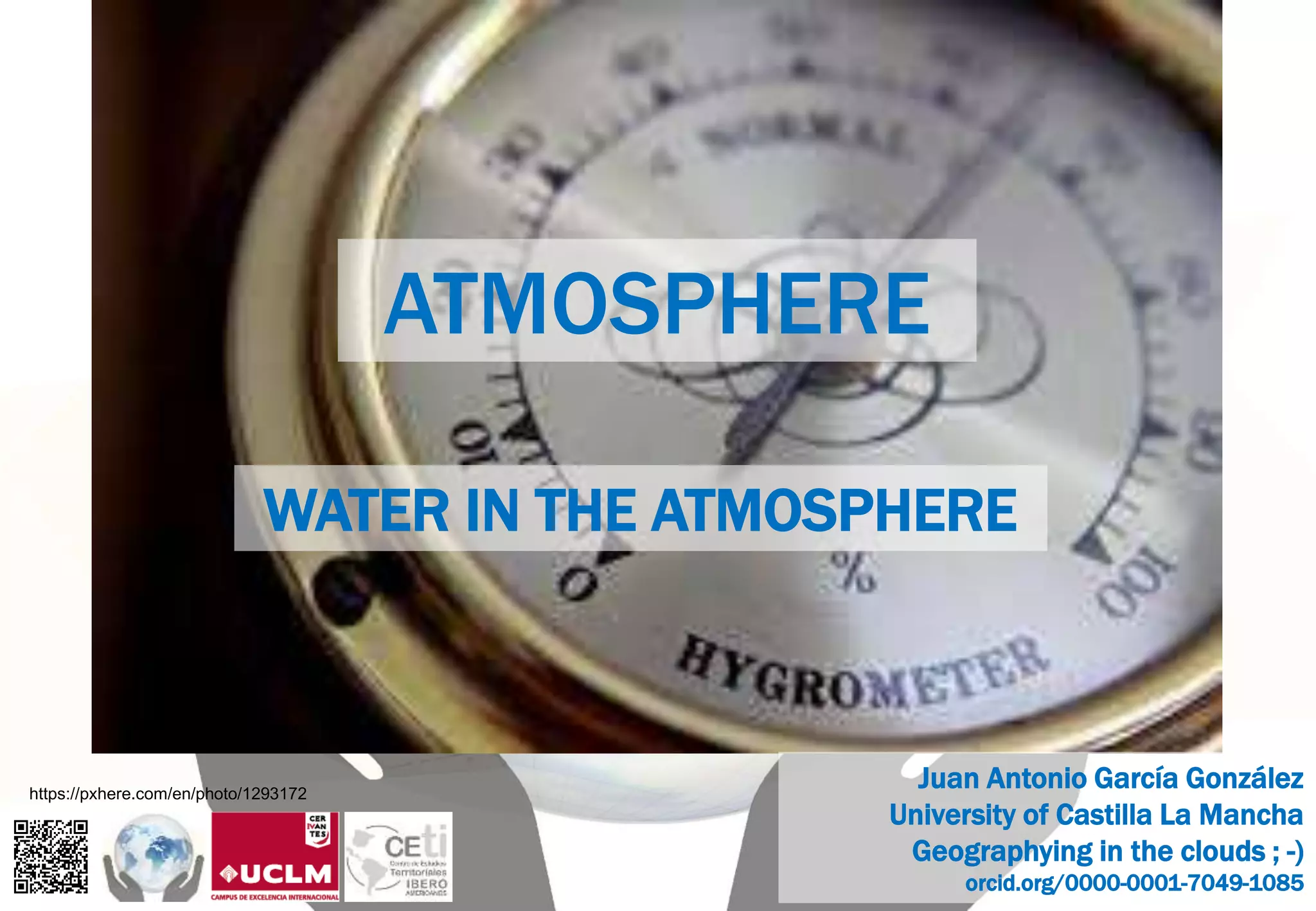



ATMOSPHERE
WATER IN THE ATMOSPHERE
Juan Antonio García González
University of Castilla La Mancha
Geographying in the clouds ; -)
orcid.org/0000-0001-7049-1085
https://pxhere.com/en/photo/1293172
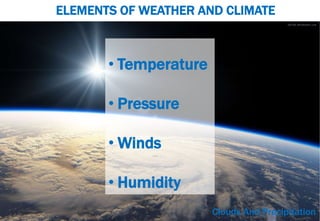
ELEMENTS OF WEATHER AND CLIMATE
• Temperature
• Pressure
• Winds
• Humidity
Clouds And Precipitation
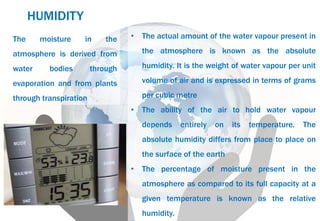
• The actual amount of the water vapour present in
the atmosphere is known as the absolute
humidity. It is the weight of water vapour per unit
volume of air and is expressed in terms of grams
per cubic metre
• The ability of the air to hold water vapour
depends entirely on its temperature. The
absolute humidity differs from place to place on
the surface of the earth
• The percentage of moisture present in the
atmosphere as compared to its full capacity at a
given temperature is known as the relative
humidity.
The moisture in the
atmosphere is derived from
water bodies through
evaporation and from plants
through transpiration
HUMIDITY
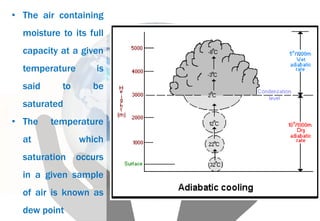
• The air containing
moisture to its full
capacity at a given
temperature is
said to be
saturated
• The temperature
at which
saturation occurs
in a given sample
of air is known as
dew point
EVAPORATION
AND
CONDENSATION
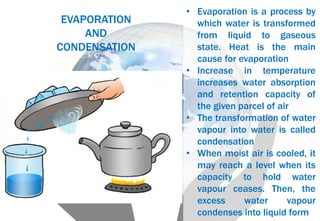
• Evaporation is a process by
which water is transformed
from liquid to gaseous
state. Heat is the main
cause for evaporation
• Increase in temperature
increases water absorption
and retention capacity of
the given parcel of air
• The transformation of water
vapour into water is called
condensation
• When moist air is cooled, it
may reach a level when its
capacity to hold water
vapour ceases. Then, the
excess water vapour
condenses into liquid form
Condensation takes place:
(i) when the temperature of the air is reduced to
dew point with its volume remaining constant
(ii) when both the volume and the temperature are
reduced
(iii) when moisture is added to the air through
evaporation.
DEW
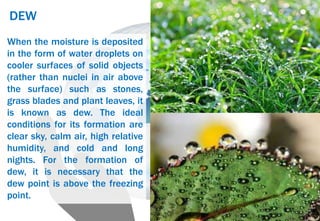
When the moisture is deposited
in the form of water droplets on
cooler surfaces of solid objects
(rather than nuclei in air above
the surface) such as stones,
grass blades and plant leaves, it
is known as dew. The ideal
conditions for its formation are
clear sky, calm air, high relative
humidity, and cold and long
nights. For the formation of
dew, it is necessary that the
dew point is above the freezing
point.
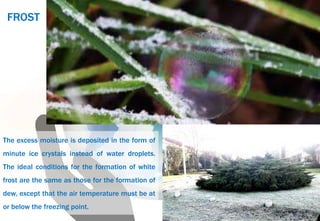
FROST
The excess moisture is deposited in the form of
minute ice crystals instead of water droplets.
The ideal conditions for the formation of white
frost are the same as those for the formation of
dew, except that the air temperature must be at
or below the freezing point.
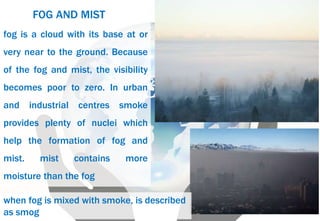
fog is a cloud with its base at or
very near to the ground. Because
of the fog and mist, the visibility
becomes poor to zero. In urban
and industrial centres smoke
provides plenty of nuclei which
help the formation of fog and
mist. mist contains more
moisture than the fog
FOG AND MIST
when fog is mixed with smoke, is described
as smog
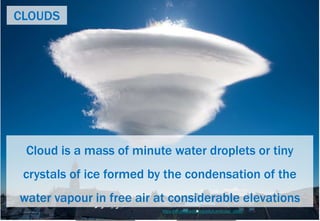
CLOUDS
Cloud is a mass of minute water droplets or tiny
crystals of ice formed by the condensation of the
water vapour in free air at considerable elevations
https://en.wikipedia.org/wiki/Lenticular_cloud
According to their height,
expanse, density and
transparency or opaqueness
clouds are grouped under four
types :
• Cirrus
• Cumulus
• Stratus
• nimbus
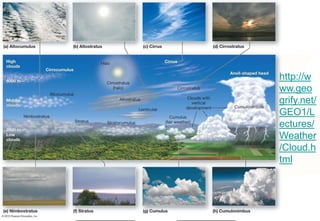
CLOUDS
A combination of these four basic types can give rise to the
following types of clouds:
• high clouds – cirrus, cirrostratus, cirrocumulus
• middle clouds – altostratus and altocumulus
• low clouds – stratocumulus and nimbostratus
• clouds with extensive vertical development – cumulus
and cumulonimbus
http://w
ww.geo
grify.net/
GEO1/L
ectures/
Weather
/Cloud.h
tml
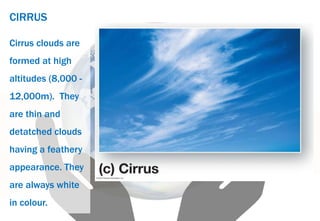
CIRRUS
Cirrus clouds are
formed at high
altitudes (8,000 -
12,000m). They
are thin and
detatched clouds
having a feathery
appearance. They
are always white
in colour.
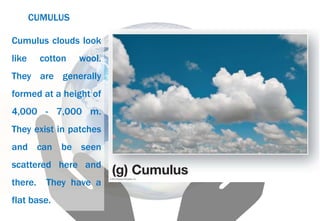
CUMULUS
Cumulus clouds look
like cotton wool.
They are generally
formed at a height of
4,000 - 7,000 m.
They exist in patches
and can be seen
scattered here and
there. They have a
flat base.
STRATUS
As their name implies,
these are layered
clouds covering large
portions of the sky.
These clouds are
generally formed either
due to loss of heat or
the mixing of air
masses with different
temperatures.
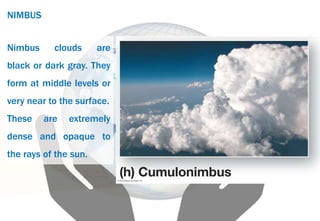
NIMBUS
Nimbus clouds are
black or dark gray. They
form at middle levels or
very near to the surface.
These are extremely
dense and opaque to
the rays of the sun.
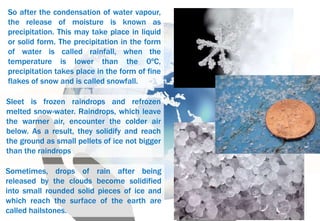
Sometimes, drops of rain after being
released by the clouds become solidified
into small rounded solid pieces of ice and
which reach the surface of the earth are
called hailstones.
Sleet is frozen raindrops and refrozen
melted snow-water. Raindrops, which leave
the warmer air, encounter the colder air
below. As a result, they solidify and reach
the ground as small pellets of ice not bigger
than the raindrops
So after the condensation of water vapour,
the release of moisture is known as
precipitation. This may take place in liquid
or solid form. The precipitation in the form
of water is called rainfall, when the
temperature is lower than the 0ºC,
precipitation takes place in the form of fine
flakes of snow and is called snowfall.
TYPES OF RAINFALL
• the convectional
• orographic or relief
• the cyclonic or frontal
CONVENTIONAL RAIN
air on being heated,
becomes light and rises
up in convection
currents. As it rises, it
expands and loses heat
and consequently,
condensation takes
place and cumulous
clouds are formed. With
thunder and lightening,
heavy rainfall takes
place
Such rain is common in the summer or in the hotter part of the day
http://www.markedbyteachers.com/as-and-a-level/geography/the-causes-of-rainfall.html
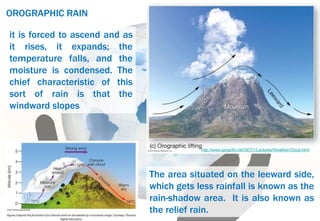
OROGRAPHIC RAIN
it is forced to ascend and as
it rises, it expands; the
temperature falls, and the
moisture is condensed. The
chief characteristic of this
sort of rain is that the
windward slopes
The area situated on the leeward side,
which gets less rainfall is known as the
rain-shadow area. It is also known as
the relief rain.
http://www.geogrify.net/GEO1/Lectures/Weather/Cloud.html
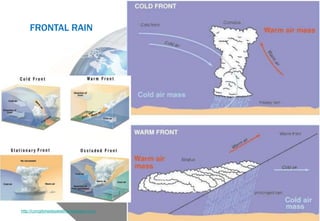
FRONTAL RAIN
http://ccingitonedayatatime.blogspot.com/
https://geography-student.blogspot.com/
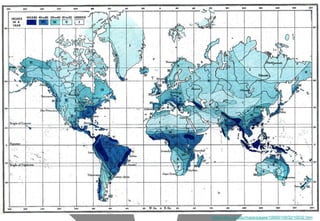
WORLD DISTRIBUTION OF RAINFALL
• In general, as we proceed from the equator towards the poles, rainfall
goes on decreasing steadily
• The coastal areas of the world receive greater amounts of rainfall than
the interior of the continents
• The rainfall is more over the oceans than on the landmasses of the
world because of being great sources of water
• Between the latitudes 35º and 40º N and S of the equator, the rain is
heavier on the eastern coasts and goes on decreasing towards the
west. But, between 45º and 65º N and S of equator, due to the
westerlies, the rainfall is first received on the western margins of the
continents and it goes on decreasing towards the east.
https://etc.usf.edu/maps/pages/10000/10032/10032.htm
http://www.design-is-fine.org/post/82517549729/william-c-woodbridge-isothermal-chart-or-view
https://keepcalms.com/p/keep
-calm-and-enjoy-the-rain/
https://nios.ac.in/online-course-material/sr-secondary-courses/Geography-(316).aspx
https://www.pmfias.com/
https://pixabay.com/
http://www.physicalgeography.net/
THANKS TO….
Thanks for your attention, you can follow us in
“Geografiando en las nubes ;-)”
@JGARCIAGONZALEZ
garciagonzalez.juanantonio@gmail.com
http://www.youtube.com/user/garciotum1?feature=mhee
“Geographying in the clouds ;-)”
http://www.linkedin.com/profile/view?id=139061635&trk=tab_pro
http://es.slideshare.net/JuanAntonioGarciaGonzlez
http://pinterest.com/geografiando/boards/
http://geografiandoenlasnubes.blogspot.com.es/
http://www.scoop.it/u/dr-juan-antonio-garcia-gonzalez
https://plus.google.com/u/0/105941284089211583758/posts
http://www.facebook.com/juanantonio.garciagonzalez.37

2019 tg atmosphere3 humidity

  • 1.
    ATMOSPHERE WATER IN THEATMOSPHERE Juan Antonio García González University of Castilla La Mancha Geographying in the clouds ; -) orcid.org/0000-0001-7049-1085 https://pxhere.com/en/photo/1293172
  • 2.
    ELEMENTS OF WEATHERAND CLIMATE • Temperature • Pressure • Winds • Humidity Clouds And Precipitation
  • 3.
    • The actualamount of the water vapour present in the atmosphere is known as the absolute humidity. It is the weight of water vapour per unit volume of air and is expressed in terms of grams per cubic metre • The ability of the air to hold water vapour depends entirely on its temperature. The absolute humidity differs from place to place on the surface of the earth • The percentage of moisture present in the atmosphere as compared to its full capacity at a given temperature is known as the relative humidity. The moisture in the atmosphere is derived from water bodies through evaporation and from plants through transpiration HUMIDITY
  • 4.
    • The aircontaining moisture to its full capacity at a given temperature is said to be saturated • The temperature at which saturation occurs in a given sample of air is known as dew point
  • 5.
    EVAPORATION AND CONDENSATION • Evaporation isa process by which water is transformed from liquid to gaseous state. Heat is the main cause for evaporation • Increase in temperature increases water absorption and retention capacity of the given parcel of air • The transformation of water vapour into water is called condensation • When moist air is cooled, it may reach a level when its capacity to hold water vapour ceases. Then, the excess water vapour condenses into liquid form
  • 6.
    Condensation takes place: (i)when the temperature of the air is reduced to dew point with its volume remaining constant (ii) when both the volume and the temperature are reduced (iii) when moisture is added to the air through evaporation.
  • 7.
    DEW When the moistureis deposited in the form of water droplets on cooler surfaces of solid objects (rather than nuclei in air above the surface) such as stones, grass blades and plant leaves, it is known as dew. The ideal conditions for its formation are clear sky, calm air, high relative humidity, and cold and long nights. For the formation of dew, it is necessary that the dew point is above the freezing point.
  • 8.
    FROST The excess moistureis deposited in the form of minute ice crystals instead of water droplets. The ideal conditions for the formation of white frost are the same as those for the formation of dew, except that the air temperature must be at or below the freezing point.
  • 9.
    fog is acloud with its base at or very near to the ground. Because of the fog and mist, the visibility becomes poor to zero. In urban and industrial centres smoke provides plenty of nuclei which help the formation of fog and mist. mist contains more moisture than the fog FOG AND MIST when fog is mixed with smoke, is described as smog
  • 10.
    CLOUDS Cloud is amass of minute water droplets or tiny crystals of ice formed by the condensation of the water vapour in free air at considerable elevations https://en.wikipedia.org/wiki/Lenticular_cloud
  • 11.
    According to theirheight, expanse, density and transparency or opaqueness clouds are grouped under four types : • Cirrus • Cumulus • Stratus • nimbus CLOUDS
  • 12.
    A combination ofthese four basic types can give rise to the following types of clouds: • high clouds – cirrus, cirrostratus, cirrocumulus • middle clouds – altostratus and altocumulus • low clouds – stratocumulus and nimbostratus • clouds with extensive vertical development – cumulus and cumulonimbus
  • 13.
  • 14.
    CIRRUS Cirrus clouds are formedat high altitudes (8,000 - 12,000m). They are thin and detatched clouds having a feathery appearance. They are always white in colour.
  • 15.
    CUMULUS Cumulus clouds look likecotton wool. They are generally formed at a height of 4,000 - 7,000 m. They exist in patches and can be seen scattered here and there. They have a flat base.
  • 16.
    STRATUS As their nameimplies, these are layered clouds covering large portions of the sky. These clouds are generally formed either due to loss of heat or the mixing of air masses with different temperatures.
  • 17.
    NIMBUS Nimbus clouds are blackor dark gray. They form at middle levels or very near to the surface. These are extremely dense and opaque to the rays of the sun.
  • 18.
    Sometimes, drops ofrain after being released by the clouds become solidified into small rounded solid pieces of ice and which reach the surface of the earth are called hailstones. Sleet is frozen raindrops and refrozen melted snow-water. Raindrops, which leave the warmer air, encounter the colder air below. As a result, they solidify and reach the ground as small pellets of ice not bigger than the raindrops So after the condensation of water vapour, the release of moisture is known as precipitation. This may take place in liquid or solid form. The precipitation in the form of water is called rainfall, when the temperature is lower than the 0ºC, precipitation takes place in the form of fine flakes of snow and is called snowfall.
  • 19.
    TYPES OF RAINFALL •the convectional • orographic or relief • the cyclonic or frontal
  • 20.
    CONVENTIONAL RAIN air onbeing heated, becomes light and rises up in convection currents. As it rises, it expands and loses heat and consequently, condensation takes place and cumulous clouds are formed. With thunder and lightening, heavy rainfall takes place Such rain is common in the summer or in the hotter part of the day http://www.markedbyteachers.com/as-and-a-level/geography/the-causes-of-rainfall.html
  • 21.
    OROGRAPHIC RAIN it isforced to ascend and as it rises, it expands; the temperature falls, and the moisture is condensed. The chief characteristic of this sort of rain is that the windward slopes The area situated on the leeward side, which gets less rainfall is known as the rain-shadow area. It is also known as the relief rain. http://www.geogrify.net/GEO1/Lectures/Weather/Cloud.html
  • 22.
  • 23.
  • 24.
    WORLD DISTRIBUTION OFRAINFALL • In general, as we proceed from the equator towards the poles, rainfall goes on decreasing steadily • The coastal areas of the world receive greater amounts of rainfall than the interior of the continents • The rainfall is more over the oceans than on the landmasses of the world because of being great sources of water • Between the latitudes 35º and 40º N and S of the equator, the rain is heavier on the eastern coasts and goes on decreasing towards the west. But, between 45º and 65º N and S of equator, due to the westerlies, the rainfall is first received on the western margins of the continents and it goes on decreasing towards the east.
  • 25.
  • 26.
  • 27.
  • 28.
  • 29.
    Thanks for yourattention, you can follow us in “Geografiando en las nubes ;-)” @JGARCIAGONZALEZ garciagonzalez.juanantonio@gmail.com http://www.youtube.com/user/garciotum1?feature=mhee “Geographying in the clouds ;-)” http://www.linkedin.com/profile/view?id=139061635&trk=tab_pro http://es.slideshare.net/JuanAntonioGarciaGonzlez http://pinterest.com/geografiando/boards/ http://geografiandoenlasnubes.blogspot.com.es/ http://www.scoop.it/u/dr-juan-antonio-garcia-gonzalez https://plus.google.com/u/0/105941284089211583758/posts http://www.facebook.com/juanantonio.garciagonzalez.37