Kristen Curran
MAT 601 – Summer 2011

Webquest – Weather – Grade 4 “Breaking News: Chicken Little had it right, the sky is falling!”

Standard: Students will understand that the elements of weather can be observed, measured, and
recorded to make predictions and determine simple weather patterns.

   1. Measurement: http://www.weatherwizkids.com/weather-instruments.htm
        a. How do we measure weather? Describe 4 different ways.
__________________________________________________________________
__________________________________________________________________
__________________________________________________________________
__________________________________________________________________
__________________________________________________________________
           b. Why do we measure weather?
__________________________________________________________________
__________________________________________________________________
__________________________________________________________________
__________________________________________________________________
__________________________________________________________________
   2. Wind: http://www.tryscience.org/experiments/experiments_windbubbles_athome.html
        a. Perform and experiment on wind. Record results on separate page.
        b. Describe how wind works.
__________________________________________________________________
__________________________________________________________________
__________________________________________________________________
__________________________________________________________________
__________________________________________________________________
   3. Clouds: http://www.weatherwizkids.com/weather-clouds.htm
         a. List the different cloud groups.
__________________________________________________________________
__________________________________________________________________
           b. Define 4 cloud types in your own words. Be concise.
__________________________________________________________________
__________________________________________________________________
__________________________________________________________________
__________________________________________________________________
   4. Lightning: http://www.youtube.com/watch?v=h7c6z_3dLE4
         a. Draw a diagram of lightning and label the parts.
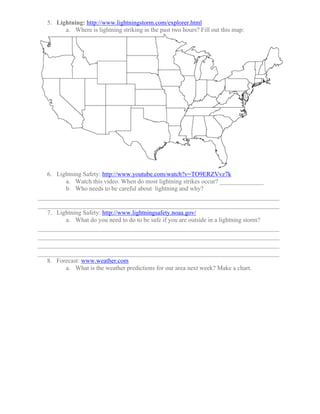
5. Lightning: http://www.lightningstorm.com/explorer.html
        a. Where is lightning striking in the past two hours? Fill out this map:


  6. Lightning Safety: http://www.youtube.com/watch?v=TO9ERZVvz7k
        a. Watch this video. When do most lightning strikes occur? ______________
        b. Who needs to be careful about lightning and why?
__________________________________________________________________
__________________________________________________________________
  7. Lightning Safety: http://www.lightningsafety.noaa.gov/
        a. What do you need to do to be safe if you are outside in a lightning storm?
__________________________________________________________________
__________________________________________________________________
__________________________________________________________________
__________________________________________________________________
  8. Forecast: www.weather.com
        a. What is the weather predictions for our area next week? Make a chart.
9. Forcast Predictions: http://www.almanac.com/weather/longrange
         a. Predict the weather for zone 13 for the next month. Make a chart.


   10. Weather Description: http://www.almanac.com/content/weather-cams
         a. Pick a weather-cam and describe the weather using at least 4 terms from our
             weather vocabulary list.
__________________________________________________________________
__________________________________________________________________
__________________________________________________________________
__________________________________________________________________
__________________________________________________________________
__________________________________________________________________


Weather Vocabulary: atmosphere, meteorologist, freezing, cumulus, stratus, cirrus, air
pressure, thermometer, air temperature, wind speed, forecast, severe, phenomena, precipitation,
seasonal, accuracy, barometer, rain gauge, components.
Answer Key

  1. A THERMOMETER measures the air temperature. Most thermometers are closed glass
     tubes containing liquids such as alcohol or mercury. When air around the tube heats the
     liquid, the liquid expands and moves up the tube. A scale then shows what the actual
     temperature is.
     A BAROMETER measures air pressure. It tells you whether or not the pressure is rising
     or falling. A rising barometer means sunny and dry conditions, while a falling barometer
     means stormy and wet conditions. An Italian scientist named Torricelli built the first
     barometer in 1643.
     A SLING PSYCHROMETER measures relative humidity, using the cooling effect of
     evaporation. Two thermometers are used in a sling psychrometer. Wet the cloth of one of
     the thermometers and swing the psychrometer around a few times. Water evaporates
     from the cloth, causing the temperatures on that thermometer to be lower the the other.
     A RAIN GAUGE measures the amount of rain that has fallen over a specific time period.
     A WIND VANE is an instrument that determines the direction from which the wind is
     blowing.
     An ANEMOMETER measures wind speed. The cups catch the wind, turning a dial
     attached to the instrument. The dial shows the wind speed.
     WEATHER MAPS indicate atmospheric conditions above a large portion of the Earth's
     surface. Meteorologists use weather maps to forecast the weather.
     A HYGROMETER measures the water vapor content of air or the humidity.
     A WEATHER BALLOON measures weather conditions higher up in the atmosphere.
     A COMPASS is a navigational instrument for finding directions.
     WEATHER SATELLITES are used to photograph and track large-scale air movements.
     Then meteorologists compile and analyze the data with the help of computers.
     YOUR EYES are one of the the best ways to help detect the weather. Always keep an eye
     at the sky and you'll usually be on top of weather conditions
  2. TBD
  3. Clouds
          a. Cirrus, Alto, Stratus
         b.        Cirrus Clouds
              Cirrus clouds are the most common of the high clouds. They are composed of ice
              and are thin, wispy clouds blown in high winds into long streamers. Cirrus clouds
              are usually white and predict fair to pleasant weather. By watching the movement
              of cirrus clouds you can tell from which direction weather is approaching. When
              you see cirrus clouds, it usually indicates that a change in the weather will occur
              within 24 hours.
              Cirrostratus clouds are thin, sheetlike high clouds that often cover the entire sky.
              They are so thin that the sun and moon can be seen through them. Cirrostratus
              clouds usually come 12-24 hours before a rain or snow storm.
              Cirrocumulus clouds appear as small, rounded white puffs that appear in long
              rows. The small ripples in the cirrocumulus clouds sometime resemble the scales
              of a fish. Cirrocumulus clouds are usually seen in the winter and indicate fair, but
              cold weather. In tropical regions, they may indicate an approaching hurricane.
                  "Alto" Clouds
              Altostratus clouds are gray or blue-gray mid level clouds composed of ice
              crystals and water droplets. The clouds usually cover the entire sky. In the thinner
areas of the clouds, the sun may be dimly visible as a round disk. Altostratus
           clouds often form ahead of storms with continuous rain or snow.
           Altocumulus clouds are mid level clouds that are made of water droplets and
           appear as gray puffy masses. They usually form in groups. If you see altocumulus
           clouds on a warm, sticky morning, be prepared to see thunderstorms late in the
           afternoon.
                Stratus Clouds
           Stratus clouds are uniform grayish clouds that often cover the entire sky. They
           resemble fog that doesn't reach the ground. Light mist or drizzle sometimes falls
           out of these clouds.
           Stratocumulus clouds are low, puffy and gray. Most form in rows with blue sky
           visible in between them. Rain rarely occurs with stratocumulus clouds, however,
           they can turn into nimbostratus clouds.
           Nimbostratus clouds form a dark gray, wet looking cloudy layer associated with
           continuously falling rain or snow. They often produce precipitation that is usually
           light to moderate.
                Cumulus Clouds
           Cumulus clouds are white, puffy clouds that look like pieces of floating cotton.
           Cumulus clouds are often called "fair-weather clouds". The base of each cloud is
           flat and the top of each cloud has rounded towers. When the top of the cumulus
           clouds resemble the head of a cauliflower, it is called cumulus congestus or
           towering cumulus. These clouds grow upward and they can develop into giant
           cumulonimbus clouds, which are thunderstorm clouds.
           Cumulonimbus clouds are thunderstorm clouds. High winds can flatten the top
           of the cloud into an anvil-like shape. Cumulonimbus clouds are associated with
           heavy rain, snow, hail, lightning and even tornadoes. The anvil usually points in
           the direction the storm is moving.
               Special Clouds
          Mammatus clouds are low hanging bulges that droop from cumulonimbus
          clouds. Mammatus clouds are usually associated with severe weather.
          Lenticular clouds are caused by a wave wind pattern created by the mountains.
          They look like discs or flying saucers that form near mountains.
          Contrails are condensation trails left behind jet aircrafts. Contrails form when hot
          humid air from jet exhaust mixes with environmental air of low vapor pressure
          and low temperature. The mixing is a result of turbulence generated by the engine
          exhaust.
          Green Clouds are often associated with severe weather. The green color is not
          completely understood, but it is thought to have something to do with having a
          high amount of liquid water drops and hail inside the clouds. In the Great Plains
          region of the U.S. green clouds are associated with storms likely to produce hail
          and tornadoes.
      c. Fog is a cloud on the ground. It is composed of billions of tiny water droplets
          floating in the air. Fog exists if the atmospheric visibility near the Earth's surface
          is reduced to 1 kilometer or less.
4. TBD
5. From the cloud – Negative Stepped Leader, From the ground – Positive Stepped Leader.
   The visible combination - Return stroke.
6. Lightning
      a. The Summer
      b. Everyone
7. TBD
8. TBD
9. TBD
10. TBD

Webquest-Weather

  • 1.
    Kristen Curran MAT 601– Summer 2011 Webquest – Weather – Grade 4 “Breaking News: Chicken Little had it right, the sky is falling!” Standard: Students will understand that the elements of weather can be observed, measured, and recorded to make predictions and determine simple weather patterns. 1. Measurement: http://www.weatherwizkids.com/weather-instruments.htm a. How do we measure weather? Describe 4 different ways. __________________________________________________________________ __________________________________________________________________ __________________________________________________________________ __________________________________________________________________ __________________________________________________________________ b. Why do we measure weather? __________________________________________________________________ __________________________________________________________________ __________________________________________________________________ __________________________________________________________________ __________________________________________________________________ 2. Wind: http://www.tryscience.org/experiments/experiments_windbubbles_athome.html a. Perform and experiment on wind. Record results on separate page. b. Describe how wind works. __________________________________________________________________ __________________________________________________________________ __________________________________________________________________ __________________________________________________________________ __________________________________________________________________ 3. Clouds: http://www.weatherwizkids.com/weather-clouds.htm a. List the different cloud groups. __________________________________________________________________ __________________________________________________________________ b. Define 4 cloud types in your own words. Be concise. __________________________________________________________________ __________________________________________________________________ __________________________________________________________________ __________________________________________________________________ 4. Lightning: http://www.youtube.com/watch?v=h7c6z_3dLE4 a. Draw a diagram of lightning and label the parts.
  • 2.
    5. Lightning: http://www.lightningstorm.com/explorer.html a. Where is lightning striking in the past two hours? Fill out this map: 6. Lightning Safety: http://www.youtube.com/watch?v=TO9ERZVvz7k a. Watch this video. When do most lightning strikes occur? ______________ b. Who needs to be careful about lightning and why? __________________________________________________________________ __________________________________________________________________ 7. Lightning Safety: http://www.lightningsafety.noaa.gov/ a. What do you need to do to be safe if you are outside in a lightning storm? __________________________________________________________________ __________________________________________________________________ __________________________________________________________________ __________________________________________________________________ 8. Forecast: www.weather.com a. What is the weather predictions for our area next week? Make a chart.
  • 3.
    9. Forcast Predictions:http://www.almanac.com/weather/longrange a. Predict the weather for zone 13 for the next month. Make a chart. 10. Weather Description: http://www.almanac.com/content/weather-cams a. Pick a weather-cam and describe the weather using at least 4 terms from our weather vocabulary list. __________________________________________________________________ __________________________________________________________________ __________________________________________________________________ __________________________________________________________________ __________________________________________________________________ __________________________________________________________________ Weather Vocabulary: atmosphere, meteorologist, freezing, cumulus, stratus, cirrus, air pressure, thermometer, air temperature, wind speed, forecast, severe, phenomena, precipitation, seasonal, accuracy, barometer, rain gauge, components.
  • 4.
    Answer Key 1. A THERMOMETER measures the air temperature. Most thermometers are closed glass tubes containing liquids such as alcohol or mercury. When air around the tube heats the liquid, the liquid expands and moves up the tube. A scale then shows what the actual temperature is. A BAROMETER measures air pressure. It tells you whether or not the pressure is rising or falling. A rising barometer means sunny and dry conditions, while a falling barometer means stormy and wet conditions. An Italian scientist named Torricelli built the first barometer in 1643. A SLING PSYCHROMETER measures relative humidity, using the cooling effect of evaporation. Two thermometers are used in a sling psychrometer. Wet the cloth of one of the thermometers and swing the psychrometer around a few times. Water evaporates from the cloth, causing the temperatures on that thermometer to be lower the the other. A RAIN GAUGE measures the amount of rain that has fallen over a specific time period. A WIND VANE is an instrument that determines the direction from which the wind is blowing. An ANEMOMETER measures wind speed. The cups catch the wind, turning a dial attached to the instrument. The dial shows the wind speed. WEATHER MAPS indicate atmospheric conditions above a large portion of the Earth's surface. Meteorologists use weather maps to forecast the weather. A HYGROMETER measures the water vapor content of air or the humidity. A WEATHER BALLOON measures weather conditions higher up in the atmosphere. A COMPASS is a navigational instrument for finding directions. WEATHER SATELLITES are used to photograph and track large-scale air movements. Then meteorologists compile and analyze the data with the help of computers. YOUR EYES are one of the the best ways to help detect the weather. Always keep an eye at the sky and you'll usually be on top of weather conditions 2. TBD 3. Clouds a. Cirrus, Alto, Stratus b. Cirrus Clouds Cirrus clouds are the most common of the high clouds. They are composed of ice and are thin, wispy clouds blown in high winds into long streamers. Cirrus clouds are usually white and predict fair to pleasant weather. By watching the movement of cirrus clouds you can tell from which direction weather is approaching. When you see cirrus clouds, it usually indicates that a change in the weather will occur within 24 hours. Cirrostratus clouds are thin, sheetlike high clouds that often cover the entire sky. They are so thin that the sun and moon can be seen through them. Cirrostratus clouds usually come 12-24 hours before a rain or snow storm. Cirrocumulus clouds appear as small, rounded white puffs that appear in long rows. The small ripples in the cirrocumulus clouds sometime resemble the scales of a fish. Cirrocumulus clouds are usually seen in the winter and indicate fair, but cold weather. In tropical regions, they may indicate an approaching hurricane. "Alto" Clouds Altostratus clouds are gray or blue-gray mid level clouds composed of ice crystals and water droplets. The clouds usually cover the entire sky. In the thinner
  • 5.
    areas of theclouds, the sun may be dimly visible as a round disk. Altostratus clouds often form ahead of storms with continuous rain or snow. Altocumulus clouds are mid level clouds that are made of water droplets and appear as gray puffy masses. They usually form in groups. If you see altocumulus clouds on a warm, sticky morning, be prepared to see thunderstorms late in the afternoon. Stratus Clouds Stratus clouds are uniform grayish clouds that often cover the entire sky. They resemble fog that doesn't reach the ground. Light mist or drizzle sometimes falls out of these clouds. Stratocumulus clouds are low, puffy and gray. Most form in rows with blue sky visible in between them. Rain rarely occurs with stratocumulus clouds, however, they can turn into nimbostratus clouds. Nimbostratus clouds form a dark gray, wet looking cloudy layer associated with continuously falling rain or snow. They often produce precipitation that is usually light to moderate. Cumulus Clouds Cumulus clouds are white, puffy clouds that look like pieces of floating cotton. Cumulus clouds are often called "fair-weather clouds". The base of each cloud is flat and the top of each cloud has rounded towers. When the top of the cumulus clouds resemble the head of a cauliflower, it is called cumulus congestus or towering cumulus. These clouds grow upward and they can develop into giant cumulonimbus clouds, which are thunderstorm clouds. Cumulonimbus clouds are thunderstorm clouds. High winds can flatten the top of the cloud into an anvil-like shape. Cumulonimbus clouds are associated with heavy rain, snow, hail, lightning and even tornadoes. The anvil usually points in the direction the storm is moving. Special Clouds Mammatus clouds are low hanging bulges that droop from cumulonimbus clouds. Mammatus clouds are usually associated with severe weather. Lenticular clouds are caused by a wave wind pattern created by the mountains. They look like discs or flying saucers that form near mountains. Contrails are condensation trails left behind jet aircrafts. Contrails form when hot humid air from jet exhaust mixes with environmental air of low vapor pressure and low temperature. The mixing is a result of turbulence generated by the engine exhaust. Green Clouds are often associated with severe weather. The green color is not completely understood, but it is thought to have something to do with having a high amount of liquid water drops and hail inside the clouds. In the Great Plains region of the U.S. green clouds are associated with storms likely to produce hail and tornadoes. c. Fog is a cloud on the ground. It is composed of billions of tiny water droplets floating in the air. Fog exists if the atmospheric visibility near the Earth's surface is reduced to 1 kilometer or less. 4. TBD 5. From the cloud – Negative Stepped Leader, From the ground – Positive Stepped Leader. The visible combination - Return stroke.
  • 6.
    6. Lightning a. The Summer b. Everyone 7. TBD 8. TBD 9. TBD 10. TBD