DEPARTMENT OF NANO SCIENCE AND MATERIALS,
CENTRAL UNIVERSITY OF JAMMU,J&K
CRYSTALLLISABILITY
AND
FACTORS AFFECT
By
Lokanath mohapatra
M.Sc. In Material Science
&Tech.
Guided By
Dr. Pawan Kumar
Assistant Professor
CONTENT :
• SOLIDS
• CRYSTALLINITY
• CRYSTALLISABLITY
• FACTORS AFFECTING
CRYSTALLISABILITY
SOLIDS
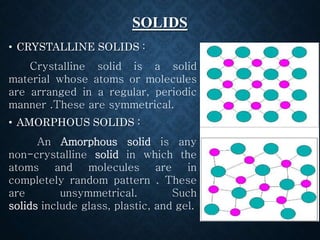
• CRYSTALLINE SOLIDS :
Crystalline solid is a solid
material whose atoms or molecules
are arranged in a regular, periodic
manner .These are symmetrical.
• AMORPHOUS SOLIDS :
An Amorphous solid is any
non-crystalline solid in which the
atoms and molecules are in
completely random pattern . These
are unsymmetrical. Such
solids include glass, plastic, and gel.
CRYSTALLINITY
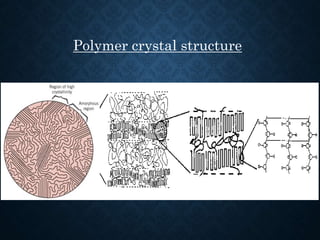
• Polymer exists both in crystalline and amorphous form.
In polymer molecule part of molecules are arranged in
regular order, these regions are called crystalline
regions. In between these ordered regions molecules are
arranged in random disorganized state and these are
called amorphous region.
• Crystallinity is
indication of amount
of crystalline region
in polymer with
respect to
amorphous content.
Polymer crystal structure
CRYSTALLISABLITY
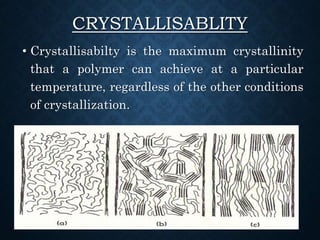
• Crystallisabilty is the maximum crystallinity
that a polymer can achieve at a particular
temperature, regardless of the other conditions
of crystallization.
Crystallisability at a particular temperature
depends on
a)Nature of the macromolecular chain
• Harder the polymer greater the crystallinity
• Intermolecular forces
b)Molecular weight and molecular weight
distribution
• Narrow molecular weight, and high molecular weight
increase the crystallinity.
c)Rate of cooling,
d)Residance time,
e) Temperature of molten polymer,
f) rate of crystal growth,
FACTOR AFFECTING CRYSTALLISABILITY
Linear polyethylene has highly regular configuration whose
crystallinity 90% branched polyethylene has 40% crystallinity
So it also depends on pattern of branching.
1 )Geometrical regularity:-
a) linear and branched structure :-
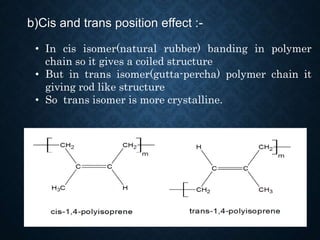
b)Cis and trans position effect :-
• In cis isomer(natural rubber) banding in polymer
chain so it gives a coiled structure
• But in trans isomer(gutta-percha) polymer chain it
giving rod like structure
• So trans isomer is more crystalline.
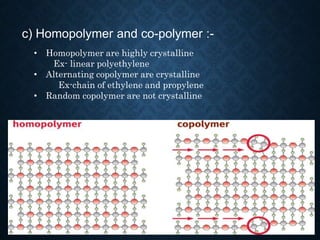
c) Homopolymer and co-polymer :-
• Homopolymer are highly crystalline
Ex- linear polyethylene
• Alternating copolymer are crystalline
Ex-chain of ethylene and propylene
• Random copolymer are not crystalline
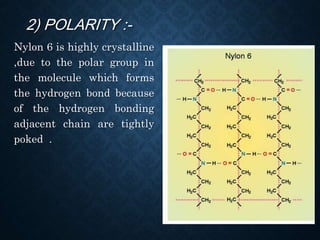
2) POLARITY :-
Nylon 6 is highly crystalline
,due to the polar group in
the molecule which forms
the hydrogen bond because
of the hydrogen bonding
adjacent chain are tightly
poked .
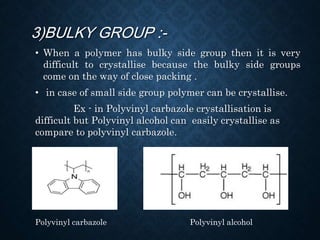
3)BULKY GROUP :-
• When a polymer has bulky side group then it is very
difficult to crystallise because the bulky side groups
come on the way of close packing .
• in case of small side group polymer can be crystallise.
Ex - in Polyvinyl carbazole crystallisation is
difficult but Polyvinyl alcohol can easily crystallise as
compare to polyvinyl carbazole.
Polyvinyl carbazole Polyvinyl alcohol
Crystallisability in polymer

Crystallisability in polymer

  • 1.
    DEPARTMENT OF NANOSCIENCE AND MATERIALS, CENTRAL UNIVERSITY OF JAMMU,J&K CRYSTALLLISABILITY AND FACTORS AFFECT By Lokanath mohapatra M.Sc. In Material Science &Tech. Guided By Dr. Pawan Kumar Assistant Professor
  • 2.
    CONTENT : • SOLIDS •CRYSTALLINITY • CRYSTALLISABLITY • FACTORS AFFECTING CRYSTALLISABILITY
  • 3.
    SOLIDS • CRYSTALLINE SOLIDS: Crystalline solid is a solid material whose atoms or molecules are arranged in a regular, periodic manner .These are symmetrical. • AMORPHOUS SOLIDS : An Amorphous solid is any non-crystalline solid in which the atoms and molecules are in completely random pattern . These are unsymmetrical. Such solids include glass, plastic, and gel.
  • 4.
    CRYSTALLINITY • Polymer existsboth in crystalline and amorphous form. In polymer molecule part of molecules are arranged in regular order, these regions are called crystalline regions. In between these ordered regions molecules are arranged in random disorganized state and these are called amorphous region. • Crystallinity is indication of amount of crystalline region in polymer with respect to amorphous content.
  • 5.
  • 6.
    CRYSTALLISABLITY • Crystallisabilty isthe maximum crystallinity that a polymer can achieve at a particular temperature, regardless of the other conditions of crystallization.
  • 7.
    Crystallisability at aparticular temperature depends on a)Nature of the macromolecular chain • Harder the polymer greater the crystallinity • Intermolecular forces b)Molecular weight and molecular weight distribution • Narrow molecular weight, and high molecular weight increase the crystallinity. c)Rate of cooling, d)Residance time, e) Temperature of molten polymer, f) rate of crystal growth,
  • 8.
    FACTOR AFFECTING CRYSTALLISABILITY Linearpolyethylene has highly regular configuration whose crystallinity 90% branched polyethylene has 40% crystallinity So it also depends on pattern of branching. 1 )Geometrical regularity:- a) linear and branched structure :-
  • 9.
    b)Cis and transposition effect :- • In cis isomer(natural rubber) banding in polymer chain so it gives a coiled structure • But in trans isomer(gutta-percha) polymer chain it giving rod like structure • So trans isomer is more crystalline.
  • 10.
    c) Homopolymer andco-polymer :- • Homopolymer are highly crystalline Ex- linear polyethylene • Alternating copolymer are crystalline Ex-chain of ethylene and propylene • Random copolymer are not crystalline
  • 11.
    2) POLARITY :- Nylon6 is highly crystalline ,due to the polar group in the molecule which forms the hydrogen bond because of the hydrogen bonding adjacent chain are tightly poked .
  • 12.
    3)BULKY GROUP :- •When a polymer has bulky side group then it is very difficult to crystallise because the bulky side groups come on the way of close packing . • in case of small side group polymer can be crystallise. Ex - in Polyvinyl carbazole crystallisation is difficult but Polyvinyl alcohol can easily crystallise as compare to polyvinyl carbazole. Polyvinyl carbazole Polyvinyl alcohol