© 2013 International Business Machines Corporation 1
Jeff Stuecheli
IBM Power Systems
IBM Systems & Technology Group Development
POWER8
© 2013 International Business Machines Corporation 2
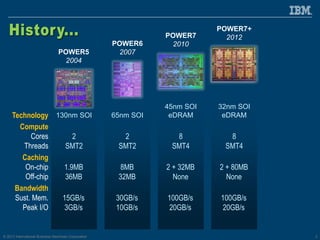
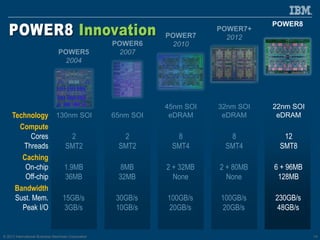
Technology
POWER5
2004
POWER6
2007
POWER7
2010
POWER7+
2012
Compute
Cores
Threads
Caching
On-chip
Off-chip
Bandwidth
Sust. Mem.
Peak I/O
130nm SOI 65nm SOI
45nm SOI
eDRAM
32nm SOI
eDRAM
2
SMT2
2
SMT2
8
SMT4
8
SMT4
1.9MB
36MB
8MB
32MB
2 + 32MB
None
2 + 80MB
None
15GB/s
3GB/s
30GB/s
10GB/s
100GB/s
20GB/s
100GB/s
20GB/s
© 2013 International Business Machines Corporation 3
Technology
POWER5
2004
POWER8
POWER6
2007
POWER7
2010
POWER7+
2012
Compute
Cores
Threads
Caching
On-chip
Off-chip
Bandwidth
Sust. Mem.
Peak I/O
130nm SOI 65nm SOI
45nm SOI
eDRAM
32nm SOI
eDRAM
2
SMT2
2
SMT2
8
SMT4
8
SMT4
1.9MB
36MB
8MB
32MB
2 + 32MB
None
2 + 80MB
None
15GB/s
3GB/s
30GB/s
10GB/s
100GB/s
20GB/s
100GB/s
20GB/s
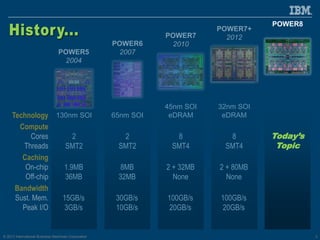
Today’s
Topic
© 2013 International Business Machines Corporation 4
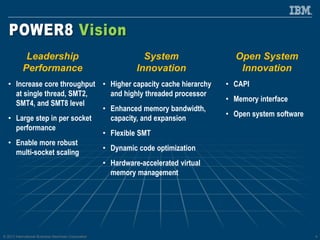
Leadership
Performance
• Increase core throughput
at single thread, SMT2,
SMT4, and SMT8 level
• Large step in per socket
performance
• Enable more robust
multi-socket scaling
System
Innovation
• Higher capacity cache hierarchy
and highly threaded processor
• Enhanced memory bandwidth,
capacity, and expansion
• Flexible SMT
• Dynamic code optimization
• Hardware-accelerated virtual
memory management
Open System
Innovation
• CAPI
• Memory interface
• Open system software
© 2013 International Business Machines Corporation 5
Caches
• 512 KB SRAM L2 / core
• 96 MB eDRAM shared L3
• Up to 128 MB eDRAM L4
(off-chip)
Memory
• Up to 230 GB/s
sustained bandwidth
Bus Interfaces
• Durable open memory
attach interface
• Integrated PCIe Gen3
• SMP Interconnect
• CAPI (Coherent
Accelerator Processor
Interface)
Cores
• 12 cores (SMT8)
• 8 dispatch, 10 issue,
16 exec pipe
• 2X internal data
flows/queues
• Enhanced prefetching
• 64K data cache,
32K instruction cache
Accelerators
• Crypto & memory
expansion
• Transactional Memory
• VMM assist
• Data Move / VM Mobility Energy Management
• On-chip Power Management Micro-controller
• Integrated Per-core VRM
• Critical Path Monitors
Technology
• 22nm SOI, eDRAM, 15 ML 650mm2
Core
L2
Core
L2
Core
L2
Core
L2
Core
L2
Core
L2
Core
L2
Core
L2
Core
L2
Core
L2
Core
L2
Core
L2
L3 Cache & Chip Interconnect
8M L3
Region
Mem. Ctrl.
Mem. Ctrl.
Local
SMP
Links
Accelerators
Local
SMP
Links
Accelerators
© 2013 International Business Machines Corporation 6
VSU
FXU
IFU
DFU
ISU
LSU
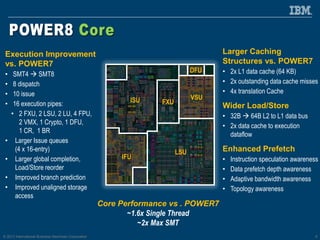
Larger Caching
Structures vs. POWER7
• 2x L1 data cache (64 KB)
• 2x outstanding data cache misses
• 4x translation Cache
Wider Load/Store
• 32B  64B L2 to L1 data bus
• 2x data cache to execution
dataflow
Enhanced Prefetch
• Instruction speculation awareness
• Data prefetch depth awareness
• Adaptive bandwidth awareness
• Topology awareness
Execution Improvement
vs. POWER7
• SMT4  SMT8
• 8 dispatch
• 10 issue
• 16 execution pipes:
• 2 FXU, 2 LSU, 2 LU, 4 FPU,
2 VMX, 1 Crypto, 1 DFU,
1 CR, 1 BR
• Larger Issue queues
(4 x 16-entry)
• Larger global completion,
Load/Store reorder
• Improved branch prediction
• Improved unaligned storage
access
Core Performance vs . POWER7
~1.6x Single Thread
~2x Max SMT
© 2013 International Business Machines Corporation 7
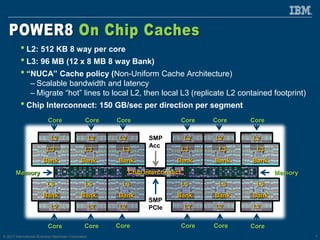
• L2: 512 KB 8 way per core
• L3: 96 MB (12 x 8 MB 8 way Bank)
• “NUCA” Cache policy (Non-Uniform Cache Architecture)
– Scalable bandwidth and latency
– Migrate “hot” lines to local L2, then local L3 (replicate L2 contained footprint)
• Chip Interconnect: 150 GB/sec per direction per segment
L2
L2 L2 L2
L2 L2 L2 L2
L2 L2
L2
L2
L3
Bank
L3
Bank
L3
Bank
L3
Bank
L3
Bank
L3
Bank
L3
Bank
L3
Bank
L3
Bank
L3
Bank
L3
Bank
L3
Bank
Chip Interconnect
Memory Memory
Core Core Core
SMP
Acc
Core Core
Core
Core
Core
Core
Core
Core
SMP
PCIe
Core
© 2013 International Business Machines Corporation 8
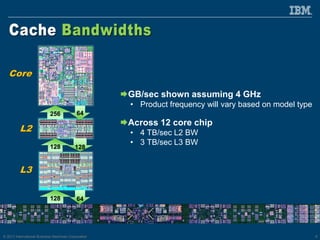
GB/sec shown assuming 4 GHz
• Product frequency will vary based on model type
Across 12 core chip
• 4 TB/sec L2 BW
• 3 TB/sec L3 BW
Core
L2
L3
128 128
256
64
128
64
© 2013 International Business Machines Corporation 9
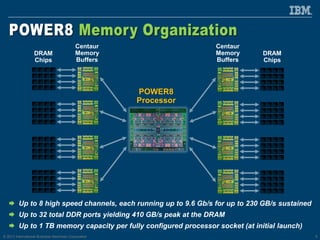
POWER8
Processor
Centaur
Memory
Buffers
DRAM
Chips
 Up to 8 high speed channels, each running up to 9.6 Gb/s for up to 230 GB/s sustained
 Up to 32 total DDR ports yielding 410 GB/s peak at the DRAM
 Up to 1 TB memory capacity per fully configured processor socket (at initial launch)
Centaur
Memory
Buffers
DRAM
Chips
© 2013 International Business Machines Corporation 10
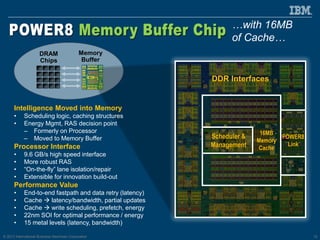
…with 16MB
of Cache…
Memory
Buffer
DRAM
Chips
DDR Interfaces
POWER8
Link
Scheduler &
Management
16MB
Memory
Cache
Intelligence Moved into Memory
• Scheduling logic, caching structures
• Energy Mgmt, RAS decision point
– Formerly on Processor
– Moved to Memory Buffer
Processor Interface
• 9.6 GB/s high speed interface
• More robust RAS
• “On-the-fly” lane isolation/repair
• Extensible for innovation build-out
Performance Value
• End-to-end fastpath and data retry (latency)
• Cache  latency/bandwidth, partial updates
• Cache  write scheduling, prefetch, energy
• 22nm SOI for optimal performance / energy
• 15 metal levels (latency, bandwidth)
© 2013 International Business Machines Corporation 11
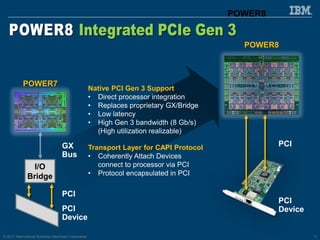
POWER7
I/O
Bridge
GX
Bus
PCI
PCI
Device
POWER8
PCI
PCI
Device
Native PCI Gen 3 Support
• Direct processor integration
• Replaces proprietary GX/Bridge
• Low latency
• High Gen 3 bandwidth (8 Gb/s)
(High utilization realizable)
Transport Layer for CAPI Protocol
• Coherently Attach Devices
connect to processor via PCI
• Protocol encapsulated in PCI
POWER8
© 2013 International Business Machines Corporation 12
Custom
Hardware
Application
POWER8
CAPP
Coherence Bus
PSL
FPGA or ASIC
Customizable Hardware
Application Accelerator
• Specific system SW, middleware,
or user application
• Written to durable interface
provided by PSL
POWER8
PCI Gen 3
Transport for encapsulated messages
Processor Service Layer (PSL)
• Present robust, durable interfaces to applications
• Offload complexity / content from CAPP
Virtual Addressing
• Accelerator can work with same memory addresses that the
processors use
• Pointers de-referenced same as the host application
• Removes OS & device driver overhead
Hardware Managed Cache Coherence
• Enables the accelerator to participate in “Locks” as a normal
thread Lowers Latency over IO communication model
© 2013 International Business Machines Corporation 13
0
0.5
1
1.5
2
2.5
3
POWER7+
baseline
Memory
Bandwidth
Commercial Java Integer Floating
Point
© 2013 International Business Machines Corporation 14
POWER5
2004
POWER6
2007
POWER7
2010
POWER7+
2012
130nm SOI 65nm SOI
45nm SOI
eDRAM
32nm SOI
eDRAM
2
SMT2
2
SMT2
8
SMT4
8
SMT4
1.9MB
36MB
8MB
32MB
2 + 32MB
None
2 + 80MB
None
15GB/s
3GB/s
30GB/s
10GB/s
100GB/s
20GB/s
100GB/s
20GB/s
Technology
Compute
Cores
Threads
Caching
On-chip
Off-chip
Bandwidth
Sust. Mem.
Peak I/O
POWER8
22nm SOI
eDRAM
12
SMT8
6 + 96MB
128MB
230GB/s
48GB/s
© 2013 International Business Machines Corporation 15
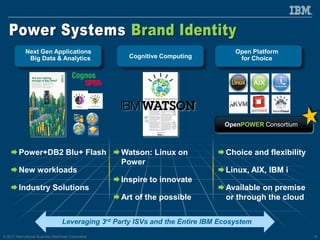
Next Gen Applications
Big Data & Analytics Cognitive Computing
Open Platform
for Choice
Leveraging 3rd Party ISVs and the Entire IBM Ecosystem
Power+DB2 Blu+ Flash
New workloads
Industry Solutions
Watson: Linux on
Power
Inspire to innovate
Art of the possible
Choice and flexibility
Linux, AIX, IBM i
Available on premise
or through the cloud
OpenPOWER Consortium
© 2013 International Business Machines Corporation 16
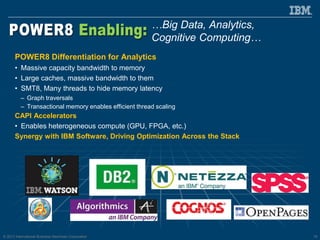
…Big Data, Analytics,
Cognitive Computing…
POWER8 Differentiation for Analytics
• Massive capacity bandwidth to memory
• Large caches, massive bandwidth to them
• SMT8, Many threads to hide memory latency
– Graph traversals
– Transactional memory enables efficient thread scaling
CAPI Accelerators
• Enables heterogeneous compute (GPU, FPGA, etc.)
Synergy with IBM Software, Driving Optimization Across the Stack
© 2013 International Business Machines Corporation 17
Significant Performance at Thread, Core, and System
Optimization for VM Density & Efficiency
Strong Enablement of Autonomic System Optimization
Excellent Big Data Analytics Capability
© 2013 International Business Machines Corporation 18
Thank You!
© 2013 International Business Machines Corporation 19
This document was developed for IBM offerings in the United States as of the date of publication. IBM may not make these offerings available in
other countries, and the information is subject to change without notice. Consult your local IBM business contact for information on the IBM
offerings available in your area.
Information in this document concerning non-IBM products was obtained from the suppliers of these products or other public sources. Questions
on the capabilities of non-IBM products should be addressed to the suppliers of those products.
IBM may have patents or pending patent applications covering subject matter in this document. The furnishing of this document does not give
you any license to these patents. Send license inquires, in writing, to IBM Director of Licensing, IBM Corporation, New Castle Drive, Armonk, NY
10504-1785 USA.
All statements regarding IBM future direction and intent are subject to change or withdrawal without notice, and represent goals and objectives
only.
The information contained in this document has not been submitted to any formal IBM test and is provided "AS IS" with no warranties or
guarantees either expressed or implied.
All examples cited or described in this document are presented as illustrations of the manner in which some IBM products can be used and the
results that may be achieved. Actual environmental costs and performance characteristics will vary depending on individual client configurations
and conditions.
IBM Global Financing offerings are provided through IBM Credit Corporation in the United States and other IBM subsidiaries and divisions
worldwide to qualified commercial and government clients. Rates are based on a client's credit rating, financing terms, offering type, equipment
type and options, and may vary by country. Other restrictions may apply. Rates and offerings are subject to change, extension or withdrawal
without notice.
IBM is not responsible for printing errors in this document that result in pricing or information inaccuracies.
IBM hardware products are manufactured from new parts, or new and serviceable used parts. Regardless, our warranty terms apply.
Any performance data contained in this document was determined in a controlled environment. Actual results may vary significantly and are
dependent on many factors including system hardware configuration and software design and configuration. Some measurements quoted in this
document may have been made on development-level systems. There is no guarantee these measurements will be the same on generally-
available systems. Some measurements quoted in this document may have been estimated through extrapolation. Users of this document
should verify the applicable data for their specific environment.
Revised September 26, 2006
Special notices
© 2013 International Business Machines Corporation 20
IBM, the IBM logo, ibm.com AIX, AIX (logo), AIX 5L, AIX 6 (logo), AS/400, BladeCenter, Blue Gene, ClusterProven, DB2, ESCON, i5/OS, i5/OS (logo), IBM Business
Partner (logo), IntelliStation, LoadLeveler, Lotus, Lotus Notes, Notes, Operating System/400, OS/400, PartnerLink, PartnerWorld, PowerPC, pSeries, Rational, RISC
System/6000, RS/6000, THINK, Tivoli, Tivoli (logo), Tivoli Management Environment, WebSphere, xSeries, z/OS, zSeries, Active Memory, Balanced Warehouse,
CacheFlow, Cool Blue, IBM Watson, IBM Systems Director VMControl, pureScale, TurboCore, Chiphopper, Cloudscape, DB2 Universal Database, DS4000, DS6000,
DS8000, EnergyScale, Enterprise Workload Manager, General Parallel File System, , GPFS, HACMP, HACMP/6000, HASM, IBM Systems Director Active Energy
Manager, iSeries, Micro-Partitioning, POWER, PowerLinux, PowerExecutive, PowerVM, PowerVM (logo), PowerHA, Power Architecture, Power Everywhere, Power
Family, POWER Hypervisor, Power Systems, Power Systems (logo), Power Systems Software, Power Systems Software (logo), POWER2, POWER3, POWER4,
POWER4+, POWER5, POWER5+, POWER6, POWER6+, POWER7, POWER7+, Systems, System i, System p, System p5, System Storage, System z, TME 10,
Workload Partitions Manager and X-Architecture are trademarks or registered trademarks of International Business Machines Corporation in the United States, other
countries, or both. If these and other IBM trademarked terms are marked on their first occurrence in this information with a trademark symbol (® or ™), these symbols
indicate U.S. registered or common law trademarks owned by IBM at the time this information was published. Such trademarks may also be registered or common law
trademarks in other countries.
A full list of U.S. trademarks owned by IBM may be found at: http://www.ibm.com/legal/copytrade.shtml.
Adobe, the Adobe logo, PostScript, and the PostScript logo are either registered trademarks or trademarks of Adobe Systems Incorporated in the United States, and/or
other countries.
AltiVec is a trademark of Freescale Semiconductor, Inc.
AMD Opteron is a trademark of Advanced Micro Devices, Inc.
InfiniBand, InfiniBand Trade Association and the InfiniBand design marks are trademarks and/or service marks of the InfiniBand Trade Association.
Intel, Intel logo, Intel Inside, Intel Inside logo, Intel Centrino, Intel Centrino logo, Celeron, Intel Xeon, Intel SpeedStep, Itanium, and Pentium are trademarks or registered
trademarks of Intel Corporation or its subsidiaries in the United States and other countries.
IT Infrastructure Library is a registered trademark of the Central Computer and Telecommunications Agency which is now part of the Office of Government Commerce.
Java and all Java-based trademarks and logos are trademarks or registered trademarks of Oracle and/or its affiliates.
Linear Tape-Open, LTO, the LTO Logo, Ultrium, and the Ultrium logo are trademarks of HP, IBM Corp. and Quantum in the U.S. and other countries.
Linux is a registered trademark of Linus Torvalds in the United States, other countries or both.
PowerLinux™ uses the registered trademark Linux® pursuant to a sublicense from LMI, the exclusive licensee of Linus Torvalds, owner of the Linux® mark on a world-
wide basis.
Microsoft, Windows and the Windows logo are registered trademarks of Microsoft Corporation in the United States, other countries or both.
NetBench is a registered trademark of Ziff Davis Media in the United States, other countries or both.
SPECint, SPECfp, SPECjbb, SPECweb, SPECjAppServer, SPEC OMP, SPECviewperf, SPECapc, SPEChpc, SPECjvm, SPECmail, SPECimap and SPECsfs are
trademarks of the Standard Performance Evaluation Corp (SPEC).
The Power Architecture and Power.org wordmarks and the Power and Power.org logos and related marks are trademarks and service marks licensed by Power.org.
TPC-C and TPC-H are trademarks of the Transaction Performance Processing Council (TPPC).
UNIX is a registered trademark of The Open Group in the United States, other countries or both.
Other company, product and service names may be trademarks or service marks of others.
Revised November 28, 2012
Special notices (cont.)

IBM POWER8 Systems Technology Group Development

  • 1.
    © 2013 InternationalBusiness Machines Corporation 1 Jeff Stuecheli IBM Power Systems IBM Systems & Technology Group Development POWER8
  • 2.
    © 2013 InternationalBusiness Machines Corporation 2 Technology POWER5 2004 POWER6 2007 POWER7 2010 POWER7+ 2012 Compute Cores Threads Caching On-chip Off-chip Bandwidth Sust. Mem. Peak I/O 130nm SOI 65nm SOI 45nm SOI eDRAM 32nm SOI eDRAM 2 SMT2 2 SMT2 8 SMT4 8 SMT4 1.9MB 36MB 8MB 32MB 2 + 32MB None 2 + 80MB None 15GB/s 3GB/s 30GB/s 10GB/s 100GB/s 20GB/s 100GB/s 20GB/s
  • 3.
    © 2013 InternationalBusiness Machines Corporation 3 Technology POWER5 2004 POWER8 POWER6 2007 POWER7 2010 POWER7+ 2012 Compute Cores Threads Caching On-chip Off-chip Bandwidth Sust. Mem. Peak I/O 130nm SOI 65nm SOI 45nm SOI eDRAM 32nm SOI eDRAM 2 SMT2 2 SMT2 8 SMT4 8 SMT4 1.9MB 36MB 8MB 32MB 2 + 32MB None 2 + 80MB None 15GB/s 3GB/s 30GB/s 10GB/s 100GB/s 20GB/s 100GB/s 20GB/s Today’s Topic
  • 4.
    © 2013 InternationalBusiness Machines Corporation 4 Leadership Performance • Increase core throughput at single thread, SMT2, SMT4, and SMT8 level • Large step in per socket performance • Enable more robust multi-socket scaling System Innovation • Higher capacity cache hierarchy and highly threaded processor • Enhanced memory bandwidth, capacity, and expansion • Flexible SMT • Dynamic code optimization • Hardware-accelerated virtual memory management Open System Innovation • CAPI • Memory interface • Open system software
  • 5.
    © 2013 InternationalBusiness Machines Corporation 5 Caches • 512 KB SRAM L2 / core • 96 MB eDRAM shared L3 • Up to 128 MB eDRAM L4 (off-chip) Memory • Up to 230 GB/s sustained bandwidth Bus Interfaces • Durable open memory attach interface • Integrated PCIe Gen3 • SMP Interconnect • CAPI (Coherent Accelerator Processor Interface) Cores • 12 cores (SMT8) • 8 dispatch, 10 issue, 16 exec pipe • 2X internal data flows/queues • Enhanced prefetching • 64K data cache, 32K instruction cache Accelerators • Crypto & memory expansion • Transactional Memory • VMM assist • Data Move / VM Mobility Energy Management • On-chip Power Management Micro-controller • Integrated Per-core VRM • Critical Path Monitors Technology • 22nm SOI, eDRAM, 15 ML 650mm2 Core L2 Core L2 Core L2 Core L2 Core L2 Core L2 Core L2 Core L2 Core L2 Core L2 Core L2 Core L2 L3 Cache & Chip Interconnect 8M L3 Region Mem. Ctrl. Mem. Ctrl. Local SMP Links Accelerators Local SMP Links Accelerators
  • 6.
    © 2013 InternationalBusiness Machines Corporation 6 VSU FXU IFU DFU ISU LSU Larger Caching Structures vs. POWER7 • 2x L1 data cache (64 KB) • 2x outstanding data cache misses • 4x translation Cache Wider Load/Store • 32B  64B L2 to L1 data bus • 2x data cache to execution dataflow Enhanced Prefetch • Instruction speculation awareness • Data prefetch depth awareness • Adaptive bandwidth awareness • Topology awareness Execution Improvement vs. POWER7 • SMT4  SMT8 • 8 dispatch • 10 issue • 16 execution pipes: • 2 FXU, 2 LSU, 2 LU, 4 FPU, 2 VMX, 1 Crypto, 1 DFU, 1 CR, 1 BR • Larger Issue queues (4 x 16-entry) • Larger global completion, Load/Store reorder • Improved branch prediction • Improved unaligned storage access Core Performance vs . POWER7 ~1.6x Single Thread ~2x Max SMT
  • 7.
    © 2013 InternationalBusiness Machines Corporation 7 • L2: 512 KB 8 way per core • L3: 96 MB (12 x 8 MB 8 way Bank) • “NUCA” Cache policy (Non-Uniform Cache Architecture) – Scalable bandwidth and latency – Migrate “hot” lines to local L2, then local L3 (replicate L2 contained footprint) • Chip Interconnect: 150 GB/sec per direction per segment L2 L2 L2 L2 L2 L2 L2 L2 L2 L2 L2 L2 L3 Bank L3 Bank L3 Bank L3 Bank L3 Bank L3 Bank L3 Bank L3 Bank L3 Bank L3 Bank L3 Bank L3 Bank Chip Interconnect Memory Memory Core Core Core SMP Acc Core Core Core Core Core Core Core Core SMP PCIe Core
  • 8.
    © 2013 InternationalBusiness Machines Corporation 8 GB/sec shown assuming 4 GHz • Product frequency will vary based on model type Across 12 core chip • 4 TB/sec L2 BW • 3 TB/sec L3 BW Core L2 L3 128 128 256 64 128 64
  • 9.
    © 2013 InternationalBusiness Machines Corporation 9 POWER8 Processor Centaur Memory Buffers DRAM Chips  Up to 8 high speed channels, each running up to 9.6 Gb/s for up to 230 GB/s sustained  Up to 32 total DDR ports yielding 410 GB/s peak at the DRAM  Up to 1 TB memory capacity per fully configured processor socket (at initial launch) Centaur Memory Buffers DRAM Chips
  • 10.
    © 2013 InternationalBusiness Machines Corporation 10 …with 16MB of Cache… Memory Buffer DRAM Chips DDR Interfaces POWER8 Link Scheduler & Management 16MB Memory Cache Intelligence Moved into Memory • Scheduling logic, caching structures • Energy Mgmt, RAS decision point – Formerly on Processor – Moved to Memory Buffer Processor Interface • 9.6 GB/s high speed interface • More robust RAS • “On-the-fly” lane isolation/repair • Extensible for innovation build-out Performance Value • End-to-end fastpath and data retry (latency) • Cache  latency/bandwidth, partial updates • Cache  write scheduling, prefetch, energy • 22nm SOI for optimal performance / energy • 15 metal levels (latency, bandwidth)
  • 11.
    © 2013 InternationalBusiness Machines Corporation 11 POWER7 I/O Bridge GX Bus PCI PCI Device POWER8 PCI PCI Device Native PCI Gen 3 Support • Direct processor integration • Replaces proprietary GX/Bridge • Low latency • High Gen 3 bandwidth (8 Gb/s) (High utilization realizable) Transport Layer for CAPI Protocol • Coherently Attach Devices connect to processor via PCI • Protocol encapsulated in PCI POWER8
  • 12.
    © 2013 InternationalBusiness Machines Corporation 12 Custom Hardware Application POWER8 CAPP Coherence Bus PSL FPGA or ASIC Customizable Hardware Application Accelerator • Specific system SW, middleware, or user application • Written to durable interface provided by PSL POWER8 PCI Gen 3 Transport for encapsulated messages Processor Service Layer (PSL) • Present robust, durable interfaces to applications • Offload complexity / content from CAPP Virtual Addressing • Accelerator can work with same memory addresses that the processors use • Pointers de-referenced same as the host application • Removes OS & device driver overhead Hardware Managed Cache Coherence • Enables the accelerator to participate in “Locks” as a normal thread Lowers Latency over IO communication model
  • 13.
    © 2013 InternationalBusiness Machines Corporation 13 0 0.5 1 1.5 2 2.5 3 POWER7+ baseline Memory Bandwidth Commercial Java Integer Floating Point
  • 14.
    © 2013 InternationalBusiness Machines Corporation 14 POWER5 2004 POWER6 2007 POWER7 2010 POWER7+ 2012 130nm SOI 65nm SOI 45nm SOI eDRAM 32nm SOI eDRAM 2 SMT2 2 SMT2 8 SMT4 8 SMT4 1.9MB 36MB 8MB 32MB 2 + 32MB None 2 + 80MB None 15GB/s 3GB/s 30GB/s 10GB/s 100GB/s 20GB/s 100GB/s 20GB/s Technology Compute Cores Threads Caching On-chip Off-chip Bandwidth Sust. Mem. Peak I/O POWER8 22nm SOI eDRAM 12 SMT8 6 + 96MB 128MB 230GB/s 48GB/s
  • 15.
    © 2013 InternationalBusiness Machines Corporation 15 Next Gen Applications Big Data & Analytics Cognitive Computing Open Platform for Choice Leveraging 3rd Party ISVs and the Entire IBM Ecosystem Power+DB2 Blu+ Flash New workloads Industry Solutions Watson: Linux on Power Inspire to innovate Art of the possible Choice and flexibility Linux, AIX, IBM i Available on premise or through the cloud OpenPOWER Consortium
  • 16.
    © 2013 InternationalBusiness Machines Corporation 16 …Big Data, Analytics, Cognitive Computing… POWER8 Differentiation for Analytics • Massive capacity bandwidth to memory • Large caches, massive bandwidth to them • SMT8, Many threads to hide memory latency – Graph traversals – Transactional memory enables efficient thread scaling CAPI Accelerators • Enables heterogeneous compute (GPU, FPGA, etc.) Synergy with IBM Software, Driving Optimization Across the Stack
  • 17.
    © 2013 InternationalBusiness Machines Corporation 17 Significant Performance at Thread, Core, and System Optimization for VM Density & Efficiency Strong Enablement of Autonomic System Optimization Excellent Big Data Analytics Capability
  • 18.
    © 2013 InternationalBusiness Machines Corporation 18 Thank You!
  • 19.
    © 2013 InternationalBusiness Machines Corporation 19 This document was developed for IBM offerings in the United States as of the date of publication. IBM may not make these offerings available in other countries, and the information is subject to change without notice. Consult your local IBM business contact for information on the IBM offerings available in your area. Information in this document concerning non-IBM products was obtained from the suppliers of these products or other public sources. Questions on the capabilities of non-IBM products should be addressed to the suppliers of those products. IBM may have patents or pending patent applications covering subject matter in this document. The furnishing of this document does not give you any license to these patents. Send license inquires, in writing, to IBM Director of Licensing, IBM Corporation, New Castle Drive, Armonk, NY 10504-1785 USA. All statements regarding IBM future direction and intent are subject to change or withdrawal without notice, and represent goals and objectives only. The information contained in this document has not been submitted to any formal IBM test and is provided "AS IS" with no warranties or guarantees either expressed or implied. All examples cited or described in this document are presented as illustrations of the manner in which some IBM products can be used and the results that may be achieved. Actual environmental costs and performance characteristics will vary depending on individual client configurations and conditions. IBM Global Financing offerings are provided through IBM Credit Corporation in the United States and other IBM subsidiaries and divisions worldwide to qualified commercial and government clients. Rates are based on a client's credit rating, financing terms, offering type, equipment type and options, and may vary by country. Other restrictions may apply. Rates and offerings are subject to change, extension or withdrawal without notice. IBM is not responsible for printing errors in this document that result in pricing or information inaccuracies. IBM hardware products are manufactured from new parts, or new and serviceable used parts. Regardless, our warranty terms apply. Any performance data contained in this document was determined in a controlled environment. Actual results may vary significantly and are dependent on many factors including system hardware configuration and software design and configuration. Some measurements quoted in this document may have been made on development-level systems. There is no guarantee these measurements will be the same on generally- available systems. Some measurements quoted in this document may have been estimated through extrapolation. Users of this document should verify the applicable data for their specific environment. Revised September 26, 2006 Special notices
  • 20.
    © 2013 InternationalBusiness Machines Corporation 20 IBM, the IBM logo, ibm.com AIX, AIX (logo), AIX 5L, AIX 6 (logo), AS/400, BladeCenter, Blue Gene, ClusterProven, DB2, ESCON, i5/OS, i5/OS (logo), IBM Business Partner (logo), IntelliStation, LoadLeveler, Lotus, Lotus Notes, Notes, Operating System/400, OS/400, PartnerLink, PartnerWorld, PowerPC, pSeries, Rational, RISC System/6000, RS/6000, THINK, Tivoli, Tivoli (logo), Tivoli Management Environment, WebSphere, xSeries, z/OS, zSeries, Active Memory, Balanced Warehouse, CacheFlow, Cool Blue, IBM Watson, IBM Systems Director VMControl, pureScale, TurboCore, Chiphopper, Cloudscape, DB2 Universal Database, DS4000, DS6000, DS8000, EnergyScale, Enterprise Workload Manager, General Parallel File System, , GPFS, HACMP, HACMP/6000, HASM, IBM Systems Director Active Energy Manager, iSeries, Micro-Partitioning, POWER, PowerLinux, PowerExecutive, PowerVM, PowerVM (logo), PowerHA, Power Architecture, Power Everywhere, Power Family, POWER Hypervisor, Power Systems, Power Systems (logo), Power Systems Software, Power Systems Software (logo), POWER2, POWER3, POWER4, POWER4+, POWER5, POWER5+, POWER6, POWER6+, POWER7, POWER7+, Systems, System i, System p, System p5, System Storage, System z, TME 10, Workload Partitions Manager and X-Architecture are trademarks or registered trademarks of International Business Machines Corporation in the United States, other countries, or both. If these and other IBM trademarked terms are marked on their first occurrence in this information with a trademark symbol (® or ™), these symbols indicate U.S. registered or common law trademarks owned by IBM at the time this information was published. Such trademarks may also be registered or common law trademarks in other countries. A full list of U.S. trademarks owned by IBM may be found at: http://www.ibm.com/legal/copytrade.shtml. Adobe, the Adobe logo, PostScript, and the PostScript logo are either registered trademarks or trademarks of Adobe Systems Incorporated in the United States, and/or other countries. AltiVec is a trademark of Freescale Semiconductor, Inc. AMD Opteron is a trademark of Advanced Micro Devices, Inc. InfiniBand, InfiniBand Trade Association and the InfiniBand design marks are trademarks and/or service marks of the InfiniBand Trade Association. Intel, Intel logo, Intel Inside, Intel Inside logo, Intel Centrino, Intel Centrino logo, Celeron, Intel Xeon, Intel SpeedStep, Itanium, and Pentium are trademarks or registered trademarks of Intel Corporation or its subsidiaries in the United States and other countries. IT Infrastructure Library is a registered trademark of the Central Computer and Telecommunications Agency which is now part of the Office of Government Commerce. Java and all Java-based trademarks and logos are trademarks or registered trademarks of Oracle and/or its affiliates. Linear Tape-Open, LTO, the LTO Logo, Ultrium, and the Ultrium logo are trademarks of HP, IBM Corp. and Quantum in the U.S. and other countries. Linux is a registered trademark of Linus Torvalds in the United States, other countries or both. PowerLinux™ uses the registered trademark Linux® pursuant to a sublicense from LMI, the exclusive licensee of Linus Torvalds, owner of the Linux® mark on a world- wide basis. Microsoft, Windows and the Windows logo are registered trademarks of Microsoft Corporation in the United States, other countries or both. NetBench is a registered trademark of Ziff Davis Media in the United States, other countries or both. SPECint, SPECfp, SPECjbb, SPECweb, SPECjAppServer, SPEC OMP, SPECviewperf, SPECapc, SPEChpc, SPECjvm, SPECmail, SPECimap and SPECsfs are trademarks of the Standard Performance Evaluation Corp (SPEC). The Power Architecture and Power.org wordmarks and the Power and Power.org logos and related marks are trademarks and service marks licensed by Power.org. TPC-C and TPC-H are trademarks of the Transaction Performance Processing Council (TPPC). UNIX is a registered trademark of The Open Group in the United States, other countries or both. Other company, product and service names may be trademarks or service marks of others. Revised November 28, 2012 Special notices (cont.)