Production
Part
Approval
Process
Divisional Quality
By
PPAP
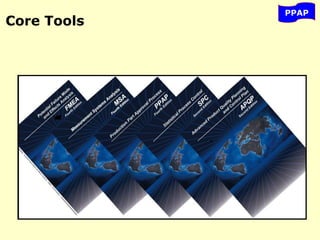
Core Tools
PPAP
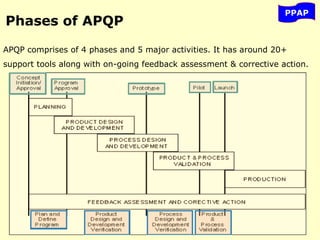
Phases of APQP
APQP comprises of 4 phases and 5 major activities. It has around 20+
support tools along with on-going feedback assessment & corrective action.
PPAP
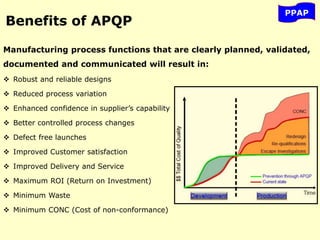
Benefits of APQP
Manufacturing process functions that are clearly planned, validated,
documented and communicated will result in:
 Robust and reliable designs
 Reduced process variation
 Enhanced confidence in supplier’s capability
 Better controlled process changes
 Defect free launches
 Improved Customer satisfaction
 Improved Delivery and Service
 Maximum ROI (Return on Investment)
 Minimum Waste
 Minimum CONC (Cost of non-conformance)
PPAP
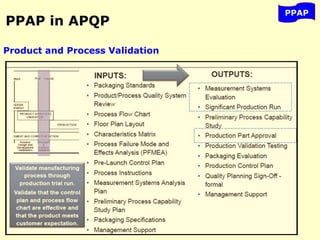
PPAP in APQP
Product and Process Validation
What is customer interaction ?
 Instead of merely talking to customers, listen to what
they say so you can accurately identify their needs and
help them find solutions.
 Through the course of a simple conversation, you may
discover that you offer a specific product or service that
would make your customer's life more convenient.
 By offering that service, you raise the level of
satisfaction and successfully cross-sell for your
company at the same time.
 Each customer interaction is an opportunity to create a
good impression.
PPAP
Open to the forum
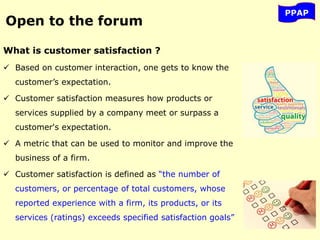
What is customer satisfaction ?
 Based on customer interaction, one gets to know the
customer’s expectation.
 Customer satisfaction measures how products or
services supplied by a company meet or surpass a
customer's expectation.
 A metric that can be used to monitor and improve the
business of a firm.
 Customer satisfaction is defined as “the number of
customers, or percentage of total customers, whose
reported experience with a firm, its products, or its
services (ratings) exceeds specified satisfaction goals”
PPAP
Open to the forum
What is PPAP
 Production Part Approval Process is a team oriented
approach that uses well established tools and techniques
to formally reduce risks prior to the release of a product
or service.
 This standard was initially developed by AIAG
(Automotive Industry Action GroChrysler & GMup) in
1993 based on the inputs given by the Big 3: Ford,.
 PPAP has now spread to many industries beyond
automotive
 PPAP manages change and ensures product conformance
thereby enhancing customer satisfaction
PPAP
Risk
High Risk
 Parts associated with multiple critical features, complex
design or high end technology that is not yet established
in the general manufacturing environment.
Medium Risk
 Parts that have at least one critical feature
Low Risk
 Parts that have no critical features & can be manufactured
by any manufacturer in commodity category.
 Supplier’s quality system & quality performance are
acceptable
PPAP
Purpose of PPAP
 To provide evidence that all customer
engineering design record and specification
requirements are properly understood by
the organization.
 To demonstrate that the manufacturing
process has the potential to produce
product that consistently meets all
requirements during an actual production
run at the quoted production rate.
 PPAP also helps in managing change and
ensures the conformance of the product to
customer’s requirement
PPAP
Submission of PPAP
 New part
 Engineering change(s)
 Tooling: transfer, replacement, refurbishment, or additional
 Correction of discrepancy
 Tooling inactive > one year
 Change to optional construction or material
 Sub-supplier or material source change
 Change in part processing
 Parts produced at a new or additional location
PPAP submission is required when there is any significant change
to product or process
PPAP
Significant Production Run
PPAP data must be submitted from a production run using:
 Production equipment and tooling
 Production employees
 Production rate
 Production process
Data should reflect upon actual production process to be used at start-up.
The significant production run shall be from one hour to 8 hours of
production, and with the specific production quantity to total a minimum of
300 consecutive parts, unless otherwise specified by the authorized
customer representative.
PPAP
PPAP Requirements
Design Records
Engineering Change Documents
Customer Engineering Approval, if required
Design Failure Modes and Effects Analysis (DFMEA)
Process Flow Diagram
Process Failure Modes and Effects Analysis (PFMEA)
Control Plan
Measurement Systems Analysis (MSA)
Dimensional Results
Material, Performance Test Results
Initial Process Studies
Qualified Laboratory Documentation
Appearance Approval Report (AAR) if applicable.
Sample Product
Master Sample
Checking Aids
Records of Compliance Customer-Specific Requirements
Part Submission Warrant (PSW)
PPAP
1
2
3
4
5
6
7
8
9
10
11
12
13
14
15
16
17
18
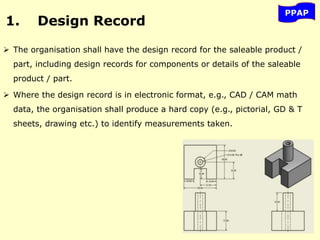
1. Design Record
 The organisation shall have the design record for the saleable product /
part, including design records for components or details of the saleable
product / part.
 Where the design record is in electronic format, e.g., CAD / CAM math
data, the organisation shall produce a hard copy (e.g., pictorial, GD & T
sheets, drawing etc.) to identify measurements taken.
PPAP
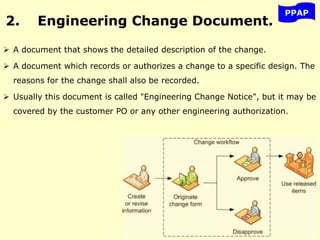
2. Engineering Change Document.
 A document that shows the detailed description of the change.
 A document which records or authorizes a change to a specific design. The
reasons for the change shall also be recorded.
 Usually this document is called "Engineering Change Notice", but it may be
covered by the customer PO or any other engineering authorization.
PPAP
3. Customer Engineering. Approval
 Where specified by the customer, the organization shall have evidence of
customer engineering approval.
 Customer engineering approval may be required for a product or
associated documentation relating to that product, if this is required, it will
be stated on the customer’s drawing or similar.
PPAP
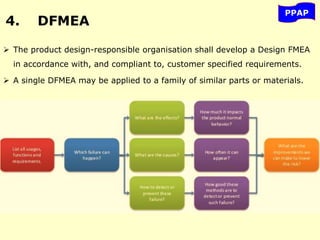
4. DFMEA
 The product design-responsible organisation shall develop a Design FMEA
in accordance with, and compliant to, customer specified requirements.
 A single DFMEA may be applied to a family of similar parts or materials.
PPAP
4. DFMEA
There are 11 steps to complete a DFMEA
1) Design Review – Use the product / service design drawings or documents
to identify each component and its relation with other components of
product / service
2) Brainstorm potential failure modes
3) List potential failure modes
4) List potential effects of failure modes
5) Assign the severity ranking which should be based on consequences of
failure (1 to 10)
(Threat to human life, accident or safety issue is scored 10)
6) Assign the occurrence ranking (1 to 10)
PPAP
4. DFMEA
7) Assign detection ranking based on the chance of detection prior to failure
(1 to 10) (Easy for detection gets less score – 1, difficult to
detect should be assigned higher score)
8) Calculate the SOD (Severity x Occurrence x Detection) number or risk
priority number (RPN)
9) Develop action plan to reduce vital RPNs (Above set baseline)
10)Implement the improvements identified
11)Calculate RPN again based on improvements. Do mistake proofing
PPAP
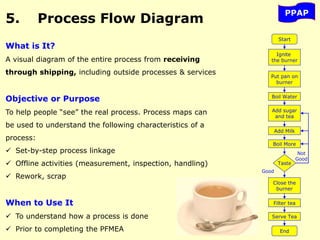
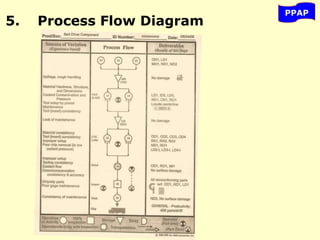
5. Process Flow Diagram
PPAP
What is It?
A visual diagram of the entire process from receiving
through shipping, including outside processes & services
Objective or Purpose
To help people “see” the real process. Process maps can
be used to understand the following characteristics of a
process:
 Set-by-step process linkage
 Offline activities (measurement, inspection, handling)
 Rework, scrap
When to Use It
 To understand how a process is done
 Prior to completing the PFMEA
Start
Ignite
the burner
Put pan on
burner
Boil Water
Add sugar
and tea
Add Milk
Boil More
Taste
Close the
burner
Filter tea
Serve Tea
End
Good
Not
Good
5. Process Flow Diagram
PPAP
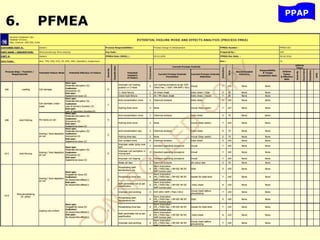
6. PFMEA
PPAP
What is It?
A tool used to identify and prioritize risk areas and their mitigation plans.
Objective or Purpose
 Identifies potential failure modes, causes, and effects. Inputs come from the
process flow diagram.
 Identifies key inputs which positively or negatively affect quality, reliability and
safety of a product or process.
When to Use It
 After completion of the process flow diagram.
 Prior to tooling for production
PFMEA should be completed using cross-functional team !!
6. PFMEA
PPAP
6. PFMEA
PPAP
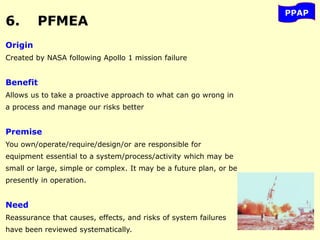
Origin
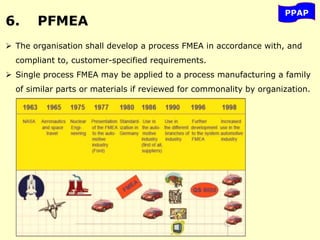
Created by NASA following Apollo 1 mission failure
Benefit
Allows us to take a proactive approach to what can go wrong in
a process and manage our risks better
Premise
You own/operate/require/design/or are responsible for
equipment essential to a system/process/activity which may be
small or large, simple or complex. It may be a future plan, or be
presently in operation.
Need
Reassurance that causes, effects, and risks of system failures
have been reviewed systematically.
6. PFMEA
PPAP
 The organisation shall develop a process FMEA in accordance with, and
compliant to, customer-specified requirements.
 Single process FMEA may be applied to a process manufacturing a family
of similar parts or materials if reviewed for commonality by organization.
6. PFMEA
PPAP
1. For each Process Input, determine the ways in which the Process Step
can go wrong (these are Failure Modes).
2. For each Failure Mode associated with the inputs, determine Effects on
the outputs.
3. Identify potential Causes of each Failure Mode.
4. List the Current Controls for each Cause.
5. Assign Severity, Occurrence and Detection ratings after creating a
ratings key appropriate for your project.
6. Calculate RPN.
7. Determine Recommended Actions to reduce High RPNs.
8. Take appropriate Actions and Document.
9. Recalculate RPNs.
10. Revisit steps 7 and 8 until all the significant RPNs have been addressed.
7. Control Plan
PPAP
What is It?
A document that describes how to control the critical inputs to continue to meet
customer expectations of the output.
Objective or Purpose
 Primary reference source for minimizing process and product variation.
 Description of how teams should react to out-of-control situations.
When to Use It
 Implementation of new process
 Following a process change
Since processes are expected to be continuously updated
and improved, the control plan is a living document !!
7. Control Plan
PPAP
7. Control Plan
PPAP
There are 3 distinct phases in the control plan:
 Prototype build control plan
 Pre-Launch / PPAP control plan
 Production control plan
1 st Phase
1. Prototype – a description of the
dimensional measurements and material
and performance tests that will occur during
Prototype build.
2 nd Phase
2. Pre-Launch – a description of the
dimensional measurements and material
and performance tests that will occur after
Prototype and before full Production.
3 rd Phase
3. Production – a comprehensive
documentation of product/process
characteristics, process controls, tests, and
measurement systems that will occur during
mass production
7. Control Plan
PPAP
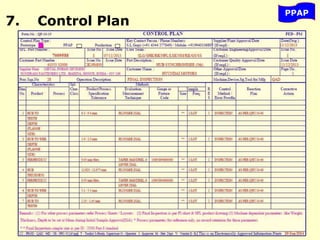
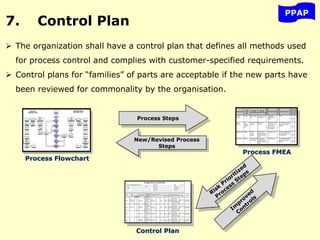
 The organization shall have a control plan that defines all methods used
for process control and complies with customer-specified requirements.
 Control plans for “families” of parts are acceptable if the new parts have
been reviewed for commonality by the organisation.
Process Steps
New/Revised Process
Steps
Project Idea
Fill Out Master
Form
with Initial
Information
Is Hard
Savings > $???
Does the
Project Involve
Only Your
Group?
Does the
Project Involve
>3 Depts.
outside Eng?
Does the
Project Involve
>2 Groups in
Eng?
Do you
have BB/GB to
Assist/Work the
project?
Prefer to work
this project
within your
area?
6 Sigma
Project
Department
or Group
Project
Yes
No
Yes
No
Yes
No
No
No
Yes
Yes
Yes No
Enter Remaining
Information on
Master Form
Master Form Will
Generate
Contract
Finance Approval
and Signature
Other Required
Signatures:
Segment CEO
Champion
Process Owner
BB or GB
6 Sigma Assigns
Project Number
Get WO Assigned
Begin/Work
Project
Follow DMAIC or
DFSS process
Monitor Progress
through Power
Steering and
Monthly
Financial
Reviews
Complete Project
(Has to be fully
Documented
Finance Approval
and Signature
Other Required
Signatures:
Champion: Dir T&E
Process Owner
Project Owner
Dept BB or MBB
Enter Remaining
Information on
Master Form
Master Form Will
Generate
Contract
Finance Approval
and Signature
Other Required
Signatures:
Champion:
Process Owner
Project Owner
Dept GB/BB/MBB
Group Assigns
Project Number
Get DLN
Assigned
Monitor Progress
through Bi-
Weekly Updates
and Monthly
Reviews
Begin/Work
Project
Follow DMAIC or
DFSS process
Complete Project
(Has to be fully
Documented)
Finance Approval
and Signature
Other Required
Signatures:
Champion: Dir T&E
Process Owner
Project Owner
Dept BB or MBB
Complete all
Documentation
including a
(1) Page Close-
out Sheet
Close
Project
Complete all
Documentation
including a
(1) Page Close-
out Sheet
Final Project
Review
Close
Project
Final Project
Review
6 Sigma Project
High Level Process Map
Department/Group Project
High Level Process Map
Process Flowchart
Process Step
Key
Process
Input
Potential
Failure Mode
Potential
Failure Effects
S
E
V
Potential Causes
O
C
C
Current Controls
D
E
T
R
P
N
E
O
C
Actions
Recommended
Resp. Actions
Receive
Payment
Checks Delay internal
mail
AR balance does
not go down
7
Inadequate
staffing in mail
room 7
None
10 490
Investigate mail room
staffing and associated
processes
G. Lee Added anoth
clerk. Adjus
schedule.
Identify
Customer
Wire
Transfer
reference
line
Information not
supplied
AR balance is
past due
10
Customer or bank
did not include
name and/or
account info on
wire transfer
5
Acct identifies problem
when trying to apply
payment
5 250
Poka-Yoke wire transer
process
N. Peart Contacted b
established w
transfer proc
2112)
Identify Invoice Checks Incorrect
invoice
supplied
Invoice shows
outstanding (AR
balance does go
down)
5
Customer error
5
Customer might catch
it when reviewing the
next statement 10 250
Provide payment stub
with statement for each
invoice
A. Lifeson Revised stat
include paym
with each inv
Identify Invoice Checks Invoice number
not supplied
Invoice shows
outstanding (AR
balance does go
down)
5
Customer error
10
Acct identifies problem
when trying to apply
payment 5 250
Provide payment stub
with statement for each
invoice
S. Hagar Revised stat
include paym
with each inv
Process FMEA
Control Plan
8. Measurement System Analysis
PPAP
What is It?
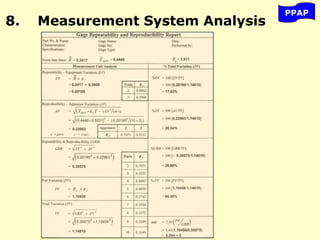
An MSA is a statistical tool used to determine if a measurement system is capable of
precise measurement.
Objective or Purpose
 To determine how much error is in the measurement due to the measurement
process itself.
 Quantifies the variability added by the measurement system.
 Applicable to attribute data and variable data.
When to Use It
 On the critical inputs and outputs prior to collecting data for analysis.
 For any new or modified process in order to ensure the quality of the data.
MSA: Analysis of measurement process, not an analysis of people !!
8. Measurement System Analysis
PPAP
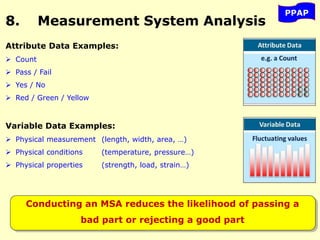
Attribute Data Examples:
 Count
 Pass / Fail
 Yes / No
 Red / Green / Yellow
Variable Data Examples:
 Physical measurement (length, width, area, …)
 Physical conditions (temperature, pressure…)
 Physical properties (strength, load, strain…)
Conducting an MSA reduces the likelihood of passing a
bad part or rejecting a good part
8. Measurement System Analysis
PPAP
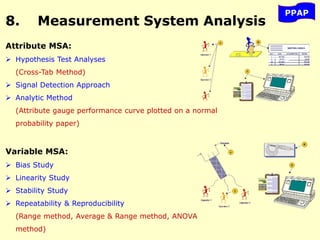
Attribute MSA:
 Hypothesis Test Analyses
(Cross-Tab Method)
 Signal Detection Approach
 Analytic Method
(Attribute gauge performance curve plotted on a normal
probability paper)
Variable MSA:
 Bias Study
 Linearity Study
 Stability Study
 Repeatability & Reproducibility
(Range method, Average & Range method, ANOVA
method)
8. Measurement System Analysis
PPAP
9. Dimensional Results
PPAP
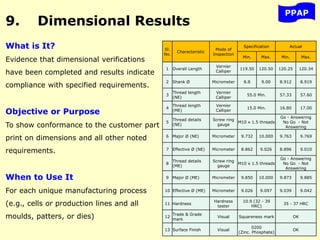
What is It?
Evidence that dimensional verifications
have been completed and results indicate
compliance with specified requirements.
Objective or Purpose
To show conformance to the customer part
print on dimensions and all other noted
requirements.
When to Use It
For each unique manufacturing process
(e.g., cells or production lines and all
moulds, patters, or dies)
Sl.
No.
Characteristic
Mode of
Inspection
Specification Actual
Min. Max. Min. Max.
1 Overall Length
Vernier
Calliper
119.50 120.50 120.25 120.34
2 Shank Ø Micrometer 8.8 9.00 8.912 8.919
3
Thread length
(NE)
Vernier
Calliper
55.0 Min. 57.33 57.60
4
Thread length
(ME)
Vernier
Calliper
15.0 Min. 16.80 17.00
5
Thread details
(NE)
Screw ring
gauge
M10 x 1.5 threads
Go - Answering
No Go - Not
Answering
6 Major Ø (NE) Micrometer 9.732 10.000 9.763 9.769
7 Effective Ø (NE) Micrometer 8.862 9.026 8.896 9.010
8
Thread details
(ME)
Screw ring
gauge
M10 x 1.5 threads
Go - Answering
No Go - Not
Answering
9 Major Ø (ME) Micrometer 9.850 10.000 9.873 9.885
10 Effective Ø (ME) Micrometer 9.026 9.097 9.039 9.042
11 Hardness
Hardness
tester
10.9 (32 - 39
HRC)
35 - 37 HRC
12
Trade & Grade
mark
Visual Squareness mark OK
13 Surface Finish Visual
0200
(Zinc. Phosphate)
OK
10.Material,Performance Test Result
PPAP
Material Tests:
 The supplier shall perform tests for all parts and product materials when
chemical, physical, or metallurgical requirements are specified by the
design record or Control Plan.
 For products with customer-developed material specifications and/or an
customer-approved supplier list, the supplier shall procure materials
and/or services from suppliers on that list.
Performance Tests:
 The supplier shall perform tests for all parts or product materials when
performance or functional requirements are specified by the design
record or Control Plan.
PPAP
Material Test Performance Test
10.Material,Performance Test Result
11. Initial Process Studies
PPAP
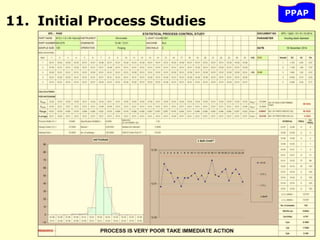
What is It?
A set of tools used to understand process capability.
Objective or Purpose
 To evaluate the performance of your process as compared to specification limits.
 To determine if the production process is likely to produce product that will meet
customer requirements
When to Use It
 To establish baseline capability.
 To validate process improvements.
The organisation shall perform measurement system analysis to understand
how measurement error affects the study measurements.
PPAP
11. Initial Process Studies
PPAP
11. Initial Process Studies
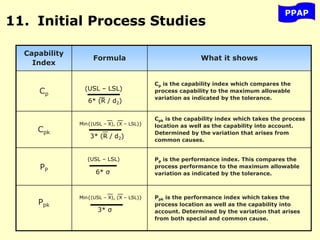
Step 1 Step 2 Step 3 Step 4 Step 5 Step 6 Step 7
1. Decide on the product or process characteristic to be assessed
2. Validate the specification limits
3. Validate the measurement system
4. Collect data
5. Assess data characteristics
6. Assess process stability
7. Calculate process capability
PPAP
11. Initial Process Studies
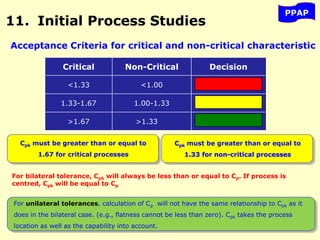
Capability
Index
Formula What it shows
Cp
Cp is the capability index which compares the
process capability to the maximum allowable
variation as indicated by the tolerance.
Cpk
Cpk is the capability index which takes the process
location as well as the capability into account.
Determined by the variation that arises from
common causes.
PP
Pp is the performance index. This compares the
process performance to the maximum allowable
variation as indicated by the tolerance.
Ppk
Ppk is the performance index which takes the
process location as well as the capability into
account. Determined by the variation that arises
from both special and common cause.
(USL – LSL)
6* (R / d2)
(USL – LSL)
6* σ
Min{(USL – X), (X – LSL)}
3* (R / d2)
3* σ
Min{(USL – X), (X – LSL)}
PPAP
11. Initial Process Studies
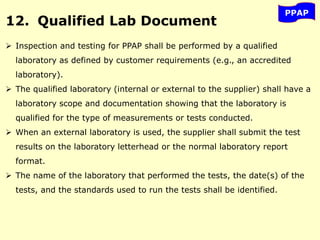
Critical Non-Critical Decision
<1.33 <1.00
1.33-1.67 1.00-1.33
>1.67 >1.33
Cpk must be greater than or equal to
1.67 for critical processes
Cpk must be greater than or equal to
1.33 for non-critical processes
Acceptance Criteria for critical and non-critical characteristic
For unilateral tolerances, calculation of Cp will not have the same relationship to Cpk as it
does in the bilateral case. (e.g., flatness cannot be less than zero). Cpk takes the process
location as well as the capability into account.
For bilateral tolerance, Cpk will always be less than or equal to Cp. If process is
centred, Cpk will be equal to Cp
PPAP
12. Qualified Lab Document
 Inspection and testing for PPAP shall be performed by a qualified
laboratory as defined by customer requirements (e.g., an accredited
laboratory).
 The qualified laboratory (internal or external to the supplier) shall have a
laboratory scope and documentation showing that the laboratory is
qualified for the type of measurements or tests conducted.
 When an external laboratory is used, the supplier shall submit the test
results on the laboratory letterhead or the normal laboratory report
format.
 The name of the laboratory that performed the tests, the date(s) of the
tests, and the standards used to run the tests shall be identified.
PPAP
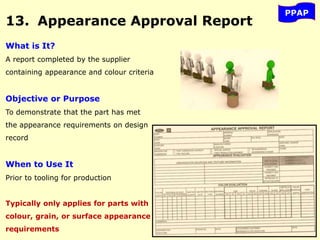
13. Appearance Approval Report
What is It?
A report completed by the supplier
containing appearance and colour criteria
Objective or Purpose
To demonstrate that the part has met
the appearance requirements on design
record
When to Use It
Prior to tooling for production
Typically only applies for parts with
colour, grain, or surface appearance
requirements
PPAP
14. Sample Production Parts
What is It?
Actual samples that reflect the parts documented in the PPAP.
Objective or Purpose
Confirm cosmetic or functional part approval.
When to Use It
Sample parts should be delivered with the PPAP submission
The sample parts provided should be the same parts measured for the
dimensional results.
Default quantity for all submissions is 3 parts unless otherwise requested.
PPAP
14. Sample Production Parts
Sample production parts MUST be properly identified
 Include the following information on the part label:
 Date parts were packed
 Customer part number
 Quantity
 Serial number
 Supplier part number (optional)
 Part description
 Country of origin
 Indication of RoHS compliance
 Approval markings (UL, CE, etc.) where applicable
PPAP
15. Master Sample
 The organisation shall retain a master sample for the same period as the
production part approval records, or:
a) Until a new master sample is produced for the same customer part number
for customer approval
b) Where a master sample is required by the design record, control plan or
inspection criteria, as a reference or standard.
 The master sample shall be identified as such, and shall show the
customer approval date on the sample.
 The organization shall retain a master sample.
 e for each position of a multiple cavity die, mould, tool or pattern, or
production process unless specified by the customer.
 When part size, sheer volume of parts etc. makes storage of a master
sample difficult, the sample retention requirements may be modified or
waived in writing by the authorized customer representative.
PPAP
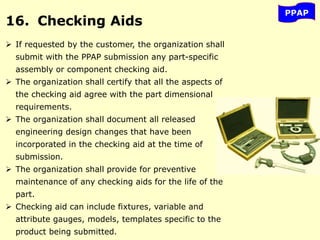
16. Checking Aids
 If requested by the customer, the organization shall
submit with the PPAP submission any part-specific
assembly or component checking aid.
 The organization shall certify that all the aspects of
the checking aid agree with the part dimensional
requirements.
 The organization shall document all released
engineering design changes that have been
incorporated in the checking aid at the time of
submission.
 The organization shall provide for preventive
maintenance of any checking aids for the life of the
part.
 Checking aid can include fixtures, variable and
attribute gauges, models, templates specific to the
product being submitted.
PPAP
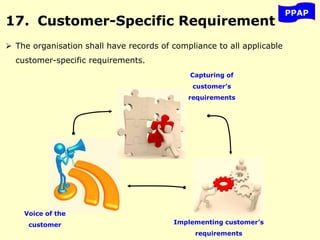
17. Customer-Specific Requirement
 The organisation shall have records of compliance to all applicable
customer-specific requirements.
Voice of the
customer
Capturing of
customer’s
requirements
Implementing customer’s
requirements
PPAP
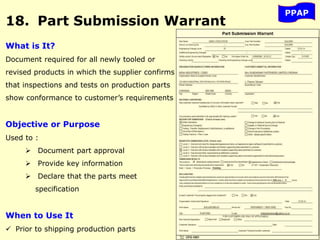
18. Part Submission Warrant
What is It?
Document required for all newly tooled or
revised products in which the supplier confirms
that inspections and tests on production parts
show conformance to customer’s requirements
Objective or Purpose
Used to :
 Document part approval
 Provide key information
 Declare that the parts meet
specification
When to Use It
 Prior to shipping production parts
PPAP
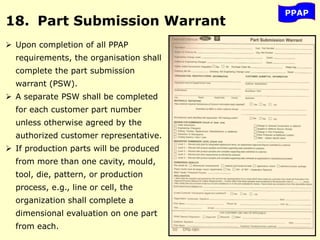
18. Part Submission Warrant
 Upon completion of all PPAP
requirements, the organisation shall
complete the part submission
warrant (PSW).
 A separate PSW shall be completed
for each customer part number
unless otherwise agreed by the
authorized customer representative.
 If production parts will be produced
from more than one cavity, mould,
tool, die, pattern, or production
process, e.g., line or cell, the
organization shall complete a
dimensional evaluation on one part
from each.
PPAP
18. Part Submission Warrant
 The organization shall verify that all of the measurement and test results
show conformance with customer requirements and that all required
documentation is available and, for Level 2, 3 & 4, is included in the
submission as appropriate. A responsible official of the organization shall
approve the PSW and provide contact information.
 One warrant per customer part number can be used to summarize many
changes providing that the changes are adequately documented, and the
submission is in compliance with customer program timing requirements.
PPAP
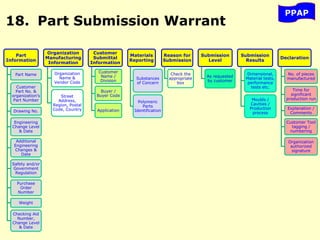
18. Part Submission Warrant
Part
Information
Part Name
Customer
Part No. &
organization’s
Part Number
Drawing No.
Engineering
Change Level
& Date
Additional
Engineering
Changes &
Date
Safety and/or
Government
Regulation
Purchase
Order
Number
Weight
Checking Aid
Number,
Change Level
& Date
Organization
Manufacturing
Information
Organization
Name &
Vendor Code
Street
Address,
Region, Postal
Code, Country
Customer
Submittal
Information
Customer
Name /
Division
Buyer /
Buyer Code
Application
Materials
Reporting
Substances
of Concern
Polymeric
Parts
Identification
Reason for
Submission
Check the
appropriate
box
Submission
Level
As requested
by customer
Submission
Results
Dimensional,
Material tests,
performance
tests etc.
Moulds /
Cavities /
Production
process
Declaration
No. of pieces
manufactured
Time for
significant
production run
Explanation /
Comments
Customer Tool
tagging /
numbering
Organization
authorized
signature
PPAP
Customer Notification
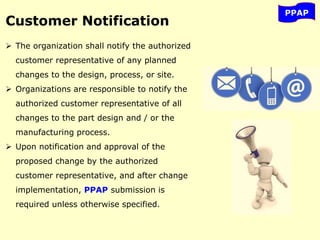
 The organization shall notify the authorized
customer representative of any planned
changes to the design, process, or site.
 Organizations are responsible to notify the
authorized customer representative of all
changes to the part design and / or the
manufacturing process.
 Upon notification and approval of the
proposed change by the authorized
customer representative, and after change
implementation, PPAP submission is
required unless otherwise specified.
PPAP
Customer Notification
Design
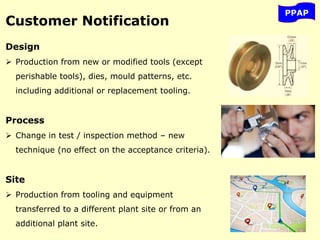
 Production from new or modified tools (except
perishable tools), dies, mould patterns, etc.
including additional or replacement tooling.
Process
 Change in test / inspection method – new
technique (no effect on the acceptance criteria).
Site
 Production from tooling and equipment
transferred to a different plant site or from an
additional plant site.
PPAP
Submission to Customer
 The organization shall submit for PPAP approval
prior to the first production shipment in the
following situations unless the customer
representative has waived this requirement.
 The organization shall review and update, as
necessary, all applicable items in the PPAP file to
reflect the production process, regardless of
whether or not the customer requests a formal
submission.
 The PPAP file shall contain the name of the
authorized customer representative granting the
waiver and the date.
PPAP
Submission to Customer
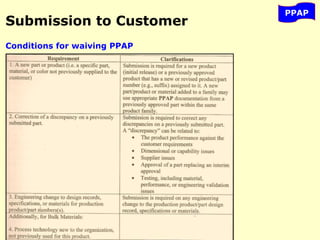
Conditions for waiving PPAP
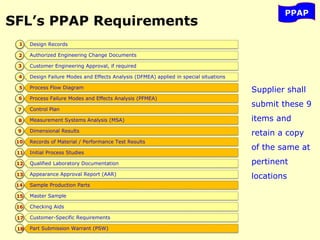
SFL’s PPAP Requirements
Design Records
Authorized Engineering Change Documents
Customer Engineering Approval, if required
Design Failure Modes and Effects Analysis (DFMEA) applied in special situations
Process Flow Diagram
Process Failure Modes and Effects Analysis (PFMEA)
Control Plan
Measurement Systems Analysis (MSA)
Dimensional Results
Records of Material / Performance Test Results
Initial Process Studies
Qualified Laboratory Documentation
Appearance Approval Report (AAR)
Sample Production Parts
Master Sample
Checking Aids
Customer-Specific Requirements
Part Submission Warrant (PSW)
PPAP
1
2
3
4
5
6
7
8
9
10
11
12
13
14
15
16
17
18
Supplier shall
submit these 9
items and
retain a copy
of the same at
pertinent
locations
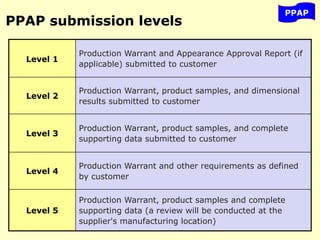
PPAP submission levels
PPAP
Level 1
Production Warrant and Appearance Approval Report (if
applicable) submitted to customer
Level 2
Production Warrant, product samples, and dimensional
results submitted to customer
Level 3
Production Warrant, product samples, and complete
supporting data submitted to customer
Level 4
Production Warrant and other requirements as defined
by customer
Level 5
Production Warrant, product samples and complete
supporting data (a review will be conducted at the
supplier's manufacturing location)
PPAP
Part Submission Status
 Upon approval of the submission, the
organization shall assure that future production
continues to meet all customer requirements.
 For those organizations that have been
classified as “self-certifying” (PPAP submission
level 1) by a specific customer, submission of
the required organization-approved
documentation will be considered as customer
approval unless the organization is advised
otherwise.
PPAP
Part Submission Status
Customer PPAP Status
Approved:
 Approved indicate that the part or material, including all
sub-components, meet all customer requirements. The
organization is therefore authorized to ship production
quantities of the product, subject to releases from the
customer scheduling activity.
Rejected:
 Rejected means that the PPAP submission does not meet
the customer requirements, based on the production lot
from which it was taken and / or accompanying
documentation. In such cases, the submission and / or
process, as appropriate, shall be corrected to meet
customer requirements. The submission shall be approved
before production quantities may be shipped.
PPAP
Part Submission Status
Customer PPAP Status
Interim Approval:
 Interim approval permits shipment of material for production
requirements on a limited time or piece quantity basis.
 Interim approval will only be granted when the organization
has:
a) Clearly defined the non-compliance preventing approval
b) Prepared an action plan agreed upon by the customer. “PPAP”
re-submission is required to obtain a status of “approved”.
 The organization is responsible for implementing containment
actions to ensure that only acceptable material is being
shipped to the customer.
 Parts with a status of “Interim Approval” are not to be
considered “Approved”.
PPAP
Record Retention
 PPAP records, regardless of submission level, shall
be maintained for the length of the time that the
part is active plus one calendar year.
 The organization shall ensure that the appropriate
PPAP records from a superseded part PPAP file are
included, or referenced in the new part PPAP file.
 An example of an appropriate document / record
that should be carried forward from the old file to
the new part file would be a material certification
from a raw material supplier for a new part that
represents only a dimensional change from the old
part number. This should be identified by
conducting a PPAP “gap” analysis between the old
and new part numbers.
PPAP
Bulk Material - Requirements
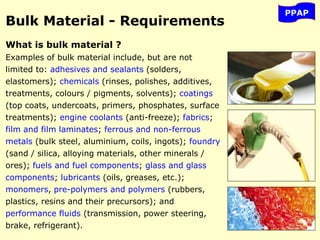
What is bulk material ?
Examples of bulk material include, but are not
limited to: adhesives and sealants (solders,
elastomers); chemicals (rinses, polishes, additives,
treatments, colours / pigments, solvents); coatings
(top coats, undercoats, primers, phosphates, surface
treatments); engine coolants (anti-freeze); fabrics;
film and film laminates; ferrous and non-ferrous
metals (bulk steel, aluminium, coils, ingots); foundry
(sand / silica, alloying materials, other minerals /
ores); fuels and fuel components; glass and glass
components; lubricants (oils, greases, etc.);
monomers, pre-polymers and polymers (rubbers,
plastics, resins and their precursors); and
performance fluids (transmission, power steering,
brake, refrigerant).
PPAP
Applicability
 Organizations are responsible for applying PPAP to their suppliers of
ingredients which have organization-designated special characteristics.
 Where OEM PPAP approval of bulk material exists, evidence of that
approval is sufficient as the PPAP submission at other levels in the
supply chain.
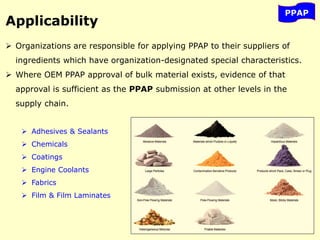
 Adhesives & Sealants
 Chemicals
 Coatings
 Engine Coolants
 Fabrics
 Film & Film Laminates
PPAP
Checklist
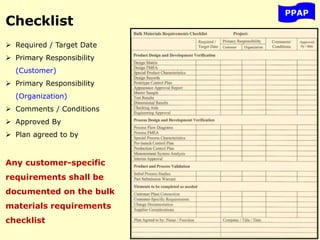
 Required / Target Date
 Primary Responsibility
(Customer)
 Primary Responsibility
(Organization)
 Comments / Conditions
 Approved By
 Plan agreed to by
Any customer-specific
requirements shall be
documented on the bulk
materials requirements
checklist
PPAP
Design Matrix
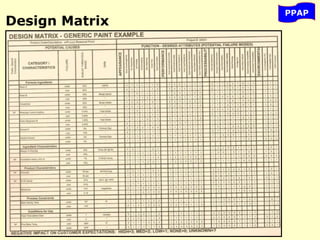
 Organizations supplying bulk material generally deal with the chemistry
and functionality of the product being designed.
 Use of these suggestions will arrive at the same end point of a
completed Design FMEA, but with greater applicability to bulk materials.
 For bulk materials, a Design Matrix, when required, shall be prepared
prior to developing the Design FMEA.
 The Design Matrix determines the complex interactions of formula
ingredients, ingredient characteristics, product characteristics, process
constraints, and conditions for customer use.
 High impact items can then be effectively analysed in the Design FMEA.
 The matrix correlates customer’s expectations with the product design
items.
PPAP
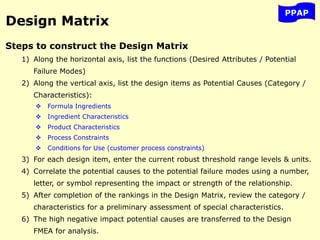
Design Matrix
Steps to construct the Design Matrix
1) Along the horizontal axis, list the functions (Desired Attributes / Potential
Failure Modes)
2) Along the vertical axis, list the design items as Potential Causes (Category /
Characteristics):
 Formula Ingredients
 Ingredient Characteristics
 Product Characteristics
 Process Constraints
 Conditions for Use (customer process constraints)
3) For each design item, enter the current robust threshold range levels & units.
4) Correlate the potential causes to the potential failure modes using a number,
letter, or symbol representing the impact or strength of the relationship.
5) After completion of the rankings in the Design Matrix, review the category /
characteristics for a preliminary assessment of special characteristics.
6) The high negative impact potential causes are transferred to the Design
FMEA for analysis.
PPAP
Design Matrix
PPAP
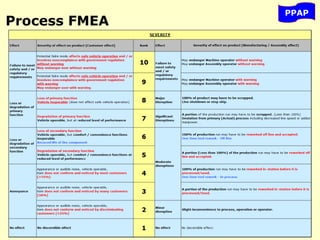
Design FMEA
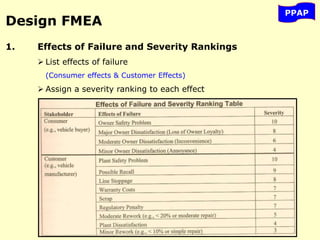
1. Effects of Failure and Severity Rankings
 List effects of failure
(Consumer effects & Customer Effects)
 Assign a severity ranking to each effect
PPAP
Design FMEA
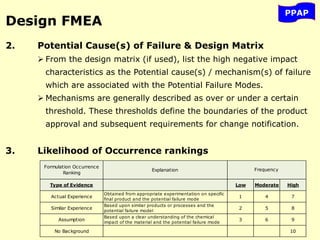
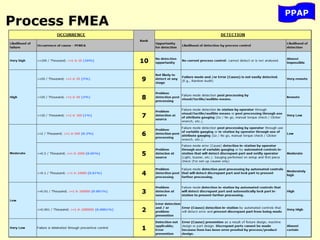
2. Potential Cause(s) of Failure & Design Matrix
 From the design matrix (if used), list the high negative impact
characteristics as the Potential cause(s) / mechanism(s) of failure
which are associated with the Potential Failure Modes.
 Mechanisms are generally described as over or under a certain
threshold. These thresholds define the boundaries of the product
approval and subsequent requirements for change notification.
3. Likelihood of Occurrence rankings
Formulation Occurrence
Ranking
Explanation
Type of Evidence Low Moderate High
Actual Experience
Obtained from appropriate experimentation on specific
final product and the potential failure mode
1 4 7
Similar Experience
Based upon similar products or processes and the
potential failure model
2 5 8
Assumption
Based upon a clear understanding of the chemical
impact of the material and the potential failure mode
3 6 9
No Background 10
Frequency
PPAP
Design FMEA
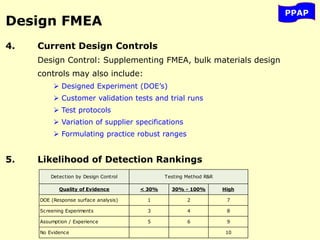
4. Current Design Controls
Design Control: Supplementing FMEA, bulk materials design
controls may also include:
 Designed Experiment (DOE’s)
 Customer validation tests and trial runs
 Test protocols
 Variation of supplier specifications
 Formulating practice robust ranges
5. Likelihood of Detection Rankings
Detection by Design Control
Quality of Evidence < 30% 30% - 100% High
DOE (Response surface analysis) 1 2 7
Screening Experiments 3 4 8
Assumption / Experience 5 6 9
No Evidence 10
Testing Method R&R
PPAP
Process FMEA
PPAP
Process FMEA
PPAP
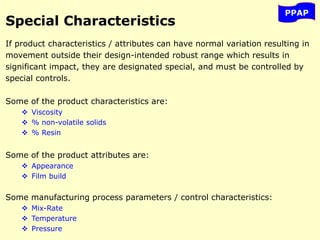
Special Characteristics
If product characteristics / attributes can have normal variation resulting in
movement outside their design-intended robust range which results in
significant impact, they are designated special, and must be controlled by
special controls.
Some of the product characteristics are:
 Viscosity
 % non-volatile solids
 % Resin
Some of the product attributes are:
 Appearance
 Film build
Some manufacturing process parameters / control characteristics:
 Mix-Rate
 Temperature
 Pressure
PPAP
Special Characteristics
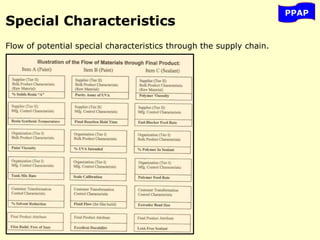
Flow of potential special characteristics through the supply chain.
PPAP
Control Plan
The Bulk Material Control Plan serves as a mechanism to:
 Highlight special product / process characteristics and their controls
 Link together sources of control methods, instructions and specification /
tolerance limits and reference them in one document.
Additionally, this control plan is not intended to re-create specification and
/ or tolerance limits that exist in other control sources such as batch
tickets, work instructions and testing protocols
There are 3 types of control plan in general:
 Prototype
 Pre-Launch
 Production
Pre-Launch and Production control plans may be applied to a family of
products or specific processes.
PPAP
Measurement System Analysis
 Bulk materials often require further processing after sampling in order to
make a measurement.
 Measurements are often destructive in nature and this prevents re-testing
the same sample.
 Measurement variability is often much larger for properties important in
the process industries (e.g., dimensions).
 Measurement may account for 50% or more of total observed variation.
 Standardized test methods (e.g., ASTM, AMS, ISO) are often followed.
 The organization need not re-verify bias, linearity, stability and GR&R.
 MSA studies are not required where standardized tests are used, however
it is still important for the organization to understand the measurement
component of variation in the test methods used.
 Customer agreement on the actual requirements for MSA for either non-
standard test methods or “new-to-supplier” test methods should be
obtained during planning phase.
PPAP
Initial Process Studies
 The manufacture of bulk materials consists of industries which span a
variety of production processes, from high volume products to speciality
products produced in small quantities no more than once or twice per year.
 Often the production process is completed or already in place before
sufficient samples can be tested.
 By the time the product is made again, personnel and / or equipment may
have changed.
 There are non-linear – meaning for example that doubling the change in a
particular input does not necessarily double the change in the output.
 The effects and relationships between all these variables and controls are
also not usually known without error.
 Multiple processes are usually interconnected , sometimes with feedback.
 There are also timing considerations and delays in reaction time.
 Measurement of component variables are generally less precise than the
measurements of component parts, such that in many cases correlated
variables must be used.
PPAP
Master Sample
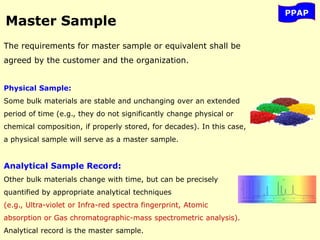
The requirements for master sample or equivalent shall be
agreed by the customer and the organization.
Physical Sample:
Some bulk materials are stable and unchanging over an extended
period of time (e.g., they do not significantly change physical or
chemical composition, if properly stored, for decades). In this case,
a physical sample will serve as a master sample.
Analytical Sample Record:
Other bulk materials change with time, but can be precisely
quantified by appropriate analytical techniques
(e.g., Ultra-violet or Infra-red spectra fingerprint, Atomic
absorption or Gas chromatographic-mass spectrometric analysis).
Analytical record is the master sample.
PPAP
Part Submission Warrant
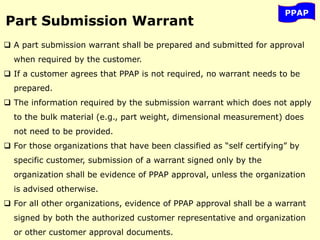
 A part submission warrant shall be prepared and submitted for approval
when required by the customer.
 If a customer agrees that PPAP is not required, no warrant needs to be
prepared.
 The information required by the submission warrant which does not apply
to the bulk material (e.g., part weight, dimensional measurement) does
not need to be provided.
 For those organizations that have been classified as “self certifying” by
specific customer, submission of a warrant signed only by the
organization shall be evidence of PPAP approval, unless the organization
is advised otherwise.
 For all other organizations, evidence of PPAP approval shall be a warrant
signed by both the authorized customer representative and organization
or other customer approval documents.
PPAP
Interim Approval
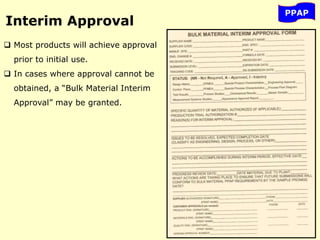
 Most products will achieve approval
prior to initial use.
 In cases where approval cannot be
obtained, a “Bulk Material Interim
Approval” may be granted.
PPAP
Customer Plant Connection
 Customer plant connection is a shared
responsibility between the organization
supplying bulk material and the customer.
 This connection defines the interaction of
specific customer plant processing steps
with special characteristics and final
product attributes of the bulk material.
 The interaction is especially significant
when bulk materials undergo chemical or
physical transformations.
[Example: wet can of paint to cured paint
film]
PPAP in SFL
PPAP
Accredited Laboratory :
Accredited laboratory is one that has been reviewed and
approved by a nationally recognized accreditation body or, as an
alternative, a customer recognized accreditation body,
conforming to ISO/IEC guide 58 for calibration or test laboratory
accreditation to ISO/IEC 17025, or national equivalent.
Active Part
Active part is one currently being supplied to the customer for
original equipment or service applications. The part remains
active until tooling scrap authorization is given by the
appropriate customer activity. For parts with no customer-owned
tooling or situations where multiple parts are made from the
same tool, written confirmation from the customer purchasing
activity is required to deactivate a part.
PPAP
Definitions
PPAP
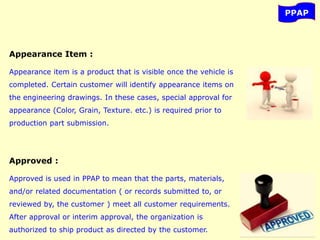
Appearance Item :
Appearance item is a product that is visible once the vehicle is
completed. Certain customer will identify appearance items on
the engineering drawings. In these cases, special approval for
appearance (Color, Grain, Texture. etc.) is required prior to
production part submission.
Approved :
Approved is used in PPAP to mean that the parts, materials,
and/or related documentation ( or records submitted to, or
reviewed by, the customer ) meet all customer requirements.
After approval or interim approval, the organization is
authorized to ship product as directed by the customer.
PPAP
Approved Drawing :
Approved is an engineering drawing signed by the engineer and
released through the customer’s system.
Approved Materials :
Approved materials are materials governed either by industry
standard specifications (e.g., SAE, ASTM, DIN, ISO ) or by
customer specifications.
Approved Source List :
Approved source list is a list of the organization and suppliers
that have been found to be acceptable to the customer. Utilizing
product from an approved supplier does not relieve the
organization of responsibility for the quality of that product.
PPAP
Attribute data :
Attribute data are qualitative data that can be counted for
recording and analysis . Examples include the presence or
absence of a required label, the installation of all required
fasteners.
Authorized Customer Representative :
Authorized customer representative is the individual or
individuals having approval authority on behalf of the customer.
Note : The customer’s process should identify the approval
authority.
PPAP
Black Box :
Black Box refers to a part (e.g., an assembly, electrical device,
mechanical device, or control module ) where design
responsibility belongs to the organization or the supplier. Black
Box requirements are generally limited to those characteristics /
items required for customer interface connections and
verification of functional requirements. ”ODD”. (Outside Design
and Development) has the equivalent meaning.
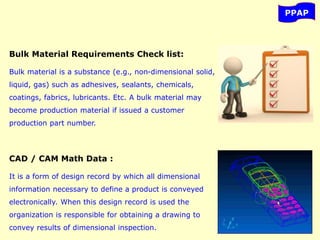
Bulk Material :
Bulk material is a substance (e.g., non-dimensional solid, liquid,
gas) such as adhesives, sealants, chemicals, coatings, fabrics,
lubricants. Etc. A bulk material may become production material
if issued a customer production part number.
PPAP
Bulk Material Requirements Check list:
Bulk material is a substance (e.g., non-dimensional solid,
liquid, gas) such as adhesives, sealants, chemicals,
coatings, fabrics, lubricants. Etc. A bulk material may
become production material if issued a customer
production part number.
CAD / CAM Math Data :
It is a form of design record by which all dimensional
information necessary to define a product is conveyed
electronically. When this design record is used the
organization is responsible for obtaining a drawing to
convey results of dimensional inspection.
PPAP
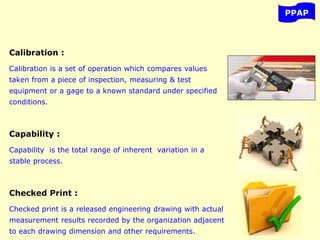
Calibration :
Calibration is a set of operation which compares values
taken from a piece of inspection, measuring & test
equipment or a gage to a known standard under specified
conditions.
Capability :
Capability is the total range of inherent variation in a
stable process.
Checked Print :
Checked print is a released engineering drawing with actual
measurement results recorded by the organization adjacent
to each drawing dimension and other requirements.
PPAP
Conformance :
Conformance means that the part or material meets the
customer ‘s specifications and requirements.
Control Plans :
Control plans are written description of the system for
controlling production parts or bulk materials and
processes. They are written by organization to address the
important characteristics and engineering requirements of
the product. Each part must have a control plan, but in
many cases “family” control plan can apply to a number of
parts produced using a common process.
PPAP
Customer :
Customer is the recipient of the organisation ‘s or supplier’s
product or service.
Design – Intended Robust Range :
Customer is the recipient of the organization ‘s or supplier’s
product or service.
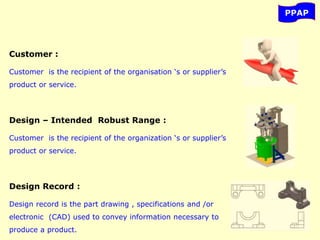
Design Record :
Design record is the part drawing , specifications and /or
electronic (CAD) used to convey information necessary to
produce a product.
PPAP
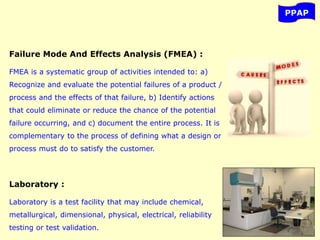
Failure Mode And Effects Analysis (FMEA) :
FMEA is a systematic group of activities intended to: a)
Recognize and evaluate the potential failures of a product /
process and the effects of that failure, b) Identify actions
that could eliminate or reduce the chance of the potential
failure occurring, and c) document the entire process. It is
complementary to the process of defining what a design or
process must do to satisfy the customer.
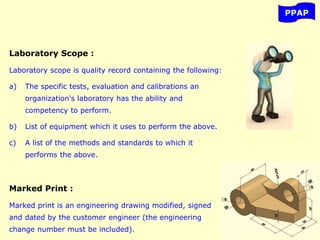
Laboratory :
Laboratory is a test facility that may include chemical,
metallurgical, dimensional, physical, electrical, reliability
testing or test validation.
PPAP
Laboratory Scope :
Laboratory scope is quality record containing the following:
a) The specific tests, evaluation and calibrations an
organization's laboratory has the ability and
competency to perform.
b) List of equipment which it uses to perform the above.
c) A list of the methods and standards to which it
performs the above.
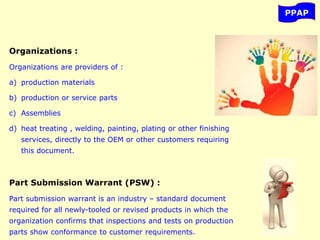
Marked Print :
Marked print is an engineering drawing modified, signed
and dated by the customer engineer (the engineering
change number must be included).
PPAP
Organizations :
Organizations are providers of :
a) production materials
b) production or service parts
c) Assemblies
d) heat treating , welding, painting, plating or other finishing
services, directly to the OEM or other customers requiring
this document.
Part Submission Warrant (PSW) :
Part submission warrant is an industry – standard document
required for all newly-tooled or revised products in which the
organization confirms that inspections and tests on production
parts show conformance to customer requirements.
PPAP
Perishable Tools :
Perishable tools are drills bits, cutters, inserts, etc. used to
produce a product and which are consumed in the process.
Process :
Process is a set of interrelated or interacting activities
which transforms inputs into outputs.
Process Flow Diagram :
Process flow diagram is a schematic representation of the
process flow.
Note 1: For PPAP the process flow diagram should focus
upon the manufacturing process, including rework and
repair.
Note 2: Process flow diagram can apply to any aspect of
business.
PPAP
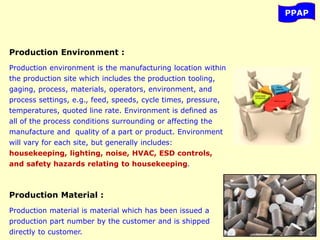
Production Environment :
Production environment is the manufacturing location within
the production site which includes the production tooling,
gaging, process, materials, operators, environment, and
process settings, e.g., feed, speeds, cycle times, pressure,
temperatures, quoted line rate. Environment is defined as
all of the process conditions surrounding or affecting the
manufacture and quality of a part or product. Environment
will vary for each site, but generally includes:
housekeeping, lighting, noise, HVAC, ESD controls,
and safety hazards relating to housekeeping.
Production Material :
Production material is material which has been issued a
production part number by the customer and is shipped
directly to customer.
PPAP
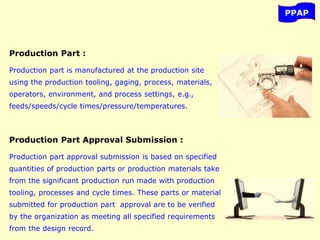
Production Part :
Production part is manufactured at the production site
using the production tooling, gaging, process, materials,
operators, environment, and process settings, e.g.,
feeds/speeds/cycle times/pressure/temperatures.
Production Part Approval Submission :
Production part approval submission is based on specified
quantities of production parts or production materials take
from the significant production run made with production
tooling, processes and cycle times. These parts or material
submitted for production part approval are to be verified
by the organization as meeting all specified requirements
from the design record.
PPAP
Production rate :
Production rate is the agreed upon number of parts
produced in a planned time period to meet customer
assembly or manufacturing plant production volume
requirements – with consideration of other product
mix and machine availability.
Note : The agreed production rate is typically
specified in the purchase agreement.
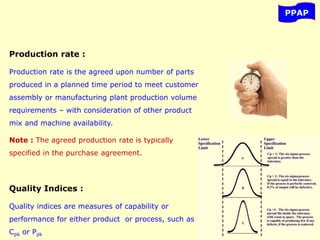
Quality Indices :
Quality indices are measures of capability or
performance for either product or process, such as
Cpk or Ppk
PPAP
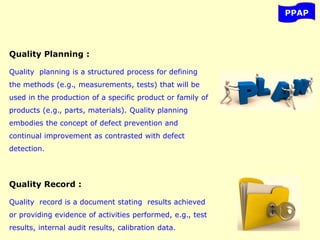
Quality Planning :
Quality planning is a structured process for defining
the methods (e.g., measurements, tests) that will be
used in the production of a specific product or family of
products (e.g., parts, materials). Quality planning
embodies the concept of defect prevention and
continual improvement as contrasted with defect
detection.
Quality Record :
Quality record is a document stating results achieved
or providing evidence of activities performed, e.g., test
results, internal audit results, calibration data.
PPAP
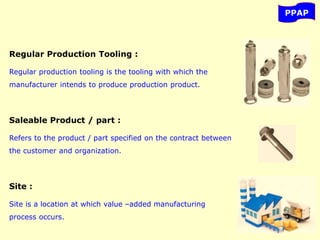
Regular Production Tooling :
Regular production tooling is the tooling with which the
manufacturer intends to produce production product.
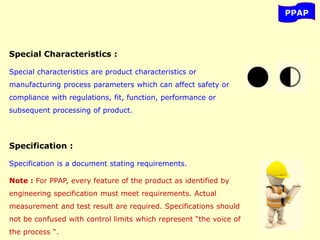
Saleable Product / part :
Refers to the product / part specified on the contract between
the customer and organization.
Site :
Site is a location at which value –added manufacturing
process occurs.
PPAP
Special Characteristics :
Special characteristics are product characteristics or
manufacturing process parameters which can affect safety or
compliance with regulations, fit, function, performance or
subsequent processing of product.
Specification :
Specification is a document stating requirements.
Note : For PPAP, every feature of the product as identified by
engineering specification must meet requirements. Actual
measurement and test result are required. Specifications should
not be confused with control limits which represent “the voice of
the process “.
PPAP
Stable process :
Stable processes are processes that are in statistical control.
Statistical Control :
Statistical control is the condition of a process from which all
special causes of variation have been eliminated and only
common cause remain.
Submission Level :
Submission level refers to the level of evidence required for
PPAP submission.
PPAP
Suppliers :
Suppliers are providers of production materials, or production or
service parts, assemblies, heat treating, welding, painting,
plating or the other finishing services directly to an organization
supplying the OEM or other customer requiring this document.
Tool :
Tool is defined as the portion of process machinery which is
specific to a component or sub-assembly. Tools ( or tooling ) are
used in process machinery to transform raw material into a
finished part or assembly.
PPAP
Validation :
Validation is confirmation, through the provision of objective
evidence, that the requirement for a specific intended use or
application have been fulfilled.
Verification :
Verification is confirmation, through the provision of objective
evidence, that specified requirements have been fulfilled.
Variables Data :
Variables data are quantitative data, where measurements are
used for analysis. Examples include the diameter of a bearing
journal in millimeters, the closing effort of a door in Newton, the
concentration of electrolyte in percent, or the torque of a
fastener in Newton-meters
PPAP
Open to the forum

PPAP.ppt

  • 1.
  • 2.
  • 3.
    PPAP Phases of APQP APQPcomprises of 4 phases and 5 major activities. It has around 20+ support tools along with on-going feedback assessment & corrective action.
  • 4.
    PPAP Benefits of APQP Manufacturingprocess functions that are clearly planned, validated, documented and communicated will result in:  Robust and reliable designs  Reduced process variation  Enhanced confidence in supplier’s capability  Better controlled process changes  Defect free launches  Improved Customer satisfaction  Improved Delivery and Service  Maximum ROI (Return on Investment)  Minimum Waste  Minimum CONC (Cost of non-conformance)
  • 5.
    PPAP PPAP in APQP Productand Process Validation
  • 6.
    What is customerinteraction ?  Instead of merely talking to customers, listen to what they say so you can accurately identify their needs and help them find solutions.  Through the course of a simple conversation, you may discover that you offer a specific product or service that would make your customer's life more convenient.  By offering that service, you raise the level of satisfaction and successfully cross-sell for your company at the same time.  Each customer interaction is an opportunity to create a good impression. PPAP Open to the forum
  • 7.
    What is customersatisfaction ?  Based on customer interaction, one gets to know the customer’s expectation.  Customer satisfaction measures how products or services supplied by a company meet or surpass a customer's expectation.  A metric that can be used to monitor and improve the business of a firm.  Customer satisfaction is defined as “the number of customers, or percentage of total customers, whose reported experience with a firm, its products, or its services (ratings) exceeds specified satisfaction goals” PPAP Open to the forum
  • 8.
    What is PPAP Production Part Approval Process is a team oriented approach that uses well established tools and techniques to formally reduce risks prior to the release of a product or service.  This standard was initially developed by AIAG (Automotive Industry Action GroChrysler & GMup) in 1993 based on the inputs given by the Big 3: Ford,.  PPAP has now spread to many industries beyond automotive  PPAP manages change and ensures product conformance thereby enhancing customer satisfaction PPAP
  • 9.
    Risk High Risk  Partsassociated with multiple critical features, complex design or high end technology that is not yet established in the general manufacturing environment. Medium Risk  Parts that have at least one critical feature Low Risk  Parts that have no critical features & can be manufactured by any manufacturer in commodity category.  Supplier’s quality system & quality performance are acceptable PPAP
  • 10.
    Purpose of PPAP To provide evidence that all customer engineering design record and specification requirements are properly understood by the organization.  To demonstrate that the manufacturing process has the potential to produce product that consistently meets all requirements during an actual production run at the quoted production rate.  PPAP also helps in managing change and ensures the conformance of the product to customer’s requirement PPAP
  • 11.
    Submission of PPAP New part  Engineering change(s)  Tooling: transfer, replacement, refurbishment, or additional  Correction of discrepancy  Tooling inactive > one year  Change to optional construction or material  Sub-supplier or material source change  Change in part processing  Parts produced at a new or additional location PPAP submission is required when there is any significant change to product or process PPAP
  • 12.
    Significant Production Run PPAPdata must be submitted from a production run using:  Production equipment and tooling  Production employees  Production rate  Production process Data should reflect upon actual production process to be used at start-up. The significant production run shall be from one hour to 8 hours of production, and with the specific production quantity to total a minimum of 300 consecutive parts, unless otherwise specified by the authorized customer representative. PPAP
  • 13.
    PPAP Requirements Design Records EngineeringChange Documents Customer Engineering Approval, if required Design Failure Modes and Effects Analysis (DFMEA) Process Flow Diagram Process Failure Modes and Effects Analysis (PFMEA) Control Plan Measurement Systems Analysis (MSA) Dimensional Results Material, Performance Test Results Initial Process Studies Qualified Laboratory Documentation Appearance Approval Report (AAR) if applicable. Sample Product Master Sample Checking Aids Records of Compliance Customer-Specific Requirements Part Submission Warrant (PSW) PPAP 1 2 3 4 5 6 7 8 9 10 11 12 13 14 15 16 17 18
  • 14.
    1. Design Record The organisation shall have the design record for the saleable product / part, including design records for components or details of the saleable product / part.  Where the design record is in electronic format, e.g., CAD / CAM math data, the organisation shall produce a hard copy (e.g., pictorial, GD & T sheets, drawing etc.) to identify measurements taken. PPAP
  • 15.
    2. Engineering ChangeDocument.  A document that shows the detailed description of the change.  A document which records or authorizes a change to a specific design. The reasons for the change shall also be recorded.  Usually this document is called "Engineering Change Notice", but it may be covered by the customer PO or any other engineering authorization. PPAP
  • 16.
    3. Customer Engineering.Approval  Where specified by the customer, the organization shall have evidence of customer engineering approval.  Customer engineering approval may be required for a product or associated documentation relating to that product, if this is required, it will be stated on the customer’s drawing or similar. PPAP
  • 17.
    4. DFMEA  Theproduct design-responsible organisation shall develop a Design FMEA in accordance with, and compliant to, customer specified requirements.  A single DFMEA may be applied to a family of similar parts or materials. PPAP
  • 18.
    4. DFMEA There are11 steps to complete a DFMEA 1) Design Review – Use the product / service design drawings or documents to identify each component and its relation with other components of product / service 2) Brainstorm potential failure modes 3) List potential failure modes 4) List potential effects of failure modes 5) Assign the severity ranking which should be based on consequences of failure (1 to 10) (Threat to human life, accident or safety issue is scored 10) 6) Assign the occurrence ranking (1 to 10) PPAP
  • 19.
    4. DFMEA 7) Assigndetection ranking based on the chance of detection prior to failure (1 to 10) (Easy for detection gets less score – 1, difficult to detect should be assigned higher score) 8) Calculate the SOD (Severity x Occurrence x Detection) number or risk priority number (RPN) 9) Develop action plan to reduce vital RPNs (Above set baseline) 10)Implement the improvements identified 11)Calculate RPN again based on improvements. Do mistake proofing PPAP
  • 20.
    5. Process FlowDiagram PPAP What is It? A visual diagram of the entire process from receiving through shipping, including outside processes & services Objective or Purpose To help people “see” the real process. Process maps can be used to understand the following characteristics of a process:  Set-by-step process linkage  Offline activities (measurement, inspection, handling)  Rework, scrap When to Use It  To understand how a process is done  Prior to completing the PFMEA Start Ignite the burner Put pan on burner Boil Water Add sugar and tea Add Milk Boil More Taste Close the burner Filter tea Serve Tea End Good Not Good
  • 21.
    5. Process FlowDiagram PPAP
  • 22.
    6. PFMEA PPAP What isIt? A tool used to identify and prioritize risk areas and their mitigation plans. Objective or Purpose  Identifies potential failure modes, causes, and effects. Inputs come from the process flow diagram.  Identifies key inputs which positively or negatively affect quality, reliability and safety of a product or process. When to Use It  After completion of the process flow diagram.  Prior to tooling for production PFMEA should be completed using cross-functional team !!
  • 23.
  • 24.
    6. PFMEA PPAP Origin Created byNASA following Apollo 1 mission failure Benefit Allows us to take a proactive approach to what can go wrong in a process and manage our risks better Premise You own/operate/require/design/or are responsible for equipment essential to a system/process/activity which may be small or large, simple or complex. It may be a future plan, or be presently in operation. Need Reassurance that causes, effects, and risks of system failures have been reviewed systematically.
  • 25.
    6. PFMEA PPAP  Theorganisation shall develop a process FMEA in accordance with, and compliant to, customer-specified requirements.  Single process FMEA may be applied to a process manufacturing a family of similar parts or materials if reviewed for commonality by organization.
  • 26.
    6. PFMEA PPAP 1. Foreach Process Input, determine the ways in which the Process Step can go wrong (these are Failure Modes). 2. For each Failure Mode associated with the inputs, determine Effects on the outputs. 3. Identify potential Causes of each Failure Mode. 4. List the Current Controls for each Cause. 5. Assign Severity, Occurrence and Detection ratings after creating a ratings key appropriate for your project. 6. Calculate RPN. 7. Determine Recommended Actions to reduce High RPNs. 8. Take appropriate Actions and Document. 9. Recalculate RPNs. 10. Revisit steps 7 and 8 until all the significant RPNs have been addressed.
  • 27.
    7. Control Plan PPAP Whatis It? A document that describes how to control the critical inputs to continue to meet customer expectations of the output. Objective or Purpose  Primary reference source for minimizing process and product variation.  Description of how teams should react to out-of-control situations. When to Use It  Implementation of new process  Following a process change Since processes are expected to be continuously updated and improved, the control plan is a living document !!
  • 28.
  • 29.
    7. Control Plan PPAP Thereare 3 distinct phases in the control plan:  Prototype build control plan  Pre-Launch / PPAP control plan  Production control plan 1 st Phase 1. Prototype – a description of the dimensional measurements and material and performance tests that will occur during Prototype build. 2 nd Phase 2. Pre-Launch – a description of the dimensional measurements and material and performance tests that will occur after Prototype and before full Production. 3 rd Phase 3. Production – a comprehensive documentation of product/process characteristics, process controls, tests, and measurement systems that will occur during mass production
  • 30.
    7. Control Plan PPAP The organization shall have a control plan that defines all methods used for process control and complies with customer-specified requirements.  Control plans for “families” of parts are acceptable if the new parts have been reviewed for commonality by the organisation. Process Steps New/Revised Process Steps Project Idea Fill Out Master Form with Initial Information Is Hard Savings > $??? Does the Project Involve Only Your Group? Does the Project Involve >3 Depts. outside Eng? Does the Project Involve >2 Groups in Eng? Do you have BB/GB to Assist/Work the project? Prefer to work this project within your area? 6 Sigma Project Department or Group Project Yes No Yes No Yes No No No Yes Yes Yes No Enter Remaining Information on Master Form Master Form Will Generate Contract Finance Approval and Signature Other Required Signatures: Segment CEO Champion Process Owner BB or GB 6 Sigma Assigns Project Number Get WO Assigned Begin/Work Project Follow DMAIC or DFSS process Monitor Progress through Power Steering and Monthly Financial Reviews Complete Project (Has to be fully Documented Finance Approval and Signature Other Required Signatures: Champion: Dir T&E Process Owner Project Owner Dept BB or MBB Enter Remaining Information on Master Form Master Form Will Generate Contract Finance Approval and Signature Other Required Signatures: Champion: Process Owner Project Owner Dept GB/BB/MBB Group Assigns Project Number Get DLN Assigned Monitor Progress through Bi- Weekly Updates and Monthly Reviews Begin/Work Project Follow DMAIC or DFSS process Complete Project (Has to be fully Documented) Finance Approval and Signature Other Required Signatures: Champion: Dir T&E Process Owner Project Owner Dept BB or MBB Complete all Documentation including a (1) Page Close- out Sheet Close Project Complete all Documentation including a (1) Page Close- out Sheet Final Project Review Close Project Final Project Review 6 Sigma Project High Level Process Map Department/Group Project High Level Process Map Process Flowchart Process Step Key Process Input Potential Failure Mode Potential Failure Effects S E V Potential Causes O C C Current Controls D E T R P N E O C Actions Recommended Resp. Actions Receive Payment Checks Delay internal mail AR balance does not go down 7 Inadequate staffing in mail room 7 None 10 490 Investigate mail room staffing and associated processes G. Lee Added anoth clerk. Adjus schedule. Identify Customer Wire Transfer reference line Information not supplied AR balance is past due 10 Customer or bank did not include name and/or account info on wire transfer 5 Acct identifies problem when trying to apply payment 5 250 Poka-Yoke wire transer process N. Peart Contacted b established w transfer proc 2112) Identify Invoice Checks Incorrect invoice supplied Invoice shows outstanding (AR balance does go down) 5 Customer error 5 Customer might catch it when reviewing the next statement 10 250 Provide payment stub with statement for each invoice A. Lifeson Revised stat include paym with each inv Identify Invoice Checks Invoice number not supplied Invoice shows outstanding (AR balance does go down) 5 Customer error 10 Acct identifies problem when trying to apply payment 5 250 Provide payment stub with statement for each invoice S. Hagar Revised stat include paym with each inv Process FMEA Control Plan
  • 31.
    8. Measurement SystemAnalysis PPAP What is It? An MSA is a statistical tool used to determine if a measurement system is capable of precise measurement. Objective or Purpose  To determine how much error is in the measurement due to the measurement process itself.  Quantifies the variability added by the measurement system.  Applicable to attribute data and variable data. When to Use It  On the critical inputs and outputs prior to collecting data for analysis.  For any new or modified process in order to ensure the quality of the data. MSA: Analysis of measurement process, not an analysis of people !!
  • 32.
    8. Measurement SystemAnalysis PPAP Attribute Data Examples:  Count  Pass / Fail  Yes / No  Red / Green / Yellow Variable Data Examples:  Physical measurement (length, width, area, …)  Physical conditions (temperature, pressure…)  Physical properties (strength, load, strain…) Conducting an MSA reduces the likelihood of passing a bad part or rejecting a good part
  • 33.
    8. Measurement SystemAnalysis PPAP Attribute MSA:  Hypothesis Test Analyses (Cross-Tab Method)  Signal Detection Approach  Analytic Method (Attribute gauge performance curve plotted on a normal probability paper) Variable MSA:  Bias Study  Linearity Study  Stability Study  Repeatability & Reproducibility (Range method, Average & Range method, ANOVA method)
  • 34.
    8. Measurement SystemAnalysis PPAP
  • 35.
    9. Dimensional Results PPAP Whatis It? Evidence that dimensional verifications have been completed and results indicate compliance with specified requirements. Objective or Purpose To show conformance to the customer part print on dimensions and all other noted requirements. When to Use It For each unique manufacturing process (e.g., cells or production lines and all moulds, patters, or dies) Sl. No. Characteristic Mode of Inspection Specification Actual Min. Max. Min. Max. 1 Overall Length Vernier Calliper 119.50 120.50 120.25 120.34 2 Shank Ø Micrometer 8.8 9.00 8.912 8.919 3 Thread length (NE) Vernier Calliper 55.0 Min. 57.33 57.60 4 Thread length (ME) Vernier Calliper 15.0 Min. 16.80 17.00 5 Thread details (NE) Screw ring gauge M10 x 1.5 threads Go - Answering No Go - Not Answering 6 Major Ø (NE) Micrometer 9.732 10.000 9.763 9.769 7 Effective Ø (NE) Micrometer 8.862 9.026 8.896 9.010 8 Thread details (ME) Screw ring gauge M10 x 1.5 threads Go - Answering No Go - Not Answering 9 Major Ø (ME) Micrometer 9.850 10.000 9.873 9.885 10 Effective Ø (ME) Micrometer 9.026 9.097 9.039 9.042 11 Hardness Hardness tester 10.9 (32 - 39 HRC) 35 - 37 HRC 12 Trade & Grade mark Visual Squareness mark OK 13 Surface Finish Visual 0200 (Zinc. Phosphate) OK
  • 36.
    10.Material,Performance Test Result PPAP MaterialTests:  The supplier shall perform tests for all parts and product materials when chemical, physical, or metallurgical requirements are specified by the design record or Control Plan.  For products with customer-developed material specifications and/or an customer-approved supplier list, the supplier shall procure materials and/or services from suppliers on that list. Performance Tests:  The supplier shall perform tests for all parts or product materials when performance or functional requirements are specified by the design record or Control Plan.
  • 37.
    PPAP Material Test PerformanceTest 10.Material,Performance Test Result
  • 38.
    11. Initial ProcessStudies PPAP What is It? A set of tools used to understand process capability. Objective or Purpose  To evaluate the performance of your process as compared to specification limits.  To determine if the production process is likely to produce product that will meet customer requirements When to Use It  To establish baseline capability.  To validate process improvements. The organisation shall perform measurement system analysis to understand how measurement error affects the study measurements.
  • 39.
  • 40.
    PPAP 11. Initial ProcessStudies Step 1 Step 2 Step 3 Step 4 Step 5 Step 6 Step 7 1. Decide on the product or process characteristic to be assessed 2. Validate the specification limits 3. Validate the measurement system 4. Collect data 5. Assess data characteristics 6. Assess process stability 7. Calculate process capability
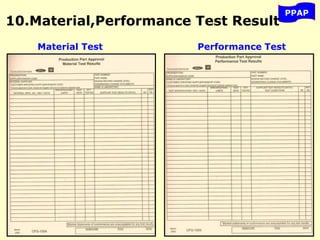
  • 41.
    PPAP 11. Initial ProcessStudies Capability Index Formula What it shows Cp Cp is the capability index which compares the process capability to the maximum allowable variation as indicated by the tolerance. Cpk Cpk is the capability index which takes the process location as well as the capability into account. Determined by the variation that arises from common causes. PP Pp is the performance index. This compares the process performance to the maximum allowable variation as indicated by the tolerance. Ppk Ppk is the performance index which takes the process location as well as the capability into account. Determined by the variation that arises from both special and common cause. (USL – LSL) 6* (R / d2) (USL – LSL) 6* σ Min{(USL – X), (X – LSL)} 3* (R / d2) 3* σ Min{(USL – X), (X – LSL)}
  • 42.
    PPAP 11. Initial ProcessStudies Critical Non-Critical Decision <1.33 <1.00 1.33-1.67 1.00-1.33 >1.67 >1.33 Cpk must be greater than or equal to 1.67 for critical processes Cpk must be greater than or equal to 1.33 for non-critical processes Acceptance Criteria for critical and non-critical characteristic For unilateral tolerances, calculation of Cp will not have the same relationship to Cpk as it does in the bilateral case. (e.g., flatness cannot be less than zero). Cpk takes the process location as well as the capability into account. For bilateral tolerance, Cpk will always be less than or equal to Cp. If process is centred, Cpk will be equal to Cp
  • 43.
    PPAP 12. Qualified LabDocument  Inspection and testing for PPAP shall be performed by a qualified laboratory as defined by customer requirements (e.g., an accredited laboratory).  The qualified laboratory (internal or external to the supplier) shall have a laboratory scope and documentation showing that the laboratory is qualified for the type of measurements or tests conducted.  When an external laboratory is used, the supplier shall submit the test results on the laboratory letterhead or the normal laboratory report format.  The name of the laboratory that performed the tests, the date(s) of the tests, and the standards used to run the tests shall be identified.
  • 44.
    PPAP 13. Appearance ApprovalReport What is It? A report completed by the supplier containing appearance and colour criteria Objective or Purpose To demonstrate that the part has met the appearance requirements on design record When to Use It Prior to tooling for production Typically only applies for parts with colour, grain, or surface appearance requirements
  • 45.
    PPAP 14. Sample ProductionParts What is It? Actual samples that reflect the parts documented in the PPAP. Objective or Purpose Confirm cosmetic or functional part approval. When to Use It Sample parts should be delivered with the PPAP submission The sample parts provided should be the same parts measured for the dimensional results. Default quantity for all submissions is 3 parts unless otherwise requested.
  • 46.
    PPAP 14. Sample ProductionParts Sample production parts MUST be properly identified  Include the following information on the part label:  Date parts were packed  Customer part number  Quantity  Serial number  Supplier part number (optional)  Part description  Country of origin  Indication of RoHS compliance  Approval markings (UL, CE, etc.) where applicable
  • 47.
    PPAP 15. Master Sample The organisation shall retain a master sample for the same period as the production part approval records, or: a) Until a new master sample is produced for the same customer part number for customer approval b) Where a master sample is required by the design record, control plan or inspection criteria, as a reference or standard.  The master sample shall be identified as such, and shall show the customer approval date on the sample.  The organization shall retain a master sample.  e for each position of a multiple cavity die, mould, tool or pattern, or production process unless specified by the customer.  When part size, sheer volume of parts etc. makes storage of a master sample difficult, the sample retention requirements may be modified or waived in writing by the authorized customer representative.
  • 48.
    PPAP 16. Checking Aids If requested by the customer, the organization shall submit with the PPAP submission any part-specific assembly or component checking aid.  The organization shall certify that all the aspects of the checking aid agree with the part dimensional requirements.  The organization shall document all released engineering design changes that have been incorporated in the checking aid at the time of submission.  The organization shall provide for preventive maintenance of any checking aids for the life of the part.  Checking aid can include fixtures, variable and attribute gauges, models, templates specific to the product being submitted.
  • 49.
    PPAP 17. Customer-Specific Requirement The organisation shall have records of compliance to all applicable customer-specific requirements. Voice of the customer Capturing of customer’s requirements Implementing customer’s requirements
  • 50.
    PPAP 18. Part SubmissionWarrant What is It? Document required for all newly tooled or revised products in which the supplier confirms that inspections and tests on production parts show conformance to customer’s requirements Objective or Purpose Used to :  Document part approval  Provide key information  Declare that the parts meet specification When to Use It  Prior to shipping production parts
  • 51.
    PPAP 18. Part SubmissionWarrant  Upon completion of all PPAP requirements, the organisation shall complete the part submission warrant (PSW).  A separate PSW shall be completed for each customer part number unless otherwise agreed by the authorized customer representative.  If production parts will be produced from more than one cavity, mould, tool, die, pattern, or production process, e.g., line or cell, the organization shall complete a dimensional evaluation on one part from each.
  • 52.
    PPAP 18. Part SubmissionWarrant  The organization shall verify that all of the measurement and test results show conformance with customer requirements and that all required documentation is available and, for Level 2, 3 & 4, is included in the submission as appropriate. A responsible official of the organization shall approve the PSW and provide contact information.  One warrant per customer part number can be used to summarize many changes providing that the changes are adequately documented, and the submission is in compliance with customer program timing requirements.
  • 53.
    PPAP 18. Part SubmissionWarrant Part Information Part Name Customer Part No. & organization’s Part Number Drawing No. Engineering Change Level & Date Additional Engineering Changes & Date Safety and/or Government Regulation Purchase Order Number Weight Checking Aid Number, Change Level & Date Organization Manufacturing Information Organization Name & Vendor Code Street Address, Region, Postal Code, Country Customer Submittal Information Customer Name / Division Buyer / Buyer Code Application Materials Reporting Substances of Concern Polymeric Parts Identification Reason for Submission Check the appropriate box Submission Level As requested by customer Submission Results Dimensional, Material tests, performance tests etc. Moulds / Cavities / Production process Declaration No. of pieces manufactured Time for significant production run Explanation / Comments Customer Tool tagging / numbering Organization authorized signature
  • 54.
    PPAP Customer Notification  Theorganization shall notify the authorized customer representative of any planned changes to the design, process, or site.  Organizations are responsible to notify the authorized customer representative of all changes to the part design and / or the manufacturing process.  Upon notification and approval of the proposed change by the authorized customer representative, and after change implementation, PPAP submission is required unless otherwise specified.
  • 55.
    PPAP Customer Notification Design  Productionfrom new or modified tools (except perishable tools), dies, mould patterns, etc. including additional or replacement tooling. Process  Change in test / inspection method – new technique (no effect on the acceptance criteria). Site  Production from tooling and equipment transferred to a different plant site or from an additional plant site.
  • 56.
    PPAP Submission to Customer The organization shall submit for PPAP approval prior to the first production shipment in the following situations unless the customer representative has waived this requirement.  The organization shall review and update, as necessary, all applicable items in the PPAP file to reflect the production process, regardless of whether or not the customer requests a formal submission.  The PPAP file shall contain the name of the authorized customer representative granting the waiver and the date.
  • 57.
  • 58.
    SFL’s PPAP Requirements DesignRecords Authorized Engineering Change Documents Customer Engineering Approval, if required Design Failure Modes and Effects Analysis (DFMEA) applied in special situations Process Flow Diagram Process Failure Modes and Effects Analysis (PFMEA) Control Plan Measurement Systems Analysis (MSA) Dimensional Results Records of Material / Performance Test Results Initial Process Studies Qualified Laboratory Documentation Appearance Approval Report (AAR) Sample Production Parts Master Sample Checking Aids Customer-Specific Requirements Part Submission Warrant (PSW) PPAP 1 2 3 4 5 6 7 8 9 10 11 12 13 14 15 16 17 18 Supplier shall submit these 9 items and retain a copy of the same at pertinent locations
  • 59.
    PPAP submission levels PPAP Level1 Production Warrant and Appearance Approval Report (if applicable) submitted to customer Level 2 Production Warrant, product samples, and dimensional results submitted to customer Level 3 Production Warrant, product samples, and complete supporting data submitted to customer Level 4 Production Warrant and other requirements as defined by customer Level 5 Production Warrant, product samples and complete supporting data (a review will be conducted at the supplier's manufacturing location)
  • 60.
    PPAP Part Submission Status Upon approval of the submission, the organization shall assure that future production continues to meet all customer requirements.  For those organizations that have been classified as “self-certifying” (PPAP submission level 1) by a specific customer, submission of the required organization-approved documentation will be considered as customer approval unless the organization is advised otherwise.
  • 61.
    PPAP Part Submission Status CustomerPPAP Status Approved:  Approved indicate that the part or material, including all sub-components, meet all customer requirements. The organization is therefore authorized to ship production quantities of the product, subject to releases from the customer scheduling activity. Rejected:  Rejected means that the PPAP submission does not meet the customer requirements, based on the production lot from which it was taken and / or accompanying documentation. In such cases, the submission and / or process, as appropriate, shall be corrected to meet customer requirements. The submission shall be approved before production quantities may be shipped.
  • 62.
    PPAP Part Submission Status CustomerPPAP Status Interim Approval:  Interim approval permits shipment of material for production requirements on a limited time or piece quantity basis.  Interim approval will only be granted when the organization has: a) Clearly defined the non-compliance preventing approval b) Prepared an action plan agreed upon by the customer. “PPAP” re-submission is required to obtain a status of “approved”.  The organization is responsible for implementing containment actions to ensure that only acceptable material is being shipped to the customer.  Parts with a status of “Interim Approval” are not to be considered “Approved”.
  • 63.
    PPAP Record Retention  PPAPrecords, regardless of submission level, shall be maintained for the length of the time that the part is active plus one calendar year.  The organization shall ensure that the appropriate PPAP records from a superseded part PPAP file are included, or referenced in the new part PPAP file.  An example of an appropriate document / record that should be carried forward from the old file to the new part file would be a material certification from a raw material supplier for a new part that represents only a dimensional change from the old part number. This should be identified by conducting a PPAP “gap” analysis between the old and new part numbers.
  • 64.
    PPAP Bulk Material -Requirements What is bulk material ? Examples of bulk material include, but are not limited to: adhesives and sealants (solders, elastomers); chemicals (rinses, polishes, additives, treatments, colours / pigments, solvents); coatings (top coats, undercoats, primers, phosphates, surface treatments); engine coolants (anti-freeze); fabrics; film and film laminates; ferrous and non-ferrous metals (bulk steel, aluminium, coils, ingots); foundry (sand / silica, alloying materials, other minerals / ores); fuels and fuel components; glass and glass components; lubricants (oils, greases, etc.); monomers, pre-polymers and polymers (rubbers, plastics, resins and their precursors); and performance fluids (transmission, power steering, brake, refrigerant).
  • 65.
    PPAP Applicability  Organizations areresponsible for applying PPAP to their suppliers of ingredients which have organization-designated special characteristics.  Where OEM PPAP approval of bulk material exists, evidence of that approval is sufficient as the PPAP submission at other levels in the supply chain.  Adhesives & Sealants  Chemicals  Coatings  Engine Coolants  Fabrics  Film & Film Laminates
  • 66.
    PPAP Checklist  Required /Target Date  Primary Responsibility (Customer)  Primary Responsibility (Organization)  Comments / Conditions  Approved By  Plan agreed to by Any customer-specific requirements shall be documented on the bulk materials requirements checklist
  • 67.
    PPAP Design Matrix  Organizationssupplying bulk material generally deal with the chemistry and functionality of the product being designed.  Use of these suggestions will arrive at the same end point of a completed Design FMEA, but with greater applicability to bulk materials.  For bulk materials, a Design Matrix, when required, shall be prepared prior to developing the Design FMEA.  The Design Matrix determines the complex interactions of formula ingredients, ingredient characteristics, product characteristics, process constraints, and conditions for customer use.  High impact items can then be effectively analysed in the Design FMEA.  The matrix correlates customer’s expectations with the product design items.
  • 68.
    PPAP Design Matrix Steps toconstruct the Design Matrix 1) Along the horizontal axis, list the functions (Desired Attributes / Potential Failure Modes) 2) Along the vertical axis, list the design items as Potential Causes (Category / Characteristics):  Formula Ingredients  Ingredient Characteristics  Product Characteristics  Process Constraints  Conditions for Use (customer process constraints) 3) For each design item, enter the current robust threshold range levels & units. 4) Correlate the potential causes to the potential failure modes using a number, letter, or symbol representing the impact or strength of the relationship. 5) After completion of the rankings in the Design Matrix, review the category / characteristics for a preliminary assessment of special characteristics. 6) The high negative impact potential causes are transferred to the Design FMEA for analysis.
  • 69.
  • 70.
    PPAP Design FMEA 1. Effectsof Failure and Severity Rankings  List effects of failure (Consumer effects & Customer Effects)  Assign a severity ranking to each effect
  • 71.
    PPAP Design FMEA 2. PotentialCause(s) of Failure & Design Matrix  From the design matrix (if used), list the high negative impact characteristics as the Potential cause(s) / mechanism(s) of failure which are associated with the Potential Failure Modes.  Mechanisms are generally described as over or under a certain threshold. These thresholds define the boundaries of the product approval and subsequent requirements for change notification. 3. Likelihood of Occurrence rankings Formulation Occurrence Ranking Explanation Type of Evidence Low Moderate High Actual Experience Obtained from appropriate experimentation on specific final product and the potential failure mode 1 4 7 Similar Experience Based upon similar products or processes and the potential failure model 2 5 8 Assumption Based upon a clear understanding of the chemical impact of the material and the potential failure mode 3 6 9 No Background 10 Frequency
  • 72.
    PPAP Design FMEA 4. CurrentDesign Controls Design Control: Supplementing FMEA, bulk materials design controls may also include:  Designed Experiment (DOE’s)  Customer validation tests and trial runs  Test protocols  Variation of supplier specifications  Formulating practice robust ranges 5. Likelihood of Detection Rankings Detection by Design Control Quality of Evidence < 30% 30% - 100% High DOE (Response surface analysis) 1 2 7 Screening Experiments 3 4 8 Assumption / Experience 5 6 9 No Evidence 10 Testing Method R&R
  • 73.
  • 74.
  • 75.
    PPAP Special Characteristics If productcharacteristics / attributes can have normal variation resulting in movement outside their design-intended robust range which results in significant impact, they are designated special, and must be controlled by special controls. Some of the product characteristics are:  Viscosity  % non-volatile solids  % Resin Some of the product attributes are:  Appearance  Film build Some manufacturing process parameters / control characteristics:  Mix-Rate  Temperature  Pressure
  • 76.
    PPAP Special Characteristics Flow ofpotential special characteristics through the supply chain.
  • 77.
    PPAP Control Plan The BulkMaterial Control Plan serves as a mechanism to:  Highlight special product / process characteristics and their controls  Link together sources of control methods, instructions and specification / tolerance limits and reference them in one document. Additionally, this control plan is not intended to re-create specification and / or tolerance limits that exist in other control sources such as batch tickets, work instructions and testing protocols There are 3 types of control plan in general:  Prototype  Pre-Launch  Production Pre-Launch and Production control plans may be applied to a family of products or specific processes.
  • 78.
    PPAP Measurement System Analysis Bulk materials often require further processing after sampling in order to make a measurement.  Measurements are often destructive in nature and this prevents re-testing the same sample.  Measurement variability is often much larger for properties important in the process industries (e.g., dimensions).  Measurement may account for 50% or more of total observed variation.  Standardized test methods (e.g., ASTM, AMS, ISO) are often followed.  The organization need not re-verify bias, linearity, stability and GR&R.  MSA studies are not required where standardized tests are used, however it is still important for the organization to understand the measurement component of variation in the test methods used.  Customer agreement on the actual requirements for MSA for either non- standard test methods or “new-to-supplier” test methods should be obtained during planning phase.
  • 79.
    PPAP Initial Process Studies The manufacture of bulk materials consists of industries which span a variety of production processes, from high volume products to speciality products produced in small quantities no more than once or twice per year.  Often the production process is completed or already in place before sufficient samples can be tested.  By the time the product is made again, personnel and / or equipment may have changed.  There are non-linear – meaning for example that doubling the change in a particular input does not necessarily double the change in the output.  The effects and relationships between all these variables and controls are also not usually known without error.  Multiple processes are usually interconnected , sometimes with feedback.  There are also timing considerations and delays in reaction time.  Measurement of component variables are generally less precise than the measurements of component parts, such that in many cases correlated variables must be used.
  • 80.
    PPAP Master Sample The requirementsfor master sample or equivalent shall be agreed by the customer and the organization. Physical Sample: Some bulk materials are stable and unchanging over an extended period of time (e.g., they do not significantly change physical or chemical composition, if properly stored, for decades). In this case, a physical sample will serve as a master sample. Analytical Sample Record: Other bulk materials change with time, but can be precisely quantified by appropriate analytical techniques (e.g., Ultra-violet or Infra-red spectra fingerprint, Atomic absorption or Gas chromatographic-mass spectrometric analysis). Analytical record is the master sample.
  • 81.
    PPAP Part Submission Warrant A part submission warrant shall be prepared and submitted for approval when required by the customer.  If a customer agrees that PPAP is not required, no warrant needs to be prepared.  The information required by the submission warrant which does not apply to the bulk material (e.g., part weight, dimensional measurement) does not need to be provided.  For those organizations that have been classified as “self certifying” by specific customer, submission of a warrant signed only by the organization shall be evidence of PPAP approval, unless the organization is advised otherwise.  For all other organizations, evidence of PPAP approval shall be a warrant signed by both the authorized customer representative and organization or other customer approval documents.
  • 82.
    PPAP Interim Approval  Mostproducts will achieve approval prior to initial use.  In cases where approval cannot be obtained, a “Bulk Material Interim Approval” may be granted.
  • 83.
    PPAP Customer Plant Connection Customer plant connection is a shared responsibility between the organization supplying bulk material and the customer.  This connection defines the interaction of specific customer plant processing steps with special characteristics and final product attributes of the bulk material.  The interaction is especially significant when bulk materials undergo chemical or physical transformations. [Example: wet can of paint to cured paint film]
  • 84.
  • 85.
    Accredited Laboratory : Accreditedlaboratory is one that has been reviewed and approved by a nationally recognized accreditation body or, as an alternative, a customer recognized accreditation body, conforming to ISO/IEC guide 58 for calibration or test laboratory accreditation to ISO/IEC 17025, or national equivalent. Active Part Active part is one currently being supplied to the customer for original equipment or service applications. The part remains active until tooling scrap authorization is given by the appropriate customer activity. For parts with no customer-owned tooling or situations where multiple parts are made from the same tool, written confirmation from the customer purchasing activity is required to deactivate a part. PPAP Definitions
  • 86.
    PPAP Appearance Item : Appearanceitem is a product that is visible once the vehicle is completed. Certain customer will identify appearance items on the engineering drawings. In these cases, special approval for appearance (Color, Grain, Texture. etc.) is required prior to production part submission. Approved : Approved is used in PPAP to mean that the parts, materials, and/or related documentation ( or records submitted to, or reviewed by, the customer ) meet all customer requirements. After approval or interim approval, the organization is authorized to ship product as directed by the customer.
  • 87.
    PPAP Approved Drawing : Approvedis an engineering drawing signed by the engineer and released through the customer’s system. Approved Materials : Approved materials are materials governed either by industry standard specifications (e.g., SAE, ASTM, DIN, ISO ) or by customer specifications. Approved Source List : Approved source list is a list of the organization and suppliers that have been found to be acceptable to the customer. Utilizing product from an approved supplier does not relieve the organization of responsibility for the quality of that product.
  • 88.
    PPAP Attribute data : Attributedata are qualitative data that can be counted for recording and analysis . Examples include the presence or absence of a required label, the installation of all required fasteners. Authorized Customer Representative : Authorized customer representative is the individual or individuals having approval authority on behalf of the customer. Note : The customer’s process should identify the approval authority.
  • 89.
    PPAP Black Box : BlackBox refers to a part (e.g., an assembly, electrical device, mechanical device, or control module ) where design responsibility belongs to the organization or the supplier. Black Box requirements are generally limited to those characteristics / items required for customer interface connections and verification of functional requirements. ”ODD”. (Outside Design and Development) has the equivalent meaning. Bulk Material : Bulk material is a substance (e.g., non-dimensional solid, liquid, gas) such as adhesives, sealants, chemicals, coatings, fabrics, lubricants. Etc. A bulk material may become production material if issued a customer production part number.
  • 90.
    PPAP Bulk Material RequirementsCheck list: Bulk material is a substance (e.g., non-dimensional solid, liquid, gas) such as adhesives, sealants, chemicals, coatings, fabrics, lubricants. Etc. A bulk material may become production material if issued a customer production part number. CAD / CAM Math Data : It is a form of design record by which all dimensional information necessary to define a product is conveyed electronically. When this design record is used the organization is responsible for obtaining a drawing to convey results of dimensional inspection.
  • 91.
    PPAP Calibration : Calibration isa set of operation which compares values taken from a piece of inspection, measuring & test equipment or a gage to a known standard under specified conditions. Capability : Capability is the total range of inherent variation in a stable process. Checked Print : Checked print is a released engineering drawing with actual measurement results recorded by the organization adjacent to each drawing dimension and other requirements.
  • 92.
    PPAP Conformance : Conformance meansthat the part or material meets the customer ‘s specifications and requirements. Control Plans : Control plans are written description of the system for controlling production parts or bulk materials and processes. They are written by organization to address the important characteristics and engineering requirements of the product. Each part must have a control plan, but in many cases “family” control plan can apply to a number of parts produced using a common process.
  • 93.
    PPAP Customer : Customer isthe recipient of the organisation ‘s or supplier’s product or service. Design – Intended Robust Range : Customer is the recipient of the organization ‘s or supplier’s product or service. Design Record : Design record is the part drawing , specifications and /or electronic (CAD) used to convey information necessary to produce a product.
  • 94.
    PPAP Failure Mode AndEffects Analysis (FMEA) : FMEA is a systematic group of activities intended to: a) Recognize and evaluate the potential failures of a product / process and the effects of that failure, b) Identify actions that could eliminate or reduce the chance of the potential failure occurring, and c) document the entire process. It is complementary to the process of defining what a design or process must do to satisfy the customer. Laboratory : Laboratory is a test facility that may include chemical, metallurgical, dimensional, physical, electrical, reliability testing or test validation.
  • 95.
    PPAP Laboratory Scope : Laboratoryscope is quality record containing the following: a) The specific tests, evaluation and calibrations an organization's laboratory has the ability and competency to perform. b) List of equipment which it uses to perform the above. c) A list of the methods and standards to which it performs the above. Marked Print : Marked print is an engineering drawing modified, signed and dated by the customer engineer (the engineering change number must be included).
  • 96.
    PPAP Organizations : Organizations areproviders of : a) production materials b) production or service parts c) Assemblies d) heat treating , welding, painting, plating or other finishing services, directly to the OEM or other customers requiring this document. Part Submission Warrant (PSW) : Part submission warrant is an industry – standard document required for all newly-tooled or revised products in which the organization confirms that inspections and tests on production parts show conformance to customer requirements.
  • 97.
    PPAP Perishable Tools : Perishabletools are drills bits, cutters, inserts, etc. used to produce a product and which are consumed in the process. Process : Process is a set of interrelated or interacting activities which transforms inputs into outputs. Process Flow Diagram : Process flow diagram is a schematic representation of the process flow. Note 1: For PPAP the process flow diagram should focus upon the manufacturing process, including rework and repair. Note 2: Process flow diagram can apply to any aspect of business.
  • 98.
    PPAP Production Environment : Productionenvironment is the manufacturing location within the production site which includes the production tooling, gaging, process, materials, operators, environment, and process settings, e.g., feed, speeds, cycle times, pressure, temperatures, quoted line rate. Environment is defined as all of the process conditions surrounding or affecting the manufacture and quality of a part or product. Environment will vary for each site, but generally includes: housekeeping, lighting, noise, HVAC, ESD controls, and safety hazards relating to housekeeping. Production Material : Production material is material which has been issued a production part number by the customer and is shipped directly to customer.
  • 99.
    PPAP Production Part : Productionpart is manufactured at the production site using the production tooling, gaging, process, materials, operators, environment, and process settings, e.g., feeds/speeds/cycle times/pressure/temperatures. Production Part Approval Submission : Production part approval submission is based on specified quantities of production parts or production materials take from the significant production run made with production tooling, processes and cycle times. These parts or material submitted for production part approval are to be verified by the organization as meeting all specified requirements from the design record.
  • 100.
    PPAP Production rate : Productionrate is the agreed upon number of parts produced in a planned time period to meet customer assembly or manufacturing plant production volume requirements – with consideration of other product mix and machine availability. Note : The agreed production rate is typically specified in the purchase agreement. Quality Indices : Quality indices are measures of capability or performance for either product or process, such as Cpk or Ppk
  • 101.
    PPAP Quality Planning : Qualityplanning is a structured process for defining the methods (e.g., measurements, tests) that will be used in the production of a specific product or family of products (e.g., parts, materials). Quality planning embodies the concept of defect prevention and continual improvement as contrasted with defect detection. Quality Record : Quality record is a document stating results achieved or providing evidence of activities performed, e.g., test results, internal audit results, calibration data.
  • 102.
    PPAP Regular Production Tooling: Regular production tooling is the tooling with which the manufacturer intends to produce production product. Saleable Product / part : Refers to the product / part specified on the contract between the customer and organization. Site : Site is a location at which value –added manufacturing process occurs.
  • 103.
    PPAP Special Characteristics : Specialcharacteristics are product characteristics or manufacturing process parameters which can affect safety or compliance with regulations, fit, function, performance or subsequent processing of product. Specification : Specification is a document stating requirements. Note : For PPAP, every feature of the product as identified by engineering specification must meet requirements. Actual measurement and test result are required. Specifications should not be confused with control limits which represent “the voice of the process “.
  • 104.
    PPAP Stable process : Stableprocesses are processes that are in statistical control. Statistical Control : Statistical control is the condition of a process from which all special causes of variation have been eliminated and only common cause remain. Submission Level : Submission level refers to the level of evidence required for PPAP submission.
  • 105.
    PPAP Suppliers : Suppliers areproviders of production materials, or production or service parts, assemblies, heat treating, welding, painting, plating or the other finishing services directly to an organization supplying the OEM or other customer requiring this document. Tool : Tool is defined as the portion of process machinery which is specific to a component or sub-assembly. Tools ( or tooling ) are used in process machinery to transform raw material into a finished part or assembly.
  • 106.
    PPAP Validation : Validation isconfirmation, through the provision of objective evidence, that the requirement for a specific intended use or application have been fulfilled. Verification : Verification is confirmation, through the provision of objective evidence, that specified requirements have been fulfilled. Variables Data : Variables data are quantitative data, where measurements are used for analysis. Examples include the diameter of a bearing journal in millimeters, the closing effort of a door in Newton, the concentration of electrolyte in percent, or the torque of a fastener in Newton-meters
  • 108.