Kimmo Määttä
PRODUCTION PART APPROVAL PROCESS (PPAP) FRAMEWORK INTEGRA-
TION INTO PRODUCT DEVELOPMENT PROCESS
PRODUCTION PART APPROVAL PROCESS (PPAP) FRAMEWORK INTEGRA-
TION INTO PRODUCT DEVELOPMENT PROCESS
Kimmo Määttä
Master Thesis
Spring 2022
Degree programme in Printed Intelli-
gence
Oulu University of Applied Sciences
3
ABSTRACT
Oulu University of Applied Sciences
Degree programme in Printed Intelligence
Author: Kimmo Määttä
Title of the thesis: Production Part Approval Process (PPAP) framework integration into product
development process
Thesis examiner(s): Harri Määttä
Term and year of thesis completion: Spring 2022 Pages: 42
The Production Part Approval Process is a widely used tool in the automotive industry to approve
new or revised parts manufactured by suppliers. Usually all suppliers participating in RFI/RFQ pro-
cess initiated by the OEMs must have a capability for PPAP submission.
The case company in this thesis is TactoTek Oy which is a leading provider of solutions for Injection
Molded Structural Electronics (IMSE) that integrate printed circuitry and electronic components into
3D injection molded plastics. TactoTek is very active in the automotive market segment and cus-
tomers request compliance with the PPAP requirements.
The purpose of this thesis was to investigate how the PPAP framework could be integrated into the
company’s quality management system. The qualitative research methods were used by establish-
ing several cross-functional teams to work on the specific research questions. The gap analysis
tool was used to perform the current state analysis and to identify the gaps between the current
state and the targeted state.
As a result, the processes and procedures affected by the PPAP requirements were identified, and
the gap analysis revealed the gaps which need to be fulfilled to be compliant with the PPAP re-
quirements. The PPAP timing chart, PPAP procedure, and PPAP RASIC documents help the de-
velopment project manager to manage PPAP activities at a practical level. Based on the results,
the case company can update its quality management system to be compliant with the PPAP re-
quirements.
Keywords: PPAP, APQP, NPI, QMS
4
CONTENTS
1 INTRODUCTION................................................................................................................... 5
1.1 Company introduction ................................................................................................ 5
1.2 Thesis objectives........................................................................................................ 5
1.3 Research questions.................................................................................................... 6
2 THEORETICAL ASPECTS.................................................................................................... 7
2.1 Quality management systems .................................................................................... 7
2.1.1 ISO9001....................................................................................................... 7
2.1.2 IATF16949:2016 ........................................................................................ 10
2.2 Quality assurance tools............................................................................................ 11
2.2.1 Advanced Product Quality Planning & Control Plan (APQP) ..................... 12
2.2.2 Production Part Approval Process (PPAP) ................................................ 14
2.2.3 Failure Mode and Effects Analysis (FMEA)................................................ 15
2.2.4 Statistical Process Control (SPC) .............................................................. 16
2.2.5 Measurement System Analysis (MSA)....................................................... 17
3 DATA COLLECTION ........................................................................................................... 18
3.1 Gap analysis............................................................................................................. 18
4 RESULTS............................................................................................................................ 22
4.1 PPAP deliverables.................................................................................................... 22
4.2 PPAP timing ............................................................................................................. 31
4.3 PPAP procedure....................................................................................................... 33
4.4 PPAP RASIC............................................................................................................ 33
4.5 PPAP package ......................................................................................................... 36
5 CONCLUSION..................................................................................................................... 37
5.1 Research question 1: Which areas of the company’s QMS do the PPAP
requirements affect?................................................................................................. 37
5.2 Research question 2: How do PPAP requirements affect the company’s processes
and procedures? ...................................................................................................... 37
5.3 Research question 3: What improvement activities are required to ensure that the
company’s QMS fulfills PPAP requirements?........................................................... 38
6 GLOSSARY......................................................................................................................... 40
7 REFERENCES.................................................................................................................... 41
5
1 INTRODUCTION
1.1 Company introduction
TactoTek is the leading provider of Injection Molded Structural Electronics (IMSE®) solutions that
integrate printed circuitry and electronic components into 3D injection molded plastics. Leading
IMSE use cases include human-machine interfaces (HMI), connectivity and electronic styling fea-
tures for automotive, smart home, appliances, and other markets. TactoTek develops and industri-
alizes IMSE technology, creates mass production ready IMSE prototypes, and licenses IMSE tech-
nology for 3rd party IMSE part design and global mass production. (TactoTek Oy 2021. Cited
10.2.2022.)
TactoTek has a full-featured production line of its own for pilot projects. In addition to customer
pilots, the production line is used in the company’s own production activities. A large proportion of
TactoTek’s current customers are automotive companies. However, other segments of the elec-
tronics industry are quickly increasing their relative share, with structural electronics finding its way
into home appliances, thermostats, light switches, medical devices and many other applications.
TactoTek was founded in 2011 and the company’s headquarters is based in Oulu, Finland. The
company has also sales offices in USA, Germany, South Korea and Japan.
1.2 Thesis objectives
The purpose of this thesis is to investigate how Production Part Approval Process (PPAP) require-
ments could be integrated as a part of TactoTek’s Quality Management System (QMS).
TactoTek is working very actively in the automotive market segment. The company has several
ongoing development projects in parallel with the leading automotive OEMs and Tiers. Since PPAP
has been used for a long time in the automotive industry to approve new or revised parts manufac-
tured by suppliers, customers request TactoTek to synchronize the company’s business processes
to comply with the PPAP requirements.
6
The objective is to perform current state analysis for the Quality Management System (QMS), iden-
tify gaps regarding PPAP requirements and define a corrective action plan for how to improve the
company’s QMS in a way that it fulfills the PPAP requirements.
1.3 Research questions
Research question 1: Which areas of the company’s QMS do the PPAP requirements affect?
It is important to identify which sections of the QMS are affected in order to be able to establish
cross-functional development teams in a way that there are participants from all relevant stake-
holder groups.
Research question 2: How do PPAP requirements affect the company’s processes and proce-
dures?
Based on the results of research question 1, the identified QMS areas are analyzed at more de-
tailed level using a gap analysis tool and cross-functional team approach. The cross-functional
team approach is used to identify processes and procedures which are affected by the PPAP re-
quirements. The gap analysis tool is used to perform current state analysis as well as to identify
gaps between the current state and targeted state.
Research question 3: What improvement activities are required to ensure that the company’s QMS
fulfills PPAP requirements?
When the gaps are identified by using the gap analysis tool, a corrective action plan needs to be
defined in order to improve the QMS processes and procedures in a way that when processes are
executed the PPAP requirements are fulfilled.
7
2 THEORETICAL ASPECTS
2.1 Quality management systems
The idea that a quality management system could impact the quality of a product or service was
first introduced in the 1970s by several large organizations, such as Ford and USA Ministry of
Defence. Since there were not any international quality standards available, they released their
own quality management standards. Their approach was that if you want to trade with them, your
business had to meet the requirements of their quality management standards.
The BSI published the first UK standard in 1971, the BS 9000, which was specifically designed for
the electronics industry. BS 5179 "Guidelines for Quality Assurance" was released 1974 and
BS5750, the UK’s first management system quality standard was published 1979. For the first time,
the responsibility of quality assurance was transferred to the supplier from the customer. (Clear
Quality 2022, cited 10.2.2022.)
With the rise of international trade in the 1980’s there was a need for an internationally recognised
quality system. A Technical Committee 176 was formed in 1979 to create a universal quality stand-
ard. Based on the British Standard BS5750, ISO 9000 was first released in 1987. It was referred to
as a “quality assurance standard,” with ISO 9000 being the guidance document. The actual certifi-
cation standards were divided into three parts:
• ISO 9001 was for organizations that conducted design, production and servicing.
• ISO 9002 was the standard for production and servicing companies that did not do de-
sign.
• ISO 9003 was applicable to organizations that neither designed nor produced products,
such as those engaged in testing and distribution (Clear Quality 2022, cited 10.2.2022.).
2.1.1 ISO9001
The ISO 9001 defines the criteria for a Quality Management System and is the only standard in the
ISO 9000 family that can be audited against with the goal of voluntary compliance or to become
3rd party registered. In fact, there are over one million companies and organizations in over 170
8
countries certified to ISO 9001. All the requirements of ISO 9001 are generic and are intended to
be applicable to any organization, regardless of its type or size, or the products and services it
provides. (Quality One 2022, cited 12.2.2022.)
ISO9001 versions are as follows: (ASQ 2022, cited 12.2.2022.):
1987 - First edition
1994 – Second edition
2000 – Third edition
2008 – Fourth edition
2015 – Fifth edition, the latest edition
The ISO9001:2015 is based on the seven main principles: (ISO 2022, cited 14.2.2022.):
QMP 1 – Customer focus
QMP 2 – Leadership
QMP 3 – Engagement of people
QMP 4 – Process approach
QMP 5 – Improvement
QMP 6 – Evidence-based decision making
QMP 7 – Relationship management
Quality Management Principle 1 – Customer focus
The primary focus of quality management is to meet customer requirements and to strive to exceed
customer expectations. Sustained success is achieved when an organization attracts and retains
the confidence of customers and other interested parties. Every aspect of customer interaction
provides an opportunity to create more value for the customer. Understanding current and future

needs of customers and other interested parties contributes to sustained success of the organiza-
tion. (ISO 2022, cited 14.2.2022.)
Quality Management Principle 2 – Leadership
Leaders at all levels establish unity of purpose and direction and create conditions in which people
are engaged in achieving the organization’s quality objectives. Creation of unity of purpose and
direction and engagement of people enable an organization to align its strategies, policies, pro-
cesses and resources to achieve its objectives. (ISO 2022, cited 14.2.2022.)
9
Quality Management Principle 3 – Engagement of people
Competent, empowered and engaged people at all levels throughout the organization are essential
to enhance its capability to create and deliver value. To manage an organization effectively and
efficiently, it is important to involve all people at all levels and to respect them as individuals. Recog-
nition, empowerment, and enhancement of competence facilitate the engagement of people in
achieving the organization’s quality objectives. (ISO 2022, cited 14.2.2022.)
Quality Management Principle 4 – Process approach
Statement Consistent and predictable results are achieved more effectively and efficiently when
activities are understood and managed as interrelated processes that function as a coherent sys-
tem. Rationale The quality management system consists of interrelated processes. Understanding
how results are produced by this system enables an organization to optimize the system and its
performance. (ISO 2022, cited 14.2.2022.)
Quality Management Principle 5 – Improvement
Statement Successful organizations have an ongoing focus on improvement. Rationale Improve-
ment is essential for an organization to maintain current levels of performance, to react to changes
in its internal and external conditions and to create new opportunities. (ISO 2022, cited 14.2.2022.)
Quality Management Principle 6 – Evidence-based decision making
Statement Decisions based on the analysis and evaluation of data and information are more likely
to produce desired results. Rationale Decision making can be a complex process, and it always
involves some uncertainty. It often involves multiple types and sources of inputs, as well as their
interpretation, which can be subjective. It is important to understand cause-and-effect relationships
and potential unintended consequences. Facts, evidence and data analysis lead to greater objec-
tivity and confidence in decision making. (ISO 2022, cited 14.2.2022.)
Quality Management Principle 7 – Relationship management
Statement For sustained success, an organization manages its relationships with interested parties
such as suppliers. Rationale Interested parties influence the performance of an organization. Sus-
tained success is more likely to be achieved when the organization manages relationships with all
its interested parties to optimize their impact on its performance. Relationship management with its
supplier and partner networks is of particular importance. (ISO 2022, cited 14.2.2022.)
10
2.1.2 IATF16949:2016
The International Automotive Task Force (IATF) is a group of automotive manufacturers and their
respective national automotive industry associations, formed to provide improved quality products
to automotive customers worldwide.
Specifically, the purposes for which the IATF was established are (IATF 2022, cited 16.2.2022.):
• to develop a consensus regarding international fundamental quality system requirements,
primarily for the participating companies’ direct suppliers of production materials, product
or service parts or finishing services. These requirements will also be available for other
interested parties in the automotive industry.
• to develop policies and procedures for the common IATF third party registration scheme
to ensure consistency worldwide.
• to provide appropriate training to support IATF 16949 requirements and the IATF registra-
tion scheme.
• to establish formal liaisons with appropriate bodies to support IATF objectives.
The IATF members include the following vehicle manufacturers: BMW Group, Ford Motor Com-
pany, Geely Group, General Motors, IVECO Group, Jaguar Land Rover (JLR) Limited, Mercedes-
Benz Group AG, Renault Group, Stellantis (ex FCA), Stellantis (ex PSA), Volkswagen AG and their
respective National Automotive Industry Associations – AIAG (U.S.), ANFIA (Italy), FIEV (France),
SMMT (U.K.) and VDA (Germany). (IATF 2022, cited 16.2.2022.)
The IATF 16949 is a global quality management system standard for the automotive industry. The
IATF 16949:2016 incorporates the structure and requirements of the ISO 9001:2015 quality man-
agement system standard with additional automotive customer-specific requirements. It was devel-
oped by the IATF, with support from the AIAG.
The primary focus of the IATF 16949 standard is the development of a quality management system
that provides for continual improvement, emphasizing defect prevention and the reduction of vari-
ation and waste in the supply chain. The standard, combined with applicable Customer-Specific
11
Requirements (CSR’s), defines the QMS requirements for automotive production, service and/or
accessory parts.
IATF 16949:2016 is an independent QMS standard that is fully aligned with the structure and re-
quirements of ISO 9001:2015. Therefore, the IATF 16949 cannot be implemented alone as a stand-
alone document but must be implemented as a supplement and in conjunction with ISO 9001:2015.
(Quality One 2022b, cited 16.2.2022.).
2.2 Quality assurance tools
The AIAG is the Automotive Industry Action Group founded in 1982 by the three largest North
American automotive OEMs: Ford, General Motors, and Chrysler. AIAG membership has grown to
over 4,000 member companies, including global OEMs such as GM, Boeing, Toyota, Tesla, Honda,
Polaris, Volkswagen, Caterpillar, PACCAR, BAE Systems, Nissan, Oshkosh, Stellantis, Rivian, AM
General, Deere, and Co., Ryder and many of their part suppliers including Adient, ZF, Aptive,
Bosch, Tenneco, Continental, Magna, Lear, Dana, Freudenberg.
The AIAG is a non-profit organization where companies in the mobility industries have worked
collaboratively to drive down cost and complexity in the supply chain. The AIAG manages and
publishes standards and educational resources for member organizations to help them maintain
compliance with guidelines and standards defined by the AIAG in tandem with automotive manu-
facturers and quality organizations like ISO. (AIAGa 2022, cited 18.2.2022.)
The AIAG has developed common quality methods and tools, which became known as the quality
core tools. These quality methods support employees in improving procedures and are fundamen-
tal for an effective quality management system, in accordance with the current requirements of the
automotive industry. Over 30 years ago, AIAG and ASQ (American Society of Quality) in collabo-
ration with the automotive manufacturers Ford, GM, and Chrysler (now FCA) established these
quality methods and tools to enhance the effectiveness of the IATF 16949-based QMS to provide
high-quality products, delivered on time. (AIAGa 2022, cited 18.2.2022.)
12
The five quality core tools are:
1. Advanced Product Quality Planning & Control Plan (APQP)
2. Production Part Approval Process (PPAP)
3. Failure Mode and Effects Analysis (FMEA)
4. Statistical Process Control (SPC)
5. Measurement System Analysis (MSA)
The tools proved so useful that they were adopted by other manufacturing sectors, including aero-
space, defence, medical, and pharmaceutical. (AIAGb 2022, cited 18.2.2022.)
2.2.1 Advanced Product Quality Planning & Control Plan (APQP)
The first version of the APQP manual was published in June 1994 and the second edition in July
2008. The manual is developed by the AIAG as a tool to help reduce the complexity of product
planning for suppliers and buying organizations. The APQP manual provides guidelines designed
to produce a product quality plan which will support the development of a product or service that
will satisfy the customer’s needs. (AIAG APQP 2008, 1.)
13
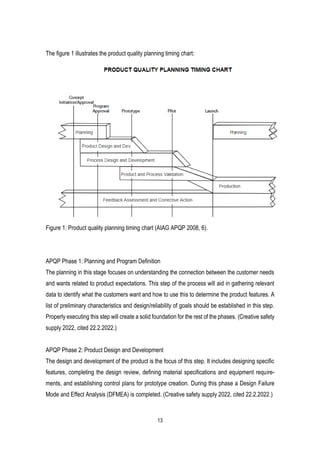
The figure 1 illustrates the product quality planning timing chart:
Figure 1: Product quality planning timing chart (AIAG APQP 2008, 6).
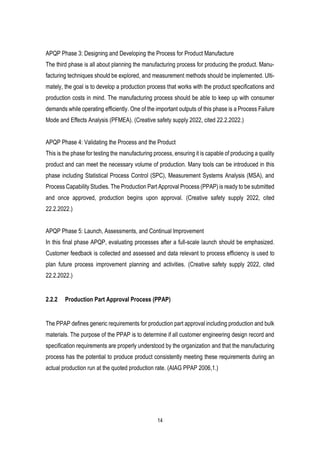
APQP Phase 1: Planning and Program Definition
The planning in this stage focuses on understanding the connection between the customer needs
and wants related to product expectations. This step of the process will aid in gathering relevant
data to identify what the customers want and how to use this to determine the product features. A
list of preliminary characteristics and design/reliability of goals should be established in this step.
Properly executing this step will create a solid foundation for the rest of the phases. (Creative safety
supply 2022, cited 22.2.2022.)
APQP Phase 2: Product Design and Development
The design and development of the product is the focus of this step. It includes designing specific
features, completing the design review, defining material specifications and equipment require-
ments, and establishing control plans for prototype creation. During this phase a Design Failure
Mode and Effect Analysis (DFMEA) is completed. (Creative safety supply 2022, cited 22.2.2022.)
14
APQP Phase 3: Designing and Developing the Process for Product Manufacture
The third phase is all about planning the manufacturing process for producing the product. Manu-
facturing techniques should be explored, and measurement methods should be implemented. Ulti-
mately, the goal is to develop a production process that works with the product specifications and
production costs in mind. The manufacturing process should be able to keep up with consumer
demands while operating efficiently. One of the important outputs of this phase is a Process Failure
Mode and Effects Analysis (PFMEA). (Creative safety supply 2022, cited 22.2.2022.)
APQP Phase 4: Validating the Process and the Product
This is the phase for testing the manufacturing process, ensuring it is capable of producing a quality
product and can meet the necessary volume of production. Many tools can be introduced in this
phase including Statistical Process Control (SPC), Measurement Systems Analysis (MSA), and
Process Capability Studies. The Production Part Approval Process (PPAP) is ready to be submitted
and once approved, production begins upon approval. (Creative safety supply 2022, cited
22.2.2022.)
APQP Phase 5: Launch, Assessments, and Continual Improvement
In this final phase APQP, evaluating processes after a full-scale launch should be emphasized.
Customer feedback is collected and assessed and data relevant to process efficiency is used to
plan future process improvement planning and activities. (Creative safety supply 2022, cited
22.2.2022.)
2.2.2 Production Part Approval Process (PPAP)
The PPAP defines generic requirements for production part approval including production and bulk
materials. The purpose of the PPAP is to determine if all customer engineering design record and
specification requirements are properly understood by the organization and that the manufacturing
process has the potential to produce product consistently meeting these requirements during an
actual production run at the quoted production rate. (AIAG PPAP 2006,1.)
15
The full PPAP consist of 18 elements (AIAG PPAP 2006,18.):
Table 1 PPAP elements
1. Design records
2. Authorized Engineering Change Documents
Customer Engineering approval
3. Customer Engineering approval
4. Design FMEA
5. Process Flow Diagrams
6. Process FMEA
7. Control Plan
8. Measurement System Analysis Studies
9. Dimensional Results
10. Material, Performance Test Results
11. Initial Process Studies/ Capability Study
12. Quality laboratory Documentation
13. Appearance Approval Report (AAR)
14. Sample Product
15. Master Sample
16.
17.
18.
Checking Aids
Customer Specific Requirements
Part Submission Warrant
All elements are not required for every use case (submissions). There are five generally accepted
PPAP submission levels. (AIAG PPAP 2006, 17.):
• Level 1 – Part Submission Warrant (PSW) is only requested and submitted to the cus-
tomer
• Level 2 – PSW with limited supporting data and product samples is submitted
• Level 3 – PSW with product samples and complete supporting data is submitted
• Level 4 – PSW and other requirements as defined by the customer
• Level 5 – PSW with product samples and complete supporting data available for reviews
at the supplier’s manufacturing plant
2.2.3 Failure Mode and Effects Analysis (FMEA)
The FMEA is an analytical methodology used to ensure that the potential problems have been
considered and addressed throughout the product and process development process. The FMEA
is considered to be a method to identify severity of potential effects of failure and to provide an
input to mitigating measures to reduce risk. The FMEA also includes an estimation of the probability
of occurrence of the causes of failure and their resultant failure modes. This broadens the analysis
by providing a measure of the failure mode’s likelihood. To minimize risk, the likelihood of failure
occurrence is reduced which increases product or process reliability. The FMEA is a tool that is
16
instrumental in reliability improvement. There are two broad categories of FMEA, Design
FMEA(DFMEA) and Process FMEA(PFMEA). (AIAG FMEA 2008, 2.)
The Design FMEA (DFMEA) explores the possibility of product malfunctions, reduced product life,
and safety and regulatory concerns derived from: (Quality One 2022c, cited 16.2.2022.)
• Material Properties
• Geometry
• Tolerances
• Interfaces with other components and/or systems
• Engineering Noise: environments, user profile, degradation, systems interactions
The Process FMEA (PFMEA) discovers failure that impacts product quality, reduced reliability of
the process, customer dissatisfaction, and safety or environmental hazards derived from: (Quality
One 2022c, cited 16.2.2022.)
• Human Factors
• Methods followed while processing
• Materials used
• Machines utilized
• Measurement systems impact on acceptance
• Environment Factors on process performance
2.2.4 Statistical Process Control (SPC)
The SPC is a method of measuring and controlling quality by monitoring the manufacturing process.
Quality data is collected in the form of product or process measurements or readings from various
machines or instrumentation. The data is collected and used to evaluate, monitor, and control a
process. SPC is an effective method to drive continuous improvement. By monitoring and control-
ling a process, we can assure that it operates at its fullest potential. (Quality One 2022d, cited
16.2.2022 Quality One 2022d.)
The SPC focuses on optimizing continuous improvement by using statistical tools to analyze data,
make inferences about process behaviour and then make appropriate decisions. The basic as-
sumption of the SPC is that all processes are subject to variation. Variation measures how data are
spread around the central tendency. Moreover, variation may be classified as one of two types,
random or chance cause variation and assignable cause variation.
17
The common cause is a cause of variation in the process due to change but is not assignable to
any factor. It is the variation that is inherent in the process. The process under the influence of a
common cause will always be stable and predictable.
The assignable cause is also known as “special cause”. The variation in a process that is not due
to chance therefore can be identified and eliminated. The process under influence of special cause
will not be stable and predictable. (Six Sigma Study Guide 2022, cited 24.2.2022.)
2.2.5 Measurement System Analysis (MSA)
The MSA is defined as an experimental and mathematical method of determining the amount of
variation that exists within a measurement process. Variation in the measurement process can
directly contribute to our overall process variability. MSA is used to certify the measurement system
for use by evaluating the system’s accuracy, precision, and stability.
A measurement system has been described as a system of related measures that enables the
quantification of particular characteristics. It can also include a collection of gages, fixtures, soft-
ware, and personnel required to validate a particular unit of measure or make an assessment of
the feature or characteristic being measured. The sources of variation in a measurement process
can include the following: (Quality One 2022e, cited 16.2.2022.)
• Process – test method, specification
• Personnel – the operators, their skill level, training, etc.
• Tools / Equipment – gages, fixtures, test equipment used and their associated calibration
systems
• Items to be measured – the part or material samples measured, the sampling plan, etc.
• Environmental factors – temperature, humidity, etc.
All these possible sources of variation should be considered during Measurement System Analysis.
Evaluation of a measurement system should include the use of specific quality tools to identify the
most likely source of variation. Most MSA activities examine two primary sources of variation, the
parts and the measurement of those parts. The sum of these two values represents the total vari-
ation in a measurement system. (Quality One 2022e, cited 16.2.2022.)
18
3 DATA COLLECTION
3.1 Gap analysis
A gap analysis is a tool that may be used for detecting the necessary steps to improve from the
current state to the targeted state. The targeted state is defined and then the current state is meas-
ured by using an adequate method. If the current state is not matching the targeted state, the gap
is detected, and corrective actions are defined in order to close the detected gaps. (Smartsheet
2019.)
The gap analysis was performed during several development meetings using a cross-functional
team approach. The cross-functional team was established in a way that there was representative
from all relevant departments.
Company’s New Product Introduction (NPI) process has been updated several times during the
last years as a part of QMS continual improvement activities. The NPI process has been synchro-
nized with the APQP model and the process phases follow APQP guidelines.
NPI process has following milestones: (TT NPI 2022, cited 14.3.2022.)
G-2: Business case evaluation
G0: Statement of work (SOW) approval
G1: Plan approval
G1.5: Pre-tool approval
G2: Design approval
G2.5: Tool approval
G3: Pilot readiness
G4: Launch readiness
GC: Project close
19
G-2: Business case evaluation
The purpose of this milestone is to evaluate the business opportunity and decide if TactoTek as a
company wants to invest to this opportunity and proceed to technical feasibility phase. Output of
the milestone is go/no go decision.
G0: Statement of Work (SOW) approval
The purpose of this milestone is to approve the proposal for the new project with the customer. The
main deliverable of this milestone is the SOW (Statement of Work) document. The document con-
tains information regarding requirements, technical solutions at a high level defining planned pro-
ject deliverables, schedule and cost estimation, and risk and opportunity assessment.
G1: Plan approval
The main purpose of the G1 milestone is that after passing this milestone TactoTek as a company
is committed to project content, schedule, and budget. The main deliverable is a plan including data
concerning schedule, content, budget, risks, opportunities, and project organization.
G1.5: Pre-tool approval
This milestone is used to evaluate if the project is ready to order manufacturing tools in order to
manufacture sample parts. The main deliverables of this milestone are tooling related design veri-
fication data and tool and tester design input data.
G2: Design approval
The purpose of this milestone is to approve design that has been verified to fulfill customer require-
ments including required production volumes and schedule. The main deliverables are DFMEA,
Design verification data, PFMEA, control plan, design drawings and specifications.
G2.5: Tool approval
The main purpose of G2.5 milestone is to evaluate the readiness to order tools for mass production
including mass production machinery and testers. Main deliverables are tooling related design ver-
ification data and tool and tester design input data.
G3: Pilot readiness
When this milestone is approved it is possible to send sample parts to customers for example for
validation purposes.
20
G4: Launch readiness
This milestone evaluates the readiness to start mass producing parts. If this milestone is approved,
mass production can be started.
GC: Project close
This milestone is approved when all the project tasks are completed. The project is closed from all
company’s systems which means that working hours and costs cannot be reported for that project
any longer.
Each milestone has its own set of criteria which should be fulfilled before passing the milestone
review. Also, each milestone has a set of outputs which need to be completed before proceeding
to the next phase of the process.
Identified gaps
1. From PPAP perspective the gap was that the current NPI process output does not contain
PPAP deliverables. However, the current process produces data and documents which
contain information needed for the PPAP deliverables. One of the activities that needs to
be performed is to cross-check if the data and documents that the process currently pro-
duces is sufficient to fulfill PPAP requirements.
2. Data required for PPAP is maturing during the whole process lifecycle, so the timing when
the process produces data to the certain PPAP deliverables needs to be identified and
documented.
3. During the development meetings it was also identified that we need to define roles and
responsibilities to ensure that all PPAP deliverables are available and delivered to cus-
tomer when requested.
4. It was also identified that the easiest way requiring the minimum amount of effort is to have
a dedicated location, for example folder in the server, where the data required for PPAP
deliverables are stored whenever the process produces data required for PPAP delivera-
bles.
21
5. For the person responsible for the PPAP delivery, it is important to have a clear under-
standing of the PPAP status during the whole NPI process. For this purpose, it would be
beneficial to have a documented procedure defining the activities at the high level which
are required to deliver high quality PPAP in planned schedule to the customer.
22
4 RESULTS
The first phase of the gap analysis identified the gaps between the current status and the targeted
state. The next step is to define a corrective action plan describing the tasks needed to reach the
targeted state.
4.1 PPAP deliverables
The PPAP requires that data on certain PPAP elements are taken from the parts manufactured
during a significant production run. The PPAP manual describes that the significant production run
shall be from one hour to eight hours of production and with the specific production quantity to a
total of a minimum of 300 consecutive parts unless otherwise specified by the authorized customer
representative.
The significant production run shall be conducted at the production site, at the production rate using
the production tooling, production gaging, production process, production materials, and production
operators. Parts from each unique production process, e.g., duplicate assembly line and/or work
cell, each position of a multiple cavities die, mold, tool, or pattern, shall be measured and repre-
sentative parts tested. (AIAG PPAP 2006, 3.)
Using the cross-functional team approach, the deliverables that the NPI project delivers were com-
pared against each of the PPAP element’s requirements.
Design records
PPAP Requirement:
PPAP manual describes this deliverable in the following way: The organization shall have the de-
sign record for the saleable product or part including design records for components or details of
the saleable product or part. For bulk materials, the design records may include identification raw
materials, formulations, processing steps and parameters and final product specification or ac-
ceptance criteria.
23
The organization shall provide evidence that the material/substance composition reporting that is
required by the customer has been completed for the part and that the reported data complies with
all customer-specific requirements. (AIAG PPAP 2006, 4.)
Available data for PPAP deliverable:
Injection Molded Structural Electronics (IMSE®) design disciplines provides quite a lot of design
documents. Design process produces documents related to mechanical design, illumination de-
sign, artwork design, electrical design, substrate film design. All these design documents are re-
quired for IMSE part design. In addition, the tool design documents are needed if a new manufac-
turing tool is needed. The PPAP requirement will be fulfilled when all these design documents are
included in the deliverable.
Engineering change documents
Requirement:
The organization shall have any authorized engineering change documents for those changes not
yet recorded in the design record but incorporated in the product or product tooling. (AIAG PPAP
2006, 5.)
Available data for PPAP deliverable:
TactoTek utilizes engineering change order procedure to manage changes during the product de-
velopment in a controlled way. The PPAP deliverable will contain documentation of all completed
engineering change orders that have not been incorporated to the product drawings.
Customer Engineering approval
PPAP requirement:
Where specified by the customer, the organization shall have evidence of customer engineering
approval. (AIAG PPAP 2006, 5.)
Available data for PPAP deliverable:
The deliverable could be part samples that are delivered to the customer for on-site testing. When
the testing is completed, the customer’s test engineer provides approval to be included as a part of
the PPAP submission.
24
Design FMEA
PPAP requirement:
The product design-responsible organization shall develop a Design FMEA in accordance with and
compliant to customer specified requirements. (AIAG PPAP 2006, 5.)
Available data for PPAP deliverable:
The DFMEA is already completed for all projects producing sample parts or production parts to the
customer. TactoTek is utilizing the latest version of the FMEA templates introduced in the new
AIAG & VDA FMEA handbook released in 2019.
Process Flow Diagram
PPAP requirement:
The organization shall have a process flow diagram in an organization-specific format that clearly
describes the production steps and sequence, as appropriate, and meets the specified customer
needs, requirements and expectations. (AIAG PPAP 2006, 5.)
Available data for PPAP deliverable:
The process flow diagram is already a mandatory document for all projects producing sample parts
or production parts to the customer. The Process Flow Diagram describes the entire process from
receiving the raw materials to shipping.
Process FMEA
PPAP requirement:
The organization shall develop a process FMEA in accordance with and compliant to customer-
specific requirements. (AIAG PPAP 2006, 5.)
Available data for PPAP deliverable:
The process FMEA is already a mandatory document for all projects producing sample parts or
production parts to the customer. TactoTek utilizes the latest version of the FMEA templates intro-
duced in the new AIAG & VDA FMEA handbook released in 2019.
25
Control Plan
PPAP requirement:
The organization shall have a control plan that defines all methods used for the process control
and complies with customer-specific requirements. (AIAG PPAP 2006, 5.)
Available data for PPAP deliverable:
The control plan is a mandatory document for all projects producing sample parts or production
parts to the customer. The control plan is an output from the PFMEA. It lists all control points for
product and inspection methods required to deliver products that continually meet customer quality
requirements.
Measurement System Analysis studies
PPAP requirement:
The organization shall have applicable measurement system analysis studies, e.g, gage R&R, bias,
linearity, stability, for all new or modified gauges, measurement and test equipment. (AIAG PPAP
2006, 6.)
Available data for PPAP deliverable:
The gage repeatability and reproducibility process has been used to evaluate gauging instrument’s
accuracy to ensure that the measurements are repeatable and reproducible. It needs to be checked
that MSA is performed for all measurement equipment that are needed to complete controls defined
in the control plan. The calibration records for all needed gages and measurement equipment
needs to be included to the PPAP submission.
Dimensional Results
PPAP requirement:
The organization shall provide evidence that dimensional verification required by the design record
and the control plan have been completed and results indicate compliance with specified require-
ments. The organization shall have dimensional results for each unique manufacturing process,
e.g., cells or production lines and all cavities, molds, patterns or dies. The organization shall record,
26
with the actual results: all dimensions (except reference dimensions), characteristics and specifi-
cations as noted on the design record and control plan.
The organization shall indicate the date of the design record, change level and any authorized
engineering change document not yet incorporated in the design record to which the pard was
made. The organization shall record the change level, drawing date, organization name and part
number on all auxiliary documents (e.g., supplementary layout results sheets, sketches, tracings,
cross sections, CMM inspection points results, geometric dimensioning and tolerancing sheets or
other auxiliary drawings used in conjunction with the part drawing). Copies of these auxiliary mate-
rials shall accompany the dimensional results according to the Retention/Submission requirements
table. All tracing shall be included when an optical comparator is necessary for inspection. (AIAG
PPAP 2006, 6.)
Available data for PPAP deliverable:
For all projects that produce sample or production parts to the customer all parts are tested after
each of the manufacturing process phase. This requirement can be fulfilled by validating that the
produced parts meet the part specifications. The results need to be documented and included in
the PPAP submission.
Material, Performance Test results
PPAP requirement:
The organization shall have records of material and/or performance test results for test specified
on the design records or control plan.
Material test results shall indicate and include:
• The design record change level of the parts tested
• Any authorized engineering change documents that have not yet been incorporated in the
design record
• The number, date and change level of the specification to which the part was tested
• The date on which the testing took place
• The quantity tested
• The actual results
• The material supplier’s name and the customer- assigned supplier/vendor code
27
For performance test results the organization shall perform tests for all parts or product material
when performance or functional requirements are specified by the design record or control plan
Performance test results shall indicate and include: (AIAG PPAP 2006, 6-7.)
• The design record change level of the parts tested
• Any authorized engineering change documents that have not yet been incorporated in the
design record
• The number, date and change level of the specification to which the part was tested
• The date on which the testing took place
• The quantity tested
• The actual results
Available data for PPAP deliverable
Since TactoTek is developing IMSE technology it is very important to test the manufactured part
and analyze the test results in very detailed level. It is as important to know why the manufactured
part fulfills the requirements as well as to investigate why certain tests failed. The requirements of
this PPAP element can be fulfilled by summarizing a document which contains list for every test
performed, a description of how the test was performed and the result of each test.
Initial Process Studies
PPAP requirement:
The purpose of this requirement is to determine if the production process is likely to produce a
product that will meet the customer requirements. The initial process studies will be done on all the
production processes and will include Statistical Process Control (SPC) charts on the critical char-
acteristics of the product. These studies demonstrate that the critical processes are stable, demon-
strate normal variation and are running near the intended nominal value. (AIAG PPAP 2006, 7.)
Available data for PPAP deliverable:
The statistical process control practices have been used to some extent, but it needs to be checked
that the activities currently done are sufficient to fulfill PPAP requirements.
28
Qualified Laboratory Documentation
PPAP requirement:
Inspection and testing for PPAP shall be performed by a qualified laboratory as defined by customer
requirements. The qualified laboratory (internal or external to the organization) shall have a labor-
atory scope and documentation showing that the laboratory is qualified for the type of the meas-
urements or tests conducted. (AIAG PPAP 2006, 10.)
Available data for PPAP deliverable:
TactoTek uses an internal laboratory for testing. This PPAP element requirement can be fulfilled
by creating a document showing that the internal laboratory is qualified for the type of measure-
ments and tests conducted.
Appearance Approval Report
PPAP requirement:
A separate Appearance Approval Report (AAR) shall be completed for each part or series of parts
if the product/part has appearance requirements on the design records. Upon satisfactory comple-
tion of all required criteria, the organization shall record the required information on the AAR. The
completed AAR and representative production parts shall be submitted to the location specified by
the customer to receive disposition. (AIAG PPAP 2006, 10.)
Available data for PPAP deliverable:
Currently projects do not provide sufficient documentation for this deliverable. The criteria for visual
quality have been defined and the visual quality of the produced parts are controlled. The formal
customer approval concerning the visual quality of the parts is not currently included to the process.
Sample production parts
PPAP requirement:
The organization shall provide sample parts as specified by the customer. (AIAG PPAP 2006, 10).
29
Available data for PPAP deliverable:
TactoTek collects sample parts from all production runs and delivers sample parts to the customer
as agreed with the customer. For PPAP the customer approval concerning the sample parts needs
to be recorded.
Master Sample
PPAP requirement:
The organization shall retain a master sample for the same period as the production part approval
records or until a new master sample is produced for the same customer part number approval or
where a master sample is required by the design record, control plan or inspection criteria as a
reference or standard. The master sample shall be identified as such and shall show the customer
approval date on the sample. The organization shall retain a master sample for each position of a
multiple cavity die, mold, tool or pattern or production process unless otherwise specified by the
customer. (AIAG PPAP 2006, 10.)
Available data for PPAP deliverable:
A master sample is a final sample of the part that is inspected and approved by the customer. The
master part is used as a benchmark for comparison to standard production parts if any part quality
question arises. Currently, TactoTek does not have a procedure how to manage master samples.
Checking Aids
PPAP requirement:
If requested by the customer, the organization shall submit with the PPAP submission any part-
specific assembly or component checking aid. The organization shall certify that all aspects of the
checking aid agree with part dimensional requirements. The organization shall document all re-
leased engineering design changes that have been incorporated in the checking aids at the time of
submission. The organization shall provide for preventive maintenance of any checking aids for the
life of the part. (AIAG PPAP 2006, 11.)
Available data for PPAP deliverable:
There has not been a need to use checking aids during the production since the production volumes
for each product are quite low. When production volumes increases and there is a need for check-
ing aids, a procedure how to manage the checking aids need to be defined.
30
Records of compliance with CSR
PPAP requirement:
The organization shall have records of compliance to all applicable customer-specific requirements.
(AIAG PPAP 2006, 11.)
Available data for PPAP deliverable:
TactoTek uses a compliance matrix to collect all the requirements which also includes all the cus-
tomer specific requirements. This PPAP element requirement can be fulfilled by including the com-
pliance matrix to the PPAP submission.
Part Submission Warrant
PPAP requirement:
Upon completion of all PPAP requirements, the organization shall complete the Part Submission
Warrant (PSW). A separate PSW shall be completed for each customer part number unless other-
wise agreed to by the authorized customer representative.
If production parts are produced from more than one cavity, mold, tool, die, pattern or production
process, e.g., line or cell, the organization shall complete a dimensional evaluation on one part
from each. The specific cavities, molds, line, etc... shall then be identified in the “Mold/Cavity/Pro-
duction Process” line on a PSW.
The organization shall verify that all the measurements and test results show conformance with
customer requirements and that all required documentation is available and included to the sub-
mission as appropriate. A responsible official of the organization shall approve the PSW and pro-
vide contact information. (AIAG PPAP 2006, 11.)
Available data for PPAP deliverable:
TactoTek has not yet submitted any PPAP submission so there are not any deliverables available
for this PPAP element.
31
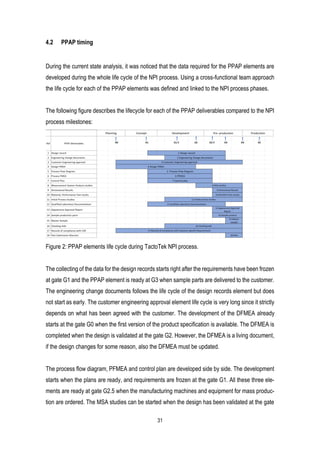
4.2 PPAP timing
During the current state analysis, it was noticed that the data required for the PPAP elements are
developed during the whole life cycle of the NPI process. Using a cross-functional team approach
the life cycle for each of the PPAP elements was defined and linked to the NPI process phases.
The following figure describes the lifecycle for each of the PPAP deliverables compared to the NPI
process milestones:
Figure 2: PPAP elements life cycle during TactoTek NPI process.
The collecting of the data for the design records starts right after the requirements have been frozen
at gate G1 and the PPAP element is ready at G3 when sample parts are delivered to the customer.
The engineering change documents follows the life cycle of the design records element but does
not start as early. The customer engineering approval element life cycle is very long since it strictly
depends on what has been agreed with the customer. The development of the DFMEA already
starts at the gate G0 when the first version of the product specification is available. The DFMEA is
completed when the design is validated at the gate G2. However, the DFMEA is a living document,
if the design changes for some reason, also the DFMEA must be updated.
The process flow diagram, PFMEA and control plan are developed side by side. The development
starts when the plans are ready, and requirements are frozen at the gate G1. All these three ele-
ments are ready at gate G2.5 when the manufacturing machines and equipment for mass produc-
tion are ordered. The MSA studies can be started when the design has been validated at the gate
32
G2. The Gage R&R must be performed to all gauges and measurement equipment which are
needed to perform tests defined in the control plan before the significant production run can be
started. The MSA studies are completed before the PPAP submission is sent to the customer.
Dimensional results are done using manufactured parts during the significant production run.
Therefore, it cannot be performed before the mass production line is available. The dimensional
results need to be completed before the PPAP submission is sent to the customer. The same
applies also to material and performance test results PPAP element.
The initial process studies data is collected during the whole life cycle of the manufacturing process
development, and it is completed before the PPAP submission. The same applies also for checking
aids PPAP element. The qualified laboratory documentation can be started when the plans are
ready at the gate G1 and it needs to be completed before sample parts are delivered to the cus-
tomer at the gate G3. The appearance approval report is completed using the parts from the sig-
nificant production run and it needs to be completed before the PPAP submission.
Sample products can be manufactured when the mass production line is operational but according
to the company’s NPI process the sample parts can be delivered to the customer only after the
gate G3 has been approved. The reason for this is that the gate G3 defines certain requirements
before sample parts can be delivered to the customer. The master sample must be taken from the
significant production run, and it must be approved by the customer before PPAP submission can
be delivered. Records of the compliance with customer specific requirements element’s life cycle
covers the whole NPI process since the customer specific requirements vary from project to project.
The part submission warrant is the last PPAP element and all other PPAP elements needs to be
available before the PSW can be submitted to the customer.
The PPAP timing analysis helps the PPAP coordinator and project manager manage that creation
for each of the PPAP deliverables are started early enough and each of the deliverables are avail-
able when needed. The PPAP deliverables needs to be included in the project plan. The project
plan must also contain key events such as the Gage R&R, the significant production run and the
PPAP submission.
33
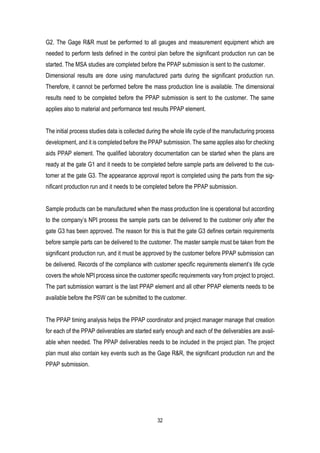
4.3 PPAP procedure
The PPAP procedure defines the workflow how PPAP is managed in the organization from negoti-
ation with the customer to PPAP approval. It also describes the stakeholders that are involved in
the procedure. There is a blue dot for each of the PPAP deliverables in the procedure description.
These dots define that which procedure phase each of the PPAP deliverables are included.
The following figure describes the PPAP procedure:
Figure 3: PPAP procedure
4.4 PPAP RASIC
IPMA, International Project Management Association describes RASIC in the following way:
The RASIC-Chart or matrix is an integrated view of who is involved and in which role across all
project activities or process steps, e.g. from start to end of a project. On the horizontal view you
see all the roles involved, e.g. the decision maker, the sales role, the project manager, the design
role, the manufacturing role, the quality assurance role and so on and so forth. (IPMA 2022, cited
28.2.2022.)
34
The responsible role(R) is the individual who is ultimately responsible for getting the job done. The
accountable role(A) is the individual who is ultimately answerable for the activity or decision. The
support role(S) is the individual who delivers input that can help the responsible body achieve task
completion. The inform role(I) are the individuals to be informed of the task’s progress and any
decisions being made. These are the people who need to know when the task is complete. The
consult role(C) is individual(s) (typically subject matter experts) to be consulted prior to a final de-
cision or action. (IPMA 2022, cited 28.2.2022.)
35
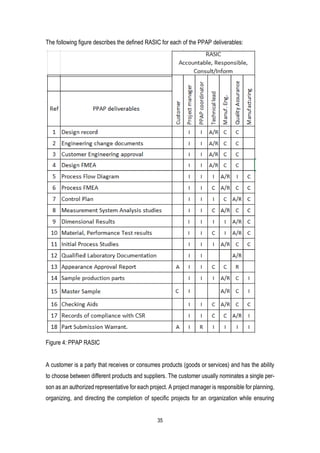
The following figure describes the defined RASIC for each of the PPAP deliverables:
Figure 4: PPAP RASIC
A customer is a party that receives or consumes products (goods or services) and has the ability
to choose between different products and suppliers. The customer usually nominates a single per-
son as an authorized representative for each project. A project manager is responsible for planning,
organizing, and directing the completion of specific projects for an organization while ensuring
36
these projects are on time, on budget, and within scope. The PPAP coordinator is the person ac-
countable for ensuring that the PPAP requirements are understood and transferred into delivera-
bles for the product within the scope and verifies that all necessary activities are implemented and
monitored to satisfy PPAP. The technical lead is responsible for managing technical aspects of
product development flow in a specific context or team. The manufacturing engineering lead is
responsible for the process of transferring new products from product development to production.
A quality assurance role is responsible for ensuring that products and services meet the established
requirements and standards set by the company.
The PPAP timing chart and PPAP RASIC matrix together provide a good toolset for the project
manager as well as for the PPAP coordinator to manage that PPAP deliverables are created and
available when needed.
4.5 PPAP package
The PPAP manual defines that all PPAP records must be maintained for the length of time that the
part is active plus one calendar year. (PPAP manual 2006, p 21).
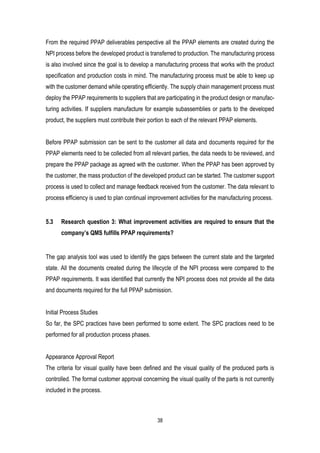
All the PPAP packages are stored in its own dedicated server folder with limited access rights. The
minimum requirement is that the PPAP package is updated for every project milestone. If a cus-
tomer requests PPAP deliverables between project milestones, the PPAP package must be up-
dated between project milestones.
37
5 CONCLUSION
5.1 Research question 1: Which areas of the company’s QMS do the PPAP requirements
affect?
The cross-functional development team approach was used to solve the first research question.
The cross-functional team was established in a way that there was a representative from all rele-
vant company departments. The business activities where PPAP requirements have an effect start
already from the customer interface. During the negotiations with the customer, the sales repre-
sentative needs to agree with the customer, if PPAP is valid for that specific project.
The NPI process is used to develop a product that fulfills all the relevant requirements including
customer-specific requirements. If a customer is requesting PPAP submission, the NPI process
has a significant role in preparing the PPAP deliverables. The manufacturing process is responsible
that the manufactured parts comply with specified standards and parts can be constantly produced
at the quoted production rate. The supply chain management process is also affected since it is
responsible for establishing and managing the supply chain required to manufacture parts.
The developed product needs to be maintained during the product’s whole life cycle. For this rea-
son, also the customer support activities are affected by the PPAP requirements.
5.2 Research question 2: How do PPAP requirements affect the company’s processes
and procedures?
The company’s business processes were reviewed using a cross-functional team approach. It was
noticed that during the customer management process in case the PPAP is requested by the cus-
tomer, it needs to be agreed on which PPAP submission level will be used in that project. It also
needs to be agreed are all the PPAP elements relevant or can some of the PPAP elements be left
out from the PPAP submission. The customer-specific requirements need to be identified and doc-
umented during the discussions with the customer. For discussions related to the technical details
in addition to the sales representative also a technical pre-sales engineering representative must
participate in negotiations.
38
From the required PPAP deliverables perspective all the PPAP elements are created during the
NPI process before the developed product is transferred to production. The manufacturing process
is also involved since the goal is to develop a manufacturing process that works with the product
specification and production costs in mind. The manufacturing process must be able to keep up
with the customer demand while operating efficiently. The supply chain management process must
deploy the PPAP requirements to suppliers that are participating in the product design or manufac-
turing activities. If suppliers manufacture for example subassemblies or parts to the developed
product, the suppliers must contribute their portion to each of the relevant PPAP elements.
Before PPAP submission can be sent to the customer all data and documents required for the
PPAP elements need to be collected from all relevant parties, the data needs to be reviewed, and
prepare the PPAP package as agreed with the customer. When the PPAP has been approved by
the customer, the mass production of the developed product can be started. The customer support
process is used to collect and manage feedback received from the customer. The data relevant to
process efficiency is used to plan continual improvement activities for the manufacturing process.
5.3 Research question 3: What improvement activities are required to ensure that the
company’s QMS fulfills PPAP requirements?
The gap analysis tool was used to identify the gaps between the current state and the targeted
state. All the documents created during the lifecycle of the NPI process were compared to the
PPAP requirements. It was identified that currently the NPI process does not provide all the data
and documents required for the full PPAP submission.
Initial Process Studies
So far, the SPC practices have been performed to some extent. The SPC practices need to be
performed for all production process phases.
Appearance Approval Report
The criteria for visual quality have been defined and the visual quality of the produced parts is
controlled. The formal customer approval concerning the visual quality of the parts is not currently
included in the process.
39
A template for record verifying that the customer has inspected the final product and it meets all
the required appearance specifications for the design needs to be defined and approval practice
needs to be implemented in the NPI process.
Sample parts
Sample parts are collected after each of the manufacturing process phases but the customer ap-
proval is not recorded. A template for record verifying that the customer has approved the sample
parts needs to be defined and approval practice needs to be implemented to the NPI process.
Master Sample
A procedure how to create, approve, use and maintain the master samples needs to be defined.
Checking Aids
The checking aids have not yet been used. If there is a need for checking aids, a procedure on how
to manage the checking aids needs to be defined. The procedure shall include how checking aids
can be identified and how they are used. Also, the calibration schedule for checking aids needs to
be defined.
PSW
TactoTek has not yet submitted any PPAP submission so there are not any deliverables available
for this PPAP element. The PPAP manual provides a template for PSW which can be used when
PSW needs to be submitted.
The detailed corrective action plan as well as the deployment plan are out of scope of this thesis.
These plans will be executed by using a pilot project. The pilot project plan will include all the tasks
required for corrective actions and deployment of the corrective actions. The effectiveness of the
corrective and deployment activities will be evaluated using internal audits.
40
6 GLOSSARY
AAR Appearance Approval Report
AIAG Automotive Industry Action Group
APQP Advanced Quality Planning Process
ASQ American Society of Quality
CSR Customer Specific Requirements
DFMEA Design Failure Mode and Effect Analysis
Gage R&R Gage Repeatability and Reproducibility
HMI Human Machine Interface
IATF International Automotive Task Force
IMSE Injection Molded Structural Electronics
ISO International Organization for Standardization
MSA Measurement System Analysis
NPI New Product Introduction
MSA Measurement System Analysis
OEM Original Equipment Manufacturer
PFMEA Process Failure Mode and Effect Analysis
PSW Part Submission Warrant
QMP Quality Management Principle
QMS Quality Management System
RASIC Responsible, Approving, Supporting, Informed, Consulted
RFI/RFQ Request For Information / Request For Quotation
SOW Statement of Work
SPC Statistical Process Control
VDA Verband Der Automobilindustrie
41
7 REFERENCES
AIAG PPAP 2006. Production Part Approval Process (PPAP), 4th ed. Southfield, MI: AIAG.
AIAG APQP 2008. Advance Product Quality Planning and Control Plan (APQP) – Reference man-
ual second edition.
AIAG FMEA 2008. Potential Failure Mode and Effects Analysis (FMEA) – FMEA process
ASQ 2022. What is ISO 9001:2015. Cited 12.2.2022.
https://asq.org/quality-resources/iso-9001#:~:text=Originally%20pub-
lished%20in%201987%2C%20ISO,well%20as%20provide%20other%20clarifications.
Automotive Industry Action Group (AIAG) 2022a. About AIAG. Cited 18.2.2022
https://www.aiag.org/about
Automotive Industry Action Group (AIAG) 2022b. Automotive Core Tools. Cited 18.2.2022
https://www.aiag.org/quality/automotive-core-tools
Clear Quality 2022. ISO 9001 history. Cited 10.2.2022.
https://www.clearquality.co.uk/iso-9001-history
Creative safety supply 2022. APQP (Advanced Product Quality Planning). Cited 22.2.2022
https://www.creativesafetysupply.com/glossary/apqp-advanced-product-quality-planning/
International Automotive Task Force (IATF) 2022. About IATF. Cited 16.2.2022
https://www.iatfglobaloversight.org/about-iatf/
International project management association (IPMA) 2022. The RASIC-Chart – a key tool for col-
laboration in projects. Cited 28.2.2022
https://www.ipma.world/rasic-chart-key-tool-collaboration-projects/
42
ISO 2022. Quality management principles. Cited 14.2.2022
https://www.iso.org/files/live/sites/isoorg/files/store/en/PUB100080.pdf
Quality One 2022a. What is ISO9001. Cited 12.2.2022
https://quality-one.com/iso-9001/
Quality One 2022b. Introduction to IATF 16949. Cited 16.2.2022
https://quality-one.com/iatf-16949/
Quality One 2022c. Introduction to FMEA. Cited 16.2.2022
https://quality-one.com/fmea/#Intro
Quality One 2022d. Introduction to Statistical Process Control. Cited 16.2.2022
https://quality-one.com/spc/
Quality One 2022e. Introduction to Measurement System Analysis. Cited 16.2.2022
https://quality-one.com/msa/
Six Sigma Study Guide 2022. Statistical Process Control (SPC). Cited 24.2.2022
https://sixsigmastudyguide.com/statistical-process-control-spc/
Smartsheet. 2019. The Complete Guide to Gap Analysis. Cited 5.10.2019.
https://www.smartsheet.com/gap-analysis-method-examples
TactoTek Oy 2022. Kyocera Licenses TactoTek® Injection Molded Structural Electronics (IMSE®)
Technology. Cited 10.2.2022
https://global.kyocera.com/newsroom/news/2021/000041.html
TT NPI 2022. TactoTek new product introduction process. Cited 14.3.2022

Maatta_Kimmo.pdf

  • 1.
    Kimmo Määttä PRODUCTION PARTAPPROVAL PROCESS (PPAP) FRAMEWORK INTEGRA- TION INTO PRODUCT DEVELOPMENT PROCESS
  • 2.
    PRODUCTION PART APPROVALPROCESS (PPAP) FRAMEWORK INTEGRA- TION INTO PRODUCT DEVELOPMENT PROCESS Kimmo Määttä Master Thesis Spring 2022 Degree programme in Printed Intelli- gence Oulu University of Applied Sciences
  • 3.
    3 ABSTRACT Oulu University ofApplied Sciences Degree programme in Printed Intelligence Author: Kimmo Määttä Title of the thesis: Production Part Approval Process (PPAP) framework integration into product development process Thesis examiner(s): Harri Määttä Term and year of thesis completion: Spring 2022 Pages: 42 The Production Part Approval Process is a widely used tool in the automotive industry to approve new or revised parts manufactured by suppliers. Usually all suppliers participating in RFI/RFQ pro- cess initiated by the OEMs must have a capability for PPAP submission. The case company in this thesis is TactoTek Oy which is a leading provider of solutions for Injection Molded Structural Electronics (IMSE) that integrate printed circuitry and electronic components into 3D injection molded plastics. TactoTek is very active in the automotive market segment and cus- tomers request compliance with the PPAP requirements. The purpose of this thesis was to investigate how the PPAP framework could be integrated into the company’s quality management system. The qualitative research methods were used by establish- ing several cross-functional teams to work on the specific research questions. The gap analysis tool was used to perform the current state analysis and to identify the gaps between the current state and the targeted state. As a result, the processes and procedures affected by the PPAP requirements were identified, and the gap analysis revealed the gaps which need to be fulfilled to be compliant with the PPAP re- quirements. The PPAP timing chart, PPAP procedure, and PPAP RASIC documents help the de- velopment project manager to manage PPAP activities at a practical level. Based on the results, the case company can update its quality management system to be compliant with the PPAP re- quirements. Keywords: PPAP, APQP, NPI, QMS
  • 4.
    4 CONTENTS 1 INTRODUCTION................................................................................................................... 5 1.1Company introduction ................................................................................................ 5 1.2 Thesis objectives........................................................................................................ 5 1.3 Research questions.................................................................................................... 6 2 THEORETICAL ASPECTS.................................................................................................... 7 2.1 Quality management systems .................................................................................... 7 2.1.1 ISO9001....................................................................................................... 7 2.1.2 IATF16949:2016 ........................................................................................ 10 2.2 Quality assurance tools............................................................................................ 11 2.2.1 Advanced Product Quality Planning & Control Plan (APQP) ..................... 12 2.2.2 Production Part Approval Process (PPAP) ................................................ 14 2.2.3 Failure Mode and Effects Analysis (FMEA)................................................ 15 2.2.4 Statistical Process Control (SPC) .............................................................. 16 2.2.5 Measurement System Analysis (MSA)....................................................... 17 3 DATA COLLECTION ........................................................................................................... 18 3.1 Gap analysis............................................................................................................. 18 4 RESULTS............................................................................................................................ 22 4.1 PPAP deliverables.................................................................................................... 22 4.2 PPAP timing ............................................................................................................. 31 4.3 PPAP procedure....................................................................................................... 33 4.4 PPAP RASIC............................................................................................................ 33 4.5 PPAP package ......................................................................................................... 36 5 CONCLUSION..................................................................................................................... 37 5.1 Research question 1: Which areas of the company’s QMS do the PPAP requirements affect?................................................................................................. 37 5.2 Research question 2: How do PPAP requirements affect the company’s processes and procedures? ...................................................................................................... 37 5.3 Research question 3: What improvement activities are required to ensure that the company’s QMS fulfills PPAP requirements?........................................................... 38 6 GLOSSARY......................................................................................................................... 40 7 REFERENCES.................................................................................................................... 41
  • 5.
    5 1 INTRODUCTION 1.1 Companyintroduction TactoTek is the leading provider of Injection Molded Structural Electronics (IMSE®) solutions that integrate printed circuitry and electronic components into 3D injection molded plastics. Leading IMSE use cases include human-machine interfaces (HMI), connectivity and electronic styling fea- tures for automotive, smart home, appliances, and other markets. TactoTek develops and industri- alizes IMSE technology, creates mass production ready IMSE prototypes, and licenses IMSE tech- nology for 3rd party IMSE part design and global mass production. (TactoTek Oy 2021. Cited 10.2.2022.) TactoTek has a full-featured production line of its own for pilot projects. In addition to customer pilots, the production line is used in the company’s own production activities. A large proportion of TactoTek’s current customers are automotive companies. However, other segments of the elec- tronics industry are quickly increasing their relative share, with structural electronics finding its way into home appliances, thermostats, light switches, medical devices and many other applications. TactoTek was founded in 2011 and the company’s headquarters is based in Oulu, Finland. The company has also sales offices in USA, Germany, South Korea and Japan. 1.2 Thesis objectives The purpose of this thesis is to investigate how Production Part Approval Process (PPAP) require- ments could be integrated as a part of TactoTek’s Quality Management System (QMS). TactoTek is working very actively in the automotive market segment. The company has several ongoing development projects in parallel with the leading automotive OEMs and Tiers. Since PPAP has been used for a long time in the automotive industry to approve new or revised parts manufac- tured by suppliers, customers request TactoTek to synchronize the company’s business processes to comply with the PPAP requirements.
  • 6.
    6 The objective isto perform current state analysis for the Quality Management System (QMS), iden- tify gaps regarding PPAP requirements and define a corrective action plan for how to improve the company’s QMS in a way that it fulfills the PPAP requirements. 1.3 Research questions Research question 1: Which areas of the company’s QMS do the PPAP requirements affect? It is important to identify which sections of the QMS are affected in order to be able to establish cross-functional development teams in a way that there are participants from all relevant stake- holder groups. Research question 2: How do PPAP requirements affect the company’s processes and proce- dures? Based on the results of research question 1, the identified QMS areas are analyzed at more de- tailed level using a gap analysis tool and cross-functional team approach. The cross-functional team approach is used to identify processes and procedures which are affected by the PPAP re- quirements. The gap analysis tool is used to perform current state analysis as well as to identify gaps between the current state and targeted state. Research question 3: What improvement activities are required to ensure that the company’s QMS fulfills PPAP requirements? When the gaps are identified by using the gap analysis tool, a corrective action plan needs to be defined in order to improve the QMS processes and procedures in a way that when processes are executed the PPAP requirements are fulfilled.
  • 7.
    7 2 THEORETICAL ASPECTS 2.1Quality management systems The idea that a quality management system could impact the quality of a product or service was first introduced in the 1970s by several large organizations, such as Ford and USA Ministry of Defence. Since there were not any international quality standards available, they released their own quality management standards. Their approach was that if you want to trade with them, your business had to meet the requirements of their quality management standards. The BSI published the first UK standard in 1971, the BS 9000, which was specifically designed for the electronics industry. BS 5179 "Guidelines for Quality Assurance" was released 1974 and BS5750, the UK’s first management system quality standard was published 1979. For the first time, the responsibility of quality assurance was transferred to the supplier from the customer. (Clear Quality 2022, cited 10.2.2022.) With the rise of international trade in the 1980’s there was a need for an internationally recognised quality system. A Technical Committee 176 was formed in 1979 to create a universal quality stand- ard. Based on the British Standard BS5750, ISO 9000 was first released in 1987. It was referred to as a “quality assurance standard,” with ISO 9000 being the guidance document. The actual certifi- cation standards were divided into three parts: • ISO 9001 was for organizations that conducted design, production and servicing. • ISO 9002 was the standard for production and servicing companies that did not do de- sign. • ISO 9003 was applicable to organizations that neither designed nor produced products, such as those engaged in testing and distribution (Clear Quality 2022, cited 10.2.2022.). 2.1.1 ISO9001 The ISO 9001 defines the criteria for a Quality Management System and is the only standard in the ISO 9000 family that can be audited against with the goal of voluntary compliance or to become 3rd party registered. In fact, there are over one million companies and organizations in over 170
  • 8.
    8 countries certified toISO 9001. All the requirements of ISO 9001 are generic and are intended to be applicable to any organization, regardless of its type or size, or the products and services it provides. (Quality One 2022, cited 12.2.2022.) ISO9001 versions are as follows: (ASQ 2022, cited 12.2.2022.): 1987 - First edition 1994 – Second edition 2000 – Third edition 2008 – Fourth edition 2015 – Fifth edition, the latest edition The ISO9001:2015 is based on the seven main principles: (ISO 2022, cited 14.2.2022.): QMP 1 – Customer focus QMP 2 – Leadership QMP 3 – Engagement of people QMP 4 – Process approach QMP 5 – Improvement QMP 6 – Evidence-based decision making QMP 7 – Relationship management Quality Management Principle 1 – Customer focus The primary focus of quality management is to meet customer requirements and to strive to exceed customer expectations. Sustained success is achieved when an organization attracts and retains the confidence of customers and other interested parties. Every aspect of customer interaction provides an opportunity to create more value for the customer. Understanding current and future needs of customers and other interested parties contributes to sustained success of the organiza- tion. (ISO 2022, cited 14.2.2022.) Quality Management Principle 2 – Leadership Leaders at all levels establish unity of purpose and direction and create conditions in which people are engaged in achieving the organization’s quality objectives. Creation of unity of purpose and direction and engagement of people enable an organization to align its strategies, policies, pro- cesses and resources to achieve its objectives. (ISO 2022, cited 14.2.2022.)
  • 9.
    9 Quality Management Principle3 – Engagement of people Competent, empowered and engaged people at all levels throughout the organization are essential to enhance its capability to create and deliver value. To manage an organization effectively and efficiently, it is important to involve all people at all levels and to respect them as individuals. Recog- nition, empowerment, and enhancement of competence facilitate the engagement of people in achieving the organization’s quality objectives. (ISO 2022, cited 14.2.2022.) Quality Management Principle 4 – Process approach Statement Consistent and predictable results are achieved more effectively and efficiently when activities are understood and managed as interrelated processes that function as a coherent sys- tem. Rationale The quality management system consists of interrelated processes. Understanding how results are produced by this system enables an organization to optimize the system and its performance. (ISO 2022, cited 14.2.2022.) Quality Management Principle 5 – Improvement Statement Successful organizations have an ongoing focus on improvement. Rationale Improve- ment is essential for an organization to maintain current levels of performance, to react to changes in its internal and external conditions and to create new opportunities. (ISO 2022, cited 14.2.2022.) Quality Management Principle 6 – Evidence-based decision making Statement Decisions based on the analysis and evaluation of data and information are more likely to produce desired results. Rationale Decision making can be a complex process, and it always involves some uncertainty. It often involves multiple types and sources of inputs, as well as their interpretation, which can be subjective. It is important to understand cause-and-effect relationships and potential unintended consequences. Facts, evidence and data analysis lead to greater objec- tivity and confidence in decision making. (ISO 2022, cited 14.2.2022.) Quality Management Principle 7 – Relationship management Statement For sustained success, an organization manages its relationships with interested parties such as suppliers. Rationale Interested parties influence the performance of an organization. Sus- tained success is more likely to be achieved when the organization manages relationships with all its interested parties to optimize their impact on its performance. Relationship management with its supplier and partner networks is of particular importance. (ISO 2022, cited 14.2.2022.)
  • 10.
    10 2.1.2 IATF16949:2016 The InternationalAutomotive Task Force (IATF) is a group of automotive manufacturers and their respective national automotive industry associations, formed to provide improved quality products to automotive customers worldwide. Specifically, the purposes for which the IATF was established are (IATF 2022, cited 16.2.2022.): • to develop a consensus regarding international fundamental quality system requirements, primarily for the participating companies’ direct suppliers of production materials, product or service parts or finishing services. These requirements will also be available for other interested parties in the automotive industry. • to develop policies and procedures for the common IATF third party registration scheme to ensure consistency worldwide. • to provide appropriate training to support IATF 16949 requirements and the IATF registra- tion scheme. • to establish formal liaisons with appropriate bodies to support IATF objectives. The IATF members include the following vehicle manufacturers: BMW Group, Ford Motor Com- pany, Geely Group, General Motors, IVECO Group, Jaguar Land Rover (JLR) Limited, Mercedes- Benz Group AG, Renault Group, Stellantis (ex FCA), Stellantis (ex PSA), Volkswagen AG and their respective National Automotive Industry Associations – AIAG (U.S.), ANFIA (Italy), FIEV (France), SMMT (U.K.) and VDA (Germany). (IATF 2022, cited 16.2.2022.) The IATF 16949 is a global quality management system standard for the automotive industry. The IATF 16949:2016 incorporates the structure and requirements of the ISO 9001:2015 quality man- agement system standard with additional automotive customer-specific requirements. It was devel- oped by the IATF, with support from the AIAG. The primary focus of the IATF 16949 standard is the development of a quality management system that provides for continual improvement, emphasizing defect prevention and the reduction of vari- ation and waste in the supply chain. The standard, combined with applicable Customer-Specific
  • 11.
    11 Requirements (CSR’s), definesthe QMS requirements for automotive production, service and/or accessory parts. IATF 16949:2016 is an independent QMS standard that is fully aligned with the structure and re- quirements of ISO 9001:2015. Therefore, the IATF 16949 cannot be implemented alone as a stand- alone document but must be implemented as a supplement and in conjunction with ISO 9001:2015. (Quality One 2022b, cited 16.2.2022.). 2.2 Quality assurance tools The AIAG is the Automotive Industry Action Group founded in 1982 by the three largest North American automotive OEMs: Ford, General Motors, and Chrysler. AIAG membership has grown to over 4,000 member companies, including global OEMs such as GM, Boeing, Toyota, Tesla, Honda, Polaris, Volkswagen, Caterpillar, PACCAR, BAE Systems, Nissan, Oshkosh, Stellantis, Rivian, AM General, Deere, and Co., Ryder and many of their part suppliers including Adient, ZF, Aptive, Bosch, Tenneco, Continental, Magna, Lear, Dana, Freudenberg. The AIAG is a non-profit organization where companies in the mobility industries have worked collaboratively to drive down cost and complexity in the supply chain. The AIAG manages and publishes standards and educational resources for member organizations to help them maintain compliance with guidelines and standards defined by the AIAG in tandem with automotive manu- facturers and quality organizations like ISO. (AIAGa 2022, cited 18.2.2022.) The AIAG has developed common quality methods and tools, which became known as the quality core tools. These quality methods support employees in improving procedures and are fundamen- tal for an effective quality management system, in accordance with the current requirements of the automotive industry. Over 30 years ago, AIAG and ASQ (American Society of Quality) in collabo- ration with the automotive manufacturers Ford, GM, and Chrysler (now FCA) established these quality methods and tools to enhance the effectiveness of the IATF 16949-based QMS to provide high-quality products, delivered on time. (AIAGa 2022, cited 18.2.2022.)
  • 12.
    12 The five qualitycore tools are: 1. Advanced Product Quality Planning & Control Plan (APQP) 2. Production Part Approval Process (PPAP) 3. Failure Mode and Effects Analysis (FMEA) 4. Statistical Process Control (SPC) 5. Measurement System Analysis (MSA) The tools proved so useful that they were adopted by other manufacturing sectors, including aero- space, defence, medical, and pharmaceutical. (AIAGb 2022, cited 18.2.2022.) 2.2.1 Advanced Product Quality Planning & Control Plan (APQP) The first version of the APQP manual was published in June 1994 and the second edition in July 2008. The manual is developed by the AIAG as a tool to help reduce the complexity of product planning for suppliers and buying organizations. The APQP manual provides guidelines designed to produce a product quality plan which will support the development of a product or service that will satisfy the customer’s needs. (AIAG APQP 2008, 1.)
  • 13.
    13 The figure 1illustrates the product quality planning timing chart: Figure 1: Product quality planning timing chart (AIAG APQP 2008, 6). APQP Phase 1: Planning and Program Definition The planning in this stage focuses on understanding the connection between the customer needs and wants related to product expectations. This step of the process will aid in gathering relevant data to identify what the customers want and how to use this to determine the product features. A list of preliminary characteristics and design/reliability of goals should be established in this step. Properly executing this step will create a solid foundation for the rest of the phases. (Creative safety supply 2022, cited 22.2.2022.) APQP Phase 2: Product Design and Development The design and development of the product is the focus of this step. It includes designing specific features, completing the design review, defining material specifications and equipment require- ments, and establishing control plans for prototype creation. During this phase a Design Failure Mode and Effect Analysis (DFMEA) is completed. (Creative safety supply 2022, cited 22.2.2022.)
  • 14.
    14 APQP Phase 3:Designing and Developing the Process for Product Manufacture The third phase is all about planning the manufacturing process for producing the product. Manu- facturing techniques should be explored, and measurement methods should be implemented. Ulti- mately, the goal is to develop a production process that works with the product specifications and production costs in mind. The manufacturing process should be able to keep up with consumer demands while operating efficiently. One of the important outputs of this phase is a Process Failure Mode and Effects Analysis (PFMEA). (Creative safety supply 2022, cited 22.2.2022.) APQP Phase 4: Validating the Process and the Product This is the phase for testing the manufacturing process, ensuring it is capable of producing a quality product and can meet the necessary volume of production. Many tools can be introduced in this phase including Statistical Process Control (SPC), Measurement Systems Analysis (MSA), and Process Capability Studies. The Production Part Approval Process (PPAP) is ready to be submitted and once approved, production begins upon approval. (Creative safety supply 2022, cited 22.2.2022.) APQP Phase 5: Launch, Assessments, and Continual Improvement In this final phase APQP, evaluating processes after a full-scale launch should be emphasized. Customer feedback is collected and assessed and data relevant to process efficiency is used to plan future process improvement planning and activities. (Creative safety supply 2022, cited 22.2.2022.) 2.2.2 Production Part Approval Process (PPAP) The PPAP defines generic requirements for production part approval including production and bulk materials. The purpose of the PPAP is to determine if all customer engineering design record and specification requirements are properly understood by the organization and that the manufacturing process has the potential to produce product consistently meeting these requirements during an actual production run at the quoted production rate. (AIAG PPAP 2006,1.)
  • 15.
    15 The full PPAPconsist of 18 elements (AIAG PPAP 2006,18.): Table 1 PPAP elements 1. Design records 2. Authorized Engineering Change Documents Customer Engineering approval 3. Customer Engineering approval 4. Design FMEA 5. Process Flow Diagrams 6. Process FMEA 7. Control Plan 8. Measurement System Analysis Studies 9. Dimensional Results 10. Material, Performance Test Results 11. Initial Process Studies/ Capability Study 12. Quality laboratory Documentation 13. Appearance Approval Report (AAR) 14. Sample Product 15. Master Sample 16. 17. 18. Checking Aids Customer Specific Requirements Part Submission Warrant All elements are not required for every use case (submissions). There are five generally accepted PPAP submission levels. (AIAG PPAP 2006, 17.): • Level 1 – Part Submission Warrant (PSW) is only requested and submitted to the cus- tomer • Level 2 – PSW with limited supporting data and product samples is submitted • Level 3 – PSW with product samples and complete supporting data is submitted • Level 4 – PSW and other requirements as defined by the customer • Level 5 – PSW with product samples and complete supporting data available for reviews at the supplier’s manufacturing plant 2.2.3 Failure Mode and Effects Analysis (FMEA) The FMEA is an analytical methodology used to ensure that the potential problems have been considered and addressed throughout the product and process development process. The FMEA is considered to be a method to identify severity of potential effects of failure and to provide an input to mitigating measures to reduce risk. The FMEA also includes an estimation of the probability of occurrence of the causes of failure and their resultant failure modes. This broadens the analysis by providing a measure of the failure mode’s likelihood. To minimize risk, the likelihood of failure occurrence is reduced which increases product or process reliability. The FMEA is a tool that is
  • 16.
    16 instrumental in reliabilityimprovement. There are two broad categories of FMEA, Design FMEA(DFMEA) and Process FMEA(PFMEA). (AIAG FMEA 2008, 2.) The Design FMEA (DFMEA) explores the possibility of product malfunctions, reduced product life, and safety and regulatory concerns derived from: (Quality One 2022c, cited 16.2.2022.) • Material Properties • Geometry • Tolerances • Interfaces with other components and/or systems • Engineering Noise: environments, user profile, degradation, systems interactions The Process FMEA (PFMEA) discovers failure that impacts product quality, reduced reliability of the process, customer dissatisfaction, and safety or environmental hazards derived from: (Quality One 2022c, cited 16.2.2022.) • Human Factors • Methods followed while processing • Materials used • Machines utilized • Measurement systems impact on acceptance • Environment Factors on process performance 2.2.4 Statistical Process Control (SPC) The SPC is a method of measuring and controlling quality by monitoring the manufacturing process. Quality data is collected in the form of product or process measurements or readings from various machines or instrumentation. The data is collected and used to evaluate, monitor, and control a process. SPC is an effective method to drive continuous improvement. By monitoring and control- ling a process, we can assure that it operates at its fullest potential. (Quality One 2022d, cited 16.2.2022 Quality One 2022d.) The SPC focuses on optimizing continuous improvement by using statistical tools to analyze data, make inferences about process behaviour and then make appropriate decisions. The basic as- sumption of the SPC is that all processes are subject to variation. Variation measures how data are spread around the central tendency. Moreover, variation may be classified as one of two types, random or chance cause variation and assignable cause variation.
  • 17.
    17 The common causeis a cause of variation in the process due to change but is not assignable to any factor. It is the variation that is inherent in the process. The process under the influence of a common cause will always be stable and predictable. The assignable cause is also known as “special cause”. The variation in a process that is not due to chance therefore can be identified and eliminated. The process under influence of special cause will not be stable and predictable. (Six Sigma Study Guide 2022, cited 24.2.2022.) 2.2.5 Measurement System Analysis (MSA) The MSA is defined as an experimental and mathematical method of determining the amount of variation that exists within a measurement process. Variation in the measurement process can directly contribute to our overall process variability. MSA is used to certify the measurement system for use by evaluating the system’s accuracy, precision, and stability. A measurement system has been described as a system of related measures that enables the quantification of particular characteristics. It can also include a collection of gages, fixtures, soft- ware, and personnel required to validate a particular unit of measure or make an assessment of the feature or characteristic being measured. The sources of variation in a measurement process can include the following: (Quality One 2022e, cited 16.2.2022.) • Process – test method, specification • Personnel – the operators, their skill level, training, etc. • Tools / Equipment – gages, fixtures, test equipment used and their associated calibration systems • Items to be measured – the part or material samples measured, the sampling plan, etc. • Environmental factors – temperature, humidity, etc. All these possible sources of variation should be considered during Measurement System Analysis. Evaluation of a measurement system should include the use of specific quality tools to identify the most likely source of variation. Most MSA activities examine two primary sources of variation, the parts and the measurement of those parts. The sum of these two values represents the total vari- ation in a measurement system. (Quality One 2022e, cited 16.2.2022.)
  • 18.
    18 3 DATA COLLECTION 3.1Gap analysis A gap analysis is a tool that may be used for detecting the necessary steps to improve from the current state to the targeted state. The targeted state is defined and then the current state is meas- ured by using an adequate method. If the current state is not matching the targeted state, the gap is detected, and corrective actions are defined in order to close the detected gaps. (Smartsheet 2019.) The gap analysis was performed during several development meetings using a cross-functional team approach. The cross-functional team was established in a way that there was representative from all relevant departments. Company’s New Product Introduction (NPI) process has been updated several times during the last years as a part of QMS continual improvement activities. The NPI process has been synchro- nized with the APQP model and the process phases follow APQP guidelines. NPI process has following milestones: (TT NPI 2022, cited 14.3.2022.) G-2: Business case evaluation G0: Statement of work (SOW) approval G1: Plan approval G1.5: Pre-tool approval G2: Design approval G2.5: Tool approval G3: Pilot readiness G4: Launch readiness GC: Project close
  • 19.
    19 G-2: Business caseevaluation The purpose of this milestone is to evaluate the business opportunity and decide if TactoTek as a company wants to invest to this opportunity and proceed to technical feasibility phase. Output of the milestone is go/no go decision. G0: Statement of Work (SOW) approval The purpose of this milestone is to approve the proposal for the new project with the customer. The main deliverable of this milestone is the SOW (Statement of Work) document. The document con- tains information regarding requirements, technical solutions at a high level defining planned pro- ject deliverables, schedule and cost estimation, and risk and opportunity assessment. G1: Plan approval The main purpose of the G1 milestone is that after passing this milestone TactoTek as a company is committed to project content, schedule, and budget. The main deliverable is a plan including data concerning schedule, content, budget, risks, opportunities, and project organization. G1.5: Pre-tool approval This milestone is used to evaluate if the project is ready to order manufacturing tools in order to manufacture sample parts. The main deliverables of this milestone are tooling related design veri- fication data and tool and tester design input data. G2: Design approval The purpose of this milestone is to approve design that has been verified to fulfill customer require- ments including required production volumes and schedule. The main deliverables are DFMEA, Design verification data, PFMEA, control plan, design drawings and specifications. G2.5: Tool approval The main purpose of G2.5 milestone is to evaluate the readiness to order tools for mass production including mass production machinery and testers. Main deliverables are tooling related design ver- ification data and tool and tester design input data. G3: Pilot readiness When this milestone is approved it is possible to send sample parts to customers for example for validation purposes.
  • 20.
    20 G4: Launch readiness Thismilestone evaluates the readiness to start mass producing parts. If this milestone is approved, mass production can be started. GC: Project close This milestone is approved when all the project tasks are completed. The project is closed from all company’s systems which means that working hours and costs cannot be reported for that project any longer. Each milestone has its own set of criteria which should be fulfilled before passing the milestone review. Also, each milestone has a set of outputs which need to be completed before proceeding to the next phase of the process. Identified gaps 1. From PPAP perspective the gap was that the current NPI process output does not contain PPAP deliverables. However, the current process produces data and documents which contain information needed for the PPAP deliverables. One of the activities that needs to be performed is to cross-check if the data and documents that the process currently pro- duces is sufficient to fulfill PPAP requirements. 2. Data required for PPAP is maturing during the whole process lifecycle, so the timing when the process produces data to the certain PPAP deliverables needs to be identified and documented. 3. During the development meetings it was also identified that we need to define roles and responsibilities to ensure that all PPAP deliverables are available and delivered to cus- tomer when requested. 4. It was also identified that the easiest way requiring the minimum amount of effort is to have a dedicated location, for example folder in the server, where the data required for PPAP deliverables are stored whenever the process produces data required for PPAP delivera- bles.
  • 21.
    21 5. For theperson responsible for the PPAP delivery, it is important to have a clear under- standing of the PPAP status during the whole NPI process. For this purpose, it would be beneficial to have a documented procedure defining the activities at the high level which are required to deliver high quality PPAP in planned schedule to the customer.
  • 22.
    22 4 RESULTS The firstphase of the gap analysis identified the gaps between the current status and the targeted state. The next step is to define a corrective action plan describing the tasks needed to reach the targeted state. 4.1 PPAP deliverables The PPAP requires that data on certain PPAP elements are taken from the parts manufactured during a significant production run. The PPAP manual describes that the significant production run shall be from one hour to eight hours of production and with the specific production quantity to a total of a minimum of 300 consecutive parts unless otherwise specified by the authorized customer representative. The significant production run shall be conducted at the production site, at the production rate using the production tooling, production gaging, production process, production materials, and production operators. Parts from each unique production process, e.g., duplicate assembly line and/or work cell, each position of a multiple cavities die, mold, tool, or pattern, shall be measured and repre- sentative parts tested. (AIAG PPAP 2006, 3.) Using the cross-functional team approach, the deliverables that the NPI project delivers were com- pared against each of the PPAP element’s requirements. Design records PPAP Requirement: PPAP manual describes this deliverable in the following way: The organization shall have the de- sign record for the saleable product or part including design records for components or details of the saleable product or part. For bulk materials, the design records may include identification raw materials, formulations, processing steps and parameters and final product specification or ac- ceptance criteria.
  • 23.
    23 The organization shallprovide evidence that the material/substance composition reporting that is required by the customer has been completed for the part and that the reported data complies with all customer-specific requirements. (AIAG PPAP 2006, 4.) Available data for PPAP deliverable: Injection Molded Structural Electronics (IMSE®) design disciplines provides quite a lot of design documents. Design process produces documents related to mechanical design, illumination de- sign, artwork design, electrical design, substrate film design. All these design documents are re- quired for IMSE part design. In addition, the tool design documents are needed if a new manufac- turing tool is needed. The PPAP requirement will be fulfilled when all these design documents are included in the deliverable. Engineering change documents Requirement: The organization shall have any authorized engineering change documents for those changes not yet recorded in the design record but incorporated in the product or product tooling. (AIAG PPAP 2006, 5.) Available data for PPAP deliverable: TactoTek utilizes engineering change order procedure to manage changes during the product de- velopment in a controlled way. The PPAP deliverable will contain documentation of all completed engineering change orders that have not been incorporated to the product drawings. Customer Engineering approval PPAP requirement: Where specified by the customer, the organization shall have evidence of customer engineering approval. (AIAG PPAP 2006, 5.) Available data for PPAP deliverable: The deliverable could be part samples that are delivered to the customer for on-site testing. When the testing is completed, the customer’s test engineer provides approval to be included as a part of the PPAP submission.
  • 24.
    24 Design FMEA PPAP requirement: Theproduct design-responsible organization shall develop a Design FMEA in accordance with and compliant to customer specified requirements. (AIAG PPAP 2006, 5.) Available data for PPAP deliverable: The DFMEA is already completed for all projects producing sample parts or production parts to the customer. TactoTek is utilizing the latest version of the FMEA templates introduced in the new AIAG & VDA FMEA handbook released in 2019. Process Flow Diagram PPAP requirement: The organization shall have a process flow diagram in an organization-specific format that clearly describes the production steps and sequence, as appropriate, and meets the specified customer needs, requirements and expectations. (AIAG PPAP 2006, 5.) Available data for PPAP deliverable: The process flow diagram is already a mandatory document for all projects producing sample parts or production parts to the customer. The Process Flow Diagram describes the entire process from receiving the raw materials to shipping. Process FMEA PPAP requirement: The organization shall develop a process FMEA in accordance with and compliant to customer- specific requirements. (AIAG PPAP 2006, 5.) Available data for PPAP deliverable: The process FMEA is already a mandatory document for all projects producing sample parts or production parts to the customer. TactoTek utilizes the latest version of the FMEA templates intro- duced in the new AIAG & VDA FMEA handbook released in 2019.
  • 25.
    25 Control Plan PPAP requirement: Theorganization shall have a control plan that defines all methods used for the process control and complies with customer-specific requirements. (AIAG PPAP 2006, 5.) Available data for PPAP deliverable: The control plan is a mandatory document for all projects producing sample parts or production parts to the customer. The control plan is an output from the PFMEA. It lists all control points for product and inspection methods required to deliver products that continually meet customer quality requirements. Measurement System Analysis studies PPAP requirement: The organization shall have applicable measurement system analysis studies, e.g, gage R&R, bias, linearity, stability, for all new or modified gauges, measurement and test equipment. (AIAG PPAP 2006, 6.) Available data for PPAP deliverable: The gage repeatability and reproducibility process has been used to evaluate gauging instrument’s accuracy to ensure that the measurements are repeatable and reproducible. It needs to be checked that MSA is performed for all measurement equipment that are needed to complete controls defined in the control plan. The calibration records for all needed gages and measurement equipment needs to be included to the PPAP submission. Dimensional Results PPAP requirement: The organization shall provide evidence that dimensional verification required by the design record and the control plan have been completed and results indicate compliance with specified require- ments. The organization shall have dimensional results for each unique manufacturing process, e.g., cells or production lines and all cavities, molds, patterns or dies. The organization shall record,
  • 26.
    26 with the actualresults: all dimensions (except reference dimensions), characteristics and specifi- cations as noted on the design record and control plan. The organization shall indicate the date of the design record, change level and any authorized engineering change document not yet incorporated in the design record to which the pard was made. The organization shall record the change level, drawing date, organization name and part number on all auxiliary documents (e.g., supplementary layout results sheets, sketches, tracings, cross sections, CMM inspection points results, geometric dimensioning and tolerancing sheets or other auxiliary drawings used in conjunction with the part drawing). Copies of these auxiliary mate- rials shall accompany the dimensional results according to the Retention/Submission requirements table. All tracing shall be included when an optical comparator is necessary for inspection. (AIAG PPAP 2006, 6.) Available data for PPAP deliverable: For all projects that produce sample or production parts to the customer all parts are tested after each of the manufacturing process phase. This requirement can be fulfilled by validating that the produced parts meet the part specifications. The results need to be documented and included in the PPAP submission. Material, Performance Test results PPAP requirement: The organization shall have records of material and/or performance test results for test specified on the design records or control plan. Material test results shall indicate and include: • The design record change level of the parts tested • Any authorized engineering change documents that have not yet been incorporated in the design record • The number, date and change level of the specification to which the part was tested • The date on which the testing took place • The quantity tested • The actual results • The material supplier’s name and the customer- assigned supplier/vendor code
  • 27.
    27 For performance testresults the organization shall perform tests for all parts or product material when performance or functional requirements are specified by the design record or control plan Performance test results shall indicate and include: (AIAG PPAP 2006, 6-7.) • The design record change level of the parts tested • Any authorized engineering change documents that have not yet been incorporated in the design record • The number, date and change level of the specification to which the part was tested • The date on which the testing took place • The quantity tested • The actual results Available data for PPAP deliverable Since TactoTek is developing IMSE technology it is very important to test the manufactured part and analyze the test results in very detailed level. It is as important to know why the manufactured part fulfills the requirements as well as to investigate why certain tests failed. The requirements of this PPAP element can be fulfilled by summarizing a document which contains list for every test performed, a description of how the test was performed and the result of each test. Initial Process Studies PPAP requirement: The purpose of this requirement is to determine if the production process is likely to produce a product that will meet the customer requirements. The initial process studies will be done on all the production processes and will include Statistical Process Control (SPC) charts on the critical char- acteristics of the product. These studies demonstrate that the critical processes are stable, demon- strate normal variation and are running near the intended nominal value. (AIAG PPAP 2006, 7.) Available data for PPAP deliverable: The statistical process control practices have been used to some extent, but it needs to be checked that the activities currently done are sufficient to fulfill PPAP requirements.
  • 28.
    28 Qualified Laboratory Documentation PPAPrequirement: Inspection and testing for PPAP shall be performed by a qualified laboratory as defined by customer requirements. The qualified laboratory (internal or external to the organization) shall have a labor- atory scope and documentation showing that the laboratory is qualified for the type of the meas- urements or tests conducted. (AIAG PPAP 2006, 10.) Available data for PPAP deliverable: TactoTek uses an internal laboratory for testing. This PPAP element requirement can be fulfilled by creating a document showing that the internal laboratory is qualified for the type of measure- ments and tests conducted. Appearance Approval Report PPAP requirement: A separate Appearance Approval Report (AAR) shall be completed for each part or series of parts if the product/part has appearance requirements on the design records. Upon satisfactory comple- tion of all required criteria, the organization shall record the required information on the AAR. The completed AAR and representative production parts shall be submitted to the location specified by the customer to receive disposition. (AIAG PPAP 2006, 10.) Available data for PPAP deliverable: Currently projects do not provide sufficient documentation for this deliverable. The criteria for visual quality have been defined and the visual quality of the produced parts are controlled. The formal customer approval concerning the visual quality of the parts is not currently included to the process. Sample production parts PPAP requirement: The organization shall provide sample parts as specified by the customer. (AIAG PPAP 2006, 10).
  • 29.
    29 Available data forPPAP deliverable: TactoTek collects sample parts from all production runs and delivers sample parts to the customer as agreed with the customer. For PPAP the customer approval concerning the sample parts needs to be recorded. Master Sample PPAP requirement: The organization shall retain a master sample for the same period as the production part approval records or until a new master sample is produced for the same customer part number approval or where a master sample is required by the design record, control plan or inspection criteria as a reference or standard. The master sample shall be identified as such and shall show the customer approval date on the sample. The organization shall retain a master sample for each position of a multiple cavity die, mold, tool or pattern or production process unless otherwise specified by the customer. (AIAG PPAP 2006, 10.) Available data for PPAP deliverable: A master sample is a final sample of the part that is inspected and approved by the customer. The master part is used as a benchmark for comparison to standard production parts if any part quality question arises. Currently, TactoTek does not have a procedure how to manage master samples. Checking Aids PPAP requirement: If requested by the customer, the organization shall submit with the PPAP submission any part- specific assembly or component checking aid. The organization shall certify that all aspects of the checking aid agree with part dimensional requirements. The organization shall document all re- leased engineering design changes that have been incorporated in the checking aids at the time of submission. The organization shall provide for preventive maintenance of any checking aids for the life of the part. (AIAG PPAP 2006, 11.) Available data for PPAP deliverable: There has not been a need to use checking aids during the production since the production volumes for each product are quite low. When production volumes increases and there is a need for check- ing aids, a procedure how to manage the checking aids need to be defined.
  • 30.
    30 Records of compliancewith CSR PPAP requirement: The organization shall have records of compliance to all applicable customer-specific requirements. (AIAG PPAP 2006, 11.) Available data for PPAP deliverable: TactoTek uses a compliance matrix to collect all the requirements which also includes all the cus- tomer specific requirements. This PPAP element requirement can be fulfilled by including the com- pliance matrix to the PPAP submission. Part Submission Warrant PPAP requirement: Upon completion of all PPAP requirements, the organization shall complete the Part Submission Warrant (PSW). A separate PSW shall be completed for each customer part number unless other- wise agreed to by the authorized customer representative. If production parts are produced from more than one cavity, mold, tool, die, pattern or production process, e.g., line or cell, the organization shall complete a dimensional evaluation on one part from each. The specific cavities, molds, line, etc... shall then be identified in the “Mold/Cavity/Pro- duction Process” line on a PSW. The organization shall verify that all the measurements and test results show conformance with customer requirements and that all required documentation is available and included to the sub- mission as appropriate. A responsible official of the organization shall approve the PSW and pro- vide contact information. (AIAG PPAP 2006, 11.) Available data for PPAP deliverable: TactoTek has not yet submitted any PPAP submission so there are not any deliverables available for this PPAP element.
  • 31.
    31 4.2 PPAP timing Duringthe current state analysis, it was noticed that the data required for the PPAP elements are developed during the whole life cycle of the NPI process. Using a cross-functional team approach the life cycle for each of the PPAP elements was defined and linked to the NPI process phases. The following figure describes the lifecycle for each of the PPAP deliverables compared to the NPI process milestones: Figure 2: PPAP elements life cycle during TactoTek NPI process. The collecting of the data for the design records starts right after the requirements have been frozen at gate G1 and the PPAP element is ready at G3 when sample parts are delivered to the customer. The engineering change documents follows the life cycle of the design records element but does not start as early. The customer engineering approval element life cycle is very long since it strictly depends on what has been agreed with the customer. The development of the DFMEA already starts at the gate G0 when the first version of the product specification is available. The DFMEA is completed when the design is validated at the gate G2. However, the DFMEA is a living document, if the design changes for some reason, also the DFMEA must be updated. The process flow diagram, PFMEA and control plan are developed side by side. The development starts when the plans are ready, and requirements are frozen at the gate G1. All these three ele- ments are ready at gate G2.5 when the manufacturing machines and equipment for mass produc- tion are ordered. The MSA studies can be started when the design has been validated at the gate
  • 32.
    32 G2. The GageR&R must be performed to all gauges and measurement equipment which are needed to perform tests defined in the control plan before the significant production run can be started. The MSA studies are completed before the PPAP submission is sent to the customer. Dimensional results are done using manufactured parts during the significant production run. Therefore, it cannot be performed before the mass production line is available. The dimensional results need to be completed before the PPAP submission is sent to the customer. The same applies also to material and performance test results PPAP element. The initial process studies data is collected during the whole life cycle of the manufacturing process development, and it is completed before the PPAP submission. The same applies also for checking aids PPAP element. The qualified laboratory documentation can be started when the plans are ready at the gate G1 and it needs to be completed before sample parts are delivered to the cus- tomer at the gate G3. The appearance approval report is completed using the parts from the sig- nificant production run and it needs to be completed before the PPAP submission. Sample products can be manufactured when the mass production line is operational but according to the company’s NPI process the sample parts can be delivered to the customer only after the gate G3 has been approved. The reason for this is that the gate G3 defines certain requirements before sample parts can be delivered to the customer. The master sample must be taken from the significant production run, and it must be approved by the customer before PPAP submission can be delivered. Records of the compliance with customer specific requirements element’s life cycle covers the whole NPI process since the customer specific requirements vary from project to project. The part submission warrant is the last PPAP element and all other PPAP elements needs to be available before the PSW can be submitted to the customer. The PPAP timing analysis helps the PPAP coordinator and project manager manage that creation for each of the PPAP deliverables are started early enough and each of the deliverables are avail- able when needed. The PPAP deliverables needs to be included in the project plan. The project plan must also contain key events such as the Gage R&R, the significant production run and the PPAP submission.
  • 33.
    33 4.3 PPAP procedure ThePPAP procedure defines the workflow how PPAP is managed in the organization from negoti- ation with the customer to PPAP approval. It also describes the stakeholders that are involved in the procedure. There is a blue dot for each of the PPAP deliverables in the procedure description. These dots define that which procedure phase each of the PPAP deliverables are included. The following figure describes the PPAP procedure: Figure 3: PPAP procedure 4.4 PPAP RASIC IPMA, International Project Management Association describes RASIC in the following way: The RASIC-Chart or matrix is an integrated view of who is involved and in which role across all project activities or process steps, e.g. from start to end of a project. On the horizontal view you see all the roles involved, e.g. the decision maker, the sales role, the project manager, the design role, the manufacturing role, the quality assurance role and so on and so forth. (IPMA 2022, cited 28.2.2022.)
  • 34.
    34 The responsible role(R)is the individual who is ultimately responsible for getting the job done. The accountable role(A) is the individual who is ultimately answerable for the activity or decision. The support role(S) is the individual who delivers input that can help the responsible body achieve task completion. The inform role(I) are the individuals to be informed of the task’s progress and any decisions being made. These are the people who need to know when the task is complete. The consult role(C) is individual(s) (typically subject matter experts) to be consulted prior to a final de- cision or action. (IPMA 2022, cited 28.2.2022.)
  • 35.
    35 The following figuredescribes the defined RASIC for each of the PPAP deliverables: Figure 4: PPAP RASIC A customer is a party that receives or consumes products (goods or services) and has the ability to choose between different products and suppliers. The customer usually nominates a single per- son as an authorized representative for each project. A project manager is responsible for planning, organizing, and directing the completion of specific projects for an organization while ensuring
  • 36.
    36 these projects areon time, on budget, and within scope. The PPAP coordinator is the person ac- countable for ensuring that the PPAP requirements are understood and transferred into delivera- bles for the product within the scope and verifies that all necessary activities are implemented and monitored to satisfy PPAP. The technical lead is responsible for managing technical aspects of product development flow in a specific context or team. The manufacturing engineering lead is responsible for the process of transferring new products from product development to production. A quality assurance role is responsible for ensuring that products and services meet the established requirements and standards set by the company. The PPAP timing chart and PPAP RASIC matrix together provide a good toolset for the project manager as well as for the PPAP coordinator to manage that PPAP deliverables are created and available when needed. 4.5 PPAP package The PPAP manual defines that all PPAP records must be maintained for the length of time that the part is active plus one calendar year. (PPAP manual 2006, p 21). All the PPAP packages are stored in its own dedicated server folder with limited access rights. The minimum requirement is that the PPAP package is updated for every project milestone. If a cus- tomer requests PPAP deliverables between project milestones, the PPAP package must be up- dated between project milestones.
  • 37.
    37 5 CONCLUSION 5.1 Researchquestion 1: Which areas of the company’s QMS do the PPAP requirements affect? The cross-functional development team approach was used to solve the first research question. The cross-functional team was established in a way that there was a representative from all rele- vant company departments. The business activities where PPAP requirements have an effect start already from the customer interface. During the negotiations with the customer, the sales repre- sentative needs to agree with the customer, if PPAP is valid for that specific project. The NPI process is used to develop a product that fulfills all the relevant requirements including customer-specific requirements. If a customer is requesting PPAP submission, the NPI process has a significant role in preparing the PPAP deliverables. The manufacturing process is responsible that the manufactured parts comply with specified standards and parts can be constantly produced at the quoted production rate. The supply chain management process is also affected since it is responsible for establishing and managing the supply chain required to manufacture parts. The developed product needs to be maintained during the product’s whole life cycle. For this rea- son, also the customer support activities are affected by the PPAP requirements. 5.2 Research question 2: How do PPAP requirements affect the company’s processes and procedures? The company’s business processes were reviewed using a cross-functional team approach. It was noticed that during the customer management process in case the PPAP is requested by the cus- tomer, it needs to be agreed on which PPAP submission level will be used in that project. It also needs to be agreed are all the PPAP elements relevant or can some of the PPAP elements be left out from the PPAP submission. The customer-specific requirements need to be identified and doc- umented during the discussions with the customer. For discussions related to the technical details in addition to the sales representative also a technical pre-sales engineering representative must participate in negotiations.
  • 38.
    38 From the requiredPPAP deliverables perspective all the PPAP elements are created during the NPI process before the developed product is transferred to production. The manufacturing process is also involved since the goal is to develop a manufacturing process that works with the product specification and production costs in mind. The manufacturing process must be able to keep up with the customer demand while operating efficiently. The supply chain management process must deploy the PPAP requirements to suppliers that are participating in the product design or manufac- turing activities. If suppliers manufacture for example subassemblies or parts to the developed product, the suppliers must contribute their portion to each of the relevant PPAP elements. Before PPAP submission can be sent to the customer all data and documents required for the PPAP elements need to be collected from all relevant parties, the data needs to be reviewed, and prepare the PPAP package as agreed with the customer. When the PPAP has been approved by the customer, the mass production of the developed product can be started. The customer support process is used to collect and manage feedback received from the customer. The data relevant to process efficiency is used to plan continual improvement activities for the manufacturing process. 5.3 Research question 3: What improvement activities are required to ensure that the company’s QMS fulfills PPAP requirements? The gap analysis tool was used to identify the gaps between the current state and the targeted state. All the documents created during the lifecycle of the NPI process were compared to the PPAP requirements. It was identified that currently the NPI process does not provide all the data and documents required for the full PPAP submission. Initial Process Studies So far, the SPC practices have been performed to some extent. The SPC practices need to be performed for all production process phases. Appearance Approval Report The criteria for visual quality have been defined and the visual quality of the produced parts is controlled. The formal customer approval concerning the visual quality of the parts is not currently included in the process.
  • 39.
    39 A template forrecord verifying that the customer has inspected the final product and it meets all the required appearance specifications for the design needs to be defined and approval practice needs to be implemented in the NPI process. Sample parts Sample parts are collected after each of the manufacturing process phases but the customer ap- proval is not recorded. A template for record verifying that the customer has approved the sample parts needs to be defined and approval practice needs to be implemented to the NPI process. Master Sample A procedure how to create, approve, use and maintain the master samples needs to be defined. Checking Aids The checking aids have not yet been used. If there is a need for checking aids, a procedure on how to manage the checking aids needs to be defined. The procedure shall include how checking aids can be identified and how they are used. Also, the calibration schedule for checking aids needs to be defined. PSW TactoTek has not yet submitted any PPAP submission so there are not any deliverables available for this PPAP element. The PPAP manual provides a template for PSW which can be used when PSW needs to be submitted. The detailed corrective action plan as well as the deployment plan are out of scope of this thesis. These plans will be executed by using a pilot project. The pilot project plan will include all the tasks required for corrective actions and deployment of the corrective actions. The effectiveness of the corrective and deployment activities will be evaluated using internal audits.
  • 40.
    40 6 GLOSSARY AAR AppearanceApproval Report AIAG Automotive Industry Action Group APQP Advanced Quality Planning Process ASQ American Society of Quality CSR Customer Specific Requirements DFMEA Design Failure Mode and Effect Analysis Gage R&R Gage Repeatability and Reproducibility HMI Human Machine Interface IATF International Automotive Task Force IMSE Injection Molded Structural Electronics ISO International Organization for Standardization MSA Measurement System Analysis NPI New Product Introduction MSA Measurement System Analysis OEM Original Equipment Manufacturer PFMEA Process Failure Mode and Effect Analysis PSW Part Submission Warrant QMP Quality Management Principle QMS Quality Management System RASIC Responsible, Approving, Supporting, Informed, Consulted RFI/RFQ Request For Information / Request For Quotation SOW Statement of Work SPC Statistical Process Control VDA Verband Der Automobilindustrie
  • 41.
    41 7 REFERENCES AIAG PPAP2006. Production Part Approval Process (PPAP), 4th ed. Southfield, MI: AIAG. AIAG APQP 2008. Advance Product Quality Planning and Control Plan (APQP) – Reference man- ual second edition. AIAG FMEA 2008. Potential Failure Mode and Effects Analysis (FMEA) – FMEA process ASQ 2022. What is ISO 9001:2015. Cited 12.2.2022. https://asq.org/quality-resources/iso-9001#:~:text=Originally%20pub- lished%20in%201987%2C%20ISO,well%20as%20provide%20other%20clarifications. Automotive Industry Action Group (AIAG) 2022a. About AIAG. Cited 18.2.2022 https://www.aiag.org/about Automotive Industry Action Group (AIAG) 2022b. Automotive Core Tools. Cited 18.2.2022 https://www.aiag.org/quality/automotive-core-tools Clear Quality 2022. ISO 9001 history. Cited 10.2.2022. https://www.clearquality.co.uk/iso-9001-history Creative safety supply 2022. APQP (Advanced Product Quality Planning). Cited 22.2.2022 https://www.creativesafetysupply.com/glossary/apqp-advanced-product-quality-planning/ International Automotive Task Force (IATF) 2022. About IATF. Cited 16.2.2022 https://www.iatfglobaloversight.org/about-iatf/ International project management association (IPMA) 2022. The RASIC-Chart – a key tool for col- laboration in projects. Cited 28.2.2022 https://www.ipma.world/rasic-chart-key-tool-collaboration-projects/
  • 42.
    42 ISO 2022. Qualitymanagement principles. Cited 14.2.2022 https://www.iso.org/files/live/sites/isoorg/files/store/en/PUB100080.pdf Quality One 2022a. What is ISO9001. Cited 12.2.2022 https://quality-one.com/iso-9001/ Quality One 2022b. Introduction to IATF 16949. Cited 16.2.2022 https://quality-one.com/iatf-16949/ Quality One 2022c. Introduction to FMEA. Cited 16.2.2022 https://quality-one.com/fmea/#Intro Quality One 2022d. Introduction to Statistical Process Control. Cited 16.2.2022 https://quality-one.com/spc/ Quality One 2022e. Introduction to Measurement System Analysis. Cited 16.2.2022 https://quality-one.com/msa/ Six Sigma Study Guide 2022. Statistical Process Control (SPC). Cited 24.2.2022 https://sixsigmastudyguide.com/statistical-process-control-spc/ Smartsheet. 2019. The Complete Guide to Gap Analysis. Cited 5.10.2019. https://www.smartsheet.com/gap-analysis-method-examples TactoTek Oy 2022. Kyocera Licenses TactoTek® Injection Molded Structural Electronics (IMSE®) Technology. Cited 10.2.2022 https://global.kyocera.com/newsroom/news/2021/000041.html TT NPI 2022. TactoTek new product introduction process. Cited 14.3.2022