© Boardworks Ltd 20071 of 40
© Boardworks Ltd 20072 of 40
© Boardworks Ltd 20073 of 40
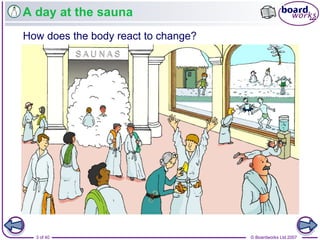
A day at the sauna
How does the body react to change?
© Boardworks Ltd 20074 of 40
Saving energy?
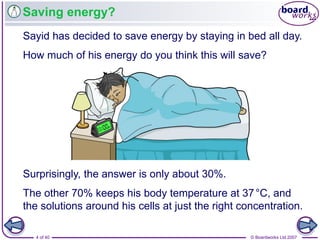
Sayid has decided to save energy by staying in bed all day.
Surprisingly, the answer is only about 30%.
How much of his energy do you think this will save?
The other 70% keeps his body temperature at 37°C, and
the solutions around his cells at just the right concentration.
© Boardworks Ltd 20075 of 40
What is homeostasis?
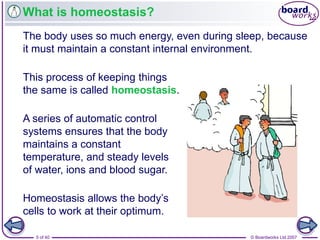
The body uses so much energy, even during sleep, because
it must maintain a constant internal environment.
This process of keeping things
the same is called homeostasis.
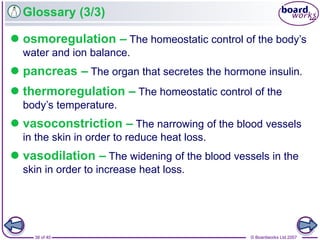
A series of automatic control
systems ensures that the body
maintains a constant
temperature, and steady levels
of water, ions and blood sugar.

Homeostasis allows the body’s
cells to work at their optimum.
© Boardworks Ltd 20076 of 40
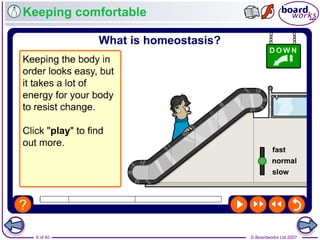
Keeping comfortable
© Boardworks Ltd 20077 of 40
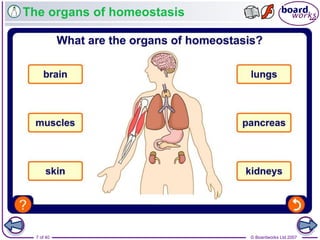
The organs of homeostasis
© Boardworks Ltd 20078 of 40
© Boardworks Ltd 20079 of 40
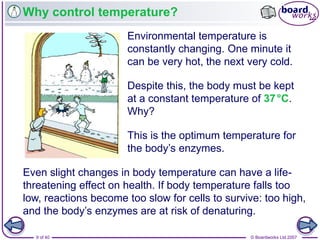
Why control temperature?
Environmental temperature is
constantly changing. One minute it
can be very hot, the next very cold.
Even slight changes in body temperature can have a life-
threatening effect on health. If body temperature falls too
low, reactions become too slow for cells to survive: too high,
and the body’s enzymes are at risk of denaturing.
Despite this, the body must be kept
at a constant temperature of 37°C.
Why?
This is the optimum temperature for
the body’s enzymes.
© Boardworks Ltd 200710 of 40
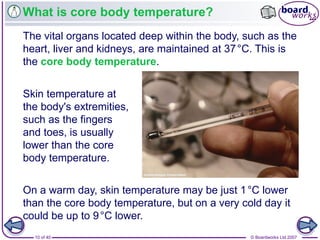
What is core body temperature?
The vital organs located deep within the body, such as the
heart, liver and kidneys, are maintained at 37°C. This is
the core body temperature.
Skin temperature at
the body's extremities,
such as the fingers
and toes, is usually
lower than the core
body temperature.
On a warm day, skin temperature may be just 1°C lower
than the core body temperature, but on a very cold day it
could be up to 9°C lower.
© Boardworks Ltd 200711 of 40
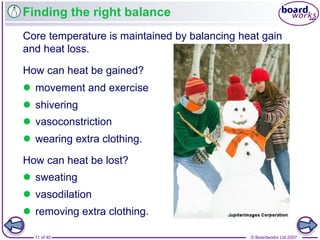
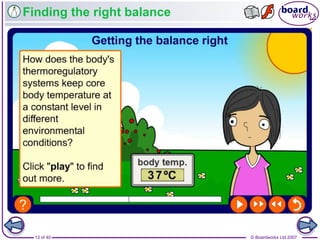
Finding the right balance
Core temperature is maintained by balancing heat gain
and heat loss.
How can heat be gained?
How can heat be lost?
 movement and exercise
 shivering
 vasoconstriction
 wearing extra clothing.
 sweating
 vasodilation
 removing extra clothing.
© Boardworks Ltd 200712 of 40
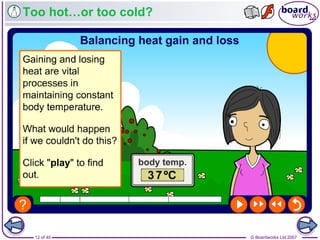
Too hot…or too cold?
© Boardworks Ltd 200713 of 40
Finding the right balance
© Boardworks Ltd 200714 of 40
How is temperature controlled?
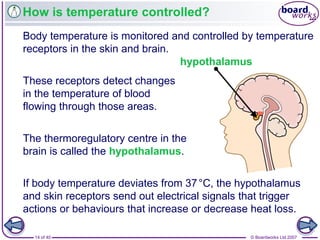
Body temperature is monitored and controlled by temperature
receptors in the skin and brain.
hypothalamus
These receptors detect changes
in the temperature of blood
flowing through those areas.
The thermoregulatory centre in the
brain is called the hypothalamus.
If body temperature deviates from 37°C, the hypothalamus
and skin receptors send out electrical signals that trigger
actions or behaviours that increase or decrease heat loss.
© Boardworks Ltd 200715 of 40
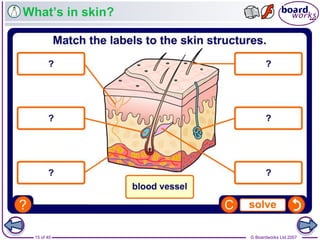
What’s in skin?
© Boardworks Ltd 200716 of 40
Why do we shiver?
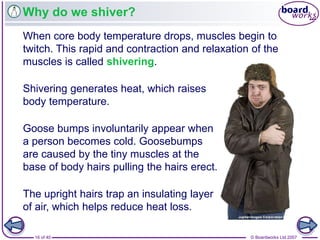
When core body temperature drops, muscles begin to
twitch. This rapid and contraction and relaxation of the
muscles is called shivering.
Shivering generates heat, which raises
body temperature.
Goose bumps involuntarily appear when
a person becomes cold. Goosebumps
are caused by the tiny muscles at the
base of body hairs pulling the hairs erect.
The upright hairs trap an insulating layer
of air, which helps reduce heat loss.
© Boardworks Ltd 200717 of 40
Vasoconstriction and warming up
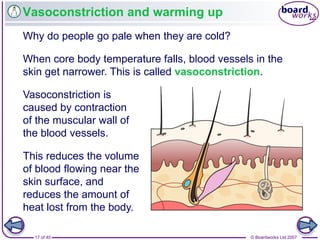
Why do people go pale when they are cold?
Vasoconstriction is
caused by contraction
of the muscular wall of
the blood vessels.
When core body temperature falls, blood vessels in the
skin get narrower. This is called vasoconstriction.
This reduces the volume
of blood flowing near the
skin surface, and
reduces the amount of
heat lost from the body.
© Boardworks Ltd 200718 of 40
Vasodilation and cooling down
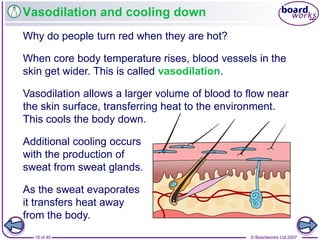
Why do people turn red when they are hot?
Additional cooling occurs
with the production of
sweat from sweat glands.
Vasodilation allows a larger volume of blood to flow near
the skin surface, transferring heat to the environment.
This cools the body down.
When core body temperature rises, blood vessels in the
skin get wider. This is called vasodilation.
As the sweat evaporates
it transfers heat away
from the body.
© Boardworks Ltd 200719 of 40
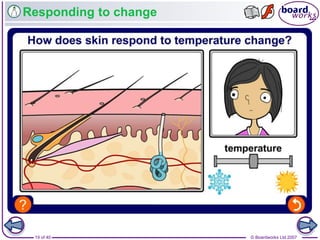
Responding to change
© Boardworks Ltd 200720 of 40
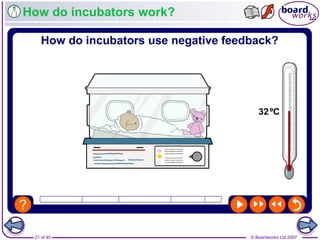
Temperature control in newborns
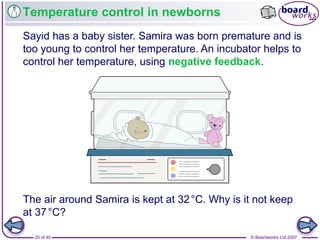
Sayid has a baby sister. Samira was born premature and is
too young to control her temperature. An incubator helps to
control her temperature, using negative feedback.
The air around Samira is kept at 32°C. Why is it not keep
at 37°C?
© Boardworks Ltd 200721 of 40
How do incubators work?
© Boardworks Ltd 200722 of 40
Negative feedback in the body
© Boardworks Ltd 200723 of 40
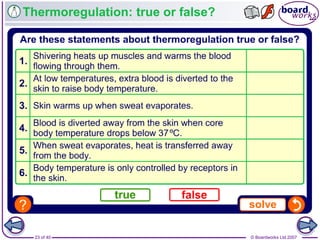
Thermoregulation: true or false?
© Boardworks Ltd 200724 of 40
© Boardworks Ltd 200725 of 40
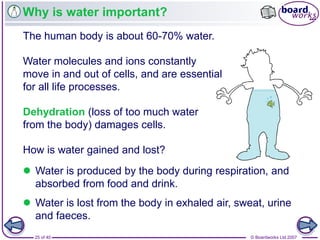
Why is water important?
The human body is about 60-70% water.
 Water is produced by the body during respiration, and
absorbed from food and drink.
 Water is lost from the body in exhaled air, sweat, urine
and faeces.
How is water gained and lost?
Water molecules and ions constantly
move in and out of cells, and are essential
for all life processes.
Dehydration (loss of too much water
from the body) damages cells.
© Boardworks Ltd 200726 of 40
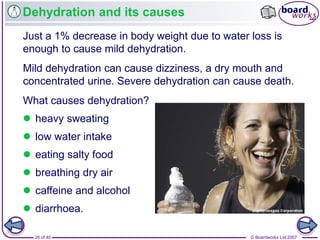
Dehydration and its causes
Just a 1% decrease in body weight due to water loss is
enough to cause mild dehydration.
Mild dehydration can cause dizziness, a dry mouth and
concentrated urine. Severe dehydration can cause death.
What causes dehydration?
 heavy sweating
 low water intake
 eating salty food
 breathing dry air
 caffeine and alcohol
 diarrhoea.
© Boardworks Ltd 200727 of 40
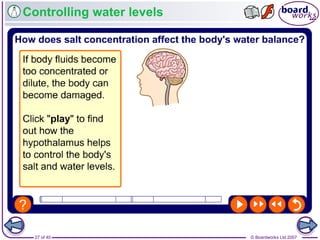
Controlling water levels
© Boardworks Ltd 200728 of 40
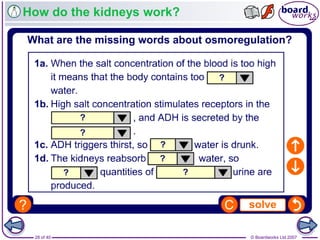
How do the kidneys work?
© Boardworks Ltd 200729 of 40
© Boardworks Ltd 200730 of 40
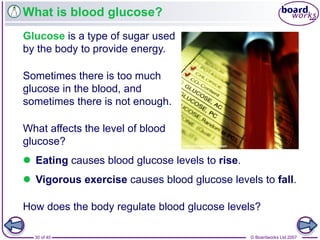
What is blood glucose?
Glucose is a type of sugar used
by the body to provide energy.
Sometimes there is too much
glucose in the blood, and
sometimes there is not enough.
How does the body regulate blood glucose levels?
 Eating causes blood glucose levels to rise.
 Vigorous exercise causes blood glucose levels to fall.
What affects the level of blood
glucose?
© Boardworks Ltd 200731 of 40
Controlling blood glucose
Between meals, blood glucose levels are topped up from
stored deposits in the liver and muscles.
After a meal, blood glucose rises but quickly returns to
normal. Where does the excess go? Why not leave it in
the blood?
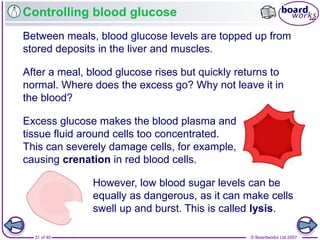
Excess glucose makes the blood plasma and
tissue fluid around cells too concentrated.
This can severely damage cells, for example,
causing crenation in red blood cells.
However, low blood sugar levels can be
equally as dangerous, as it can make cells
swell up and burst. This is called lysis.
© Boardworks Ltd 200732 of 40
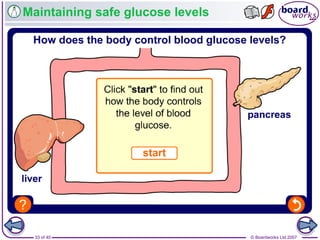
The pancreas and blood glucose
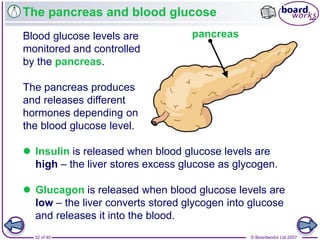
Blood glucose levels are
monitored and controlled
by the pancreas.
The pancreas produces
and releases different
hormones depending on
the blood glucose level.
pancreas
 Insulin is released when blood glucose levels are
high – the liver stores excess glucose as glycogen.
 Glucagon is released when blood glucose levels are
low – the liver converts stored glycogen into glucose
and releases it into the blood.
© Boardworks Ltd 200733 of 40
Maintaining safe glucose levels
© Boardworks Ltd 200734 of 40
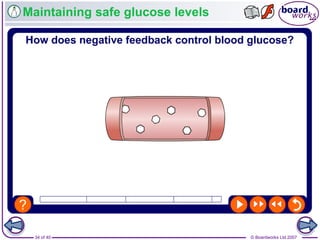
Maintaining safe glucose levels
© Boardworks Ltd 200735 of 40
© Boardworks Ltd 200736 of 40
Glossary (1/3)
 ADH – The hormone released from the pituitary gland that
acts on kidneys and blood vessels to maintain the body’s
water balance.
 dehydration – The loss of too much water from the body.
 homeostasis – The constant regulation of the body's
internal environment.
 hyperthermia – Dangerously high body temperature.
 hypothalamus – The part of the brain that helps to
regulate the body's internal environment.
 hypothermia – Dangerously low body temperature.
 glucose – The main source of energy for the body.
© Boardworks Ltd 200737 of 40
Glossary (2/3)
 glucoregulation – The homeostatic control of the body’s
blood sugar level.
 glycogen – A storage form of glucose, found in the liver
and muscles.
 insulin – A hormone involved in the control of blood sugar,
and which is reduced or absent in people with diabetes.
 kidney – The bean-shaped organ that filters the blood and
produces urine.
 negative feedback – A stabilizing mechanism that slows
down or reverses a stimulus.
© Boardworks Ltd 200738 of 40
Glossary (3/3)
 osmoregulation – The homeostatic control of the body’s
water and ion balance.
 pancreas – The organ that secretes the hormone insulin.
 thermoregulation – The homeostatic control of the
body’s temperature.
 vasoconstriction – The narrowing of the blood vessels
in the skin in order to reduce heat loss.
 vasodilation – The widening of the blood vessels in the
skin in order to increase heat loss.
© Boardworks Ltd 200739 of 40
Anagrams
© Boardworks Ltd 200740 of 40
Multiple-choice quiz

Homeostasis

  • 1.
    © Boardworks Ltd20071 of 40
  • 2.
    © Boardworks Ltd20072 of 40
  • 3.
    © Boardworks Ltd20073 of 40 A day at the sauna How does the body react to change?
  • 4.
    © Boardworks Ltd20074 of 40 Saving energy? Sayid has decided to save energy by staying in bed all day. Surprisingly, the answer is only about 30%. How much of his energy do you think this will save? The other 70% keeps his body temperature at 37°C, and the solutions around his cells at just the right concentration.
  • 5.
    © Boardworks Ltd20075 of 40 What is homeostasis? The body uses so much energy, even during sleep, because it must maintain a constant internal environment. This process of keeping things the same is called homeostasis. A series of automatic control systems ensures that the body maintains a constant temperature, and steady levels of water, ions and blood sugar. Homeostasis allows the body’s cells to work at their optimum.
  • 6.
    © Boardworks Ltd20076 of 40 Keeping comfortable
  • 7.
    © Boardworks Ltd20077 of 40 The organs of homeostasis
  • 8.
    © Boardworks Ltd20078 of 40
  • 9.
    © Boardworks Ltd20079 of 40 Why control temperature? Environmental temperature is constantly changing. One minute it can be very hot, the next very cold. Even slight changes in body temperature can have a life- threatening effect on health. If body temperature falls too low, reactions become too slow for cells to survive: too high, and the body’s enzymes are at risk of denaturing. Despite this, the body must be kept at a constant temperature of 37°C. Why? This is the optimum temperature for the body’s enzymes.
  • 10.
    © Boardworks Ltd200710 of 40 What is core body temperature? The vital organs located deep within the body, such as the heart, liver and kidneys, are maintained at 37°C. This is the core body temperature. Skin temperature at the body's extremities, such as the fingers and toes, is usually lower than the core body temperature. On a warm day, skin temperature may be just 1°C lower than the core body temperature, but on a very cold day it could be up to 9°C lower.
  • 11.
    © Boardworks Ltd200711 of 40 Finding the right balance Core temperature is maintained by balancing heat gain and heat loss. How can heat be gained? How can heat be lost?  movement and exercise  shivering  vasoconstriction  wearing extra clothing.  sweating  vasodilation  removing extra clothing.
  • 12.
    © Boardworks Ltd200712 of 40 Too hot…or too cold?
  • 13.
    © Boardworks Ltd200713 of 40 Finding the right balance
  • 14.
    © Boardworks Ltd200714 of 40 How is temperature controlled? Body temperature is monitored and controlled by temperature receptors in the skin and brain. hypothalamus These receptors detect changes in the temperature of blood flowing through those areas. The thermoregulatory centre in the brain is called the hypothalamus. If body temperature deviates from 37°C, the hypothalamus and skin receptors send out electrical signals that trigger actions or behaviours that increase or decrease heat loss.
  • 15.
    © Boardworks Ltd200715 of 40 What’s in skin?
  • 16.
    © Boardworks Ltd200716 of 40 Why do we shiver? When core body temperature drops, muscles begin to twitch. This rapid and contraction and relaxation of the muscles is called shivering. Shivering generates heat, which raises body temperature. Goose bumps involuntarily appear when a person becomes cold. Goosebumps are caused by the tiny muscles at the base of body hairs pulling the hairs erect. The upright hairs trap an insulating layer of air, which helps reduce heat loss.
  • 17.
    © Boardworks Ltd200717 of 40 Vasoconstriction and warming up Why do people go pale when they are cold? Vasoconstriction is caused by contraction of the muscular wall of the blood vessels. When core body temperature falls, blood vessels in the skin get narrower. This is called vasoconstriction. This reduces the volume of blood flowing near the skin surface, and reduces the amount of heat lost from the body.
  • 18.
    © Boardworks Ltd200718 of 40 Vasodilation and cooling down Why do people turn red when they are hot? Additional cooling occurs with the production of sweat from sweat glands. Vasodilation allows a larger volume of blood to flow near the skin surface, transferring heat to the environment. This cools the body down. When core body temperature rises, blood vessels in the skin get wider. This is called vasodilation. As the sweat evaporates it transfers heat away from the body.
  • 19.
    © Boardworks Ltd200719 of 40 Responding to change
  • 20.
    © Boardworks Ltd200720 of 40 Temperature control in newborns Sayid has a baby sister. Samira was born premature and is too young to control her temperature. An incubator helps to control her temperature, using negative feedback. The air around Samira is kept at 32°C. Why is it not keep at 37°C?
  • 21.
    © Boardworks Ltd200721 of 40 How do incubators work?
  • 22.
    © Boardworks Ltd200722 of 40 Negative feedback in the body
  • 23.
    © Boardworks Ltd200723 of 40 Thermoregulation: true or false?
  • 24.
    © Boardworks Ltd200724 of 40
  • 25.
    © Boardworks Ltd200725 of 40 Why is water important? The human body is about 60-70% water.  Water is produced by the body during respiration, and absorbed from food and drink.  Water is lost from the body in exhaled air, sweat, urine and faeces. How is water gained and lost? Water molecules and ions constantly move in and out of cells, and are essential for all life processes. Dehydration (loss of too much water from the body) damages cells.
  • 26.
    © Boardworks Ltd200726 of 40 Dehydration and its causes Just a 1% decrease in body weight due to water loss is enough to cause mild dehydration. Mild dehydration can cause dizziness, a dry mouth and concentrated urine. Severe dehydration can cause death. What causes dehydration?  heavy sweating  low water intake  eating salty food  breathing dry air  caffeine and alcohol  diarrhoea.
  • 27.
    © Boardworks Ltd200727 of 40 Controlling water levels
  • 28.
    © Boardworks Ltd200728 of 40 How do the kidneys work?
  • 29.
    © Boardworks Ltd200729 of 40
  • 30.
    © Boardworks Ltd200730 of 40 What is blood glucose? Glucose is a type of sugar used by the body to provide energy. Sometimes there is too much glucose in the blood, and sometimes there is not enough. How does the body regulate blood glucose levels?  Eating causes blood glucose levels to rise.  Vigorous exercise causes blood glucose levels to fall. What affects the level of blood glucose?
  • 31.
    © Boardworks Ltd200731 of 40 Controlling blood glucose Between meals, blood glucose levels are topped up from stored deposits in the liver and muscles. After a meal, blood glucose rises but quickly returns to normal. Where does the excess go? Why not leave it in the blood? Excess glucose makes the blood plasma and tissue fluid around cells too concentrated. This can severely damage cells, for example, causing crenation in red blood cells. However, low blood sugar levels can be equally as dangerous, as it can make cells swell up and burst. This is called lysis.
  • 32.
    © Boardworks Ltd200732 of 40 The pancreas and blood glucose Blood glucose levels are monitored and controlled by the pancreas. The pancreas produces and releases different hormones depending on the blood glucose level. pancreas  Insulin is released when blood glucose levels are high – the liver stores excess glucose as glycogen.  Glucagon is released when blood glucose levels are low – the liver converts stored glycogen into glucose and releases it into the blood.
  • 33.
    © Boardworks Ltd200733 of 40 Maintaining safe glucose levels
  • 34.
    © Boardworks Ltd200734 of 40 Maintaining safe glucose levels
  • 35.
    © Boardworks Ltd200735 of 40
  • 36.
    © Boardworks Ltd200736 of 40 Glossary (1/3)  ADH – The hormone released from the pituitary gland that acts on kidneys and blood vessels to maintain the body’s water balance.  dehydration – The loss of too much water from the body.  homeostasis – The constant regulation of the body's internal environment.  hyperthermia – Dangerously high body temperature.  hypothalamus – The part of the brain that helps to regulate the body's internal environment.  hypothermia – Dangerously low body temperature.  glucose – The main source of energy for the body.
  • 37.
    © Boardworks Ltd200737 of 40 Glossary (2/3)  glucoregulation – The homeostatic control of the body’s blood sugar level.  glycogen – A storage form of glucose, found in the liver and muscles.  insulin – A hormone involved in the control of blood sugar, and which is reduced or absent in people with diabetes.  kidney – The bean-shaped organ that filters the blood and produces urine.  negative feedback – A stabilizing mechanism that slows down or reverses a stimulus.
  • 38.
    © Boardworks Ltd200738 of 40 Glossary (3/3)  osmoregulation – The homeostatic control of the body’s water and ion balance.  pancreas – The organ that secretes the hormone insulin.  thermoregulation – The homeostatic control of the body’s temperature.  vasoconstriction – The narrowing of the blood vessels in the skin in order to reduce heat loss.  vasodilation – The widening of the blood vessels in the skin in order to increase heat loss.
  • 39.
    © Boardworks Ltd200739 of 40 Anagrams
  • 40.
    © Boardworks Ltd200740 of 40 Multiple-choice quiz

Editor's Notes

  • #2 Boardworks GCSE Additional Science: Biology Homeostasis
  • #3 Boardworks GCSE Additional Science: Biology Homeostasis
  • #4 Boardworks GCSE Additional Science: Biology Homeostasis
  • #5 Boardworks GCSE Additional Science: Biology Homeostasis
  • #6 Boardworks GCSE Additional Science: Biology Homeostasis
  • #7 Boardworks GCSE Additional Science: Biology Homeostasis
  • #8 Boardworks GCSE Additional Science: Biology Homeostasis
  • #9 Boardworks GCSE Additional Science: Biology Homeostasis
  • #10 Boardworks GCSE Additional Science: Biology Homeostasis
  • #11 Boardworks GCSE Additional Science: Biology Homeostasis
  • #12 Boardworks GCSE Additional Science: Biology Homeostasis
  • #13 Boardworks GCSE Additional Science: Biology Homeostasis
  • #14 Boardworks GCSE Additional Science: Biology Homeostasis
  • #15 Boardworks GCSE Additional Science: Biology Homeostasis
  • #16 Boardworks GCSE Additional Science: Biology Homeostasis
  • #17 Boardworks GCSE Additional Science: Biology Homeostasis
  • #18 Boardworks GCSE Additional Science: Biology Homeostasis
  • #19 Boardworks GCSE Additional Science: Biology Homeostasis
  • #20 Boardworks GCSE Additional Science: Biology Homeostasis
  • #21 Boardworks GCSE Additional Science: Biology Homeostasis
  • #22 Boardworks GCSE Additional Science: Biology Homeostasis
  • #23 Boardworks GCSE Additional Science: Biology Homeostasis
  • #24 Boardworks GCSE Additional Science: Biology Homeostasis
  • #25 Boardworks GCSE Additional Science: Biology Homeostasis
  • #26 Boardworks GCSE Additional Science: Biology Homeostasis
  • #27 Boardworks GCSE Additional Science: Biology Homeostasis
  • #28 Boardworks GCSE Additional Science: Biology Homeostasis
  • #29 Boardworks GCSE Additional Science: Biology Homeostasis
  • #30 Boardworks GCSE Additional Science: Biology Homeostasis
  • #31 Boardworks GCSE Additional Science: Biology Homeostasis
  • #32 Boardworks GCSE Additional Science: Biology Homeostasis
  • #33 Boardworks GCSE Additional Science: Biology Homeostasis
  • #34 Boardworks GCSE Additional Science: Biology Homeostasis
  • #35 Boardworks GCSE Additional Science: Biology Homeostasis
  • #36 Boardworks GCSE Additional Science: Biology Homeostasis
  • #37 Boardworks GCSE Additional Science: Biology Homeostasis
  • #38 Boardworks GCSE Additional Science: Biology Homeostasis
  • #39 Boardworks GCSE Additional Science: Biology Homeostasis
  • #40 Boardworks GCSE Additional Science: Biology Homeostasis
  • #41 Boardworks GCSE Additional Science: Biology Homeostasis