“Thermal Power Plants”
By
Dr.G.Nageswara Rao
Professor, EEE Department
Lakireddy Bali Reddy College of Engineering
Mylavaram, Krishna Dt, AP, India
ENERGY RESOURCES
• Non Renewable Energy Resources
• Renewable Energy Resources
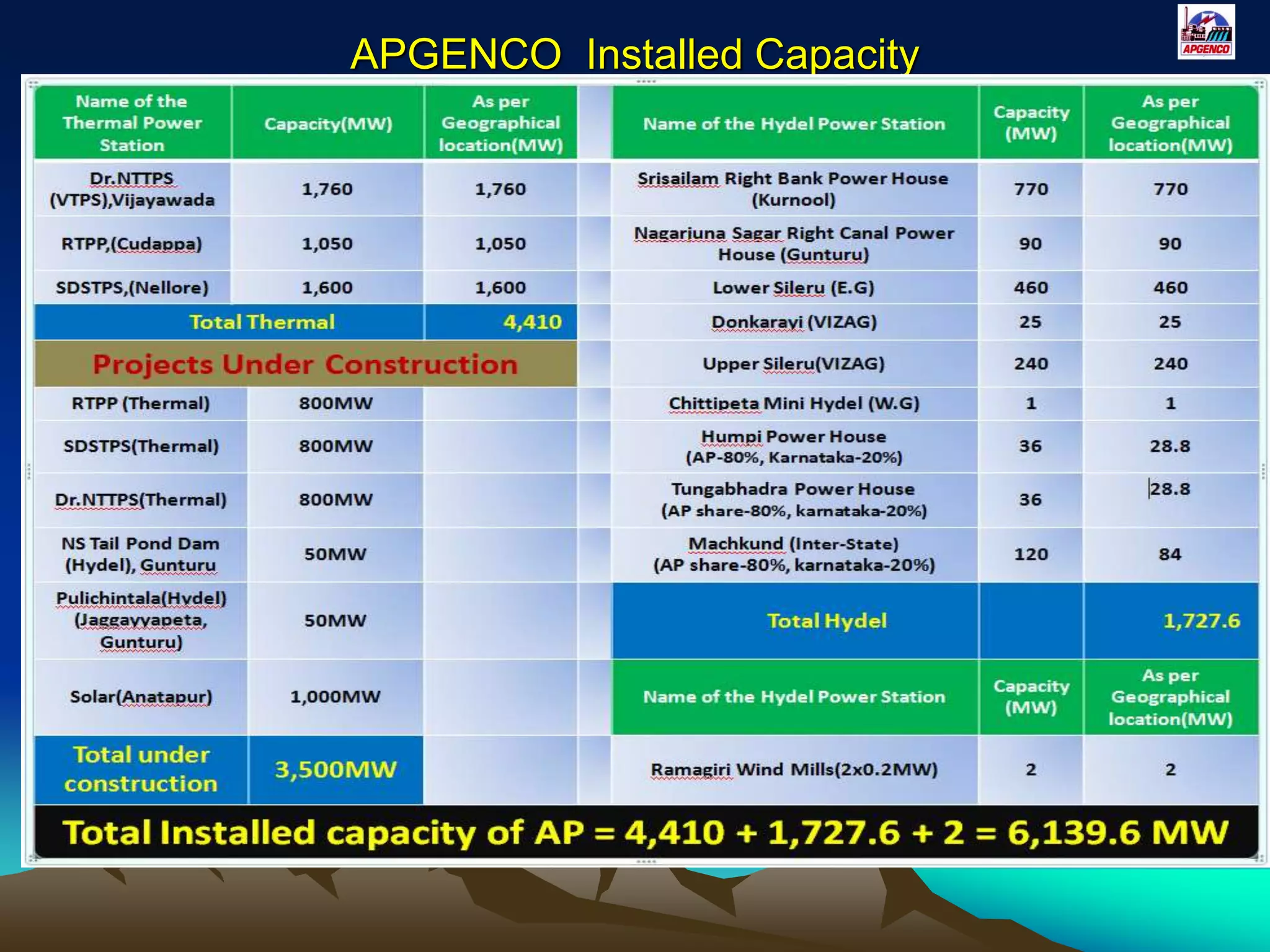
APGENCO Installed Capacity
THERMAL POWER PLANT(6 Units, Each 210MW)
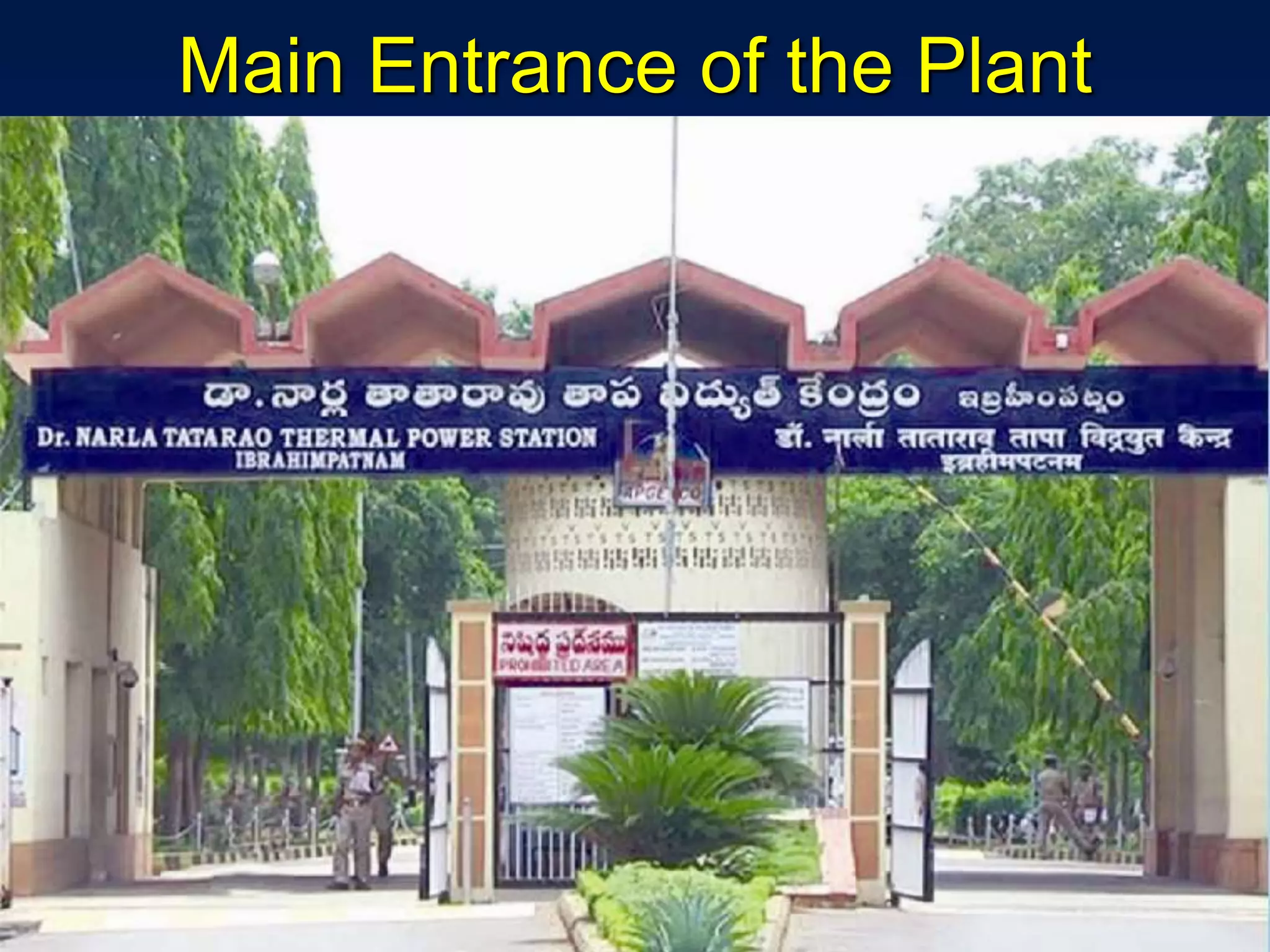
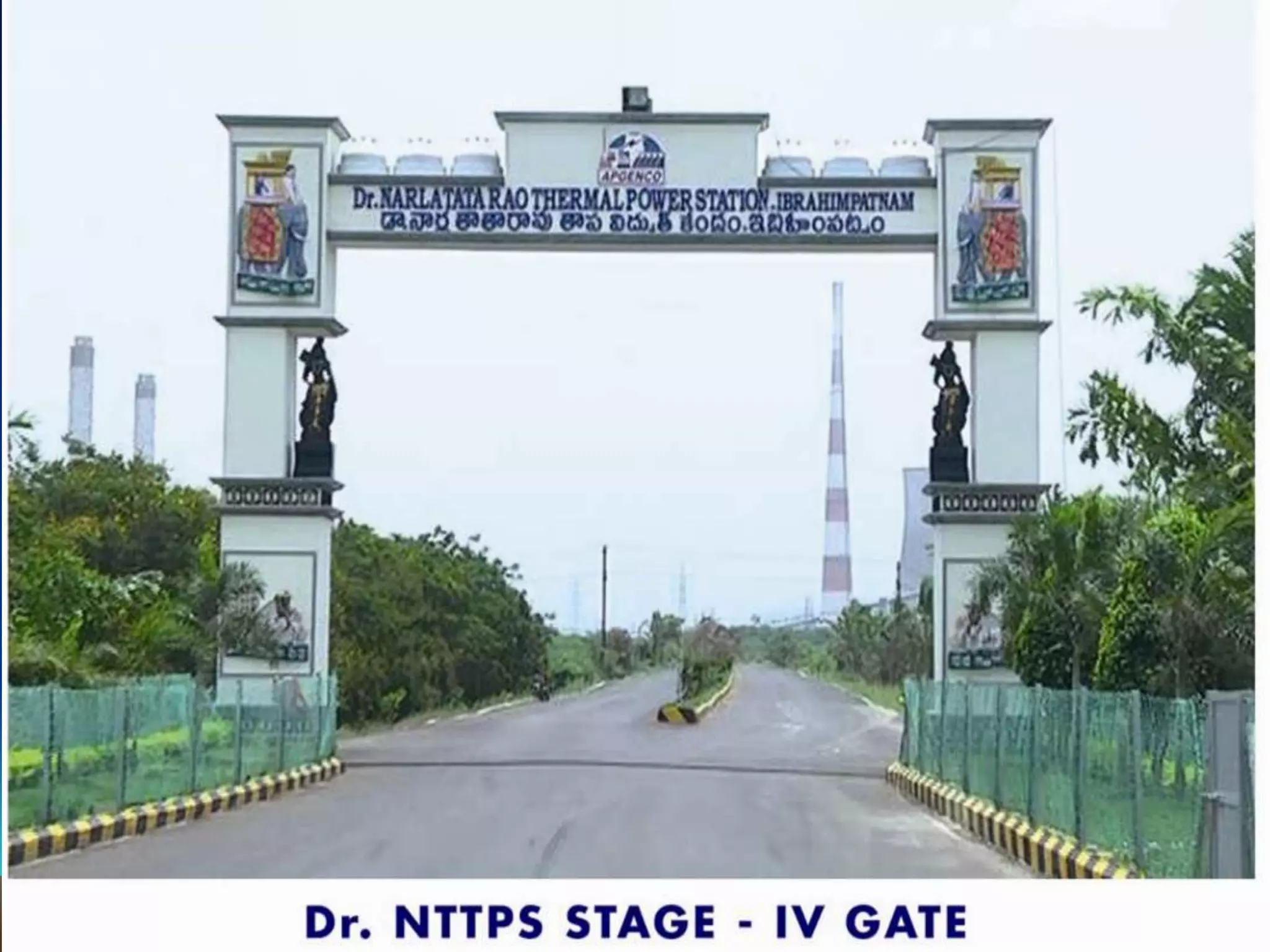
Main Entrance of the Plant
THERMAL POWER PLANT
(6 Units, Each 210MW + 500MW), Installed Capacity=1,760MW
STAGE
NO.
UNIT
NO.
INSTALLED
CAPACITY
DATE OF COMMISSIONING
I 1
2
210 MW
210 MW
01-11-1979
10-10-1980
II 3
4
210 MW
210 MW
05-10-1989
23-08-1990
III 5
6
210 MW
210 MW
31-03-1994
24-02-1995
IV 7 500 MW 29-01-2010
V 8 800 MW
Under construction
Works starts from July-2016
,expected by 2020(4-years)
The project was completed in Four stages, I,II, III & IV
Stages. Consisting of two units of 210 MW each and iv
stage by one unit thus the total capacity being 1760 MW.
This session divide in to
 Coal handling Plant
 Boiler and its Auxiliaries
 Turbine and its Auxiliaries
 Common Auxiliaries
 Generator Auxiliaries
 Switch yard
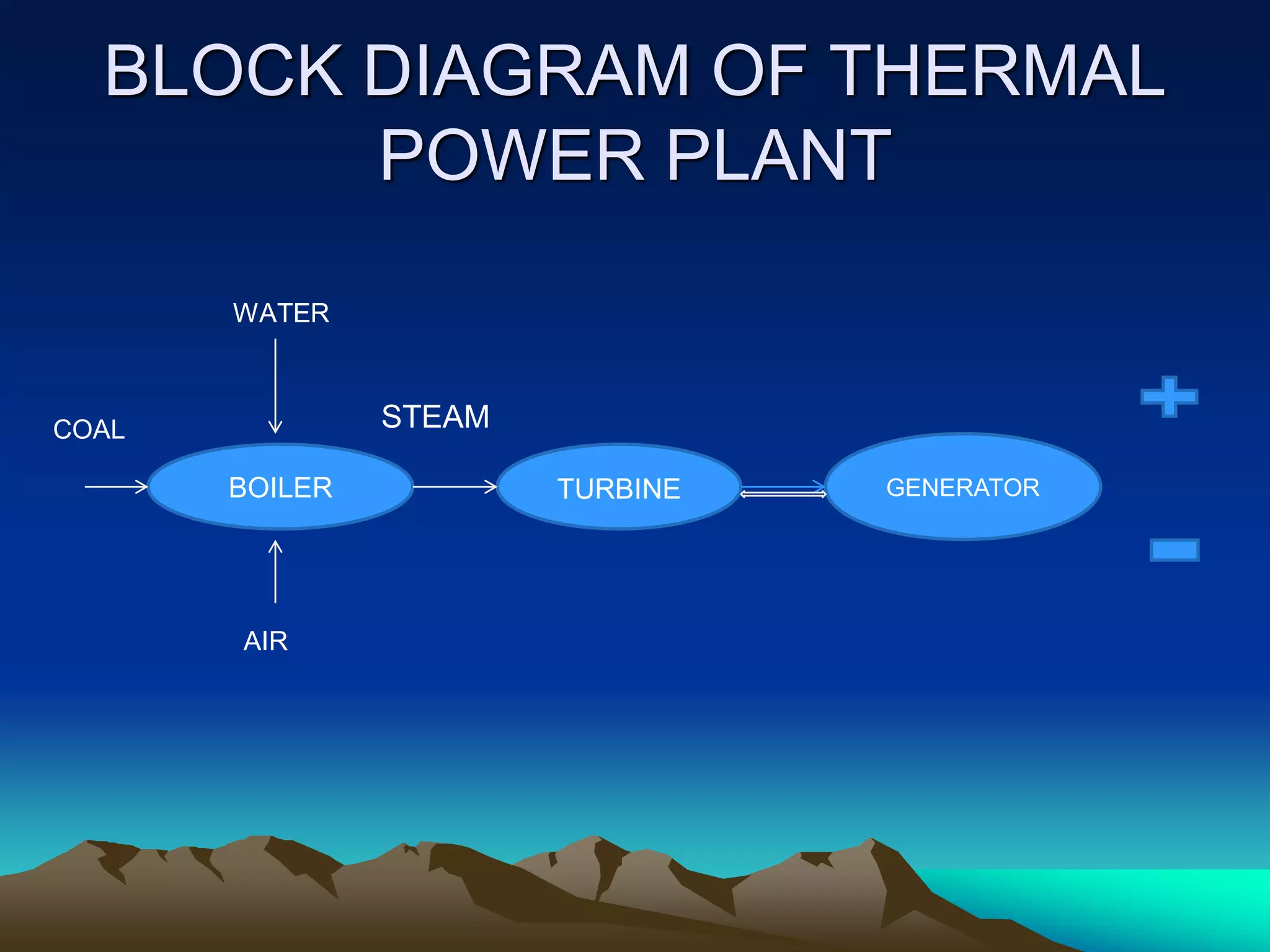
BLOCK DIAGRAM OF THERMAL
POWER PLANT
WATER
BOILER TURBINE GENERATOR
COAL
AIR
STEAM
COAL HANDLING PLANT (CHP)
Wagon Tippler
Crusher House
Bunker
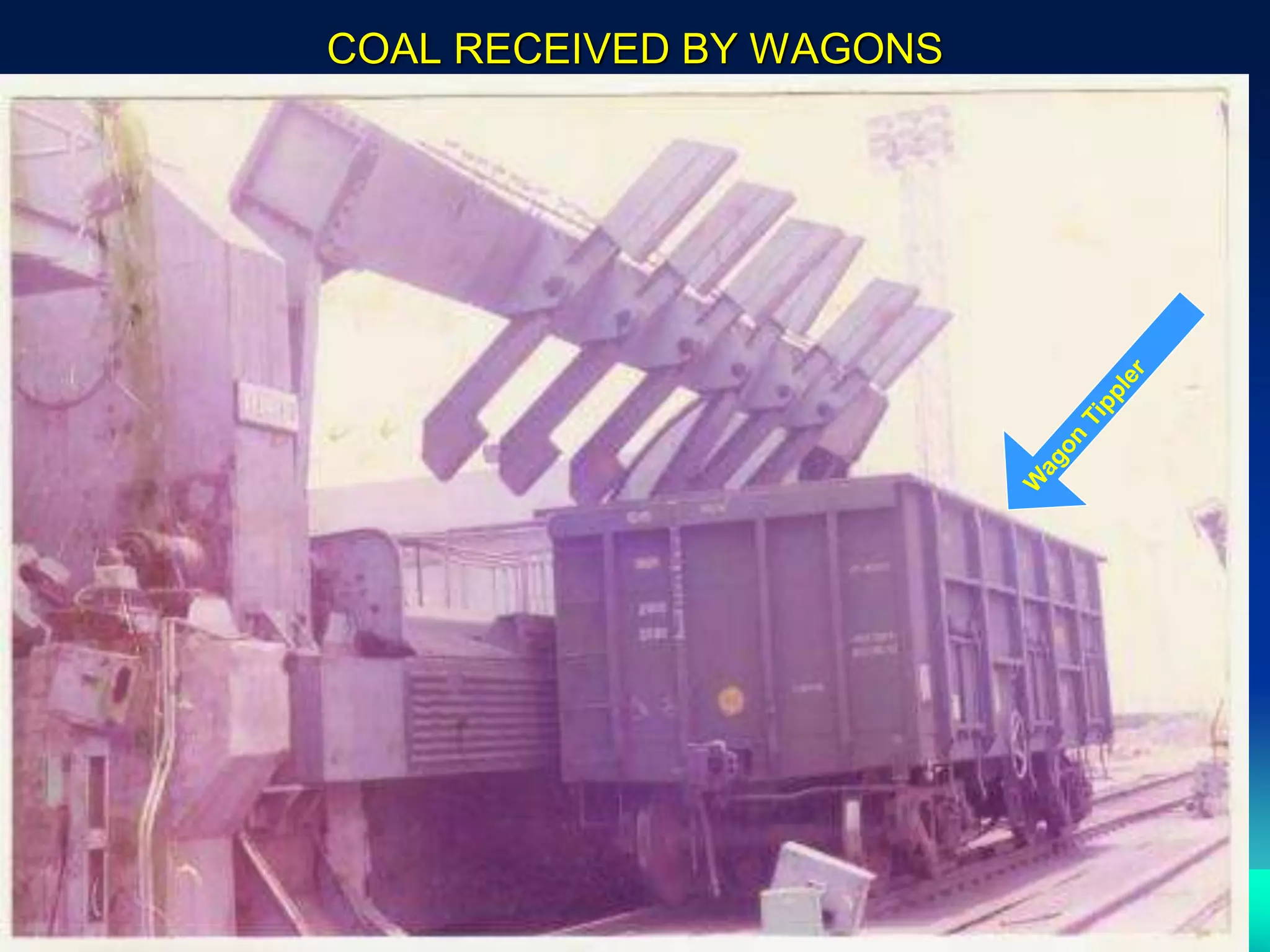
Wagon Tippler
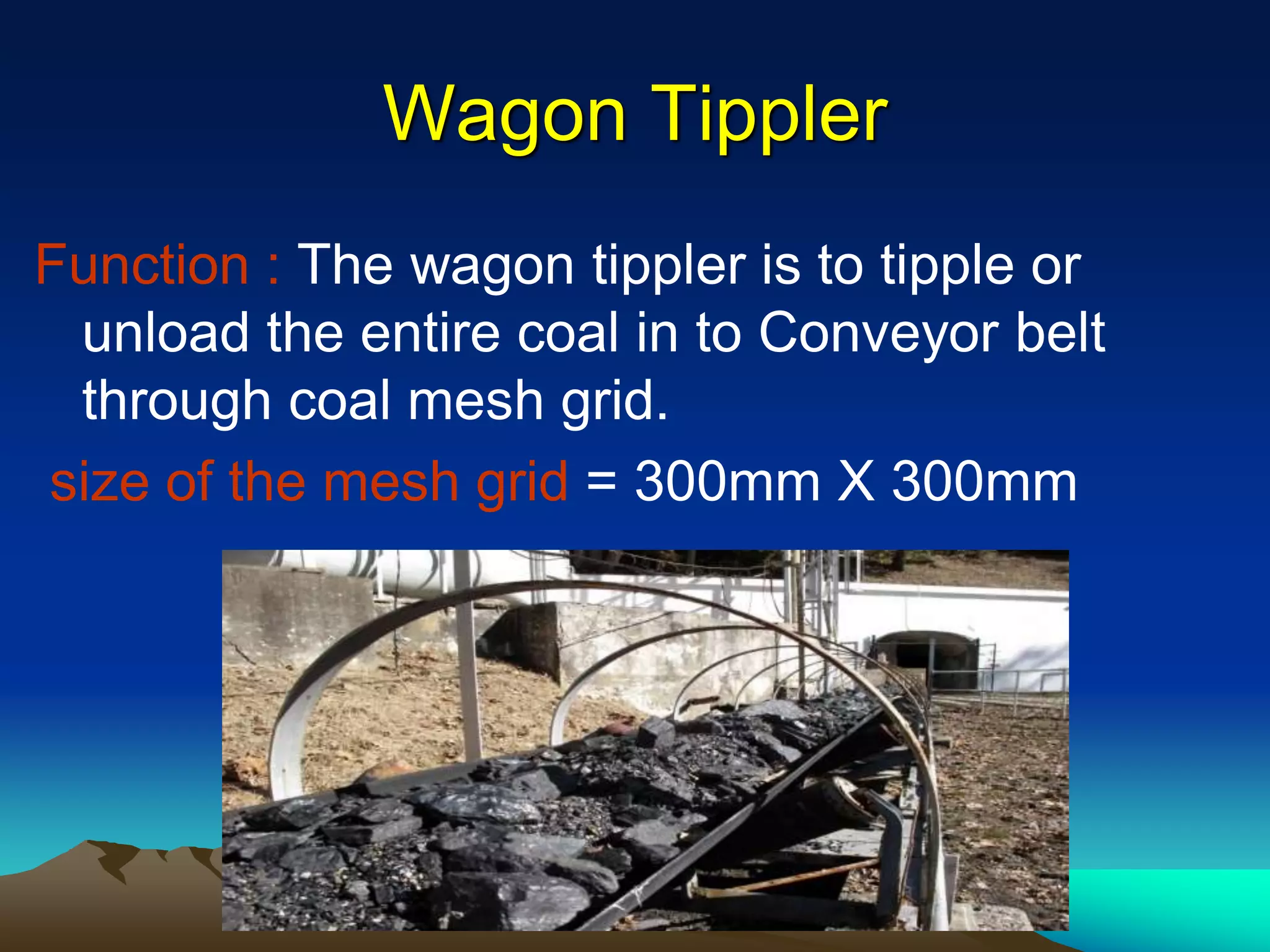
Function : The wagon tippler is to tipple or
unload the entire coal in to Conveyor belt
through coal mesh grid.
size of the mesh grid = 300mm X 300mm
COAL RECEIVED BY WAGONS
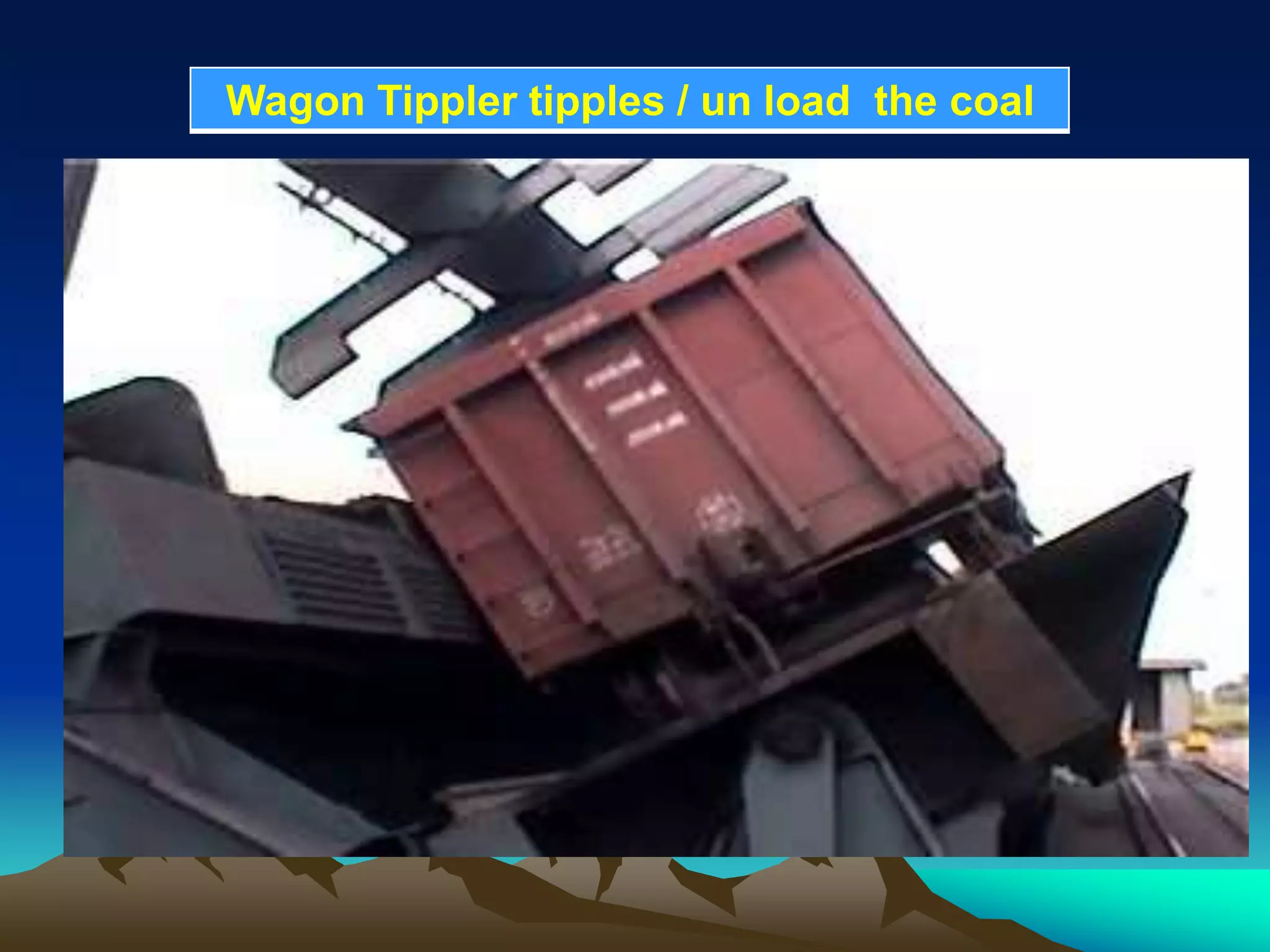
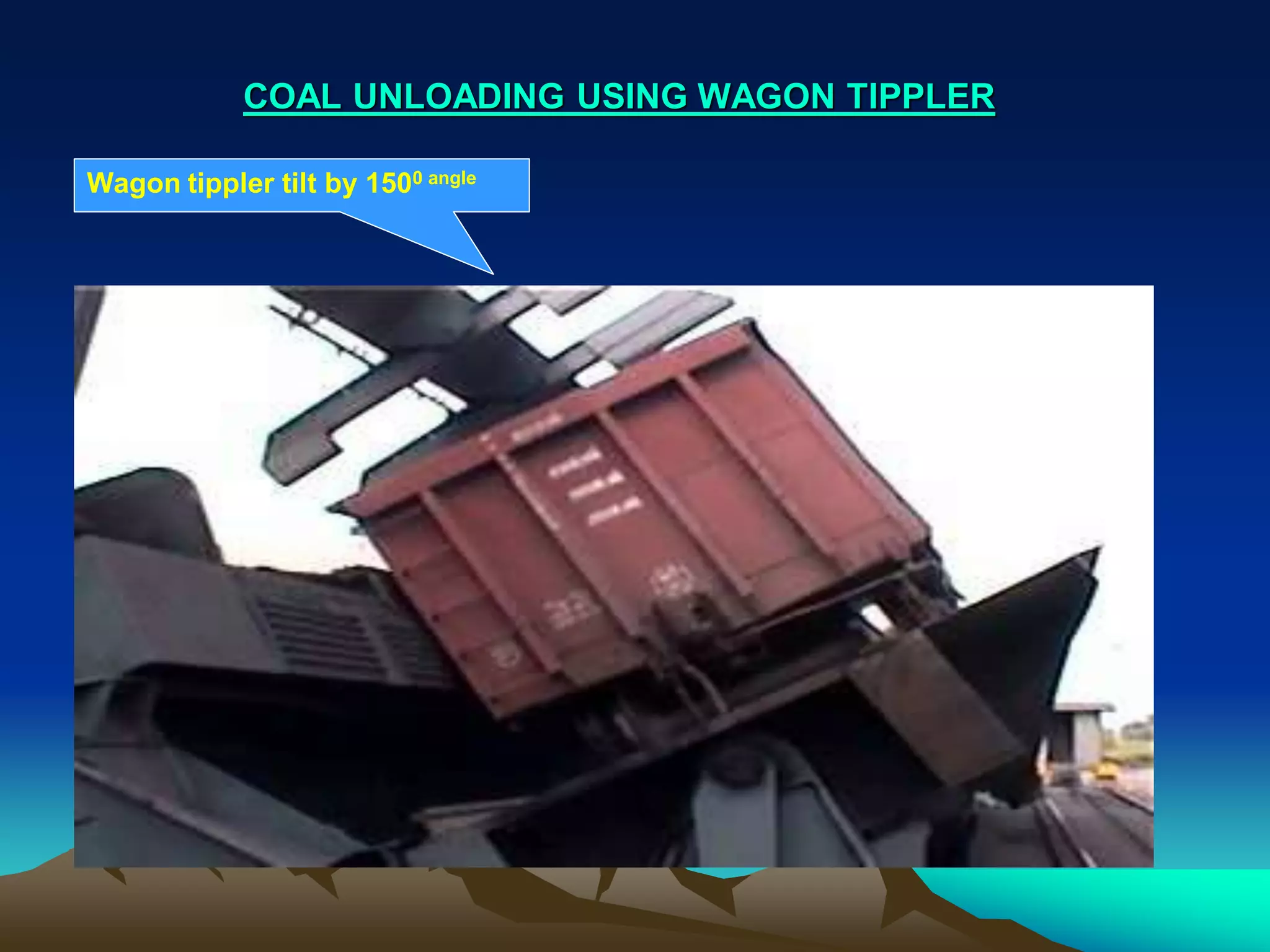
Wagon Tippler tipples / un load the coal
COAL UNLOADING USING WAGON TIPPLER
Wagon tippler tilt by 1500 angle
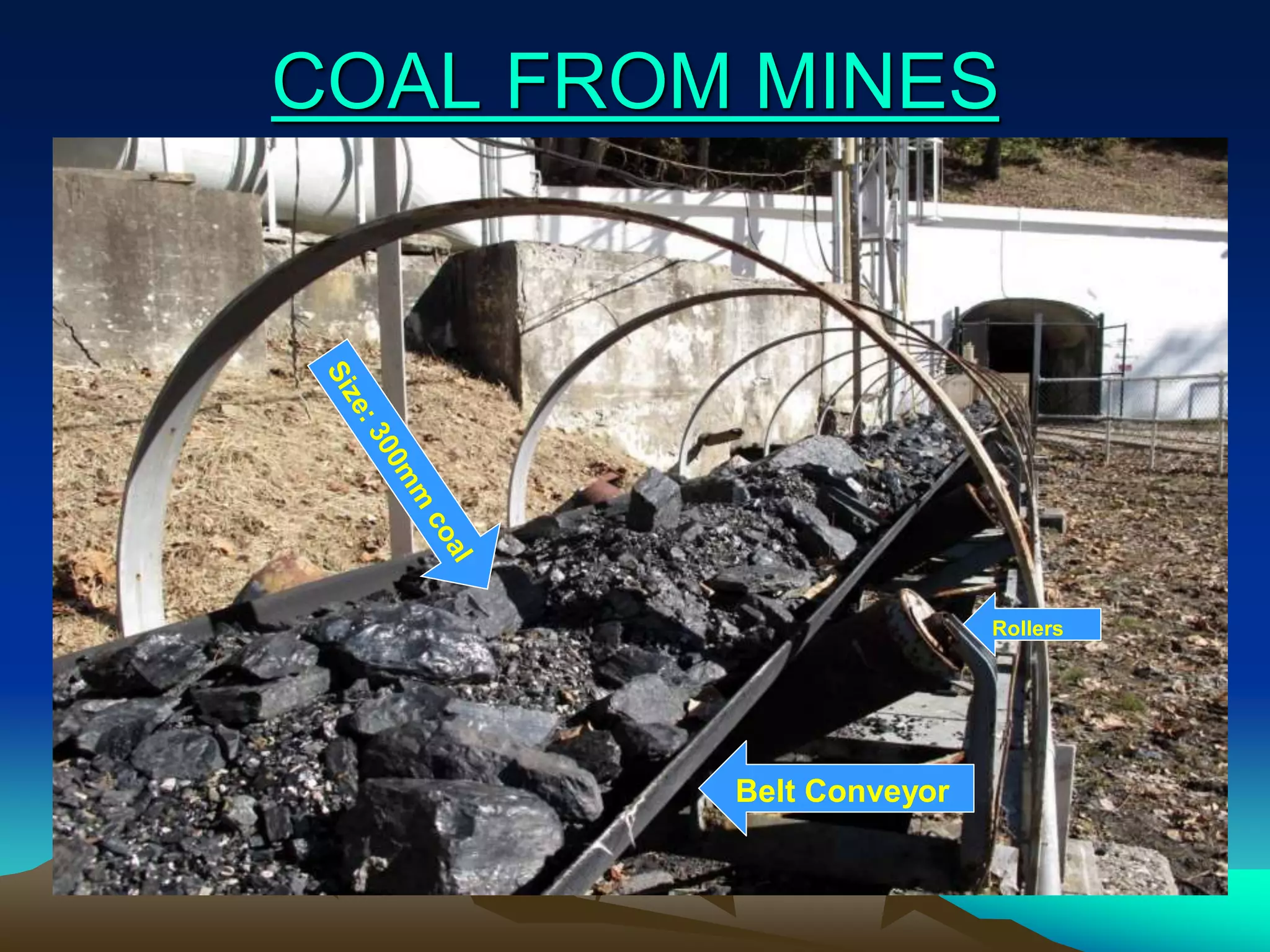
COAL FROM MINES
Belt Conveyor
Rollers
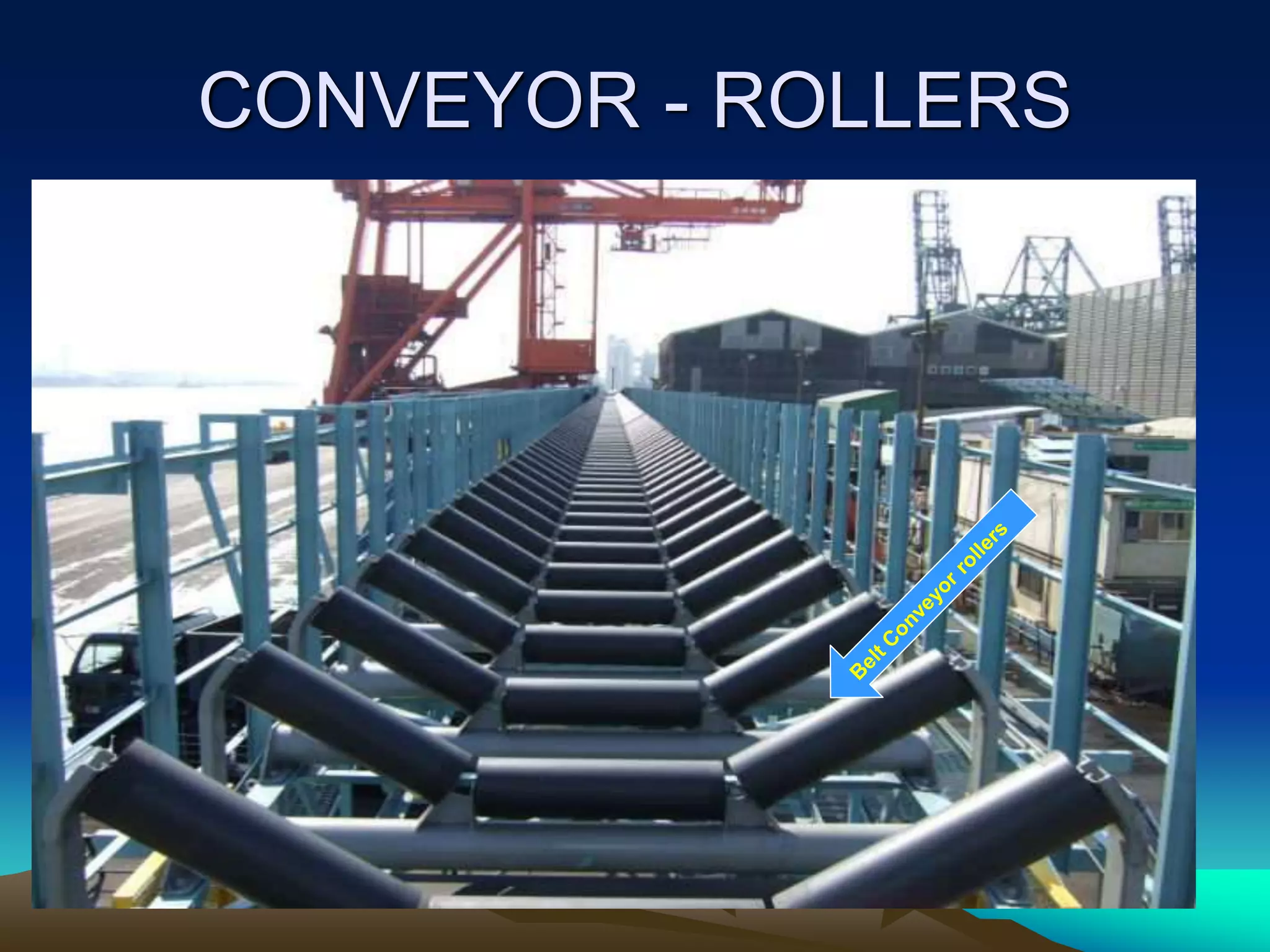
CONVEYOR - ROLLERS
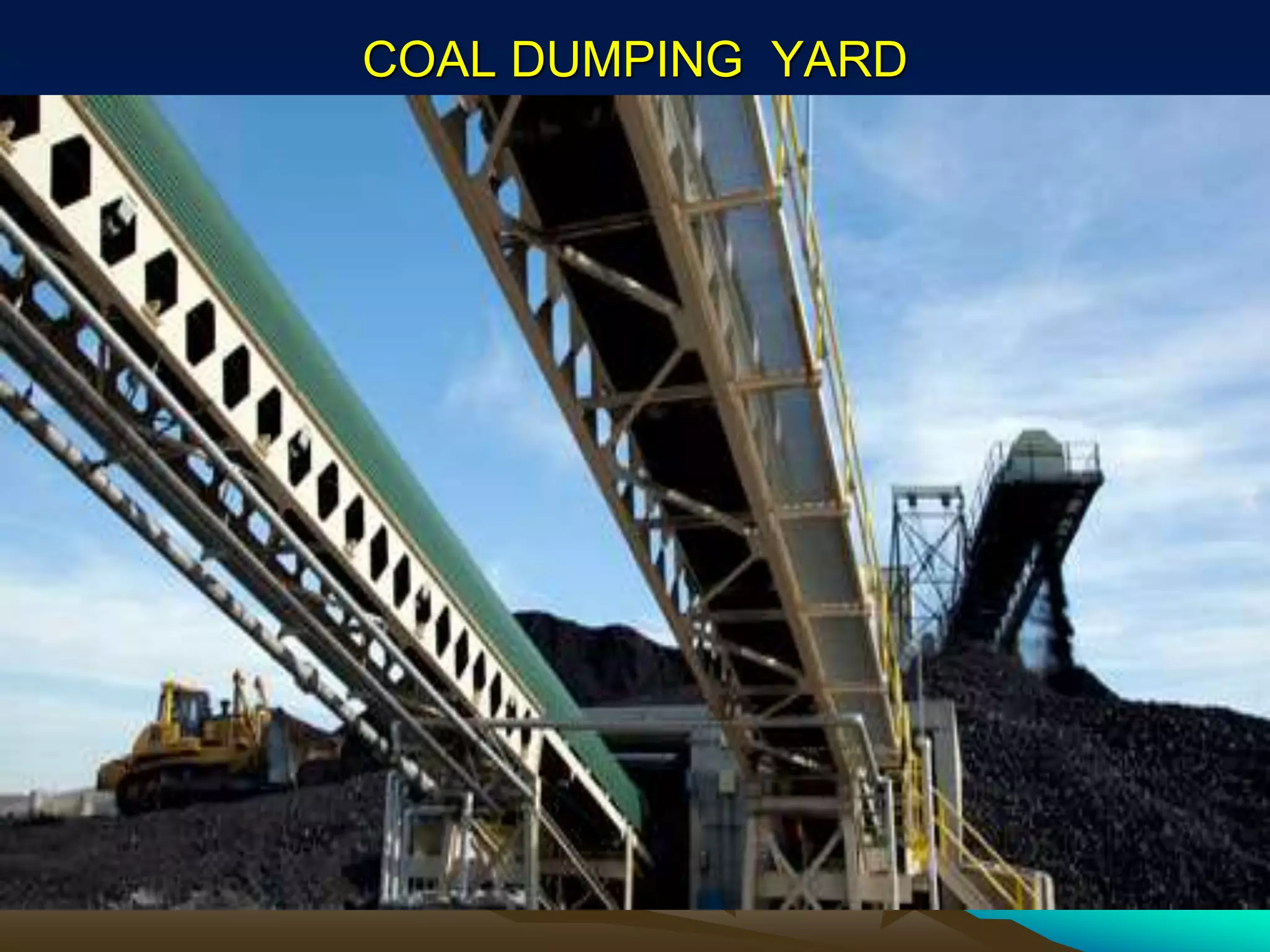
COAL DUMPING YARD
COAL CONVEYOR
COAL DUMPING YARD
•Receipt of Coal fro•Unloading of Coal
•Coal Stacking & Reclamation
Crusher House:
In this the size of coal
reduced from 300mm to 20mm size coal
pieces with the help of ring rollers.
Bunker:
It is a conical shape container which
receives the 20mm size coal pieces from
crusher house. Its capacity 500MT.
6 Nos. bunkers for each 210 MW unit.
Total coal required for 210MW = 3,000MT per day.
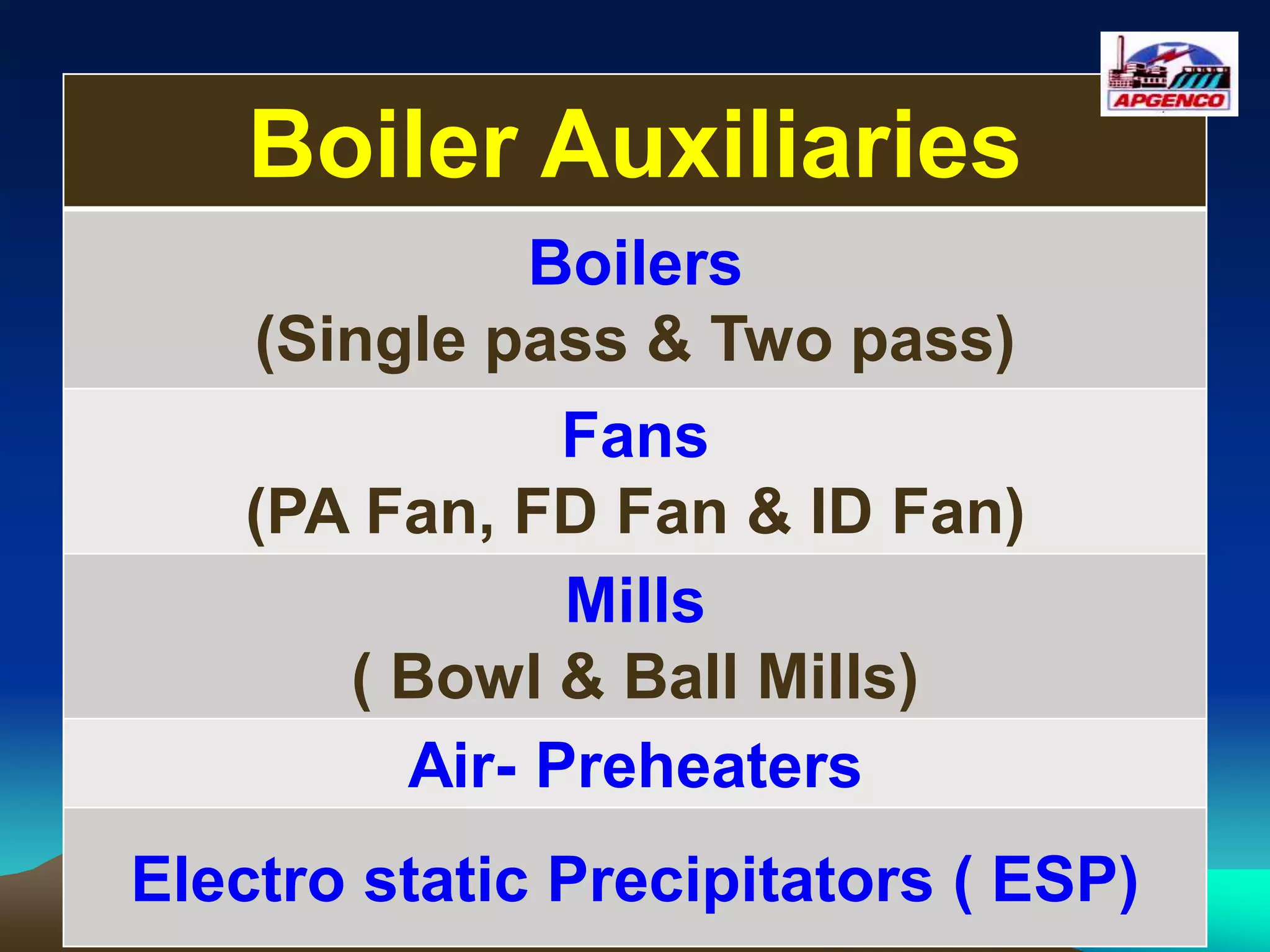
Boiler Auxiliaries
Boilers
(Single pass & Two pass)
Fans
(PA Fan, FD Fan & ID Fan)
Mills
( Bowl & Ball Mills)
Air- Preheaters
Electro static Precipitators ( ESP)
Types of Boilers
Based on Media
1. Fire Tube Boilers.
2. Water Tube Boilers
Based on Construction
1) Single pass boiler.
2) Two-pass Boiler.
SINGLE - PASS BOILER.
(TOWER TYPE BOILER)
From BFP
TO IPT
TOWER TYPE BOILER
DRUM
BOTTOM RING HDR
Economiser
LTRH
LTSH
HTSH
HTRH
ITSH
HANGER PLATEN
TO HPT
AFTER HPT
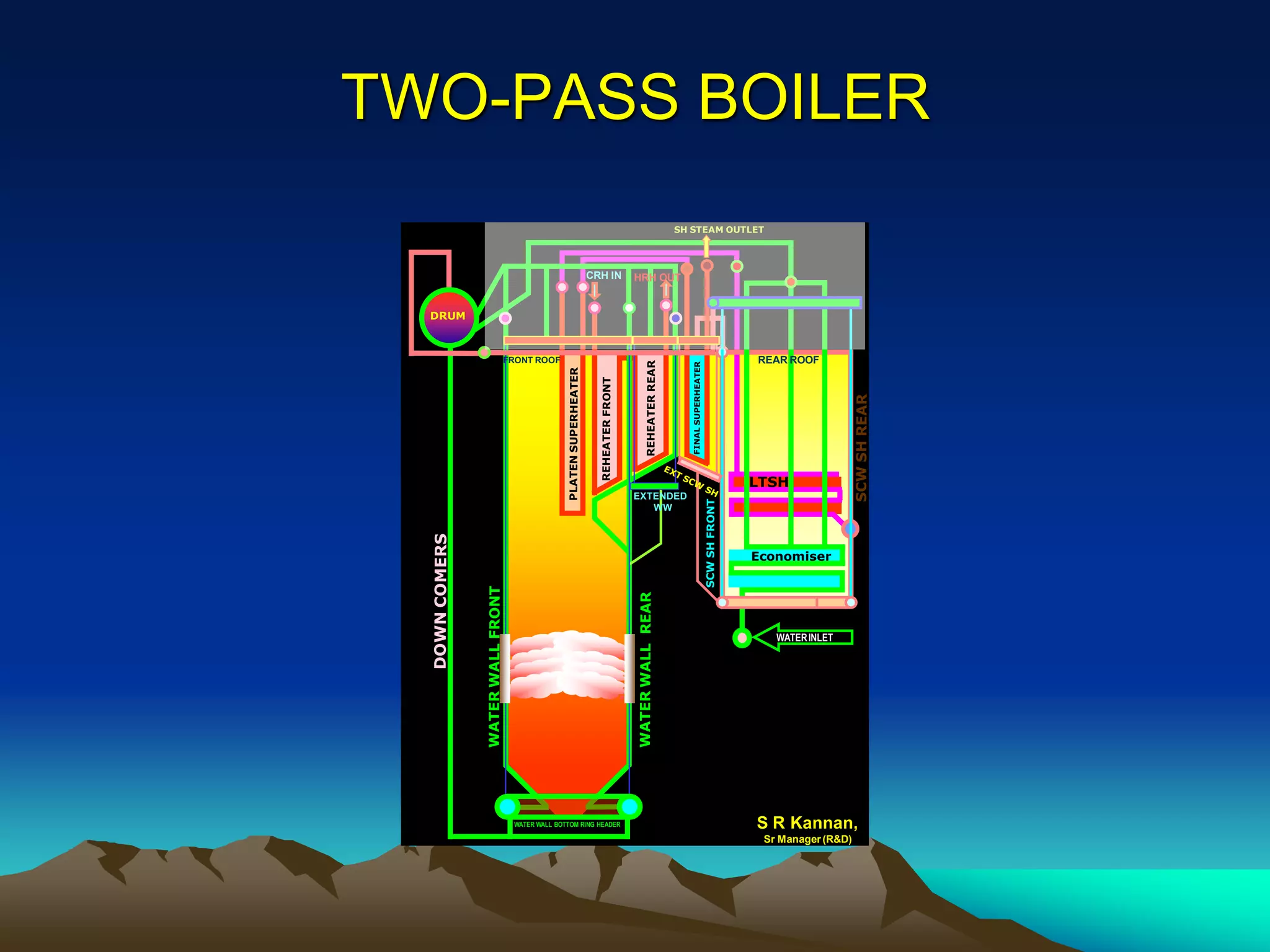
TWO-PASS BOILER
WATER WALL BOTTOM RING HEADER
DRUM
CRH IN
REAR ROOF
WATERINLET
SH STEAM OUTLET
EXTENDED
WW
FRONT ROOF
HRH OUT
S R Kannan,
Sr Manager (R&D)
LTSH
Economiser
HOW TO RECONGNISE GOOD COMBUSTION?
 COLOUR OF FLAME AT BURNER ELEVATION
OBSERVED THROUGH PEEP HOLES
 COLOUR- PALE ORANGE WHILE ON COOL FIRING
 FLAME 300 TO 400 mm AWAY FROM BURNER TIP.
 FLAME TEMP. 1050 Deg.C TO 1150 Deg.C
(AS MEASURED BY OPTICAL PYROMETER)
Water Tube Boiler (Box Type )
Boiler Drum
Water wall tube
Peep Hole
Coal feeding
Furnace Area
Super Heater Coils
Bottom Ring
Header
Top Ring Header
Types of Fans
1. PA Fan.
2. FD Fan.
3.ID Fan .
Location of APH, ID Fan & FD Fan
PA Fan Function:
The air supplied by the fan is called
primary Air. The primary air is used to lift the
pulverized coal in the mill to Furnace for combustion.
FD Fan function:
The air supplied by the FD fan is called
Secondary Air. The Secondary air is used to combustion
the pulverized coal effectively in the furnace zone .
ID Fan function:
It removes / suck the flue gasses from the
furnace and exit the flue gasses to the atmosphere through
the chimney .
Types of Mills
1. Bowl Mills
2.Ball Mills
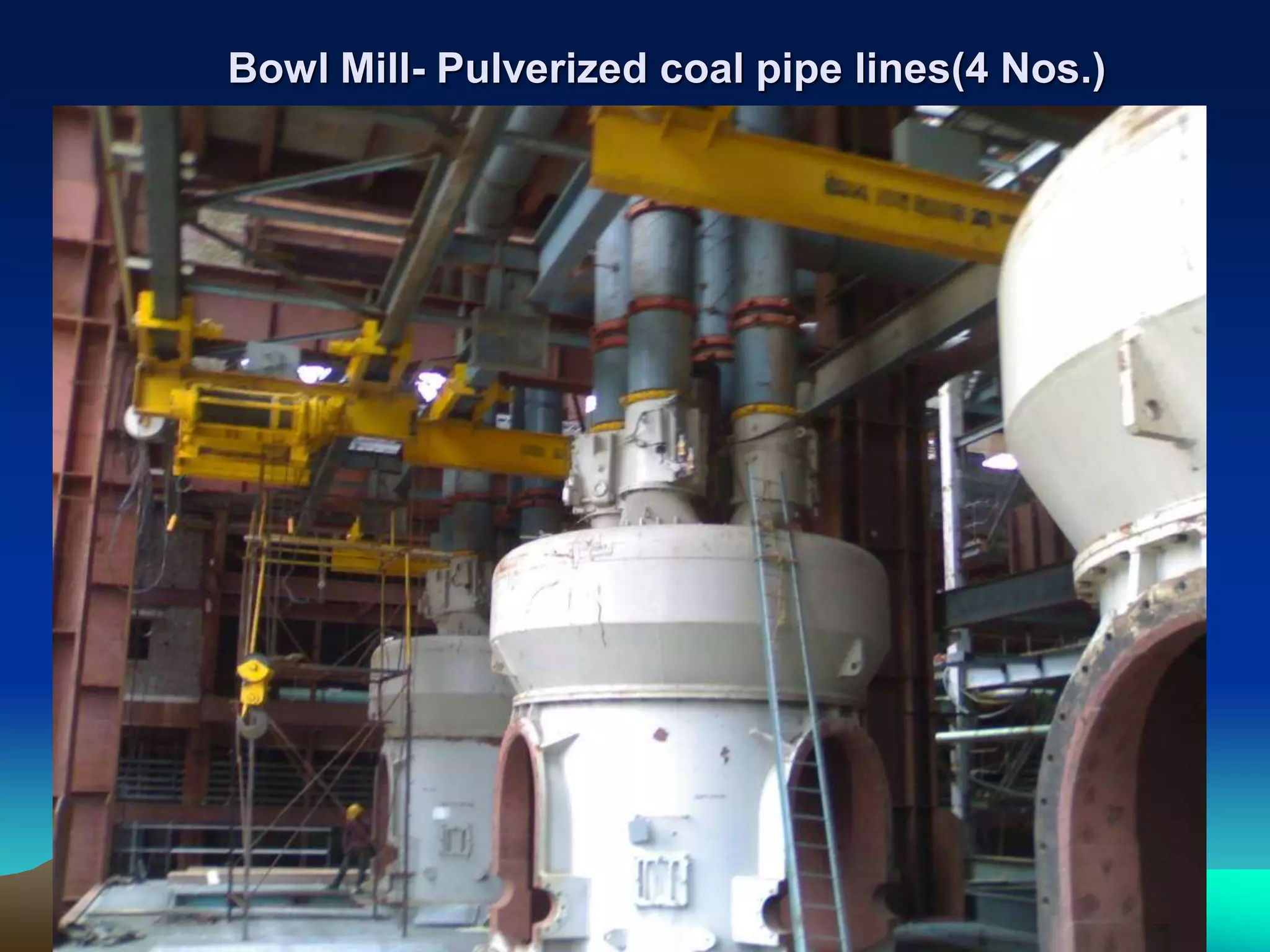
Bowl Mill- Pulverized coal pipe lines(4 Nos.)
BOWL MILL ROLLER ASSY
Ball Mills
Mill speed = 15 rpm
BALL TUBE MILLS
• These mills are manufactured as per
STEIN, France design.
• Type : BBD 4760
• BBD stands for Boyer’s Balls Direct.
• 4760 stands for 4.7 meters inside diameter
and 6.0 meter length of the Pulverizing
zone.
• These are also called horizontal mills as
their axis of rotation is horizontal .
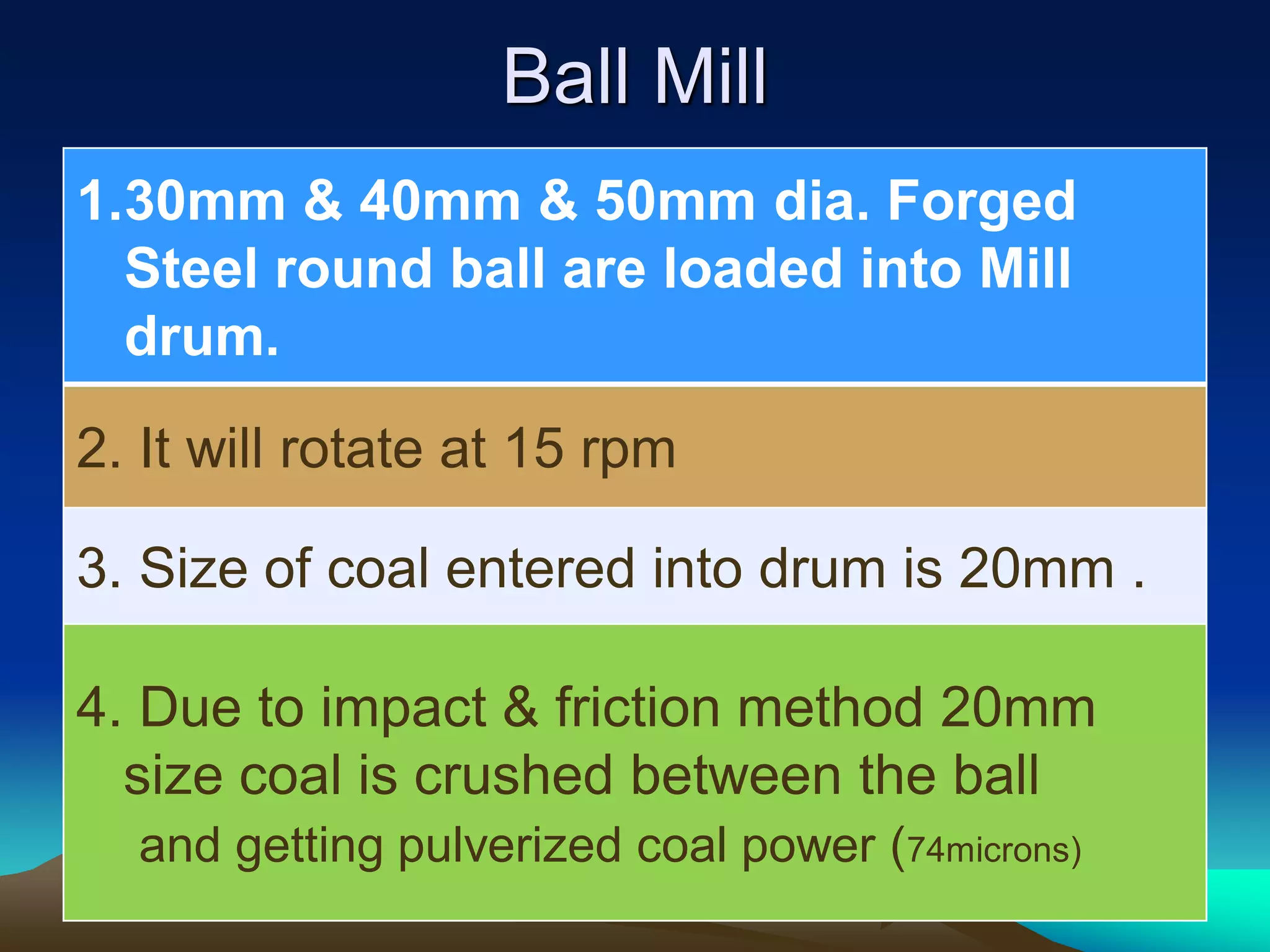
Ball Mill
1.30mm & 40mm & 50mm dia. Forged
Steel round ball are loaded into Mill
drum.
2. It will rotate at 15 rpm
3. Size of coal entered into drum is 20mm .
4. Due to impact & friction method 20mm
size coal is crushed between the ball
and getting pulverized coal power (74microns)
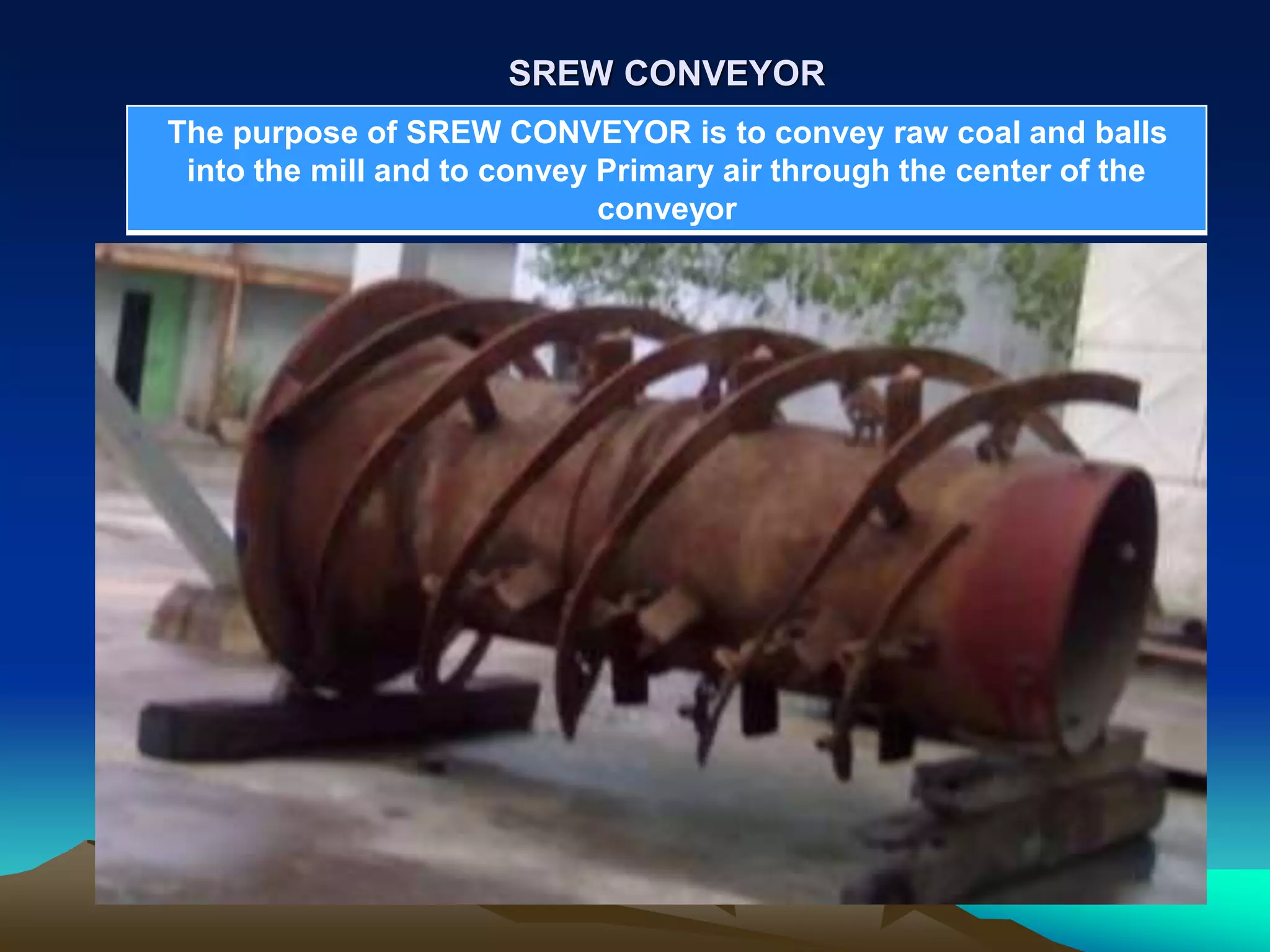
SREW CONVEYOR
The purpose of SREW CONVEYOR is to convey raw coal and balls
into the mill and to convey Primary air through the center of the
conveyor
Mill air system
Pulverized Fuel Boiler
Tangential firing
Coal is pulverised to a fine powder, so that less than 2% is +300
microns, and 70-75% is below 75 microns.
Coal is blown with part of the combustion air into the boiler plant
through a series of burner nozzles.
• Combustion takes place at
temperatures from 1300-1700°C
• Particle residence time in the
boiler is typically 2-5 seconds
• One of the most popular system
for firing pulverized coal is the
tangential firing using four
burners corner to corner to create a
fire ball at the center of the
furnace. See Figure
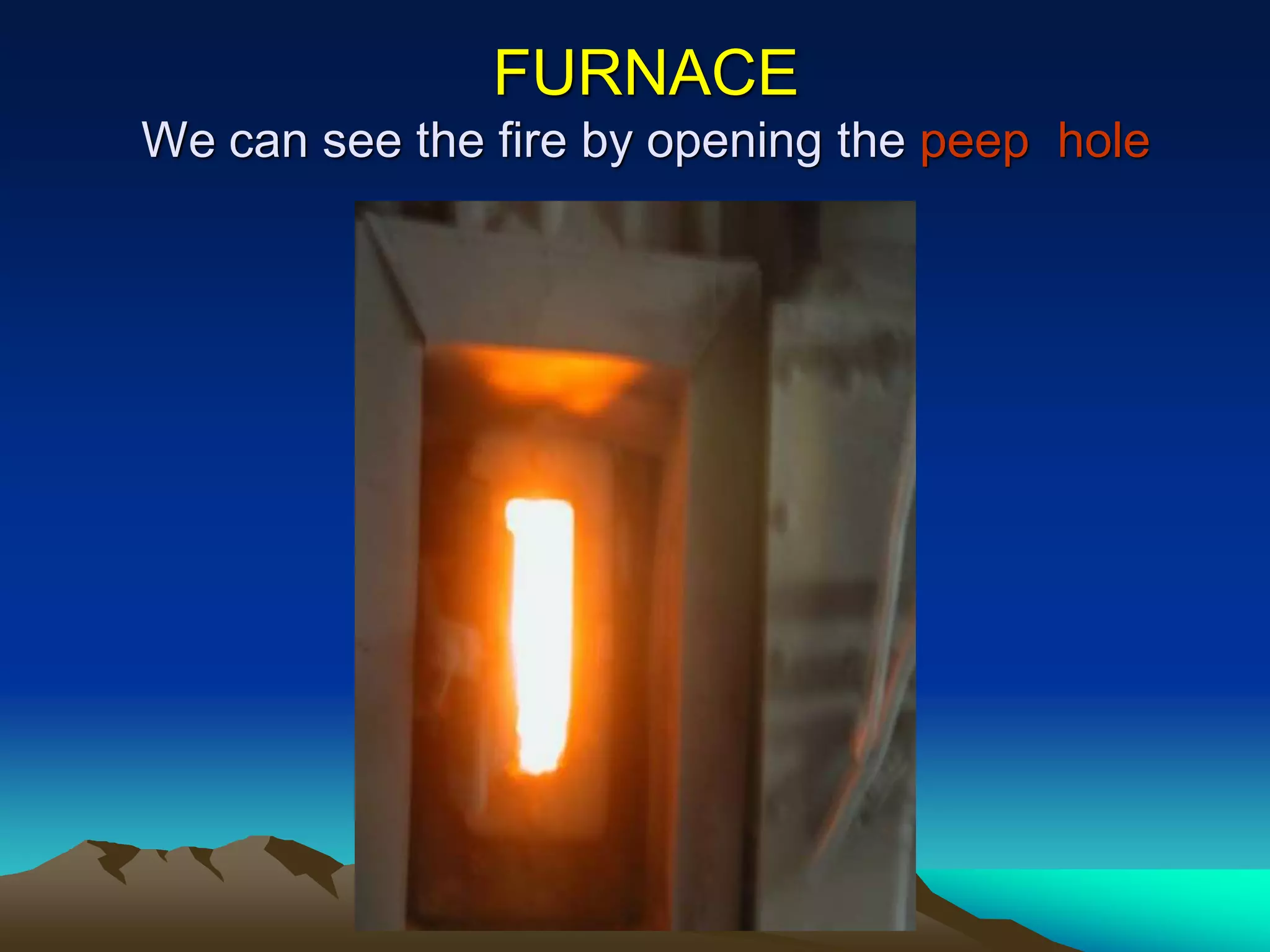
FURNACE
We can see the fire by opening the peep hole
2coal_fired_animation.mov
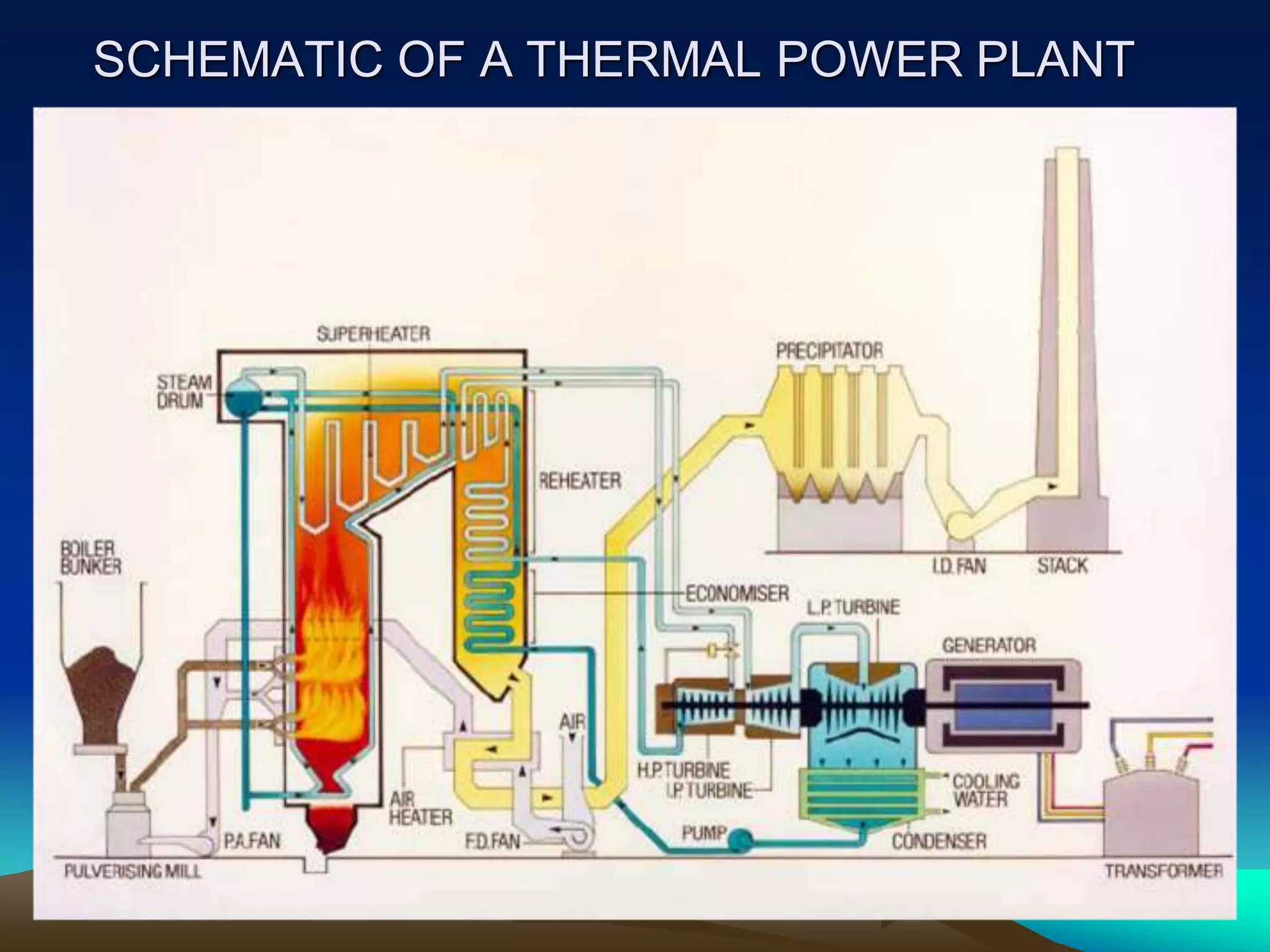
SCHEMATIC OF A THERMAL POWER PLANT
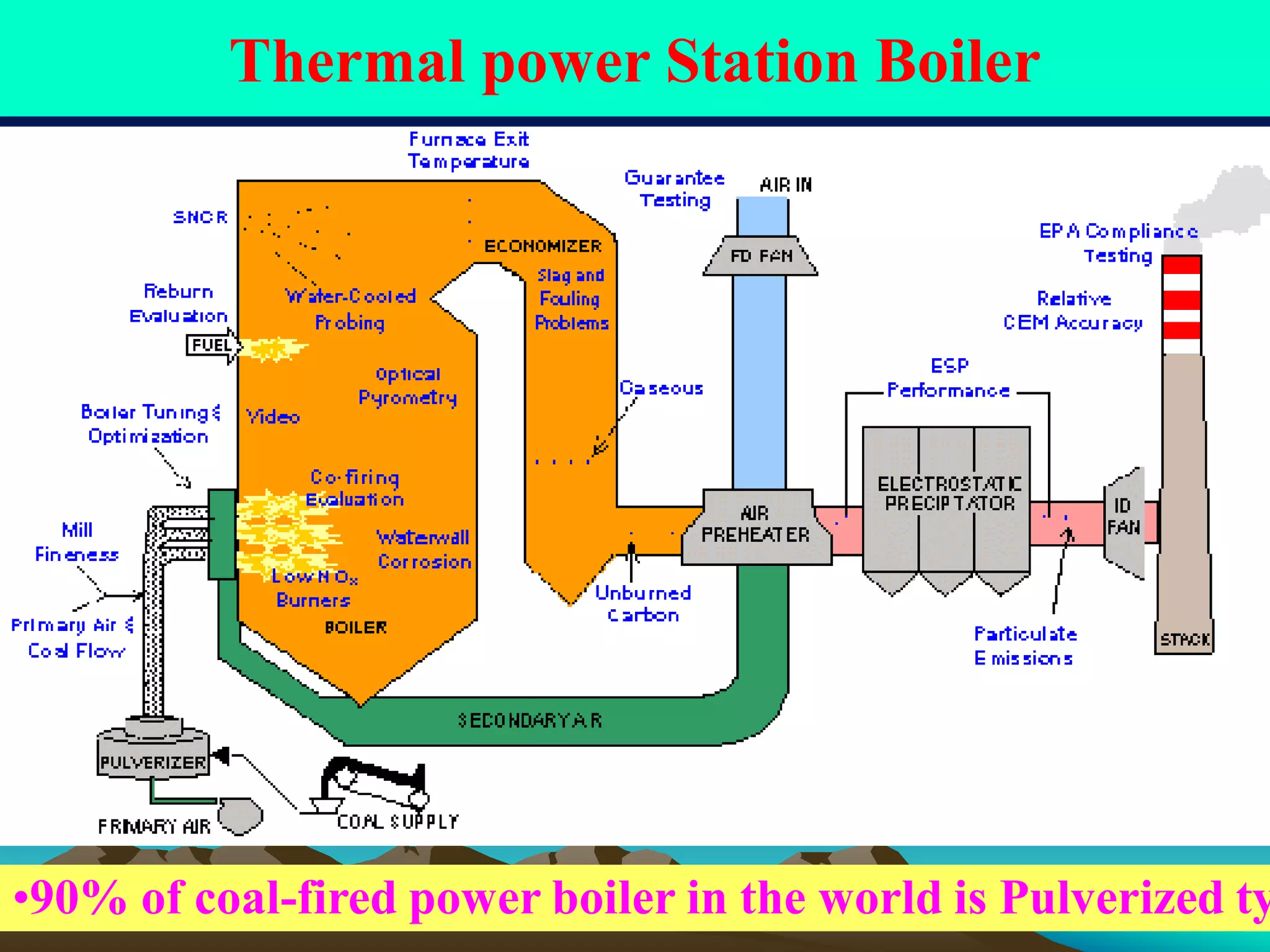
Thermal power Station Boiler
•90% of coal-fired power boiler in the world is Pulverized ty
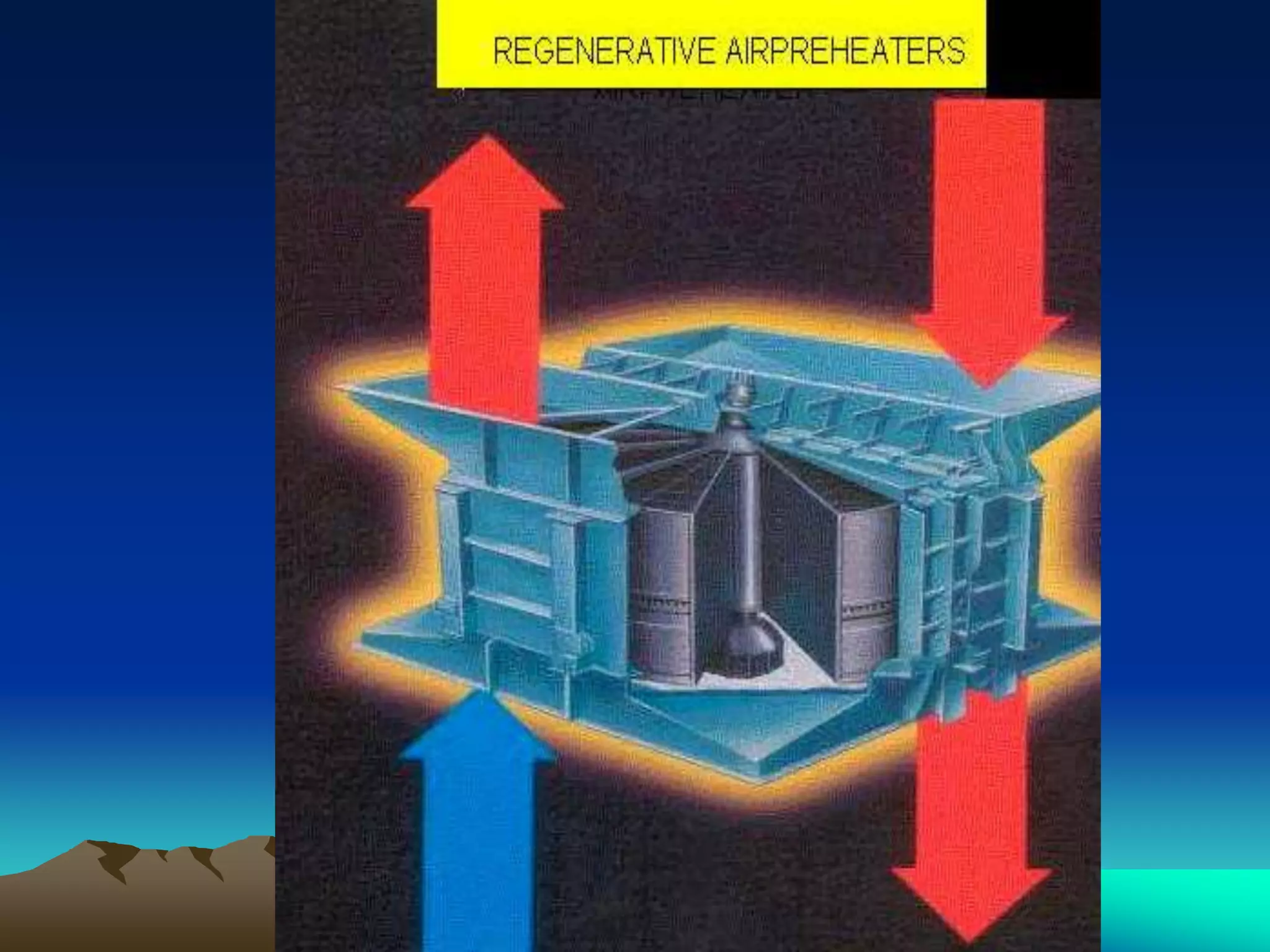
Air Pre - Heater
Location of APH,IDF & FDF
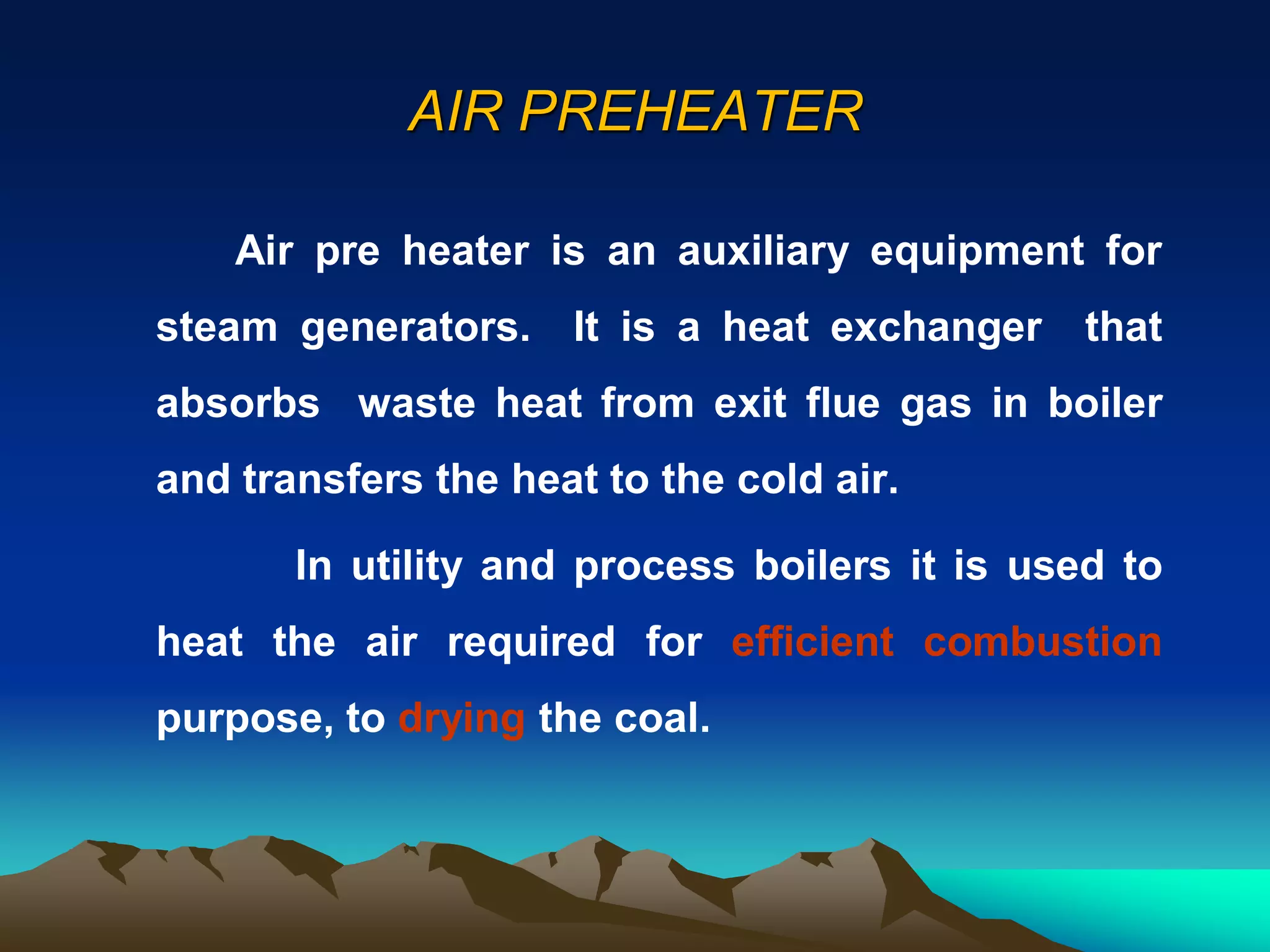
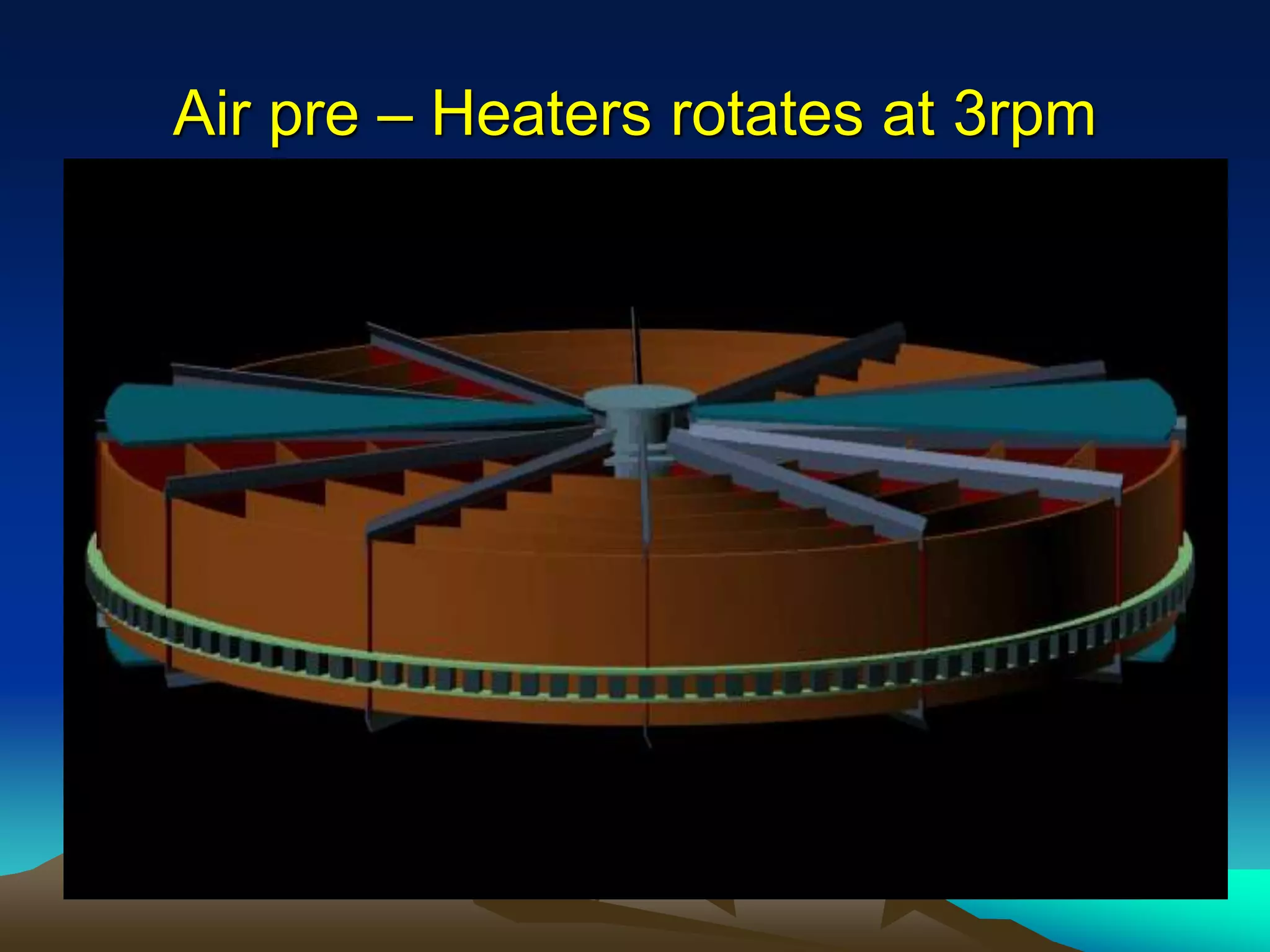
AIR PREHEATER
Air pre heater is an auxiliary equipment for
steam generators. It is a heat exchanger that
absorbs waste heat from exit flue gas in boiler
and transfers the heat to the cold air.
In utility and process boilers it is used to
heat the air required for efficient combustion
purpose, to drying the coal.
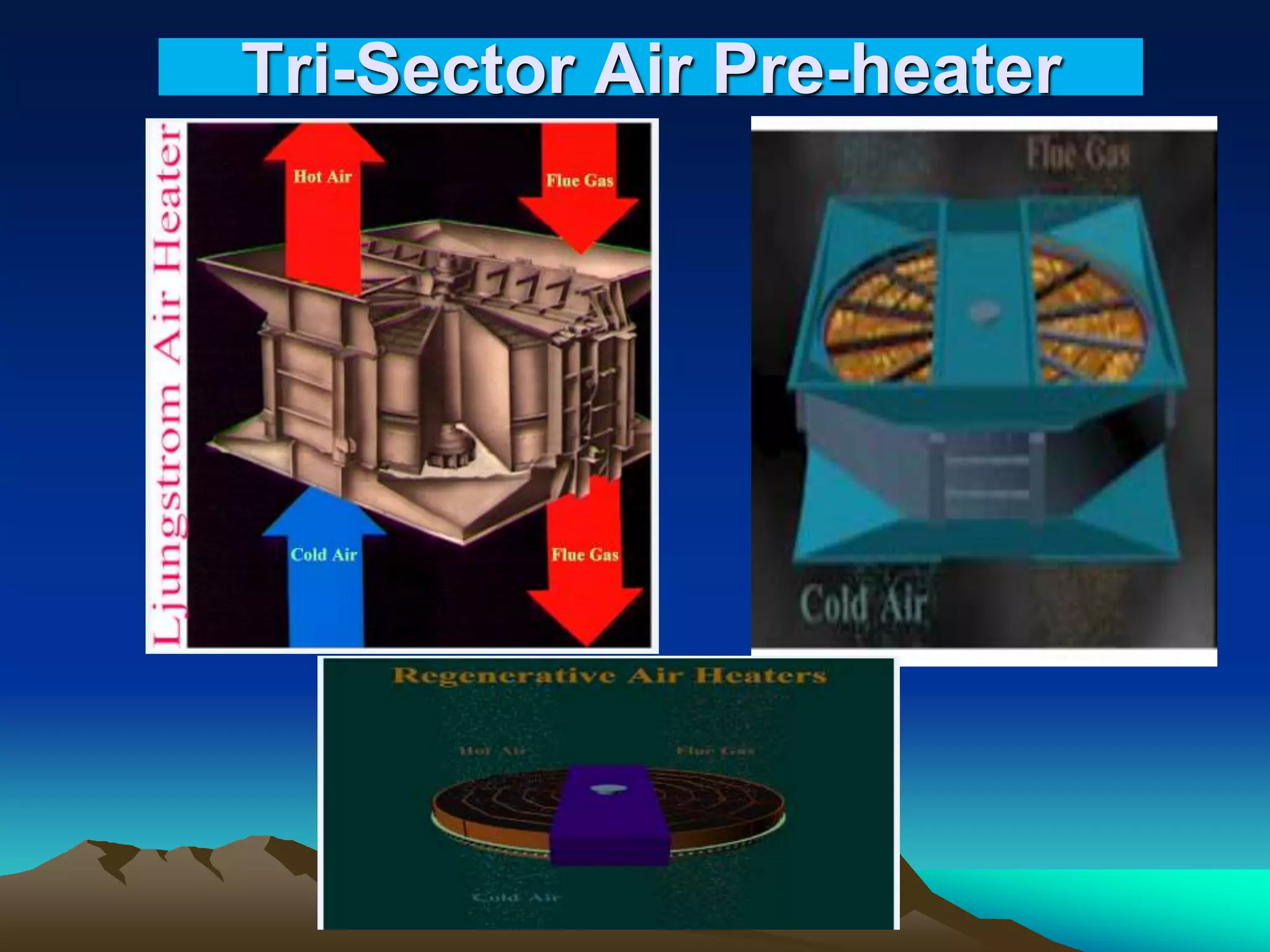
Tri – Sector Air Heater
Tri-Sector Air Pre-heater
Air pre – Heaters rotates at 3rpm
Introduction of Air Preheater
BOILER PRESSURE PARTS
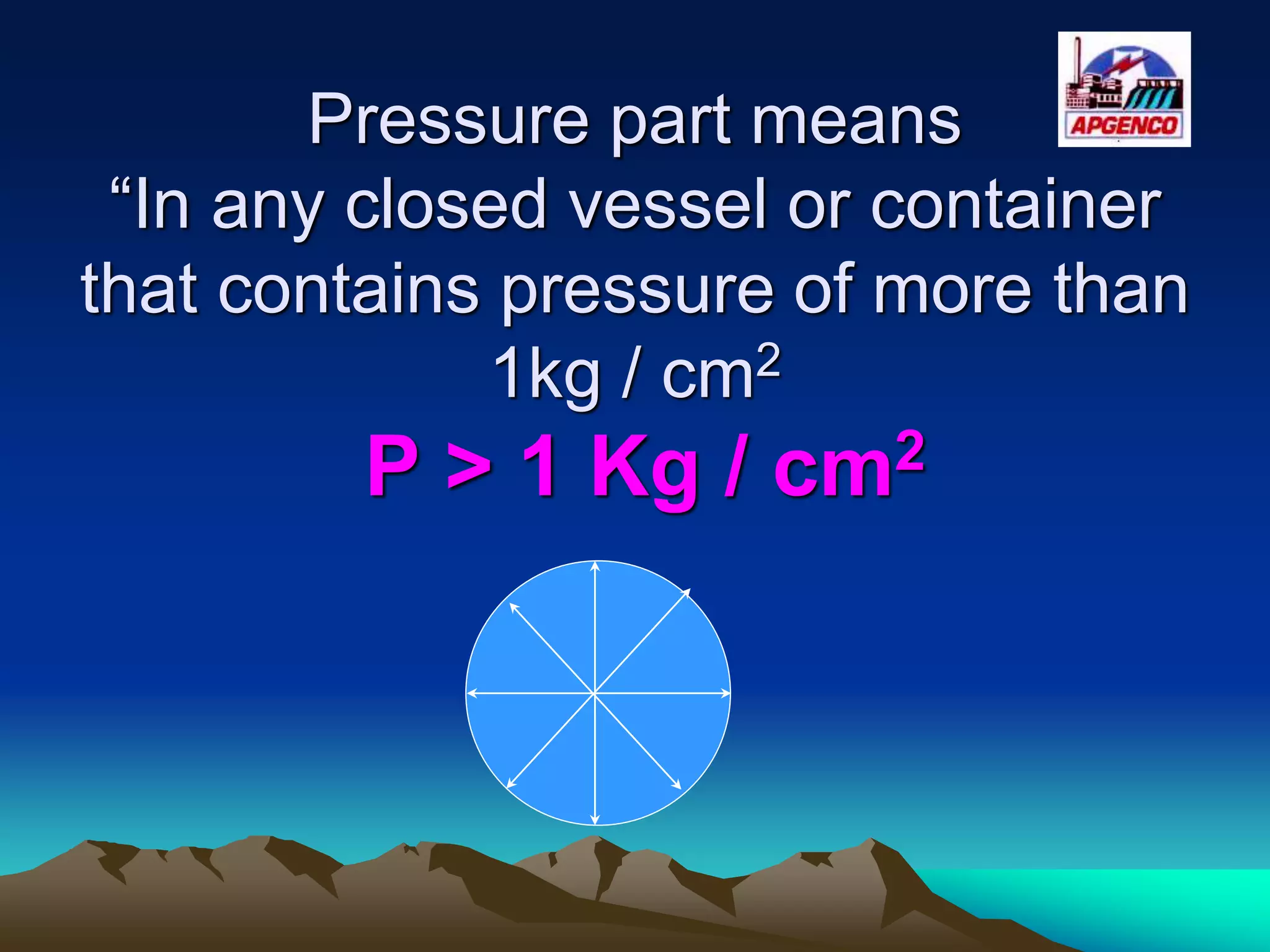
Pressure part means
“In any closed vessel or container
that contains pressure of more than
1kg / cm2
P > 1 Kg / cm2
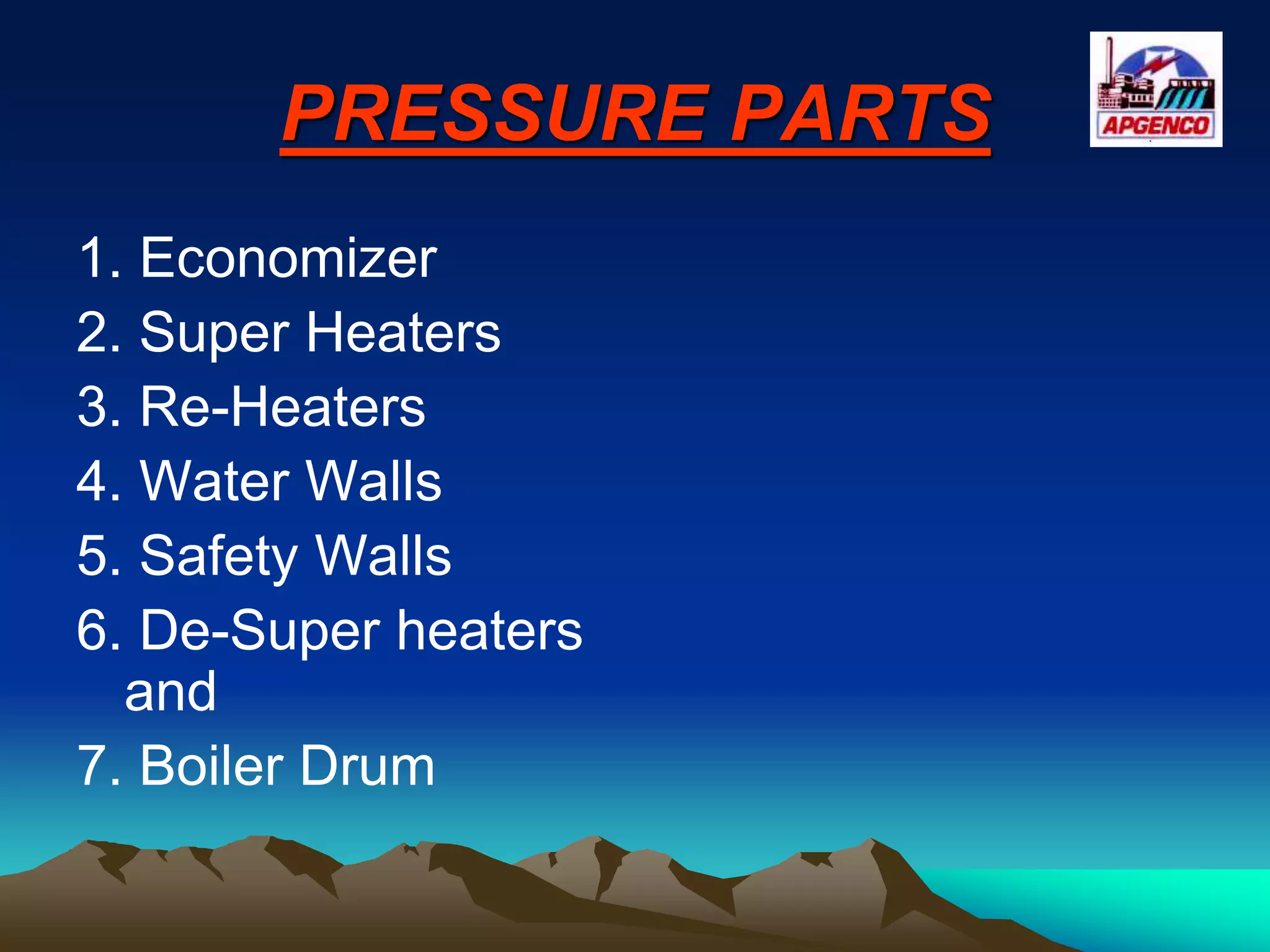
PRESSURE PARTS
1. Economizer
2. Super Heaters
3. Re-Heaters
4. Water Walls
5. Safety Walls
6. De-Super heaters
and
7. Boiler Drum
ECONOMISER
FUNCTION:
Increases the feed water temperature
by extracting the temperature from
flue gases.
SUPER HEATER
FUNCTION:
It increases the temperature of Main
steam with the help of temperature
of flue gases to get Saturated Steam
admitted to the HPT.
RE - HEATERS
FUNCTION:
It heats the temperature of steam
outlet from HPT with the help of Flue
gas temperature.
WATER WALLS
FUNCTION:
Water walls carry feed water from ring
headers to Boiler Drum through raiser
tubes by natural Circulation.
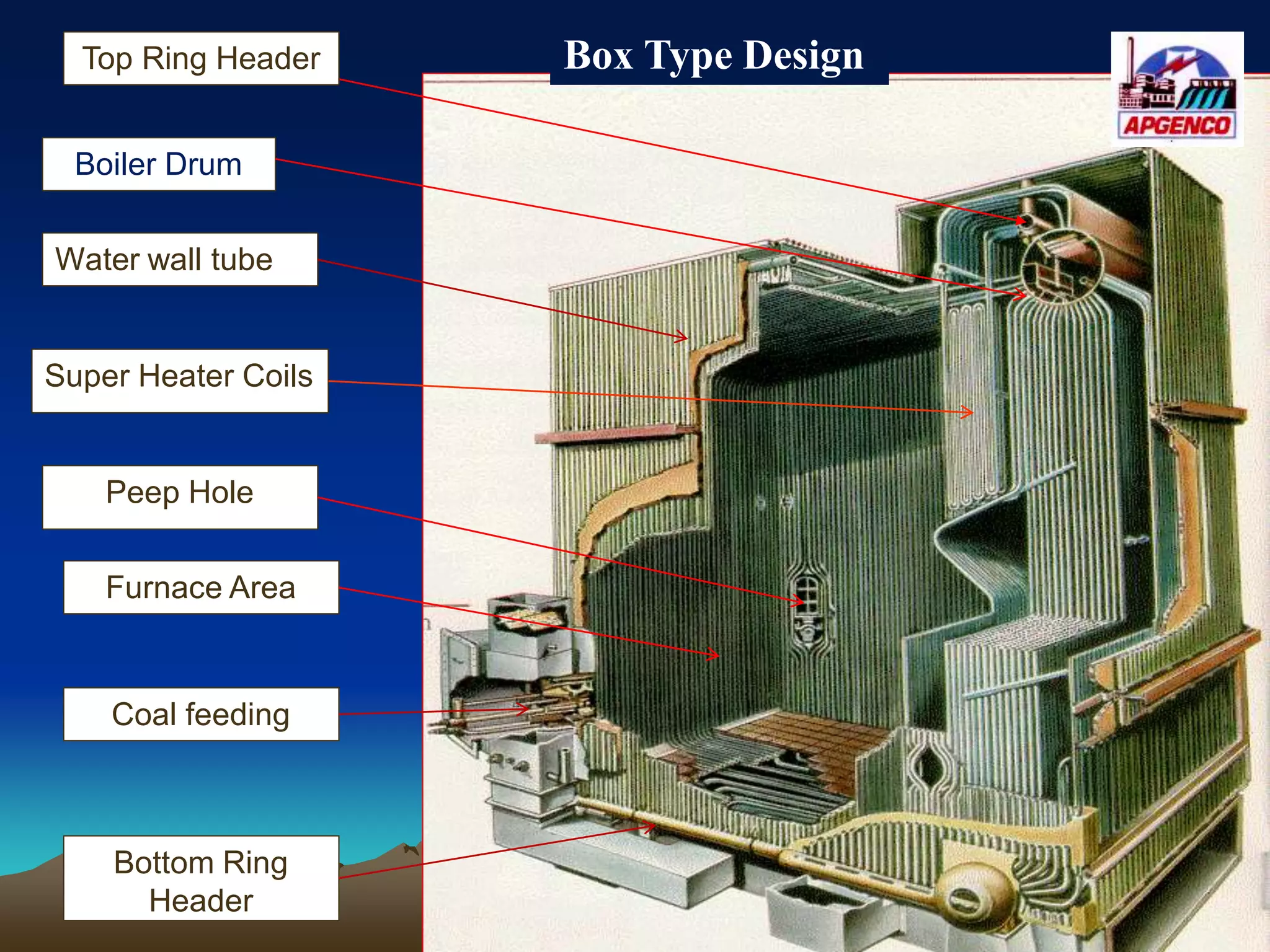
Box Type Design
Boiler Drum
Water wall tube
Peep Hole
Coal feeding
Furnace Area
Super Heater Coils
Bottom Ring
Header
Top Ring Header
SAFETY VALVES
FUNCTION
These are used to safe guard the
equipment in case of emergencies.
DE-SUPERHEATERS
FUNCTION:
It controls the main steam temperatures
to safe limit.
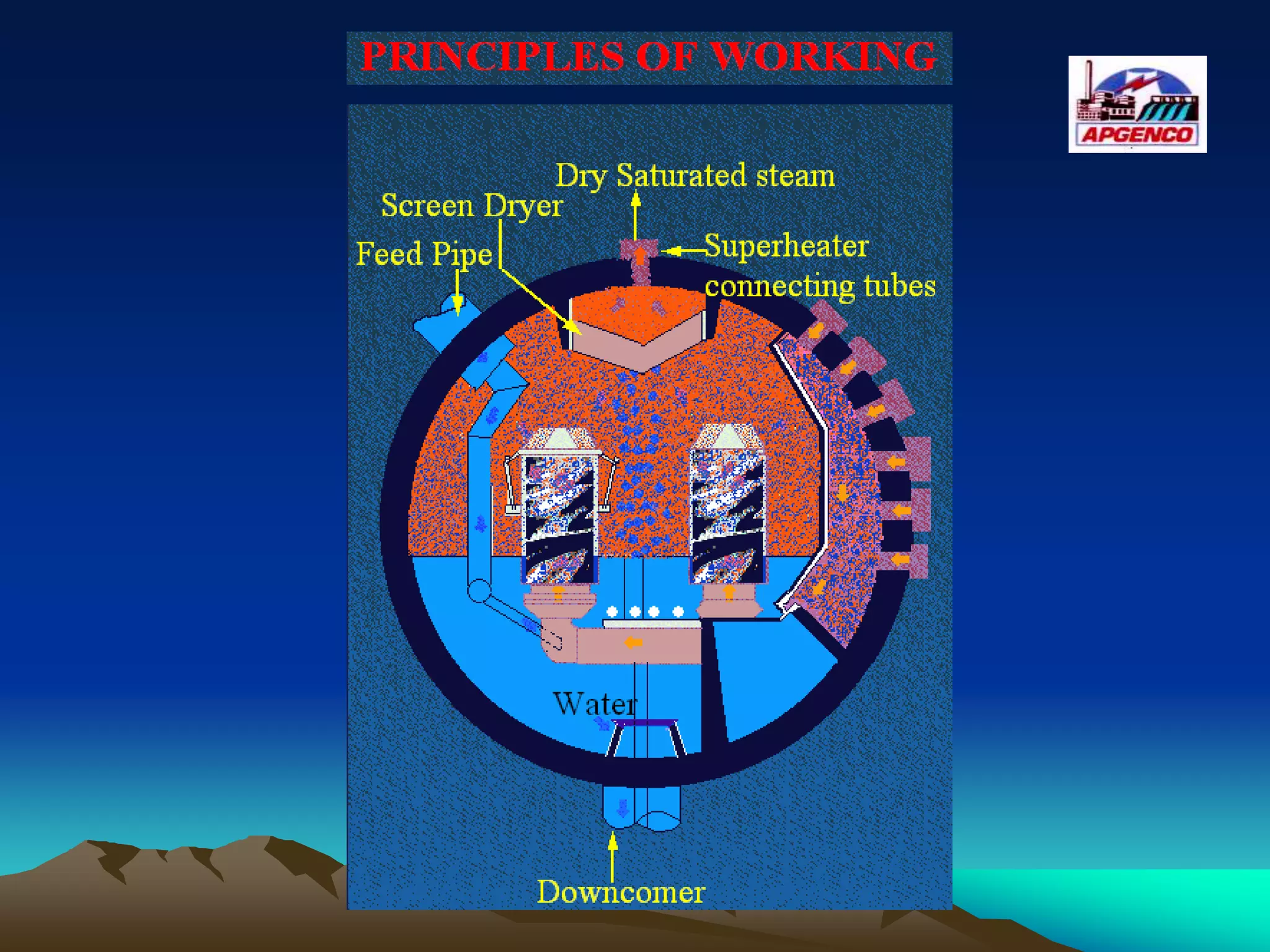
BOILER DRUM
FUNCTION:
• It separates the steam from steam-water mixture.
• It houses all equipments used for purification of
steam, after being separated from water.
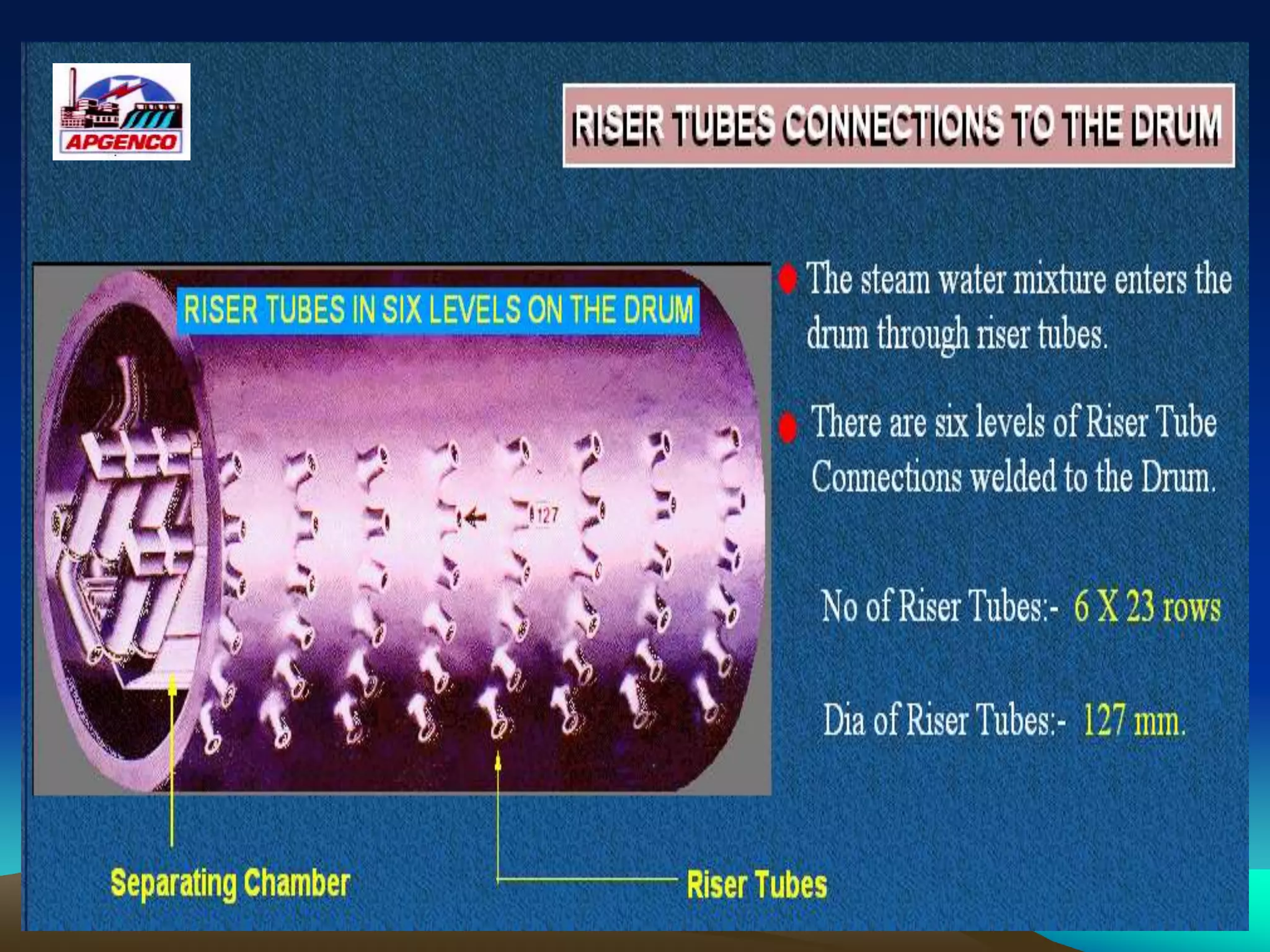
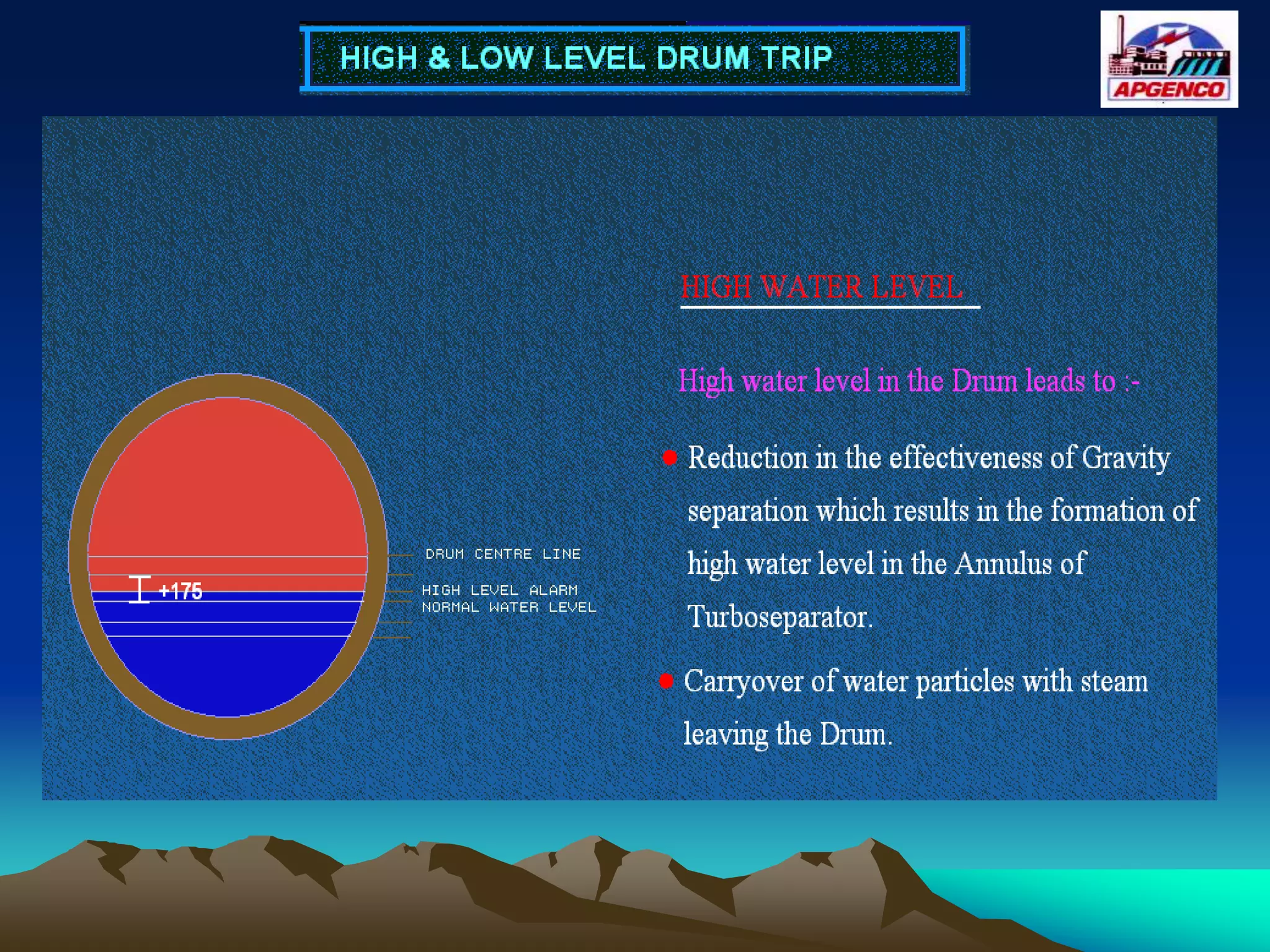
210MW - Boiler Drum Internals
Raiser
bes(500MW)
STEAM TURBINES
TYPE OF TURBINES
STAGE – I
Three cylinder, Tandem Compound, Impulse, Reheat and
Condensing type with double flow in LP Turbine & Nozzle
Governing
STAGE – II & III
Three cylinder, Tandem Compound, Reaction, Reheat and
Condensing type with double flow in IP Turbine & LP
Turbine and Throttle Governing
STAGE – I V
Three cylinder, Tandem Compound, Impulse, Reheat and
Condensing type with double flow in LP Turbine & Nozzle
Governing with TDBFP
•High Pressure Turbine
•Inner Casing
•I
n
l
e
t
•Outer Casing-Barrel type
•Exhaust
•Inner Casing
•Inlet
•Exhau
•Outer Ca
•Extraction
•Intermediate Pressure Turbine
•Inlet
•Rotor
LP STEAM TURBINE
210 MW LMW Turbine
Turbine video
8-STEAM AND WATER CYCLE
OF 210 MW
(LMW TURBINE ) UNIT.pps
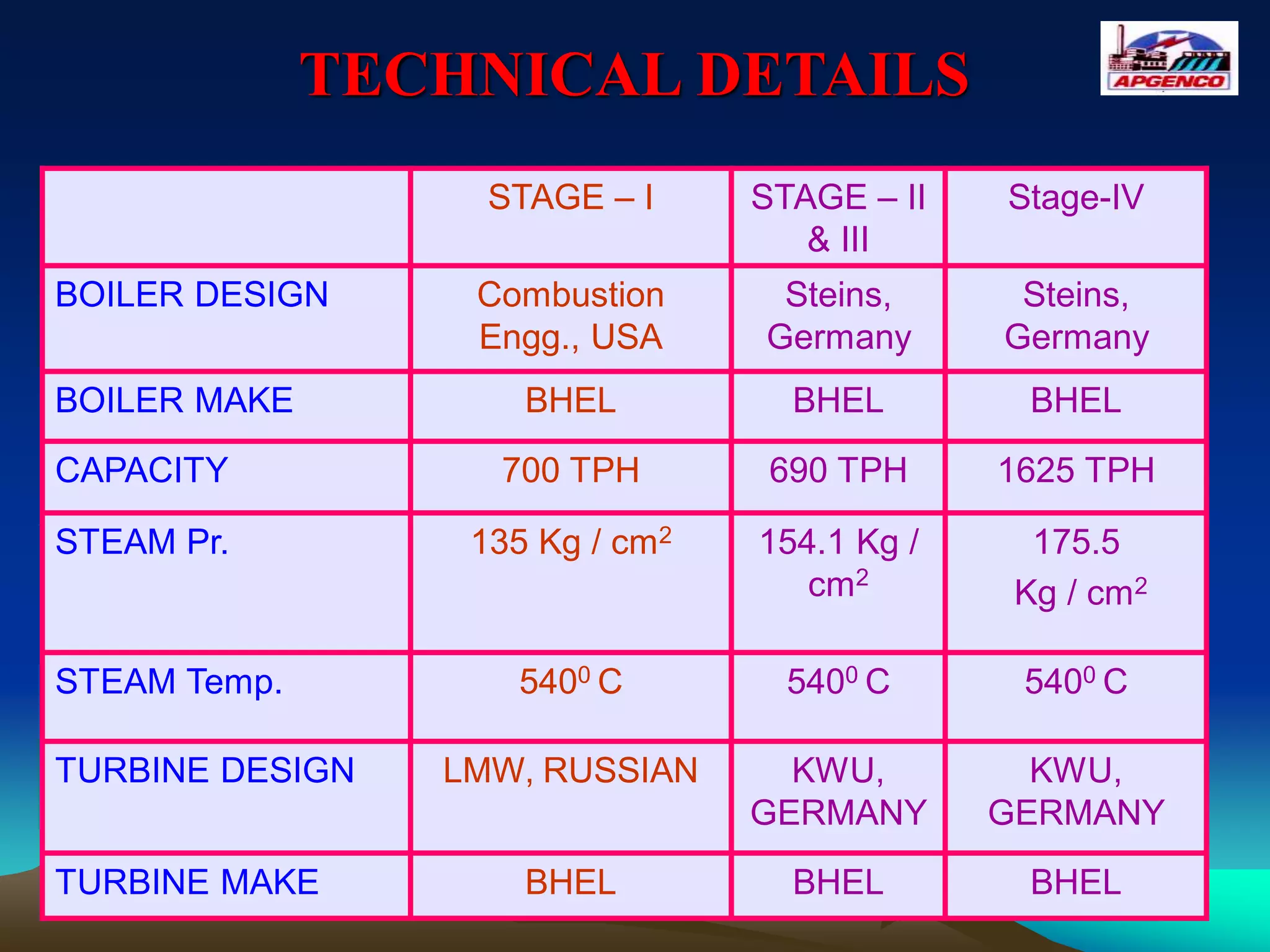
TECHNICAL DETAILS
STAGE – I STAGE – II
& III
Stage-IV
BOILER DESIGN Combustion
Engg., USA
Steins,
Germany
Steins,
Germany
BOILER MAKE BHEL BHEL BHEL
CAPACITY 700 TPH 690 TPH 1625 TPH
STEAM Pr. 135 Kg / cm2 154.1 Kg /
cm2
175.5
Kg / cm2
STEAM Temp. 5400 C 5400 C 5400 C
TURBINE DESIGN LMW, RUSSIAN KWU,
GERMANY
KWU,
GERMANY
TURBINE MAKE BHEL BHEL BHEL
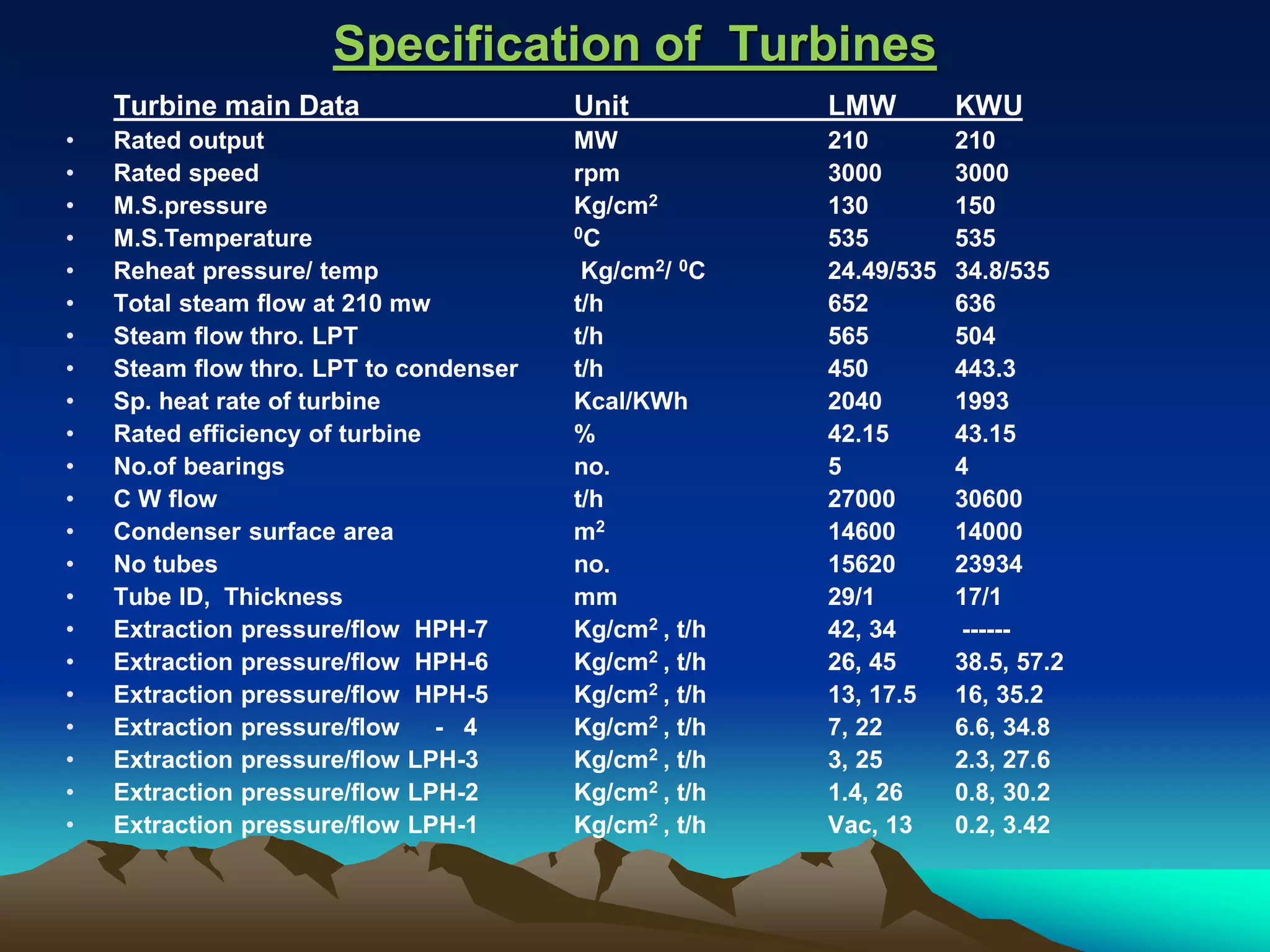
Specification of Turbines
Turbine main Data Unit LMW KWU
• Rated output MW 210 210
• Rated speed rpm 3000 3000
• M.S.pressure Kg/cm2 130 150
• M.S.Temperature 0C 535 535
• Reheat pressure/ temp Kg/cm2/ 0C 24.49/535 34.8/535
• Total steam flow at 210 mw t/h 652 636
• Steam flow thro. LPT t/h 565 504
• Steam flow thro. LPT to condenser t/h 450 443.3
• Sp. heat rate of turbine Kcal/KWh 2040 1993
• Rated efficiency of turbine % 42.15 43.15
• No.of bearings no. 5 4
• C W flow t/h 27000 30600
• Condenser surface area m2 14600 14000
• No tubes no. 15620 23934
• Tube ID, Thickness mm 29/1 17/1
• Extraction pressure/flow HPH-7 Kg/cm2 , t/h 42, 34 ------
• Extraction pressure/flow HPH-6 Kg/cm2 , t/h 26, 45 38.5, 57.2
• Extraction pressure/flow HPH-5 Kg/cm2 , t/h 13, 17.5 16, 35.2
• Extraction pressure/flow - 4 Kg/cm2 , t/h 7, 22 6.6, 34.8
• Extraction pressure/flow LPH-3 Kg/cm2 , t/h 3, 25 2.3, 27.6
• Extraction pressure/flow LPH-2 Kg/cm2 , t/h 1.4, 26 0.8, 30.2
• Extraction pressure/flow LPH-1 Kg/cm2 , t/h Vac, 13 0.2, 3.42
TURBINE & GENERATOR
ENERGY TRANSFORMATION
MECH
ENERGY OF
TURBINE TO
ELECTRICAL
ENERGY IN
GENERATOR
HIGH
PRESSURE
STEAM
KINETIC
ENERGY TO
MECH.
ENERGY IN
TURBINE
VIDEO3-▶ How does a Thermal
Power Plant Work.mp4
Ash collection points
Generally ash will be collected by the following locations.
1) Ash collected at Bottom Ashing. ( Moderately)
2) Ash collected at ESP Hoppers.( Major portion)
3) Ash collected at Duct Hoppers.
4) Ash collected at APH Hoppers.
5) Ash collected at Economizer Hoppers.
6) Ash collected at Scraper conveyors.
7) Stack hoppers
8) Common ash slurry sluice way trench)Ash pump house
10) Ash disposal lines
11) Ash pond
Bottom Ashing
Ash collected at the bottom of boiler Ash collected at Scrapper conveyor
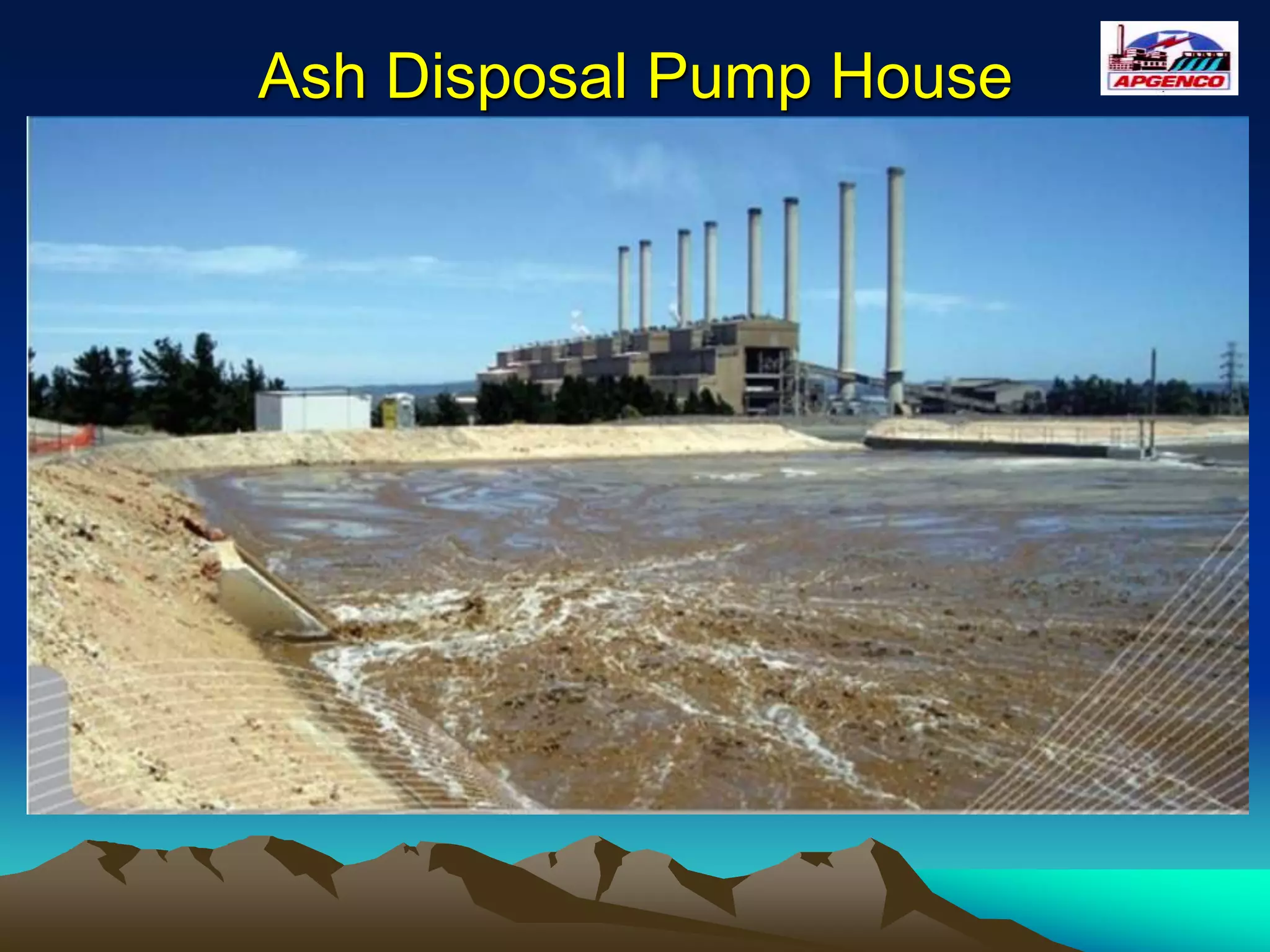
Ash Disposal Pump House
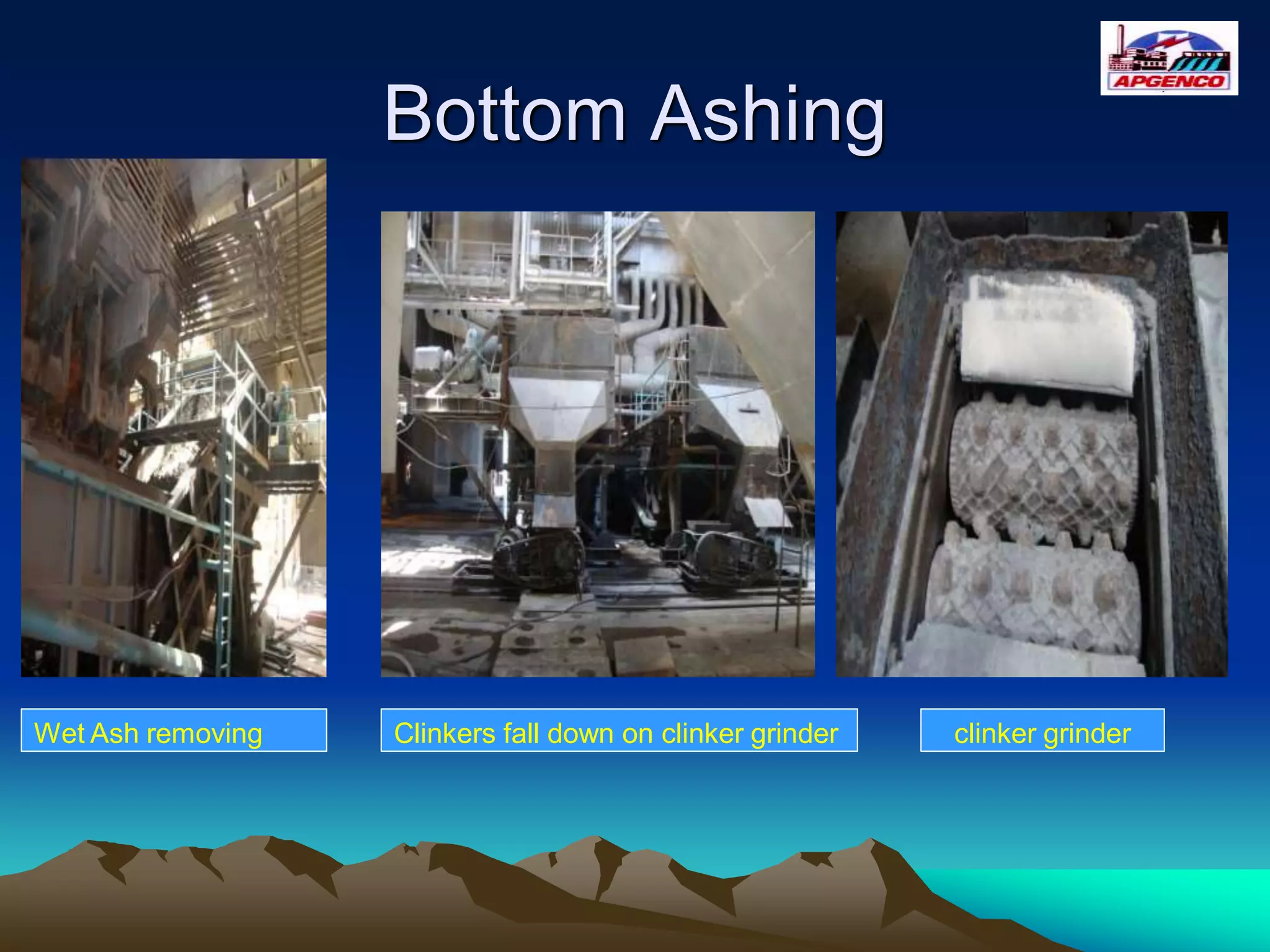
Bottom Ashing
Wet Ash removing Clinkers fall down on clinker grinder clinker grinder
ESP & Duct Hoppers
Real location of ESP
Ash loading points Ash loading points
Ash Pond
Ash Disposal Lines Ash Pond Area Decanting well
Ash Pond
Wet Ash loading process
Seepage pits
Decanting process
Ash Pond
Seepage pitsDecanting process
Fly Ash Utilization
1. Earth Works: Embankments, Backfills,
Highways- Base and Sub base, Soil
stabilization, Structural Fills.
2. Buildings: Pozzalona Cement, Bricks
Blocks, Slabs and Walls Panels,
Concrete, Grouts.
3. Agriculture: Soil Conditioning,
Manufacture of Fertilizers.
TotalHeatinput100%
Heat Loss in Flue gas ~5%
Losses in boiler and piping ~8%
Losses in Turbine, Generator and
Transformer ~4%
Condenser cooling water rejection ~45%
Unit self consumption ~3%
NetavailableEnergy~35%
Energy Distribution
TYPE OF GENERATORS
STAGE – I
Alternator with Cylindrical rotor, Static excitation,
3-Phase Double Star Winding, Water & Hydrogen
cooled
STAGE – II , III & IV
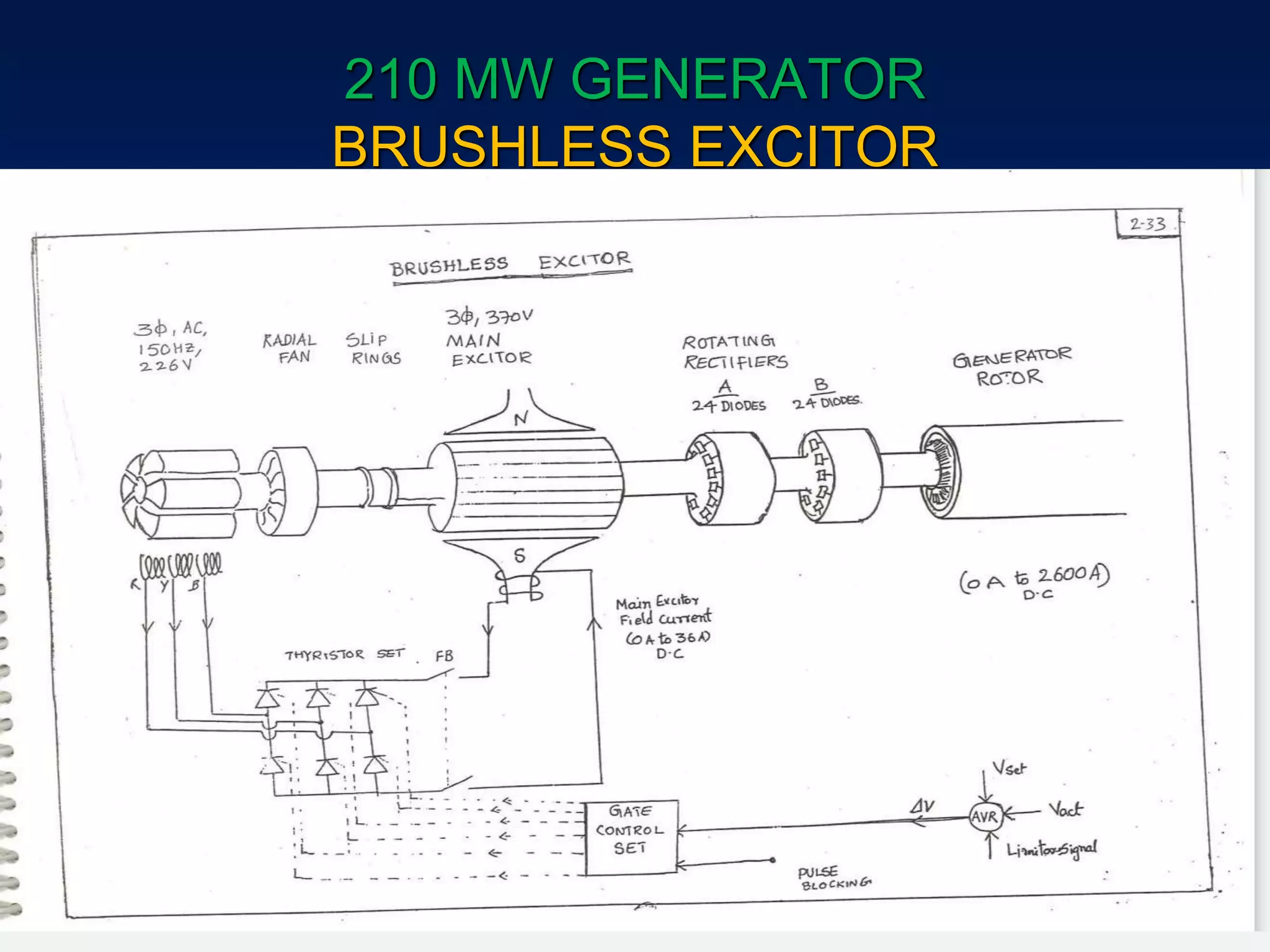
Alternator with Cylindrical rotor, Brush less excitation,
3-Phase Double Star Winding, Hydrogen cooled
Generator details
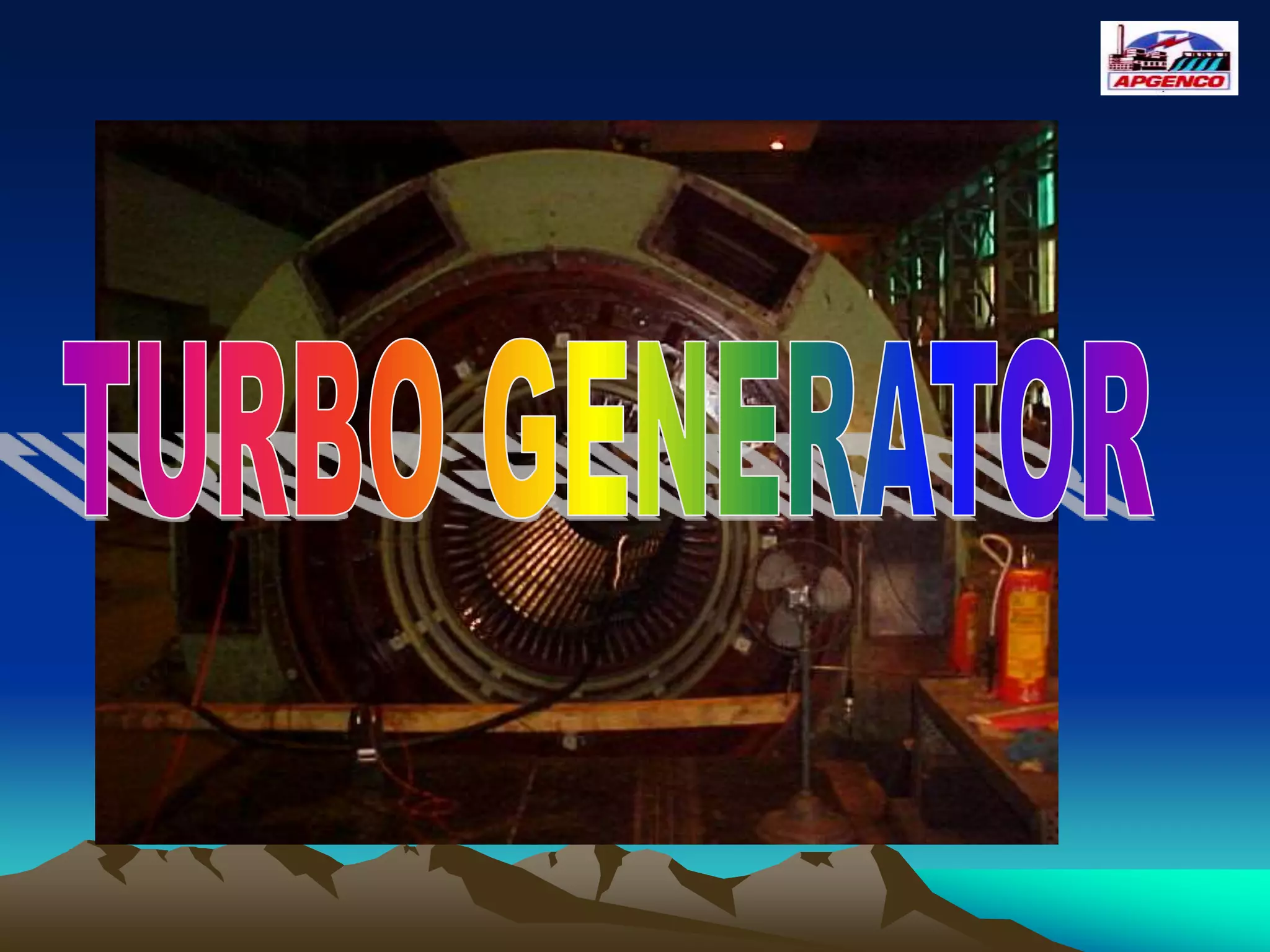
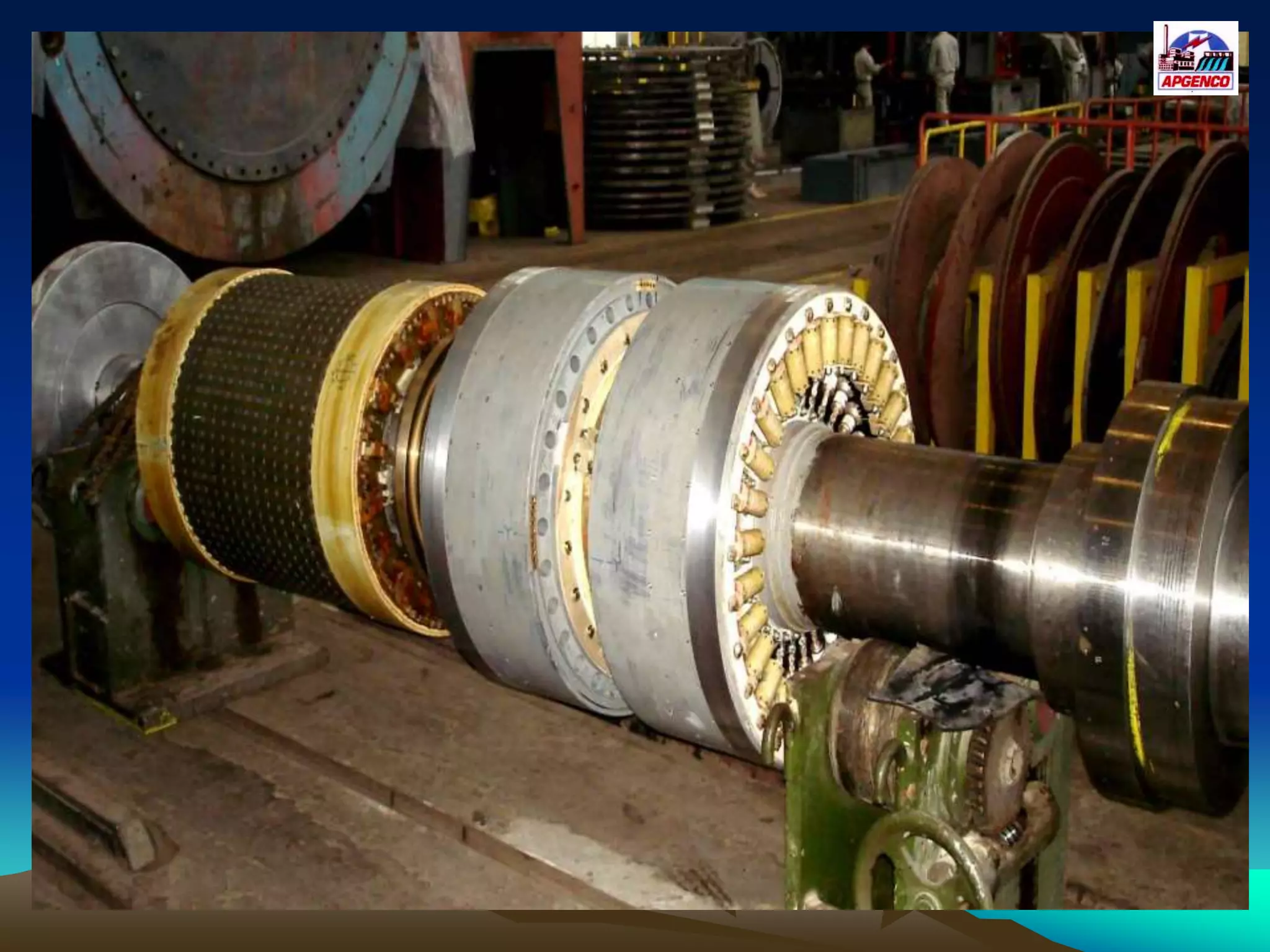
TURBO GENERATOR
• The main parts of a Turbo Generator are
STATOR and ROTOR.
• Detailed constructional features
• STATOR BODY:
 Stator body is a robust totally enclosed
gas tight fabricated structure.
Designed mechanically to withstand high
internal pressure of explosion of Hydrogen
–Air mixture
Hydrogen gas coolers are housed
longitudinally inside the stator body
The end shields are made in 2 halves for
ease in assembly
TURBO GENERATOR
• STATOR CORE:
 Made up of segmental, varnished insulated
punchings of CRGO silicon steel laminations
 Built in several packets separated by steel
spacers for radial cooling of the core by
Hydrogen
 Pressing of the core stampings is done to
ensure monolithic core
 Core is held firmly by means of Heavy Non –
Magnetic Steel press rings bolted thoroughly
with the ends of core bars
TURBO GENERATOR
TURBO GENERATOR
STATOR WINDING:
 Three phase, double layer short chorded bar type
windings with two parallel paths
 Each coil consists of glass insulated solid and hollow
conductors
 The elementary conductors are transposed in the slot
portion to minimize eddy losses.
 Coils are held in the slots firmly in the slots by fibrous
wedges.
 Overhang portion is securely tied with glass cord to
binding rings and special Non-Magnetic brackets
TURBO GENERATOR
TURBO GENERATOR
• Distillate Headers:
 Two Copper ring type water headers are
provided for both inlet and outlet of the Stator
winding on the Turbine end
 The winding ends are solidly soldered into the
coil lugs which pass ultrasonic test
 Each individual bar is connected with PTFE
hose which in-turn are connected to ring header
 The water circuit is subjected to Hydraulic test at
various stages to ensure water tight
TURBO GENERATOR
• TERMINAL BUSHINGS
 Porcelain insulators are provided to insulate the
terminal bars from the stator body
 Terminal bushings are situated in the lower part
of the stator casing (Slip ring side)
 Sealing is provided between bushings and stator
body to avoid any possibility of leakage of
Hydrogen gas
 Three phase and six Neutral bushings are
available.
TURBO GENERATOR
• ROTOR
 The rotor shaft is a forged from one single piece
from Chromium, Nickel, Molybdenum and
Vanadium steel.
 It undergoes all types of series of mechanical
tests to ensure any internal flaws.
 Rotor is dynamically balanced to a high degree
of accuracy.
TURBO GENERATOR
TURBO GENERATOR
Field winding:
 Field winding is made up of hard drawn silver bearing
copper.
 It is held in position against centrifugal forces by means
of duralumin wedges in the slot portion
 Overhang portion is held by the non-magnetic steel
retaining ring.
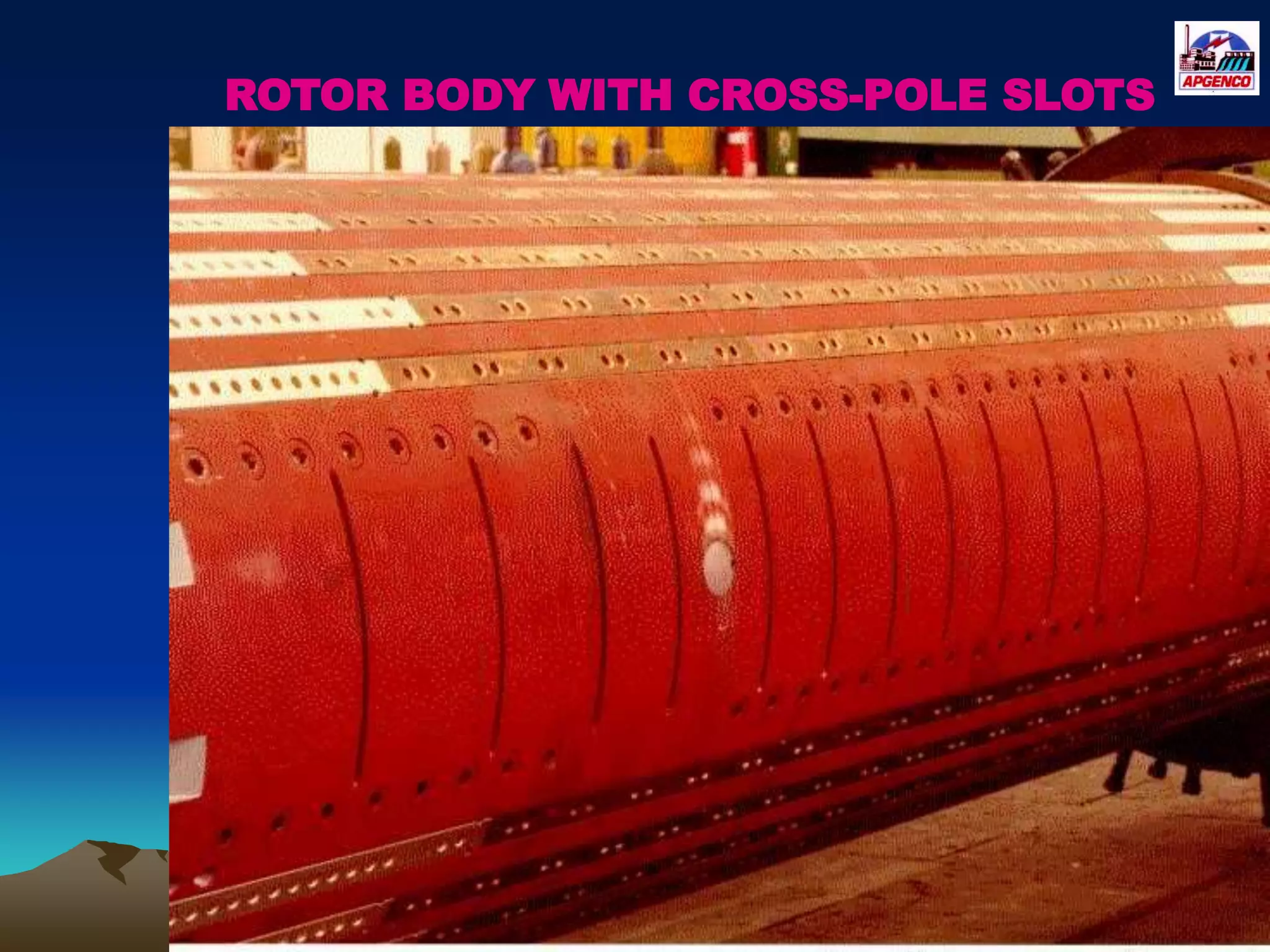
 Several ventilating ducts are milled on the slots for
Hydrogen gas cooling of the rotor.
 Copper segmental type damper winding is provided to
prevent overheating of retaining rings
TURBO GENERATOR
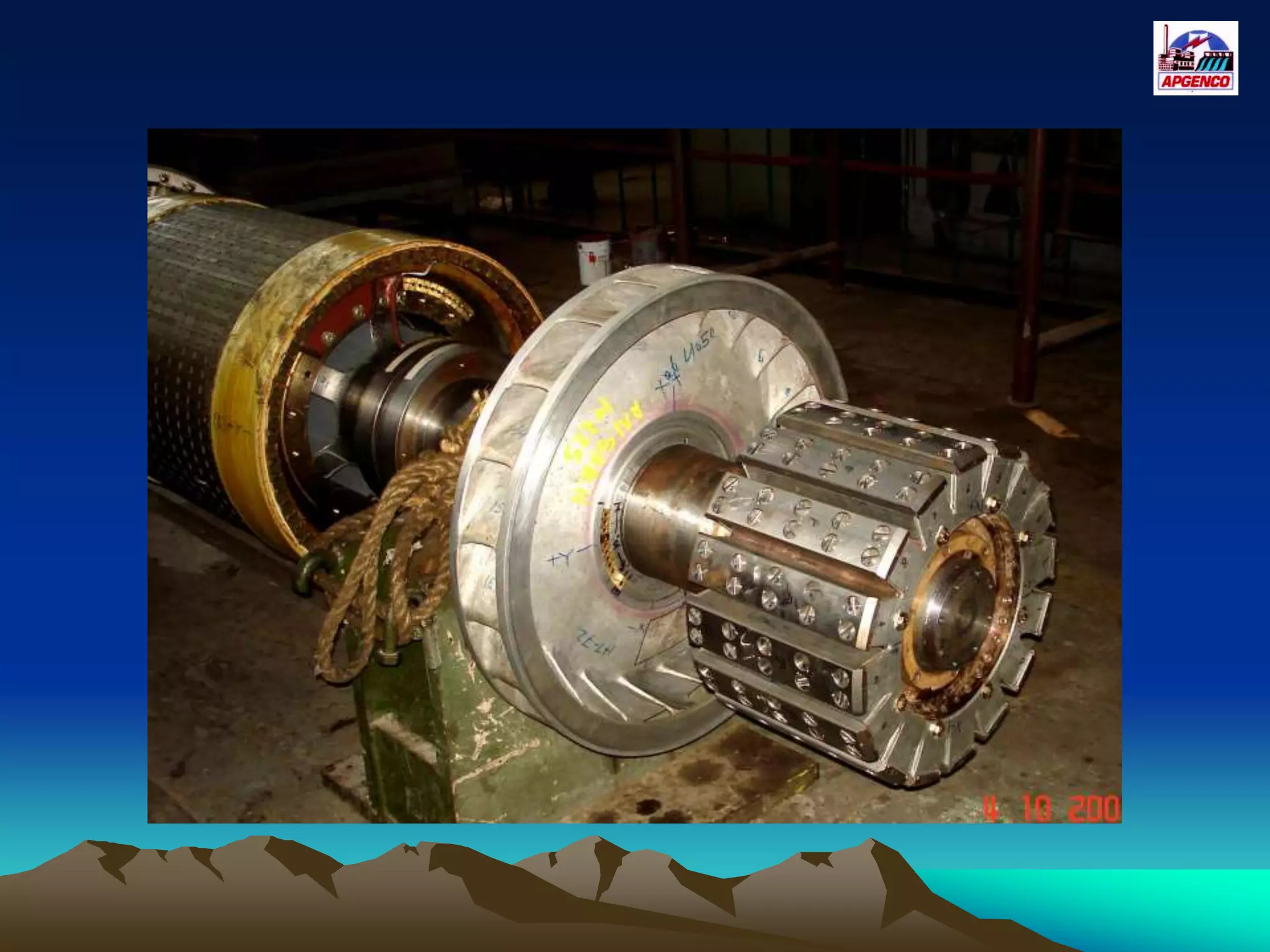
Shaft Mounted Fans
 For circulating the Hydrogen gas inside the
Turbo Generator two propeller type fans are
mounted on either sides of the rotor shaft
 Alloy steel cast fan blades are machined in the
tail portion with special profile
 Fan shields are fixed to the end shields to guide
the flow of Hydrogen gas
TURBO GENERATOR
RETAINING RINGS
 End windings are held intact against centrifugal forces by
retaining rings machined from stress free, heat treated
non-magnetic alloy steel.
 Retaining rings are shrunk fitted on the rotor body.
 Centering rings mounted at the end of retaining rings
support and prevent the movement of rotor winding in
axial direction.
CROSS SECTIONAL VIEW OF TURBO GENERATOR
Stator Winding
ROTOR
RET RING
Seal Rings
Bushings
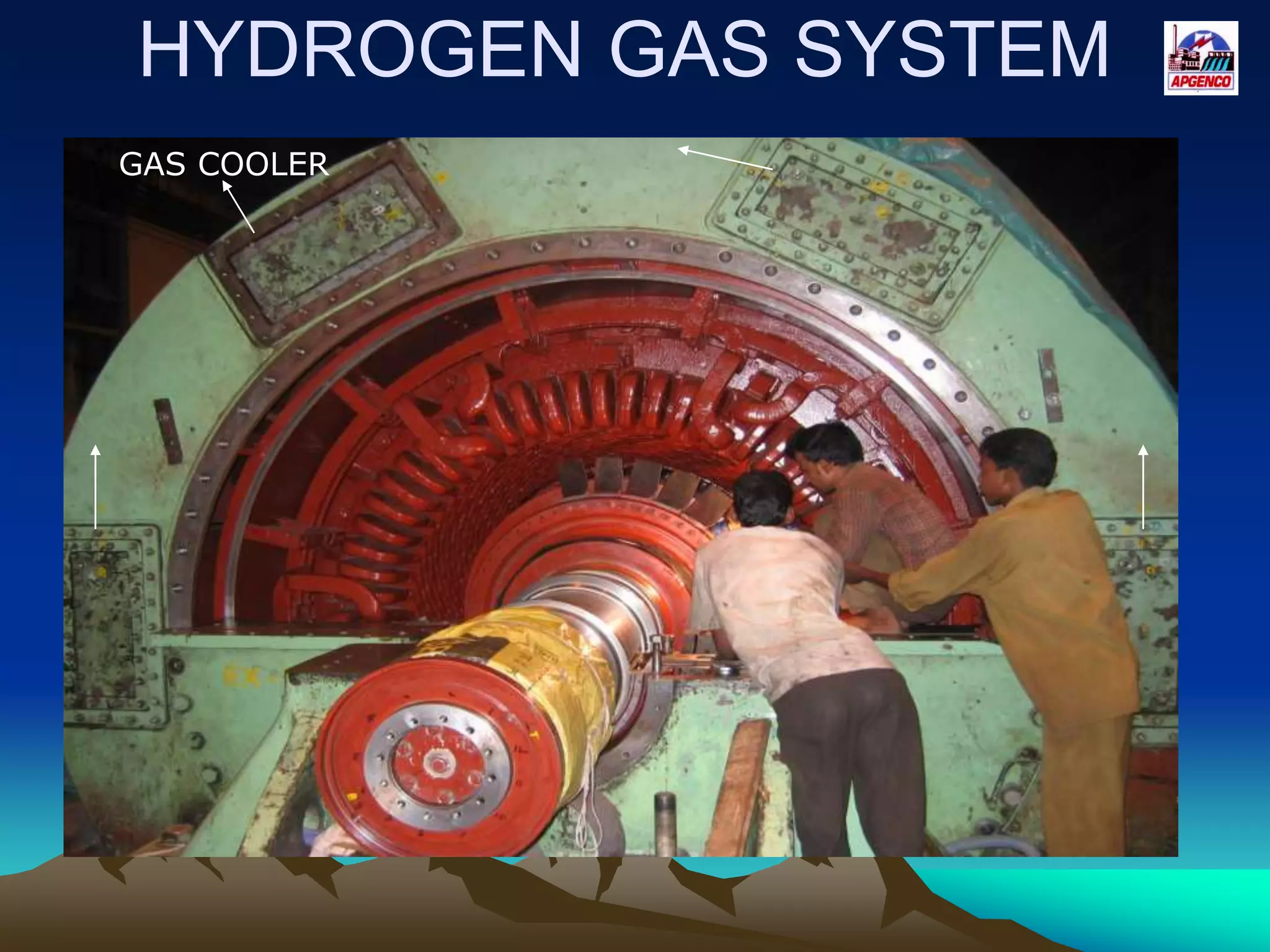
Gas cooler
TURBO GENERATOR
SLIP RINGS
 Helically grooved alloy steel rings are shrunk on the
rotor.
 Both the rings are mounted on a common single steel
bush which has an insulating jacket.
 Radial holes are made on the slip rings for fixing Current
Carrying Bolts.
 Slip rings are connected to the field winding thru semi
flexible copper leads.
TURBO GENERATOR
BRUSH GEAR
 Brush gear is provided on the extended part of
the bearing pedestal on the excitation side.
 Brush holders are fixed on the brass rings in
such a way to provide staggering of the brushes
along the circumference of the ring.
 Brushes are loaded with contact pressure which
can be adjusted individually.
 Brushes can be replaced easily during normal
running condition.
TURBO GENERATOR
GAS COOLERS
 Four numbers gas coolers are mounted longitudinally
inside the TG stator body.
 Gas coolers consist of cooling tubes made out of brass
and coiled copper wire is wound to increase the surface
area of cooling.
 Cooling water flows thru the tubes (inside) and hot
Hydrogen across the cooler surface thereby taking away
the heat from the gas.
TURBO GENERATOR
SHAFT SEALS
 Shaft seals are provided in order to prevent Hydrogen
escape from the TG casing along the rotor shaft.
 Seal oil (pressurized) is a used to seal Hydrogen gas
escape.
 The shaft seals are radial thrust type and are mounted
between end shield and the bearing at either ends of the
Rotor.
HISTORY OF GENERATORS
Electro-Magnetic Induction principle enunciated by Sir Micheal Farady 1831.
First AC Turbo –Generator was developed by Sir Charles A Parsons 1888.
First 3 phase generator, salient pole 1900.
First turbo type 3 phase 25 MW generator 1912.
CEA, UK made 50 HZ as standard frequency for Europe 1925.
First Hydrogen cooled 3 phase 30 MW generator 1937.
First Hydrogen cooled TG with direct cooling of rotor 1949.
First generator with water cooled stator winding 1956.
First generator with water cooling for stator and rotor winding 1959.
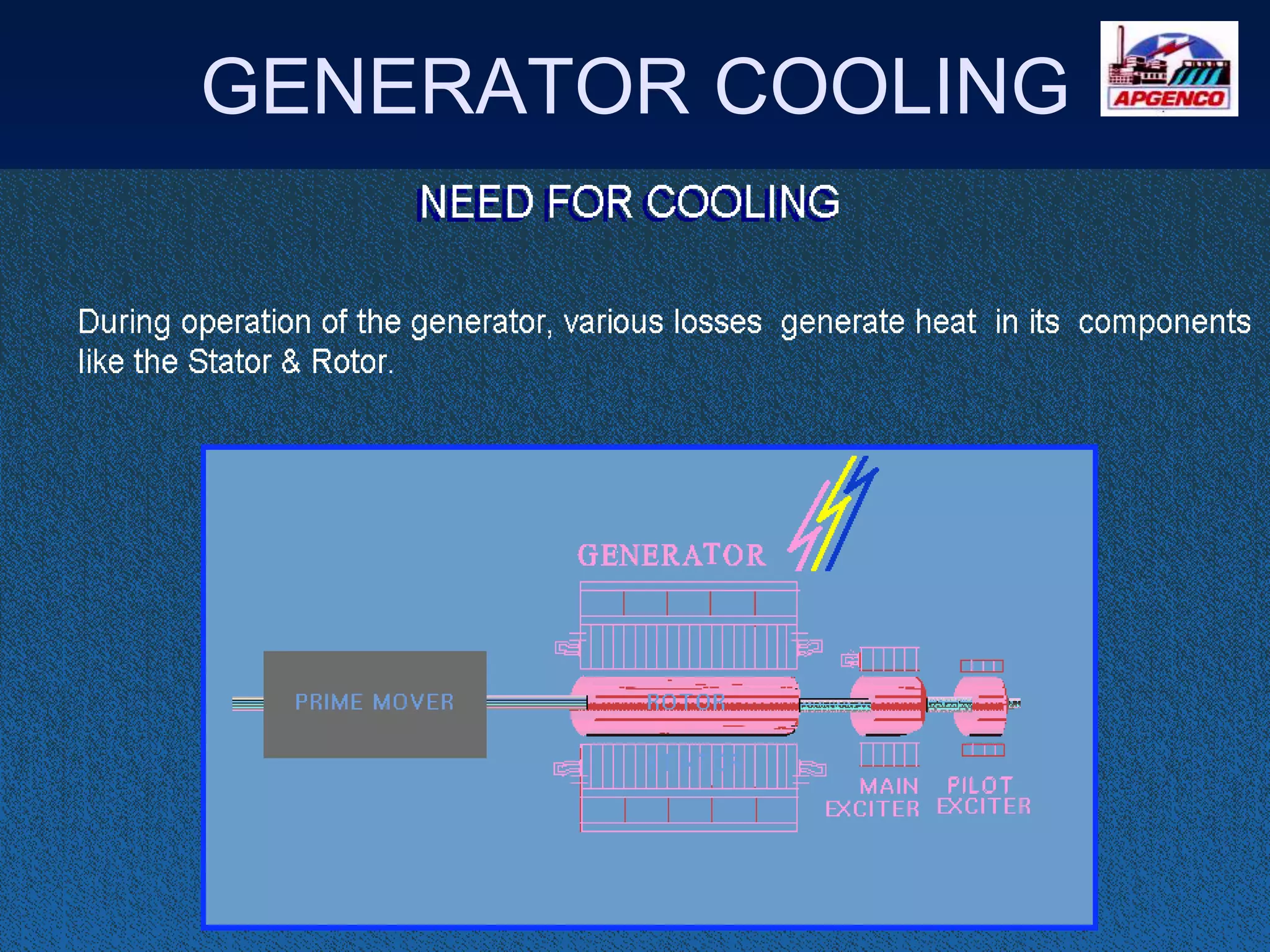
GENERATOR COOLING
210 MW Turbo Generator losses
Different cooling Methods
Closed cycle Air cooled Generators
Advantages of closed circuit Air cooled Generators
Hydrogen Gas Coolers
HYDROGEN GAS SYSTEM
GAS COOLER
Stator water cooling system
TURBINE SIDE TEFLON HOSE OUTLET HEADER
INLET HEADER
ROTOR BODY WITH CROSS-POLE SLOTS
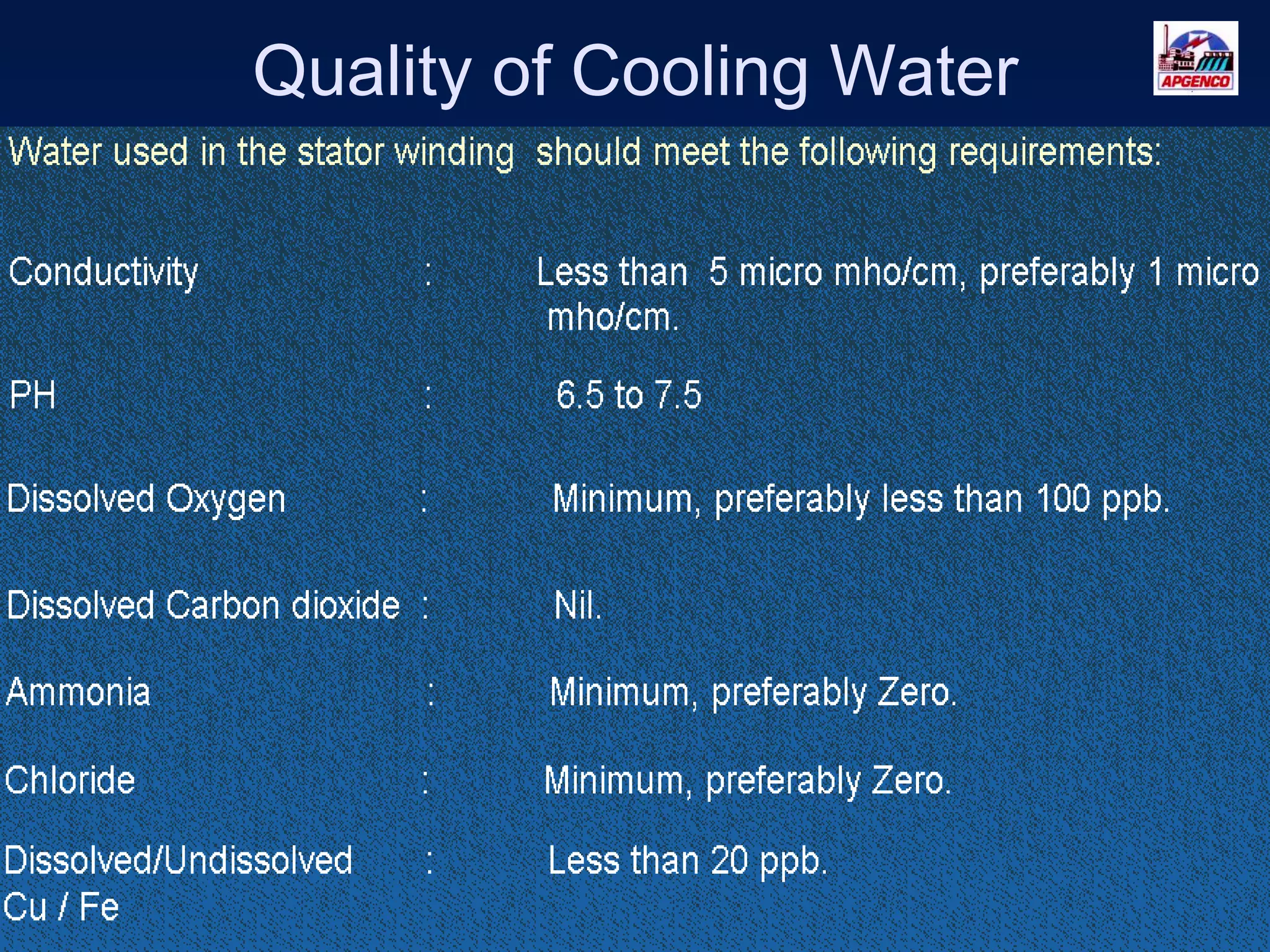
Quality of Cooling Water
210 MW GENERATOR
BRUSHLESS EXCITOR
TRIP LOGIC OF GENERATOR PROTECTION
• TWO INDEPENDENT CHANNELS WITH INDEPENDENT CT/VT
INPUTS/DC SUPPLY/TRIP RELAY
CLASS - A TRIPS
• ALL ELECTRICAL TRIP
• TRIP TURBINE , GENERATOR,GT,UT
CLASS - B TRIPS
• MECHANICAL TRIPS
• AVOID OVER SPEEDING OF TURBINE DUE TO STEAM ENTRAPPED
IN TURBINE. TURBINE TRIP SIGNAL IS GIVEN FIRST AND THE ACTIVE
POWER, SENSED BY THE LOW FORWARD RELAY (32G) GIVES THE
TRIP SIGNAL TO THE UNIT BREAKER & FIELD BREAKER AFTER A
TIME DELAY
CLASS - C TRIPS
• TRIPS ONLY HV CB IN CASE OF GCB SCHEME
220 KV SWITCH YARD
Electro
Mechanical Relays
Electro Mechanical Relays
SUMMARY
Stages Of Power Generation
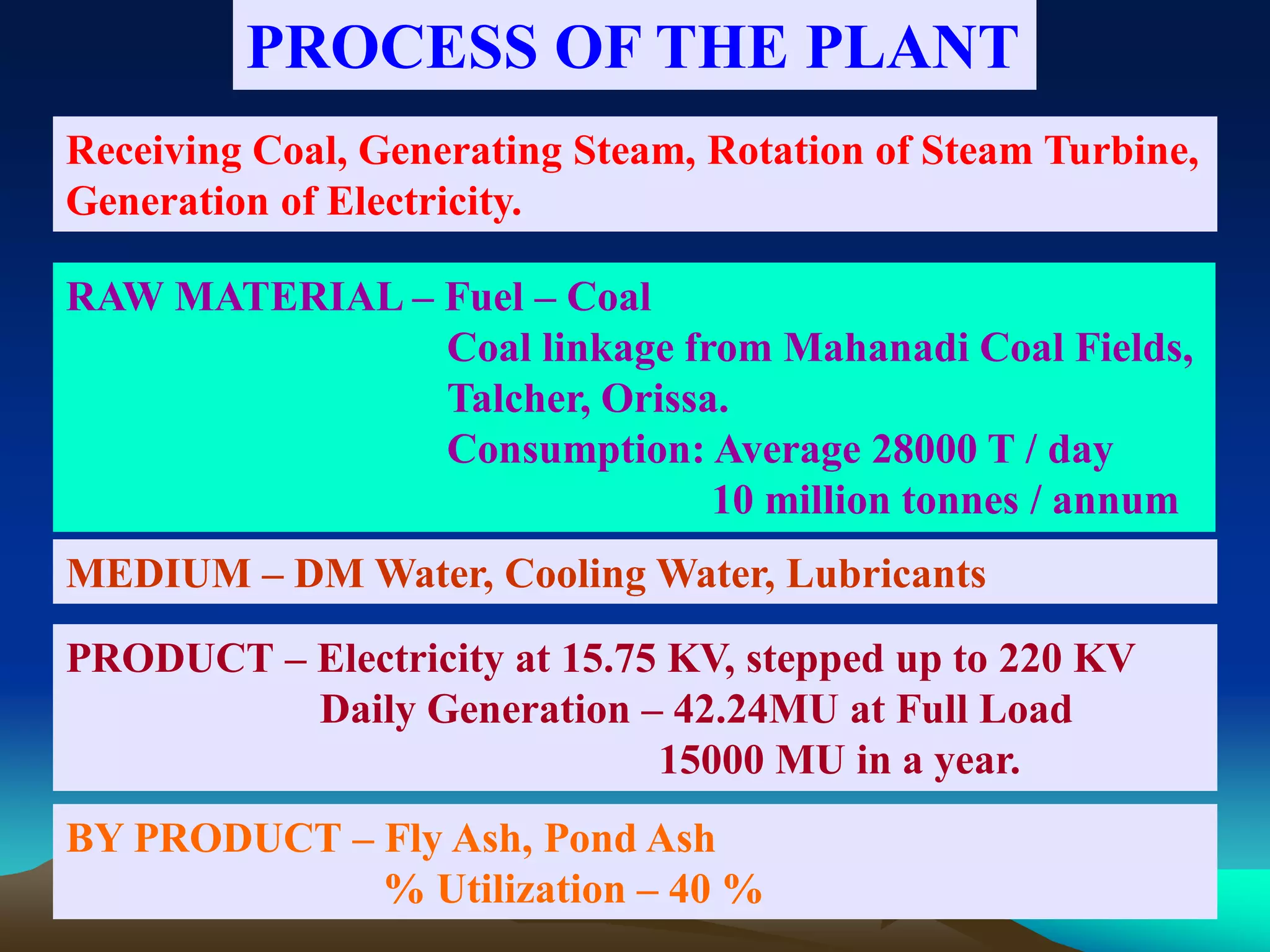
PROCESS OF THE PLANT
Receiving Coal, Generating Steam, Rotation of Steam Turbine,
Generation of Electricity.
RAW MATERIAL – Fuel – Coal
Coal linkage from Mahanadi Coal Fields,
Talcher, Orissa.
Consumption: Average 28000 T / day
10 million tonnes / annum
MEDIUM – DM Water, Cooling Water, Lubricants
PRODUCT – Electricity at 15.75 KV, stepped up to 220 KV
Daily Generation – 42.24MU at Full Load
15000 MU in a year.
BY PRODUCT – Fly Ash, Pond Ash
% Utilization – 40 %
166

Thermal power plants

  • 1.
    “Thermal Power Plants” By Dr.G.NageswaraRao Professor, EEE Department Lakireddy Bali Reddy College of Engineering Mylavaram, Krishna Dt, AP, India
  • 2.
    ENERGY RESOURCES • NonRenewable Energy Resources • Renewable Energy Resources
  • 4.
  • 6.
    THERMAL POWER PLANT(6Units, Each 210MW)
  • 7.
  • 9.
    THERMAL POWER PLANT (6Units, Each 210MW + 500MW), Installed Capacity=1,760MW
  • 10.
    STAGE NO. UNIT NO. INSTALLED CAPACITY DATE OF COMMISSIONING I1 2 210 MW 210 MW 01-11-1979 10-10-1980 II 3 4 210 MW 210 MW 05-10-1989 23-08-1990 III 5 6 210 MW 210 MW 31-03-1994 24-02-1995 IV 7 500 MW 29-01-2010 V 8 800 MW Under construction Works starts from July-2016 ,expected by 2020(4-years) The project was completed in Four stages, I,II, III & IV Stages. Consisting of two units of 210 MW each and iv stage by one unit thus the total capacity being 1760 MW.
  • 11.
    This session dividein to  Coal handling Plant  Boiler and its Auxiliaries  Turbine and its Auxiliaries  Common Auxiliaries  Generator Auxiliaries  Switch yard
  • 12.
    BLOCK DIAGRAM OFTHERMAL POWER PLANT WATER BOILER TURBINE GENERATOR COAL AIR STEAM
  • 14.
    COAL HANDLING PLANT(CHP) Wagon Tippler Crusher House Bunker
  • 15.
    Wagon Tippler Function :The wagon tippler is to tipple or unload the entire coal in to Conveyor belt through coal mesh grid. size of the mesh grid = 300mm X 300mm
  • 16.
  • 17.
    Wagon Tippler tipples/ un load the coal
  • 18.
    COAL UNLOADING USINGWAGON TIPPLER Wagon tippler tilt by 1500 angle
  • 19.
    COAL FROM MINES BeltConveyor Rollers
  • 20.
  • 21.
  • 22.
  • 23.
  • 24.
    •Receipt of Coalfro•Unloading of Coal •Coal Stacking & Reclamation
  • 25.
    Crusher House: In thisthe size of coal reduced from 300mm to 20mm size coal pieces with the help of ring rollers. Bunker: It is a conical shape container which receives the 20mm size coal pieces from crusher house. Its capacity 500MT. 6 Nos. bunkers for each 210 MW unit. Total coal required for 210MW = 3,000MT per day.
  • 26.
    Boiler Auxiliaries Boilers (Single pass& Two pass) Fans (PA Fan, FD Fan & ID Fan) Mills ( Bowl & Ball Mills) Air- Preheaters Electro static Precipitators ( ESP)
  • 27.
    Types of Boilers Basedon Media 1. Fire Tube Boilers. 2. Water Tube Boilers Based on Construction 1) Single pass boiler. 2) Two-pass Boiler.
  • 28.
    SINGLE - PASSBOILER. (TOWER TYPE BOILER) From BFP TO IPT TOWER TYPE BOILER DRUM BOTTOM RING HDR Economiser LTRH LTSH HTSH HTRH ITSH HANGER PLATEN TO HPT AFTER HPT
  • 29.
    TWO-PASS BOILER WATER WALLBOTTOM RING HEADER DRUM CRH IN REAR ROOF WATERINLET SH STEAM OUTLET EXTENDED WW FRONT ROOF HRH OUT S R Kannan, Sr Manager (R&D) LTSH Economiser
  • 30.
    HOW TO RECONGNISEGOOD COMBUSTION?  COLOUR OF FLAME AT BURNER ELEVATION OBSERVED THROUGH PEEP HOLES  COLOUR- PALE ORANGE WHILE ON COOL FIRING  FLAME 300 TO 400 mm AWAY FROM BURNER TIP.  FLAME TEMP. 1050 Deg.C TO 1150 Deg.C (AS MEASURED BY OPTICAL PYROMETER)
  • 31.
    Water Tube Boiler(Box Type ) Boiler Drum Water wall tube Peep Hole Coal feeding Furnace Area Super Heater Coils Bottom Ring Header Top Ring Header
  • 33.
    Types of Fans 1.PA Fan. 2. FD Fan. 3.ID Fan .
  • 34.
    Location of APH,ID Fan & FD Fan
  • 35.
    PA Fan Function: Theair supplied by the fan is called primary Air. The primary air is used to lift the pulverized coal in the mill to Furnace for combustion. FD Fan function: The air supplied by the FD fan is called Secondary Air. The Secondary air is used to combustion the pulverized coal effectively in the furnace zone . ID Fan function: It removes / suck the flue gasses from the furnace and exit the flue gasses to the atmosphere through the chimney .
  • 36.
    Types of Mills 1.Bowl Mills 2.Ball Mills
  • 37.
    Bowl Mill- Pulverizedcoal pipe lines(4 Nos.)
  • 38.
  • 39.
  • 40.
    BALL TUBE MILLS •These mills are manufactured as per STEIN, France design. • Type : BBD 4760 • BBD stands for Boyer’s Balls Direct. • 4760 stands for 4.7 meters inside diameter and 6.0 meter length of the Pulverizing zone. • These are also called horizontal mills as their axis of rotation is horizontal .
  • 41.
    Ball Mill 1.30mm &40mm & 50mm dia. Forged Steel round ball are loaded into Mill drum. 2. It will rotate at 15 rpm 3. Size of coal entered into drum is 20mm . 4. Due to impact & friction method 20mm size coal is crushed between the ball and getting pulverized coal power (74microns)
  • 42.
    SREW CONVEYOR The purposeof SREW CONVEYOR is to convey raw coal and balls into the mill and to convey Primary air through the center of the conveyor
  • 43.
  • 45.
    Pulverized Fuel Boiler Tangentialfiring Coal is pulverised to a fine powder, so that less than 2% is +300 microns, and 70-75% is below 75 microns. Coal is blown with part of the combustion air into the boiler plant through a series of burner nozzles. • Combustion takes place at temperatures from 1300-1700°C • Particle residence time in the boiler is typically 2-5 seconds • One of the most popular system for firing pulverized coal is the tangential firing using four burners corner to corner to create a fire ball at the center of the furnace. See Figure
  • 46.
    FURNACE We can seethe fire by opening the peep hole
  • 47.
  • 48.
    SCHEMATIC OF ATHERMAL POWER PLANT
  • 49.
    Thermal power StationBoiler •90% of coal-fired power boiler in the world is Pulverized ty
  • 50.
    Air Pre -Heater
  • 51.
  • 52.
    AIR PREHEATER Air preheater is an auxiliary equipment for steam generators. It is a heat exchanger that absorbs waste heat from exit flue gas in boiler and transfers the heat to the cold air. In utility and process boilers it is used to heat the air required for efficient combustion purpose, to drying the coal.
  • 54.
    Tri – SectorAir Heater
  • 55.
  • 56.
  • 57.
    Air pre –Heaters rotates at 3rpm
  • 58.
    Air pre –Heaters rotates at 3rpm
  • 60.
  • 61.
  • 62.
    Pressure part means “Inany closed vessel or container that contains pressure of more than 1kg / cm2 P > 1 Kg / cm2
  • 63.
    PRESSURE PARTS 1. Economizer 2.Super Heaters 3. Re-Heaters 4. Water Walls 5. Safety Walls 6. De-Super heaters and 7. Boiler Drum
  • 64.
    ECONOMISER FUNCTION: Increases the feedwater temperature by extracting the temperature from flue gases.
  • 65.
    SUPER HEATER FUNCTION: It increasesthe temperature of Main steam with the help of temperature of flue gases to get Saturated Steam admitted to the HPT.
  • 66.
    RE - HEATERS FUNCTION: Itheats the temperature of steam outlet from HPT with the help of Flue gas temperature.
  • 67.
    WATER WALLS FUNCTION: Water wallscarry feed water from ring headers to Boiler Drum through raiser tubes by natural Circulation.
  • 68.
    Box Type Design BoilerDrum Water wall tube Peep Hole Coal feeding Furnace Area Super Heater Coils Bottom Ring Header Top Ring Header
  • 69.
    SAFETY VALVES FUNCTION These areused to safe guard the equipment in case of emergencies.
  • 70.
    DE-SUPERHEATERS FUNCTION: It controls themain steam temperatures to safe limit.
  • 74.
    BOILER DRUM FUNCTION: • Itseparates the steam from steam-water mixture. • It houses all equipments used for purification of steam, after being separated from water.
  • 75.
    210MW - BoilerDrum Internals
  • 76.
  • 88.
  • 90.
    TYPE OF TURBINES STAGE– I Three cylinder, Tandem Compound, Impulse, Reheat and Condensing type with double flow in LP Turbine & Nozzle Governing STAGE – II & III Three cylinder, Tandem Compound, Reaction, Reheat and Condensing type with double flow in IP Turbine & LP Turbine and Throttle Governing STAGE – I V Three cylinder, Tandem Compound, Impulse, Reheat and Condensing type with double flow in LP Turbine & Nozzle Governing with TDBFP
  • 91.
    •High Pressure Turbine •InnerCasing •I n l e t •Outer Casing-Barrel type •Exhaust
  • 92.
  • 93.
  • 94.
    210 MW LMWTurbine
  • 95.
    Turbine video 8-STEAM ANDWATER CYCLE OF 210 MW (LMW TURBINE ) UNIT.pps
  • 96.
    TECHNICAL DETAILS STAGE –I STAGE – II & III Stage-IV BOILER DESIGN Combustion Engg., USA Steins, Germany Steins, Germany BOILER MAKE BHEL BHEL BHEL CAPACITY 700 TPH 690 TPH 1625 TPH STEAM Pr. 135 Kg / cm2 154.1 Kg / cm2 175.5 Kg / cm2 STEAM Temp. 5400 C 5400 C 5400 C TURBINE DESIGN LMW, RUSSIAN KWU, GERMANY KWU, GERMANY TURBINE MAKE BHEL BHEL BHEL
  • 97.
    Specification of Turbines Turbinemain Data Unit LMW KWU • Rated output MW 210 210 • Rated speed rpm 3000 3000 • M.S.pressure Kg/cm2 130 150 • M.S.Temperature 0C 535 535 • Reheat pressure/ temp Kg/cm2/ 0C 24.49/535 34.8/535 • Total steam flow at 210 mw t/h 652 636 • Steam flow thro. LPT t/h 565 504 • Steam flow thro. LPT to condenser t/h 450 443.3 • Sp. heat rate of turbine Kcal/KWh 2040 1993 • Rated efficiency of turbine % 42.15 43.15 • No.of bearings no. 5 4 • C W flow t/h 27000 30600 • Condenser surface area m2 14600 14000 • No tubes no. 15620 23934 • Tube ID, Thickness mm 29/1 17/1 • Extraction pressure/flow HPH-7 Kg/cm2 , t/h 42, 34 ------ • Extraction pressure/flow HPH-6 Kg/cm2 , t/h 26, 45 38.5, 57.2 • Extraction pressure/flow HPH-5 Kg/cm2 , t/h 13, 17.5 16, 35.2 • Extraction pressure/flow - 4 Kg/cm2 , t/h 7, 22 6.6, 34.8 • Extraction pressure/flow LPH-3 Kg/cm2 , t/h 3, 25 2.3, 27.6 • Extraction pressure/flow LPH-2 Kg/cm2 , t/h 1.4, 26 0.8, 30.2 • Extraction pressure/flow LPH-1 Kg/cm2 , t/h Vac, 13 0.2, 3.42
  • 98.
  • 99.
    ENERGY TRANSFORMATION MECH ENERGY OF TURBINETO ELECTRICAL ENERGY IN GENERATOR HIGH PRESSURE STEAM KINETIC ENERGY TO MECH. ENERGY IN TURBINE
  • 100.
    VIDEO3-▶ How doesa Thermal Power Plant Work.mp4
  • 101.
    Ash collection points Generallyash will be collected by the following locations. 1) Ash collected at Bottom Ashing. ( Moderately) 2) Ash collected at ESP Hoppers.( Major portion) 3) Ash collected at Duct Hoppers. 4) Ash collected at APH Hoppers. 5) Ash collected at Economizer Hoppers. 6) Ash collected at Scraper conveyors. 7) Stack hoppers 8) Common ash slurry sluice way trench)Ash pump house 10) Ash disposal lines 11) Ash pond
  • 102.
    Bottom Ashing Ash collectedat the bottom of boiler Ash collected at Scrapper conveyor
  • 103.
  • 104.
    Bottom Ashing Wet Ashremoving Clinkers fall down on clinker grinder clinker grinder
  • 105.
    ESP & DuctHoppers
  • 106.
  • 107.
    Ash loading pointsAsh loading points
  • 108.
    Ash Pond Ash DisposalLines Ash Pond Area Decanting well
  • 109.
    Ash Pond Wet Ashloading process Seepage pits Decanting process
  • 110.
  • 111.
    Fly Ash Utilization 1.Earth Works: Embankments, Backfills, Highways- Base and Sub base, Soil stabilization, Structural Fills. 2. Buildings: Pozzalona Cement, Bricks Blocks, Slabs and Walls Panels, Concrete, Grouts. 3. Agriculture: Soil Conditioning, Manufacture of Fertilizers.
  • 112.
    TotalHeatinput100% Heat Loss inFlue gas ~5% Losses in boiler and piping ~8% Losses in Turbine, Generator and Transformer ~4% Condenser cooling water rejection ~45% Unit self consumption ~3% NetavailableEnergy~35% Energy Distribution
  • 114.
    TYPE OF GENERATORS STAGE– I Alternator with Cylindrical rotor, Static excitation, 3-Phase Double Star Winding, Water & Hydrogen cooled STAGE – II , III & IV Alternator with Cylindrical rotor, Brush less excitation, 3-Phase Double Star Winding, Hydrogen cooled
  • 115.
  • 116.
    TURBO GENERATOR • Themain parts of a Turbo Generator are STATOR and ROTOR. • Detailed constructional features • STATOR BODY:  Stator body is a robust totally enclosed gas tight fabricated structure. Designed mechanically to withstand high internal pressure of explosion of Hydrogen –Air mixture Hydrogen gas coolers are housed longitudinally inside the stator body The end shields are made in 2 halves for ease in assembly
  • 117.
    TURBO GENERATOR • STATORCORE:  Made up of segmental, varnished insulated punchings of CRGO silicon steel laminations  Built in several packets separated by steel spacers for radial cooling of the core by Hydrogen  Pressing of the core stampings is done to ensure monolithic core  Core is held firmly by means of Heavy Non – Magnetic Steel press rings bolted thoroughly with the ends of core bars
  • 118.
  • 119.
    TURBO GENERATOR STATOR WINDING: Three phase, double layer short chorded bar type windings with two parallel paths  Each coil consists of glass insulated solid and hollow conductors  The elementary conductors are transposed in the slot portion to minimize eddy losses.  Coils are held in the slots firmly in the slots by fibrous wedges.  Overhang portion is securely tied with glass cord to binding rings and special Non-Magnetic brackets
  • 120.
  • 121.
    TURBO GENERATOR • DistillateHeaders:  Two Copper ring type water headers are provided for both inlet and outlet of the Stator winding on the Turbine end  The winding ends are solidly soldered into the coil lugs which pass ultrasonic test  Each individual bar is connected with PTFE hose which in-turn are connected to ring header  The water circuit is subjected to Hydraulic test at various stages to ensure water tight
  • 122.
    TURBO GENERATOR • TERMINALBUSHINGS  Porcelain insulators are provided to insulate the terminal bars from the stator body  Terminal bushings are situated in the lower part of the stator casing (Slip ring side)  Sealing is provided between bushings and stator body to avoid any possibility of leakage of Hydrogen gas  Three phase and six Neutral bushings are available.
  • 123.
    TURBO GENERATOR • ROTOR The rotor shaft is a forged from one single piece from Chromium, Nickel, Molybdenum and Vanadium steel.  It undergoes all types of series of mechanical tests to ensure any internal flaws.  Rotor is dynamically balanced to a high degree of accuracy.
  • 124.
  • 125.
    TURBO GENERATOR Field winding: Field winding is made up of hard drawn silver bearing copper.  It is held in position against centrifugal forces by means of duralumin wedges in the slot portion  Overhang portion is held by the non-magnetic steel retaining ring.  Several ventilating ducts are milled on the slots for Hydrogen gas cooling of the rotor.  Copper segmental type damper winding is provided to prevent overheating of retaining rings
  • 126.
    TURBO GENERATOR Shaft MountedFans  For circulating the Hydrogen gas inside the Turbo Generator two propeller type fans are mounted on either sides of the rotor shaft  Alloy steel cast fan blades are machined in the tail portion with special profile  Fan shields are fixed to the end shields to guide the flow of Hydrogen gas
  • 127.
    TURBO GENERATOR RETAINING RINGS End windings are held intact against centrifugal forces by retaining rings machined from stress free, heat treated non-magnetic alloy steel.  Retaining rings are shrunk fitted on the rotor body.  Centering rings mounted at the end of retaining rings support and prevent the movement of rotor winding in axial direction.
  • 128.
    CROSS SECTIONAL VIEWOF TURBO GENERATOR Stator Winding ROTOR RET RING Seal Rings Bushings Gas cooler
  • 129.
    TURBO GENERATOR SLIP RINGS Helically grooved alloy steel rings are shrunk on the rotor.  Both the rings are mounted on a common single steel bush which has an insulating jacket.  Radial holes are made on the slip rings for fixing Current Carrying Bolts.  Slip rings are connected to the field winding thru semi flexible copper leads.
  • 130.
    TURBO GENERATOR BRUSH GEAR Brush gear is provided on the extended part of the bearing pedestal on the excitation side.  Brush holders are fixed on the brass rings in such a way to provide staggering of the brushes along the circumference of the ring.  Brushes are loaded with contact pressure which can be adjusted individually.  Brushes can be replaced easily during normal running condition.
  • 131.
    TURBO GENERATOR GAS COOLERS Four numbers gas coolers are mounted longitudinally inside the TG stator body.  Gas coolers consist of cooling tubes made out of brass and coiled copper wire is wound to increase the surface area of cooling.  Cooling water flows thru the tubes (inside) and hot Hydrogen across the cooler surface thereby taking away the heat from the gas.
  • 132.
    TURBO GENERATOR SHAFT SEALS Shaft seals are provided in order to prevent Hydrogen escape from the TG casing along the rotor shaft.  Seal oil (pressurized) is a used to seal Hydrogen gas escape.  The shaft seals are radial thrust type and are mounted between end shield and the bearing at either ends of the Rotor.
  • 134.
    HISTORY OF GENERATORS Electro-MagneticInduction principle enunciated by Sir Micheal Farady 1831. First AC Turbo –Generator was developed by Sir Charles A Parsons 1888. First 3 phase generator, salient pole 1900. First turbo type 3 phase 25 MW generator 1912. CEA, UK made 50 HZ as standard frequency for Europe 1925. First Hydrogen cooled 3 phase 30 MW generator 1937. First Hydrogen cooled TG with direct cooling of rotor 1949. First generator with water cooled stator winding 1956. First generator with water cooling for stator and rotor winding 1959.
  • 135.
  • 140.
    210 MW TurboGenerator losses
  • 141.
  • 142.
  • 143.
    Closed cycle Aircooled Generators
  • 144.
    Advantages of closedcircuit Air cooled Generators
  • 145.
  • 146.
  • 147.
    Stator water coolingsystem TURBINE SIDE TEFLON HOSE OUTLET HEADER INLET HEADER
  • 149.
    ROTOR BODY WITHCROSS-POLE SLOTS
  • 150.
  • 151.
  • 158.
    TRIP LOGIC OFGENERATOR PROTECTION • TWO INDEPENDENT CHANNELS WITH INDEPENDENT CT/VT INPUTS/DC SUPPLY/TRIP RELAY CLASS - A TRIPS • ALL ELECTRICAL TRIP • TRIP TURBINE , GENERATOR,GT,UT CLASS - B TRIPS • MECHANICAL TRIPS • AVOID OVER SPEEDING OF TURBINE DUE TO STEAM ENTRAPPED IN TURBINE. TURBINE TRIP SIGNAL IS GIVEN FIRST AND THE ACTIVE POWER, SENSED BY THE LOW FORWARD RELAY (32G) GIVES THE TRIP SIGNAL TO THE UNIT BREAKER & FIELD BREAKER AFTER A TIME DELAY CLASS - C TRIPS • TRIPS ONLY HV CB IN CASE OF GCB SCHEME
  • 159.
  • 160.
  • 163.
  • 164.
    PROCESS OF THEPLANT Receiving Coal, Generating Steam, Rotation of Steam Turbine, Generation of Electricity. RAW MATERIAL – Fuel – Coal Coal linkage from Mahanadi Coal Fields, Talcher, Orissa. Consumption: Average 28000 T / day 10 million tonnes / annum MEDIUM – DM Water, Cooling Water, Lubricants PRODUCT – Electricity at 15.75 KV, stepped up to 220 KV Daily Generation – 42.24MU at Full Load 15000 MU in a year. BY PRODUCT – Fly Ash, Pond Ash % Utilization – 40 %
  • 165.