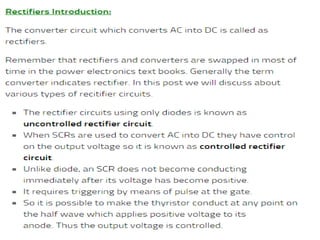
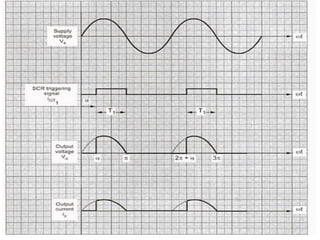
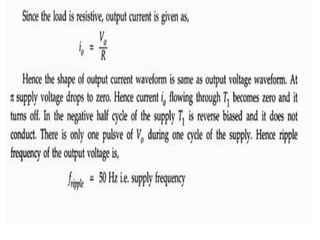
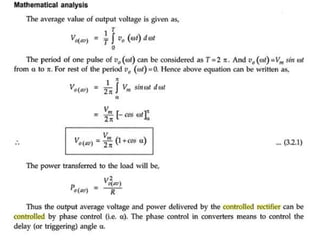
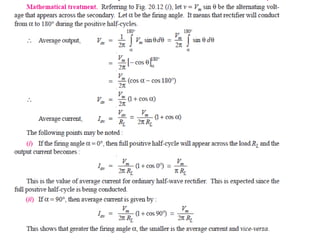
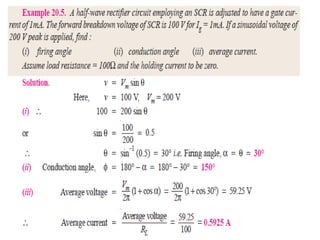
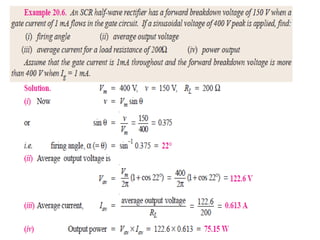
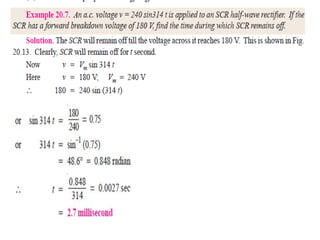
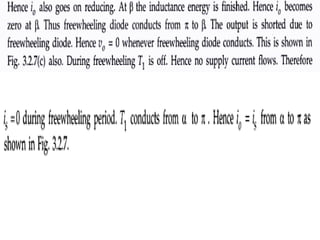
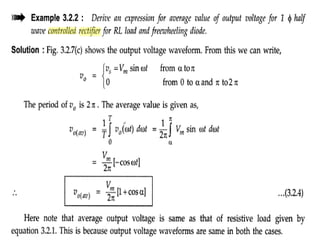
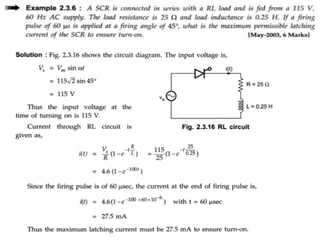
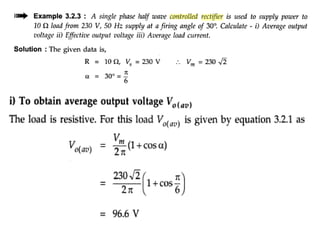
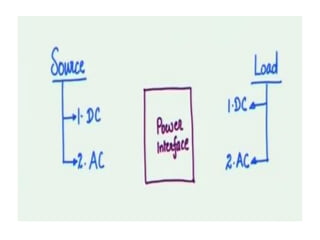
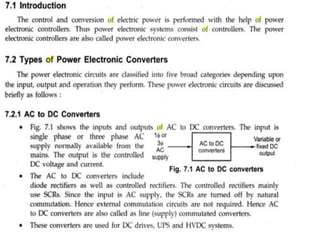
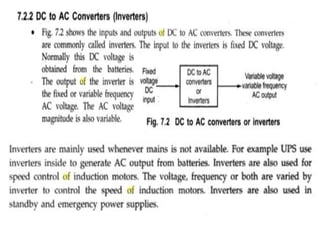
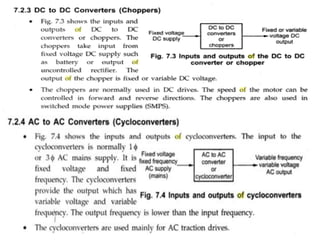
Uncontrolled & controlled
Rectifiers
Engr. Jahangeer badar soomro
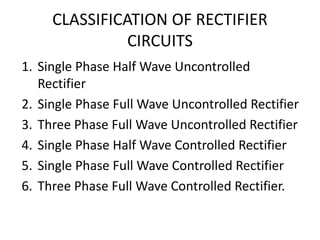
CLASSIFICATION OF RECTIFIER
CIRCUITS
1. Single Phase Half Wave Uncontrolled
Rectifier
2. Single Phase Full Wave Uncontrolled Rectifier
3. Three Phase Full Wave Uncontrolled Rectifier
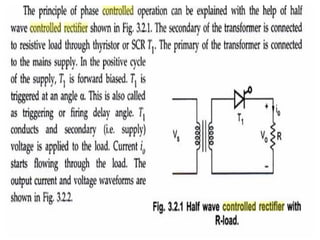
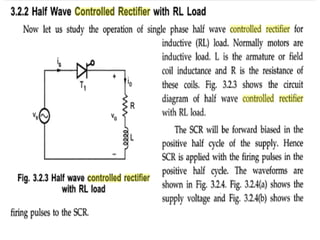
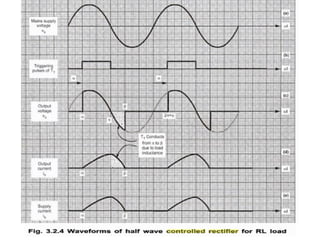
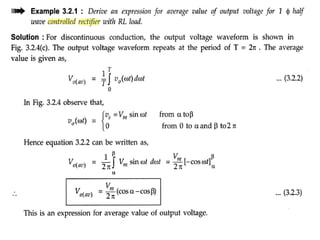
4. Single Phase Half Wave Controlled Rectifier
5. Single Phase Full Wave Controlled Rectifier
6. Three Phase Full Wave Controlled Rectifier.
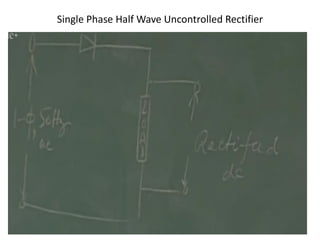
Single Phase Half Wave Uncontrolled Rectifier
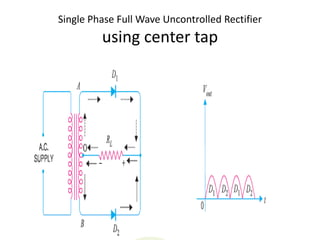
Single Phase Full Wave Uncontrolled Rectifier
using center tap
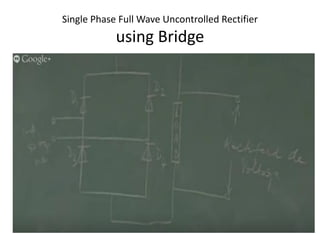
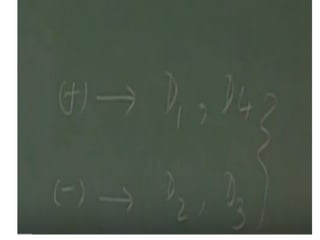
Single Phase Full Wave Uncontrolled Rectifier
using Bridge
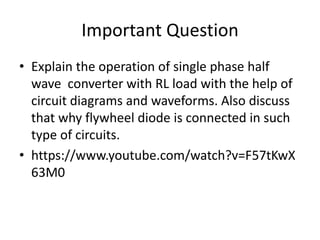
Important Question
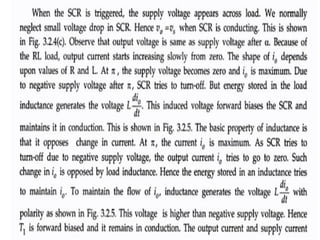
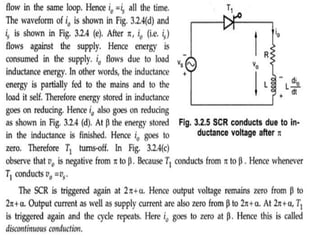
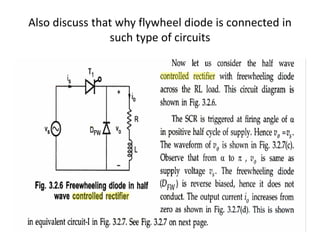
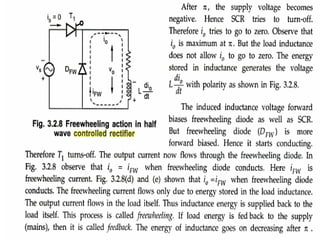
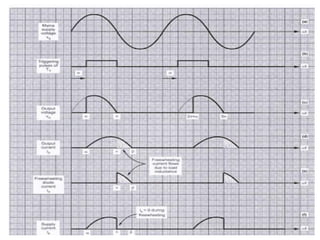
• Explain the operation of single phase half
wave converter with RL load with the help of
circuit diagrams and waveforms. Also discuss
that why flywheel diode is connected in such
type of circuits.
• https://www.youtube.com/watch?v=F57tKwX
63M0
Also discuss that why flywheel diode is connected in
such type of circuits
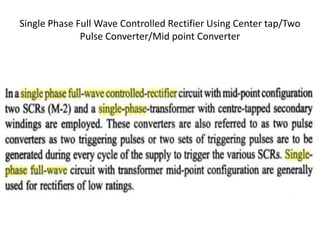
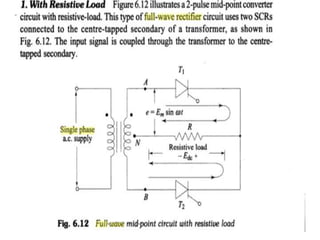
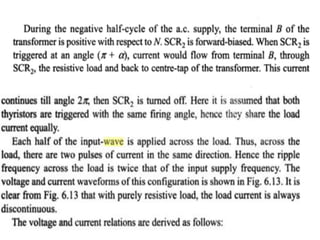
Single Phase Full Wave Controlled Rectifier Using Center tap/Two
Pulse Converter/Mid point Converter
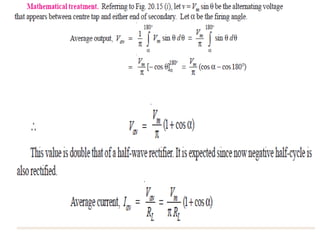
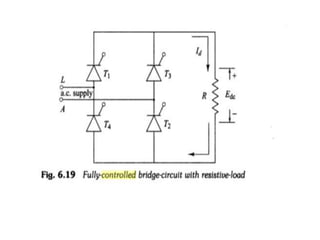
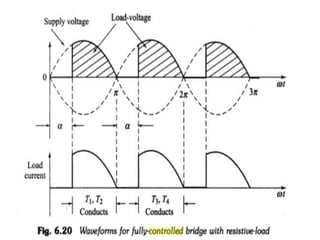
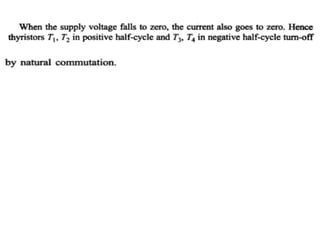
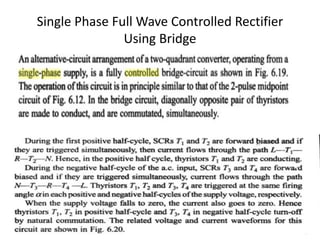
Single Phase Full Wave Controlled Rectifier
Using Bridge
Single Phase Full Wave Controlled Rectifier
Using Bridge
• You guys now know very well about this circuit
that how it will operate.
• This is our today lab.
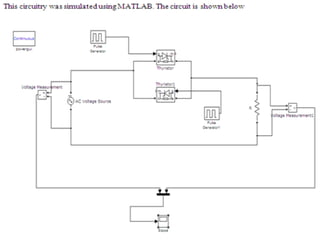
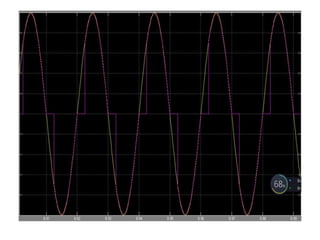
• Design this circuit in MATLAB. And show the
satisfactory results.
Three Phase Full Wave Uncontrolled Rectifier
• https://www.youtube.com/watch?v=Ij9aCSC8
QBY
• It is your assignment to cover three phase
uncontrolled rectifier from this video.
• Very easily explained and informative.
• You must listen this video.
Three Phase Full Wave controlled Rectifier
• https://www.youtube.com/watch?v=Ij9aCSC8
QBY
• It is your assignment to cover three phase
controlled rectifier from this video.
• Very easily explained and informative.
• You must listen this video.
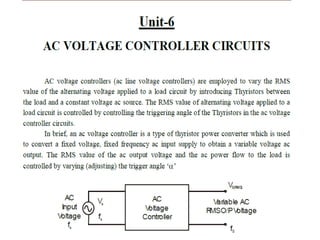
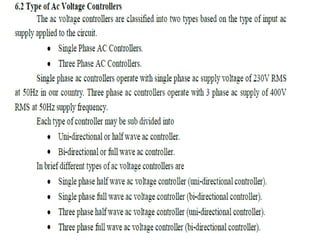
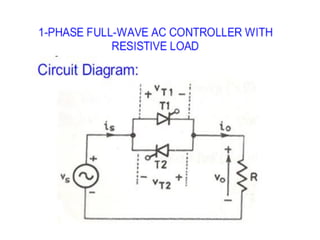
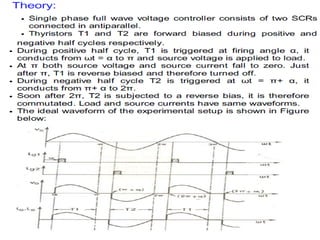
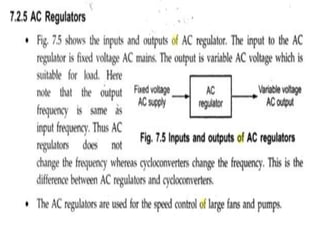
AC VOLTAGE
CONTROLLER/REGULATOR.
ENGR.JAHANGEER BADAR
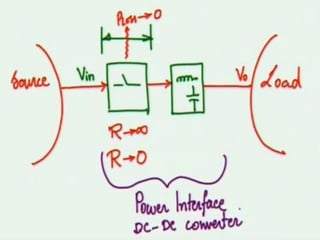
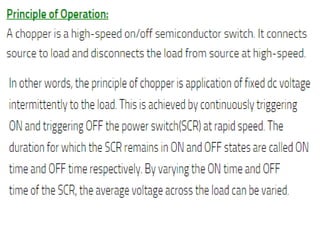
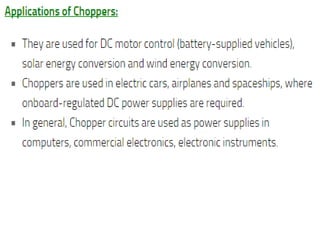
DC TO DC CONVERTER
OR
CHOPPER
ENGR. JAHANGEER BADAR SOOMRO
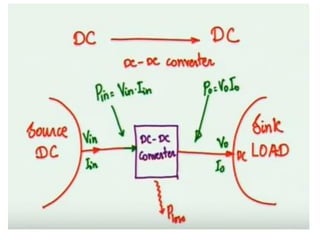
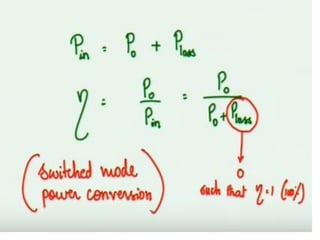
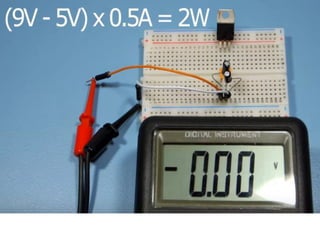
Efficiency & Power Losses
• Efficiency is a good measure of the success of a given
converter technology.
• With very small amount of power lost, the converter
elements can be packaged with high density, leading to a
converter of small size and weight, and of low temperature
rise.
• How can we build a circuit that changes the voltage, yet
dissipates negligible power?
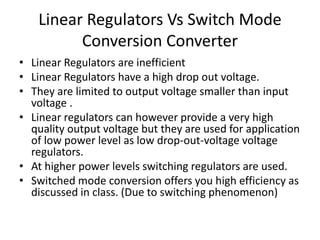
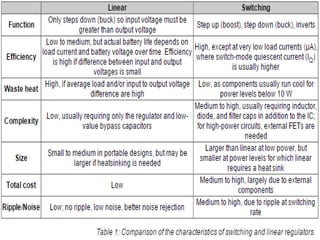
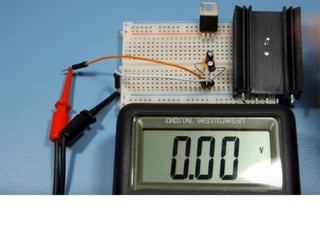
Linear Regulators Vs Switch Mode
Conversion Converter
• Linear Regulators are inefficient
• Linear Regulators have a high drop out voltage.
• They are limited to output voltage smaller than input
voltage .
• Linear regulators can however provide a very high
quality output voltage but they are used for application
of low power level as low drop-out-voltage voltage
regulators.
• At higher power levels switching regulators are used.
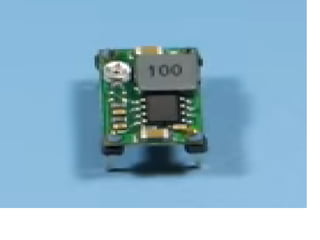
• Switched mode conversion offers you high efficiency as
discussed in class. (Due to switching phenomenon)
Linear Regulators Vs Switch Mode
Conversion Converter
• A 7 minute video comparing beautifully linear
regulator vs switch mode conversion
converter.
• https://www.youtube.com/watch?v=giGRrOD
KJSE
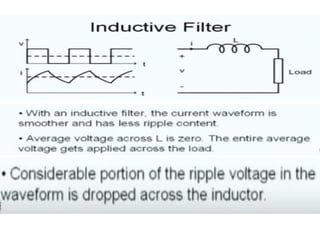
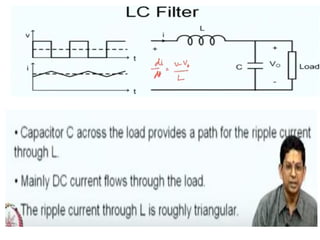
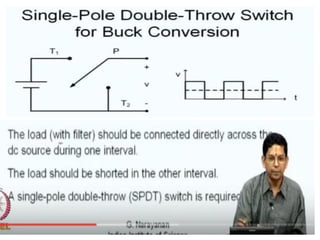
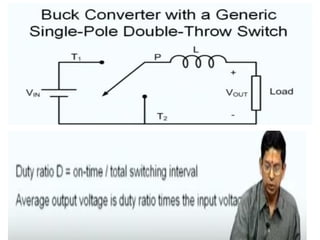
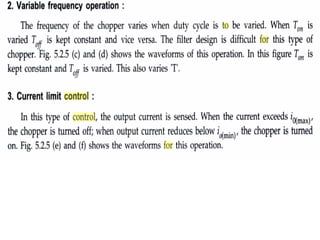
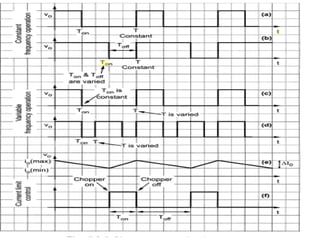
Principle of Step Down
Chopper
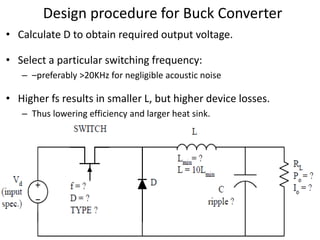
Design procedure for Buck Converter
• Calculate D to obtain required output voltage.
• Select a particular switching frequency:
– –preferably >20KHz for negligible acoustic noise
• Higher fs results in smaller L, but higher device losses.
– Thus lowering efficiency and larger heat sink.
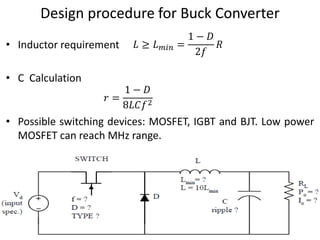
Design procedure for Buck Converter
• Inductor requirement
• C Calculation
• Possible switching devices: MOSFET, IGBT and BJT. Low power
MOSFET can reach MHz range.
𝑟 =
1 − 𝐷
8𝐿𝐶𝑓2
𝐿 ≥ 𝐿 𝑚𝑖𝑛 =
1 − 𝐷
2𝑓
𝑅
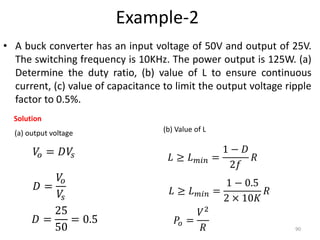
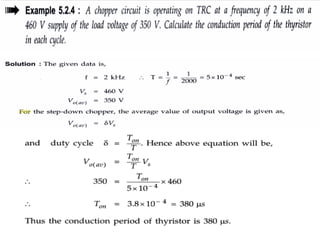
Example-2
• A buck converter has an input voltage of 50V and output of 25V.
The switching frequency is 10KHz. The power output is 125W. (a)
Determine the duty ratio, (b) value of L to ensure continuous
current, (c) value of capacitance to limit the output voltage ripple
factor to 0.5%.
90
Solution
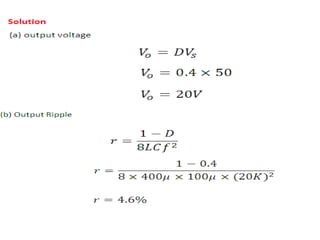
(a) output voltage
𝑉𝑜 = 𝐷𝑉𝑠
(b) Value of L
𝐷 =
𝑉𝑜
𝑉𝑠
𝐷 =
25
50
= 0.5
𝐿 ≥ 𝐿 𝑚𝑖𝑛 =
1 − 𝐷
2𝑓
𝑅
𝐿 ≥ 𝐿 𝑚𝑖𝑛 =
1 − 0.5
2 × 10𝐾
𝑅
𝑃𝑜 =
𝑉2
𝑅
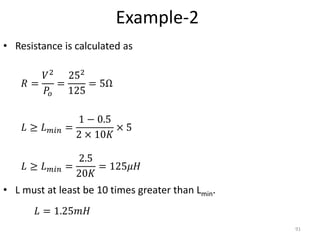
Example-2
• Resistance is calculated as
• L must at least be 10 times greater than Lmin.
91
𝑅 =
𝑉2
𝑃𝑜
=
252
125
= 5Ω
𝐿 ≥ 𝐿 𝑚𝑖𝑛 =
1 − 0.5
2 × 10𝐾
× 5
𝐿 ≥ 𝐿 𝑚𝑖𝑛 =
2.5
20𝐾
= 125𝜇𝐻
𝐿 = 1.25𝑚𝐻
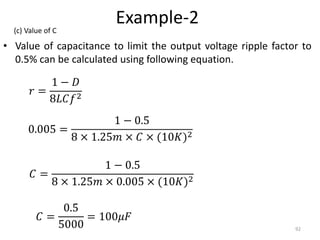
Example-2
• Value of capacitance to limit the output voltage ripple factor to
0.5% can be calculated using following equation.
92
(c) Value of C
𝑟 =
1 − 𝐷
8𝐿𝐶𝑓2
0.005 =
1 − 0.5
8 × 1.25𝑚 × 𝐶 × (10𝐾)2
𝐶 =
1 − 0.5
8 × 1.25𝑚 × 0.005 × (10𝐾)2
𝐶 =
0.5
5000
= 100𝜇𝐹
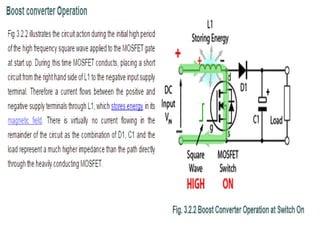
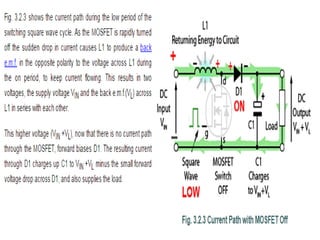
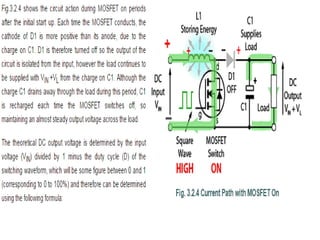
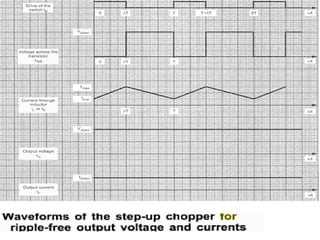
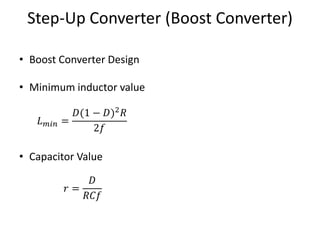
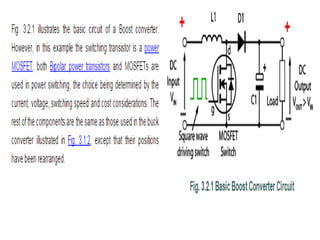
Step-Up Converter (Boost Converter)
• Boost Converter Design
• Minimum inductor value
• Capacitor Value
𝐿 𝑚𝑖𝑛 =
𝐷(1 − 𝐷)2
𝑅
2𝑓
𝑟 =
𝐷
𝑅𝐶𝑓
http://www.learnabout-
electronics.org/PSU/psu33.php
Buck-Boost Converter
Please refer to following link for excellent
material on buck-boost.
Concept Of Commutation
Engr. Jahangeer Badar Soomeo
Power Converters
Engr. Jahangeer Badar Soomro
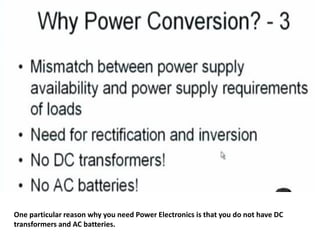
One particular reason why you need Power Electronics is that you do not have DC
transformers and AC batteries.
DC TO AC CONVERTER
OR
IINVERTER
ENGR.JAHANGEER BADAR
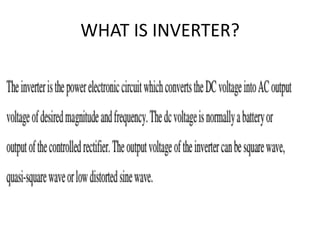
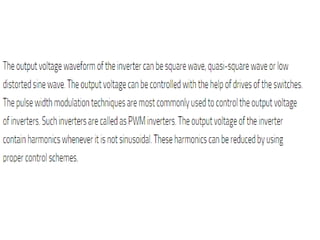
WHAT IS INVERTER?
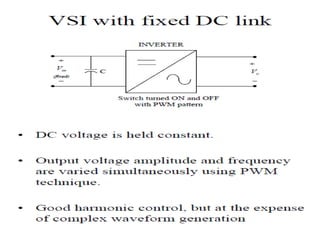
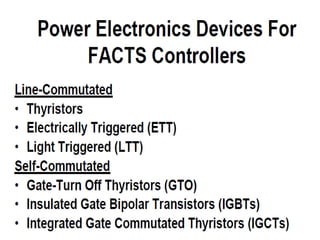
• Thyristor based inverters are used for high
power applications.
• For low and medium power inverters fully
controlled devices such as Power BJT and
Power Mosfet, IGBT, GTO, SIT are used. In
addition to having fully controlled these
devices high switching frequencies.
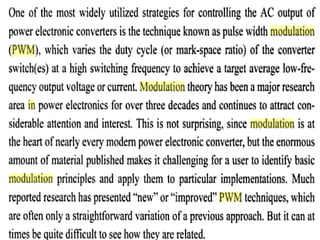
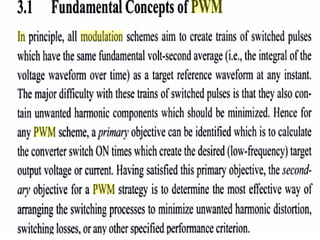
• Therefore these devices may be employed
very efficiently in inverters where the output
voltage is controlled using PWM techniques.
TYPICAL APPLICATIONS
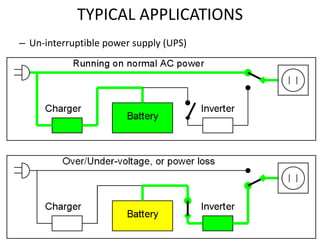
– Un-interruptible power supply (UPS)
146
TYPICAL APPLICATIONS
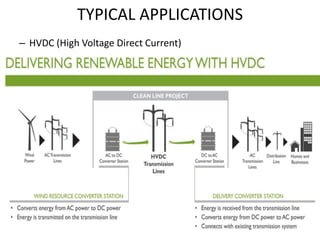
– HVDC (High Voltage Direct Current)
147
Types of Inverters
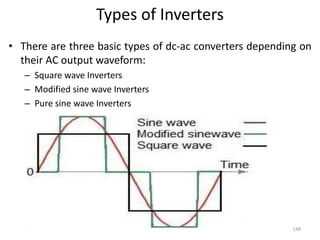
• There are three basic types of dc-ac converters depending on
their AC output waveform:
– Square wave Inverters
– Modified sine wave Inverters
– Pure sine wave Inverters
148
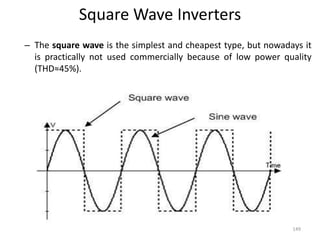
Square Wave Inverters
– The square wave is the simplest and cheapest type, but nowadays it
is practically not used commercially because of low power quality
(THD≈45%).
149
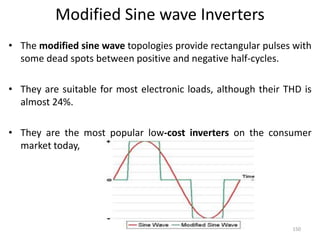
Modified Sine wave Inverters
• The modified sine wave topologies provide rectangular pulses with
some dead spots between positive and negative half-cycles.
• They are suitable for most electronic loads, although their THD is
almost 24%.
• They are the most popular low-cost inverters on the consumer
market today,
150
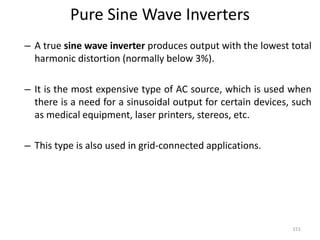
Pure Sine Wave Inverters
– A true sine wave inverter produces output with the lowest total
harmonic distortion (normally below 3%).
– It is the most expensive type of AC source, which is used when
there is a need for a sinusoidal output for certain devices, such
as medical equipment, laser printers, stereos, etc.
– This type is also used in grid-connected applications.
151
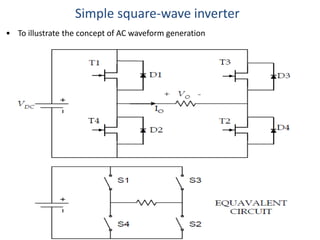
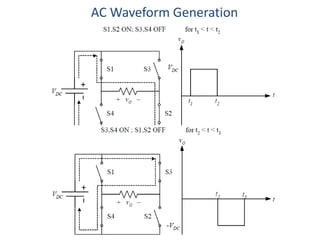
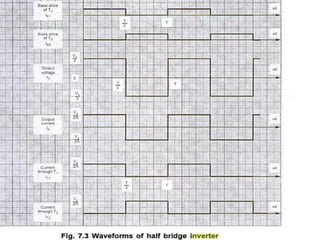
Simple square-wave inverter
• To illustrate the concept of AC waveform generation
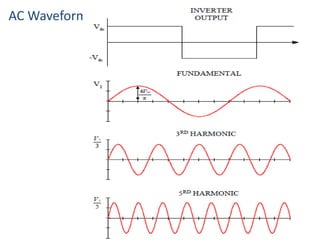
AC Waveform Generation
AC Waveforms
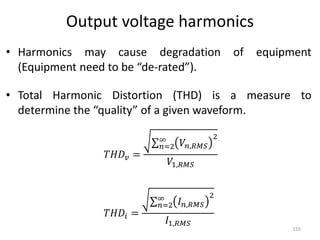
Output voltage harmonics
• Harmonics may cause degradation of equipment
(Equipment need to be “de-rated”).
• Total Harmonic Distortion (THD) is a measure to
determine the “quality” of a given waveform.
155
𝑇𝐻𝐷𝑣 =
𝑛=2
∞
𝑉𝑛,𝑅𝑀𝑆
2
𝑉1,𝑅𝑀𝑆
𝑇𝐻𝐷𝑖 =
𝑛=2
∞
𝐼 𝑛,𝑅𝑀𝑆
2
𝐼1,𝑅𝑀𝑆
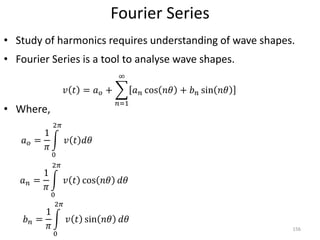
Fourier Series
• Study of harmonics requires understanding of wave shapes.
• Fourier Series is a tool to analyse wave shapes.
• Where,
156
𝑣 𝑡 = 𝑎 𝑜 +
𝑛=1
∞
𝑎 𝑛 cos 𝑛𝜃 + 𝑏 𝑛 sin 𝑛𝜃
𝑎 𝑛 =
1
𝜋
0
2𝜋
𝑣 𝑡 cos 𝑛𝜃 𝑑𝜃
𝑏 𝑛 =
1
𝜋
0
2𝜋
𝑣 𝑡 sin 𝑛𝜃 𝑑𝜃
𝑎 𝑜 =
1
𝜋
0
2𝜋
𝑣 𝑡 𝑑𝜃
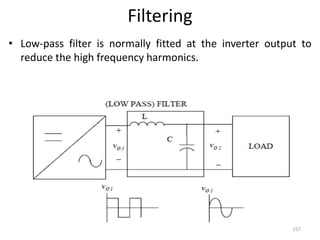
Filtering
• Low-pass filter is normally fitted at the inverter output to
reduce the high frequency harmonics.
157
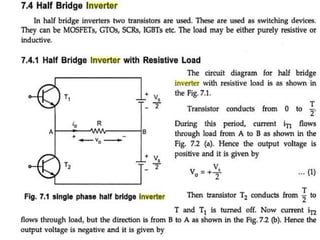
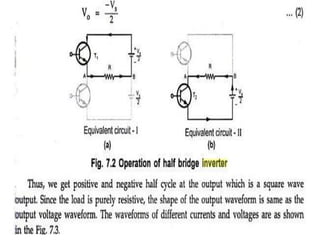
1-∅ Voltage source Inverters
• Single phase voltage source inverters are of
two types.
– Single Phase Half Bridge voltage source inverters
– Single Phase full Bridge voltage source inverters
158
CycloConverter
Engr. Jahangeer Badar Soomro
Power Transistors & Power
MOSFETS
Engr. Jahangeer Badar Soomro
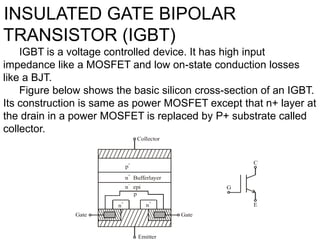
INSULATED GATE BIPOLAR
TRANSISTOR (IGBT)
IGBT is a voltage controlled device. It has high input
impedance like a MOSFET and low on-state conduction losses
like a BJT.
Figure below shows the basic silicon cross-section of an IGBT.
Its construction is same as power MOSFET except that n+ layer at
the drain in a power MOSFET is replaced by P+ substrate called
collector.
n epi

n Bufferlayer

p

p
n

n

Gate Gate
Emitter
Collector
G
E
C
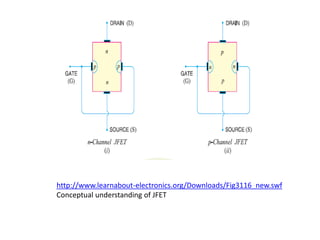
http://www.learnabout-electronics.org/Downloads/Fig3116_new.swf
Conceptual understanding of JFET
power electronics(ii)

power electronics(ii)

  • 1.
  • 3.
    CLASSIFICATION OF RECTIFIER CIRCUITS 1.Single Phase Half Wave Uncontrolled Rectifier 2. Single Phase Full Wave Uncontrolled Rectifier 3. Three Phase Full Wave Uncontrolled Rectifier 4. Single Phase Half Wave Controlled Rectifier 5. Single Phase Full Wave Controlled Rectifier 6. Three Phase Full Wave Controlled Rectifier.
  • 4.
    Single Phase HalfWave Uncontrolled Rectifier
  • 5.
    Single Phase FullWave Uncontrolled Rectifier using center tap
  • 6.
    Single Phase FullWave Uncontrolled Rectifier using Bridge
  • 17.
    Important Question • Explainthe operation of single phase half wave converter with RL load with the help of circuit diagrams and waveforms. Also discuss that why flywheel diode is connected in such type of circuits. • https://www.youtube.com/watch?v=F57tKwX 63M0
  • 23.
    Also discuss thatwhy flywheel diode is connected in such type of circuits
  • 31.
    Single Phase FullWave Controlled Rectifier Using Center tap/Two Pulse Converter/Mid point Converter
  • 38.
    Single Phase FullWave Controlled Rectifier Using Bridge
  • 42.
    Single Phase FullWave Controlled Rectifier Using Bridge • You guys now know very well about this circuit that how it will operate. • This is our today lab. • Design this circuit in MATLAB. And show the satisfactory results.
  • 43.
    Three Phase FullWave Uncontrolled Rectifier • https://www.youtube.com/watch?v=Ij9aCSC8 QBY • It is your assignment to cover three phase uncontrolled rectifier from this video. • Very easily explained and informative. • You must listen this video.
  • 44.
    Three Phase FullWave controlled Rectifier • https://www.youtube.com/watch?v=Ij9aCSC8 QBY • It is your assignment to cover three phase controlled rectifier from this video. • Very easily explained and informative. • You must listen this video.
  • 45.
  • 55.
    DC TO DCCONVERTER OR CHOPPER ENGR. JAHANGEER BADAR SOOMRO
  • 59.
    Efficiency & PowerLosses • Efficiency is a good measure of the success of a given converter technology. • With very small amount of power lost, the converter elements can be packaged with high density, leading to a converter of small size and weight, and of low temperature rise. • How can we build a circuit that changes the voltage, yet dissipates negligible power?
  • 76.
    Linear Regulators VsSwitch Mode Conversion Converter • Linear Regulators are inefficient • Linear Regulators have a high drop out voltage. • They are limited to output voltage smaller than input voltage . • Linear regulators can however provide a very high quality output voltage but they are used for application of low power level as low drop-out-voltage voltage regulators. • At higher power levels switching regulators are used. • Switched mode conversion offers you high efficiency as discussed in class. (Due to switching phenomenon)
  • 81.
    Linear Regulators VsSwitch Mode Conversion Converter • A 7 minute video comparing beautifully linear regulator vs switch mode conversion converter. • https://www.youtube.com/watch?v=giGRrOD KJSE
  • 82.
    Principle of StepDown Chopper
  • 86.
    Design procedure forBuck Converter • Calculate D to obtain required output voltage. • Select a particular switching frequency: – –preferably >20KHz for negligible acoustic noise • Higher fs results in smaller L, but higher device losses. – Thus lowering efficiency and larger heat sink.
  • 87.
    Design procedure forBuck Converter • Inductor requirement • C Calculation • Possible switching devices: MOSFET, IGBT and BJT. Low power MOSFET can reach MHz range. 𝑟 = 1 − 𝐷 8𝐿𝐶𝑓2 𝐿 ≥ 𝐿 𝑚𝑖𝑛 = 1 − 𝐷 2𝑓 𝑅
  • 90.
    Example-2 • A buckconverter has an input voltage of 50V and output of 25V. The switching frequency is 10KHz. The power output is 125W. (a) Determine the duty ratio, (b) value of L to ensure continuous current, (c) value of capacitance to limit the output voltage ripple factor to 0.5%. 90 Solution (a) output voltage 𝑉𝑜 = 𝐷𝑉𝑠 (b) Value of L 𝐷 = 𝑉𝑜 𝑉𝑠 𝐷 = 25 50 = 0.5 𝐿 ≥ 𝐿 𝑚𝑖𝑛 = 1 − 𝐷 2𝑓 𝑅 𝐿 ≥ 𝐿 𝑚𝑖𝑛 = 1 − 0.5 2 × 10𝐾 𝑅 𝑃𝑜 = 𝑉2 𝑅
  • 91.
    Example-2 • Resistance iscalculated as • L must at least be 10 times greater than Lmin. 91 𝑅 = 𝑉2 𝑃𝑜 = 252 125 = 5Ω 𝐿 ≥ 𝐿 𝑚𝑖𝑛 = 1 − 0.5 2 × 10𝐾 × 5 𝐿 ≥ 𝐿 𝑚𝑖𝑛 = 2.5 20𝐾 = 125𝜇𝐻 𝐿 = 1.25𝑚𝐻
  • 92.
    Example-2 • Value ofcapacitance to limit the output voltage ripple factor to 0.5% can be calculated using following equation. 92 (c) Value of C 𝑟 = 1 − 𝐷 8𝐿𝐶𝑓2 0.005 = 1 − 0.5 8 × 1.25𝑚 × 𝐶 × (10𝐾)2 𝐶 = 1 − 0.5 8 × 1.25𝑚 × 0.005 × (10𝐾)2 𝐶 = 0.5 5000 = 100𝜇𝐹
  • 114.
    Step-Up Converter (BoostConverter) • Boost Converter Design • Minimum inductor value • Capacitor Value 𝐿 𝑚𝑖𝑛 = 𝐷(1 − 𝐷)2 𝑅 2𝑓 𝑟 = 𝐷 𝑅𝐶𝑓
  • 116.
  • 117.
    Concept Of Commutation Engr.Jahangeer Badar Soomeo
  • 123.
  • 128.
    One particular reasonwhy you need Power Electronics is that you do not have DC transformers and AC batteries.
  • 134.
    DC TO ACCONVERTER OR IINVERTER ENGR.JAHANGEER BADAR
  • 135.
  • 137.
    • Thyristor basedinverters are used for high power applications. • For low and medium power inverters fully controlled devices such as Power BJT and Power Mosfet, IGBT, GTO, SIT are used. In addition to having fully controlled these devices high switching frequencies. • Therefore these devices may be employed very efficiently in inverters where the output voltage is controlled using PWM techniques.
  • 146.
  • 147.
    TYPICAL APPLICATIONS – HVDC(High Voltage Direct Current) 147
  • 148.
    Types of Inverters •There are three basic types of dc-ac converters depending on their AC output waveform: – Square wave Inverters – Modified sine wave Inverters – Pure sine wave Inverters 148
  • 149.
    Square Wave Inverters –The square wave is the simplest and cheapest type, but nowadays it is practically not used commercially because of low power quality (THD≈45%). 149
  • 150.
    Modified Sine waveInverters • The modified sine wave topologies provide rectangular pulses with some dead spots between positive and negative half-cycles. • They are suitable for most electronic loads, although their THD is almost 24%. • They are the most popular low-cost inverters on the consumer market today, 150
  • 151.
    Pure Sine WaveInverters – A true sine wave inverter produces output with the lowest total harmonic distortion (normally below 3%). – It is the most expensive type of AC source, which is used when there is a need for a sinusoidal output for certain devices, such as medical equipment, laser printers, stereos, etc. – This type is also used in grid-connected applications. 151
  • 152.
    Simple square-wave inverter •To illustrate the concept of AC waveform generation
  • 153.
  • 154.
  • 155.
    Output voltage harmonics •Harmonics may cause degradation of equipment (Equipment need to be “de-rated”). • Total Harmonic Distortion (THD) is a measure to determine the “quality” of a given waveform. 155 𝑇𝐻𝐷𝑣 = 𝑛=2 ∞ 𝑉𝑛,𝑅𝑀𝑆 2 𝑉1,𝑅𝑀𝑆 𝑇𝐻𝐷𝑖 = 𝑛=2 ∞ 𝐼 𝑛,𝑅𝑀𝑆 2 𝐼1,𝑅𝑀𝑆
  • 156.
    Fourier Series • Studyof harmonics requires understanding of wave shapes. • Fourier Series is a tool to analyse wave shapes. • Where, 156 𝑣 𝑡 = 𝑎 𝑜 + 𝑛=1 ∞ 𝑎 𝑛 cos 𝑛𝜃 + 𝑏 𝑛 sin 𝑛𝜃 𝑎 𝑛 = 1 𝜋 0 2𝜋 𝑣 𝑡 cos 𝑛𝜃 𝑑𝜃 𝑏 𝑛 = 1 𝜋 0 2𝜋 𝑣 𝑡 sin 𝑛𝜃 𝑑𝜃 𝑎 𝑜 = 1 𝜋 0 2𝜋 𝑣 𝑡 𝑑𝜃
  • 157.
    Filtering • Low-pass filteris normally fitted at the inverter output to reduce the high frequency harmonics. 157
  • 158.
    1-∅ Voltage sourceInverters • Single phase voltage source inverters are of two types. – Single Phase Half Bridge voltage source inverters – Single Phase full Bridge voltage source inverters 158
  • 162.
  • 181.
    Power Transistors &Power MOSFETS Engr. Jahangeer Badar Soomro
  • 183.
    INSULATED GATE BIPOLAR TRANSISTOR(IGBT) IGBT is a voltage controlled device. It has high input impedance like a MOSFET and low on-state conduction losses like a BJT. Figure below shows the basic silicon cross-section of an IGBT. Its construction is same as power MOSFET except that n+ layer at the drain in a power MOSFET is replaced by P+ substrate called collector. n epi  n Bufferlayer  p  p n  n  Gate Gate Emitter Collector G E C
  • 207.