Blood Vessels of Lower Limb
Dr Mathew Joseph
MBBS, MD(AIIMS), BCC(Palliative Medicine)
Assistant Professor
Department of Anatomy
Amala Institute of Medical Sciences, Thrissur
Arteries of Lower Limb
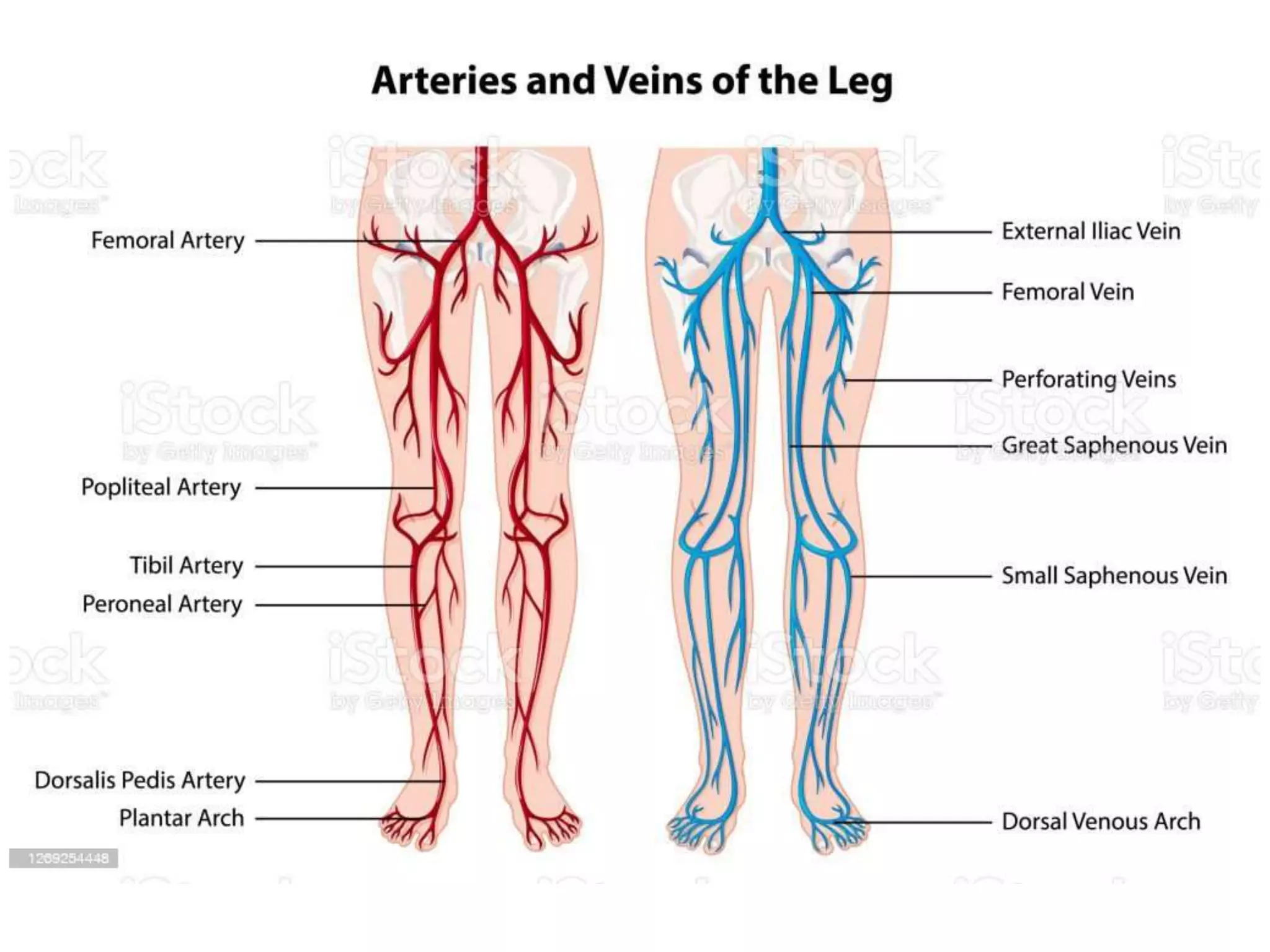
• The main artery of the lower limb is the Femoral artery.
• It is a continuation of the External iliac artery (terminal
branch of the abdominal aorta).
• The external iliac becomes the femoral artery when it
crosses under the inguinal ligament and enters the
femoral triangle.
Arteries of Lower Limb - Thigh
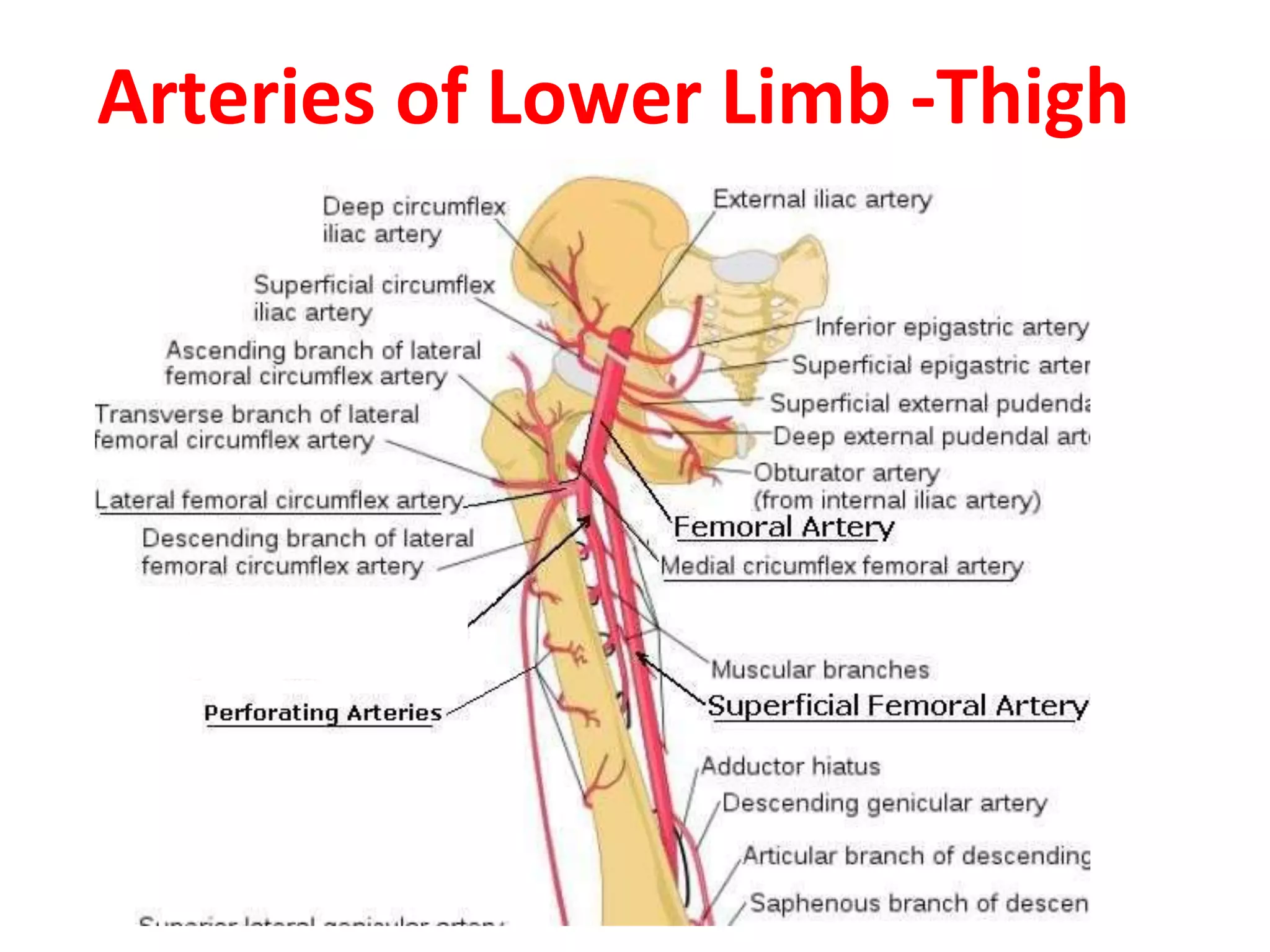
In the femoral triangle, the profunda femoris artery arises from the
posterolateral aspect of the femoral artery.
• Perforating branches – Consists of three or four arteries that
perforate the adductor magnus, contributing to the supply of the
muscles in the medial and posterior thigh.
• Lateral femoral circumflex artery – Wraps round the anterior,
lateral side of the femur, supplying some of the muscles on the
lateral aspect of the thigh.
• Medial femoral circumflex artery – Wraps round the posterior side
of the femur, supplying its neck and head. In a fracture of the
femoral neck this artery can easily be damaged, and avascular
necrosis of the femur head can occur.
Arteries of Lower Limb -Thigh
Arteries of Lower Limb
After exiting the femoral triangle, the femoral artery continues down
the anterior aspect of the thigh, through a tunnel known as the
adductor canal. During its descent, the artery supplies the anterior
thigh muscles.
The adductor canal ends at an opening in the adductor magnus,
called the adductor hiatus. The femoral artery moves through this
opening, and enters the posterior compartment of the thigh,
proximal to the knee. The femoral artery is now known as the
popliteal artery
Arteries of Lower Limb - Knee, Leg
The popliteal artery descends down the posterior thigh, giving rise to
genicular branches that supply the knee joint. It moves through the
popliteal fossa, exiting between the gastrocnemius and popliteus
muscles.
At the lower border of the popliteus, the popliteal artery terminates
by dividing into the anterior tibial artery and the tibioperoneal trunk.
The tibioperoneal trunk bifurcates into the posterior tibial and fibular
arteries.
Arteries of Lower Limb - Leg
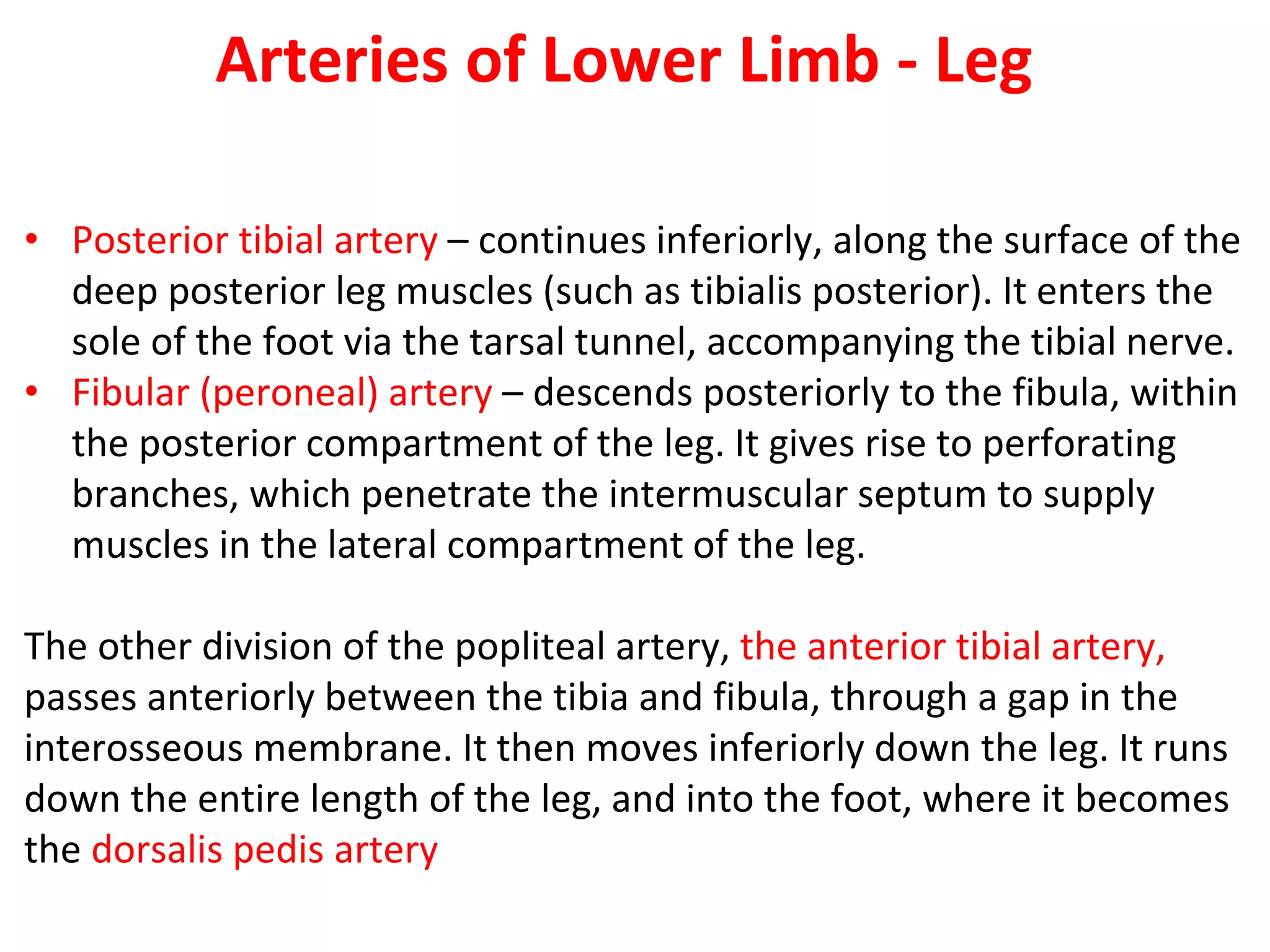
• Posterior tibial artery – continues inferiorly, along the surface of the
deep posterior leg muscles (such as tibialis posterior). It enters the
sole of the foot via the tarsal tunnel, accompanying the tibial nerve.
• Fibular (peroneal) artery – descends posteriorly to the fibula, within
the posterior compartment of the leg. It gives rise to perforating
branches, which penetrate the intermuscular septum to supply
muscles in the lateral compartment of the leg.
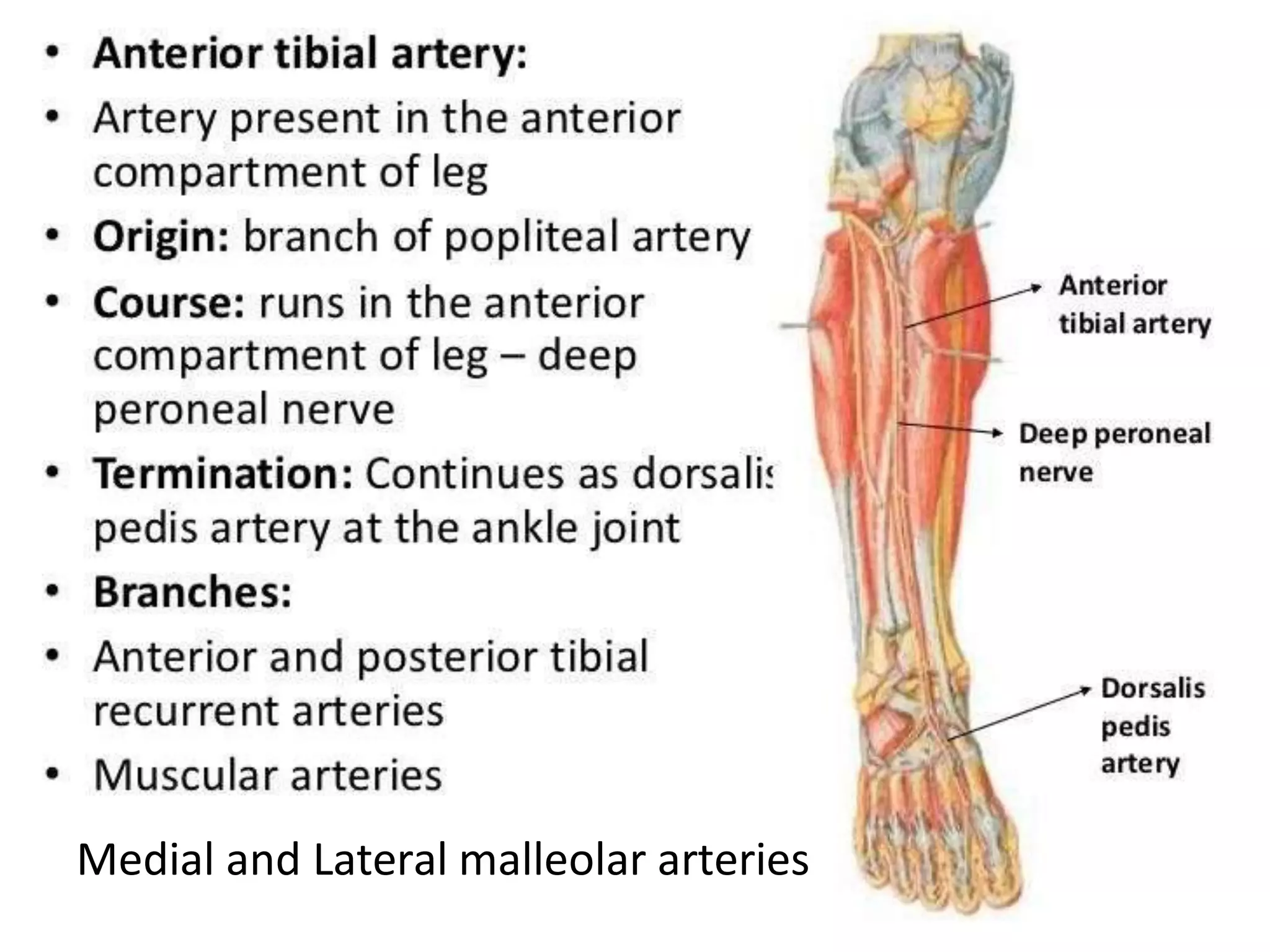
The other division of the popliteal artery, the anterior tibial artery,
passes anteriorly between the tibia and fibula, through a gap in the
interosseous membrane. It then moves inferiorly down the leg. It runs
down the entire length of the leg, and into the foot, where it becomes
the dorsalis pedis artery
Medial and Lateral malleolar arteries
Lower Limb Venous Drainage
Superficial veins : Great Saphenous Vein
and
Short Saphenous Vein
Deep veins: Tibial, Peroneal,
Popliteal, Femoral veins
Perforators:
Blood flow
deep veins in the sole
superficial veins in the dorsum
But
In leg and thigh from superficial to
deep veins.
Factors helping venous return
• Negative intra-thoracic pressure.
• Transmitted pulsations from adjacent arteries.
• Valves maintain uni-directional flow.
• Valves in perforating veins prevent reflux into
low pressure superficial veins.
• Calf Pump—Peripheral Heart.
• Vis-a –tergo produced by contraction of heart.
• Suction action of diaphragm during inspiration.
Dorsal venous arch of Foot
• It lies in the subcutaneous tissue over the
heads of metatarsals with convexity directed
distally.
• It is formed by union of 4 dorsal metatarsal
veins.
Each dorsal metatarsal
vein recieves blood in
the clefts from
• dorsal digital veins.
• and proximal and distal
perforating veins
conveying blood from
plantar surface of sole.
Begins from the medial
side of dorsal venous
arch.
Supplemented by
medial marginal vein
Ascends 2.5 cm
anterior to medial
malleolus.
Passes posterior to
medial border of
patella.
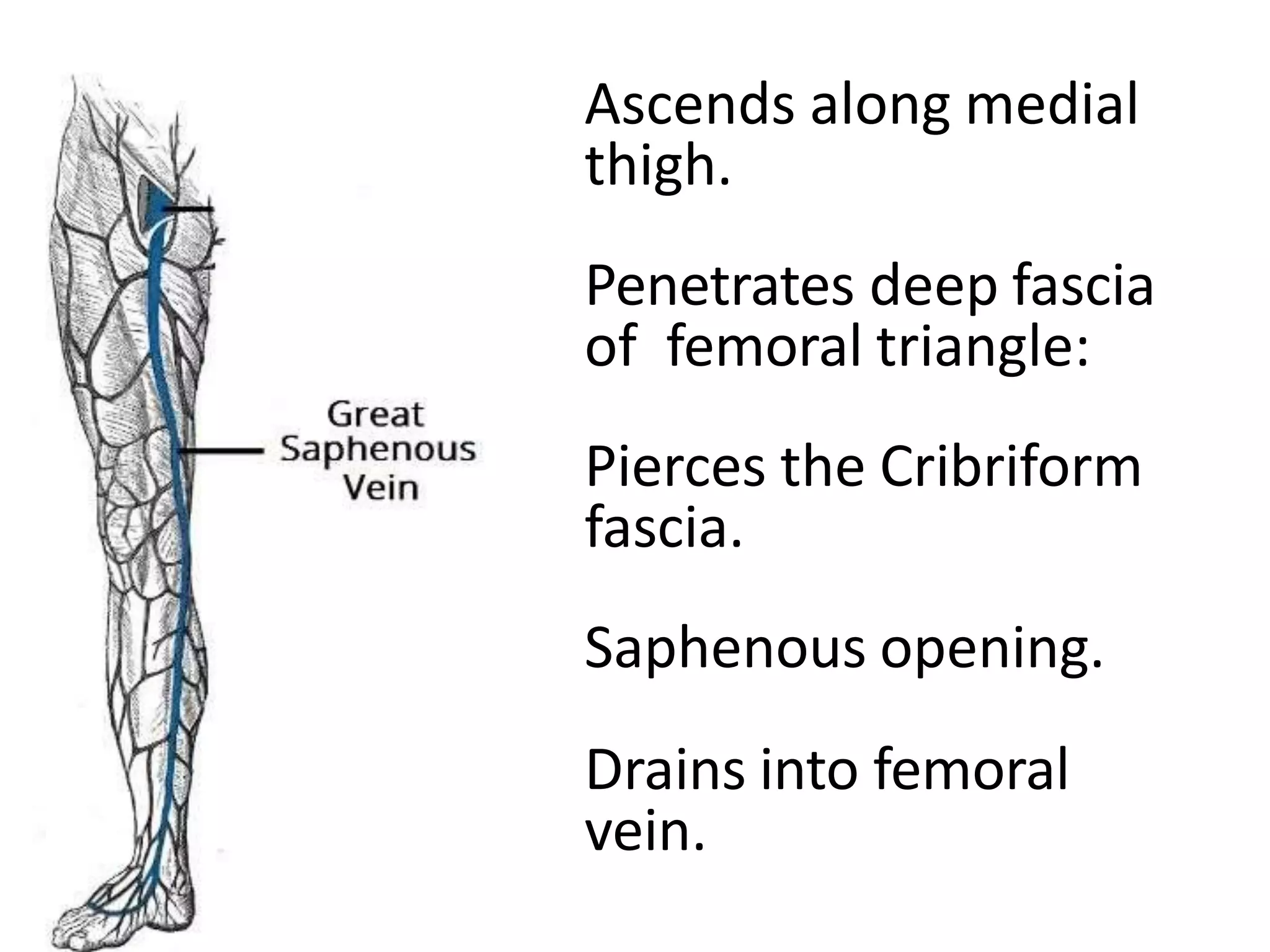
Great saphenous Vein
Ascends along medial
thigh.
Penetrates deep fascia
of femoral triangle:
Pierces the Cribriform
fascia.
Saphenous opening.
Drains into femoral
vein.
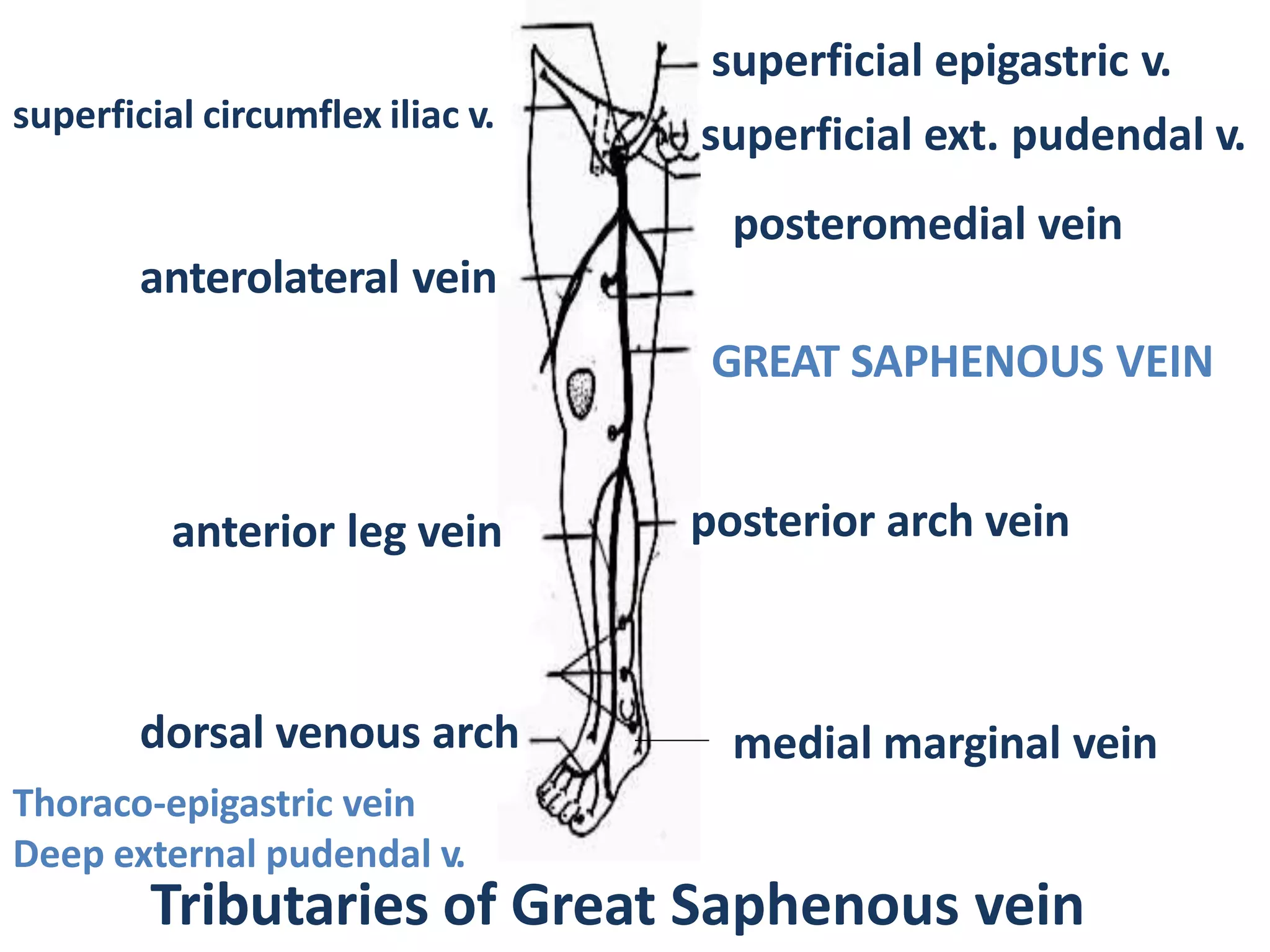
superficial circumflex iliac v.
superficial epigastric v.
superficial ext. pudendal v.
posteromedial vein
anterior leg vein posterior arch vein
anterolateral vein
GREAT SAPHENOUS VEIN
Tributaries of Great Saphenous vein
dorsal venous arch
Thoraco-epigastric vein
Deep external pudendal v.
medial marginal vein
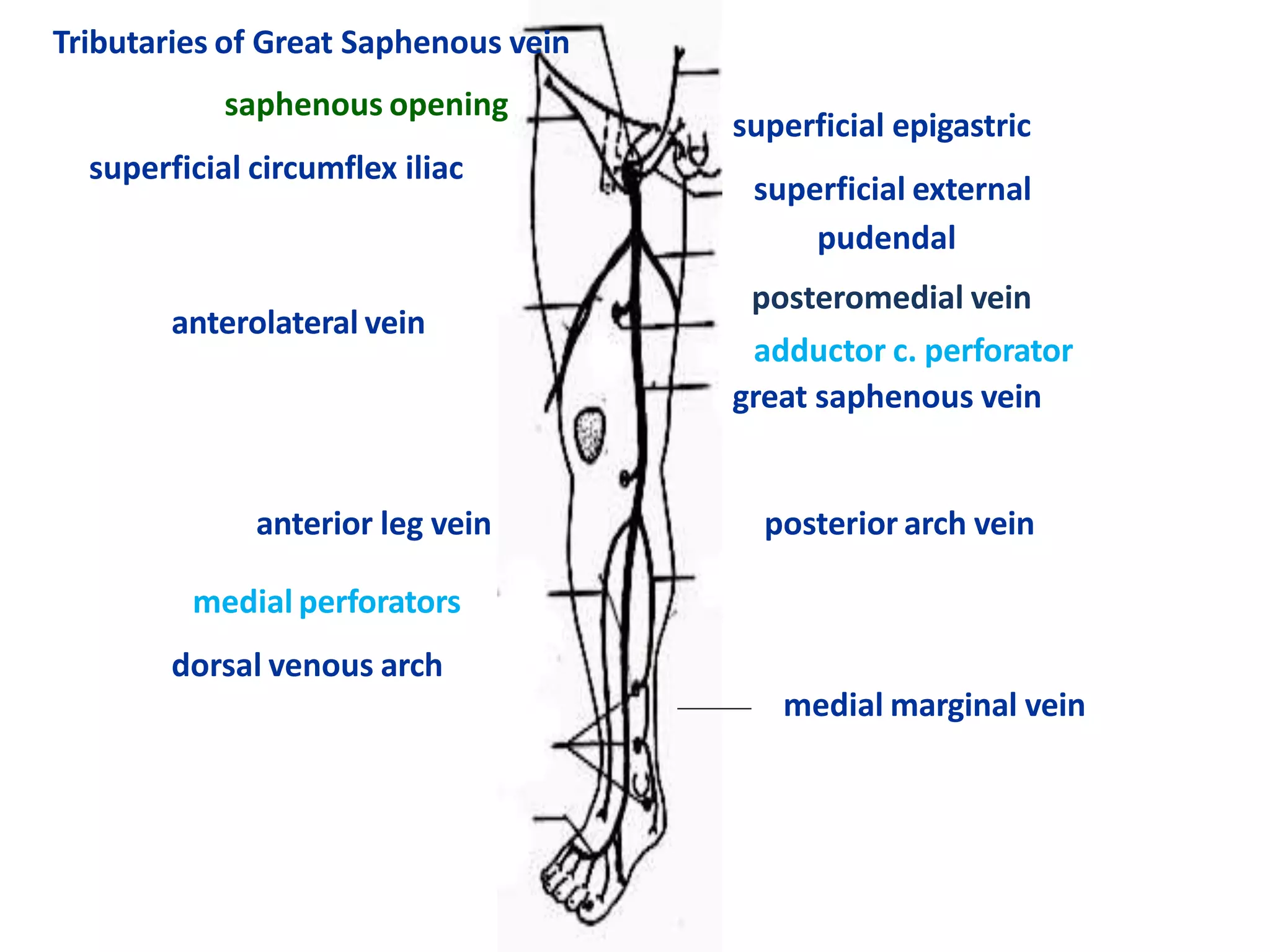
saphenous opening
superficial circumflex iliac
superficial epigastric
superficial external
pudendal
posteromedial vein
adductor c. perforator
great saphenous vein
anterolateral vein
anterior leg vein posterior arch vein
medial perforators
dorsal venous arch
Tributaries of Great Saphenous vein
medial marginal vein
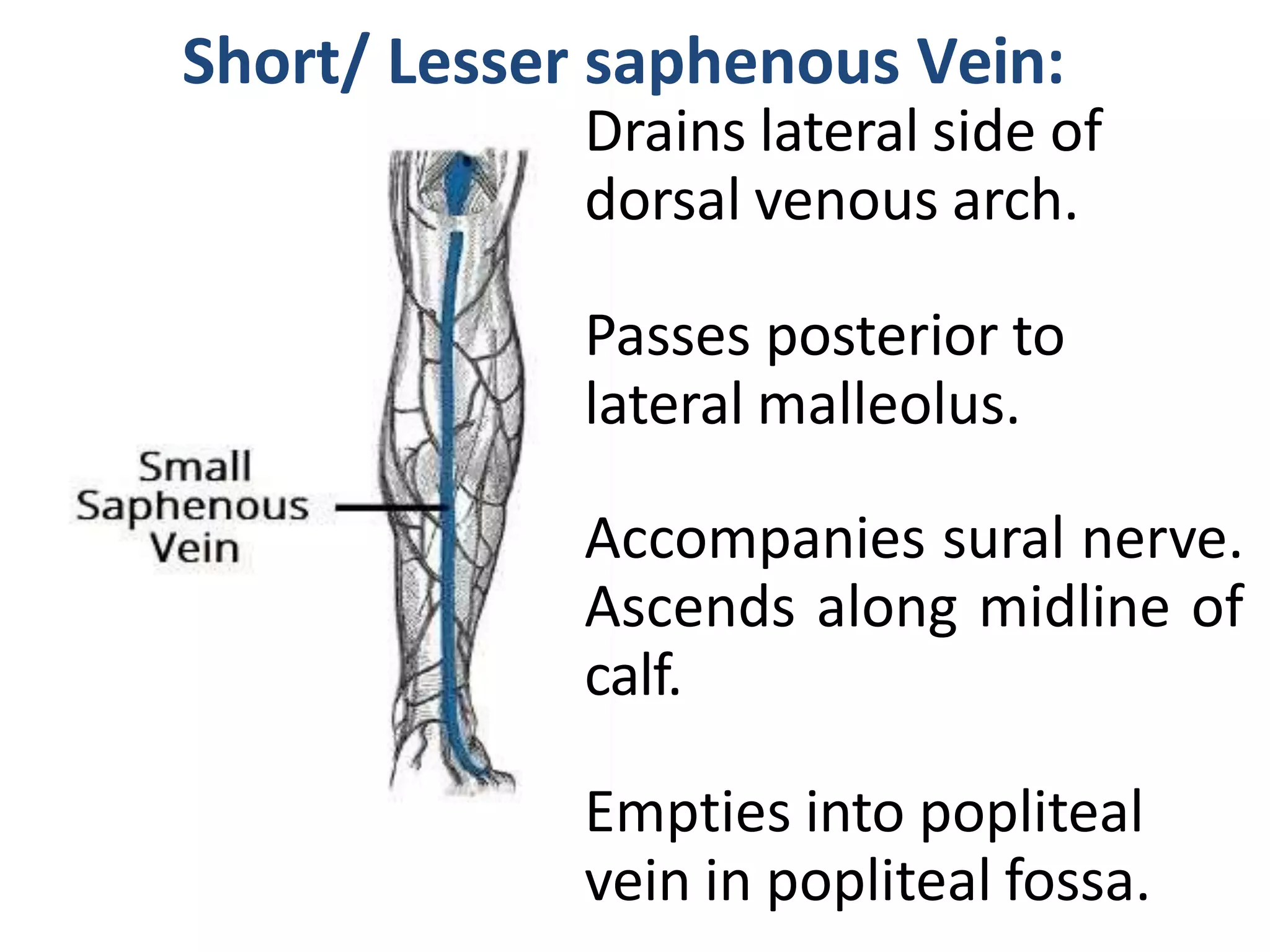
Short/ Lesser saphenous Vein:
Drains lateral side of
dorsal venous arch.
Passes posterior to
lateral malleolus.
Accompanies sural nerve.
Ascends along midline of
calf.
Empties into popliteal
vein in popliteal fossa.
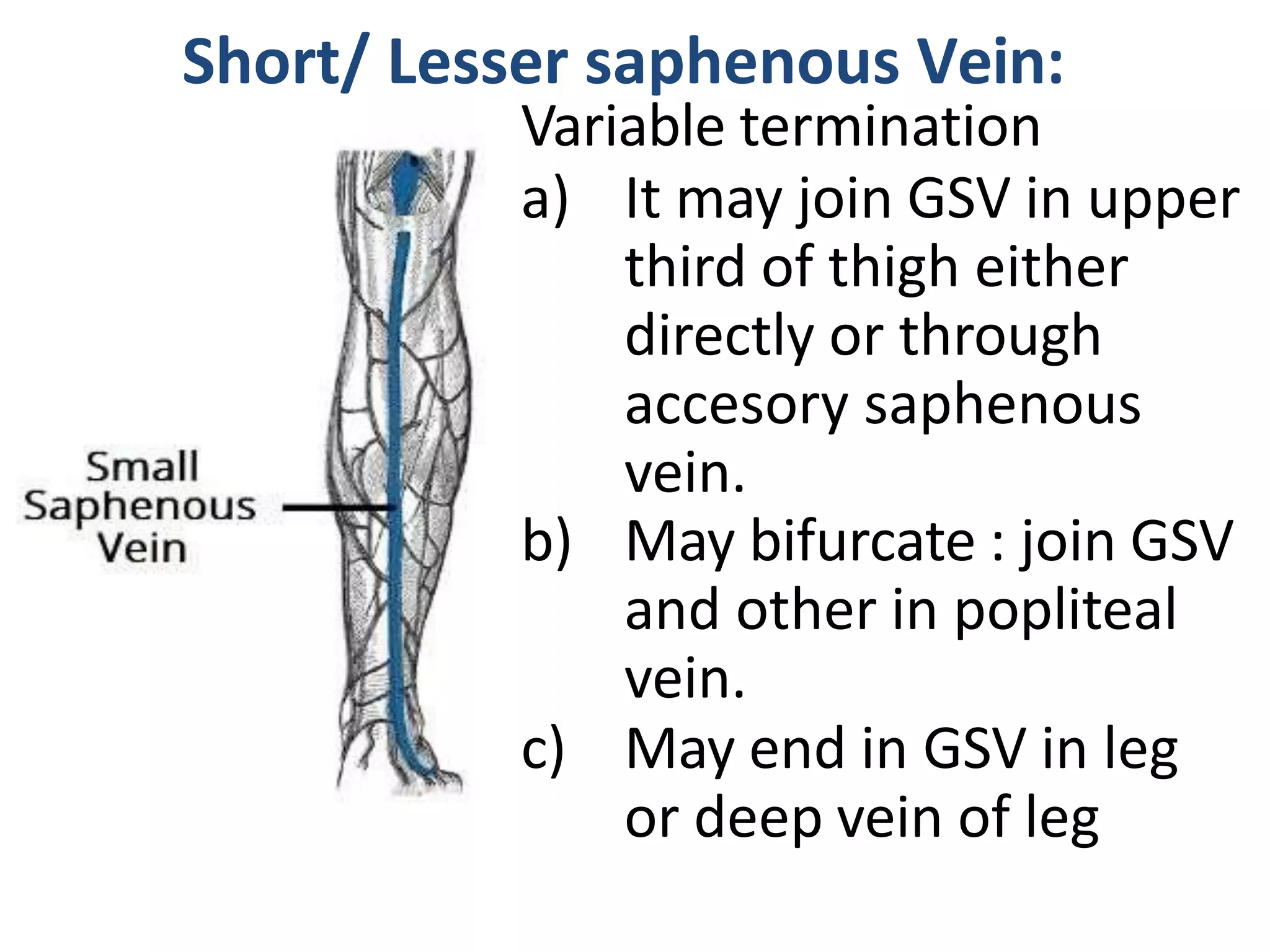
Short/ Lesser saphenous Vein:
Variable termination
a) It may join GSV in upper
third of thigh either
directly or through
accesory saphenous
vein.
b) May bifurcate : join GSV
and other in popliteal
vein.
c) May end in GSV in leg
or deep vein of leg
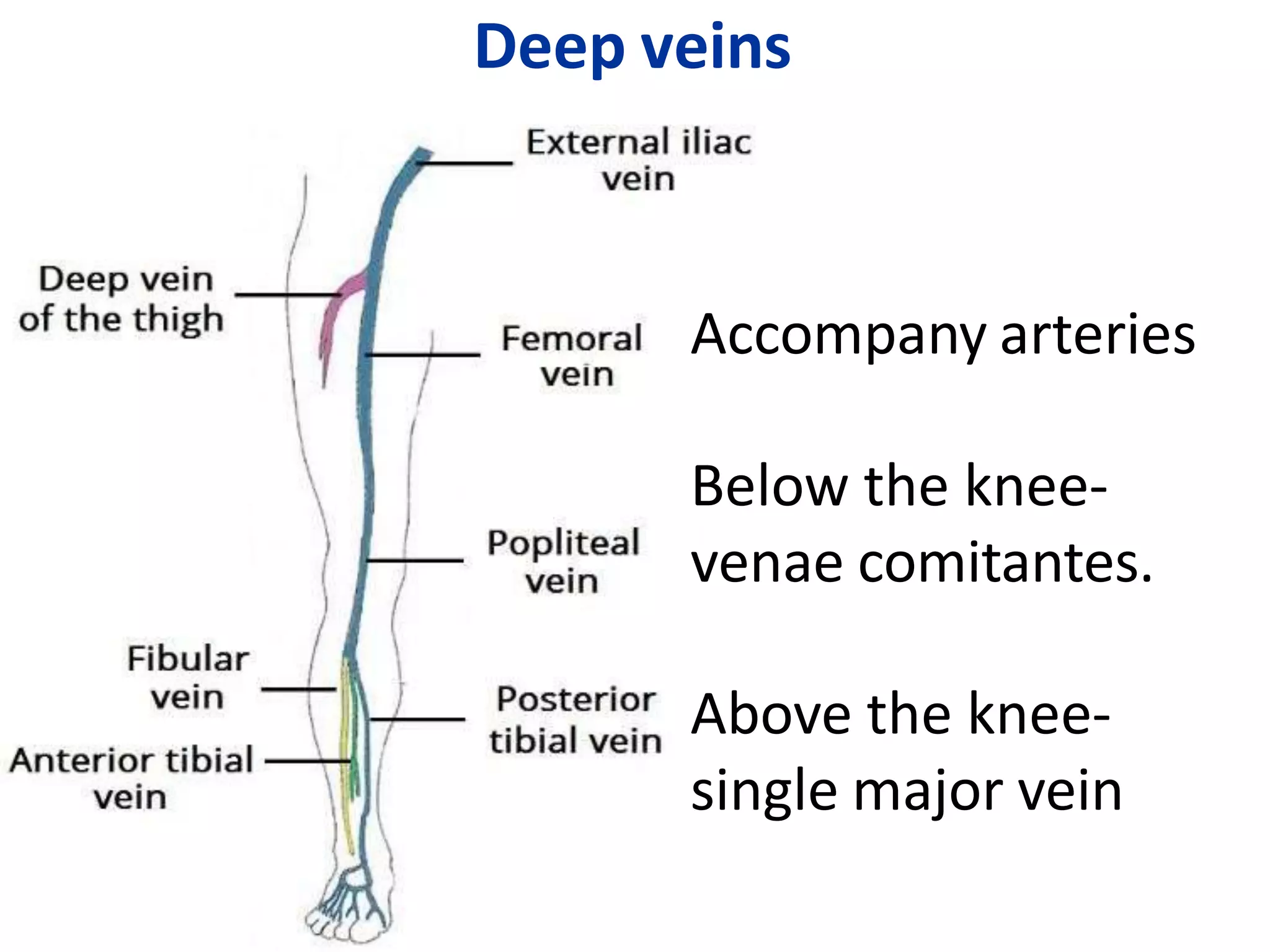
Deep veins
Present within the
deep fascia
surrounded by
powerful muscles.
Blood flow in greater
pressure and volume.
Accounts for 80 -90%
venous return.
Deep veins
Accompany arteries
Below the knee-
venae comitantes.
Above the knee-
single major vein
Deep veins of lower limb
Femoral vein
Poplitealvein
POPLITEAL
ANTERIOR
TIBIAL
MEDIAL
MALLEOLUS
POSTERIOR
TIBIAL
PERONEAL
FEMORAL
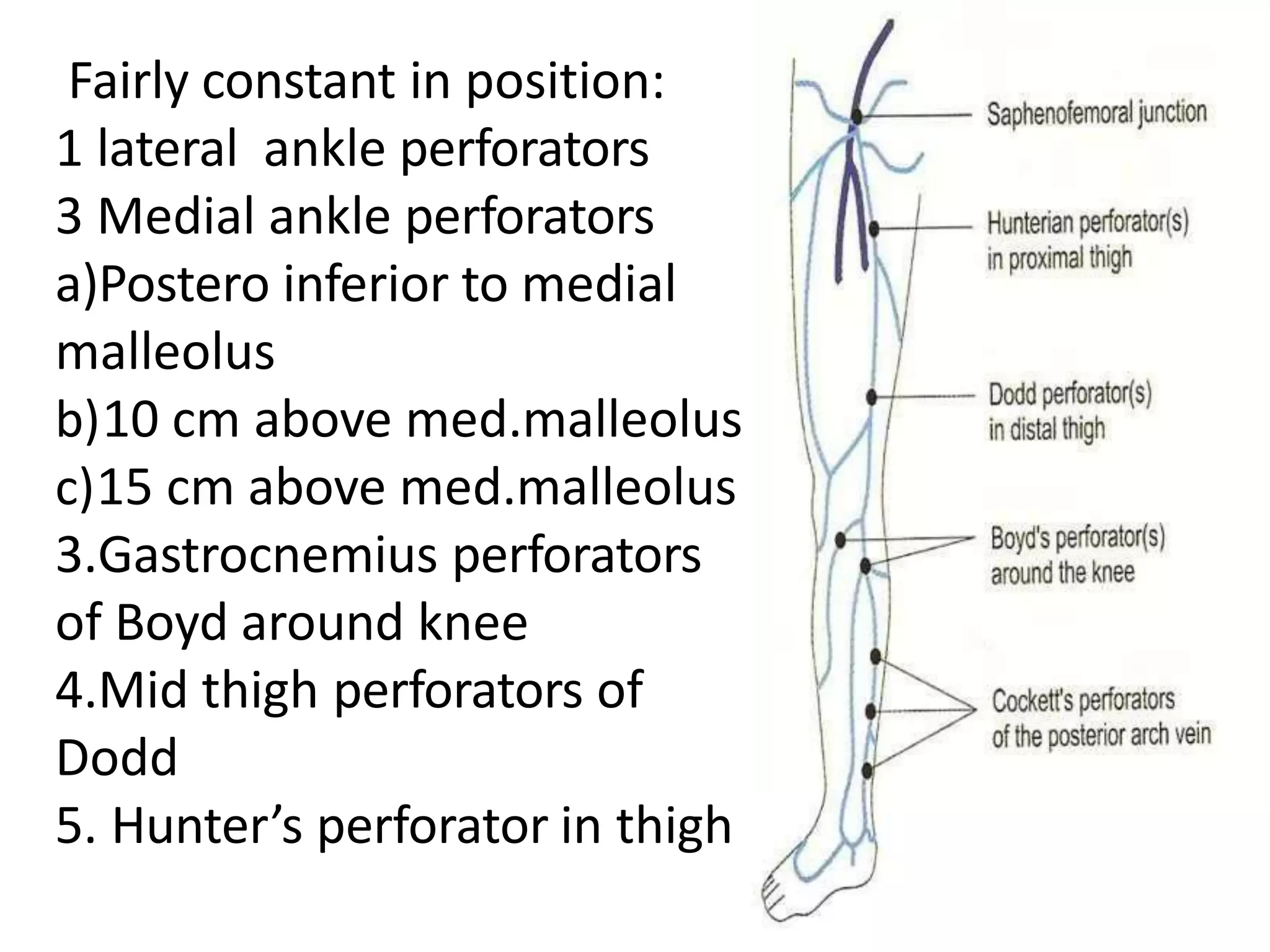
PERFORATORS
Communicate
superficial veins to
deep veins
Have role in varicose
veins.
All veins in lower
limb have valves
Fairly constant in position:
1 lateral ankle perforators
3 Medial ankle perforators
a)Postero inferior to medial
malleolus
b)10 cm above med.malleolus
c)15 cm above med.malleolus
3.Gastrocnemius perforators
of Boyd around knee
4.Mid thigh perforators of
Dodd
5. Hunter’s perforator in thigh
Valves in Great
Saphenous Vein
•10-20 valves
•1 valve just before GSV
pierces Cribriform fascia
•valve at Sapheno-femoral
junction
•In 80% of people, a valve
is present in external iliac
vein which protects
Sapheno-femoral junction.
Dilated,tortuous and elongated veins
with reversal of blood flow mainly
due to valvular incompetence
Includes
varicose veins in legs
Hemorrhoids
Varicocele
Oesophageal varices
Varicose veins
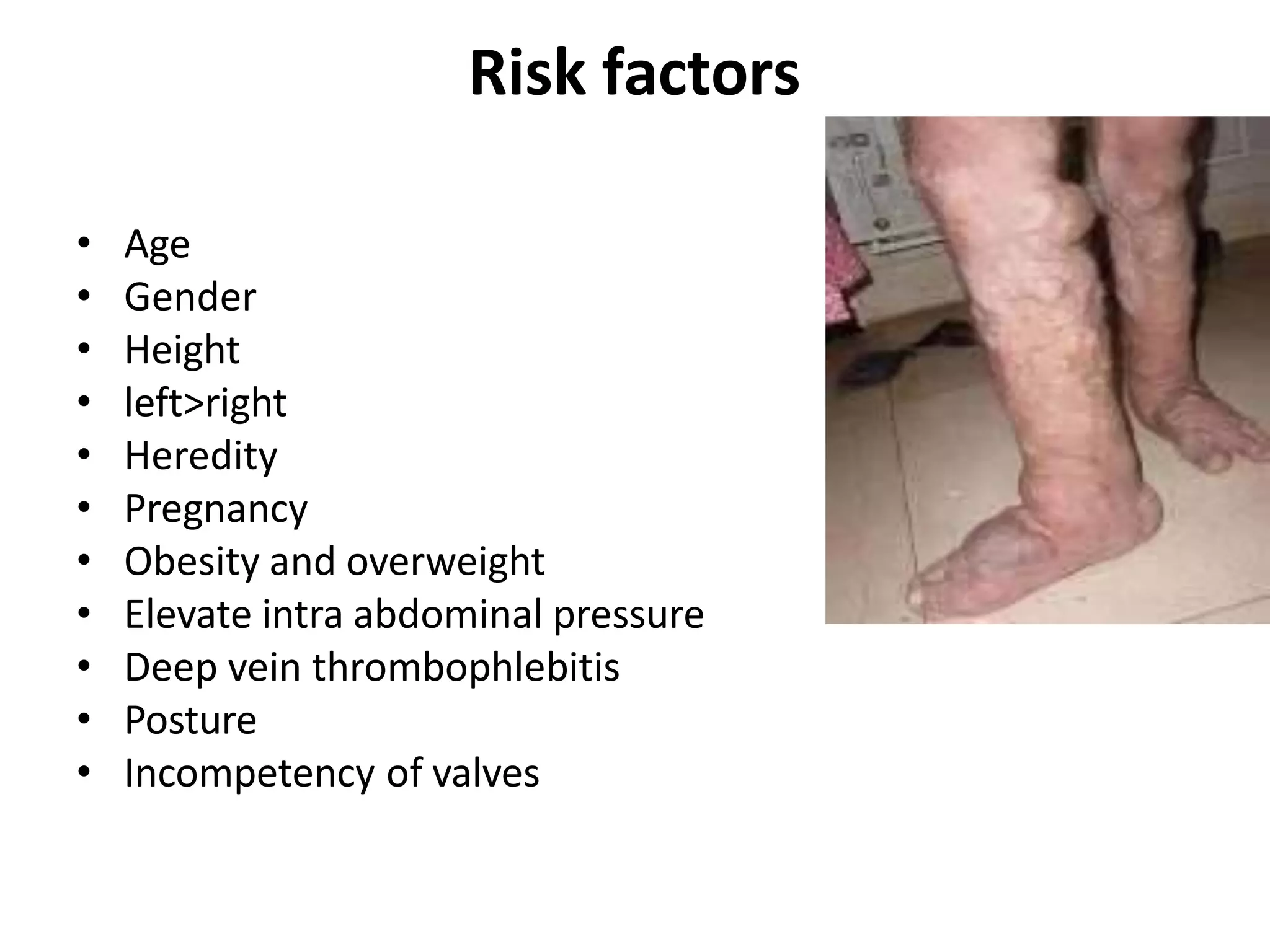
Risk factors
• Age
• Gender
• Height
• left>right
• Heredity
• Pregnancy
• Obesity and overweight
• Elevate intra abdominal pressure
• Deep vein thrombophlebitis
• Posture
• Incompetency of valves
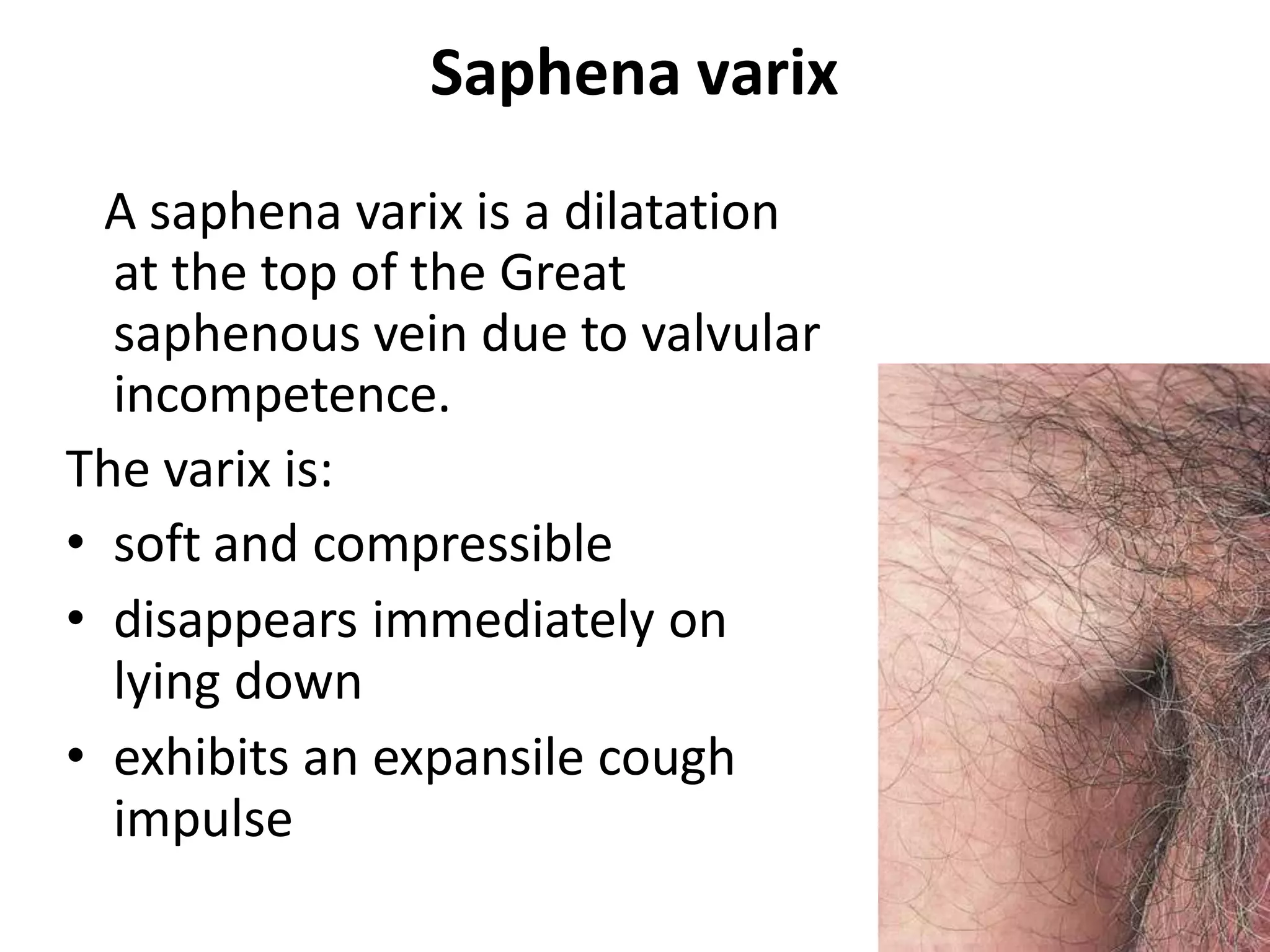
Saphena varix
A saphena varix is a dilatation
at the top of the Great
saphenous vein due to valvular
incompetence.
The varix is:
• soft and compressible
• disappears immediately on
lying down
• exhibits an expansile cough
impulse
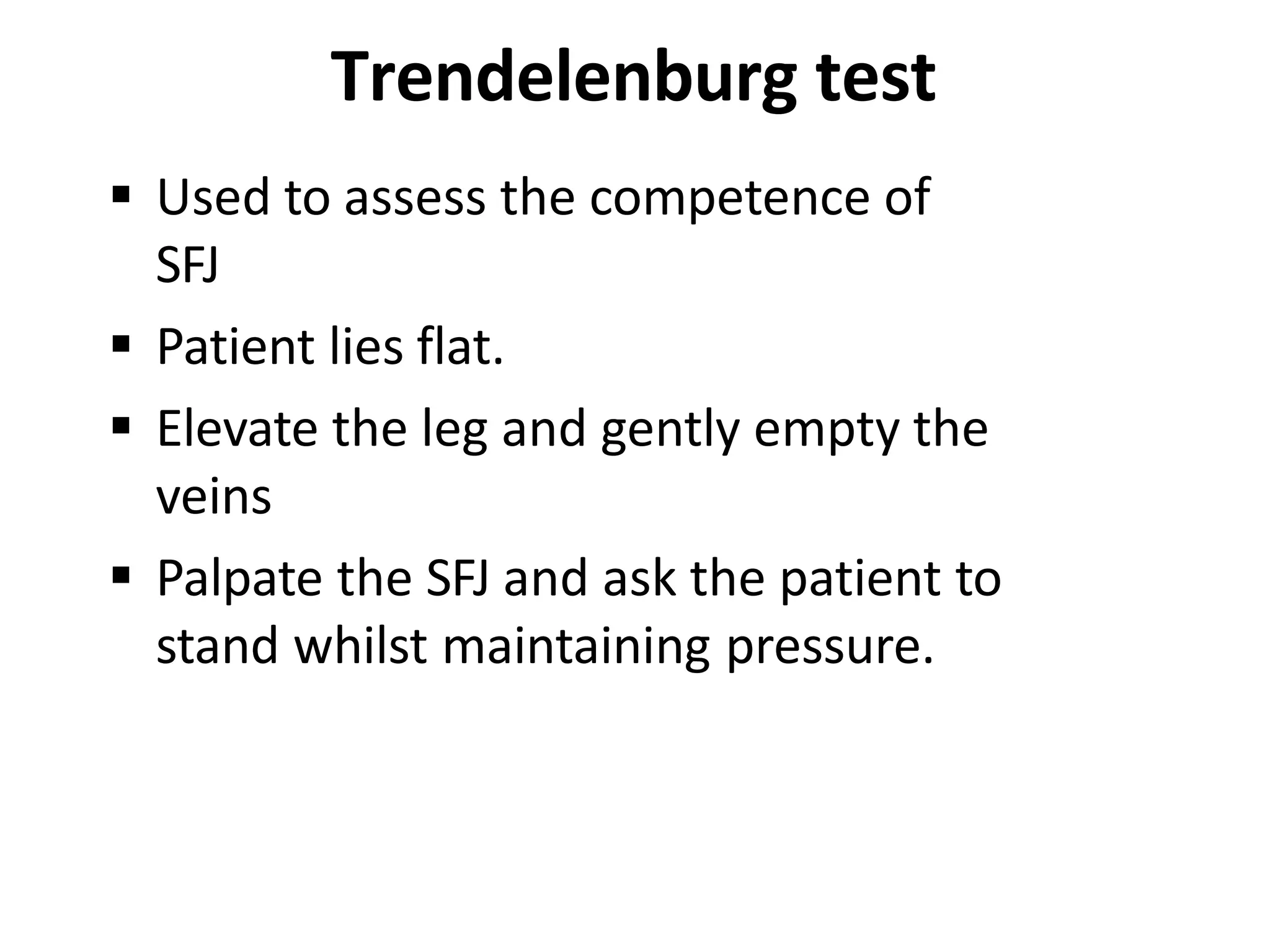
Trendelenburg test
 Used to assess the competence of
SFJ
 Patient lies flat.
 Elevate the leg and gently empty the
veins
 Palpate the SFJ and ask the patient to
stand whilst maintaining pressure.
 Rapid filling after thumb released→ SFJ is
incompetent
 Filling from below upwards without releasing
thumb →presence of distal incompetent
perforators
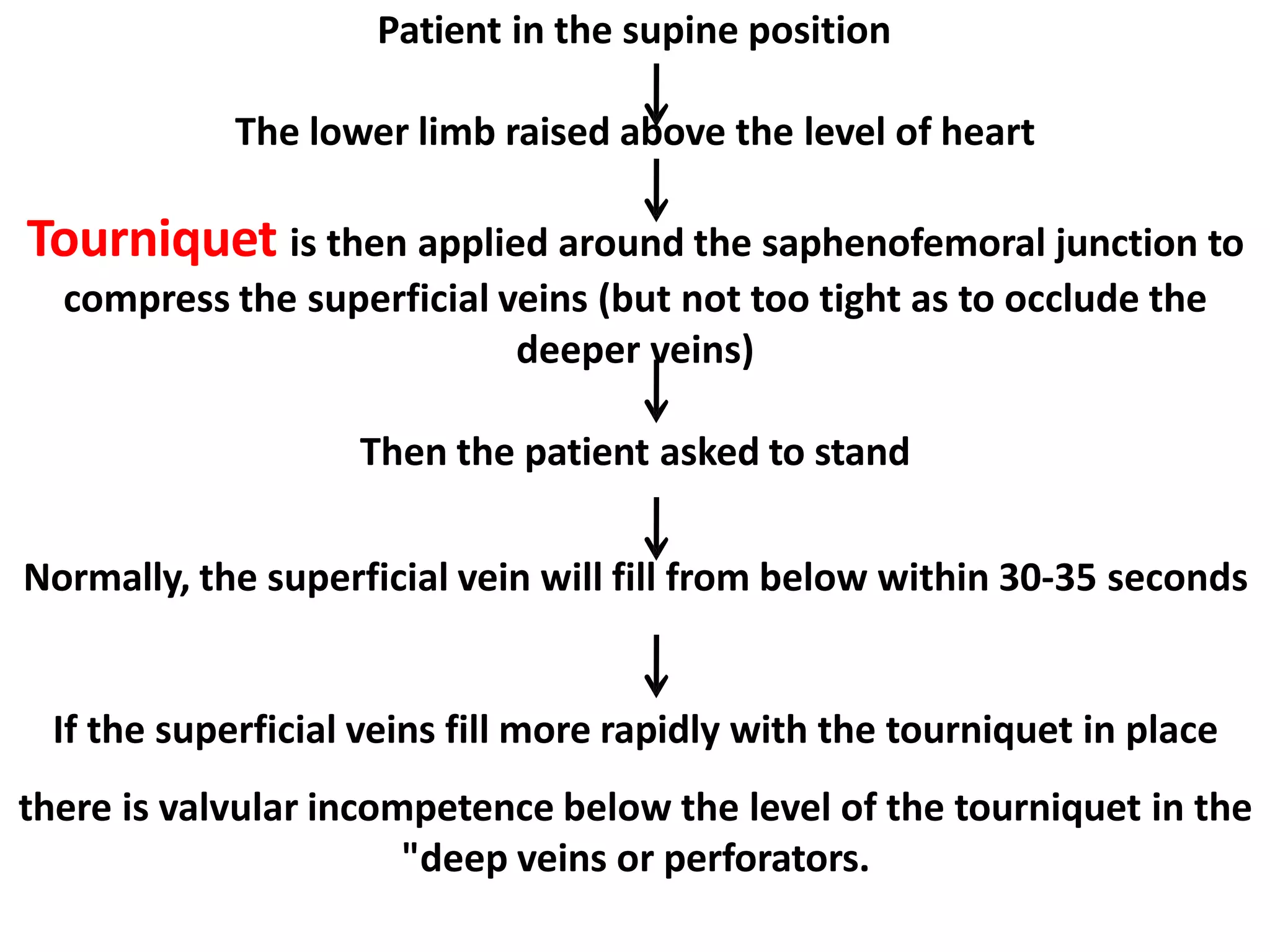
Patient in the supine position
The lower limb raised above the level of heart
Tourniquet is then applied around the saphenofemoral junction to
compress the superficial veins (but not too tight as to occlude the
deeper veins)
Then the patient asked to stand
Normally, the superficial vein will fill from below within 30-35 seconds
If the superficial veins fill more rapidly with the tourniquet in place
there is valvular incompetence below the level of the tourniquet in the
"deep veins or perforators.
If there has been no rapid filling even
after 20 seconds the tourniquet is
released.
If rapid filling from above then it indicates
that the deep and perforating veins are
competent
&
superficial veins are incompetent
The test is reported in 2 parts
a) Standing up of the patient with tourniquet on
based on rapid filling + or – deep veins/perforators
incompetent
b) When Tourniquet is removed
based upon rapid filling + or - superficial vein
incompetent
The test can be repeated with the tourniquet at different
levels to further pinpoint the level of valvular
incompetence
Perthes Test
Empty the vein as above, place a
tourniquet around the thigh, stand
the patient up.
Ask them to rapidly stand up and
down on their toes
filling of the veins indicated deep
venous incompetence.
This is a painful and rarely used
test.
V
ARICOSE ULCER
Trendelenburg’s
Operation
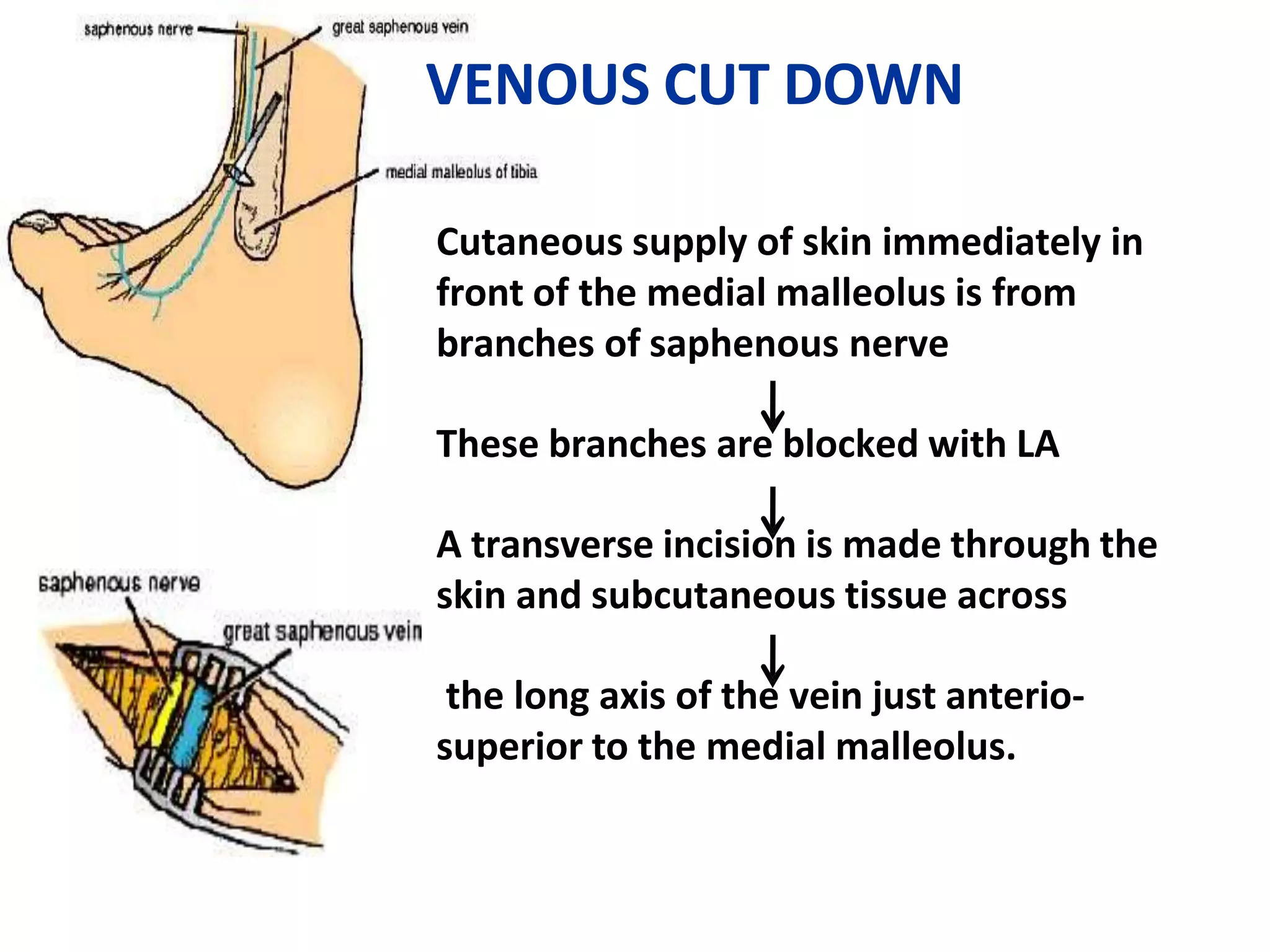
VENOUS CUT DOWN
Cutaneous supply of skin immediately in
front of the medial malleolus is from
branches of saphenous nerve
These branches are blocked with LA
A transverse incision is made through the
skin and subcutaneous tissue across
the long axis of the vein just anterio-
superior to the medial malleolus.
Femoral Vein
Catheterization
Coronary artery bypass

Blood Vessels of Lower Limb.pptx

  • 1.
    Blood Vessels ofLower Limb Dr Mathew Joseph MBBS, MD(AIIMS), BCC(Palliative Medicine) Assistant Professor Department of Anatomy Amala Institute of Medical Sciences, Thrissur
  • 5.
    Arteries of LowerLimb • The main artery of the lower limb is the Femoral artery. • It is a continuation of the External iliac artery (terminal branch of the abdominal aorta). • The external iliac becomes the femoral artery when it crosses under the inguinal ligament and enters the femoral triangle.
  • 6.
    Arteries of LowerLimb - Thigh In the femoral triangle, the profunda femoris artery arises from the posterolateral aspect of the femoral artery. • Perforating branches – Consists of three or four arteries that perforate the adductor magnus, contributing to the supply of the muscles in the medial and posterior thigh. • Lateral femoral circumflex artery – Wraps round the anterior, lateral side of the femur, supplying some of the muscles on the lateral aspect of the thigh. • Medial femoral circumflex artery – Wraps round the posterior side of the femur, supplying its neck and head. In a fracture of the femoral neck this artery can easily be damaged, and avascular necrosis of the femur head can occur.
  • 7.
    Arteries of LowerLimb -Thigh
  • 8.
    Arteries of LowerLimb After exiting the femoral triangle, the femoral artery continues down the anterior aspect of the thigh, through a tunnel known as the adductor canal. During its descent, the artery supplies the anterior thigh muscles. The adductor canal ends at an opening in the adductor magnus, called the adductor hiatus. The femoral artery moves through this opening, and enters the posterior compartment of the thigh, proximal to the knee. The femoral artery is now known as the popliteal artery
  • 10.
    Arteries of LowerLimb - Knee, Leg The popliteal artery descends down the posterior thigh, giving rise to genicular branches that supply the knee joint. It moves through the popliteal fossa, exiting between the gastrocnemius and popliteus muscles. At the lower border of the popliteus, the popliteal artery terminates by dividing into the anterior tibial artery and the tibioperoneal trunk. The tibioperoneal trunk bifurcates into the posterior tibial and fibular arteries.
  • 11.
    Arteries of LowerLimb - Leg • Posterior tibial artery – continues inferiorly, along the surface of the deep posterior leg muscles (such as tibialis posterior). It enters the sole of the foot via the tarsal tunnel, accompanying the tibial nerve. • Fibular (peroneal) artery – descends posteriorly to the fibula, within the posterior compartment of the leg. It gives rise to perforating branches, which penetrate the intermuscular septum to supply muscles in the lateral compartment of the leg. The other division of the popliteal artery, the anterior tibial artery, passes anteriorly between the tibia and fibula, through a gap in the interosseous membrane. It then moves inferiorly down the leg. It runs down the entire length of the leg, and into the foot, where it becomes the dorsalis pedis artery
  • 14.
    Medial and Lateralmalleolar arteries
  • 17.
    Lower Limb VenousDrainage Superficial veins : Great Saphenous Vein and Short Saphenous Vein Deep veins: Tibial, Peroneal, Popliteal, Femoral veins Perforators:
  • 18.
    Blood flow deep veinsin the sole superficial veins in the dorsum But In leg and thigh from superficial to deep veins.
  • 19.
    Factors helping venousreturn • Negative intra-thoracic pressure. • Transmitted pulsations from adjacent arteries. • Valves maintain uni-directional flow. • Valves in perforating veins prevent reflux into low pressure superficial veins. • Calf Pump—Peripheral Heart. • Vis-a –tergo produced by contraction of heart. • Suction action of diaphragm during inspiration.
  • 20.
    Dorsal venous archof Foot • It lies in the subcutaneous tissue over the heads of metatarsals with convexity directed distally. • It is formed by union of 4 dorsal metatarsal veins.
  • 21.
    Each dorsal metatarsal veinrecieves blood in the clefts from • dorsal digital veins. • and proximal and distal perforating veins conveying blood from plantar surface of sole.
  • 22.
    Begins from themedial side of dorsal venous arch. Supplemented by medial marginal vein Ascends 2.5 cm anterior to medial malleolus. Passes posterior to medial border of patella. Great saphenous Vein
  • 23.
    Ascends along medial thigh. Penetratesdeep fascia of femoral triangle: Pierces the Cribriform fascia. Saphenous opening. Drains into femoral vein.
  • 24.
    superficial circumflex iliacv. superficial epigastric v. superficial ext. pudendal v. posteromedial vein anterior leg vein posterior arch vein anterolateral vein GREAT SAPHENOUS VEIN Tributaries of Great Saphenous vein dorsal venous arch Thoraco-epigastric vein Deep external pudendal v. medial marginal vein
  • 25.
    saphenous opening superficial circumflexiliac superficial epigastric superficial external pudendal posteromedial vein adductor c. perforator great saphenous vein anterolateral vein anterior leg vein posterior arch vein medial perforators dorsal venous arch Tributaries of Great Saphenous vein medial marginal vein
  • 26.
    Short/ Lesser saphenousVein: Drains lateral side of dorsal venous arch. Passes posterior to lateral malleolus. Accompanies sural nerve. Ascends along midline of calf. Empties into popliteal vein in popliteal fossa.
  • 27.
    Short/ Lesser saphenousVein: Variable termination a) It may join GSV in upper third of thigh either directly or through accesory saphenous vein. b) May bifurcate : join GSV and other in popliteal vein. c) May end in GSV in leg or deep vein of leg
  • 28.
    Deep veins Present withinthe deep fascia surrounded by powerful muscles. Blood flow in greater pressure and volume. Accounts for 80 -90% venous return.
  • 29.
    Deep veins Accompany arteries Belowthe knee- venae comitantes. Above the knee- single major vein
  • 30.
    Deep veins oflower limb Femoral vein Poplitealvein POPLITEAL ANTERIOR TIBIAL MEDIAL MALLEOLUS POSTERIOR TIBIAL PERONEAL FEMORAL
  • 31.
    PERFORATORS Communicate superficial veins to deepveins Have role in varicose veins. All veins in lower limb have valves
  • 32.
    Fairly constant inposition: 1 lateral ankle perforators 3 Medial ankle perforators a)Postero inferior to medial malleolus b)10 cm above med.malleolus c)15 cm above med.malleolus 3.Gastrocnemius perforators of Boyd around knee 4.Mid thigh perforators of Dodd 5. Hunter’s perforator in thigh
  • 33.
    Valves in Great SaphenousVein •10-20 valves •1 valve just before GSV pierces Cribriform fascia •valve at Sapheno-femoral junction •In 80% of people, a valve is present in external iliac vein which protects Sapheno-femoral junction.
  • 34.
    Dilated,tortuous and elongatedveins with reversal of blood flow mainly due to valvular incompetence Includes varicose veins in legs Hemorrhoids Varicocele Oesophageal varices Varicose veins
  • 35.
    Risk factors • Age •Gender • Height • left>right • Heredity • Pregnancy • Obesity and overweight • Elevate intra abdominal pressure • Deep vein thrombophlebitis • Posture • Incompetency of valves
  • 36.
    Saphena varix A saphenavarix is a dilatation at the top of the Great saphenous vein due to valvular incompetence. The varix is: • soft and compressible • disappears immediately on lying down • exhibits an expansile cough impulse
  • 37.
    Trendelenburg test  Usedto assess the competence of SFJ  Patient lies flat.  Elevate the leg and gently empty the veins  Palpate the SFJ and ask the patient to stand whilst maintaining pressure.
  • 38.
     Rapid fillingafter thumb released→ SFJ is incompetent  Filling from below upwards without releasing thumb →presence of distal incompetent perforators
  • 39.
    Patient in thesupine position The lower limb raised above the level of heart Tourniquet is then applied around the saphenofemoral junction to compress the superficial veins (but not too tight as to occlude the deeper veins) Then the patient asked to stand Normally, the superficial vein will fill from below within 30-35 seconds If the superficial veins fill more rapidly with the tourniquet in place there is valvular incompetence below the level of the tourniquet in the "deep veins or perforators.
  • 40.
    If there hasbeen no rapid filling even after 20 seconds the tourniquet is released. If rapid filling from above then it indicates that the deep and perforating veins are competent & superficial veins are incompetent
  • 41.
    The test isreported in 2 parts a) Standing up of the patient with tourniquet on based on rapid filling + or – deep veins/perforators incompetent b) When Tourniquet is removed based upon rapid filling + or - superficial vein incompetent The test can be repeated with the tourniquet at different levels to further pinpoint the level of valvular incompetence
  • 42.
    Perthes Test Empty thevein as above, place a tourniquet around the thigh, stand the patient up. Ask them to rapidly stand up and down on their toes filling of the veins indicated deep venous incompetence. This is a painful and rarely used test.
  • 43.
  • 45.
  • 46.
    VENOUS CUT DOWN Cutaneoussupply of skin immediately in front of the medial malleolus is from branches of saphenous nerve These branches are blocked with LA A transverse incision is made through the skin and subcutaneous tissue across the long axis of the vein just anterio- superior to the medial malleolus.
  • 47.
  • 48.