University of dongola
Faculty of medicine
Anterior abdominal wall
By: Dr.mohammed A.rheem.
Lecturer of clinical anatomy
Vascular surgery Resident
Mohammed Rheem MBBS,M.Sc
Anterior Abdominal Wall
Mohammed Rheem MBBS,M.Sc
Think about this
Nadir is 22-year-old house officer, he
was attending his first day in the
hospital after graduation when the
senior doctor asked him to write
down the operation sheet for
several surgeries done at that
morning, he faced some difficulties
in the following:
Mohammed Rheem MBBS,M.Sc
By the end of this lecture, try to answer
these questions about the previous
story:
1.What are the nine areas dividing the
anterior abdominal wall in surface
anatomy?
2.Mention the suitable incision for the
following surgical operations:
A.Appendectomy.
B.Cholecystectomy.
C.Cesarean Section. Mohammed Rheem MBBS,M.Sc
3.Mention the site of the pain in the
following conditions:
A.Appendicitis.
B.Cholecystitis
Mohammed Rheem MBBS,M.Sc
Anterior Abdominal Wall
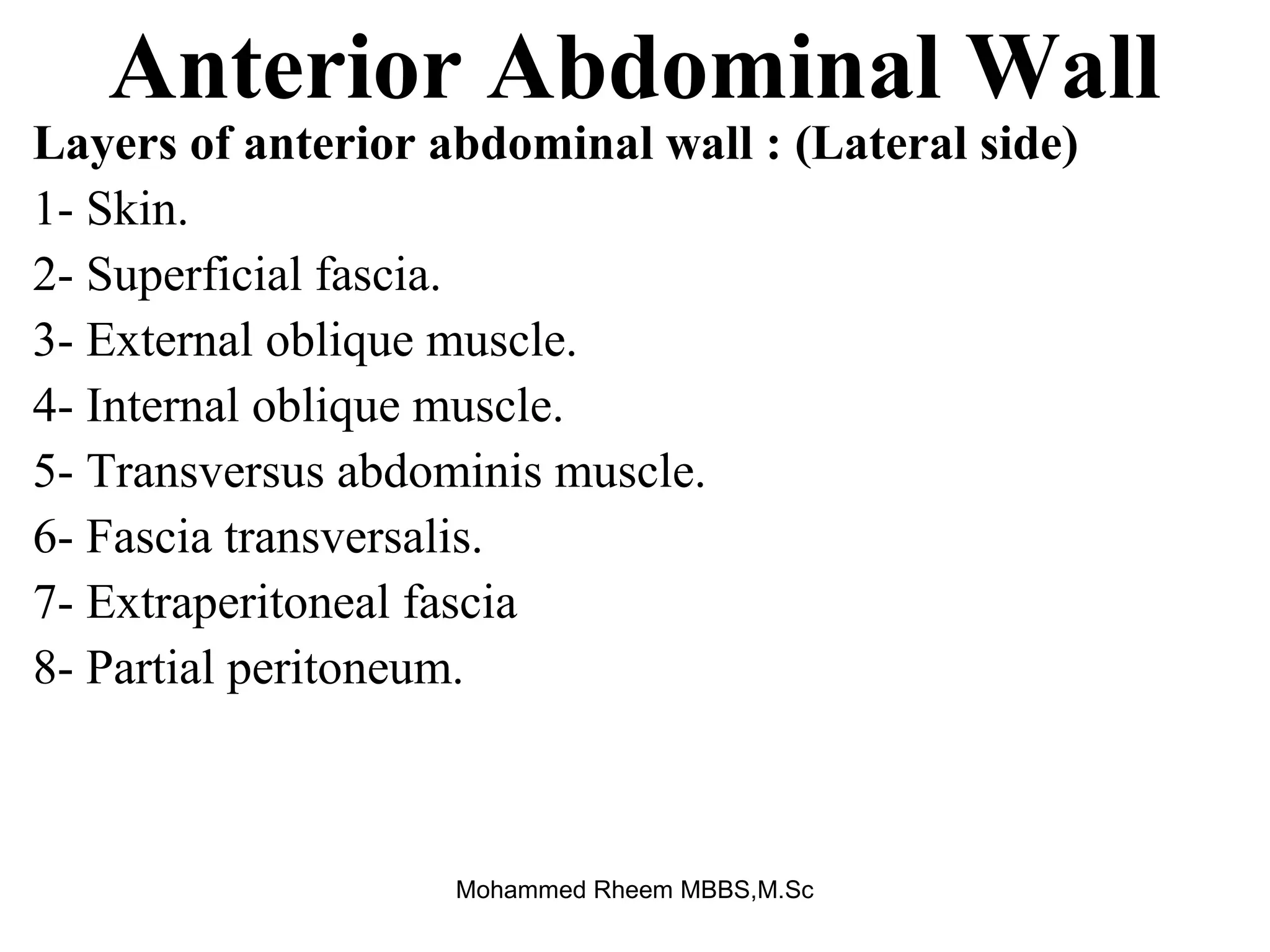
Layers of anterior abdominal wall : (Lateral side)
1- Skin.
2- Superficial fascia.
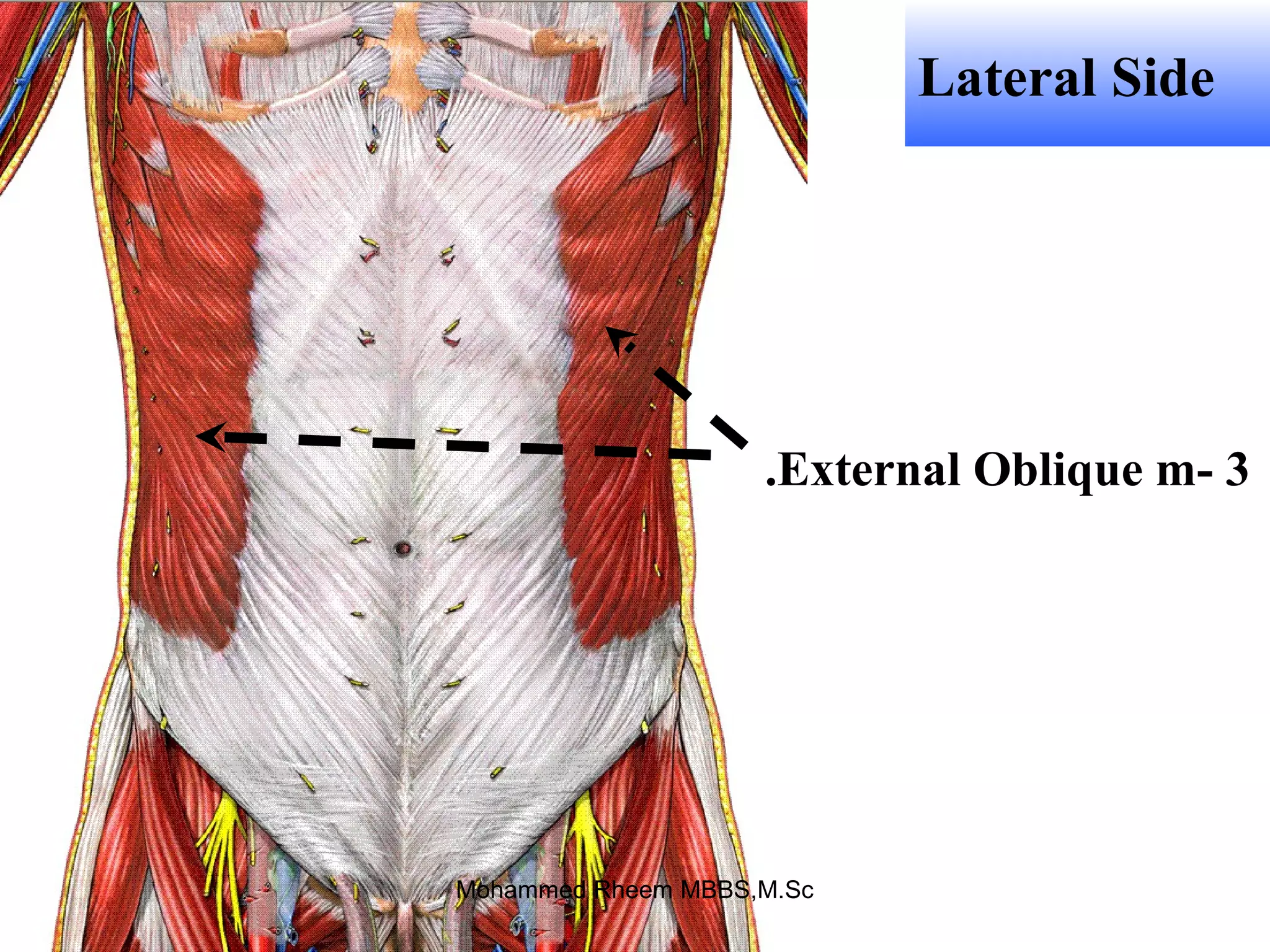
3- External oblique muscle.
4- Internal oblique muscle.
5- Transversus abdominis muscle.
6- Fascia transversalis.
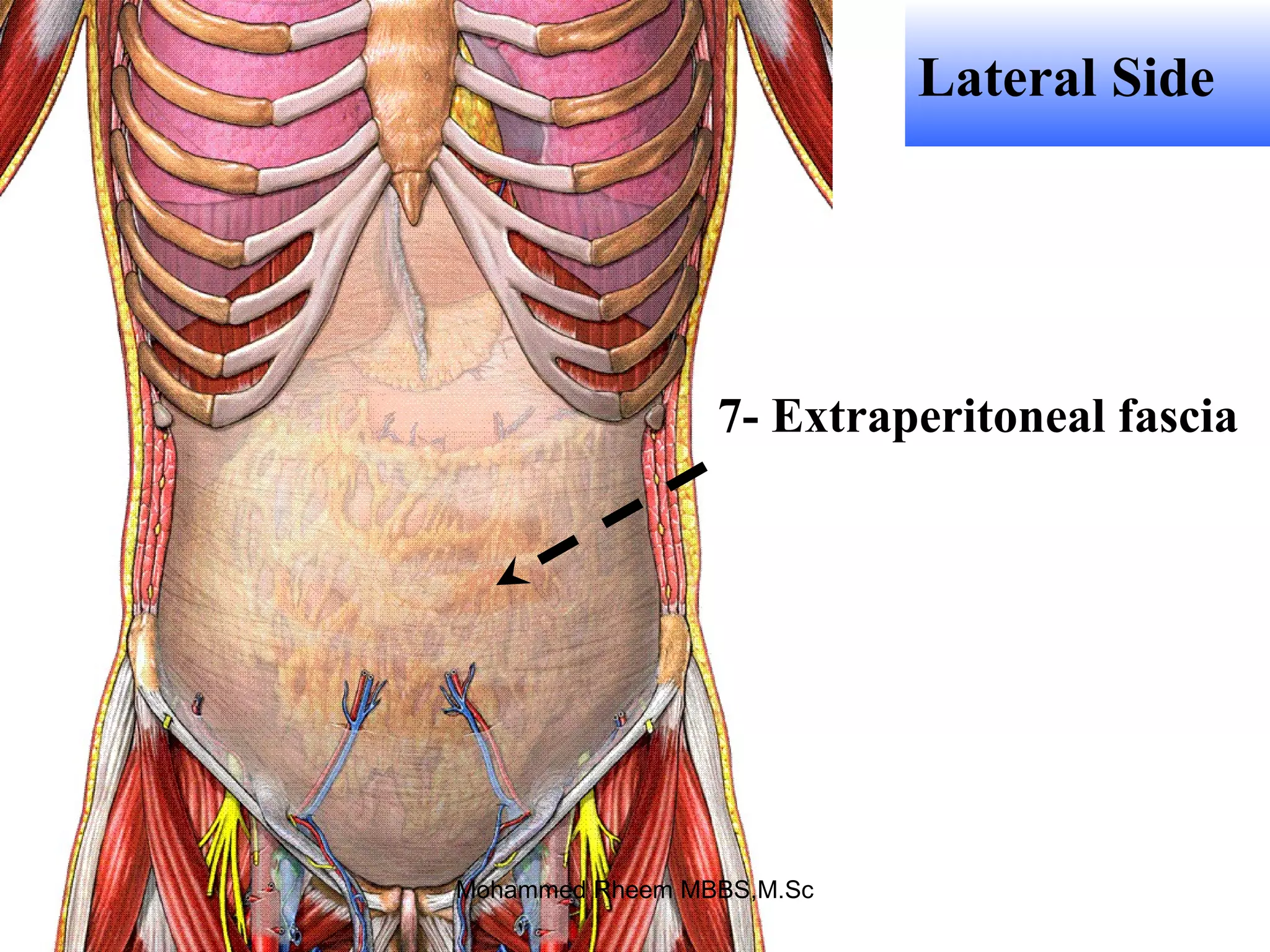
7- Extraperitoneal fascia
8- Partial peritoneum.
Mohammed Rheem MBBS,M.Sc
1-Skin
Lateral Side
Mohammed Rheem MBBS,M.Sc
2-superficial fascia
Lateral Side
Mohammed Rheem MBBS,M.Sc
3-External Oblique m.
Lateral Side
Mohammed Rheem MBBS,M.Sc
4-Internal Oblique m.
Lateral Side
Mohammed Rheem MBBS,M.Sc
5-Transversus abdominis
m.
Lateral Side
Mohammed Rheem MBBS,M.Sc
6- Fascia Transversalis
Lateral Side
Mohammed Rheem MBBS,M.Sc
7- Extraperitoneal fascia
Lateral Side
Mohammed Rheem MBBS,M.Sc
8- partial peritoneum
Lateral Side
Mohammed Rheem MBBS,M.Sc
Anterior Abdominal Wall
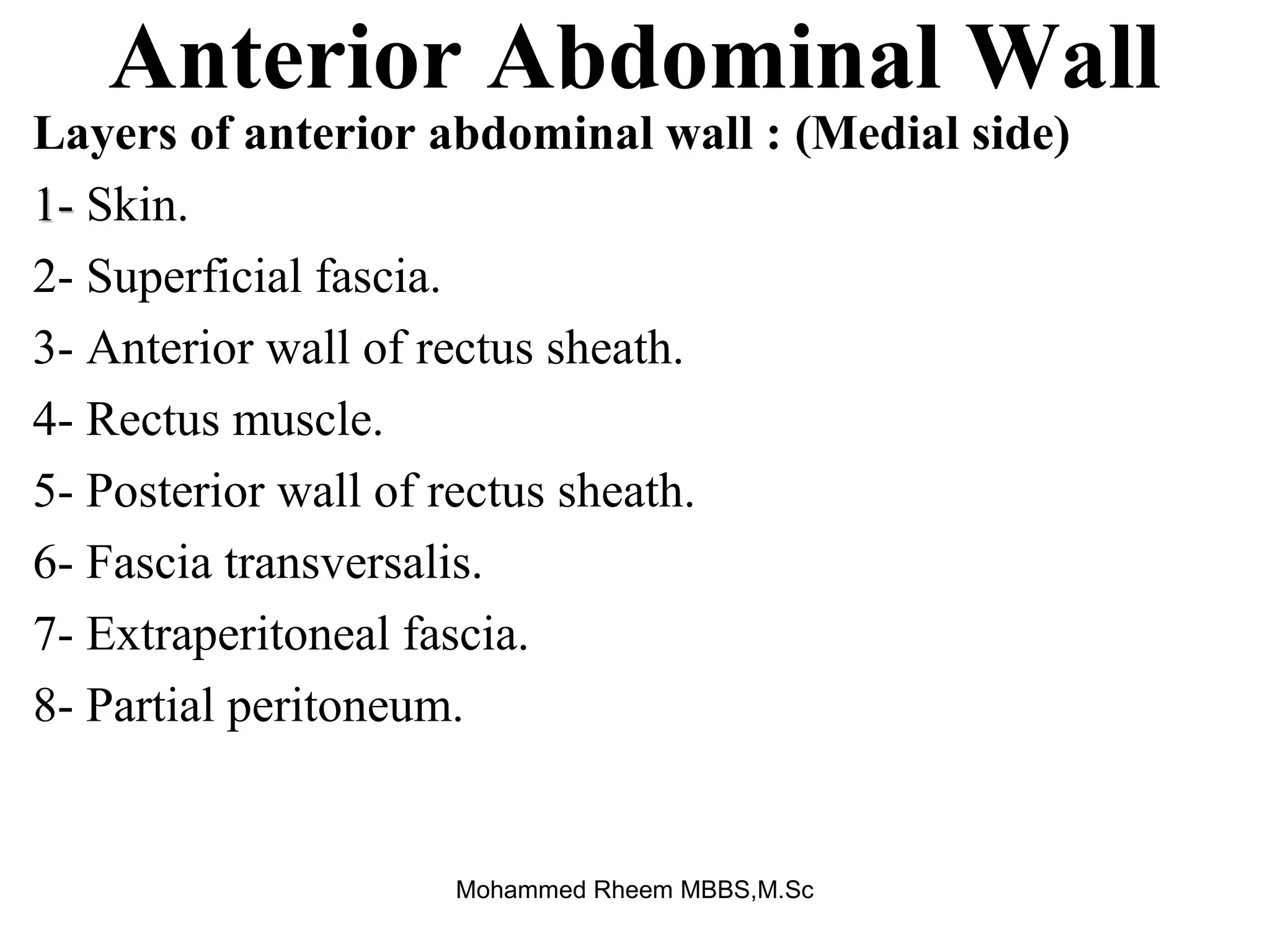
Layers of anterior abdominal wall : (Medial side)
1-1- Skin.
2- Superficial fascia.
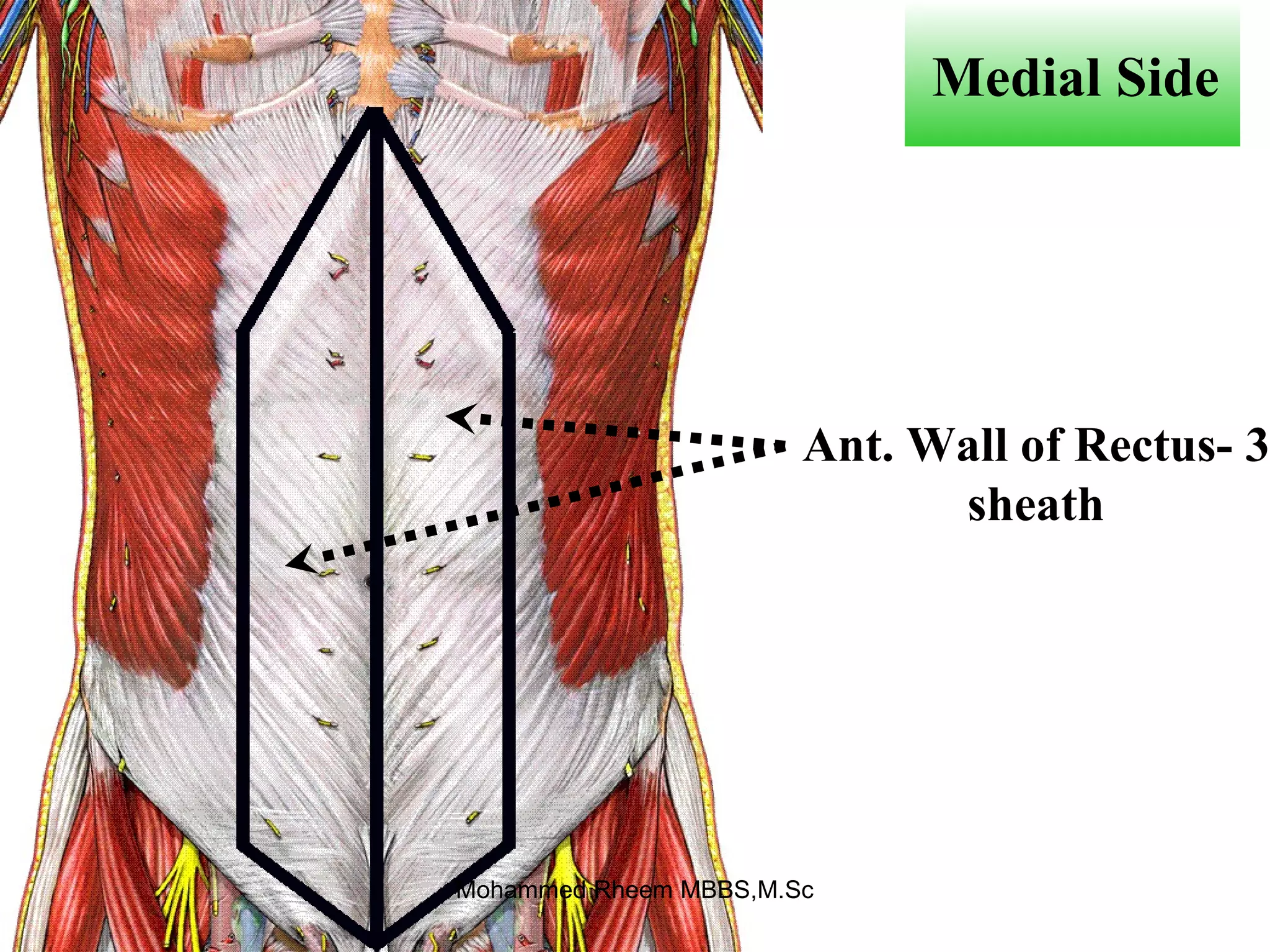
3- Anterior wall of rectus sheath.
4- Rectus muscle.
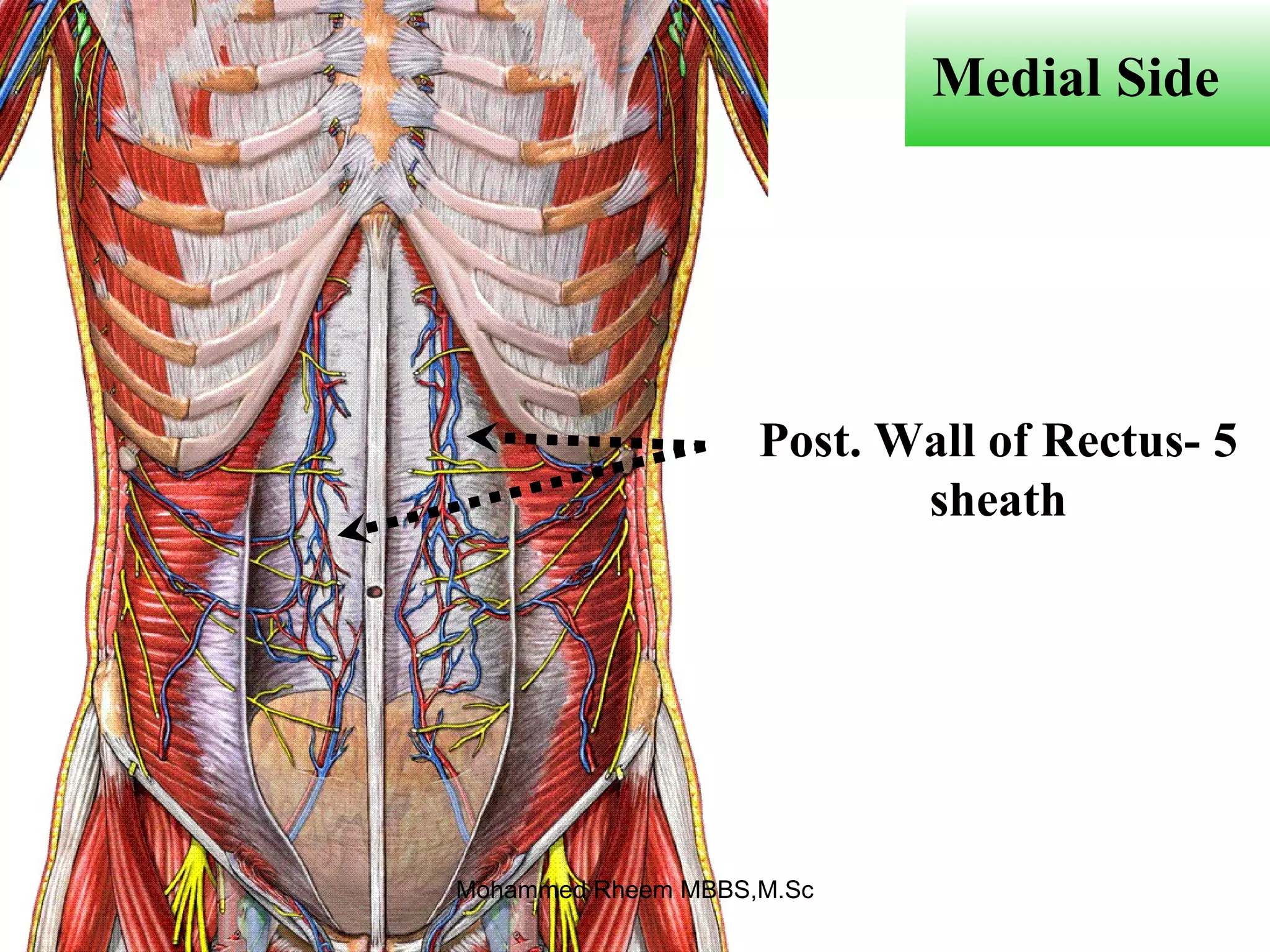
5- Posterior wall of rectus sheath.
6- Fascia transversalis.
7- Extraperitoneal fascia.
8- Partial peritoneum.
Mohammed Rheem MBBS,M.Sc
1-Skin
Medial Side
Mohammed Rheem MBBS,M.Sc
2-Superficial fascia
Medial Side
Mohammed Rheem MBBS,M.Sc
3-Ant. Wall of Rectus
sheath
Medial Side
Mohammed Rheem MBBS,M.Sc
4-Rectus Muscle
Medial Side
Mohammed Rheem MBBS,M.Sc
Medial Side
5-Post. Wall of Rectus
sheath
Mohammed Rheem MBBS,M.Sc
6-Fascia Transversalis
Medial Side
Mohammed Rheem MBBS,M.Sc
7- Extraperitoneal fascia
Medial Side
Mohammed Rheem MBBS,M.Sc
Medial Side
8-partial peritoneum
Mohammed Rheem MBBS,M.Sc
Skin of the anterior abdominal wall
 Lines of cleavage in the skin run downward and forward
almost horizontally around the trunk
 An incision along a cleavage line will heal as a narrow
scar, while one that crosses the lines will heal as a wide
scar
Mohammed Rheem MBBS,M.Sc
Cutaneous nerves of anterior abdominal wall
 It is derived from the anterior
rami of the lower six thoracic
and first lumbar nerves
 Thoracic nerves are the
lower five intercostal and
the subcostal nerves
 First lumbar nerve is
represented by the
iliohypogastric and
ilioinguinal nerves
Mohammed Rheem MBBS,M.Sc
Dermatomes of the anterolateral abdominal wall
Mohammed Rheem MBBS,M.Sc
Cutaneous arteries of anterior abdominal wall
 Skin near the midline is
supplied by branches of the
superior epigastric artery
( internal thoracic artery)
and the inferior epigastric artery
( external iliac artery)
 Skin of the flanks is
supplied by branches from
intercostal, lumbar and deep
circumflex iliac arteries
Mohammed Rheem MBBS,M.Sc
Cutaneous veins of anterior abdominal wall
 Venous blood is collected
into a network of veins that
radiate from the umbilicus
 The network is drained
above into the axillary vein via
the lateral thoracic vein
 Below into the femoral vein
via the superficial epigastric
and the great saphenous veins
 Few small veins, the paraumbilical
veins form a clinically important portal-system
venous anastomosis
Mohammed Rheem MBBS,M.Sc
Caput Medusae
 The superficial veins
around the umbilicus and
the paraumbilical veins
connecting them to the portal
vein may become grossly
distended in case of portal
vein obstruction
 The distended subcutaneous
veins radiate out from the
umbilicus, producing in severe
cases the clinical picture called
Caput Medusae
Mohammed Rheem MBBS,M.Sc
Superficial Lymphatics of anterior abdominal wall
 Lymph drainage of the skin
of the anterior abdominal wall
above the umbilicus is upward
to the anterior axillary
(pectoral group of nodes)
 Below the level of umbilicus
drains downward and laterally
to the superficial inguinal nodes
 A few drain medially and
deeply to the parasternal
and anteriordiaphragmatic
lymph nodes Mohammed Rheem MBBS,M.Sc
Superficial fascia of anterior abdominal wall
 Superficial fatty layer (Camper’s fascia)
 Deeper membranous layer (Scarpa’s fascia)
Mohammed Rheem MBBS,M.Sc
Clinical note: fluids leak deep to the
membranous layer.
Deep to Membranous layer is a potential
space where fluid may accumulate
(e.g., urine from a ruptured urethra).
Fluids cannot spread inferiorly into the
thigh because the membranous layer
fuses with the deep fascia of the thigh
(fascia lata).
Mohammed Rheem MBBS,M.Sc
Muscles of the anterior abdominal wall
The muscles of the anterior abdominal wall includes
 External Oblique Muscle
 Internal Oblique Muscle
 Transversus Abdominis Muscle
 Rectus Abdominis Muscle
 Pyramidalis Muscle
Mohammed Rheem MBBS,M.Sc
External Oblique Muscle
OriginOrigin
Fleshy digitations from
the lower 8 ribs
Mohammed Rheem MBBS,M.Sc
External Oblique Muscle
The muscle is inserted by fleshy
fibers as well as aponeurosis, as
follows:
A- Fleshy fibers:
Outer lip of the iliac crest
B- Aponeurosis:
1. Medial part → linea alba from xiphoid process
to symphysis pubis
2. Lateral part → folded upwards & backwards
upon itself to form the inguinal ligament (ASIS
→ pubic tubercle)
Insertion
Xiphoid
Process
Symphysis
Pubis
Mohammed Rheem MBBS,M.Sc
External Oblique Muscle
Direction of fibers
Downwards
Forwards
Medially
Mohammed Rheem MBBS,M.Sc
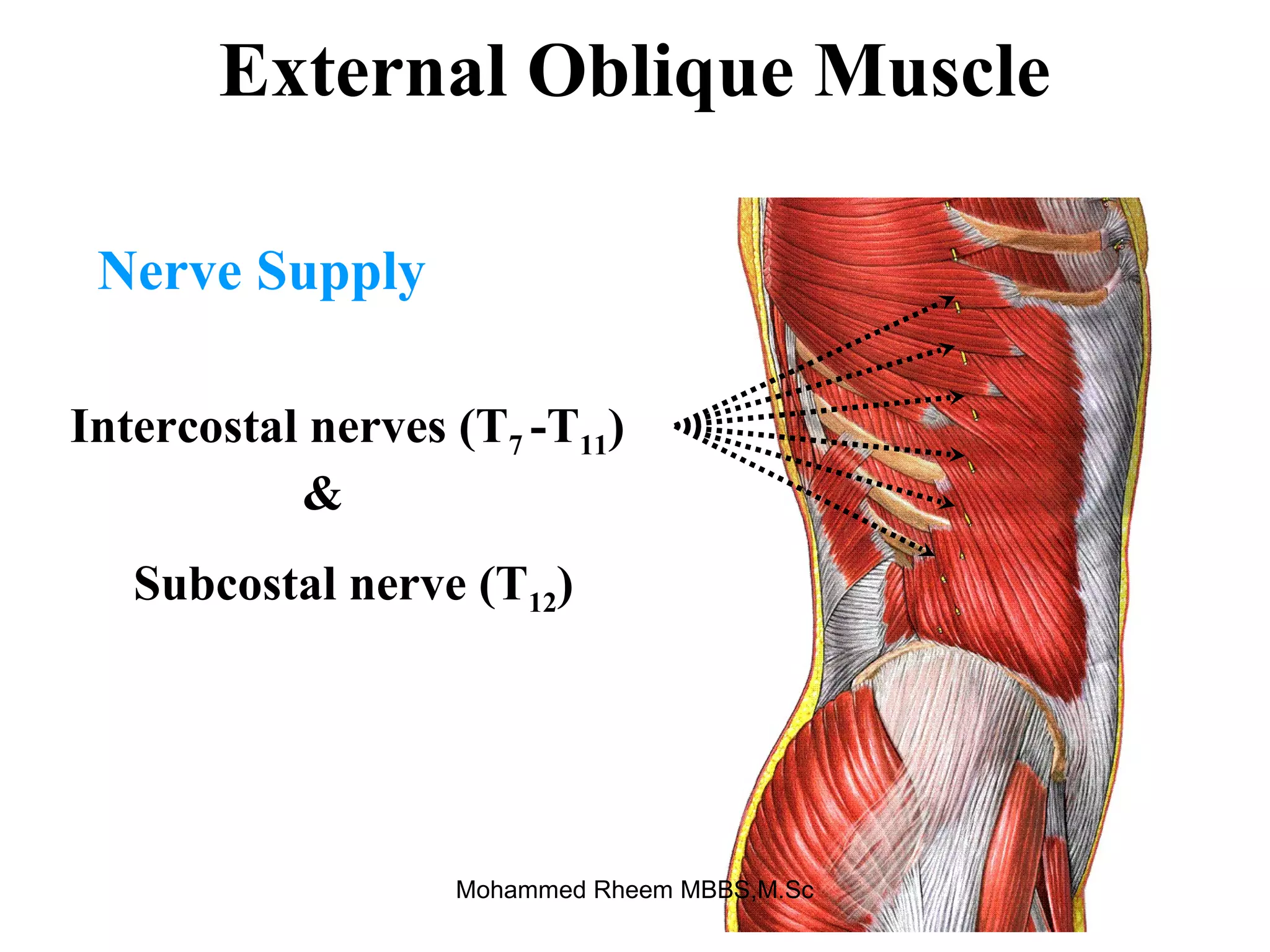
External Oblique Muscle
Nerve Supply
Intercostal nerves (T7 -T11)
&
Subcostal nerve (T12)
Mohammed Rheem MBBS,M.Sc
Internal Oblique Muscle
Origin
Insertion
1. Anterior 2/3 of the intermediate line of the iliac
crest
2. The lateral 2/3 of the inguinal ligament
3. Lumbar fascia
1. Lower 6 costal cartilages
2. Xiphoid process
3. Linea Alba
4. Pubic crest
5. Pectineal line
Mohammed Rheem MBBS,M.Sc
Internal Oblique Muscle
Direction of fibers
Upwards
Forwards
Medially
Nerve Supply
T7-T12
Iliohypogastric n.
Ilioinguinal n. Mohammed Rheem MBBS,M.Sc
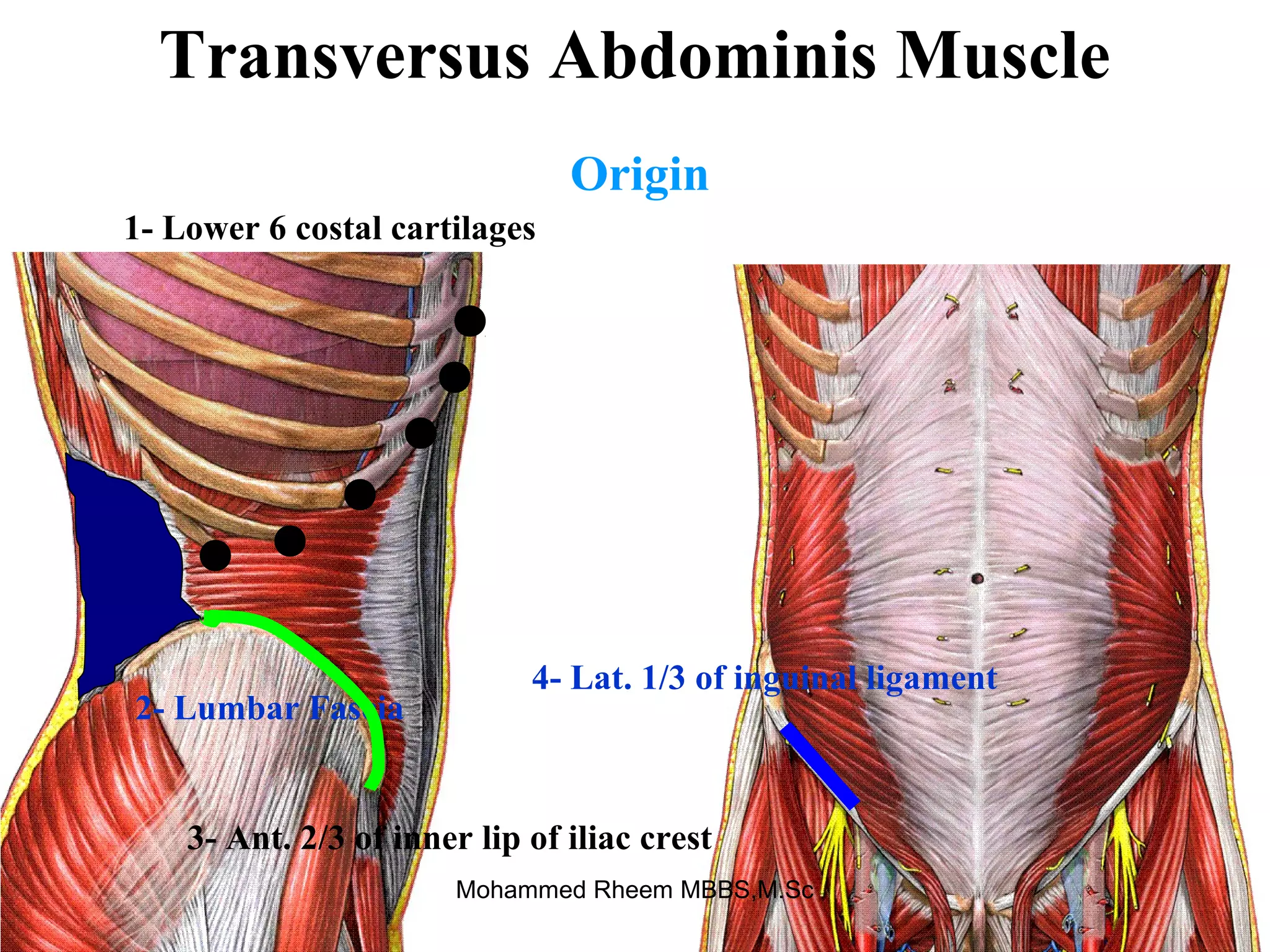
Transversus Abdominis Muscle
Origin
1- Lower 6 costal cartilages
2- Lumbar Fascia
3- Ant. 2/3 of inner lip of iliac crest
4- Lat. 1/3 of inguinal ligament
Mohammed Rheem MBBS,M.Sc
Transversus Abdominis Muscle
Insertion
1- Xiphoid Process
2- Pubic Crest
and Pectineal
line
3- Linea Alba
Mohammed Rheem MBBS,M.Sc
Direction of fibers
Transversus Abdominis Muscle
Horizontally
Mohammed Rheem MBBS,M.Sc
Nerve Supply
Transversus Abdominis Muscle
T7-T12
Iliohypogastric n.
Ilioinguinal n.
Mohammed Rheem MBBS,M.Sc
Rectus Abdominis
Muscle
Origin
From the pubic crest
Pubic symphysis
Insertion
7th, 6th, 5th costal cartilages
Xiphoid process
Nerve Supply
Intercostal nerves (T7 -T11)
&
Subcostal nerve (T12)
Mohammed Rheem MBBS,M.Sc
Rectus Abdominis
Muscle
The muscle is divided intoThe muscle is divided into
segments by tendinoussegments by tendinous
intersections, Which indicate thatintersections, Which indicate that
the muscle arises from a number ofthe muscle arises from a number of
myotomes, fused togethermyotomes, fused together
Mohammed Rheem MBBS,M.Sc
Pyramidalis Muscle
It is a landmark of linea
alba intraoperative
Mohammed Rheem MBBS,M.Sc
Actions of anterior abdominal wall muscles
 They assist in raising the intra-abdominal pressure (so,
they help in vomiting, cough, delivery, etc….)
 Keep the abdominal viscera in position.
 Movements of the trunk
 Flexion of the trunk by rectus abdominis
 Lateral flexion by on sided contraction of 2 oblique
muscles
 Rotation of the trunk by a combined action of the external
oblique with the opposite internal oblique muscles.
 Act as accessory expiratory muscles.
Mohammed Rheem MBBS,M.Sc
Medially
Laterally
Rectus Sheath
Linea AlbaLinea Alba
Linea Semilunaris
Arcuate Line
Mohammed Rheem MBBS,M.Sc
Rectus Sheath
Falciform Ligament
External Oblique
Internal Oblique
Transversus AbdominisTransversus Abdominis
Ant. Layer of Rectus Sheath
Post. Layer of Rectus SheathPost. Layer of Rectus Sheath
Rectus Abdominis
Above Arcuate Line
SKINSKIN
PeritoneumPeritoneum
Transverslais FasciaTransverslais Fascia
Mohammed Rheem MBBS,M.Sc
Rectus Sheath
External Oblique
Internal Oblique
Transversus Abdominis
Ant. Layer of Rectus Sheath
Rectus Abdominis
Below Arcuate Line
Urachus in Median Umbilical Fold
Medial Umbilical Ligament
Transverslais Fascia
SKIN
Peritoneum
Mohammed Rheem MBBS,M.Sc
Contents of
Rectus Sheath
Function of
Rectus Sheath
Mohammed Rheem MBBS,M.Sc
Deep arteries of the anterior abdominal wall
Mohammed Rheem MBBS,M.Sc
Deep nerves of the anterior abdominal wall
Mohammed Rheem MBBS,M.Sc
Regions of the abdomen
Mohammed Rheem MBBS,M.Sc
Abdominal incision
 Median or midline incisions
 Paramedian incisions
 Oblique and transverse incisions
 Gridiron (muscle-splitting) incisions
 Suprapubic (Pfannenstiel) incisions
 Subcostal incisions
Mohammed Rheem MBBS,M.Sc
Surface anatomy of the anterior abdominal wall
Mohammed Rheem MBBS,M.Sc
Inguinal canal
Mohammed Rheem MBBS,M.Sc
Inguinal Canal
 It is an oblique passage
through the lower part of
the anterior abdominal wall
 Present in both sexes
 In male it permit the
passage of the spermatic cord
 In females it permits the
passage of the round ligament
of the uterus
 Transmits ilioinguinal
nerve in both sexes
Mohammed Rheem MBBS,M.Sc
Inguinal Canal
 It is about 1 ½ inches or 4cm long in the adults
 Extends from the deep inguinal
ring downward and medially
to the superficial inguinal ring
 Lies parallel to and immediately
above the inguinal ligament
 Function of the inguinal canal
Mohammed Rheem MBBS,M.Sc
Deep Inguinal Ring
 It is an oval opening in the fascia transversalis
 Lies about ½ inch (1.3cm) above the inguinal
ligament midway between the anterosuperior iliac
spine and the symphysis pubis
Mohammed Rheem MBBS,M.Sc
Superficial Inguinal Ring
 Is triangular in shape
 Lies in the aponeurosis of the external oblique muscle
 Lies immediately above and medial to the pubic tubercle
Mohammed Rheem MBBS,M.Sc
Walls of the inguinal canal
Anterior wall
Mainly by the external
oblique aponeurosis and reinforced
laterally internal oblique muscle
Posterior wall
Fascia transversalis and conjoint
tendon and reflected part of the
inguinal ligament
Roof
Arching fibers of the internal
oblique and transversus abdominis
Floor
Inguinal ligament and lacunar ligamentMohammed Rheem MBBS,M.Sc
Anterior wall of the inguinal canal
Mohammed Rheem MBBS,M.Sc
Posterior wall of the inguinal canal
Mohammed Rheem MBBS,M.Sc
Roof of the inguinal canal
Mohammed Rheem MBBS,M.Sc
Floor of the inguinal canal
Mohammed Rheem MBBS,M.Sc
The structures of the spermatic cord
 Constituents
 Duct deferens
 Arteries
 Veins
 Lymphatics
 Nerves
 Remnants of the processus vaginalis
 Covering (spermatic fasciae)
 Internal spermatic fascia
 Cremasteric fascia and cremasteric muscle
 External spermatic fascia
Mohammed Rheem MBBS,M.Sc
A Brief Mention of Hernias
Hernias are abnormal outpouchings of the
abdominal contents (such as the small
intestine(
from the cavity in which they belong.
There are two main types of hernias that
occur at the inguinal region. Direct hernia
and indirect hernia
Mohammed Rheem MBBS,M.Sc
Direct inguinal:
Occurs in older men (rarely women(.
Due to weakness in abdominal wall
behind or lateral to superficial inguinal ring.
Passes directly through abdominal wall to
superficial inguinal ring.
Does not extend into scrotum.
Has sac formed by peritoneum
Mohammed Rheem MBBS,M.Sc
HESSELBACH’S TRIANGLE
Hesselbach’s (Inguinal) Triangle is an
important structure as it is the site for
direct hernias. The triangle has the
following borders:
1)Medial border of rectus
abdominus(medially)
2)Inguinal ligament (inferiorly)
3)Inferior epigastric vessels(laterally)
Mohammed Rheem MBBS,M.Sc
Direct inguinal hernia
Mohammed Rheem MBBS,M.Sc
DIRECT INGUINAL HERNIA
Mohammed Rheem MBBS,M.Sc
Indirect inguinal hernia
Mohammed Rheem MBBS,M.Sc
Indirect inguinal:
An indirect hernia occurs when a hernial
sac enters the deep inguinal ring lateral to
the inferior epigastric artery and passes
indirectly to the superficial ring through
the inguinal canal.
Indirect hernias are the most common type of
hernia in both men and women
CAUSE: Persistence of all or part of the
embryonic processus vaginalis results in
various inguinal anomaliesMohammed Rheem MBBS,M.Sc
LARGE INDIRECT INGUINAL HERNIA
Mohammed Rheem MBBS,M.Sc
Thank you
Mohammed Rheem MBBS,M.Sc

anterior abdominal wall

  • 1.
    University of dongola Facultyof medicine Anterior abdominal wall By: Dr.mohammed A.rheem. Lecturer of clinical anatomy Vascular surgery Resident Mohammed Rheem MBBS,M.Sc
  • 2.
  • 3.
    Think about this Nadiris 22-year-old house officer, he was attending his first day in the hospital after graduation when the senior doctor asked him to write down the operation sheet for several surgeries done at that morning, he faced some difficulties in the following: Mohammed Rheem MBBS,M.Sc
  • 4.
    By the endof this lecture, try to answer these questions about the previous story: 1.What are the nine areas dividing the anterior abdominal wall in surface anatomy? 2.Mention the suitable incision for the following surgical operations: A.Appendectomy. B.Cholecystectomy. C.Cesarean Section. Mohammed Rheem MBBS,M.Sc
  • 5.
    3.Mention the siteof the pain in the following conditions: A.Appendicitis. B.Cholecystitis Mohammed Rheem MBBS,M.Sc
  • 6.
    Anterior Abdominal Wall Layersof anterior abdominal wall : (Lateral side) 1- Skin. 2- Superficial fascia. 3- External oblique muscle. 4- Internal oblique muscle. 5- Transversus abdominis muscle. 6- Fascia transversalis. 7- Extraperitoneal fascia 8- Partial peritoneum. Mohammed Rheem MBBS,M.Sc
  • 7.
  • 8.
  • 9.
    3-External Oblique m. LateralSide Mohammed Rheem MBBS,M.Sc
  • 10.
    4-Internal Oblique m. LateralSide Mohammed Rheem MBBS,M.Sc
  • 11.
  • 12.
    6- Fascia Transversalis LateralSide Mohammed Rheem MBBS,M.Sc
  • 13.
    7- Extraperitoneal fascia LateralSide Mohammed Rheem MBBS,M.Sc
  • 14.
    8- partial peritoneum LateralSide Mohammed Rheem MBBS,M.Sc
  • 15.
    Anterior Abdominal Wall Layersof anterior abdominal wall : (Medial side) 1-1- Skin. 2- Superficial fascia. 3- Anterior wall of rectus sheath. 4- Rectus muscle. 5- Posterior wall of rectus sheath. 6- Fascia transversalis. 7- Extraperitoneal fascia. 8- Partial peritoneum. Mohammed Rheem MBBS,M.Sc
  • 16.
  • 17.
  • 18.
    3-Ant. Wall ofRectus sheath Medial Side Mohammed Rheem MBBS,M.Sc
  • 19.
  • 20.
    Medial Side 5-Post. Wallof Rectus sheath Mohammed Rheem MBBS,M.Sc
  • 21.
  • 22.
    7- Extraperitoneal fascia MedialSide Mohammed Rheem MBBS,M.Sc
  • 23.
  • 24.
    Skin of theanterior abdominal wall  Lines of cleavage in the skin run downward and forward almost horizontally around the trunk  An incision along a cleavage line will heal as a narrow scar, while one that crosses the lines will heal as a wide scar Mohammed Rheem MBBS,M.Sc
  • 25.
  • 26.
    Cutaneous nerves ofanterior abdominal wall  It is derived from the anterior rami of the lower six thoracic and first lumbar nerves  Thoracic nerves are the lower five intercostal and the subcostal nerves  First lumbar nerve is represented by the iliohypogastric and ilioinguinal nerves Mohammed Rheem MBBS,M.Sc
  • 27.
    Dermatomes of theanterolateral abdominal wall Mohammed Rheem MBBS,M.Sc
  • 28.
    Cutaneous arteries ofanterior abdominal wall  Skin near the midline is supplied by branches of the superior epigastric artery ( internal thoracic artery) and the inferior epigastric artery ( external iliac artery)  Skin of the flanks is supplied by branches from intercostal, lumbar and deep circumflex iliac arteries Mohammed Rheem MBBS,M.Sc
  • 29.
    Cutaneous veins ofanterior abdominal wall  Venous blood is collected into a network of veins that radiate from the umbilicus  The network is drained above into the axillary vein via the lateral thoracic vein  Below into the femoral vein via the superficial epigastric and the great saphenous veins  Few small veins, the paraumbilical veins form a clinically important portal-system venous anastomosis Mohammed Rheem MBBS,M.Sc
  • 30.
    Caput Medusae  Thesuperficial veins around the umbilicus and the paraumbilical veins connecting them to the portal vein may become grossly distended in case of portal vein obstruction  The distended subcutaneous veins radiate out from the umbilicus, producing in severe cases the clinical picture called Caput Medusae Mohammed Rheem MBBS,M.Sc
  • 31.
    Superficial Lymphatics ofanterior abdominal wall  Lymph drainage of the skin of the anterior abdominal wall above the umbilicus is upward to the anterior axillary (pectoral group of nodes)  Below the level of umbilicus drains downward and laterally to the superficial inguinal nodes  A few drain medially and deeply to the parasternal and anteriordiaphragmatic lymph nodes Mohammed Rheem MBBS,M.Sc
  • 32.
    Superficial fascia ofanterior abdominal wall  Superficial fatty layer (Camper’s fascia)  Deeper membranous layer (Scarpa’s fascia) Mohammed Rheem MBBS,M.Sc
  • 33.
    Clinical note: fluidsleak deep to the membranous layer. Deep to Membranous layer is a potential space where fluid may accumulate (e.g., urine from a ruptured urethra). Fluids cannot spread inferiorly into the thigh because the membranous layer fuses with the deep fascia of the thigh (fascia lata). Mohammed Rheem MBBS,M.Sc
  • 34.
    Muscles of theanterior abdominal wall The muscles of the anterior abdominal wall includes  External Oblique Muscle  Internal Oblique Muscle  Transversus Abdominis Muscle  Rectus Abdominis Muscle  Pyramidalis Muscle Mohammed Rheem MBBS,M.Sc
  • 35.
    External Oblique Muscle OriginOrigin Fleshydigitations from the lower 8 ribs Mohammed Rheem MBBS,M.Sc
  • 36.
    External Oblique Muscle Themuscle is inserted by fleshy fibers as well as aponeurosis, as follows: A- Fleshy fibers: Outer lip of the iliac crest B- Aponeurosis: 1. Medial part → linea alba from xiphoid process to symphysis pubis 2. Lateral part → folded upwards & backwards upon itself to form the inguinal ligament (ASIS → pubic tubercle) Insertion Xiphoid Process Symphysis Pubis Mohammed Rheem MBBS,M.Sc
  • 37.
    External Oblique Muscle Directionof fibers Downwards Forwards Medially Mohammed Rheem MBBS,M.Sc
  • 38.
    External Oblique Muscle NerveSupply Intercostal nerves (T7 -T11) & Subcostal nerve (T12) Mohammed Rheem MBBS,M.Sc
  • 39.
    Internal Oblique Muscle Origin Insertion 1.Anterior 2/3 of the intermediate line of the iliac crest 2. The lateral 2/3 of the inguinal ligament 3. Lumbar fascia 1. Lower 6 costal cartilages 2. Xiphoid process 3. Linea Alba 4. Pubic crest 5. Pectineal line Mohammed Rheem MBBS,M.Sc
  • 40.
    Internal Oblique Muscle Directionof fibers Upwards Forwards Medially Nerve Supply T7-T12 Iliohypogastric n. Ilioinguinal n. Mohammed Rheem MBBS,M.Sc
  • 41.
    Transversus Abdominis Muscle Origin 1-Lower 6 costal cartilages 2- Lumbar Fascia 3- Ant. 2/3 of inner lip of iliac crest 4- Lat. 1/3 of inguinal ligament Mohammed Rheem MBBS,M.Sc
  • 42.
    Transversus Abdominis Muscle Insertion 1-Xiphoid Process 2- Pubic Crest and Pectineal line 3- Linea Alba Mohammed Rheem MBBS,M.Sc
  • 43.
    Direction of fibers TransversusAbdominis Muscle Horizontally Mohammed Rheem MBBS,M.Sc
  • 44.
    Nerve Supply Transversus AbdominisMuscle T7-T12 Iliohypogastric n. Ilioinguinal n. Mohammed Rheem MBBS,M.Sc
  • 45.
    Rectus Abdominis Muscle Origin From thepubic crest Pubic symphysis Insertion 7th, 6th, 5th costal cartilages Xiphoid process Nerve Supply Intercostal nerves (T7 -T11) & Subcostal nerve (T12) Mohammed Rheem MBBS,M.Sc
  • 46.
    Rectus Abdominis Muscle The muscleis divided intoThe muscle is divided into segments by tendinoussegments by tendinous intersections, Which indicate thatintersections, Which indicate that the muscle arises from a number ofthe muscle arises from a number of myotomes, fused togethermyotomes, fused together Mohammed Rheem MBBS,M.Sc
  • 47.
    Pyramidalis Muscle It isa landmark of linea alba intraoperative Mohammed Rheem MBBS,M.Sc
  • 48.
    Actions of anteriorabdominal wall muscles  They assist in raising the intra-abdominal pressure (so, they help in vomiting, cough, delivery, etc….)  Keep the abdominal viscera in position.  Movements of the trunk  Flexion of the trunk by rectus abdominis  Lateral flexion by on sided contraction of 2 oblique muscles  Rotation of the trunk by a combined action of the external oblique with the opposite internal oblique muscles.  Act as accessory expiratory muscles. Mohammed Rheem MBBS,M.Sc
  • 49.
    Medially Laterally Rectus Sheath Linea AlbaLineaAlba Linea Semilunaris Arcuate Line Mohammed Rheem MBBS,M.Sc
  • 50.
    Rectus Sheath Falciform Ligament ExternalOblique Internal Oblique Transversus AbdominisTransversus Abdominis Ant. Layer of Rectus Sheath Post. Layer of Rectus SheathPost. Layer of Rectus Sheath Rectus Abdominis Above Arcuate Line SKINSKIN PeritoneumPeritoneum Transverslais FasciaTransverslais Fascia Mohammed Rheem MBBS,M.Sc
  • 51.
    Rectus Sheath External Oblique InternalOblique Transversus Abdominis Ant. Layer of Rectus Sheath Rectus Abdominis Below Arcuate Line Urachus in Median Umbilical Fold Medial Umbilical Ligament Transverslais Fascia SKIN Peritoneum Mohammed Rheem MBBS,M.Sc
  • 52.
    Contents of Rectus Sheath Functionof Rectus Sheath Mohammed Rheem MBBS,M.Sc
  • 53.
    Deep arteries ofthe anterior abdominal wall Mohammed Rheem MBBS,M.Sc
  • 54.
    Deep nerves ofthe anterior abdominal wall Mohammed Rheem MBBS,M.Sc
  • 55.
    Regions of theabdomen Mohammed Rheem MBBS,M.Sc
  • 56.
    Abdominal incision  Medianor midline incisions  Paramedian incisions  Oblique and transverse incisions  Gridiron (muscle-splitting) incisions  Suprapubic (Pfannenstiel) incisions  Subcostal incisions Mohammed Rheem MBBS,M.Sc
  • 57.
    Surface anatomy ofthe anterior abdominal wall Mohammed Rheem MBBS,M.Sc
  • 58.
  • 59.
    Inguinal Canal  Itis an oblique passage through the lower part of the anterior abdominal wall  Present in both sexes  In male it permit the passage of the spermatic cord  In females it permits the passage of the round ligament of the uterus  Transmits ilioinguinal nerve in both sexes Mohammed Rheem MBBS,M.Sc
  • 60.
    Inguinal Canal  Itis about 1 ½ inches or 4cm long in the adults  Extends from the deep inguinal ring downward and medially to the superficial inguinal ring  Lies parallel to and immediately above the inguinal ligament  Function of the inguinal canal Mohammed Rheem MBBS,M.Sc
  • 61.
    Deep Inguinal Ring It is an oval opening in the fascia transversalis  Lies about ½ inch (1.3cm) above the inguinal ligament midway between the anterosuperior iliac spine and the symphysis pubis Mohammed Rheem MBBS,M.Sc
  • 62.
    Superficial Inguinal Ring Is triangular in shape  Lies in the aponeurosis of the external oblique muscle  Lies immediately above and medial to the pubic tubercle Mohammed Rheem MBBS,M.Sc
  • 63.
    Walls of theinguinal canal Anterior wall Mainly by the external oblique aponeurosis and reinforced laterally internal oblique muscle Posterior wall Fascia transversalis and conjoint tendon and reflected part of the inguinal ligament Roof Arching fibers of the internal oblique and transversus abdominis Floor Inguinal ligament and lacunar ligamentMohammed Rheem MBBS,M.Sc
  • 64.
    Anterior wall ofthe inguinal canal Mohammed Rheem MBBS,M.Sc
  • 65.
    Posterior wall ofthe inguinal canal Mohammed Rheem MBBS,M.Sc
  • 66.
    Roof of theinguinal canal Mohammed Rheem MBBS,M.Sc
  • 67.
    Floor of theinguinal canal Mohammed Rheem MBBS,M.Sc
  • 68.
    The structures ofthe spermatic cord  Constituents  Duct deferens  Arteries  Veins  Lymphatics  Nerves  Remnants of the processus vaginalis  Covering (spermatic fasciae)  Internal spermatic fascia  Cremasteric fascia and cremasteric muscle  External spermatic fascia Mohammed Rheem MBBS,M.Sc
  • 69.
  • 70.
    A Brief Mentionof Hernias Hernias are abnormal outpouchings of the abdominal contents (such as the small intestine( from the cavity in which they belong. There are two main types of hernias that occur at the inguinal region. Direct hernia and indirect hernia Mohammed Rheem MBBS,M.Sc
  • 71.
    Direct inguinal: Occurs inolder men (rarely women(. Due to weakness in abdominal wall behind or lateral to superficial inguinal ring. Passes directly through abdominal wall to superficial inguinal ring. Does not extend into scrotum. Has sac formed by peritoneum Mohammed Rheem MBBS,M.Sc
  • 72.
    HESSELBACH’S TRIANGLE Hesselbach’s (Inguinal)Triangle is an important structure as it is the site for direct hernias. The triangle has the following borders: 1)Medial border of rectus abdominus(medially) 2)Inguinal ligament (inferiorly) 3)Inferior epigastric vessels(laterally) Mohammed Rheem MBBS,M.Sc
  • 73.
  • 74.
  • 75.
  • 76.
    Indirect inguinal: An indirecthernia occurs when a hernial sac enters the deep inguinal ring lateral to the inferior epigastric artery and passes indirectly to the superficial ring through the inguinal canal. Indirect hernias are the most common type of hernia in both men and women CAUSE: Persistence of all or part of the embryonic processus vaginalis results in various inguinal anomaliesMohammed Rheem MBBS,M.Sc
  • 77.
    LARGE INDIRECT INGUINALHERNIA Mohammed Rheem MBBS,M.Sc
  • 78.

Editor's Notes

  • #33 First one extend into penis and scrotum 2nd one is attached to the deep fascia of thigh 2.5cm below inguinal ligment It extend into perineum as colles fascia.in rupture urethra urine track into penis scrotum&perinum ito abdominal wall deep to scarpas It does not track into thigh coz attachment of scarpas to deep fascia of thigh.
  • #72 A direct hernia occurs when a hernial sac is pushed through the conjoint tendon directly towards the superficial ring. Direct hernias occur medial to the inferior epigastric vessels in Hasselbach Triangle through the floor of the inguinal canal Hasselbach’s