A Study on Illness Related Flood Disaster at Relief Centers Assoc. Prof. Dr. Rashidi Ahmad School of Medical Sciences Health Campus USM Kelantan Humanitarian Conference Putra World Trade Center 12 – 14 th  Nov 2009
Introduction On 19 Dec 2006, continuously heavy downpour occurred in State of Johor, Malaysia. Many towns such as Muar, Kota Tinggi & Segamat were seriously flooded with water levels as high as 10 feet above ground level.  Flood in Johor State was considered as the worst in the Malaysia southern region history.  Those flood victims were evacuated to the unprepared designated relief centers
Predisposing factors Living in temporary shelter or in the relief center is unpleasant memory to the flood victims.  Uncontrolled crowds, limited spaces and facilities such as clean toilet, medicines and nutritional food were predisposing factors that exposed the flood victims to various type of diseases especially viral infection.  More often there will be a mismatch between available health resources and facilities and patients need.
Objective The primary objective: provision of medical and humanitarian assistance to the flood victims. We took an opportunity  to investigate the common illnesses related to the flood disaster at relief centers The presented data could assist the medical relief team, humanitarian organizations and agencies preparedness in the future.
DEMAT The team members were comprised of 4 medical officers from HUSM + Medic Asia.  HUSM donated medical equipments and medications and Health clinics of Pagoh and Lenga provided the extra supplies.  The duration of medical assistance to the affected local community - 5 days (4th to 6th Jan 2006).
Methodology Cross sectional study, convenience sampling 5 relief centers at District of Muar, Johor - Kampung Sungai Berani, Balai Raya Kampung Jawa, Kampung Jawa Mosque, Kampung Tulang Gajah and Kampung Sentosa.  Those flood victims who registered and received the treatment were included.
Results Total = 170 patients were evaluated and treated  65 (38%) males; 105 (62%) females. The mean age = 31.89 ± 22.07 year old. 123 (72%) - an adults; 47 (28%) - children URTI = 58 of 170 visits; 34.1% URTI were common in children (20% of total visits) than an adult (14.1% of total visits).
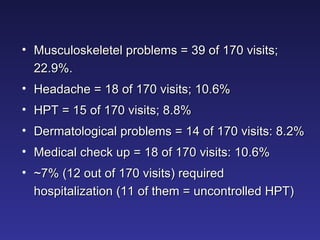
Musculoskeletel problems = 39 of 170 visits; 22.9%.  Headache = 18 of 170 visits; 10.6% HPT = 15 of 170 visits; 8.8% Dermatological problems = 14 of 170 visits: 8.2% Medical check up = 18 of 170 visits: 10.6% ~7% (12 out of 170 visits) required hospitalization (11 of them = uncontrolled HPT)
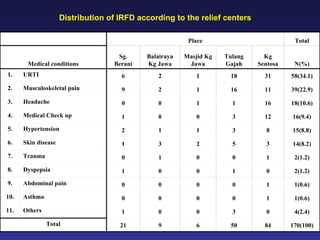
Distribution of IRFD according to the relief centers 170(100) 84 50 6 9 21 Total 4(2.4) 0 3 0 0 1 Others 11. 1(0.6) 1 0 0 0 0 Asthma 10. 1(0.6) 1 0 0 0 0 Abdominal pain 9. 2(1.2) 0 1 0 0 1 Dyspepsia 8. 2(1.2) 1 0 0 1 0 Trauma  7. 14(8.2) 3 5 2 3 1 Skin disease 6. 15(8.8) 8 3 1 1 2 Hypertension 5. 16(9.4) 12 3 0 0 1 Medical Check up 4. 18(10.6) 16 1 1 0 0 Headache 3. 39(22.9) 11 16 1 2 9 Musculoskeletal pain 2. 58(34.1) 31 18 1 2 6 URTI 1. N(%) Kg Sentosa Tulang Gajah Masjid Kg Jawa Balairaya Kg Jawa Sg. Berani Medical conditions Total Place
Discussion The occurrence of disasters creates varying degrees of chaos to the affected community.  In health perspective, disasters result in immediate medical problems, longer-term public health and emotional & social disruptions.
URTI URTI was the commonest reason of visits to the mobile clinic. Sharing a bed among the victims, physical contact, lack of sleep, more prolonged contact with carriers and difficulty in maintaining good hygiene practices are the risk factors.  In addition, over crowding may increase exposures to allergens, respiratory irritants, and infectious agents.
Musculoskeletal pain Musculoskeletal pain was common too.  We postulated that this symptom is related to the heroic phase of flood disaster whereby during this phase, people are called upon and respond to save their own and others’ lives and property.  Therefore, overuse of energy and at same time over stress predisposed the victims to such problem.
Headache Tension headache was common Disaster related stress is common among disaster survivors.  Reasons of elevated stress level include financial loss, property loss, loss of family members, crowded relief center, lack of facilities and even nervous of recurrence of flood.
Uncontrolled HPT Medical infrastructure and common road are disrupted  As a result, some of the patients have a poor accessibility to the nearest health facilities for a common treatment and continues routine medical care may not be available to survivors due to damaged healthcare facilities
Water borne illnesses There was no incidence of water borne illnesses outbreak such as diarrhea, hepatitis and cholera occurred post flood in the relief centers along the disaster event.  This reflected the effectiveness and the efficiency of the local public health authority in controlling the non-vector borne illnesses in flood disaster.
Points to ponder Providing medical care in a disaster setting is a challenge to the HCPs.  The obstacles include varying amounts of resources, type of acute illnesses & periods of time.  The mobile medical relief team bringing health care to those sick and disable victims who had a difficult access to medical facilities.  The mobile clinic is a viable option for victims who required routine medical requirements
Conclusion The common illnesses at relief centers - URTI, musculoskeletal pain, headache, HPT  Future address- over crowded relief centers & clean water supply, environmental and personal hygiene.  Hopefully the available data and the explanation will provide valuable information for our future mission on the medical preparedness and readiness post flood disaster
References World Medical Association Statement on Medical Ethics in the Event of Disasters. Adopted by the 46th WMA General Assembly Stockholm, Sweden, September 1994. Available at:  http:// www.wma.net . Accessed May 16, 2007 Auf der Heide E. Disaster Response: The principles of preparation and coordination. St. Louis: CV Mosby 1989 Dova DB, del Guercio LRLM, Stahl WM and et al. A metropolitan airport disaster plan: coordination of a multihopsital response to provide onsite resuscitation and stabilization before evacuation, J Trauma 1982; 22:550-559 Noji EK: Flood. Noji EK (ed).  The Public Health Consequences of Disaster  Oxford University Press, New York, 1997, pp 287–301.
Koido Y2005, ‘Activities of Japanese disaster relief teams against the tsunami disaster in the Indian ocean’,  Prehosp Disast Med , vol. 20(3), pp. 118s. Kondo H et al 1999, ‘The action of the Japanese disaster relief team for Nicaragua in Hurricane Mitch’,  Prehosp   Disast Med , vol. 14: Supplement. Kongsaengdao S, Bunnag S, Siriwiwattnakul N 2005, ‘Treatment of survivors after the tsunami’,  EJM , vol. 352(25), pp. 2654-2655  Morris, R.D. and R.L. Munasinghe (1994) Geographic variability in hospital admission rates for respiratory disease among the elderly in the United States.  Chest  106(4), pp. 1172-1181.Axelrod D. Primary Health care and the Midwest flood disaster. Public Health Rep 1994;109:601-605 Axelrod D. Primary Health care and the Midwest flood disaster. Public Health Rep 1994; 109:601-605 Kearns, R. A., Smith C. J. and Abbott, M. (1992) the stress of incipient homelessness,  Housing Studies  1992; Vol. 7 No 4 280-298
Thank you

Humanitarian Mercy Conference

  • 1.
    A Study onIllness Related Flood Disaster at Relief Centers Assoc. Prof. Dr. Rashidi Ahmad School of Medical Sciences Health Campus USM Kelantan Humanitarian Conference Putra World Trade Center 12 – 14 th Nov 2009
  • 2.
    Introduction On 19Dec 2006, continuously heavy downpour occurred in State of Johor, Malaysia. Many towns such as Muar, Kota Tinggi & Segamat were seriously flooded with water levels as high as 10 feet above ground level. Flood in Johor State was considered as the worst in the Malaysia southern region history. Those flood victims were evacuated to the unprepared designated relief centers
  • 3.
    Predisposing factors Livingin temporary shelter or in the relief center is unpleasant memory to the flood victims. Uncontrolled crowds, limited spaces and facilities such as clean toilet, medicines and nutritional food were predisposing factors that exposed the flood victims to various type of diseases especially viral infection. More often there will be a mismatch between available health resources and facilities and patients need.
  • 4.
    Objective The primaryobjective: provision of medical and humanitarian assistance to the flood victims. We took an opportunity to investigate the common illnesses related to the flood disaster at relief centers The presented data could assist the medical relief team, humanitarian organizations and agencies preparedness in the future.
  • 5.
    DEMAT The teammembers were comprised of 4 medical officers from HUSM + Medic Asia. HUSM donated medical equipments and medications and Health clinics of Pagoh and Lenga provided the extra supplies. The duration of medical assistance to the affected local community - 5 days (4th to 6th Jan 2006).
  • 6.
    Methodology Cross sectionalstudy, convenience sampling 5 relief centers at District of Muar, Johor - Kampung Sungai Berani, Balai Raya Kampung Jawa, Kampung Jawa Mosque, Kampung Tulang Gajah and Kampung Sentosa. Those flood victims who registered and received the treatment were included.
  • 7.
    Results Total =170 patients were evaluated and treated 65 (38%) males; 105 (62%) females. The mean age = 31.89 ± 22.07 year old. 123 (72%) - an adults; 47 (28%) - children URTI = 58 of 170 visits; 34.1% URTI were common in children (20% of total visits) than an adult (14.1% of total visits).
  • 8.
    Musculoskeletel problems =39 of 170 visits; 22.9%. Headache = 18 of 170 visits; 10.6% HPT = 15 of 170 visits; 8.8% Dermatological problems = 14 of 170 visits: 8.2% Medical check up = 18 of 170 visits: 10.6% ~7% (12 out of 170 visits) required hospitalization (11 of them = uncontrolled HPT)
  • 9.
    Distribution of IRFDaccording to the relief centers 170(100) 84 50 6 9 21 Total 4(2.4) 0 3 0 0 1 Others 11. 1(0.6) 1 0 0 0 0 Asthma 10. 1(0.6) 1 0 0 0 0 Abdominal pain 9. 2(1.2) 0 1 0 0 1 Dyspepsia 8. 2(1.2) 1 0 0 1 0 Trauma 7. 14(8.2) 3 5 2 3 1 Skin disease 6. 15(8.8) 8 3 1 1 2 Hypertension 5. 16(9.4) 12 3 0 0 1 Medical Check up 4. 18(10.6) 16 1 1 0 0 Headache 3. 39(22.9) 11 16 1 2 9 Musculoskeletal pain 2. 58(34.1) 31 18 1 2 6 URTI 1. N(%) Kg Sentosa Tulang Gajah Masjid Kg Jawa Balairaya Kg Jawa Sg. Berani Medical conditions Total Place
  • 10.
    Discussion The occurrenceof disasters creates varying degrees of chaos to the affected community. In health perspective, disasters result in immediate medical problems, longer-term public health and emotional & social disruptions.
  • 11.
    URTI URTI wasthe commonest reason of visits to the mobile clinic. Sharing a bed among the victims, physical contact, lack of sleep, more prolonged contact with carriers and difficulty in maintaining good hygiene practices are the risk factors. In addition, over crowding may increase exposures to allergens, respiratory irritants, and infectious agents.
  • 12.
    Musculoskeletal pain Musculoskeletalpain was common too. We postulated that this symptom is related to the heroic phase of flood disaster whereby during this phase, people are called upon and respond to save their own and others’ lives and property. Therefore, overuse of energy and at same time over stress predisposed the victims to such problem.
  • 13.
    Headache Tension headachewas common Disaster related stress is common among disaster survivors. Reasons of elevated stress level include financial loss, property loss, loss of family members, crowded relief center, lack of facilities and even nervous of recurrence of flood.
  • 14.
    Uncontrolled HPT Medicalinfrastructure and common road are disrupted As a result, some of the patients have a poor accessibility to the nearest health facilities for a common treatment and continues routine medical care may not be available to survivors due to damaged healthcare facilities
  • 15.
    Water borne illnessesThere was no incidence of water borne illnesses outbreak such as diarrhea, hepatitis and cholera occurred post flood in the relief centers along the disaster event. This reflected the effectiveness and the efficiency of the local public health authority in controlling the non-vector borne illnesses in flood disaster.
  • 16.
    Points to ponderProviding medical care in a disaster setting is a challenge to the HCPs. The obstacles include varying amounts of resources, type of acute illnesses & periods of time. The mobile medical relief team bringing health care to those sick and disable victims who had a difficult access to medical facilities. The mobile clinic is a viable option for victims who required routine medical requirements
  • 17.
    Conclusion The commonillnesses at relief centers - URTI, musculoskeletal pain, headache, HPT Future address- over crowded relief centers & clean water supply, environmental and personal hygiene. Hopefully the available data and the explanation will provide valuable information for our future mission on the medical preparedness and readiness post flood disaster
  • 18.
    References World MedicalAssociation Statement on Medical Ethics in the Event of Disasters. Adopted by the 46th WMA General Assembly Stockholm, Sweden, September 1994. Available at: http:// www.wma.net . Accessed May 16, 2007 Auf der Heide E. Disaster Response: The principles of preparation and coordination. St. Louis: CV Mosby 1989 Dova DB, del Guercio LRLM, Stahl WM and et al. A metropolitan airport disaster plan: coordination of a multihopsital response to provide onsite resuscitation and stabilization before evacuation, J Trauma 1982; 22:550-559 Noji EK: Flood. Noji EK (ed). The Public Health Consequences of Disaster Oxford University Press, New York, 1997, pp 287–301.
  • 19.
    Koido Y2005, ‘Activitiesof Japanese disaster relief teams against the tsunami disaster in the Indian ocean’, Prehosp Disast Med , vol. 20(3), pp. 118s. Kondo H et al 1999, ‘The action of the Japanese disaster relief team for Nicaragua in Hurricane Mitch’, Prehosp Disast Med , vol. 14: Supplement. Kongsaengdao S, Bunnag S, Siriwiwattnakul N 2005, ‘Treatment of survivors after the tsunami’, EJM , vol. 352(25), pp. 2654-2655 Morris, R.D. and R.L. Munasinghe (1994) Geographic variability in hospital admission rates for respiratory disease among the elderly in the United States. Chest 106(4), pp. 1172-1181.Axelrod D. Primary Health care and the Midwest flood disaster. Public Health Rep 1994;109:601-605 Axelrod D. Primary Health care and the Midwest flood disaster. Public Health Rep 1994; 109:601-605 Kearns, R. A., Smith C. J. and Abbott, M. (1992) the stress of incipient homelessness, Housing Studies 1992; Vol. 7 No 4 280-298
  • 20.