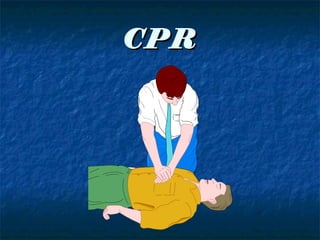
CPR
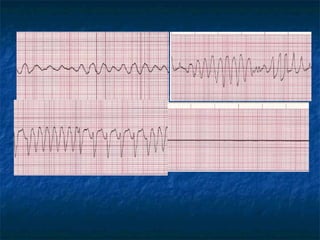
Pattern of cardiac arrest
   1-Brady-asystole.
   2-Pulseless electrical activity. (PEA)
   3-Ventricular fibrillation, Pulseless
    Ventricular tachycardia.
Causes of reversible cardiac arrest

         H                           T
   Hypoxia.                 Toxin.
   Hypovolaemia.            Thrombus Pulmonary
   Hypoglycemia.             embolism.
   Hypothermia.             Thrombus acute
   H+ions Acidosis.          coronary syndrome.
   Hypo- hyperkalemia.
                             Tension
                              pneumothorax.
                             Tamponade cardiac.
The primary survey
   Airway: Open the airway
   Breathing: Provide positive-pressure
    ventilation.
   Circulation: Give chest compressions.
   Defibrillation:     Identify   and     shock
    ventricular fibrillation (VF) and ventricular
    tachycardia (VT)
Airway
Assessment:
 1- look for respiratory activity.

 2-listen for breathing.

 3- feel for air exchange at the patient’s nose and mouth.

If these are present,
assess the patient’s ability to protect the airway by asking
   them to speak.
If the patient does not respond to questions, the absence
   of a strong gag reflex:
 confirms the inadequacy of protective airway mechanisms
   steps must be taken to provide airway support.
Steps to support airway
   1- immediately call for assistance.
   2- place the patient in a supine position.
be careful in a patient with neck trauma in-line stabilization
  of the cervical spine. This is performed by keeping one
  hand behind the head and neck while the other hand
  rolls the patient toward you.
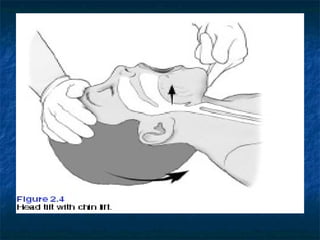
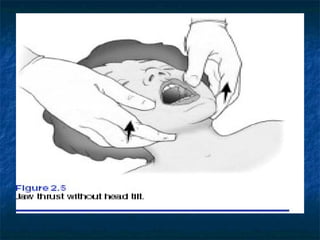
   3- open airway: use the head tilt-chin lift
    maneuver or the jaw thrust maneuver.
   4- Remove foreign material.
Breathing
   1- bag-valve mask.(2 sec) if unsuccessful.
   2-reposition the head and mask and try again.
    If unsuccessful, (obstructed airway).
   3- Open the patient’s mouth by grasping both
    the tongue and the lower jaw between the
    thumb and fingers, and then lift the mandible. If
    you see obstructing material.
   4- use a McGill forceps or clamp to remove it. If
    this equipment is not available, slide your index
    finger down the inside of the cheek to the base
    of the tongue and dislodge any foreign bodies
    using a hooking action. (if unsuccessful).
Breathing-2
   5- Abdominal thrusts.
   6- Reattempt ventilation.
        Rate 8-10 breaths  min
Circulation
   check for a carotid pulse.( the most
    central of the peripheral arteries).
   If no pulse is present, chest compressions
    should be initiated and the patient should
    be placed on a cardiac monitor.
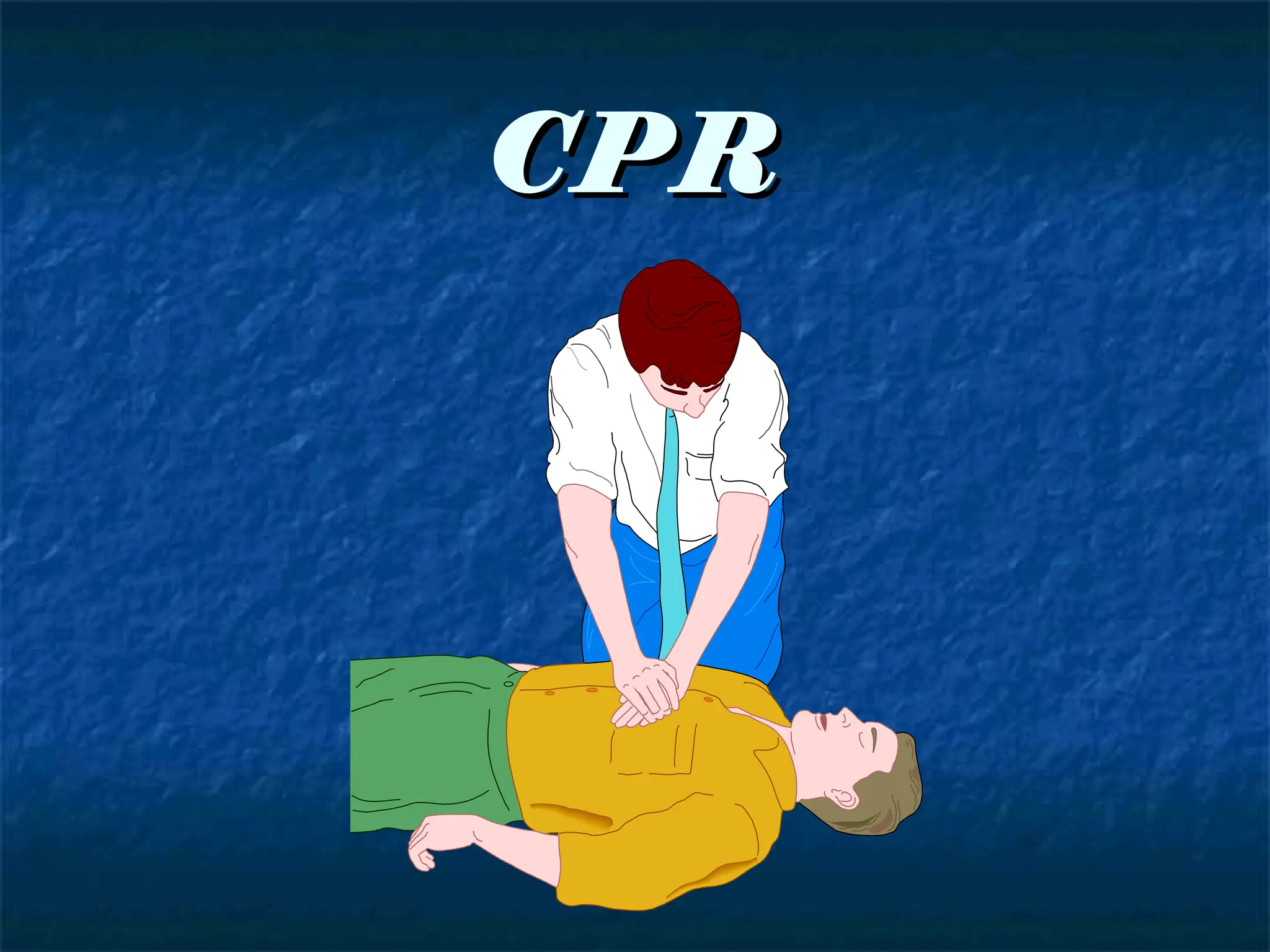
   To adequately perform chest compressions, the
    heel of one hand should be placed in the midline
    on the lower part of the sternum (just above the
    notch where the ribs meet the lower sternum).
   The other hand is placed on top of the first hand
    and the fingers interlocked and kept off of the
    chest.
   Position your shoulders directly over your hands
    and lock your elbows.
   Depress the sternum about 1.5–2 inches
    approximately 100 times per minute.
   Properly performed compressions can produce a
    systolic blood pressure of 60mmHg.
Defibrillation
      When defibrillation can be successful
  performed within the first minute or two,
as many as 90% of patients return to their
   pre-arrest neurologic status. The longer
  the patient remains in cardiac arrest, the
          more likely that defibrillation and
resuscitation will be unsuccessful. Survival
       rates are 10% when defibrillation is
       delayed 10 minutes or more after a
                          patient’s collapse.
   Deliver an electric shock to convert the
    nonperfusing rhythm to a perfusing one.
   one paddle should be placed to the right
    of the sternum below the right clavicle and
    the other in the midaxillary line at the
    level of the nipple.
   Firm pressure of approximately 25 lb
    should be applied to each paddle.
   Alternatively, “hands off” defibrillator pads
    can be used that are placed on the chest
    and the back, sandwiching the heart.
Types of defibrillator
   Monophasic
   Biphasic

     Less energy needed with
    biphasic
Prepare patient
   Correct reversible causes
   Check lanoxin level
   12 leads ECG before & after shock
   Iv line present
   Monitoring circulation and respiration
   Fasting 8 hr , sedation if elective
    cardioversion.
Size of paddle
   Adult debrillation, both handheld paddle
    electrodes     and    self-adhesive pad
    electrodes 8—12 cm in diameter are used
    and function well.
   Debrillation success may be higher with
    electrodes of 12-cm diameter compared
    with those of 8-cm.
Position of paddles
   the conventional sternal—apical position.
         The right (sternal) electrode is placed to the
        right of the sternum, below the clavicle.
        The apical paddle is placed in the mid axillary
        line, approximately level with the V6 ECG
        electrode .
   It does not matter which electrode
    (apex/sternum) is placed in either
    position.
Position of paddles-2
   Other acceptable pad positions include:

        each electrode on the lateral chest wall, one
        on the right and the other on the left side
        (biaxillary);
       one electrode in the standard apical position
        and the other on the right or left upper back;
       one electrode anteriorly, over the left
        precordium, and the other electrode posterior
        to the heart just inferior to the left scapula.
Coupling agents
   Do not use medical gels or pastes of poor
    electrical conductivity (e.g., ultrasound gel).

             Pads versus paddles
   Self-adhesive debrillation pads are safe and
    effective and are preferable to standard
    debrillation paddles.
    Consideration should be given to use of self-
    adhesive pads in peri-arrest situations.
   Successful defibrillation depends on the
    amount of current transmitted across the
    heart. (energy output of defibrillator
    transthoracic impedance).
   ↑ paddle size →↑ efficiency of shock
    current.
   Conductive gel (contain salt) so less
    energy is required, ↓ burn but not ↑
    impedence.
The secondary survey
   Airway: Definitive airway management
    (tube).
   Breathing: Confirmation of adequate
    ventilation.
   Circulation: Intravenous access, ACLS
    medications, fluids.
   Defibrillation: Continued rhythm analysis
    and treatment.
Airway
   Endotracheal intubation is the most
    effective method of ensuring adequate
    ventilation, oxygenation, and airway
    protection against aspiration during
    cardiac arrest. In addition, it is an
    additional route of entry for some
    resuscitation   medications,     such as
    atropine, epinephrine, and lidocaine.
Breathing
   the adequacy of intubation should be checked
    by auscultating the chest for equal bilateral
         breath sounds, identifying fog in the
    endotracheal tube on exhalation,
   Monitoring end-tidal CO2 (using colorimetry or
    capnography). The presence of exhaled CO2 on
    a monitor indicates proper tracheal tube
    placement and can detect subsequent tube
    dislodgement.
    A chest X-ray can help determine the location of
    the tip of the endotracheal tube in relation to
    the carina.
Breathing-2
   The patient should be placed on a
    ventilator for positive pressure ventilation.
    Continuous high flow oxygen and pulse
    oximetry should be maintained.
Circulation
   Intravenous (IV) access should be obtained,
    preferably with a central venous catheter in the
    internal jugular, subclavian, or femoral vein. Two
    large bore peripheral lines may be acceptable.
   And IV fluids should be infused. The patient’s
    rhythm should be identified and appropriate
    interventions instituted based on accepted ACLS
    guidelines.
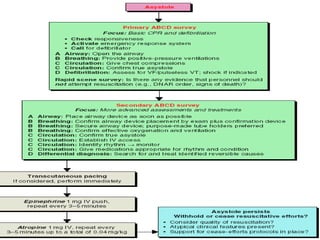
Asystole and bradycardia
   Atropine has a vagolytic effect by
    antagonizing the parasympathetic system.
   Epinephrine improves myocardial and
    cerebral blood flow during CPR.
   Early transcutaneous pacing should be
    considered for bradycardia.transcutaneous
    pacing for asystole has not been shown to
    improve survival. As some
   Somme patients with asystole are actually in fine
    VF, two or more cardiac leads should be checked
    before determining that the patient is truly in
    asystole.
   recent large randomized study from Europe
    comparing epinephrine with vasopressin for
    patients    in asystole demonstrated         that
    vasopressin was superior to epinephrine,
    suggesting that vasopressin followed by
    epinephrine may be more effective than
    epinephrine alone in the treatment of refractory
    cardiac arrest.
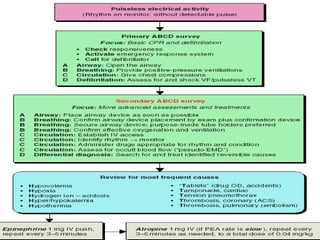
Pulseless electrical activity
      electromechanical dissociation
   Focus on determining and reversing the
    cause:

      The most common causes include severe
      hypovolemia (usually related to significant
        blood loss), hypoxia, acidosis, pericardial
       tamponade, tension pneumothorax, large
      pulmonary embolus, myocardial infarction,
                hypothermia, or drug overdose.
   Patient should be intubated to provide adequate
    oxygenation and given a rapid IV infusion of
    crystalloid.
   If the patient has a treatable rhythm, appropriate
    rhythm-specific ACLS algorithms
   If the situation warrants, pericardiocentesis or
    needle thoracostomy should be performed.
   If no reversible cause can be determined, the patient
    should be given epinephrine every 3–5 minutes. If
    the PEA rate is slow, atropine can also be given.
      Unless a reversible cause is discovered, the
    prognosis of PEA is poor, with only 1–4% of patients
    surviving to hospital discharge.
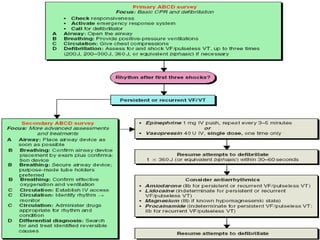
   PEA  ASYSTOLE (monitor analysis)
    {nonshockable}
   CPR (5 cycles-30:2) 2 min
   Epinephrine 1mg (repeat 3-5 min)
   Vasopressin 40 IU then epinephrine.
   Atropine 1 mg (repeat 3-5 min) {max
    3mg} (single dose)
   Then CPR 5 cycles
   Check pulse → CPR →E,A,V →CPR→
    check pulse.
Ventricular fibrillation )VF( or
                  pulseless
        )ventricular tachycardia )VT
   Attempt debrillation immediately (4 J kg-1 for all
    shocks).
   Resume CPR as soon as possible.
   After 2 min, check the cardiac rhythm on the
    monitor.
   Give second shock if still in VF/pulseless VT.
   Immediately resume CPR for 2 min and check
    monitor; if no change, give adrenaline followed
    immediately by a 3rd shock.
   CPR for 2 min.
   Give amiodarone if still in VF/pulseless VT
    followed immediately by a 4th shock.
   Give adrenaline every 3—5 min during CPR.
      If remains in VF/pulseless VT, continue to
    alternate shocks with 2 min of CPR.
     If signs of life become evident, check the
    monitor for an organised rhythm; if this is
    present, check for a central pulse.
     Identify and treat any reversible causes (4Hs
    &4Ts).
   If debrillation was successful but VF/pulseless VT
    recurs, resume CPR, give amiodarone and
    debrillate again at the dose that was effective
    previously. Start a continuous infusion of
    amiodarone.
Precordial thump
   Consider giving a single precordial thump when
    cardiac arrest is confirmed rapidly after a witnessed,
    sudden collapse and a defibrillator is not immediately
    to hand.
   the technique:
       Using the ulnar edge of a tightly clenched fist, deliver a
        sharp impact to the lower half of the sternum from a
        height of about 20 cm, then retract the fist immediately to
        create an impulse-like stimulus.
       A precordial thump is most likely to be successful in
        converting VT to sinus rhythm.
Drug administration Routes
IV access: central  peripheral
   Drugs typically require 1 to 2 minutes to reach
    the central circulation when given via a peripheral
    vein but require less time when given via central
    venous access.
   If a resuscitation drug is administered by a
    peripheral venous route, administer the drug by
    bolus injection and follow with a 20-mL bolus of
    IV fluid. Elevate the extremity for 10 to 20
    seconds to facilitate drug delivery to the central
    circulation.
Intraosseous (IO) cannulation:
   provides access to a noncollapsible venous
  plexus, enabling drug delivery similar to that
  achieved by central venous access.
 In the sternum , proximal tibia (2 cm below tt) ,
  distal tibia (2 cm above mm)

In endotracheal tube:
   Epinepherine , Atropine , Vasopressin ,
    lidocaine , naloxone.
   Give at dose 2.5-3 times usual iv dose.
   Dilute in 5-10 ml saline.
Medications for Arrest Rhythms
Vasopressors :
 at any stage during management of pulseless
  VT, VF, PEA, or asystole increases the rate of
  neurologically intact survival to hospital
  discharge.
 Epinepherine: It is appropriate to administer a 1-
  mg dose of epinephrine IV/IO every 3 to 5
  minutes during adult cardiac arrest. Higher
  doses may be indicated to treat specific
  problems, such as В-blocker or calcium channel
  blocker overdose. may be given by the
  endotracheal route at a dose of 2 to 2.5 mg.
   Vasopressin:      Vasopressin  is      a
    nonadrenergic peripheral vasoconstrictor
    that also causes coronary and renal
    vasoconstriction.(40 U, with the dose
    repetition only once).
Atropine
   in asystole or slow PEA arrest.
   The recommended dose of atropine for
    cardiac arrest is 1 mg IV, whichcan be
    repeated every 3 to 5 minutes (maximum
    total of 3 doses or 3 mg) if asystole
    persists.
   Endotracheal route also used.
Antiarrhythmics
Amiodarone:
 administered     for   VF    or    pulseless  VT
  unresponsive to CPR, shock, and a vasopressor.
 An initial dose of 300 mg IV/IO can be followed
  by one dose of 150 mg IV/IO.
Lidocaine:
 considered     an alternative treatment to
  amiodarone.The initial dose is 1 to 1.5 mg/kg IV.
 If VF/ pulseless VT persists, additional doses of
  0.5 to 0.75mg/kg IV push may be administered
  at 5- to 10 minute intervals, to a maximum dose
  of 3 mg/kg.
Magnesium:
   When VF/pulseless VT cardiac arrest is
    associated with torsades de pointes,
    magnesium sulfate at a dose of 1 to 2 g
    diluted in 10 mL D5WIV/IO push, typically
    over 5 to 20 minutes.
   When torsades is present in the patient
    with pulses, the same 1 to 2 g is mixed in
    50 to 100 mL of D5Wand given as a
    loading dose. It can be given more slowly
    (eg, over 5 to 60 minutes IV)
Pacing in Arrest
   Several randomized controlled trials failed
    to show benefit from attempted pacing for
    asystole.
    At this time use of pacing for patients
    with asystolic cardiac arrest is not
    recommended.
Routine Administration of IV Fluids
                 During
              Cardiac Arrest

   There were no published human studies
    evaluating the effect of routine fluid
    administration during normovolemic cardiac
    arrest
   There is insufficient evidence to recommend
    routine administration of fluids to treat cardiac
    arrest.
   Fluids should be infused if hypovolemia is
    suspected.
Monitoring
Assessment During CPR:
 At present there are no reliable clinical

  criteria that clinicians can use to assess
  the efficacy of CPR. Although end-tidal
  CO2 serves as an indicator of cardiac
  output produced by chest compressions
  and may indicate return of spontaneous
  circulation
Assessment of Hemodynamics
1-Coronary Perfusion Pressure
      (CPP= aortic relaxation [diastolic] pressure

          minus right atrial relaxation phase blood
                                          pressure)
      during CPR correlates with both myocardial

                             blood flow and ROSC.
       A CPP of 15 mm Hg is predictive of ROSC.

   Increased CPP correlate with improved 24-hour
                   survival rates in animal studies.
                                  Rarely available
Pulses-2
   Clinicians frequently try to palpate arterial pulses
    during chest compressions to assess the
    effectiveness of compressions.

   No studies have shown the validity or clinical
    utility of checking pulses during ongoing CPR.
    Because there are no valves in the inferior vena
    cava, retrograde blood flow into the venous
    system may produce femoral vein pulsations.
    Thus palpation of a pulse in the femoral triangle
    may indicate venous rather than arterial blood
    flow.
   Carotid pulsations during CPR do not indicate the
    efficacy of coronary blood flow or myocardial or
    cerebral perfusion during CPR.
Assessment of Respiratory
           Gases
1-Arterial Blood Gases
 not a reliable indicator of the severity of

  tissue hypoxemia, hypercarbia, or tissue
  acidosis.
2-Oximetry
 During cardiac arrest, pulse oximetry will

  not function because pulsatile blood flow
  is inadequate in peripheral tissue beds.
End-Tidal CO2 Monitoring

   useful as a noninvasive indicator of cardiac
    output generated during CPR.
   major determinant of CO2 excretion is its rate of
    delivery from the peripheral production sites to
    the lungs.
    In the low-flow state during CPR, ventilation is
    relatively high compared with blood flow, so that
    the end-tidal CO2 concentration is low.
     If ventilation is reasonably constant, then
    changes in end-tidal CO2 concentration reflect
    changes in cardiac output.
Duration of CPR
   Arrest time< 6 min→30 min CPR
   Arrest time> 6 min→15 min CPR
Post-CPR Management
   Induced hypothermia(32-34o)(12-24 hr)
   Glucose control
   Organ-Specific Evaluation and Support
Prognosis
1-strongly predict death or poor neurologic
  outcome, with 4 of the 5 predictors
  detectable at 24 hours after resuscitation:
 Absent corneal reflex at 24 hours

 Absent pupillary response at 24 hours

 Absent withdrawal response to pain at 24
  hours
 No motor response at 24 hours

 No motor response at 72 hours
   2-An electroencephalogram performed 24
    2-
    to 48 hours after resuscitation has also
    been shown to provide useful predictive
    value.
   3-GCS: <5 ON 3rd day =no chance for
    neurological recovery.
   4- Duration of coma:
       >4-6 hr =poor prognosis
       >24 hr =10% recovery
       >72 hr = 5% recovery
       > 2 wk = no recovery at all.
Cardiac arrest

Cardiac arrest

  • 1.
  • 2.
    Pattern of cardiacarrest  1-Brady-asystole.  2-Pulseless electrical activity. (PEA)  3-Ventricular fibrillation, Pulseless Ventricular tachycardia.
  • 4.
    Causes of reversiblecardiac arrest H T  Hypoxia.  Toxin.  Hypovolaemia.  Thrombus Pulmonary  Hypoglycemia. embolism.  Hypothermia.  Thrombus acute  H+ions Acidosis. coronary syndrome.  Hypo- hyperkalemia.  Tension pneumothorax.  Tamponade cardiac.
  • 5.
    The primary survey  Airway: Open the airway  Breathing: Provide positive-pressure ventilation.  Circulation: Give chest compressions.  Defibrillation: Identify and shock ventricular fibrillation (VF) and ventricular tachycardia (VT)
  • 6.
    Airway Assessment:  1- lookfor respiratory activity.  2-listen for breathing.  3- feel for air exchange at the patient’s nose and mouth. If these are present, assess the patient’s ability to protect the airway by asking them to speak. If the patient does not respond to questions, the absence of a strong gag reflex: confirms the inadequacy of protective airway mechanisms  steps must be taken to provide airway support.
  • 7.
    Steps to supportairway  1- immediately call for assistance.  2- place the patient in a supine position. be careful in a patient with neck trauma in-line stabilization of the cervical spine. This is performed by keeping one hand behind the head and neck while the other hand rolls the patient toward you.  3- open airway: use the head tilt-chin lift maneuver or the jaw thrust maneuver.  4- Remove foreign material.
  • 10.
    Breathing  1- bag-valve mask.(2 sec) if unsuccessful.  2-reposition the head and mask and try again. If unsuccessful, (obstructed airway).  3- Open the patient’s mouth by grasping both the tongue and the lower jaw between the thumb and fingers, and then lift the mandible. If you see obstructing material.  4- use a McGill forceps or clamp to remove it. If this equipment is not available, slide your index finger down the inside of the cheek to the base of the tongue and dislodge any foreign bodies using a hooking action. (if unsuccessful).
  • 11.
    Breathing-2  5- Abdominal thrusts.  6- Reattempt ventilation. Rate 8-10 breaths min
  • 12.
    Circulation  check for a carotid pulse.( the most central of the peripheral arteries).  If no pulse is present, chest compressions should be initiated and the patient should be placed on a cardiac monitor.  To adequately perform chest compressions, the heel of one hand should be placed in the midline on the lower part of the sternum (just above the notch where the ribs meet the lower sternum).
  • 13.
    The other hand is placed on top of the first hand and the fingers interlocked and kept off of the chest.  Position your shoulders directly over your hands and lock your elbows.  Depress the sternum about 1.5–2 inches approximately 100 times per minute.  Properly performed compressions can produce a systolic blood pressure of 60mmHg.
  • 14.
    Defibrillation When defibrillation can be successful performed within the first minute or two, as many as 90% of patients return to their pre-arrest neurologic status. The longer the patient remains in cardiac arrest, the more likely that defibrillation and resuscitation will be unsuccessful. Survival rates are 10% when defibrillation is delayed 10 minutes or more after a patient’s collapse.
  • 15.
    Deliver an electric shock to convert the nonperfusing rhythm to a perfusing one.  one paddle should be placed to the right of the sternum below the right clavicle and the other in the midaxillary line at the level of the nipple.  Firm pressure of approximately 25 lb should be applied to each paddle.  Alternatively, “hands off” defibrillator pads can be used that are placed on the chest and the back, sandwiching the heart.
  • 16.
    Types of defibrillator  Monophasic  Biphasic Less energy needed with biphasic
  • 17.
    Prepare patient  Correct reversible causes  Check lanoxin level  12 leads ECG before & after shock  Iv line present  Monitoring circulation and respiration  Fasting 8 hr , sedation if elective cardioversion.
  • 18.
    Size of paddle  Adult debrillation, both handheld paddle electrodes and self-adhesive pad electrodes 8—12 cm in diameter are used and function well.  Debrillation success may be higher with electrodes of 12-cm diameter compared with those of 8-cm.
  • 19.
    Position of paddles  the conventional sternal—apical position.  The right (sternal) electrode is placed to the right of the sternum, below the clavicle.  The apical paddle is placed in the mid axillary line, approximately level with the V6 ECG electrode .  It does not matter which electrode (apex/sternum) is placed in either position.
  • 20.
    Position of paddles-2  Other acceptable pad positions include:  each electrode on the lateral chest wall, one on the right and the other on the left side (biaxillary);  one electrode in the standard apical position and the other on the right or left upper back;  one electrode anteriorly, over the left precordium, and the other electrode posterior to the heart just inferior to the left scapula.
  • 21.
    Coupling agents  Do not use medical gels or pastes of poor electrical conductivity (e.g., ultrasound gel). Pads versus paddles  Self-adhesive debrillation pads are safe and effective and are preferable to standard debrillation paddles.  Consideration should be given to use of self- adhesive pads in peri-arrest situations.
  • 22.
    Successful defibrillation depends on the amount of current transmitted across the heart. (energy output of defibrillator transthoracic impedance).  ↑ paddle size →↑ efficiency of shock current.  Conductive gel (contain salt) so less energy is required, ↓ burn but not ↑ impedence.
  • 23.
    The secondary survey  Airway: Definitive airway management (tube).  Breathing: Confirmation of adequate ventilation.  Circulation: Intravenous access, ACLS medications, fluids.  Defibrillation: Continued rhythm analysis and treatment.
  • 24.
    Airway  Endotracheal intubation is the most effective method of ensuring adequate ventilation, oxygenation, and airway protection against aspiration during cardiac arrest. In addition, it is an additional route of entry for some resuscitation medications, such as atropine, epinephrine, and lidocaine.
  • 25.
    Breathing  the adequacy of intubation should be checked by auscultating the chest for equal bilateral breath sounds, identifying fog in the endotracheal tube on exhalation,  Monitoring end-tidal CO2 (using colorimetry or capnography). The presence of exhaled CO2 on a monitor indicates proper tracheal tube placement and can detect subsequent tube dislodgement.  A chest X-ray can help determine the location of the tip of the endotracheal tube in relation to the carina.
  • 26.
    Breathing-2  The patient should be placed on a ventilator for positive pressure ventilation. Continuous high flow oxygen and pulse oximetry should be maintained.
  • 27.
    Circulation  Intravenous (IV) access should be obtained, preferably with a central venous catheter in the internal jugular, subclavian, or femoral vein. Two large bore peripheral lines may be acceptable.  And IV fluids should be infused. The patient’s rhythm should be identified and appropriate interventions instituted based on accepted ACLS guidelines.
  • 31.
    Asystole and bradycardia  Atropine has a vagolytic effect by antagonizing the parasympathetic system.  Epinephrine improves myocardial and cerebral blood flow during CPR.  Early transcutaneous pacing should be considered for bradycardia.transcutaneous pacing for asystole has not been shown to improve survival. As some
  • 32.
    Somme patients with asystole are actually in fine VF, two or more cardiac leads should be checked before determining that the patient is truly in asystole.  recent large randomized study from Europe comparing epinephrine with vasopressin for patients in asystole demonstrated that vasopressin was superior to epinephrine, suggesting that vasopressin followed by epinephrine may be more effective than epinephrine alone in the treatment of refractory cardiac arrest.
  • 33.
    Pulseless electrical activity electromechanical dissociation  Focus on determining and reversing the cause: The most common causes include severe hypovolemia (usually related to significant blood loss), hypoxia, acidosis, pericardial tamponade, tension pneumothorax, large pulmonary embolus, myocardial infarction, hypothermia, or drug overdose.
  • 34.
    Patient should be intubated to provide adequate oxygenation and given a rapid IV infusion of crystalloid.  If the patient has a treatable rhythm, appropriate rhythm-specific ACLS algorithms  If the situation warrants, pericardiocentesis or needle thoracostomy should be performed.  If no reversible cause can be determined, the patient should be given epinephrine every 3–5 minutes. If the PEA rate is slow, atropine can also be given.  Unless a reversible cause is discovered, the prognosis of PEA is poor, with only 1–4% of patients surviving to hospital discharge.
  • 35.
    PEA ASYSTOLE (monitor analysis) {nonshockable}  CPR (5 cycles-30:2) 2 min  Epinephrine 1mg (repeat 3-5 min)  Vasopressin 40 IU then epinephrine.  Atropine 1 mg (repeat 3-5 min) {max 3mg} (single dose)  Then CPR 5 cycles  Check pulse → CPR →E,A,V →CPR→ check pulse.
  • 36.
    Ventricular fibrillation )VF(or pulseless )ventricular tachycardia )VT  Attempt debrillation immediately (4 J kg-1 for all shocks).  Resume CPR as soon as possible.  After 2 min, check the cardiac rhythm on the monitor.  Give second shock if still in VF/pulseless VT.  Immediately resume CPR for 2 min and check monitor; if no change, give adrenaline followed immediately by a 3rd shock.  CPR for 2 min.  Give amiodarone if still in VF/pulseless VT followed immediately by a 4th shock.
  • 37.
    Give adrenaline every 3—5 min during CPR.  If remains in VF/pulseless VT, continue to alternate shocks with 2 min of CPR.  If signs of life become evident, check the monitor for an organised rhythm; if this is present, check for a central pulse.  Identify and treat any reversible causes (4Hs &4Ts).  If debrillation was successful but VF/pulseless VT recurs, resume CPR, give amiodarone and debrillate again at the dose that was effective previously. Start a continuous infusion of amiodarone.
  • 38.
    Precordial thump  Consider giving a single precordial thump when cardiac arrest is confirmed rapidly after a witnessed, sudden collapse and a defibrillator is not immediately to hand.  the technique:  Using the ulnar edge of a tightly clenched fist, deliver a sharp impact to the lower half of the sternum from a height of about 20 cm, then retract the fist immediately to create an impulse-like stimulus.  A precordial thump is most likely to be successful in converting VT to sinus rhythm.
  • 39.
    Drug administration Routes IVaccess: central peripheral  Drugs typically require 1 to 2 minutes to reach the central circulation when given via a peripheral vein but require less time when given via central venous access.  If a resuscitation drug is administered by a peripheral venous route, administer the drug by bolus injection and follow with a 20-mL bolus of IV fluid. Elevate the extremity for 10 to 20 seconds to facilitate drug delivery to the central circulation.
  • 40.
    Intraosseous (IO) cannulation:  provides access to a noncollapsible venous plexus, enabling drug delivery similar to that achieved by central venous access.  In the sternum , proximal tibia (2 cm below tt) , distal tibia (2 cm above mm) In endotracheal tube:  Epinepherine , Atropine , Vasopressin , lidocaine , naloxone.  Give at dose 2.5-3 times usual iv dose.  Dilute in 5-10 ml saline.
  • 41.
    Medications for ArrestRhythms Vasopressors :  at any stage during management of pulseless VT, VF, PEA, or asystole increases the rate of neurologically intact survival to hospital discharge.  Epinepherine: It is appropriate to administer a 1- mg dose of epinephrine IV/IO every 3 to 5 minutes during adult cardiac arrest. Higher doses may be indicated to treat specific problems, such as В-blocker or calcium channel blocker overdose. may be given by the endotracheal route at a dose of 2 to 2.5 mg.
  • 42.
    Vasopressin: Vasopressin is a nonadrenergic peripheral vasoconstrictor that also causes coronary and renal vasoconstriction.(40 U, with the dose repetition only once).
  • 43.
    Atropine  in asystole or slow PEA arrest.  The recommended dose of atropine for cardiac arrest is 1 mg IV, whichcan be repeated every 3 to 5 minutes (maximum total of 3 doses or 3 mg) if asystole persists.  Endotracheal route also used.
  • 44.
    Antiarrhythmics Amiodarone:  administered for VF or pulseless VT unresponsive to CPR, shock, and a vasopressor.  An initial dose of 300 mg IV/IO can be followed by one dose of 150 mg IV/IO. Lidocaine:  considered an alternative treatment to amiodarone.The initial dose is 1 to 1.5 mg/kg IV.  If VF/ pulseless VT persists, additional doses of 0.5 to 0.75mg/kg IV push may be administered at 5- to 10 minute intervals, to a maximum dose of 3 mg/kg.
  • 45.
    Magnesium:  When VF/pulseless VT cardiac arrest is associated with torsades de pointes, magnesium sulfate at a dose of 1 to 2 g diluted in 10 mL D5WIV/IO push, typically over 5 to 20 minutes.  When torsades is present in the patient with pulses, the same 1 to 2 g is mixed in 50 to 100 mL of D5Wand given as a loading dose. It can be given more slowly (eg, over 5 to 60 minutes IV)
  • 46.
    Pacing in Arrest  Several randomized controlled trials failed to show benefit from attempted pacing for asystole.  At this time use of pacing for patients with asystolic cardiac arrest is not recommended.
  • 47.
    Routine Administration ofIV Fluids During Cardiac Arrest  There were no published human studies evaluating the effect of routine fluid administration during normovolemic cardiac arrest  There is insufficient evidence to recommend routine administration of fluids to treat cardiac arrest.  Fluids should be infused if hypovolemia is suspected.
  • 48.
    Monitoring Assessment During CPR: At present there are no reliable clinical criteria that clinicians can use to assess the efficacy of CPR. Although end-tidal CO2 serves as an indicator of cardiac output produced by chest compressions and may indicate return of spontaneous circulation
  • 49.
    Assessment of Hemodynamics 1-CoronaryPerfusion Pressure  (CPP= aortic relaxation [diastolic] pressure minus right atrial relaxation phase blood pressure)  during CPR correlates with both myocardial blood flow and ROSC.  A CPP of 15 mm Hg is predictive of ROSC. Increased CPP correlate with improved 24-hour survival rates in animal studies.  Rarely available
  • 50.
    Pulses-2  Clinicians frequently try to palpate arterial pulses during chest compressions to assess the effectiveness of compressions.  No studies have shown the validity or clinical utility of checking pulses during ongoing CPR. Because there are no valves in the inferior vena cava, retrograde blood flow into the venous system may produce femoral vein pulsations. Thus palpation of a pulse in the femoral triangle may indicate venous rather than arterial blood flow.  Carotid pulsations during CPR do not indicate the efficacy of coronary blood flow or myocardial or cerebral perfusion during CPR.
  • 51.
    Assessment of Respiratory Gases 1-Arterial Blood Gases  not a reliable indicator of the severity of tissue hypoxemia, hypercarbia, or tissue acidosis. 2-Oximetry  During cardiac arrest, pulse oximetry will not function because pulsatile blood flow is inadequate in peripheral tissue beds.
  • 52.
    End-Tidal CO2 Monitoring  useful as a noninvasive indicator of cardiac output generated during CPR.  major determinant of CO2 excretion is its rate of delivery from the peripheral production sites to the lungs.  In the low-flow state during CPR, ventilation is relatively high compared with blood flow, so that the end-tidal CO2 concentration is low.  If ventilation is reasonably constant, then changes in end-tidal CO2 concentration reflect changes in cardiac output.
  • 53.
    Duration of CPR  Arrest time< 6 min→30 min CPR  Arrest time> 6 min→15 min CPR
  • 54.
    Post-CPR Management  Induced hypothermia(32-34o)(12-24 hr)  Glucose control  Organ-Specific Evaluation and Support
  • 55.
    Prognosis 1-strongly predict deathor poor neurologic outcome, with 4 of the 5 predictors detectable at 24 hours after resuscitation:  Absent corneal reflex at 24 hours  Absent pupillary response at 24 hours  Absent withdrawal response to pain at 24 hours  No motor response at 24 hours  No motor response at 72 hours
  • 56.
    2-An electroencephalogram performed 24 2- to 48 hours after resuscitation has also been shown to provide useful predictive value.  3-GCS: <5 ON 3rd day =no chance for neurological recovery.  4- Duration of coma:  >4-6 hr =poor prognosis  >24 hr =10% recovery  >72 hr = 5% recovery  > 2 wk = no recovery at all.