Additive Manufacturing
and its history and future impact on society
Outline
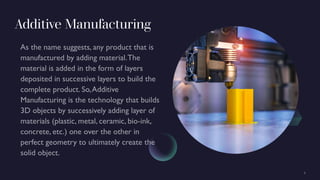
What is Additive
Manufacturing ?
Additive Manufacturing
Brief History of
Additive Manufacturing
Coiled Pottery
Ancient Additive Manufacturing
Dr. Hideo Kodama
Charles Hull
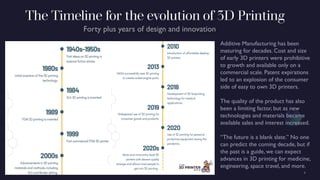
The Timeline for the evolution of 3D Printing
Additive Manufacturing has been
maturing for decades. Cost and size
of early 3D printers were prohibitive
to growth and available only on a
commercial scale. Patent expirations
led to an explosion of the consumer
side of easy to own 3D printers.
The quality of the product has also
been a limiting factor, but as new
technologies and materials became
available sales and interest increased.
“The future is a blank slate.” No one
can predict the coming decade, but if
the past is a guide, we can expect
advances in 3D printing for medicine,
engineering, space travel, and more.
Types of Additive
Manufacturing Processes
The Seven
Families of
3D Printing
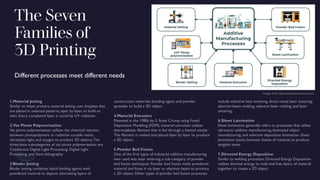
1.Material Jetting
Similar to inkjet printers, material jetting uses droplets that
are placed in selected patterns, layer by layer, to build an
item. Every completed layer is cured by UV radiation.
2.Vat Photo Polymerization
Vat photo polymerization utilizes the chemical reaction
between photopolymers or radiation curable resins,
ultraviolet light, and oxygen to produce 3D objects.The
three main subcategories of vat photo polymerization are
Continuous Digital Light Processing, Digital Light
Processing, and Stere lithography.
3.Binder Jetting
Binder jetting combines liquid binding agents with
powdered material to deposit alternating layers of
construction materials, bonding agent, and powder
spreader to build a 3D object.
4.Material Extrusion
Patented in the 1980s by S. Scott Crump using Fused
Deposition Modeling (FDM), material extrusion utilizes
thermoplastic filament that is fed through a heated nozzle.
The filament is melted and placed layer by layer to produce
a 3D object.
5.Powder Bed Fusion
One of the first types of industrial additive manufacturing
ever used was laser sintering, a sub-category of powder
bed fusion techniques. Powder bed fusion melts powdered
material and fuses it via laser or electron beam to produce
a 3D object. Other types of powder bed fusion processes
include selective heat sintering, direct metal laser sintering,
electron beam melting, selective laser melting, and laser
sintering.
6.Sheet Lamination
Sheet lamination generally refers to processes that utilize
ultrasonic additive manufacturing, laminated object
manufacturing, and selective deposition lamination. Sheet
lamination stacks laminate sheets of material to produce
tangible items.
7.Directed Energy Deposition
Similar to welding processes, Directed Energy Deposition
utilizes thermal energy to melt and fuse layers of material
together to create a 3D object.
Different processes meet different needs
Typical 3D
Printing Flow
Chart
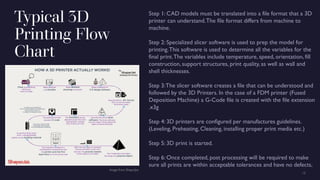
Step 1: CAD models must be translated into a file format that a 3D
printer can understand.The file format differs from machine to
machine.
Step 2: Specialized slicer software is used to prep the model for
printing.This software is used to determine all the variables for the
final print.The variables include temperature, speed, orientation, fill
construction, support structures, print quality, as well as wall and
shell thicknesses.
Step 3:The slicer software creates a file that can be understood and
followed by the 3D Printers. In the case of a FDM printer (Fused
Deposition Machine) a G-Code file is created with the file extension
.x3g
Step 4: 3D printers are configured per manufactures guidelines.
(Leveling, Preheating, Cleaning, installing proper print media etc.)
Step 5: 3D print is started.
Step 6: Once completed, post processing will be required to make
sure all prints are within acceptable tolerances and have no defects.
Advantages & Disadvantages of
Additive Manufacturing
PLUS +
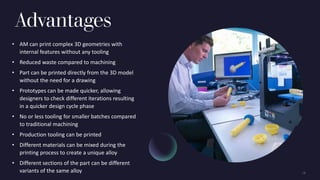
• AM can print complex 3D geometries with
internal features without any tooling
• Reduced waste compared to machining
• Part can be printed directly from the 3D model
without the need for a drawing
• Prototypes can be made quicker, allowing
designers to check different iterations resulting
in a quicker design cycle phase
• No or less tooling for smaller batches compared
to traditional machining
• Production tooling can be printed
• Different materials can be mixed during the
printing process to create a unique alloy
• Different sections of the part can be different
variants of the same alloy
Advantages
PLUS +
• Because the technology is still in its infancy, the
build process is slow and costly
• High production costs because of the equipment
cost
• Various post-processing required depending on the
type of additive manufacturing used
• Small build volume compared to other
manufacturing part size such as sand casting
• Poor mechanical properties hence need post-
processing
• Poor surface finish and texture compared
manufacturing processes like CNC and investment
casting.
• The strength of the parts is comparably weaker
compared to manufacturing processes such as Die
casting, Investment casting and CNC machining.
Disadvantages
The Future
is NOW!
References
IMAGES INTERNET PUBLICATIONS
Thank You

Honors Additive Manufacturing Presentation.pdf

  • 1.
    Additive Manufacturing and itshistory and future impact on society
  • 2.
  • 3.
  • 4.
  • 5.
  • 6.
  • 7.
  • 8.
  • 9.
    The Timeline forthe evolution of 3D Printing Additive Manufacturing has been maturing for decades. Cost and size of early 3D printers were prohibitive to growth and available only on a commercial scale. Patent expirations led to an explosion of the consumer side of easy to own 3D printers. The quality of the product has also been a limiting factor, but as new technologies and materials became available sales and interest increased. “The future is a blank slate.” No one can predict the coming decade, but if the past is a guide, we can expect advances in 3D printing for medicine, engineering, space travel, and more.
  • 10.
  • 11.
    The Seven Families of 3DPrinting 1.Material Jetting Similar to inkjet printers, material jetting uses droplets that are placed in selected patterns, layer by layer, to build an item. Every completed layer is cured by UV radiation. 2.Vat Photo Polymerization Vat photo polymerization utilizes the chemical reaction between photopolymers or radiation curable resins, ultraviolet light, and oxygen to produce 3D objects.The three main subcategories of vat photo polymerization are Continuous Digital Light Processing, Digital Light Processing, and Stere lithography. 3.Binder Jetting Binder jetting combines liquid binding agents with powdered material to deposit alternating layers of construction materials, bonding agent, and powder spreader to build a 3D object. 4.Material Extrusion Patented in the 1980s by S. Scott Crump using Fused Deposition Modeling (FDM), material extrusion utilizes thermoplastic filament that is fed through a heated nozzle. The filament is melted and placed layer by layer to produce a 3D object. 5.Powder Bed Fusion One of the first types of industrial additive manufacturing ever used was laser sintering, a sub-category of powder bed fusion techniques. Powder bed fusion melts powdered material and fuses it via laser or electron beam to produce a 3D object. Other types of powder bed fusion processes include selective heat sintering, direct metal laser sintering, electron beam melting, selective laser melting, and laser sintering. 6.Sheet Lamination Sheet lamination generally refers to processes that utilize ultrasonic additive manufacturing, laminated object manufacturing, and selective deposition lamination. Sheet lamination stacks laminate sheets of material to produce tangible items. 7.Directed Energy Deposition Similar to welding processes, Directed Energy Deposition utilizes thermal energy to melt and fuse layers of material together to create a 3D object. Different processes meet different needs
  • 12.
    Typical 3D Printing Flow Chart Step1: CAD models must be translated into a file format that a 3D printer can understand.The file format differs from machine to machine. Step 2: Specialized slicer software is used to prep the model for printing.This software is used to determine all the variables for the final print.The variables include temperature, speed, orientation, fill construction, support structures, print quality, as well as wall and shell thicknesses. Step 3:The slicer software creates a file that can be understood and followed by the 3D Printers. In the case of a FDM printer (Fused Deposition Machine) a G-Code file is created with the file extension .x3g Step 4: 3D printers are configured per manufactures guidelines. (Leveling, Preheating, Cleaning, installing proper print media etc.) Step 5: 3D print is started. Step 6: Once completed, post processing will be required to make sure all prints are within acceptable tolerances and have no defects.
  • 13.
    Advantages & Disadvantagesof Additive Manufacturing
  • 14.
    PLUS + • AMcan print complex 3D geometries with internal features without any tooling • Reduced waste compared to machining • Part can be printed directly from the 3D model without the need for a drawing • Prototypes can be made quicker, allowing designers to check different iterations resulting in a quicker design cycle phase • No or less tooling for smaller batches compared to traditional machining • Production tooling can be printed • Different materials can be mixed during the printing process to create a unique alloy • Different sections of the part can be different variants of the same alloy Advantages
  • 15.
    PLUS + • Becausethe technology is still in its infancy, the build process is slow and costly • High production costs because of the equipment cost • Various post-processing required depending on the type of additive manufacturing used • Small build volume compared to other manufacturing part size such as sand casting • Poor mechanical properties hence need post- processing • Poor surface finish and texture compared manufacturing processes like CNC and investment casting. • The strength of the parts is comparably weaker compared to manufacturing processes such as Die casting, Investment casting and CNC machining. Disadvantages
  • 16.
  • 17.
  • 18.