Subject :- Manufacturing Technology(MT)
T.Y. B.Tech. Mechatronics
1
Manufacturing
Technology
UNIT
6
2
UNIT
6
Mr. Kiran Wakchaure Manufacturing Technology SANJIVANI COLLEGE OF ENGINEERING, KOPARGAON
3
Manufacturing Technology
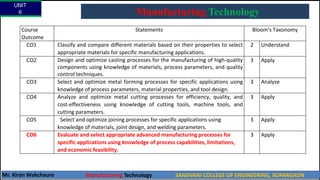
Course
Outcome
Statements Bloom’s Taxonomy
CO1 Classify and compare different materials based on their properties to select
appropriate materials for specific manufacturing applications.
2 Understand
CO2 Design and optimize casting processes for the manufacturing of high-quality
components using knowledge of materials, process parameters, and quality
control techniques.
3 Apply
CO3 Select and optimize metal forming processes for specific applications using
knowledge of process parameters, material properties, and tool design.
3 Analyse
CO4 Analyze and optimize metal cutting processes for efficiency, quality, and
cost-effectiveness using knowledge of cutting tools, machine tools, and
cutting parameters.
3 Apply
CO5 Select and optimize joining processes for specific applications using
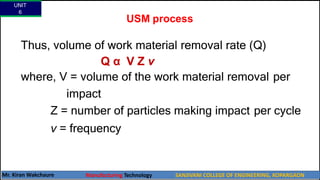
knowledge of materials, joint design, and welding parameters.
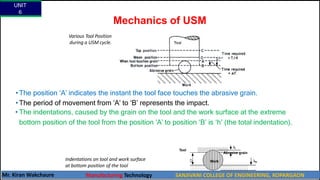
3 Apply
CO6 Evaluate and select appropriate advanced manufacturing processes for
specific applications using knowledge of process capabilities, limitations,
and economic feasibility.
3 Apply
UNIT
6
Mr. Kiran Wakchaure Manufacturing Technology SANJIVANI COLLEGE OF ENGINEERING, KOPARGAON
4
Introduction to Non-Traditional
Machining
UNIT
6
Mr. Kiran Wakchaure Manufacturing Technology SANJIVANI COLLEGE OF ENGINEERING, KOPARGAON
5
Non-Traditional Machining
• Traditional machining is mostly based on removal of materials using tools that
are harder than the materials themselves.
• New and novel materials because of their greatly improved chemical,
mechanical and thermal properties are sometimes impossible to machine
using traditional machining processes.
• Traditional machining methods are often ineffective in machining hard
materials like ceramics and composites or machiningunder very
tight tolerances as in micromachined components.
• The need to a avoid surface damage that often accompanies the stresses
created by conventional machining.
Example: aerospace and electronics industries.
• They are classified under the domain of non traditional processes.
UNIT
6
Mr. Kiran Wakchaure Manufacturing Technology SANJIVANI COLLEGE OF ENGINEERING, KOPARGAON
6
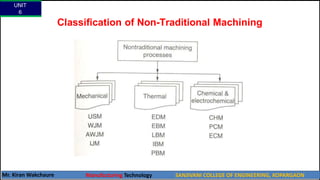
Classification of Non-Traditional Machining
These can be classified according to the source of energy used to generate such a machining
action: mechanical, thermal, chemical and electrochemical.
Mechanical: Erosion of the work material by a high velocity stream of abrasives or fluids
(or both)
Thermal: The thermal energy is applied to a very small portion of the work surface, causing
that portion to be removed by fusion and/or vaporization of the material. The thermal energy is
generated by conversion of electrical energy.
Electrochemical: Mechanism is reverse of electroplating.
Chemical: Most materials (metals particularly) are susceptible to chemical attack by certain
acids or other etchants. In chemical machining, chemicals selectively remove material from
portions of the workpart, while other portions of the surface are protected by a mask.
UNIT
6
Mr. Kiran Wakchaure Manufacturing Technology SANJIVANI COLLEGE OF ENGINEERING, KOPARGAON
7
Classification of Non-Traditional Machining
UNIT
6
Mr. Kiran Wakchaure Manufacturing Technology SANJIVANI COLLEGE OF ENGINEERING, KOPARGAON
8
Mechanical Machining
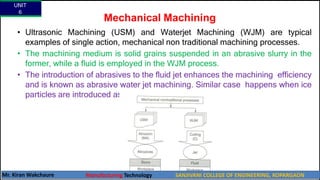
• Ultrasonic Machining (USM) and Waterjet Machining (WJM) are typical
examples of single action, mechanical non traditional machining processes.
• The machining medium is solid grains suspended in an abrasive slurry in the
former, while a fluid is employed in the WJM process.
• The introduction of abrasives to the fluid jet enhances the machining efficiency
and is known as abrasive water jet machining. Similar case happens when ice
particles are introduced as in Ice Jet Machining.
UNIT
6
Mr. Kiran Wakchaure Manufacturing Technology SANJIVANI COLLEGE OF ENGINEERING, KOPARGAON
9
Thermal Machining
UNIT
6
Mr. Kiran Wakchaure Manufacturing Technology SANJIVANI COLLEGE OF ENGINEERING, KOPARGAON
10
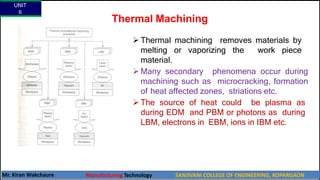
 Thermal machining removes materials by
melting or vaporizing the work piece
material.
 Many secondary phenomena occur during
machining such as microcracking, formation
of heat affected zones, striations etc.
 The source of heat could be plasma as
during EDM and PBM or photons as during
LBM, electrons in EBM, ions in IBM etc.
Chemical and Electrochemical Machining
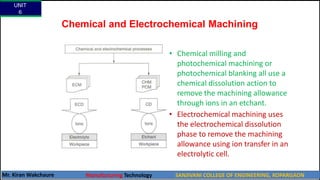
• Chemical milling and
photochemical machining or
photochemical blanking all use a
chemical dissolution action to
remove the machining allowance
through ions in an etchant.
• Electrochemical machining uses
the electrochemical dissolution
phase to remove the machining
allowance using ion transfer in an
electrolytic cell.
UNIT
6
Mr. Kiran Wakchaure Manufacturing Technology SANJIVANI COLLEGE OF ENGINEERING, KOPARGAON
11
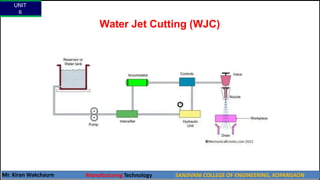
Water Jet Cutting (WJC)
• Also known as hydrodynamic machining.
• Uses a fine, high-pressure, high-velocity of water directed at the work
surface to cause cutting of the work.
•Nozzle diameter: 0.1 to 0.4 mm
•Pressure: up to 400 MPa
•Velocity: up to 900 m/s
•Fluid is pressurized by a hydraulic pump
Important process parameters
Standoff distance: small to avoid dispersion of the fluid
stream (3.2 mm)
Nozzle opening diameter: affects precision
Water pressure: high for thicker materials
Cutting feed rate: the velocity at which the WJC nozzle is
traversed along the cutting path
UNIT
6
Mr. Kiran Wakchaure Manufacturing Technology SANJIVANI COLLEGE OF ENGINEERING, KOPARGAON
12
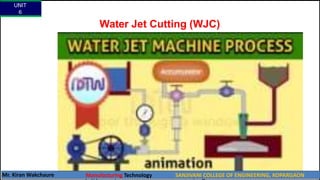
Water Jet Cutting (WJC)
UNIT
6
Mr. Kiran Wakchaure Manufacturing Technology SANJIVANI COLLEGE OF ENGINEERING, KOPARGAON
13
Construction or the Main Parts of Water Jet Machining
The main parts of the Water jet Machining Process are as follows
Pump:
The pump acts as a mediator between the reservoir and the Intensifier. The pump sucks the water from the reservoir and sends it to the
Intensifier. The pump creates pressure in the water ranging from 1500 to 4000 bars.
Hydraulic Intensifier:
It is connected after the hydraulic pump and is used to increase the pressure of the water from 4 bar to the pressure ranging from 3000-4000
bar.
Accumulator:
The accumulator is connected after the hydraulic intensifier and it is used to store the water temporarily. Accumulator supplies the water in
the system when there is a need for either a drop of pressure or high-pressure water required in the system.
Control Valve:
The duty of the control valve is to control the pressure of water and also the quantity of water to be passed into the system.
Flow regulator:
As the name flow regulator, it is used to regulate the flow of water which was arrived from the control valve and send that water towards
the nozzle.
Nozzle:
The duty of the nozzle is to convert high-pressure water into kinetic energy(K.E) and this K.E. is increased due to the decrease in the nozzle
area. This high K.E. water is impinged onto the surface of the workpiece to get the desired shape and size.
Drain:
The main duty of the drain is to collect the water coming away from the work region and is purified again to act as the main agent into the
system i.e. the purified water is again sent to the reservoir. Construction or the Main Parts of Water Jet Machining
The main parts of the Water jet Machining Process are as follows
Reservoir:
The reservoir acts as the basic unit in the setup which is used for storing water.
UNIT
6
Mr. Kiran Wakchaure Manufacturing Technology SANJIVANI COLLEGE OF ENGINEERING, KOPARGAON
14
The working of WJM is as follows.
• When very high-pressure water is passing through the convergent nozzle the pressure
energy is converted into velocity energy or kinetic energy.
• Therefore the water is coming out from the nozzle at a very high velocity which is obtained to
be 200 to 400 m per second.
• When this high-velocity water Jet is impinging onto the workpiece, the continuous impact load
is acting onto it.
• Therefore very soft materials will experience plastic deformation and fracturing.
• From the above, the mechanism of material removal is due to plastic deformation and
fracturing and also called an Etching process.
• In this, the Material Removal Rate(MRR) is directly proportional to the velocity of the water jet
and this velocity depends on the distance between the nozzle tip and workpiece.
• In this, no tool is used and the only nozzle is used and to withstand higher pressures.
• The nozzle is made by using Tungsten Carbide.
• From this,
• Medium: Water
• Wear Ratio: Infinity.
UNIT
6
Mr. Kiran Wakchaure Manufacturing Technology SANJIVANI COLLEGE OF ENGINEERING, KOPARGAON
15
Water Jet Cutting (WJC)
https://youtu.be/dmHv42wda9k?list=PLWv6RLxuaVQwMg6kFEoeeMEGTWNnr7Jmr
UNIT
6
Mr. Kiran Wakchaure Manufacturing Technology SANJIVANI COLLEGE OF ENGINEERING, KOPARGAON
16
• Applications
• It is used for machining or cutting reinforced plastic.
• Use to cut stone which can reduce the dust in the environment.
• It is used to cut hard metal like titanium, stainless steel, etc.
• It is used in aerospace industries.
• Used for machining PCB.
Advantages
• The advantages of Water Jet machining are as follows.
• Very soft materials like rubber can be easily machined
• No electrical conductivity of workpiece is required
• No thermal effects on the workpiece are required.
Disadvantages
• The disadvantages of Water Jet machining are as follows.
• Pressurizing the water to very high pressure is difficult.
• This method can't be used for the machining of hard materials.
• Developed for cutting of very soft materials like rubber.
UNIT
6
Mr. Kiran Wakchaure Manufacturing Technology SANJIVANI COLLEGE OF ENGINEERING, KOPARGAON
17
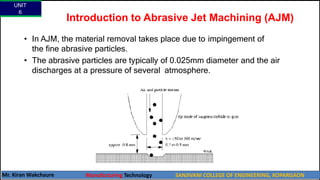
Introduction to Abrasive Jet Machining (AJM)
• In AJM, the material removal takes place due to impingement of
the fine abrasive particles.
• The abrasive particles are typically of 0.025mm diameter and the air
discharges at a pressure of several atmosphere.
UNIT
6
Mr. Kiran Wakchaure Manufacturing Technology SANJIVANI COLLEGE OF ENGINEERING, KOPARGAON
18
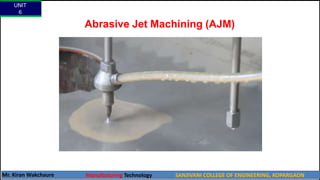
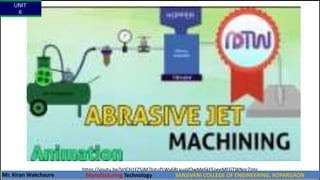
Abrasive Jet Machining (AJM)
UNIT
6
Mr. Kiran Wakchaure Manufacturing Technology SANJIVANI COLLEGE OF ENGINEERING, KOPARGAON
19
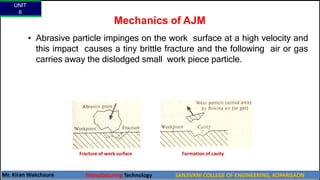
Mechanics of AJM
• Abrasive particle impinges on the work surface at a high velocity and
this impact causes a tiny brittle fracture and the following air or gas
carries away the dislodged small work piece particle.
Fracture of work surface Formation of cavity
UNIT
6
Mr. Kiran Wakchaure Manufacturing Technology SANJIVANI COLLEGE OF ENGINEERING, KOPARGAON
20
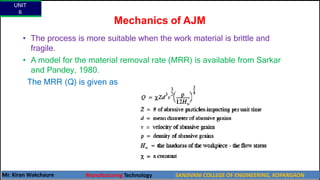
• The process is more suitable when the work material is brittle and
fragile.
• A model for the material removal rate (MRR) is available from Sarkar
and Pandey, 1980.
The MRR (Q) is given as
Mechanics of AJM
UNIT
6
Mr. Kiran Wakchaure Manufacturing Technology SANJIVANI COLLEGE OF ENGINEERING, KOPARGAON
21
Process Parameters
 The process characteristics can be evaluated by judging
(1) the MRR,
(2) the geometry of the cut,
(3) the roughness of the surface produced, and
(4) the rate of nozzle wear.
 The major parameters which control these quantities are:
1. The abrasive (composition, strength, size and mass flow rate).
2. The gas (composition, pressure and velocity).
3. The nozzle (geometry, material, distance from and inclination to the work
surface).
UNIT
6
Mr. Kiran Wakchaure Manufacturing Technology SANJIVANI COLLEGE OF ENGINEERING, KOPARGAON
22
The Abrasive
 Mainly two types of abrasives are used (1) Aluminum oxide and (2) Silicon
carbide. (Grains with a diameter 10-50 microns are readily available)
 For good wear action on the surfaces, the abrasive grains should have
sharp edges.
 A reuse of the abrasive powder is normally not recommended because of a
decrease of cutting capacity and clogging of the nozzle orifices due to
contamination.
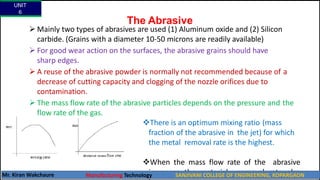
 The mass flow rate of the abrasive particles depends on the pressure and the
flow rate of the gas.
There is an optimum mixing ratio (mass
fraction of the abrasive in the jet) for which
the metal removal rate is the highest.
When the mass flow rate of the abrasive
increases the material removal rate also
UNIT
6
Mr. Kiran Wakchaure Manufacturing Technology SANJIVANI COLLEGE OF ENGINEERING, KOPARGAON
23
The Gas
 The AJM unit normally operates at a pressure of 0.2-1.0 N/mm2 .
 The composition of gas and a high velocity has a significant impact on the MRR
even if the mixing ratio is not changed.
The Nozzle
The nozzle is one of the most vital elements controlling the process
characteristics.
The nozzle material should be hard to avoid any significant wear due to the
flowing abrasive. [Normally WC (avg. life: 12-30 hrs.) or Sapphire (Appr. = 300 hrs.)
are used]
For a normal operation the cross-sectional area of the orifice can be either
circular or rectangular and between 0.05- 0.2mm2 .
UNIT
6
Mr. Kiran Wakchaure Manufacturing Technology SANJIVANI COLLEGE OF ENGINEERING, KOPARGAON
24
Abrasive Jet Machines
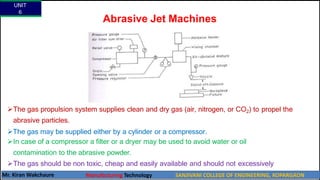
The gas propulsion system supplies clean and dry gas (air, nitrogen, or CO2) to propel the
abrasive particles.
The gas may be supplied either by a cylinder or a compressor.
In case of a compressor a filter or a dryer may be used to avoid water or oil
contamination to the abrasive powder.
The gas should be non toxic, cheap and easily available and should not excessively
spread when discharged from nozzle into atmosphere.
UNIT
6
Mr. Kiran Wakchaure Manufacturing Technology SANJIVANI COLLEGE OF ENGINEERING, KOPARGAON
25
https://youtu.be/VrlCH1FZSJM?list=PLWv6RLxuaVQwMg6kFEoeeMEGTWNnr7Jmr
UNIT
6
Mr. Kiran Wakchaure Manufacturing Technology SANJIVANI COLLEGE OF ENGINEERING, KOPARGAON
26
Applications
• It is highly used in the automotive, aerospace, and electronics industries.
• In aerospace industries, parts such as engine components (aluminum, titanium, and heat resistant alloys), aluminum body
parts, titanium bodies for military aircraft, etc. are made using abrasive water jet machining process.
Advantages
• In most cases, no secondary finishing is required
• No heat-affected zone
• No cutter induced distortion
• Eliminates thermal distortion
• Low cutting forces on workpieces
• Localises structural changes
• No slag or cutting dross
• Limited tooling requirements
• Typical finish 125-250 microns
Disadvantages
• high capital cost and high noise levels during machining.
• It cannot cut the materials that degrade quickly with moisture.
• Surface finish loses at higher cut speeds.
• This is a detailed explanation of the Abrasive Water Jet Machining Process.
UNIT
6
Mr. Kiran Wakchaure Manufacturing Technology SANJIVANI COLLEGE OF ENGINEERING, KOPARGAON
27
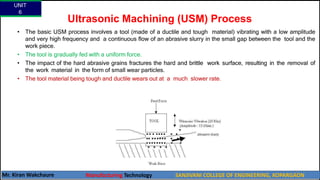
Ultrasonic Machining (USM) Process
• The basic USM process involves a tool (made of a ductile and tough material) vibrating with a low amplitude
and very high frequency and a continuous flow of an abrasive slurry in the small gap between the tool and the
work piece.
• The tool is gradually fed with a uniform force.
• The impact of the hard abrasive grains fractures the hard and brittle work surface, resulting in the removal of
the work material in the form of small wear particles.
• The tool material being tough and ductile wears out at a much slower rate.
UNIT
6
Mr. Kiran Wakchaure Manufacturing Technology SANJIVANI COLLEGE OF ENGINEERING, KOPARGAON
28
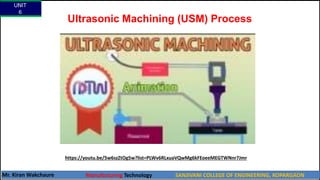
Ultrasonic Machining (USM) Process
https://youtu.be/5w6szZtOg5w?list=PLWv6RLxuaVQwMg6kFEoeeMEGTWNnr7Jmr
UNIT
6
Mr. Kiran Wakchaure Manufacturing Technology SANJIVANI COLLEGE OF ENGINEERING, KOPARGAON
29
Mechanics of USM
The reasons for material removal in an USM process are believed to be:
1. The hammering of the abrasive particles on the work surface by the
tool.
2. The impact of free abrasive particles on the work surface.
3. The erosion due to cavitation.
4. The chemical action associated with the fluid used.
Many researchers have tried to develop the theories to predict the
characteristics of ultrasonic machining. The model proposed by M.C. Shaw is
generally well accepted and explains the material removal process well.
UNIT
6
Mr. Kiran Wakchaure Manufacturing Technology SANJIVANI COLLEGE OF ENGINEERING, KOPARGAON
30
M.C. Shaw’s Model of USM Mechanics
In this model the direct impact of the tool on the grains in contact with the
work piece is taken into consideration. Also, the assumptions made are:
1. The rate of work material removal is proportional to the volume of the
work material per impact.
2. The rate of work material removal is proportional to the no. of particles
making impact per cycle.
3. The rate of work material removal is proportional to the frequency
(no. of cycles per unit time).
4. All impacts are identical.
5. All abrasive grains are identical and spherical in shape.
UNIT
6
Mr. Kiran Wakchaure Manufacturing Technology SANJIVANI COLLEGE OF ENGINEERING, KOPARGAON
31
USM process
Thus, volume of work material removal rate (Q)
Q α V Z ν
where, V = volume of the work material removal per
impact
Z = number of particles making impact per cycle
ν = frequency
UNIT
6
Mr. Kiran Wakchaure Manufacturing Technology SANJIVANI COLLEGE OF ENGINEERING, KOPARGAON
32
Mechanics of USM
Various Tool Position
during a USM cycle.
•The position ‘A’ indicates the instant the tool face touches the abrasive grain.
•The period of movement from ‘A’ to ‘B’ represents the impact.
• The indentations, caused by the grain on the tool and the work surface at the extreme
bottom position of the tool from the position ‘A’ to position ‘B’ is ‘h’ (the total indentation).
Indentations on tool and work surface
at bottom position of the tool
Tool
Work
Abrasive grain
UNIT
6
Mr. Kiran Wakchaure Manufacturing Technology SANJIVANI COLLEGE OF ENGINEERING, KOPARGAON
33
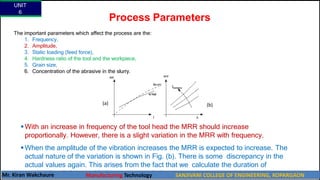
Process Parameters
The important parameters which affect the process are the:
1. Frequency,
2. Amplitude,
3. Static loading (feed force),
4. Hardness ratio of the tool and the workpiece,
5. Grain size,
6. Concentration of the abrasive in the slurry.
With an increase in frequency of the tool head the MRR should increase
proportionally. However, there is a slight variation in the MRR with frequency.
When the amplitude of the vibration increases the MRR is expected to increase. The
actual nature of the variation is shown in Fig. (b). There is some discrepancy in the
actual values again. This arises from the fact that we calculate the duration of
penetration Δt by considering average velocity.
(a) (b)
UNIT
6
Mr. Kiran Wakchaure Manufacturing Technology SANJIVANI COLLEGE OF ENGINEERING, KOPARGAON
34
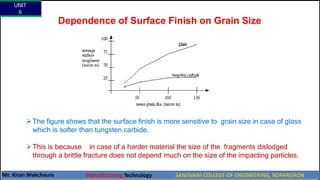
Dependence of Surface Finish on Grain Size
The figure shows that the surface finish is more sensitive to grain size in case of glass
which is softer than tungsten carbide.
This is because in case of a harder material the size of the fragments dislodged
through a brittle fracture does not depend much on the size of the impacting particles.
UNIT
6
Mr. Kiran Wakchaure Manufacturing Technology SANJIVANI COLLEGE OF ENGINEERING, KOPARGAON
35
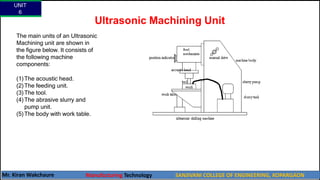
Ultrasonic Machining Unit
The main units of an Ultrasonic
Machining unit are shown in
the figure below. It consists of
the following machine
components:
(1)The acoustic head.
(2)The feeding unit.
(3)The tool.
(4)The abrasive slurry and
pump unit.
(5)The body with work table.
UNIT
6
Mr. Kiran Wakchaure Manufacturing Technology SANJIVANI COLLEGE OF ENGINEERING, KOPARGAON
36
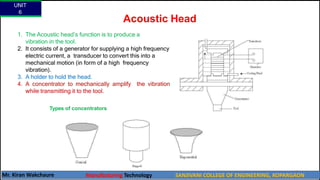
Acoustic Head
1. The Acoustic head’s function is to produce a
vibration in the tool.
2. It consists of a generator for supplying a high frequency
electric current, a transducer to convert this into a
mechanical motion (in form of a high frequency
vibration).
3. A holder to hold the head.
4. A concentrator to mechanically amplify the vibration
while transmitting it to the tool.
Types of concentrators
UNIT
6
Mr. Kiran Wakchaure Manufacturing Technology SANJIVANI COLLEGE OF ENGINEERING, KOPARGAON
37
Abrasive Slurry
 The most common abrasives are Boron Carbide (B4C), Silicon Carbide (SiC),
Corrundum (Al2O3), Diamond and Boron silicarbide.
 B4C is the best and most efficient among the rest but it is expensive.
 SiC is used on glass, germanium and most ceramics.
 Cutting time with SiC is about 20-40% more than that with B4C.
 Diamond dust is used only for cutting daimond and rubies.
 Water is the most commonly used fluid although other liquids such as benzene,
glycerol and oils are also used.
UNIT
6
Mr. Kiran Wakchaure Manufacturing Technology SANJIVANI COLLEGE OF ENGINEERING, KOPARGAON
38
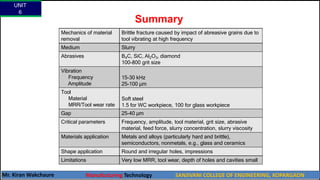
Summary
Mechanics of material
removal
Brittle fracture caused by impact of abreasive grains due to
tool vibrating at high frequency
Medium Slurry
Abrasives B4C, SiC, Al2O3, diamond
100-800 grit size
Vibration
Frequency
Amplitude
15-30 kHz
25-100 µm
Tool
Material
MRR/Tool wear rate
Soft steel
1.5 for WC workpiece, 100 for glass workpiece
Gap 25-40 µm
Critical parameters Frequency, amplitude, tool material, grit size, abrasive
material, feed force, slurry concentration, slurry viscosity
Materials application Metals and alloys (particularly hard and brittle),
semiconductors, nonmetals, e.g., glass and ceramics
Shape application Round and irregular holes, impressions
Limitations Very low MRR, tool wear, depth of holes and cavities small
UNIT
6
Mr. Kiran Wakchaure Manufacturing Technology SANJIVANI COLLEGE OF ENGINEERING, KOPARGAON
39
Advantages of Ultrasonic Machining Process (USM):
• Highly brittle materials can be easily machineable.
• Circular, non-circular of very small size is <1mm size can be produced by using this
USM method.
• Out of all the non-traditional machining methods, ultrasonic machining requires lower
specific cutting energy.
• No electrical conductivity of the workpiece is required.
• No thermal effects on the workpiece are required.
Disadvantages of Ultrasonic Machining Process (USM):
• Only brittle materials can be machinable.
• A deeper hole is not possible to produce i.e. L/D ratio up to 3 only is produced.
• Because of brittle fracturing, the surface finish produced is poor.
• Because of impact loads are acting on to the workpiece, the internal residual stresses
may be generated in the workpiece.
Applications of Ultrasonic Machining Process (USM):
• This ultrasonic machining method is mainly used for producing circular,non-circular
holes in the highly brittle materials like glass, ceramics, etc.
• The dentist uses ultrasonic machining for producing the holes in the human teeth.
UNIT
6
Mr. Kiran Wakchaure Manufacturing Technology SANJIVANI COLLEGE OF ENGINEERING, KOPARGAON
40
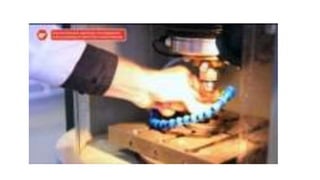
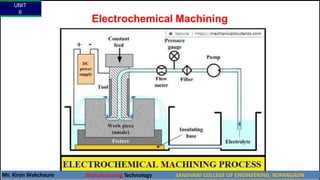
Electrochemical Machining (ECM)
Electrochemical machining is one of the most unconventional machining processes.
The process is actually the reverse of electroplating with some modifications.
It is based on the principle of electrolysis.
In a metal, electricity is conducted by free electrons but in a solution the conduction of
electricity is achieved through the movement of ions.
Thus the flow of current through an electrolyte is always accompanied by the movement of
matter.
In the ECM process the work-piece is connected to a positive electrode and the tool to the
negative terminal for metal removal.
UNIT
6
Mr. Kiran Wakchaure Manufacturing Technology SANJIVANI COLLEGE OF ENGINEERING, KOPARGAON
41
https://youtu.be/b1nX7WVIN7U?list=PLWv6RLxuaVQwMg6kFEoeeMEGTWNnr7Jmr
UNIT
6
Mr. Kiran Wakchaure Manufacturing Technology SANJIVANI COLLEGE OF ENGINEERING, KOPARGAON
43
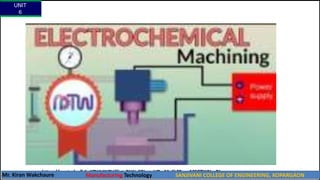
Electrochemical Machining
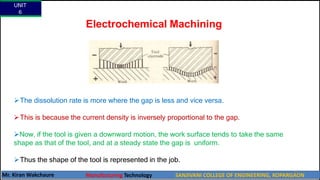
The dissolution rate is more where the gap is less and vice versa.
This is because the current density is inversely proportional to the gap.
Now, if the tool is given a downward motion, the work surface tends to take the same
shape as that of the tool, and at a steady state the gap is uniform.
Thus the shape of the tool is represented in the job.
UNIT
6
Mr. Kiran Wakchaure Manufacturing Technology SANJIVANI COLLEGE OF ENGINEERING, KOPARGAON
44
Electrochemical Machining
In an electrochemical machining process, the electrolyte is pumped at a high
pressure through the tool and the small gap between the tool and the work-
piece.
The electrolyte is so chosen that the anode is dissolved but there is no
deposition on the cathode.
The order of the current and voltage are a few 1000 amps and 8-20 volts.
The gap is of the order of 0.1-0.2mm .
The metal removal rate is typically 1600 mm3/sec for each 1000 Amp.
Approximately 3 KW-hr. are needed to remove 16000 mm3 of metal which
is almost 30 times the energy required in a conventional process.
UNIT
6
Mr. Kiran Wakchaure Manufacturing Technology SANJIVANI COLLEGE OF ENGINEERING, KOPARGAON
45
Electrochemical Machining
UNIT
6
Mr. Kiran Wakchaure Manufacturing Technology SANJIVANI COLLEGE OF ENGINEERING, KOPARGAON
46
Electrochemical Machining
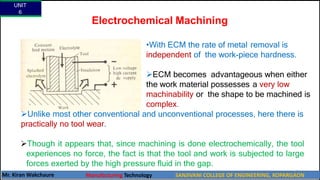
•With ECM the rate of metal removal is
independent of the work-piece hardness.
ECM becomes advantageous when either
the work material possesses a very low
machinability or the shape to be machined is
complex.
Unlike most other conventional and unconventional processes, here there is
practically no tool wear.
Though it appears that, since machining is done electrochemically, the tool
experiences no force, the fact is that the tool and work is subjected to large
forces exerted by the high pressure fluid in the gap.
UNIT
6
Mr. Kiran Wakchaure Manufacturing Technology SANJIVANI COLLEGE OF ENGINEERING, KOPARGAON
47
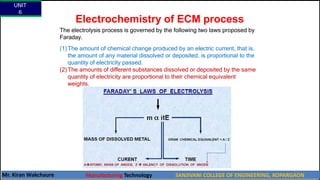
Electrochemistry of ECM process
The electrolysis process is governed by the following two laws proposed by
Faraday.
(1)The amount of chemical change produced by an electric current, that is,
the amount of any material dissolved or deposited, is proportional to the
quantity of electricity passed.
(2)The amounts of different substances dissolved or deposited by the same
quantity of electricity are proportional to their chemical equivalent
weights.
UNIT
6
Mr. Kiran Wakchaure Manufacturing Technology SANJIVANI COLLEGE OF ENGINEERING, KOPARGAON
48
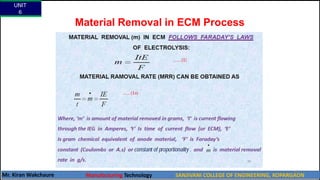
Material Removal in ECM Process
UNIT
6
Mr. Kiran Wakchaure Manufacturing Technology SANJIVANI COLLEGE OF ENGINEERING, KOPARGAON
49
Advantages of Electrochemical Machining(ECM) Process:
• Complex Concave curvature components can be easily produced by using Complex Concave
curvature tools.
• Because of ion displacement, the surface finish produced is excellent.
• Because no forces are acting, no residual stresses will be present. because of no heat generation,
no thermal effects are present on the workpiece.
• Because of no tool wear, the same tool can be used for producing an infinite number of components.
Disadvantages of Electrochemical Machining(ECM) Process:
• Workpiece material must be electrically conductive.
• Out of all the Non-traditional machining methods, electrochemical machining requires the highest
specific cutting energy Therefore, the cost of machining will be high.
• This is preferable for producing contours only but not for holes.
Applications of Electrochemical Machining Process:
• It is mainly used for producing Complex concave curvature components such as Turbine blades etc.
• The ECM process is used for profiling and contouring, die sinking operation, drilling, trepanning, and
micromachining.
• This is the explanation of Electrochemical Machining Process with its advantages, limitations, and
applications in a detailed way.
UNIT
6
Mr. Kiran Wakchaure Manufacturing Technology SANJIVANI COLLEGE OF ENGINEERING, KOPARGAON
50
UNIT
6
Mr. Kiran Wakchaure Manufacturing Technology SANJIVANI COLLEGE OF ENGINEERING, KOPARGAON
51
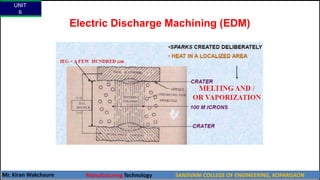
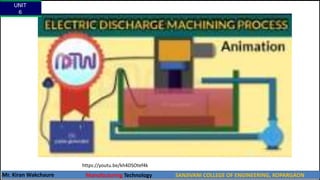
Electric Discharge Machining (EDM)
UNIT
6
Mr. Kiran Wakchaure Manufacturing Technology SANJIVANI COLLEGE OF ENGINEERING, KOPARGAON
52
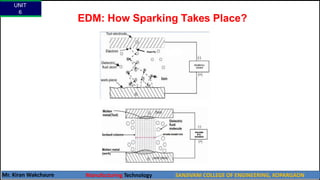
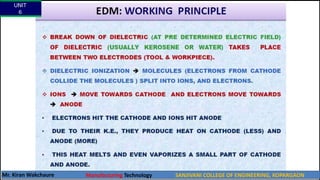
EDM: How Sparking Takes Place?
UNIT
6
Mr. Kiran Wakchaure Manufacturing Technology SANJIVANI COLLEGE OF ENGINEERING, KOPARGAON
53
UNIT
6
Mr. Kiran Wakchaure Manufacturing Technology SANJIVANI COLLEGE OF ENGINEERING, KOPARGAON
54
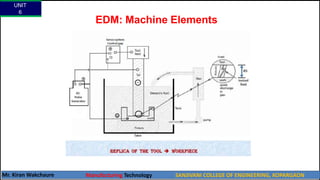
EDM: Machine Elements
UNIT
6
Mr. Kiran Wakchaure Manufacturing Technology SANJIVANI COLLEGE OF ENGINEERING, KOPARGAON
55
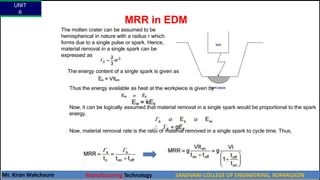
MRR in EDM
The molten crater can be assumed to be
hemispherical in nature with a radius r which
forms due to a single pulse or spark. Hence,
material removal in a single spark can be
expressed as
Thus,
The energy content of a single spark is given as
Thus the energy available as heat at the workpiece is given by
Now, it can be logically assumed that material removal in a single spark would be proportional to the spark
energy.
Now, material removal rate is the ratio of material removed in a single spark to cycle time. Thus,
UNIT
6
Mr. Kiran Wakchaure Manufacturing Technology SANJIVANI COLLEGE OF ENGINEERING, KOPARGAON
56
Advantages of EDM
Any materials that are electrically conductive can be machined by EDM.
 Materials, regardless of their hardness, strength, toughness and microstructure
can be easily machined/cut by EDM process.
The tool (electrode) and workpiece are free from cutting forces.
 Edge machining and sharp corners are possible in EDM process.
The tool making is easier as it can be made from softer and easily formable
materials like copper, brass and graphite.
UNIT
6
Mr. Kiran Wakchaure Manufacturing Technology SANJIVANI COLLEGE OF ENGINEERING, KOPARGAON
57
Advantages of EDM
The process produces good surface finish, accuracy and repeatability.
Hardened workpieces can also be machined since the deformation caused by
it does not affect the final dimensions.
 EDM is a burr free process.
 Hard die materials with complicated shapes can be easily finished with good
surface finish and accuracy through EDM process.
 Due to the presence of dielectric fluid, there is very little heating of the bulk
material.
UNIT
6
Mr. Kiran Wakchaure Manufacturing Technology SANJIVANI COLLEGE OF ENGINEERING, KOPARGAON
58
Limitations of EDM
 Material removal rates are low, making the process economical only
for very hard and difficult to machine materials.
 Re-cast layers and micro-cracks are inherent features of the EDM process,
thereby making the surface quality poor.
The EDM process is not suitable for non-conductors.
Rapid electrode wear makes the process more costly.
The surfaces produced by EDM generally have a matt type appearance,
requiring further polishing to attain a glossy finish.
UNIT
6
Mr. Kiran Wakchaure Manufacturing Technology SANJIVANI COLLEGE OF ENGINEERING, KOPARGAON
59
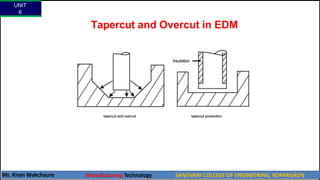
Tapercut and Overcut in EDM
UNIT
6
Mr. Kiran Wakchaure Manufacturing Technology SANJIVANI COLLEGE OF ENGINEERING, KOPARGAON
60
Applications of EDM
 Hardened steel dies, stamping tools, wire drawing and extrusion dies, header dies,
forging dies, intricate mould cavities and such parts are made by the EDM process.
 The process is widely used for machining of exotic materials that are used in aerospace and
automotive industries.
 EDM being a non-contact type of machining process, it is very well suited for making fragile
parts that cannot take the stress of machining.
Ex: washing machine agitators, electronic components, printer parts and difficult to machine
features such as the honeycomb shapes.
 Deep cavities, slots and ribs can be easily made by EDM.
 Micro-EDM process can successfully produce micro-pins, micro-nozzles and micro-cavities.
UNIT
6
Mr. Kiran Wakchaure Manufacturing Technology SANJIVANI COLLEGE OF ENGINEERING, KOPARGAON
61
https://youtu.be/kh4DSOtef4k
UNIT
6
Mr. Kiran Wakchaure Manufacturing Technology SANJIVANI COLLEGE OF ENGINEERING, KOPARGAON
62
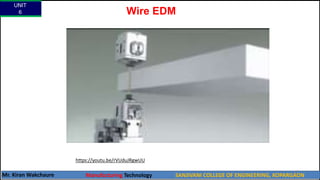
Wire EDM
UNIT
6
Mr. Kiran Wakchaure Manufacturing Technology SANJIVANI COLLEGE OF ENGINEERING, KOPARGAON
63
https://youtu.be/rVUduJRgwUU
UNIT
6
Mr. Kiran Wakchaure Manufacturing Technology SANJIVANI COLLEGE OF ENGINEERING, KOPARGAON
64
UNIT
6
Mr. Kiran Wakchaure Manufacturing Technology SANJIVANI COLLEGE OF ENGINEERING, KOPARGAON
65
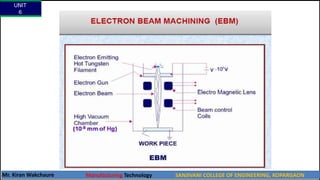
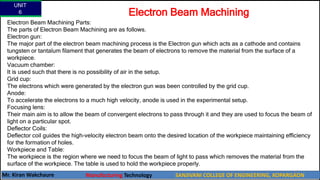
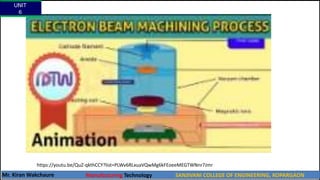
Electron Beam Machining Parts:
The parts of Electron Beam Machining are as follows.
Electron gun:
The major part of the electron beam machining process is the Electron gun which acts as a cathode and contains
tungsten or tantalum filament that generates the beam of electrons to remove the material from the surface of a
workpiece.
Vacuum chamber:
It is used such that there is no possibility of air in the setup.
Grid cup:
The electrons which were generated by the electron gun was been controlled by the grid cup.
Anode:
To accelerate the electrons to a much high velocity, anode is used in the experimental setup.
Focusing lens:
Their main aim is to allow the beam of convergent electrons to pass through it and they are used to focus the beam of
light on a particular spot.
Deflector Coils:
Deflector coil guides the high-velocity electron beam onto the desired location of the workpiece maintaining efficiency
for the formation of holes.
Workpiece and Table:
The workpiece is the region where we need to focus the beam of light to pass which removes the material from the
surface of the workpiece. The table is used to hold the workpiece properly.
Electron Beam Machining
UNIT
6
Mr. Kiran Wakchaure Manufacturing Technology SANJIVANI COLLEGE OF ENGINEERING, KOPARGAON
66
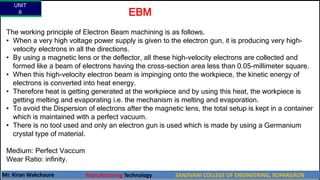
The working principle of Electron Beam machining is as follows.
• When a very high voltage power supply is given to the electron gun, it is producing very high-
velocity electrons in all the directions.
• By using a magnetic lens or the deflector, all these high-velocity electrons are collected and
formed like a beam of electrons having the cross-section area less than 0.05-millimeter square.
• When this high-velocity electron beam is impinging onto the workpiece, the kinetic energy of
electrons is converted into heat energy.
• Therefore heat is getting generated at the workpiece and by using this heat, the workpiece is
getting melting and evaporating i.e. the mechanism is melting and evaporation.
• To avoid the Dispersion of electrons after the magnetic lens, the total setup is kept in a container
which is maintained with a perfect vacuum.
• There is no tool used and only an electron gun is used which is made by using a Germanium
crystal type of material.
Medium: Perfect Vaccum
Wear Ratio: infinity.
EBM
https://youtu.be/QuZ-qkthCCY?list=PLWv6RLxuaVQwMg6kFEoeeMEGTWNnr7Jmr
UNIT
6
Mr. Kiran Wakchaure Manufacturing Technology SANJIVANI COLLEGE OF ENGINEERING, KOPARGAON
67
UNIT
6
Mr. Kiran Wakchaure Manufacturing Technology SANJIVANI COLLEGE OF ENGINEERING, KOPARGAON
68
Laser Beam Machining
UNIT
6
Mr. Kiran Wakchaure Manufacturing Technology SANJIVANI COLLEGE OF ENGINEERING, KOPARGAON
69
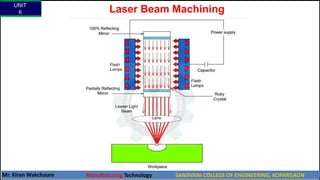
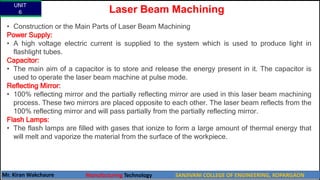
• Construction or the Main Parts of Laser Beam Machining
Power Supply:
• A high voltage electric current is supplied to the system which is used to produce light in
flashlight tubes.
Capacitor:
• The main aim of a capacitor is to store and release the energy present in it. The capacitor is
used to operate the laser beam machine at pulse mode.
Reflecting Mirror:
• 100% reflecting mirror and the partially reflecting mirror are used in this laser beam machining
process. These two mirrors are placed opposite to each other. The laser beam reflects from the
100% reflecting mirror and will pass partially from the partially reflecting mirror.
Flash Lamps:
• The flash lamps are filled with gases that ionize to form a large amount of thermal energy that
will melt and vaporize the material from the surface of the workpiece.
Laser Beam Machining
UNIT
6
Mr. Kiran Wakchaure Manufacturing Technology SANJIVANI COLLEGE OF ENGINEERING, KOPARGAON
70
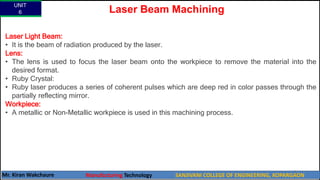
Laser Light Beam:
• It is the beam of radiation produced by the laser.
Lens:
• The lens is used to focus the laser beam onto the workpiece to remove the material into the
desired format.
• Ruby Crystal:
• Ruby laser produces a series of coherent pulses which are deep red in color passes through the
partially reflecting mirror.
Workpiece:
• A metallic or Non-Metallic workpiece is used in this machining process.
Laser Beam Machining
https://youtu.be/tTnXn498F90?list=PLWv6RLxuaVQwMg6kFEoeeMEGTWNnr7Jmr
UNIT
6
Mr. Kiran Wakchaure Manufacturing Technology SANJIVANI COLLEGE OF ENGINEERING, KOPARGAON
71
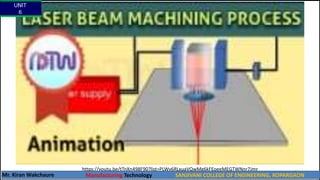
• The high voltage power supply is applied on both sides of the flash tubes which emits light
photons that contain energy. A capacitor is used to operate the flash tube at pulse mode.
• When the power supply is given to the laser gun, it is producing very high-intensity
electromagnetic waves in the form of a beam called a laser beam with a wavelength ranging from
0.1 to 70 micrometers.
• These light photons emitted by the flash tube are absorbed by the ruby crystal. As this system
has two reflecting mirrors opposite to each other can prevent and partially reflect the laser beam
through the reflecting mirror.
• After that, the laser beam can pass through the lens where the intensity or concentration of the
laser light will be increased and it can remove the material from the surface of the workpiece.
Laser Beam Machining
UNIT
6
Mr. Kiran Wakchaure Manufacturing Technology SANJIVANI COLLEGE OF ENGINEERING, KOPARGAON
72
Laser Beam Machining
• Applications
• No vacuum is required.
• Mainly used for producing holes in the diesel injection nozzle.
• Also used for producing blind holes, Narrow slots in the workpieces.
• Advantages
• No vacuum is required.
• No electrical conductivity of the workpiece is required.
• The machining zone will be seen by a machine operator.
• Because of the high flexibility of the Ruby rod, the zigzag holes can
be produced easily with Laser Beam Machining.
• Disadvantages
• The power requirement for Laser Beam Machining is very high.
• Highly reactive metals can't be machined
https://youtu.be/tTnXn498F90?list=PLWv6RLxuaVQwMg6kFEoeeMEGTWNnr7Jmr
UNIT
6
Mr. Kiran Wakchaure Manufacturing Technology SANJIVANI COLLEGE OF ENGINEERING, KOPARGAON
73

Advanced Manufacturing Processes UG Program

  • 1.
    Subject :- ManufacturingTechnology(MT) T.Y. B.Tech. Mechatronics 1
  • 2.
  • 3.
    UNIT 6 Mr. Kiran WakchaureManufacturing Technology SANJIVANI COLLEGE OF ENGINEERING, KOPARGAON 3 Manufacturing Technology Course Outcome Statements Bloom’s Taxonomy CO1 Classify and compare different materials based on their properties to select appropriate materials for specific manufacturing applications. 2 Understand CO2 Design and optimize casting processes for the manufacturing of high-quality components using knowledge of materials, process parameters, and quality control techniques. 3 Apply CO3 Select and optimize metal forming processes for specific applications using knowledge of process parameters, material properties, and tool design. 3 Analyse CO4 Analyze and optimize metal cutting processes for efficiency, quality, and cost-effectiveness using knowledge of cutting tools, machine tools, and cutting parameters. 3 Apply CO5 Select and optimize joining processes for specific applications using knowledge of materials, joint design, and welding parameters. 3 Apply CO6 Evaluate and select appropriate advanced manufacturing processes for specific applications using knowledge of process capabilities, limitations, and economic feasibility. 3 Apply
  • 4.
    UNIT 6 Mr. Kiran WakchaureManufacturing Technology SANJIVANI COLLEGE OF ENGINEERING, KOPARGAON 4
  • 5.
    Introduction to Non-Traditional Machining UNIT 6 Mr.Kiran Wakchaure Manufacturing Technology SANJIVANI COLLEGE OF ENGINEERING, KOPARGAON 5
  • 6.
    Non-Traditional Machining • Traditionalmachining is mostly based on removal of materials using tools that are harder than the materials themselves. • New and novel materials because of their greatly improved chemical, mechanical and thermal properties are sometimes impossible to machine using traditional machining processes. • Traditional machining methods are often ineffective in machining hard materials like ceramics and composites or machiningunder very tight tolerances as in micromachined components. • The need to a avoid surface damage that often accompanies the stresses created by conventional machining. Example: aerospace and electronics industries. • They are classified under the domain of non traditional processes. UNIT 6 Mr. Kiran Wakchaure Manufacturing Technology SANJIVANI COLLEGE OF ENGINEERING, KOPARGAON 6
  • 7.
    Classification of Non-TraditionalMachining These can be classified according to the source of energy used to generate such a machining action: mechanical, thermal, chemical and electrochemical. Mechanical: Erosion of the work material by a high velocity stream of abrasives or fluids (or both) Thermal: The thermal energy is applied to a very small portion of the work surface, causing that portion to be removed by fusion and/or vaporization of the material. The thermal energy is generated by conversion of electrical energy. Electrochemical: Mechanism is reverse of electroplating. Chemical: Most materials (metals particularly) are susceptible to chemical attack by certain acids or other etchants. In chemical machining, chemicals selectively remove material from portions of the workpart, while other portions of the surface are protected by a mask. UNIT 6 Mr. Kiran Wakchaure Manufacturing Technology SANJIVANI COLLEGE OF ENGINEERING, KOPARGAON 7
  • 8.
    Classification of Non-TraditionalMachining UNIT 6 Mr. Kiran Wakchaure Manufacturing Technology SANJIVANI COLLEGE OF ENGINEERING, KOPARGAON 8
  • 9.
    Mechanical Machining • UltrasonicMachining (USM) and Waterjet Machining (WJM) are typical examples of single action, mechanical non traditional machining processes. • The machining medium is solid grains suspended in an abrasive slurry in the former, while a fluid is employed in the WJM process. • The introduction of abrasives to the fluid jet enhances the machining efficiency and is known as abrasive water jet machining. Similar case happens when ice particles are introduced as in Ice Jet Machining. UNIT 6 Mr. Kiran Wakchaure Manufacturing Technology SANJIVANI COLLEGE OF ENGINEERING, KOPARGAON 9
  • 10.
    Thermal Machining UNIT 6 Mr. KiranWakchaure Manufacturing Technology SANJIVANI COLLEGE OF ENGINEERING, KOPARGAON 10  Thermal machining removes materials by melting or vaporizing the work piece material.  Many secondary phenomena occur during machining such as microcracking, formation of heat affected zones, striations etc.  The source of heat could be plasma as during EDM and PBM or photons as during LBM, electrons in EBM, ions in IBM etc.
  • 11.
    Chemical and ElectrochemicalMachining • Chemical milling and photochemical machining or photochemical blanking all use a chemical dissolution action to remove the machining allowance through ions in an etchant. • Electrochemical machining uses the electrochemical dissolution phase to remove the machining allowance using ion transfer in an electrolytic cell. UNIT 6 Mr. Kiran Wakchaure Manufacturing Technology SANJIVANI COLLEGE OF ENGINEERING, KOPARGAON 11
  • 12.
    Water Jet Cutting(WJC) • Also known as hydrodynamic machining. • Uses a fine, high-pressure, high-velocity of water directed at the work surface to cause cutting of the work. •Nozzle diameter: 0.1 to 0.4 mm •Pressure: up to 400 MPa •Velocity: up to 900 m/s •Fluid is pressurized by a hydraulic pump Important process parameters Standoff distance: small to avoid dispersion of the fluid stream (3.2 mm) Nozzle opening diameter: affects precision Water pressure: high for thicker materials Cutting feed rate: the velocity at which the WJC nozzle is traversed along the cutting path UNIT 6 Mr. Kiran Wakchaure Manufacturing Technology SANJIVANI COLLEGE OF ENGINEERING, KOPARGAON 12
  • 13.
    Water Jet Cutting(WJC) UNIT 6 Mr. Kiran Wakchaure Manufacturing Technology SANJIVANI COLLEGE OF ENGINEERING, KOPARGAON 13
  • 14.
    Construction or theMain Parts of Water Jet Machining The main parts of the Water jet Machining Process are as follows Pump: The pump acts as a mediator between the reservoir and the Intensifier. The pump sucks the water from the reservoir and sends it to the Intensifier. The pump creates pressure in the water ranging from 1500 to 4000 bars. Hydraulic Intensifier: It is connected after the hydraulic pump and is used to increase the pressure of the water from 4 bar to the pressure ranging from 3000-4000 bar. Accumulator: The accumulator is connected after the hydraulic intensifier and it is used to store the water temporarily. Accumulator supplies the water in the system when there is a need for either a drop of pressure or high-pressure water required in the system. Control Valve: The duty of the control valve is to control the pressure of water and also the quantity of water to be passed into the system. Flow regulator: As the name flow regulator, it is used to regulate the flow of water which was arrived from the control valve and send that water towards the nozzle. Nozzle: The duty of the nozzle is to convert high-pressure water into kinetic energy(K.E) and this K.E. is increased due to the decrease in the nozzle area. This high K.E. water is impinged onto the surface of the workpiece to get the desired shape and size. Drain: The main duty of the drain is to collect the water coming away from the work region and is purified again to act as the main agent into the system i.e. the purified water is again sent to the reservoir. Construction or the Main Parts of Water Jet Machining The main parts of the Water jet Machining Process are as follows Reservoir: The reservoir acts as the basic unit in the setup which is used for storing water. UNIT 6 Mr. Kiran Wakchaure Manufacturing Technology SANJIVANI COLLEGE OF ENGINEERING, KOPARGAON 14
  • 15.
    The working ofWJM is as follows. • When very high-pressure water is passing through the convergent nozzle the pressure energy is converted into velocity energy or kinetic energy. • Therefore the water is coming out from the nozzle at a very high velocity which is obtained to be 200 to 400 m per second. • When this high-velocity water Jet is impinging onto the workpiece, the continuous impact load is acting onto it. • Therefore very soft materials will experience plastic deformation and fracturing. • From the above, the mechanism of material removal is due to plastic deformation and fracturing and also called an Etching process. • In this, the Material Removal Rate(MRR) is directly proportional to the velocity of the water jet and this velocity depends on the distance between the nozzle tip and workpiece. • In this, no tool is used and the only nozzle is used and to withstand higher pressures. • The nozzle is made by using Tungsten Carbide. • From this, • Medium: Water • Wear Ratio: Infinity. UNIT 6 Mr. Kiran Wakchaure Manufacturing Technology SANJIVANI COLLEGE OF ENGINEERING, KOPARGAON 15
  • 16.
    Water Jet Cutting(WJC) https://youtu.be/dmHv42wda9k?list=PLWv6RLxuaVQwMg6kFEoeeMEGTWNnr7Jmr UNIT 6 Mr. Kiran Wakchaure Manufacturing Technology SANJIVANI COLLEGE OF ENGINEERING, KOPARGAON 16
  • 17.
    • Applications • Itis used for machining or cutting reinforced plastic. • Use to cut stone which can reduce the dust in the environment. • It is used to cut hard metal like titanium, stainless steel, etc. • It is used in aerospace industries. • Used for machining PCB. Advantages • The advantages of Water Jet machining are as follows. • Very soft materials like rubber can be easily machined • No electrical conductivity of workpiece is required • No thermal effects on the workpiece are required. Disadvantages • The disadvantages of Water Jet machining are as follows. • Pressurizing the water to very high pressure is difficult. • This method can't be used for the machining of hard materials. • Developed for cutting of very soft materials like rubber. UNIT 6 Mr. Kiran Wakchaure Manufacturing Technology SANJIVANI COLLEGE OF ENGINEERING, KOPARGAON 17
  • 18.
    Introduction to AbrasiveJet Machining (AJM) • In AJM, the material removal takes place due to impingement of the fine abrasive particles. • The abrasive particles are typically of 0.025mm diameter and the air discharges at a pressure of several atmosphere. UNIT 6 Mr. Kiran Wakchaure Manufacturing Technology SANJIVANI COLLEGE OF ENGINEERING, KOPARGAON 18
  • 19.
    Abrasive Jet Machining(AJM) UNIT 6 Mr. Kiran Wakchaure Manufacturing Technology SANJIVANI COLLEGE OF ENGINEERING, KOPARGAON 19
  • 20.
    Mechanics of AJM •Abrasive particle impinges on the work surface at a high velocity and this impact causes a tiny brittle fracture and the following air or gas carries away the dislodged small work piece particle. Fracture of work surface Formation of cavity UNIT 6 Mr. Kiran Wakchaure Manufacturing Technology SANJIVANI COLLEGE OF ENGINEERING, KOPARGAON 20
  • 21.
    • The processis more suitable when the work material is brittle and fragile. • A model for the material removal rate (MRR) is available from Sarkar and Pandey, 1980. The MRR (Q) is given as Mechanics of AJM UNIT 6 Mr. Kiran Wakchaure Manufacturing Technology SANJIVANI COLLEGE OF ENGINEERING, KOPARGAON 21
  • 22.
    Process Parameters  Theprocess characteristics can be evaluated by judging (1) the MRR, (2) the geometry of the cut, (3) the roughness of the surface produced, and (4) the rate of nozzle wear.  The major parameters which control these quantities are: 1. The abrasive (composition, strength, size and mass flow rate). 2. The gas (composition, pressure and velocity). 3. The nozzle (geometry, material, distance from and inclination to the work surface). UNIT 6 Mr. Kiran Wakchaure Manufacturing Technology SANJIVANI COLLEGE OF ENGINEERING, KOPARGAON 22
  • 23.
    The Abrasive  Mainlytwo types of abrasives are used (1) Aluminum oxide and (2) Silicon carbide. (Grains with a diameter 10-50 microns are readily available)  For good wear action on the surfaces, the abrasive grains should have sharp edges.  A reuse of the abrasive powder is normally not recommended because of a decrease of cutting capacity and clogging of the nozzle orifices due to contamination.  The mass flow rate of the abrasive particles depends on the pressure and the flow rate of the gas. There is an optimum mixing ratio (mass fraction of the abrasive in the jet) for which the metal removal rate is the highest. When the mass flow rate of the abrasive increases the material removal rate also UNIT 6 Mr. Kiran Wakchaure Manufacturing Technology SANJIVANI COLLEGE OF ENGINEERING, KOPARGAON 23
  • 24.
    The Gas  TheAJM unit normally operates at a pressure of 0.2-1.0 N/mm2 .  The composition of gas and a high velocity has a significant impact on the MRR even if the mixing ratio is not changed. The Nozzle The nozzle is one of the most vital elements controlling the process characteristics. The nozzle material should be hard to avoid any significant wear due to the flowing abrasive. [Normally WC (avg. life: 12-30 hrs.) or Sapphire (Appr. = 300 hrs.) are used] For a normal operation the cross-sectional area of the orifice can be either circular or rectangular and between 0.05- 0.2mm2 . UNIT 6 Mr. Kiran Wakchaure Manufacturing Technology SANJIVANI COLLEGE OF ENGINEERING, KOPARGAON 24
  • 25.
    Abrasive Jet Machines Thegas propulsion system supplies clean and dry gas (air, nitrogen, or CO2) to propel the abrasive particles. The gas may be supplied either by a cylinder or a compressor. In case of a compressor a filter or a dryer may be used to avoid water or oil contamination to the abrasive powder. The gas should be non toxic, cheap and easily available and should not excessively spread when discharged from nozzle into atmosphere. UNIT 6 Mr. Kiran Wakchaure Manufacturing Technology SANJIVANI COLLEGE OF ENGINEERING, KOPARGAON 25
  • 26.
    https://youtu.be/VrlCH1FZSJM?list=PLWv6RLxuaVQwMg6kFEoeeMEGTWNnr7Jmr UNIT 6 Mr. Kiran WakchaureManufacturing Technology SANJIVANI COLLEGE OF ENGINEERING, KOPARGAON 26
  • 27.
    Applications • It ishighly used in the automotive, aerospace, and electronics industries. • In aerospace industries, parts such as engine components (aluminum, titanium, and heat resistant alloys), aluminum body parts, titanium bodies for military aircraft, etc. are made using abrasive water jet machining process. Advantages • In most cases, no secondary finishing is required • No heat-affected zone • No cutter induced distortion • Eliminates thermal distortion • Low cutting forces on workpieces • Localises structural changes • No slag or cutting dross • Limited tooling requirements • Typical finish 125-250 microns Disadvantages • high capital cost and high noise levels during machining. • It cannot cut the materials that degrade quickly with moisture. • Surface finish loses at higher cut speeds. • This is a detailed explanation of the Abrasive Water Jet Machining Process. UNIT 6 Mr. Kiran Wakchaure Manufacturing Technology SANJIVANI COLLEGE OF ENGINEERING, KOPARGAON 27
  • 28.
    Ultrasonic Machining (USM)Process • The basic USM process involves a tool (made of a ductile and tough material) vibrating with a low amplitude and very high frequency and a continuous flow of an abrasive slurry in the small gap between the tool and the work piece. • The tool is gradually fed with a uniform force. • The impact of the hard abrasive grains fractures the hard and brittle work surface, resulting in the removal of the work material in the form of small wear particles. • The tool material being tough and ductile wears out at a much slower rate. UNIT 6 Mr. Kiran Wakchaure Manufacturing Technology SANJIVANI COLLEGE OF ENGINEERING, KOPARGAON 28
  • 29.
    Ultrasonic Machining (USM)Process https://youtu.be/5w6szZtOg5w?list=PLWv6RLxuaVQwMg6kFEoeeMEGTWNnr7Jmr UNIT 6 Mr. Kiran Wakchaure Manufacturing Technology SANJIVANI COLLEGE OF ENGINEERING, KOPARGAON 29
  • 30.
    Mechanics of USM Thereasons for material removal in an USM process are believed to be: 1. The hammering of the abrasive particles on the work surface by the tool. 2. The impact of free abrasive particles on the work surface. 3. The erosion due to cavitation. 4. The chemical action associated with the fluid used. Many researchers have tried to develop the theories to predict the characteristics of ultrasonic machining. The model proposed by M.C. Shaw is generally well accepted and explains the material removal process well. UNIT 6 Mr. Kiran Wakchaure Manufacturing Technology SANJIVANI COLLEGE OF ENGINEERING, KOPARGAON 30
  • 31.
    M.C. Shaw’s Modelof USM Mechanics In this model the direct impact of the tool on the grains in contact with the work piece is taken into consideration. Also, the assumptions made are: 1. The rate of work material removal is proportional to the volume of the work material per impact. 2. The rate of work material removal is proportional to the no. of particles making impact per cycle. 3. The rate of work material removal is proportional to the frequency (no. of cycles per unit time). 4. All impacts are identical. 5. All abrasive grains are identical and spherical in shape. UNIT 6 Mr. Kiran Wakchaure Manufacturing Technology SANJIVANI COLLEGE OF ENGINEERING, KOPARGAON 31
  • 32.
    USM process Thus, volumeof work material removal rate (Q) Q α V Z ν where, V = volume of the work material removal per impact Z = number of particles making impact per cycle ν = frequency UNIT 6 Mr. Kiran Wakchaure Manufacturing Technology SANJIVANI COLLEGE OF ENGINEERING, KOPARGAON 32
  • 33.
    Mechanics of USM VariousTool Position during a USM cycle. •The position ‘A’ indicates the instant the tool face touches the abrasive grain. •The period of movement from ‘A’ to ‘B’ represents the impact. • The indentations, caused by the grain on the tool and the work surface at the extreme bottom position of the tool from the position ‘A’ to position ‘B’ is ‘h’ (the total indentation). Indentations on tool and work surface at bottom position of the tool Tool Work Abrasive grain UNIT 6 Mr. Kiran Wakchaure Manufacturing Technology SANJIVANI COLLEGE OF ENGINEERING, KOPARGAON 33
  • 34.
    Process Parameters The importantparameters which affect the process are the: 1. Frequency, 2. Amplitude, 3. Static loading (feed force), 4. Hardness ratio of the tool and the workpiece, 5. Grain size, 6. Concentration of the abrasive in the slurry. With an increase in frequency of the tool head the MRR should increase proportionally. However, there is a slight variation in the MRR with frequency. When the amplitude of the vibration increases the MRR is expected to increase. The actual nature of the variation is shown in Fig. (b). There is some discrepancy in the actual values again. This arises from the fact that we calculate the duration of penetration Δt by considering average velocity. (a) (b) UNIT 6 Mr. Kiran Wakchaure Manufacturing Technology SANJIVANI COLLEGE OF ENGINEERING, KOPARGAON 34
  • 35.
    Dependence of SurfaceFinish on Grain Size The figure shows that the surface finish is more sensitive to grain size in case of glass which is softer than tungsten carbide. This is because in case of a harder material the size of the fragments dislodged through a brittle fracture does not depend much on the size of the impacting particles. UNIT 6 Mr. Kiran Wakchaure Manufacturing Technology SANJIVANI COLLEGE OF ENGINEERING, KOPARGAON 35
  • 36.
    Ultrasonic Machining Unit Themain units of an Ultrasonic Machining unit are shown in the figure below. It consists of the following machine components: (1)The acoustic head. (2)The feeding unit. (3)The tool. (4)The abrasive slurry and pump unit. (5)The body with work table. UNIT 6 Mr. Kiran Wakchaure Manufacturing Technology SANJIVANI COLLEGE OF ENGINEERING, KOPARGAON 36
  • 37.
    Acoustic Head 1. TheAcoustic head’s function is to produce a vibration in the tool. 2. It consists of a generator for supplying a high frequency electric current, a transducer to convert this into a mechanical motion (in form of a high frequency vibration). 3. A holder to hold the head. 4. A concentrator to mechanically amplify the vibration while transmitting it to the tool. Types of concentrators UNIT 6 Mr. Kiran Wakchaure Manufacturing Technology SANJIVANI COLLEGE OF ENGINEERING, KOPARGAON 37
  • 38.
    Abrasive Slurry  Themost common abrasives are Boron Carbide (B4C), Silicon Carbide (SiC), Corrundum (Al2O3), Diamond and Boron silicarbide.  B4C is the best and most efficient among the rest but it is expensive.  SiC is used on glass, germanium and most ceramics.  Cutting time with SiC is about 20-40% more than that with B4C.  Diamond dust is used only for cutting daimond and rubies.  Water is the most commonly used fluid although other liquids such as benzene, glycerol and oils are also used. UNIT 6 Mr. Kiran Wakchaure Manufacturing Technology SANJIVANI COLLEGE OF ENGINEERING, KOPARGAON 38
  • 39.
    Summary Mechanics of material removal Brittlefracture caused by impact of abreasive grains due to tool vibrating at high frequency Medium Slurry Abrasives B4C, SiC, Al2O3, diamond 100-800 grit size Vibration Frequency Amplitude 15-30 kHz 25-100 µm Tool Material MRR/Tool wear rate Soft steel 1.5 for WC workpiece, 100 for glass workpiece Gap 25-40 µm Critical parameters Frequency, amplitude, tool material, grit size, abrasive material, feed force, slurry concentration, slurry viscosity Materials application Metals and alloys (particularly hard and brittle), semiconductors, nonmetals, e.g., glass and ceramics Shape application Round and irregular holes, impressions Limitations Very low MRR, tool wear, depth of holes and cavities small UNIT 6 Mr. Kiran Wakchaure Manufacturing Technology SANJIVANI COLLEGE OF ENGINEERING, KOPARGAON 39
  • 40.
    Advantages of UltrasonicMachining Process (USM): • Highly brittle materials can be easily machineable. • Circular, non-circular of very small size is <1mm size can be produced by using this USM method. • Out of all the non-traditional machining methods, ultrasonic machining requires lower specific cutting energy. • No electrical conductivity of the workpiece is required. • No thermal effects on the workpiece are required. Disadvantages of Ultrasonic Machining Process (USM): • Only brittle materials can be machinable. • A deeper hole is not possible to produce i.e. L/D ratio up to 3 only is produced. • Because of brittle fracturing, the surface finish produced is poor. • Because of impact loads are acting on to the workpiece, the internal residual stresses may be generated in the workpiece. Applications of Ultrasonic Machining Process (USM): • This ultrasonic machining method is mainly used for producing circular,non-circular holes in the highly brittle materials like glass, ceramics, etc. • The dentist uses ultrasonic machining for producing the holes in the human teeth. UNIT 6 Mr. Kiran Wakchaure Manufacturing Technology SANJIVANI COLLEGE OF ENGINEERING, KOPARGAON 40
  • 41.
    Electrochemical Machining (ECM) Electrochemicalmachining is one of the most unconventional machining processes. The process is actually the reverse of electroplating with some modifications. It is based on the principle of electrolysis. In a metal, electricity is conducted by free electrons but in a solution the conduction of electricity is achieved through the movement of ions. Thus the flow of current through an electrolyte is always accompanied by the movement of matter. In the ECM process the work-piece is connected to a positive electrode and the tool to the negative terminal for metal removal. UNIT 6 Mr. Kiran Wakchaure Manufacturing Technology SANJIVANI COLLEGE OF ENGINEERING, KOPARGAON 41
  • 43.
    https://youtu.be/b1nX7WVIN7U?list=PLWv6RLxuaVQwMg6kFEoeeMEGTWNnr7Jmr UNIT 6 Mr. Kiran WakchaureManufacturing Technology SANJIVANI COLLEGE OF ENGINEERING, KOPARGAON 43
  • 44.
    Electrochemical Machining The dissolutionrate is more where the gap is less and vice versa. This is because the current density is inversely proportional to the gap. Now, if the tool is given a downward motion, the work surface tends to take the same shape as that of the tool, and at a steady state the gap is uniform. Thus the shape of the tool is represented in the job. UNIT 6 Mr. Kiran Wakchaure Manufacturing Technology SANJIVANI COLLEGE OF ENGINEERING, KOPARGAON 44
  • 45.
    Electrochemical Machining In anelectrochemical machining process, the electrolyte is pumped at a high pressure through the tool and the small gap between the tool and the work- piece. The electrolyte is so chosen that the anode is dissolved but there is no deposition on the cathode. The order of the current and voltage are a few 1000 amps and 8-20 volts. The gap is of the order of 0.1-0.2mm . The metal removal rate is typically 1600 mm3/sec for each 1000 Amp. Approximately 3 KW-hr. are needed to remove 16000 mm3 of metal which is almost 30 times the energy required in a conventional process. UNIT 6 Mr. Kiran Wakchaure Manufacturing Technology SANJIVANI COLLEGE OF ENGINEERING, KOPARGAON 45
  • 46.
    Electrochemical Machining UNIT 6 Mr. KiranWakchaure Manufacturing Technology SANJIVANI COLLEGE OF ENGINEERING, KOPARGAON 46
  • 47.
    Electrochemical Machining •With ECMthe rate of metal removal is independent of the work-piece hardness. ECM becomes advantageous when either the work material possesses a very low machinability or the shape to be machined is complex. Unlike most other conventional and unconventional processes, here there is practically no tool wear. Though it appears that, since machining is done electrochemically, the tool experiences no force, the fact is that the tool and work is subjected to large forces exerted by the high pressure fluid in the gap. UNIT 6 Mr. Kiran Wakchaure Manufacturing Technology SANJIVANI COLLEGE OF ENGINEERING, KOPARGAON 47
  • 48.
    Electrochemistry of ECMprocess The electrolysis process is governed by the following two laws proposed by Faraday. (1)The amount of chemical change produced by an electric current, that is, the amount of any material dissolved or deposited, is proportional to the quantity of electricity passed. (2)The amounts of different substances dissolved or deposited by the same quantity of electricity are proportional to their chemical equivalent weights. UNIT 6 Mr. Kiran Wakchaure Manufacturing Technology SANJIVANI COLLEGE OF ENGINEERING, KOPARGAON 48
  • 49.
    Material Removal inECM Process UNIT 6 Mr. Kiran Wakchaure Manufacturing Technology SANJIVANI COLLEGE OF ENGINEERING, KOPARGAON 49
  • 50.
    Advantages of ElectrochemicalMachining(ECM) Process: • Complex Concave curvature components can be easily produced by using Complex Concave curvature tools. • Because of ion displacement, the surface finish produced is excellent. • Because no forces are acting, no residual stresses will be present. because of no heat generation, no thermal effects are present on the workpiece. • Because of no tool wear, the same tool can be used for producing an infinite number of components. Disadvantages of Electrochemical Machining(ECM) Process: • Workpiece material must be electrically conductive. • Out of all the Non-traditional machining methods, electrochemical machining requires the highest specific cutting energy Therefore, the cost of machining will be high. • This is preferable for producing contours only but not for holes. Applications of Electrochemical Machining Process: • It is mainly used for producing Complex concave curvature components such as Turbine blades etc. • The ECM process is used for profiling and contouring, die sinking operation, drilling, trepanning, and micromachining. • This is the explanation of Electrochemical Machining Process with its advantages, limitations, and applications in a detailed way. UNIT 6 Mr. Kiran Wakchaure Manufacturing Technology SANJIVANI COLLEGE OF ENGINEERING, KOPARGAON 50
  • 51.
    UNIT 6 Mr. Kiran WakchaureManufacturing Technology SANJIVANI COLLEGE OF ENGINEERING, KOPARGAON 51
  • 52.
    Electric Discharge Machining(EDM) UNIT 6 Mr. Kiran Wakchaure Manufacturing Technology SANJIVANI COLLEGE OF ENGINEERING, KOPARGAON 52
  • 53.
    EDM: How SparkingTakes Place? UNIT 6 Mr. Kiran Wakchaure Manufacturing Technology SANJIVANI COLLEGE OF ENGINEERING, KOPARGAON 53
  • 54.
    UNIT 6 Mr. Kiran WakchaureManufacturing Technology SANJIVANI COLLEGE OF ENGINEERING, KOPARGAON 54
  • 55.
    EDM: Machine Elements UNIT 6 Mr.Kiran Wakchaure Manufacturing Technology SANJIVANI COLLEGE OF ENGINEERING, KOPARGAON 55
  • 56.
    MRR in EDM Themolten crater can be assumed to be hemispherical in nature with a radius r which forms due to a single pulse or spark. Hence, material removal in a single spark can be expressed as Thus, The energy content of a single spark is given as Thus the energy available as heat at the workpiece is given by Now, it can be logically assumed that material removal in a single spark would be proportional to the spark energy. Now, material removal rate is the ratio of material removed in a single spark to cycle time. Thus, UNIT 6 Mr. Kiran Wakchaure Manufacturing Technology SANJIVANI COLLEGE OF ENGINEERING, KOPARGAON 56
  • 57.
    Advantages of EDM Anymaterials that are electrically conductive can be machined by EDM.  Materials, regardless of their hardness, strength, toughness and microstructure can be easily machined/cut by EDM process. The tool (electrode) and workpiece are free from cutting forces.  Edge machining and sharp corners are possible in EDM process. The tool making is easier as it can be made from softer and easily formable materials like copper, brass and graphite. UNIT 6 Mr. Kiran Wakchaure Manufacturing Technology SANJIVANI COLLEGE OF ENGINEERING, KOPARGAON 57
  • 58.
    Advantages of EDM Theprocess produces good surface finish, accuracy and repeatability. Hardened workpieces can also be machined since the deformation caused by it does not affect the final dimensions.  EDM is a burr free process.  Hard die materials with complicated shapes can be easily finished with good surface finish and accuracy through EDM process.  Due to the presence of dielectric fluid, there is very little heating of the bulk material. UNIT 6 Mr. Kiran Wakchaure Manufacturing Technology SANJIVANI COLLEGE OF ENGINEERING, KOPARGAON 58
  • 59.
    Limitations of EDM Material removal rates are low, making the process economical only for very hard and difficult to machine materials.  Re-cast layers and micro-cracks are inherent features of the EDM process, thereby making the surface quality poor. The EDM process is not suitable for non-conductors. Rapid electrode wear makes the process more costly. The surfaces produced by EDM generally have a matt type appearance, requiring further polishing to attain a glossy finish. UNIT 6 Mr. Kiran Wakchaure Manufacturing Technology SANJIVANI COLLEGE OF ENGINEERING, KOPARGAON 59
  • 60.
    Tapercut and Overcutin EDM UNIT 6 Mr. Kiran Wakchaure Manufacturing Technology SANJIVANI COLLEGE OF ENGINEERING, KOPARGAON 60
  • 61.
    Applications of EDM Hardened steel dies, stamping tools, wire drawing and extrusion dies, header dies, forging dies, intricate mould cavities and such parts are made by the EDM process.  The process is widely used for machining of exotic materials that are used in aerospace and automotive industries.  EDM being a non-contact type of machining process, it is very well suited for making fragile parts that cannot take the stress of machining. Ex: washing machine agitators, electronic components, printer parts and difficult to machine features such as the honeycomb shapes.  Deep cavities, slots and ribs can be easily made by EDM.  Micro-EDM process can successfully produce micro-pins, micro-nozzles and micro-cavities. UNIT 6 Mr. Kiran Wakchaure Manufacturing Technology SANJIVANI COLLEGE OF ENGINEERING, KOPARGAON 61
  • 62.
    https://youtu.be/kh4DSOtef4k UNIT 6 Mr. Kiran WakchaureManufacturing Technology SANJIVANI COLLEGE OF ENGINEERING, KOPARGAON 62
  • 63.
    Wire EDM UNIT 6 Mr. KiranWakchaure Manufacturing Technology SANJIVANI COLLEGE OF ENGINEERING, KOPARGAON 63 https://youtu.be/rVUduJRgwUU
  • 64.
    UNIT 6 Mr. Kiran WakchaureManufacturing Technology SANJIVANI COLLEGE OF ENGINEERING, KOPARGAON 64
  • 65.
    UNIT 6 Mr. Kiran WakchaureManufacturing Technology SANJIVANI COLLEGE OF ENGINEERING, KOPARGAON 65 Electron Beam Machining Parts: The parts of Electron Beam Machining are as follows. Electron gun: The major part of the electron beam machining process is the Electron gun which acts as a cathode and contains tungsten or tantalum filament that generates the beam of electrons to remove the material from the surface of a workpiece. Vacuum chamber: It is used such that there is no possibility of air in the setup. Grid cup: The electrons which were generated by the electron gun was been controlled by the grid cup. Anode: To accelerate the electrons to a much high velocity, anode is used in the experimental setup. Focusing lens: Their main aim is to allow the beam of convergent electrons to pass through it and they are used to focus the beam of light on a particular spot. Deflector Coils: Deflector coil guides the high-velocity electron beam onto the desired location of the workpiece maintaining efficiency for the formation of holes. Workpiece and Table: The workpiece is the region where we need to focus the beam of light to pass which removes the material from the surface of the workpiece. The table is used to hold the workpiece properly. Electron Beam Machining
  • 66.
    UNIT 6 Mr. Kiran WakchaureManufacturing Technology SANJIVANI COLLEGE OF ENGINEERING, KOPARGAON 66 The working principle of Electron Beam machining is as follows. • When a very high voltage power supply is given to the electron gun, it is producing very high- velocity electrons in all the directions. • By using a magnetic lens or the deflector, all these high-velocity electrons are collected and formed like a beam of electrons having the cross-section area less than 0.05-millimeter square. • When this high-velocity electron beam is impinging onto the workpiece, the kinetic energy of electrons is converted into heat energy. • Therefore heat is getting generated at the workpiece and by using this heat, the workpiece is getting melting and evaporating i.e. the mechanism is melting and evaporation. • To avoid the Dispersion of electrons after the magnetic lens, the total setup is kept in a container which is maintained with a perfect vacuum. • There is no tool used and only an electron gun is used which is made by using a Germanium crystal type of material. Medium: Perfect Vaccum Wear Ratio: infinity. EBM
  • 67.
    https://youtu.be/QuZ-qkthCCY?list=PLWv6RLxuaVQwMg6kFEoeeMEGTWNnr7Jmr UNIT 6 Mr. Kiran WakchaureManufacturing Technology SANJIVANI COLLEGE OF ENGINEERING, KOPARGAON 67
  • 68.
    UNIT 6 Mr. Kiran WakchaureManufacturing Technology SANJIVANI COLLEGE OF ENGINEERING, KOPARGAON 68 Laser Beam Machining
  • 69.
    UNIT 6 Mr. Kiran WakchaureManufacturing Technology SANJIVANI COLLEGE OF ENGINEERING, KOPARGAON 69 • Construction or the Main Parts of Laser Beam Machining Power Supply: • A high voltage electric current is supplied to the system which is used to produce light in flashlight tubes. Capacitor: • The main aim of a capacitor is to store and release the energy present in it. The capacitor is used to operate the laser beam machine at pulse mode. Reflecting Mirror: • 100% reflecting mirror and the partially reflecting mirror are used in this laser beam machining process. These two mirrors are placed opposite to each other. The laser beam reflects from the 100% reflecting mirror and will pass partially from the partially reflecting mirror. Flash Lamps: • The flash lamps are filled with gases that ionize to form a large amount of thermal energy that will melt and vaporize the material from the surface of the workpiece. Laser Beam Machining
  • 70.
    UNIT 6 Mr. Kiran WakchaureManufacturing Technology SANJIVANI COLLEGE OF ENGINEERING, KOPARGAON 70 Laser Light Beam: • It is the beam of radiation produced by the laser. Lens: • The lens is used to focus the laser beam onto the workpiece to remove the material into the desired format. • Ruby Crystal: • Ruby laser produces a series of coherent pulses which are deep red in color passes through the partially reflecting mirror. Workpiece: • A metallic or Non-Metallic workpiece is used in this machining process. Laser Beam Machining
  • 71.
    https://youtu.be/tTnXn498F90?list=PLWv6RLxuaVQwMg6kFEoeeMEGTWNnr7Jmr UNIT 6 Mr. Kiran WakchaureManufacturing Technology SANJIVANI COLLEGE OF ENGINEERING, KOPARGAON 71 • The high voltage power supply is applied on both sides of the flash tubes which emits light photons that contain energy. A capacitor is used to operate the flash tube at pulse mode. • When the power supply is given to the laser gun, it is producing very high-intensity electromagnetic waves in the form of a beam called a laser beam with a wavelength ranging from 0.1 to 70 micrometers. • These light photons emitted by the flash tube are absorbed by the ruby crystal. As this system has two reflecting mirrors opposite to each other can prevent and partially reflect the laser beam through the reflecting mirror. • After that, the laser beam can pass through the lens where the intensity or concentration of the laser light will be increased and it can remove the material from the surface of the workpiece. Laser Beam Machining
  • 72.
    UNIT 6 Mr. Kiran WakchaureManufacturing Technology SANJIVANI COLLEGE OF ENGINEERING, KOPARGAON 72 Laser Beam Machining • Applications • No vacuum is required. • Mainly used for producing holes in the diesel injection nozzle. • Also used for producing blind holes, Narrow slots in the workpieces. • Advantages • No vacuum is required. • No electrical conductivity of the workpiece is required. • The machining zone will be seen by a machine operator. • Because of the high flexibility of the Ruby rod, the zigzag holes can be produced easily with Laser Beam Machining. • Disadvantages • The power requirement for Laser Beam Machining is very high. • Highly reactive metals can't be machined
  • 73.
    https://youtu.be/tTnXn498F90?list=PLWv6RLxuaVQwMg6kFEoeeMEGTWNnr7Jmr UNIT 6 Mr. Kiran WakchaureManufacturing Technology SANJIVANI COLLEGE OF ENGINEERING, KOPARGAON 73