

Related Rates Equations
 How rapidly will the fluid level inside a
vertical cylindrical tank drop if we pump the
fluid out at the rate of 3000 L/ min?
1. Draw a picture and name the variables
and constants. Use t for time. Assume that all
variables are differentiable functions of t.
2. Write down the numerical information (in terms of the
symbols you have chosen).
3. Write down what you are asked to find (usually a rate,
expressed as a derivative).
4. Write an equation that relates the variables. You may
have to combine two or more equations to get a single
equation that relates the variable whose rate you want to
the variables whose rates you know.
5. Differentiate with respect to t. Then express the rate you
want in terms of the rate and variables whose values you
know.
6. Evaluate. Use known values to find the unknown rate.
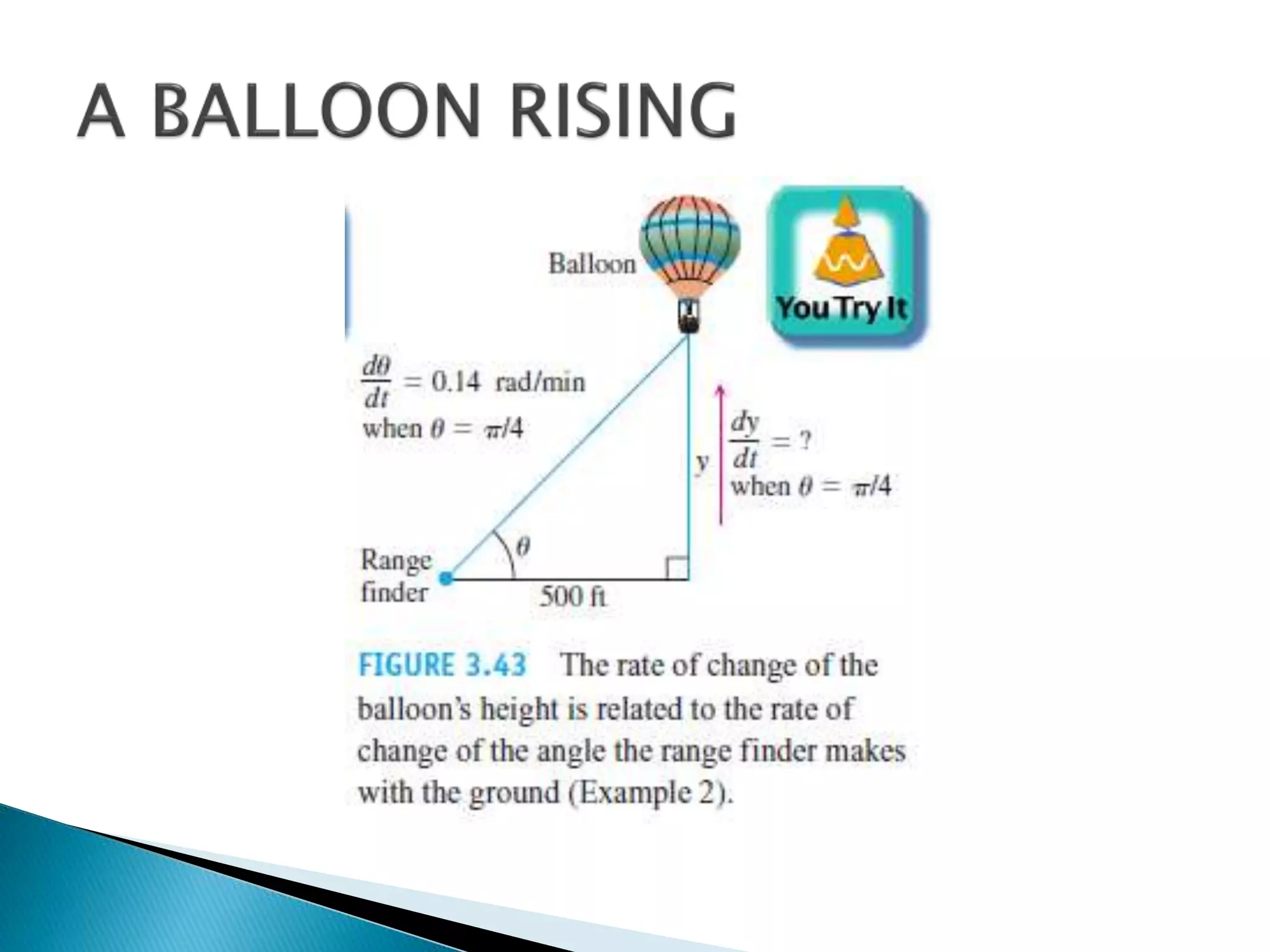
 A hot air balloon rising straight up from a
level field is tracked by a range finder 500 ft
from the liftoff point. At the moment the
range finder’s elevation angle is pi/4 the
angle is increasing at the rate of 0.14 rad
/min. How fast is the balloon rising at that
moment?
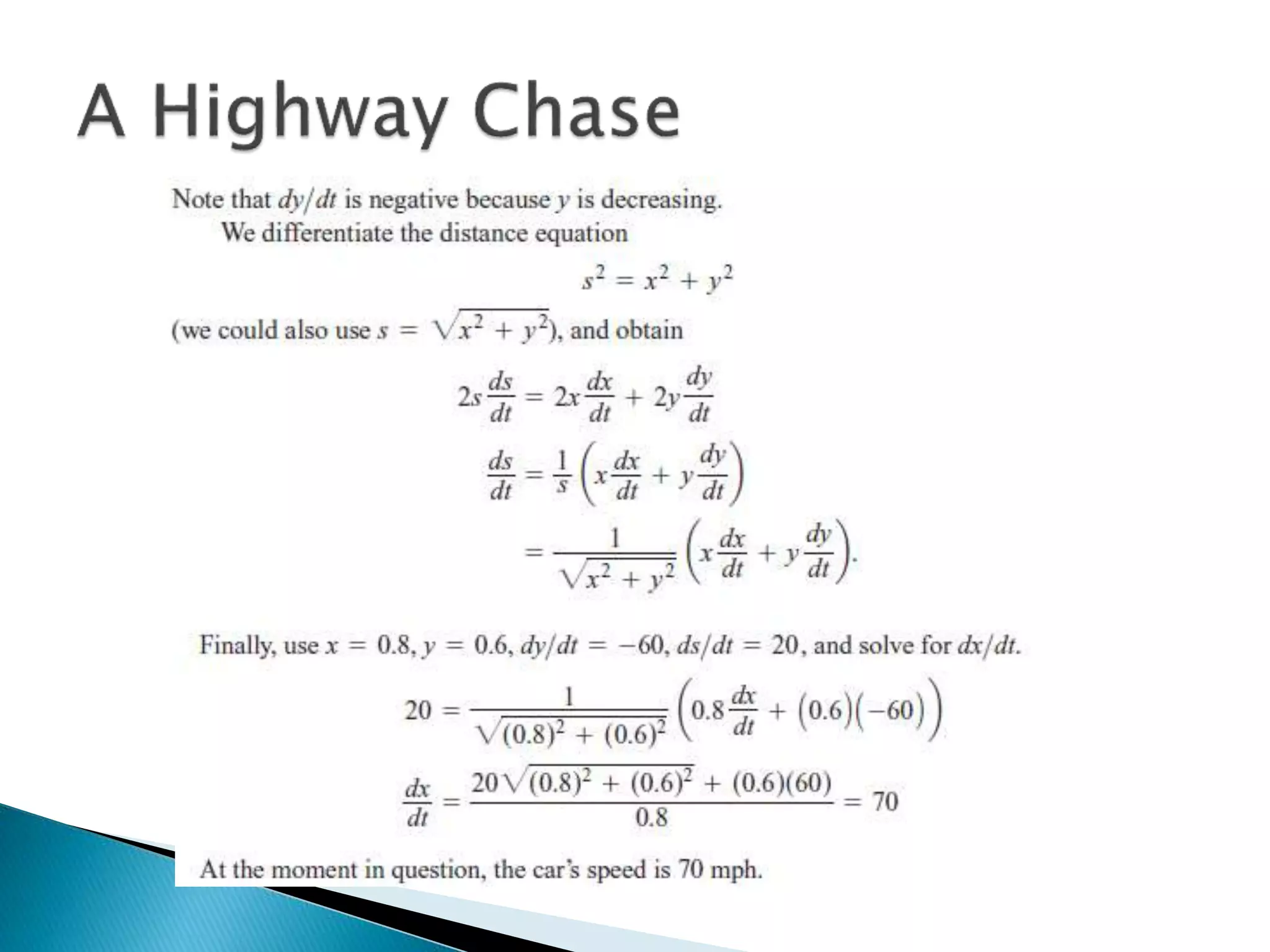
A police cruiser, approaching a right-angled
intersection from the north, is chasing a
speeding car that has turned the corner and is
now moving straight east.
When the cruiser is 0.6 mi north of the intersection
and the car is 0.8 mi to the east, the police
determine with radar that the distance between
them and the car is increasing at 20 mph.
If the cruiser is moving at 60 mph at the instant of
measurement, what is the speed of the car?
 Water runs into a conical tank at the rate of
9 c.ft/ min.
 The tank stands point down and has a height
of 10 ft and a base radius of 5 ft.
 How fast is the water level rising when the
water is 6 ft deep?
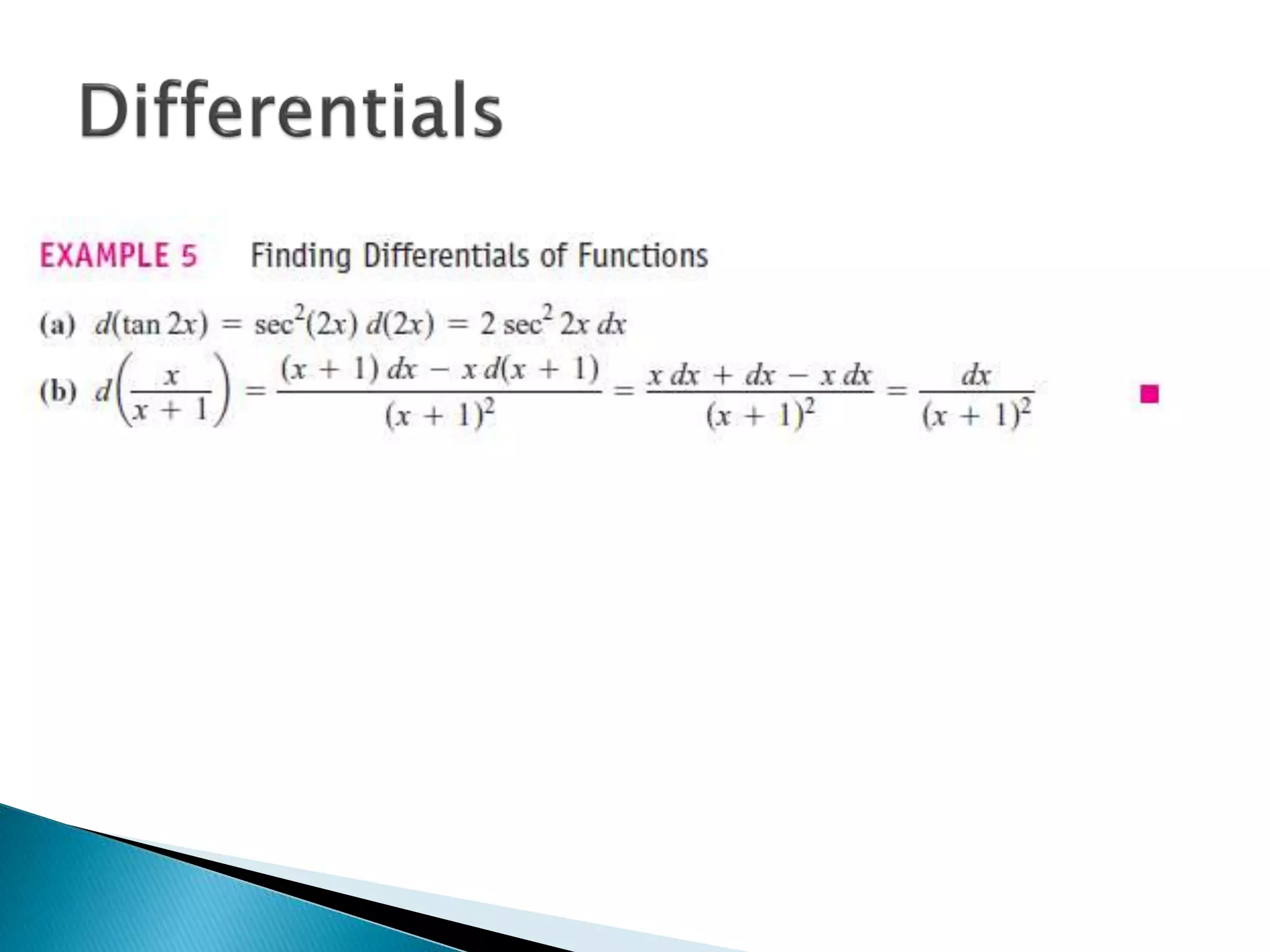
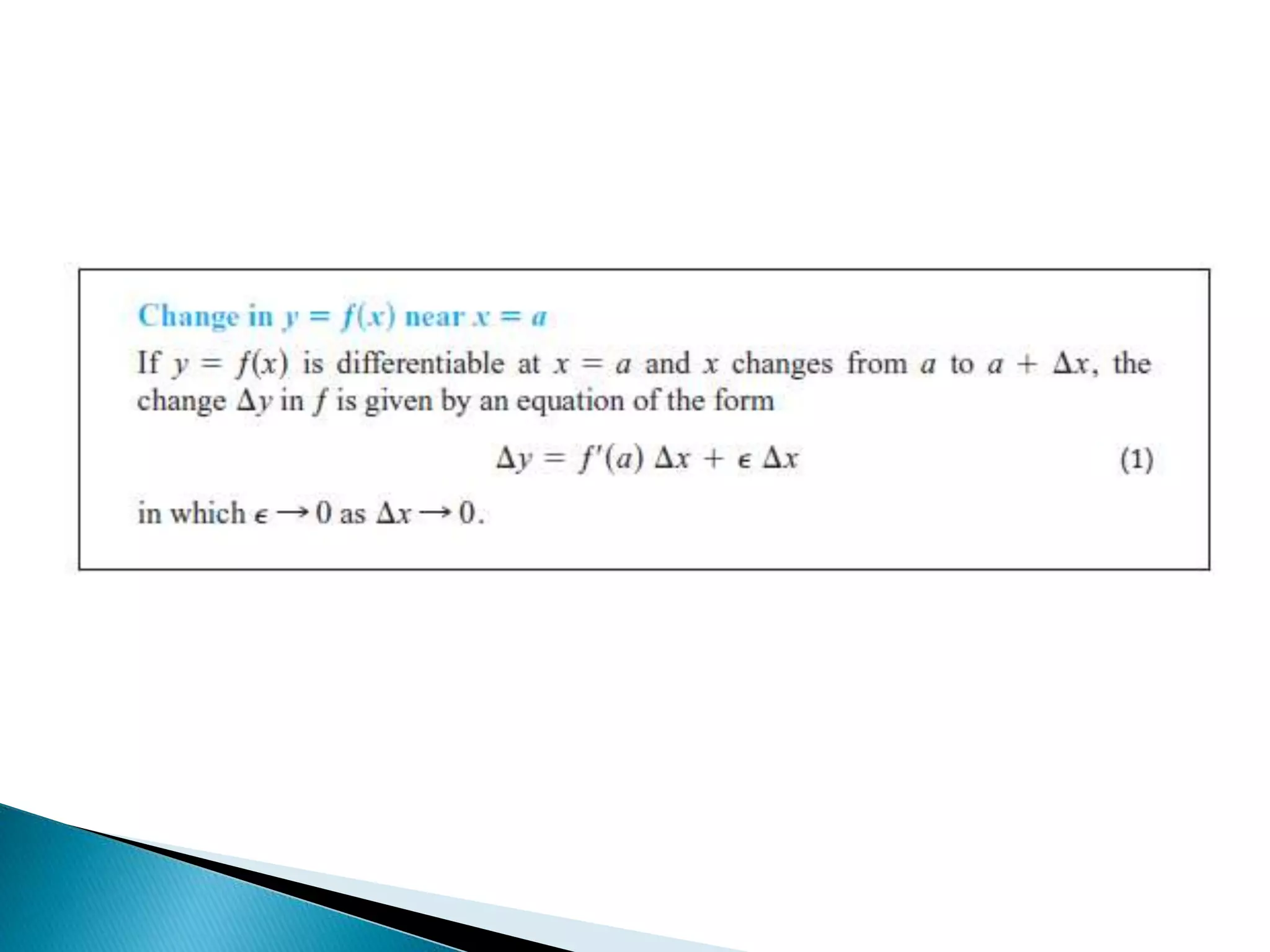
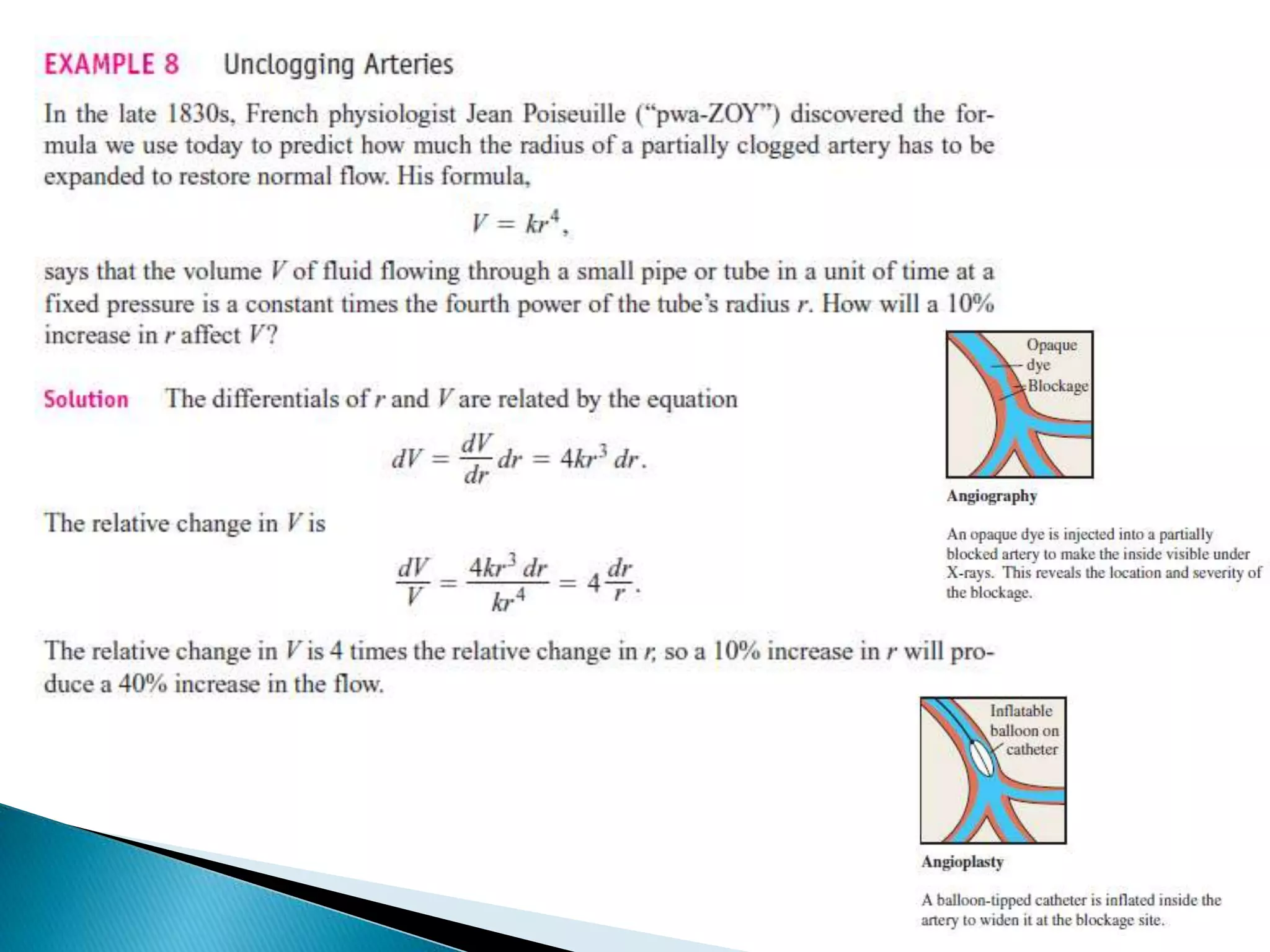
 We introduce new variables dx and dy, called
differentials, and define them in a way that
makes Leibniz’s notation for the derivative a
true ratio.
 We use dy to estimate error in measurement
and sensitivity of a function to change.
 Application of these ideas then provides for a
precise proof of the Chain Rule
Differentiation and Linearization

Differentiation and Linearization

  • 1.
  • 3.
     How rapidlywill the fluid level inside a vertical cylindrical tank drop if we pump the fluid out at the rate of 3000 L/ min?
  • 5.
    1. Draw apicture and name the variables and constants. Use t for time. Assume that all variables are differentiable functions of t. 2. Write down the numerical information (in terms of the symbols you have chosen). 3. Write down what you are asked to find (usually a rate, expressed as a derivative). 4. Write an equation that relates the variables. You may have to combine two or more equations to get a single equation that relates the variable whose rate you want to the variables whose rates you know. 5. Differentiate with respect to t. Then express the rate you want in terms of the rate and variables whose values you know. 6. Evaluate. Use known values to find the unknown rate.
  • 6.
     A hotair balloon rising straight up from a level field is tracked by a range finder 500 ft from the liftoff point. At the moment the range finder’s elevation angle is pi/4 the angle is increasing at the rate of 0.14 rad /min. How fast is the balloon rising at that moment?
  • 10.
    A police cruiser,approaching a right-angled intersection from the north, is chasing a speeding car that has turned the corner and is now moving straight east. When the cruiser is 0.6 mi north of the intersection and the car is 0.8 mi to the east, the police determine with radar that the distance between them and the car is increasing at 20 mph. If the cruiser is moving at 60 mph at the instant of measurement, what is the speed of the car?
  • 14.
     Water runsinto a conical tank at the rate of 9 c.ft/ min.  The tank stands point down and has a height of 10 ft and a base radius of 5 ft.  How fast is the water level rising when the water is 6 ft deep?
  • 20.
     We introducenew variables dx and dy, called differentials, and define them in a way that makes Leibniz’s notation for the derivative a true ratio.  We use dy to estimate error in measurement and sensitivity of a function to change.  Application of these ideas then provides for a precise proof of the Chain Rule