By
ARUNKUMAR B. WALIKAR
M.PHARM
DEPARTMENT OF PHARMACEUTICS
B.L.D.E.A’s
S S M COLLEGE OF PHARMACY, VIJAYPUR
Formula for calculating dose of
child
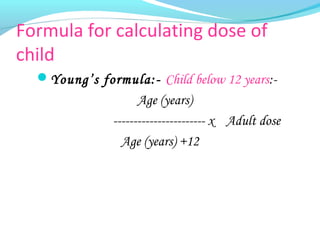
Young’s formula:- Child below 12 years:-
Age (years)
----------------------- x Adult dose
Age (years) +12
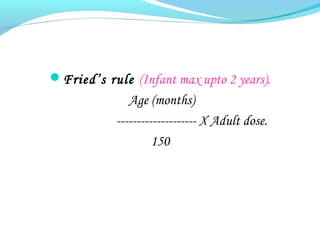
Fried’s rule (Infant max upto 2 years).
Age (months)
-------------------- X Adult dose.
150
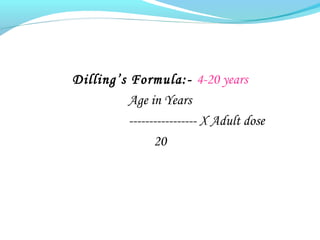
Dilling’s Formula:- 4-20 years
Age in Years
----------------- X Adult dose
20
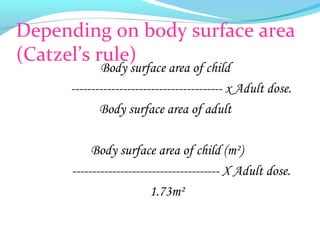
Depending on body surface area
(Catzel’s rule)
Body surface area of child
-------------------------------------- x Adult dose.
Body surface area of adult
Body surface area of child (m²)
------------------------------------- X Adult dose.
1.73m²
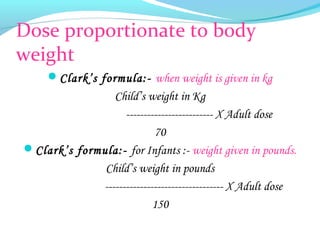
Dose proportionate to body
weight
Clark’s formula:- when weight is given in kg
Child’s weight in Kg
------------------------- X Adult dose
70
Clark’s formula:- for Infants :- weight given in pounds.
Child’s weight in pounds
---------------------------------- X Adult dose
150
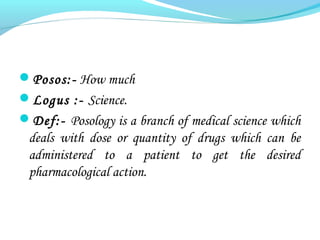
Posos:- How much
Logus :- Science.
Def:- Posology is a branch of medical science which
deals with dose or quantity of drugs which can be
administered to a patient to get the desired
pharmacological action.
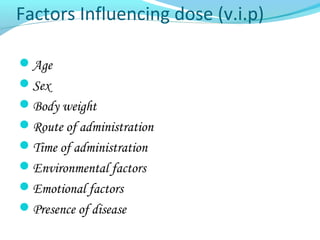
Factors Influencing dose (v.i.p)
Age
Sex
Body weight
Route of administration
Time of administration
Environmental factors
Emotional factors
Presence of disease
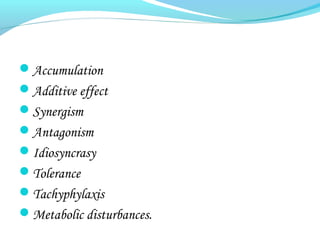
Accumulation
Additive effect
Synergism
Antagonism
Idiosyncrasy
Tolerance
Tachyphylaxis
Metabolic disturbances.
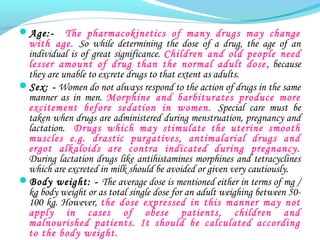
Age:- The pharmacokinetics of many drugs may change
with age. So while determining the dose of a drug, the age of an
individual is of great significance. Children and old people need
lesser amount of drug than the normal adult dose, because
they are unable to excrete drugs to that extent as adults.
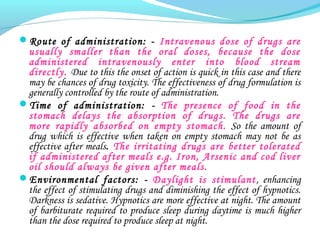
Sex: - Women do not always respond to the action of drugs in the same
manner as in men. Morphine and barbiturates produce more
excitement before sedation in women. Special care must be
taken when drugs are administered during menstruation, pregnancy and
lactation. Drugs which may stimulate the uterine smooth
muscles e.g. drastic purgatives, antimalarial drugs and
ergot alkaloids are contra indicated during pregnancy.
During lactation drugs like antihistamines morphines and tetracyclines
which are excreted in milk should be avoided or given very cautiously.
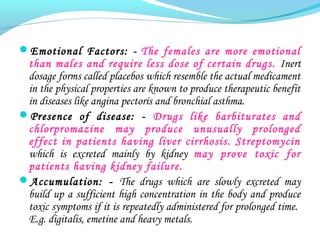
Body weight: - The average dose is mentioned either in terms of mg /
kg body weight or as total single dose for an adult weighing between 50-
100 kg. However, the dose expressed in this manner may not
apply in cases of obese patients, children and
malnourished patients. It should be calculated according
to the body weight.
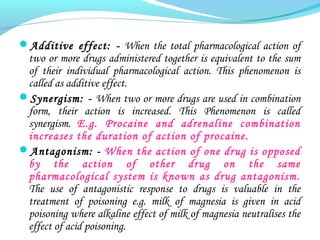
Route of administration: - Intravenous dose of drugs are
usually smaller than the oral doses, because the dose
administered intravenously enter into blood stream
directly. Due to this the onset of action is quick in this case and there
may be chances of drug toxicity. The effectiveness of drug formulation is
generally controlled by the route of administration.
Time of administration: - The presence of food in the
stomach delays the absorption of drugs. The drugs are
more rapidly absorbed on empty stomach. So the amount of
drug which is effective when taken on empty stomach may not be as
effective after meals. The irritating drugs are better tolerated
if administered after meals e.g. Iron, Arsenic and cod liver
oil should always be given after meals.
Environmental factors: - Daylight is stimulant, enhancing
the effect of stimulating drugs and diminishing the effect of hypnotics.
Darkness is sedative. Hypnotics are more effective at night. The amount
of barbiturate required to produce sleep during daytime is much higher
than the dose required to produce sleep at night.
Emotional Factors: - The females are more emotional
than males and require less dose of certain drugs. Inert
dosage forms called placebos which resemble the actual medicament
in the physical properties are known to produce therapeutic benefit
in diseases like angina pectoris and bronchial asthma.
Presence of disease: - Drugs like barbiturates and
chlorpromazine may produce unusually prolonged
effect in patients having liver cirrhosis. Streptomycin
which is excreted mainly by kidney may prove toxic for
patients having kidney failure.
Accumulation: - The drugs which are slowly excreted may
build up a sufficient high concentration in the body and produce
toxic symptoms if it is repeatedly administered for prolonged time.
E.g. digitalis, emetine and heavy metals.
Additive effect: - When the total pharmacological action of
two or more drugs administered together is equivalent to the sum
of their individual pharmacological action. This phenomenon is
called as additive effect.
Synergism: - When two or more drugs are used in combination
form, their action is increased. This Phenomenon is called
synergism. E.g. Procaine and adrenaline combination
increases the duration of action of procaine.
Antagonism: - When the action of one drug is opposed
by the action of other drug on the same
pharmacological system is known as drug antagonism.
The use of antagonistic response to drugs is valuable in the
treatment of poisoning e.g. milk of magnesia is given in acid
poisoning where alkaline effect of milk of magnesia neutralises the
effect of acid poisoning.
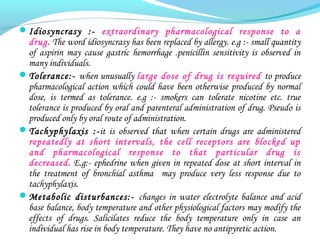
Idiosyncrasy :- extraordinary pharmacological response to a
drug. The word idiosyncrasy has been replaced by allergy. e.g :- small quantity
of aspirin may cause gastric hemorrhage .penicillin sensitivity is observed in
many individuals.
Tolerance:- when unusually large dose of drug is required to produce
pharmacological action which could have been otherwise produced by normal
dose, is termed as tolerance. e.g :- smokers can tolerate nicotine etc. true
tolerance is produced by oral and parenteral administration of drug. Pseudo is
produced only by oral route of administration.
Tachyphylaxis :-it is observed that when certain drugs are administered
repeatedly at short intervals, the cell receptors are blocked up
and pharmacological response to that particular drug is
decreased. E.g:- ephedrine when given in repeated dose at short interval in
the treatment of bronchial asthma may produce very less response due to
tachyphylaxis.
Metabolic disturbances:- changes in water electrolyte balance and acid
base balance, body temperature and other physiological factors may modify the
effects of drugs. Salicilates reduce the body temperature only in case an
individual has rise in body temperature. They have no antipyretic action.
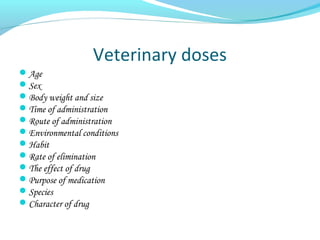
Veterinary doses
Age
Sex
Body weight and size
Time of administration
Route of administration
Environmental conditions
Habit
Rate of elimination
The effect of drug
Purpose of medication
Species
Character of drug
THANK YOU
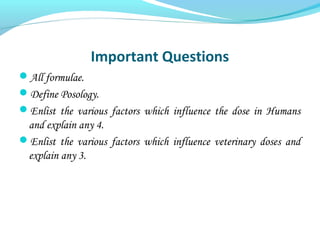
Important Questions
All formulae.
Define Posology.
Enlist the various factors which influence the dose in Humans
and explain any 4.
Enlist the various factors which influence veterinary doses and
explain any 3.

POSOLOGY by A B Walikar

  • 1.
    By ARUNKUMAR B. WALIKAR M.PHARM DEPARTMENTOF PHARMACEUTICS B.L.D.E.A’s S S M COLLEGE OF PHARMACY, VIJAYPUR
  • 2.
    Formula for calculatingdose of child Young’s formula:- Child below 12 years:- Age (years) ----------------------- x Adult dose Age (years) +12
  • 3.
    Fried’s rule (Infantmax upto 2 years). Age (months) -------------------- X Adult dose. 150
  • 4.
    Dilling’s Formula:- 4-20years Age in Years ----------------- X Adult dose 20
  • 5.
    Depending on bodysurface area (Catzel’s rule) Body surface area of child -------------------------------------- x Adult dose. Body surface area of adult Body surface area of child (m²) ------------------------------------- X Adult dose. 1.73m²
  • 6.
    Dose proportionate tobody weight Clark’s formula:- when weight is given in kg Child’s weight in Kg ------------------------- X Adult dose 70 Clark’s formula:- for Infants :- weight given in pounds. Child’s weight in pounds ---------------------------------- X Adult dose 150
  • 7.
    Posos:- How much Logus:- Science. Def:- Posology is a branch of medical science which deals with dose or quantity of drugs which can be administered to a patient to get the desired pharmacological action.
  • 8.
    Factors Influencing dose(v.i.p) Age Sex Body weight Route of administration Time of administration Environmental factors Emotional factors Presence of disease
  • 9.
  • 10.
    Age:- The pharmacokineticsof many drugs may change with age. So while determining the dose of a drug, the age of an individual is of great significance. Children and old people need lesser amount of drug than the normal adult dose, because they are unable to excrete drugs to that extent as adults. Sex: - Women do not always respond to the action of drugs in the same manner as in men. Morphine and barbiturates produce more excitement before sedation in women. Special care must be taken when drugs are administered during menstruation, pregnancy and lactation. Drugs which may stimulate the uterine smooth muscles e.g. drastic purgatives, antimalarial drugs and ergot alkaloids are contra indicated during pregnancy. During lactation drugs like antihistamines morphines and tetracyclines which are excreted in milk should be avoided or given very cautiously. Body weight: - The average dose is mentioned either in terms of mg / kg body weight or as total single dose for an adult weighing between 50- 100 kg. However, the dose expressed in this manner may not apply in cases of obese patients, children and malnourished patients. It should be calculated according to the body weight.
  • 11.
    Route of administration:- Intravenous dose of drugs are usually smaller than the oral doses, because the dose administered intravenously enter into blood stream directly. Due to this the onset of action is quick in this case and there may be chances of drug toxicity. The effectiveness of drug formulation is generally controlled by the route of administration. Time of administration: - The presence of food in the stomach delays the absorption of drugs. The drugs are more rapidly absorbed on empty stomach. So the amount of drug which is effective when taken on empty stomach may not be as effective after meals. The irritating drugs are better tolerated if administered after meals e.g. Iron, Arsenic and cod liver oil should always be given after meals. Environmental factors: - Daylight is stimulant, enhancing the effect of stimulating drugs and diminishing the effect of hypnotics. Darkness is sedative. Hypnotics are more effective at night. The amount of barbiturate required to produce sleep during daytime is much higher than the dose required to produce sleep at night.
  • 12.
    Emotional Factors: -The females are more emotional than males and require less dose of certain drugs. Inert dosage forms called placebos which resemble the actual medicament in the physical properties are known to produce therapeutic benefit in diseases like angina pectoris and bronchial asthma. Presence of disease: - Drugs like barbiturates and chlorpromazine may produce unusually prolonged effect in patients having liver cirrhosis. Streptomycin which is excreted mainly by kidney may prove toxic for patients having kidney failure. Accumulation: - The drugs which are slowly excreted may build up a sufficient high concentration in the body and produce toxic symptoms if it is repeatedly administered for prolonged time. E.g. digitalis, emetine and heavy metals.
  • 13.
    Additive effect: -When the total pharmacological action of two or more drugs administered together is equivalent to the sum of their individual pharmacological action. This phenomenon is called as additive effect. Synergism: - When two or more drugs are used in combination form, their action is increased. This Phenomenon is called synergism. E.g. Procaine and adrenaline combination increases the duration of action of procaine. Antagonism: - When the action of one drug is opposed by the action of other drug on the same pharmacological system is known as drug antagonism. The use of antagonistic response to drugs is valuable in the treatment of poisoning e.g. milk of magnesia is given in acid poisoning where alkaline effect of milk of magnesia neutralises the effect of acid poisoning.
  • 14.
    Idiosyncrasy :- extraordinarypharmacological response to a drug. The word idiosyncrasy has been replaced by allergy. e.g :- small quantity of aspirin may cause gastric hemorrhage .penicillin sensitivity is observed in many individuals. Tolerance:- when unusually large dose of drug is required to produce pharmacological action which could have been otherwise produced by normal dose, is termed as tolerance. e.g :- smokers can tolerate nicotine etc. true tolerance is produced by oral and parenteral administration of drug. Pseudo is produced only by oral route of administration. Tachyphylaxis :-it is observed that when certain drugs are administered repeatedly at short intervals, the cell receptors are blocked up and pharmacological response to that particular drug is decreased. E.g:- ephedrine when given in repeated dose at short interval in the treatment of bronchial asthma may produce very less response due to tachyphylaxis. Metabolic disturbances:- changes in water electrolyte balance and acid base balance, body temperature and other physiological factors may modify the effects of drugs. Salicilates reduce the body temperature only in case an individual has rise in body temperature. They have no antipyretic action.
  • 15.
    Veterinary doses Age Sex Body weightand size Time of administration Route of administration Environmental conditions Habit Rate of elimination The effect of drug Purpose of medication Species Character of drug
  • 16.
  • 17.
    Important Questions All formulae. DefinePosology. Enlist the various factors which influence the dose in Humans and explain any 4. Enlist the various factors which influence veterinary doses and explain any 3.