PHARMACOLOGY
Dr Saeed Anwar
Principal NAPS Swat
Lecturer Pharmacology
Pharmacy Technician (Cat-B) 1st Year
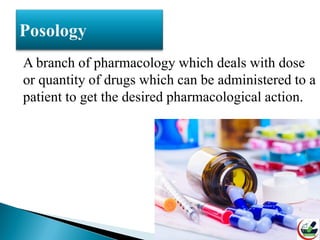
A branch of pharmacology which deals with dose
or quantity of drugs which can be administered to a
patient to get the desired pharmacological action.
Various factors responsible for dose of a drugs which are
1. Age
2. Sex
3. Body weight
4. Route of administration
5. Time of administration
6. Enviourmental factor
7. Emotinal factor
8. Presence of disease
9. Dosage form
10. Synergism & Antagonism
11. Idiosyncrasy
12. Tolerance
13. Tachyphylaxis
14. Metabolic disturbance
In children the enzyme systems in the liver and
renal excretion remain less developed. So all the
dose should be less than that of an adult. In elderly
patients the renal functions decline. Metabolism
rate in the liver also decreases. Drug absorption
from the intestine becomes slower in elderly
patients. So in geriatric patients the dose is less
and should be judiciously administered.
So we use clark,s formula, Fried’s formula and
young formula for dose calculation in children and
infants
Human beings can be categorized into the following
age groups
 Neonate: From birth up to 30days.
 Infant: 1 month to1 year age
 Toddler: 1 year to 3 years
 Child: 5 to 12 years.
 Teenagers: 12-18 years
 Adult 18+ year
 Geriatric (Elder): 65+ year
Special care should be taken while administering any drug to a
women during menstruation, pregnancy and lactation. Strong
purgatives should not be given in menstruation and pregnancy.
Antimalarials, ergot alkaloids should not be taken during
pregnancy to avoid deformation of foetus. Antihistaminic and
sedative drugs are not taken during breast feeding because these
drugs are secreted in the milk and the child may consume them.
Alcohol, barbiturate, narcotic drugs acts on foetus through
placenta.
Body weight
The average dose is mentioned either in terms of mg per kg body weight. -
Another technique used as a total single for an adult weighing between 50-
100kg. - However, the dose expressed in this fashion may not apply in case
of obese patients, children & malnourished patients. It should be calculated
according to body weight.
Route of administration
I.V doses of drug are usually smaller than the oral doses, because
Intravenous route this might enhance the chances of drug toxicity. - The
effectiveness of drug formulation is generally controlled by the route of
administration.
Time of administration
The presence of food in the stomach delay the absorption of drug & rapidly
absorbed from the empty stomach. - But it does not mean that much
effective when taken during or after meal. - Iron, arsenic & cod-liver oil
should be given after meal & antacid drugs taken before meal.
Environmental factors
Stimulant types of drug are taken at day time and sedative types of drugs are taken at
night. So the dose of a sedative required in day time will be much higher than at night.
Alcohol is better tolerated in winter than in summer.
Psychological state
Psychological state of mind can affect the response of a drug, e.g. a nervous and
anxious patient requires more general anaesthetics. Placebo is an inert substance that
does not contain any drug. Commonly used placebos are lactose tablets and distilled
water injections. Some time patients often get some psychological effects from
this placebo.
Pathological states (Presence of disease)
Several diseases may affect the dose of drugs:
In gastrointestinal disease like achlorhydria (reduced secretion of HCl acid in the
stomach) the absorption of aspirin decreases.
In liver disease (like liver cirrhosis) metabolism of some drugs (like morphine,
pentobarbitone etc.) decreases.
In kidney diseases excretion of drugs (like aminoglycosides, digoxin, phenobarbitone)
are reduced, so less dose of the drugs should be administered
Accumulation
Some drugs produces the toxic effect if it is repeatedly administered for long time e.g.
digitalis, emetine, heavy metals because these drugs excreted slowly. - This occurs due
to accumulative effect of the drug.
Synergism
When desired therapeutic result needed is difficult to achieve with single drug at that
time two or more drugs are used in the combination form for increasing their action
this phenomenon is called synergism. - E.g. procaine & adrenaline combination,
increase the duration of action of procaine.
Antagonism
The use of antagonistic response to drugs is valuable in the treatment of poisoning. -
E.g. milk of magnesia is given in acid poisoning where alkaline effect of milk of
magnesia neutralise the effect of acid poisoning. - When adrenaline & acetylcholine
are given together, they neutralise the effect of each other due to antagonism because
adrenaline is vasoconstrictor & acetylcholine is vasodilator.
Idiosyncrasy
For example small quantity of aspirin may cause gastric hemorrhag.
Tolerance
Smokers can tolerate nicotine, alcoholic can tolerate large quantity of alcohol. - The
drug tolerance is of two types,
True tolerance, which is produced by oral & parenteral administration of the drug.
Pseudo tolerance, which is produced only to the oral route of administration.
Tachyphylaxis
When some drugs administered repeatedly at short intervals, the cell receptors get
blocked up & pharmacological response to that drug decreased. - The decreased
response cannot be reversed by increasing the dose this phenomenon is called
tachyphylaxis E.g. ephedrine given repeated dose at short intervals in the treatment
of bronchial asthma may produce very less response due to tachyphylaxis.
Metabolic disturbance
Changes in water electrolyte balance & acid base balance, body temperature & other
physiological factor may modify the effect of drug. - E.g. salicylates reduce body
temperature in only in case an individual has rise in body temperature. They have no
antipyretic effect if the body temperature is normal.
Dosage calculations include calculating the
number of doses, dispensing quantities, and
ingredient quantities; these calculations are
performed in the pharmacy on a daily basis.
The pharmacy technician must have a full
working knowledge of how to perform these
calculations.
Pro drug
It is an inactive drug which become active when metabolized
in the body. e.g. Methyl dopa.
OR
A drug substance that needs to be converted into then
pharmacologically active agent by metabolic or
physicochemical transformation.
Placebo
A placebo is made to look exactly like a real drug but is made
of an inactive substance, such as a starch.
A substance that has no therapeutic effect, used as a control in
testing new drugs. Placebos are now used only in research
studies
Dose and Dosage
Dose
A Specific Amount of Drug Prescribed to be taken at one time.
Dosage
The amount of a drug given to an individual per unit body weight or
the determination and regulation of the size, frequency and number
of doses.
Loading dose
A large dose initially administered to produce an
effective concentration as quickly as possible is
called Loading dose.
Loading dose = Vd × desired steady state conc
Maintenance dose
A dose administered to maintain the therapeutic
effect or concentration in blood plasma is called
Maintenance dose
Therapeutic dose
Average dose for an adult which produce a
therapeutic effect is called therapeutic dose.
Toxic dose
Amount of drugs that produces undesirable
harmful effects of serious nature, is called toxic
dose
Fatal dose
A dose that produces death is called fatal dose
Pediatric patients, which include both infants and children,
require special dosing that is adjusted for their body weight. A
number of formulas have been used throughout the years to
determine the best dose for pediatric patients, but the most
commonly used method is stated as mg/kg of body weight.
Children need lower dosages of medication compared to
adults. Three formulas are used to help calculate a pediatric
dosage based on whatever information is available. In some
children’s hospitals the pharmacy may have a preferred
formula. However, the pharmacy technician should be able to
calculate the correct pediatric dosage using each formula.
FORMULA PEDIATRIC DOSING
Child’s dosage = Child’s weight in pounds × Adult dosage
150
Child’s dosage = Age of child in years ×Adult dosage
Age of child in years + 12
Child’s dosage = Age in months × Adult dosage
150
Clark’s Rule
Young’s Rule
Fried’s Rule
This formula used for calculating the dose for
children's under 12 years of age.
Child’s dosage = Age of child in years ×Adult dosage
Age of child in years + 12
This formula is used for calculating of dose for
infants up to 2 years.
Child’s dosage = Age in months × Adult dosage
150
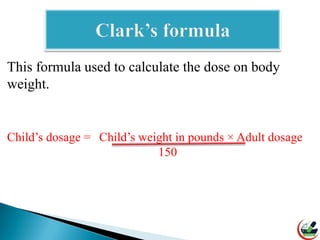
This formula used to calculate the dose on body
weight.
Child’s dosage = Child’s weight in pounds × Adult dosage
150
.

Posology pdf

  • 1.
    PHARMACOLOGY Dr Saeed Anwar PrincipalNAPS Swat Lecturer Pharmacology Pharmacy Technician (Cat-B) 1st Year
  • 2.
    A branch ofpharmacology which deals with dose or quantity of drugs which can be administered to a patient to get the desired pharmacological action.
  • 3.
    Various factors responsiblefor dose of a drugs which are 1. Age 2. Sex 3. Body weight 4. Route of administration 5. Time of administration 6. Enviourmental factor 7. Emotinal factor 8. Presence of disease 9. Dosage form 10. Synergism & Antagonism 11. Idiosyncrasy 12. Tolerance 13. Tachyphylaxis 14. Metabolic disturbance
  • 4.
    In children theenzyme systems in the liver and renal excretion remain less developed. So all the dose should be less than that of an adult. In elderly patients the renal functions decline. Metabolism rate in the liver also decreases. Drug absorption from the intestine becomes slower in elderly patients. So in geriatric patients the dose is less and should be judiciously administered. So we use clark,s formula, Fried’s formula and young formula for dose calculation in children and infants
  • 5.
    Human beings canbe categorized into the following age groups  Neonate: From birth up to 30days.  Infant: 1 month to1 year age  Toddler: 1 year to 3 years  Child: 5 to 12 years.  Teenagers: 12-18 years  Adult 18+ year  Geriatric (Elder): 65+ year
  • 6.
    Special care shouldbe taken while administering any drug to a women during menstruation, pregnancy and lactation. Strong purgatives should not be given in menstruation and pregnancy. Antimalarials, ergot alkaloids should not be taken during pregnancy to avoid deformation of foetus. Antihistaminic and sedative drugs are not taken during breast feeding because these drugs are secreted in the milk and the child may consume them. Alcohol, barbiturate, narcotic drugs acts on foetus through placenta.
  • 7.
    Body weight The averagedose is mentioned either in terms of mg per kg body weight. - Another technique used as a total single for an adult weighing between 50- 100kg. - However, the dose expressed in this fashion may not apply in case of obese patients, children & malnourished patients. It should be calculated according to body weight. Route of administration I.V doses of drug are usually smaller than the oral doses, because Intravenous route this might enhance the chances of drug toxicity. - The effectiveness of drug formulation is generally controlled by the route of administration. Time of administration The presence of food in the stomach delay the absorption of drug & rapidly absorbed from the empty stomach. - But it does not mean that much effective when taken during or after meal. - Iron, arsenic & cod-liver oil should be given after meal & antacid drugs taken before meal.
  • 8.
    Environmental factors Stimulant typesof drug are taken at day time and sedative types of drugs are taken at night. So the dose of a sedative required in day time will be much higher than at night. Alcohol is better tolerated in winter than in summer. Psychological state Psychological state of mind can affect the response of a drug, e.g. a nervous and anxious patient requires more general anaesthetics. Placebo is an inert substance that does not contain any drug. Commonly used placebos are lactose tablets and distilled water injections. Some time patients often get some psychological effects from this placebo. Pathological states (Presence of disease) Several diseases may affect the dose of drugs: In gastrointestinal disease like achlorhydria (reduced secretion of HCl acid in the stomach) the absorption of aspirin decreases. In liver disease (like liver cirrhosis) metabolism of some drugs (like morphine, pentobarbitone etc.) decreases. In kidney diseases excretion of drugs (like aminoglycosides, digoxin, phenobarbitone) are reduced, so less dose of the drugs should be administered
  • 9.
    Accumulation Some drugs producesthe toxic effect if it is repeatedly administered for long time e.g. digitalis, emetine, heavy metals because these drugs excreted slowly. - This occurs due to accumulative effect of the drug. Synergism When desired therapeutic result needed is difficult to achieve with single drug at that time two or more drugs are used in the combination form for increasing their action this phenomenon is called synergism. - E.g. procaine & adrenaline combination, increase the duration of action of procaine. Antagonism The use of antagonistic response to drugs is valuable in the treatment of poisoning. - E.g. milk of magnesia is given in acid poisoning where alkaline effect of milk of magnesia neutralise the effect of acid poisoning. - When adrenaline & acetylcholine are given together, they neutralise the effect of each other due to antagonism because adrenaline is vasoconstrictor & acetylcholine is vasodilator. Idiosyncrasy For example small quantity of aspirin may cause gastric hemorrhag.
  • 10.
    Tolerance Smokers can toleratenicotine, alcoholic can tolerate large quantity of alcohol. - The drug tolerance is of two types, True tolerance, which is produced by oral & parenteral administration of the drug. Pseudo tolerance, which is produced only to the oral route of administration. Tachyphylaxis When some drugs administered repeatedly at short intervals, the cell receptors get blocked up & pharmacological response to that drug decreased. - The decreased response cannot be reversed by increasing the dose this phenomenon is called tachyphylaxis E.g. ephedrine given repeated dose at short intervals in the treatment of bronchial asthma may produce very less response due to tachyphylaxis. Metabolic disturbance Changes in water electrolyte balance & acid base balance, body temperature & other physiological factor may modify the effect of drug. - E.g. salicylates reduce body temperature in only in case an individual has rise in body temperature. They have no antipyretic effect if the body temperature is normal.
  • 12.
    Dosage calculations includecalculating the number of doses, dispensing quantities, and ingredient quantities; these calculations are performed in the pharmacy on a daily basis. The pharmacy technician must have a full working knowledge of how to perform these calculations.
  • 13.
    Pro drug It isan inactive drug which become active when metabolized in the body. e.g. Methyl dopa. OR A drug substance that needs to be converted into then pharmacologically active agent by metabolic or physicochemical transformation. Placebo A placebo is made to look exactly like a real drug but is made of an inactive substance, such as a starch. A substance that has no therapeutic effect, used as a control in testing new drugs. Placebos are now used only in research studies
  • 14.
    Dose and Dosage Dose ASpecific Amount of Drug Prescribed to be taken at one time. Dosage The amount of a drug given to an individual per unit body weight or the determination and regulation of the size, frequency and number of doses.
  • 15.
    Loading dose A largedose initially administered to produce an effective concentration as quickly as possible is called Loading dose. Loading dose = Vd × desired steady state conc Maintenance dose A dose administered to maintain the therapeutic effect or concentration in blood plasma is called Maintenance dose
  • 16.
    Therapeutic dose Average dosefor an adult which produce a therapeutic effect is called therapeutic dose. Toxic dose Amount of drugs that produces undesirable harmful effects of serious nature, is called toxic dose Fatal dose A dose that produces death is called fatal dose
  • 17.
    Pediatric patients, whichinclude both infants and children, require special dosing that is adjusted for their body weight. A number of formulas have been used throughout the years to determine the best dose for pediatric patients, but the most commonly used method is stated as mg/kg of body weight. Children need lower dosages of medication compared to adults. Three formulas are used to help calculate a pediatric dosage based on whatever information is available. In some children’s hospitals the pharmacy may have a preferred formula. However, the pharmacy technician should be able to calculate the correct pediatric dosage using each formula.
  • 18.
    FORMULA PEDIATRIC DOSING Child’sdosage = Child’s weight in pounds × Adult dosage 150 Child’s dosage = Age of child in years ×Adult dosage Age of child in years + 12 Child’s dosage = Age in months × Adult dosage 150 Clark’s Rule Young’s Rule Fried’s Rule
  • 19.
    This formula usedfor calculating the dose for children's under 12 years of age. Child’s dosage = Age of child in years ×Adult dosage Age of child in years + 12
  • 20.
    This formula isused for calculating of dose for infants up to 2 years. Child’s dosage = Age in months × Adult dosage 150
  • 21.
    This formula usedto calculate the dose on body weight. Child’s dosage = Child’s weight in pounds × Adult dosage 150
  • 22.