PHARMACEUTICAL
DOSAGE FORMS:
ConceptandClassification
PRESENTED BY:
MD ALTAMASHAHMAD
PHARM. D 3RDYEAR
1850951001
CHITKARACOLLEGE OF PHARMACY,CHITKARA UNIVERSITY
Drug (API) – Drug is defined as a chemical compound or Active
Pharmaceutical Ingredient (API) intended for use in diagnosis, treatment
or prevention of diseases.
Excipients – They are chemical compounds also known as inactive
pharmaceutical ingredient used as diluents, binders, lubricants,
disintegrants, coatings, preservants, stabilizers, colorants and flavouring
agents
Dosage form = Drugs(API) + Excipients
• Dosage form comprises of API and suitable excipients prepared
in any of solid, semi-solid, liquid or gaseous form
Pharmaceutical dosage forms refers to pharmaceutical
preparations or formulations in which one or more Drugs
(active pharmaceutical ingredients - API) and Excipients
(inactive components) are presented in a particular
configuration or form (solid, semi-solid, liquid or gaseous
form) to facilitate easy and accurate administration and
delivery of active drug substances through various routes into
the body
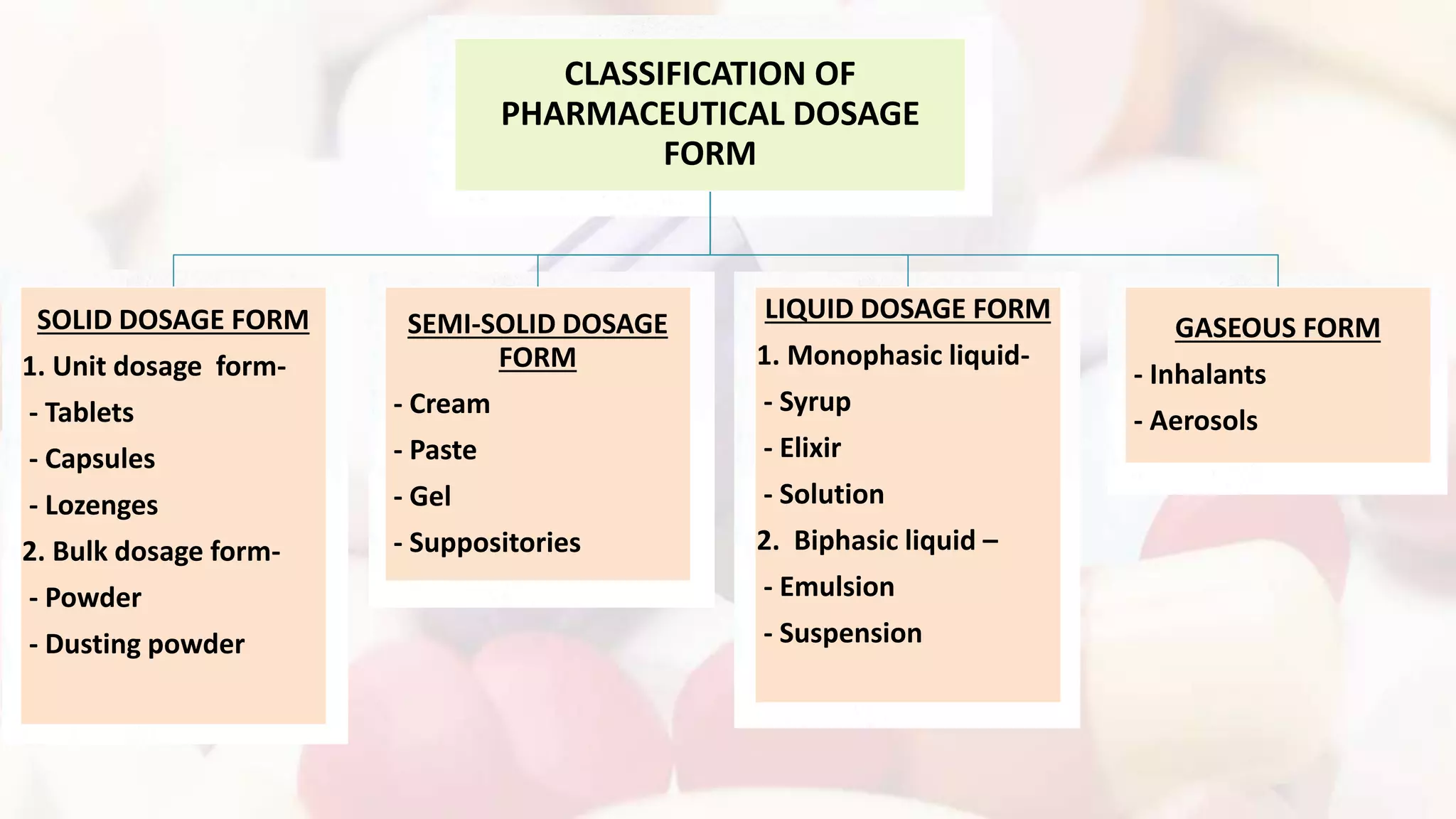
CLASSIFICATION OF
PHARMACEUTICAL DOSAGE
FORM
SOLID DOSAGE FORM
1. Unit dosage form-
- Tablets
- Capsules
- Lozenges
2. Bulk dosage form-
- Powder
- Dusting powder
SEMI-SOLID DOSAGE
FORM
- Cream
- Paste
- Gel
- Suppositories
LIQUID DOSAGE FORM
1. Monophasic liquid-
- Syrup
- Elixir
- Solution
2. Biphasic liquid –
- Emulsion
- Suspension
GASEOUS FORM
- Inhalants
- Aerosols
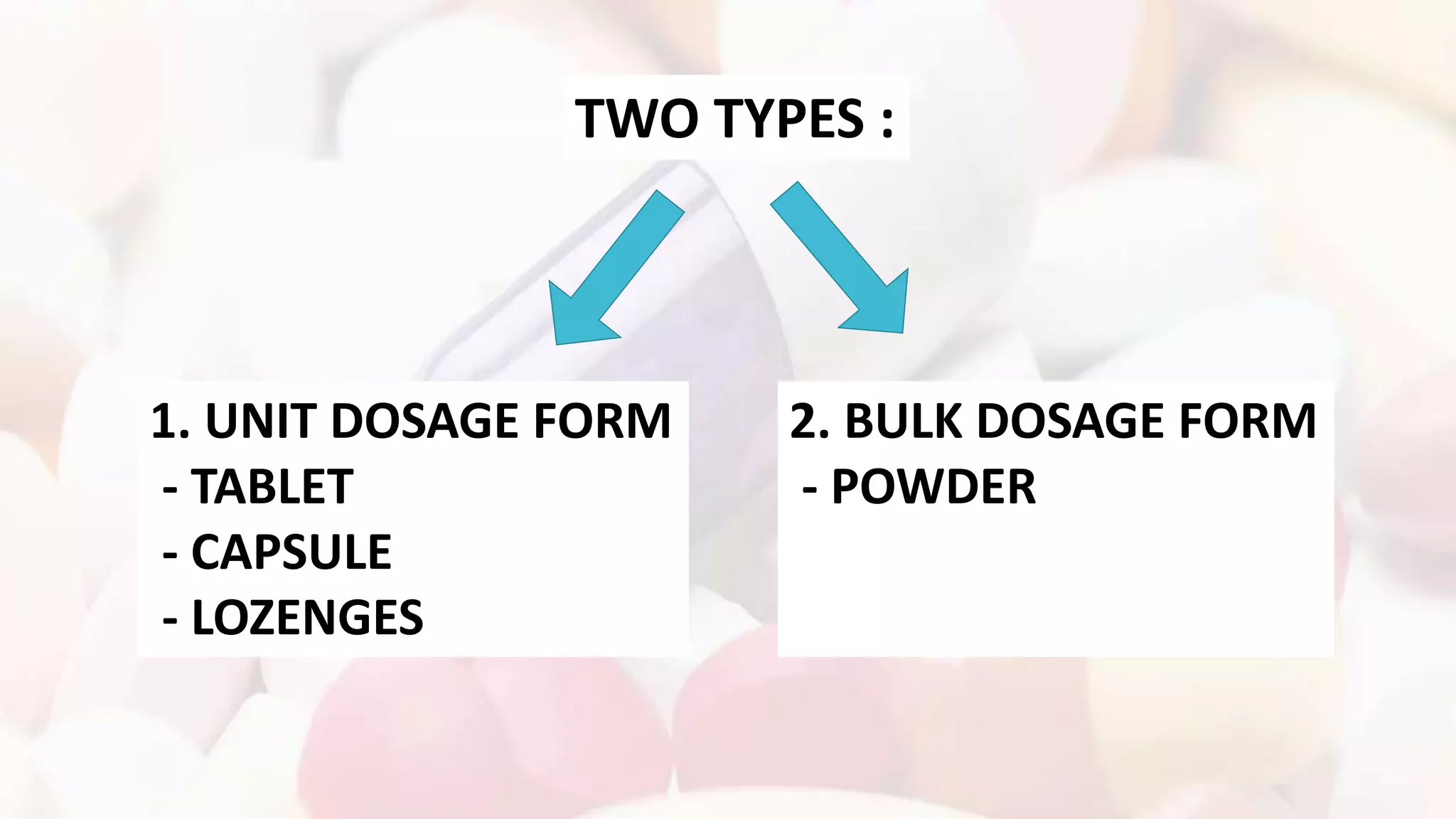
1. UNIT DOSAGE FORM
- TABLET
- CAPSULE
- LOZENGES
2. BULK DOSAGE FORM
- POWDER
TWO TYPES :
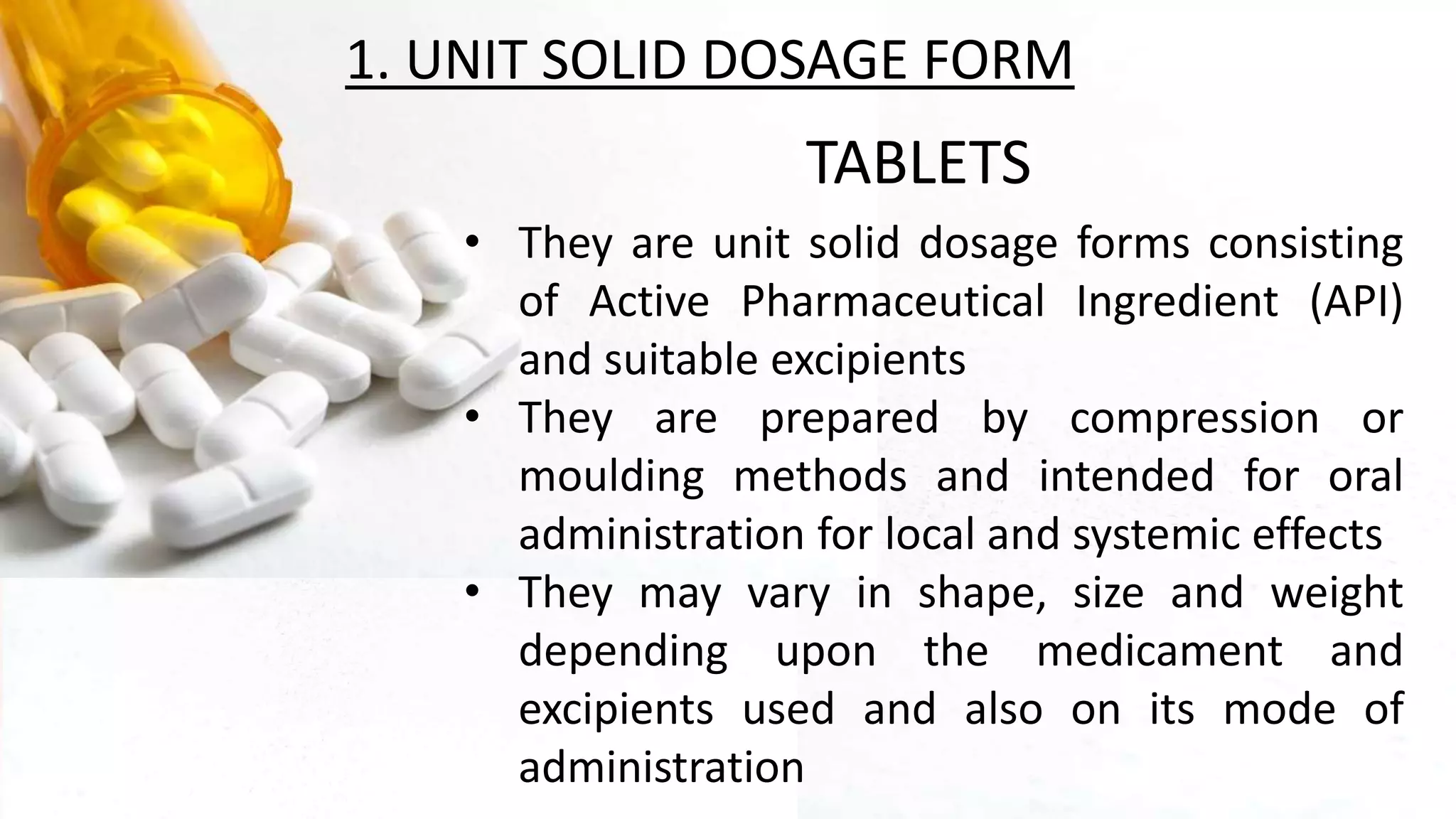
TABLETS
• They are unit solid dosage forms consisting
of Active Pharmaceutical Ingredient (API)
and suitable excipients
• They are prepared by compression or
moulding methods and intended for oral
administration for local and systemic effects
• They may vary in shape, size and weight
depending upon the medicament and
excipients used and also on its mode of
administration
1. UNIT SOLID DOSAGE FORM
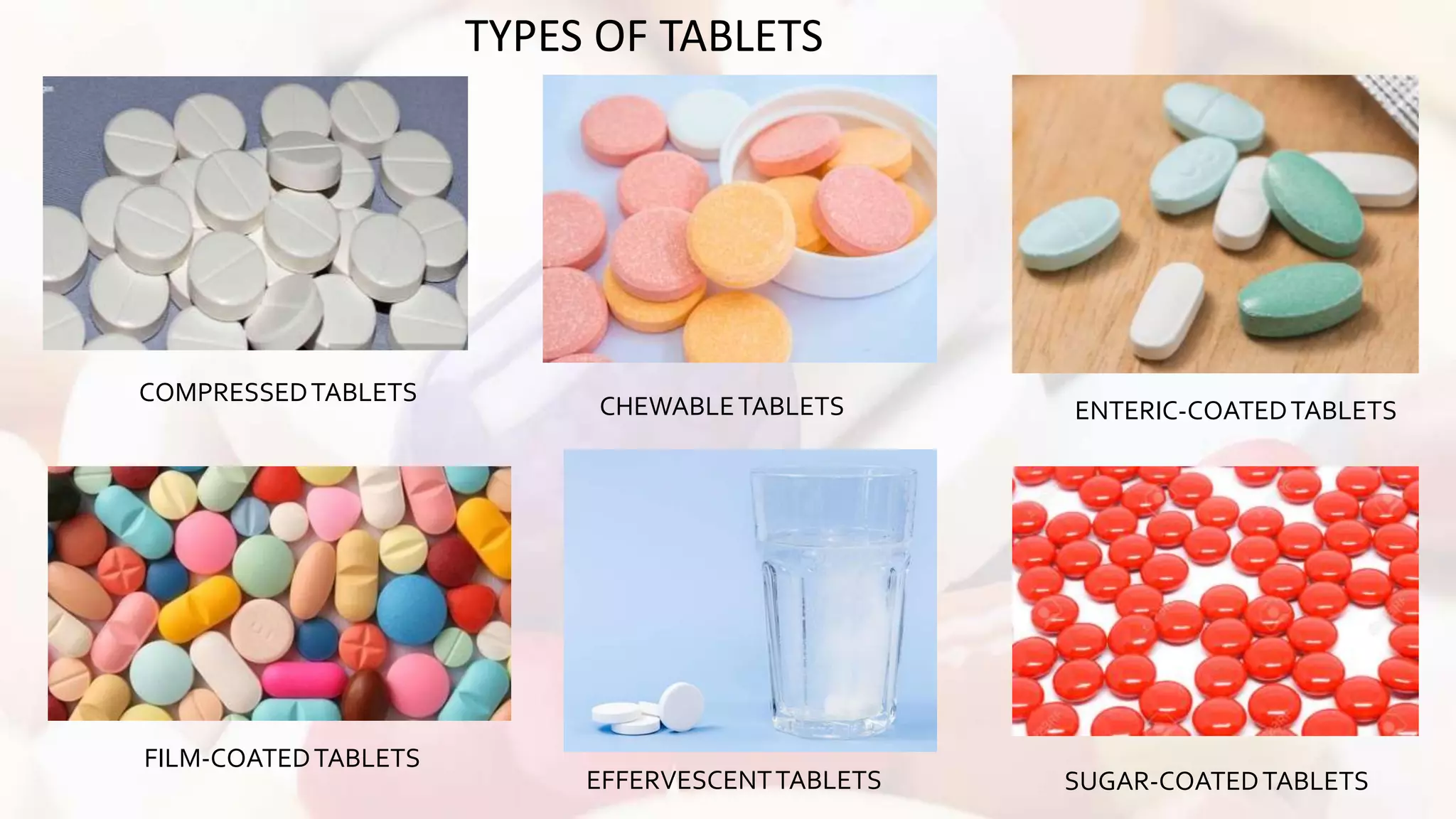
TYPES OF TABLETS
COMPRESSEDTABLETS
EFFERVESCENTTABLETS
ENTERIC-COATEDTABLETS
CHEWABLETABLETS
FILM-COATEDTABLETS
SUGAR-COATEDTABLETS
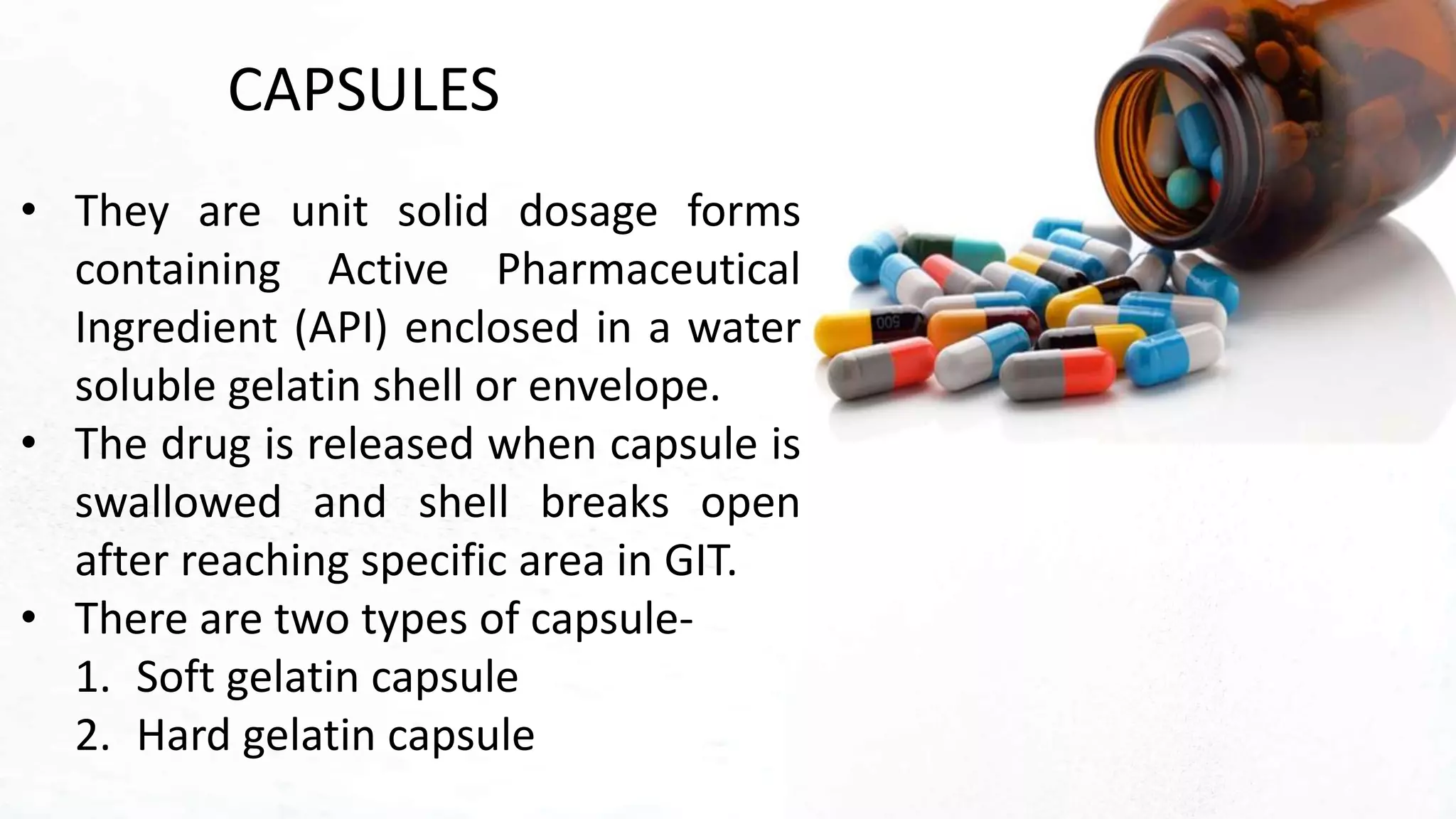
CAPSULES
• They are unit solid dosage forms
containing Active Pharmaceutical
Ingredient (API) enclosed in a water
soluble gelatin shell or envelope.
• The drug is released when capsule is
swallowed and shell breaks open
after reaching specific area in GIT.
• There are two types of capsule-
1. Soft gelatin capsule
2. Hard gelatin capsule
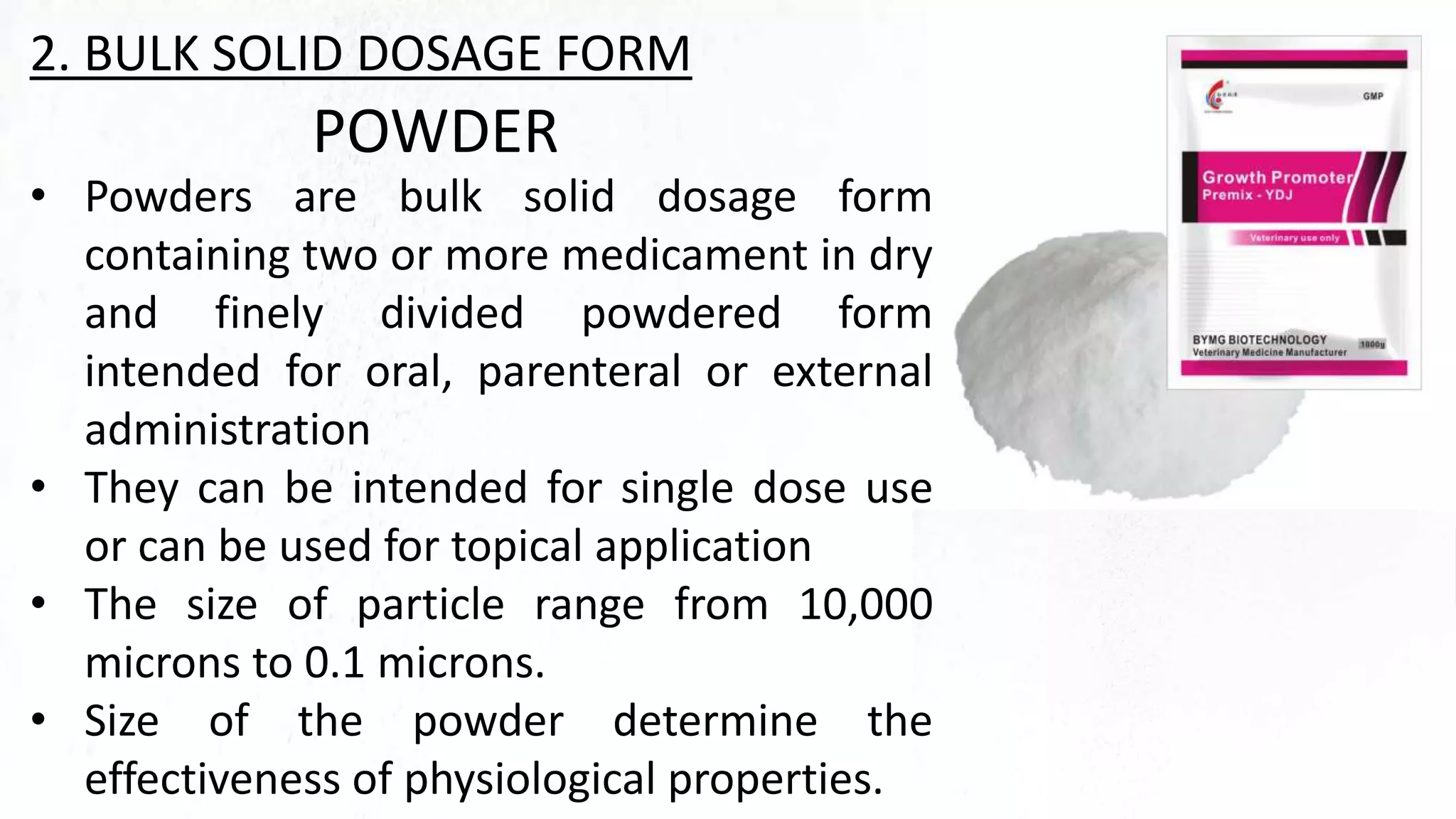
• Soft gelatin capsule – They are
soft and made from gelatin,
glycerine and sorbitol. Drug in
liquid form is filled in body and
then it is sealed over with heat.
• Eg. – fat soluble vitamins
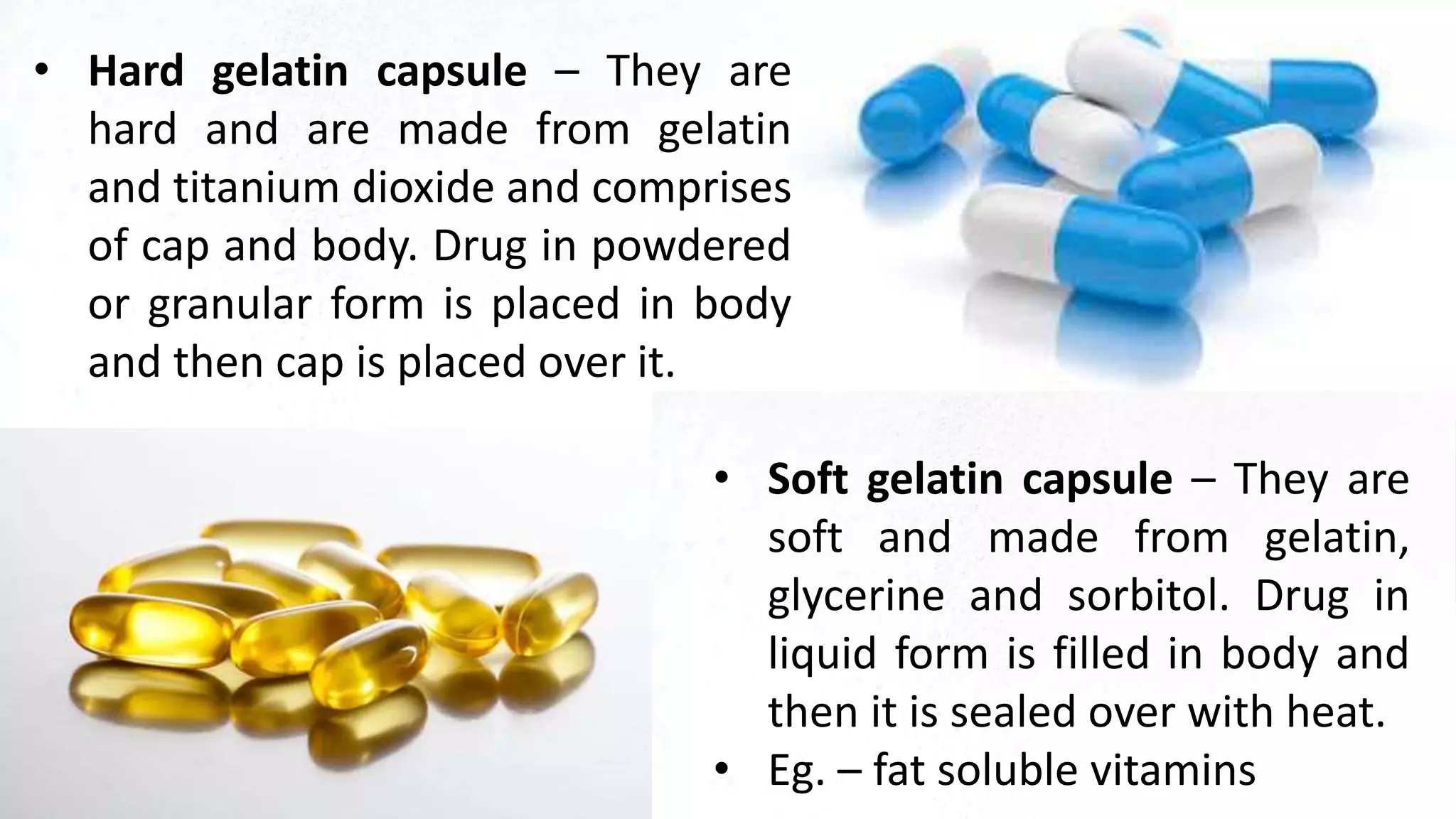
• Hard gelatin capsule – They are
hard and are made from gelatin
and titanium dioxide and comprises
of cap and body. Drug in powdered
or granular form is placed in body
and then cap is placed over it.
LOZENGES
• Lozenges are tablets formed from
hardened base of sugar and water
containing drug (API) and other
flavors.
• They are designed to dissolve slowly
in the mouth and release the drug
topically to the tissues of mouth and
throat
• They are not to be swallowed
2. BULK SOLID DOSAGE FORM
POWDER
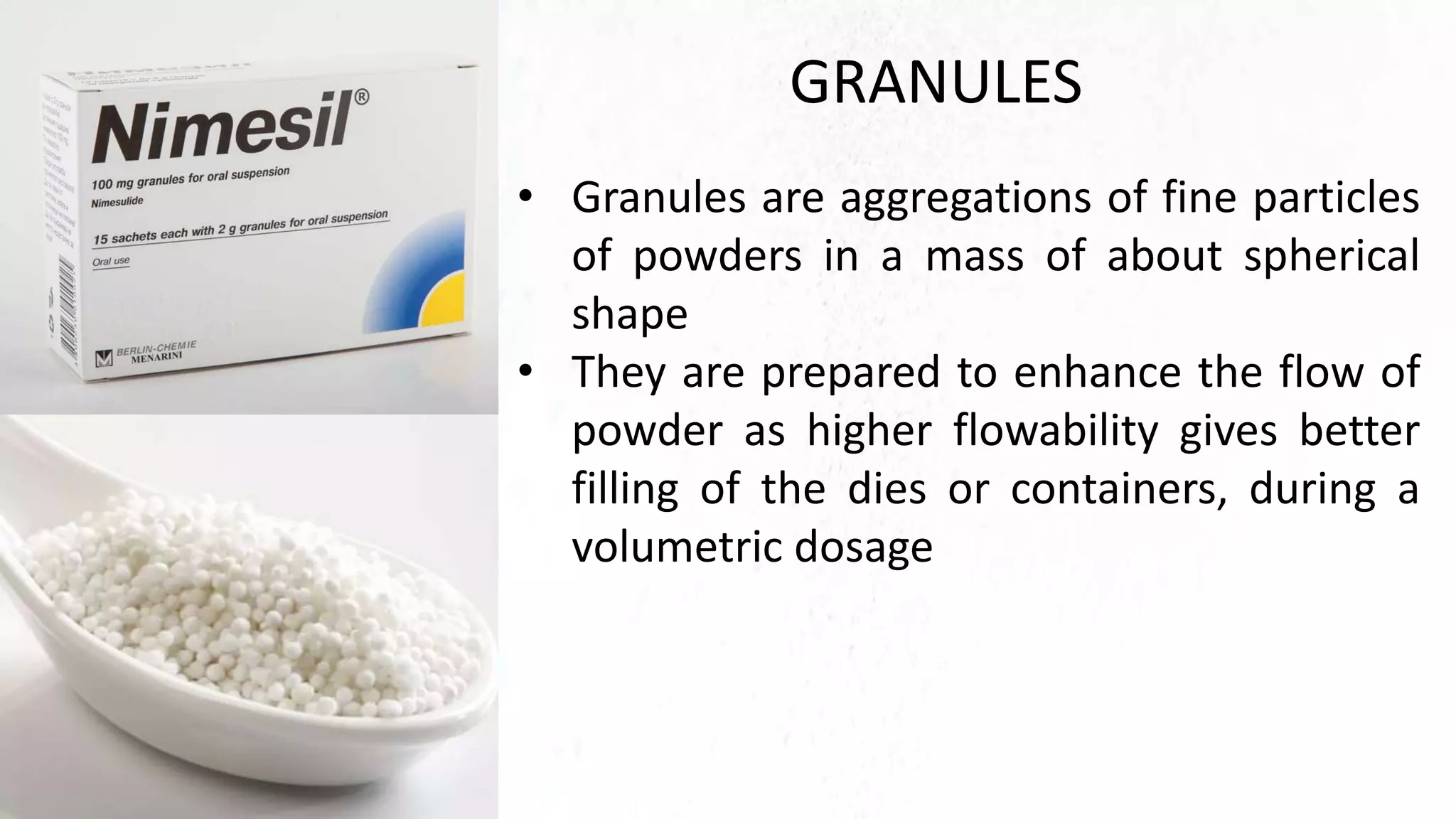
• Powders are bulk solid dosage form
containing two or more medicament in dry
and finely divided powdered form
intended for oral, parenteral or external
administration
• They can be intended for single dose use
or can be used for topical application
• The size of particle range from 10,000
microns to 0.1 microns.
• Size of the powder determine the
effectiveness of physiological properties.
GRANULES
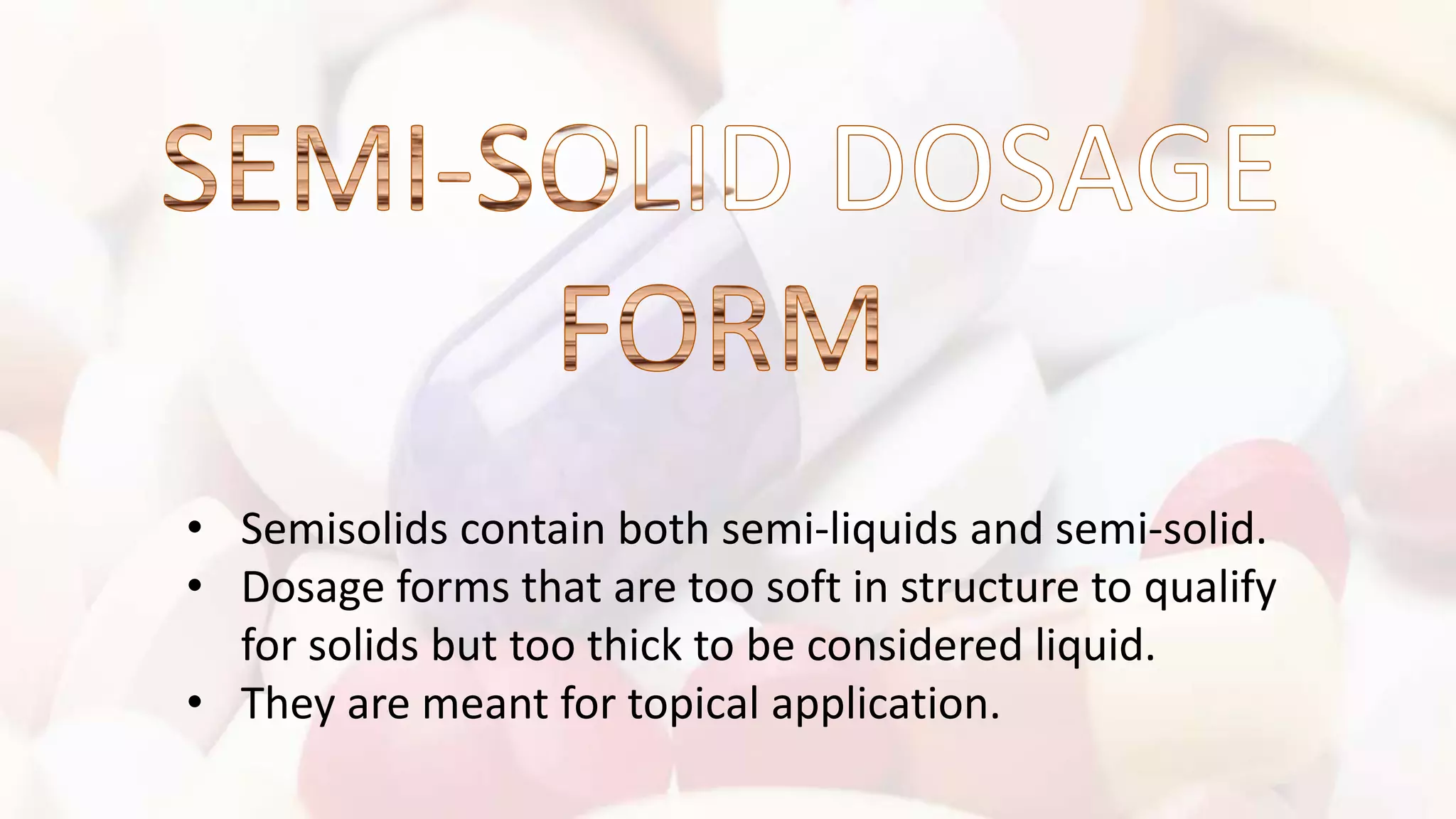
• Granules are aggregations of fine particles
of powders in a mass of about spherical
shape
• They are prepared to enhance the flow of
powder as higher flowability gives better
filling of the dies or containers, during a
volumetric dosage
• Semisolids contain both semi-liquids and semi-solid.
• Dosage forms that are too soft in structure to qualify
for solids but too thick to be considered liquid.
• They are meant for topical application.
CREAMS
• Creams are semi-solid preparations,
containing one or more medicinal agents
dissolved in either an oil in water or water
in oil emulsion or in another type of water-
washable base
• They have low viscosity and appears
“creamy white” due to the scattering of
light.
• They are of two types-
1. Oil in water
2. Water in oil
TYPES OF CREAMS
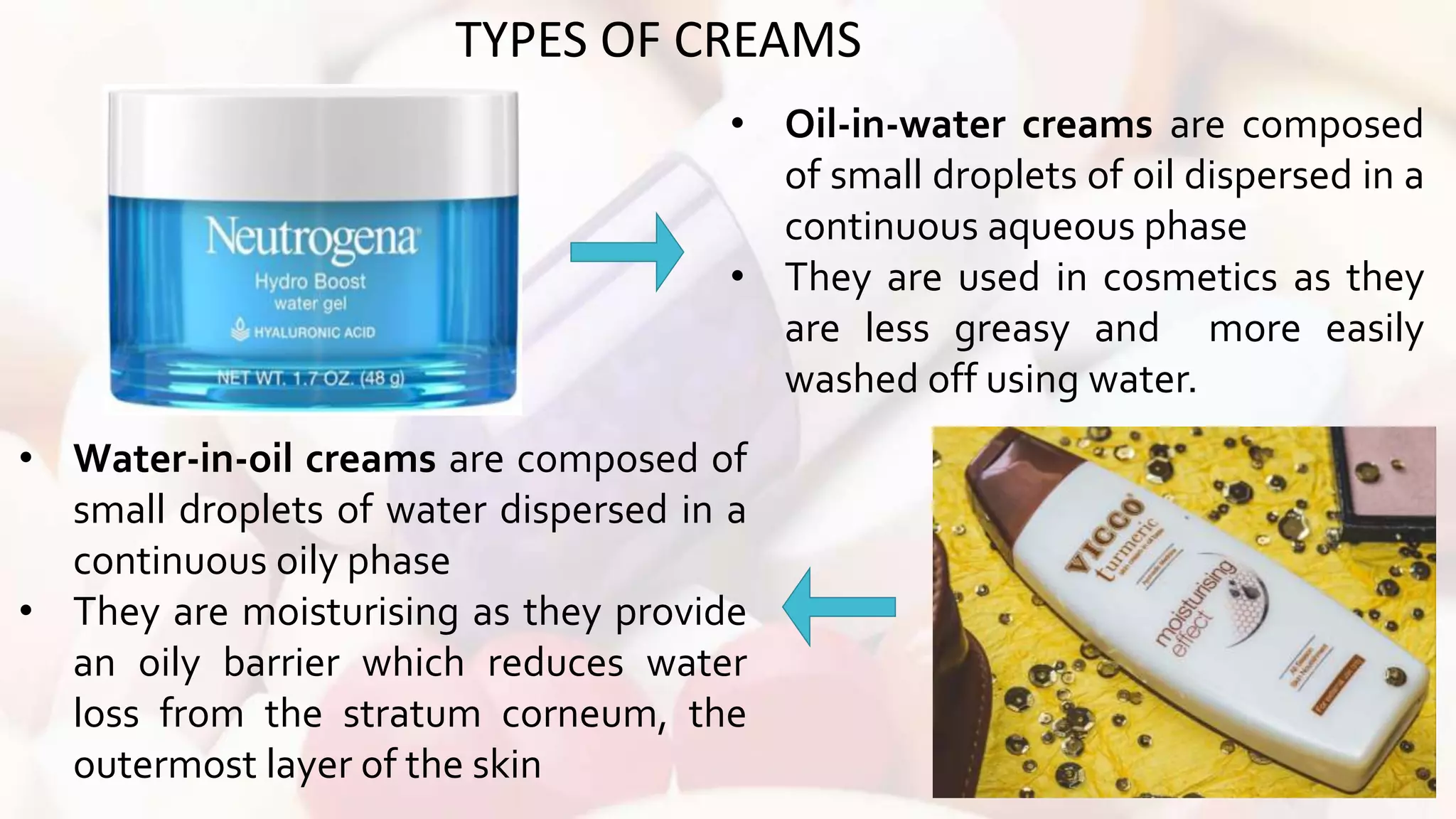
• Oil-in-water creams are composed
of small droplets of oil dispersed in a
continuous aqueous phase
• They are used in cosmetics as they
are less greasy and more easily
washed off using water.
• Water-in-oil creams are composed of
small droplets of water dispersed in a
continuous oily phase
• They are moisturising as they provide
an oily barrier which reduces water
loss from the stratum corneum, the
outermost layer of the skin
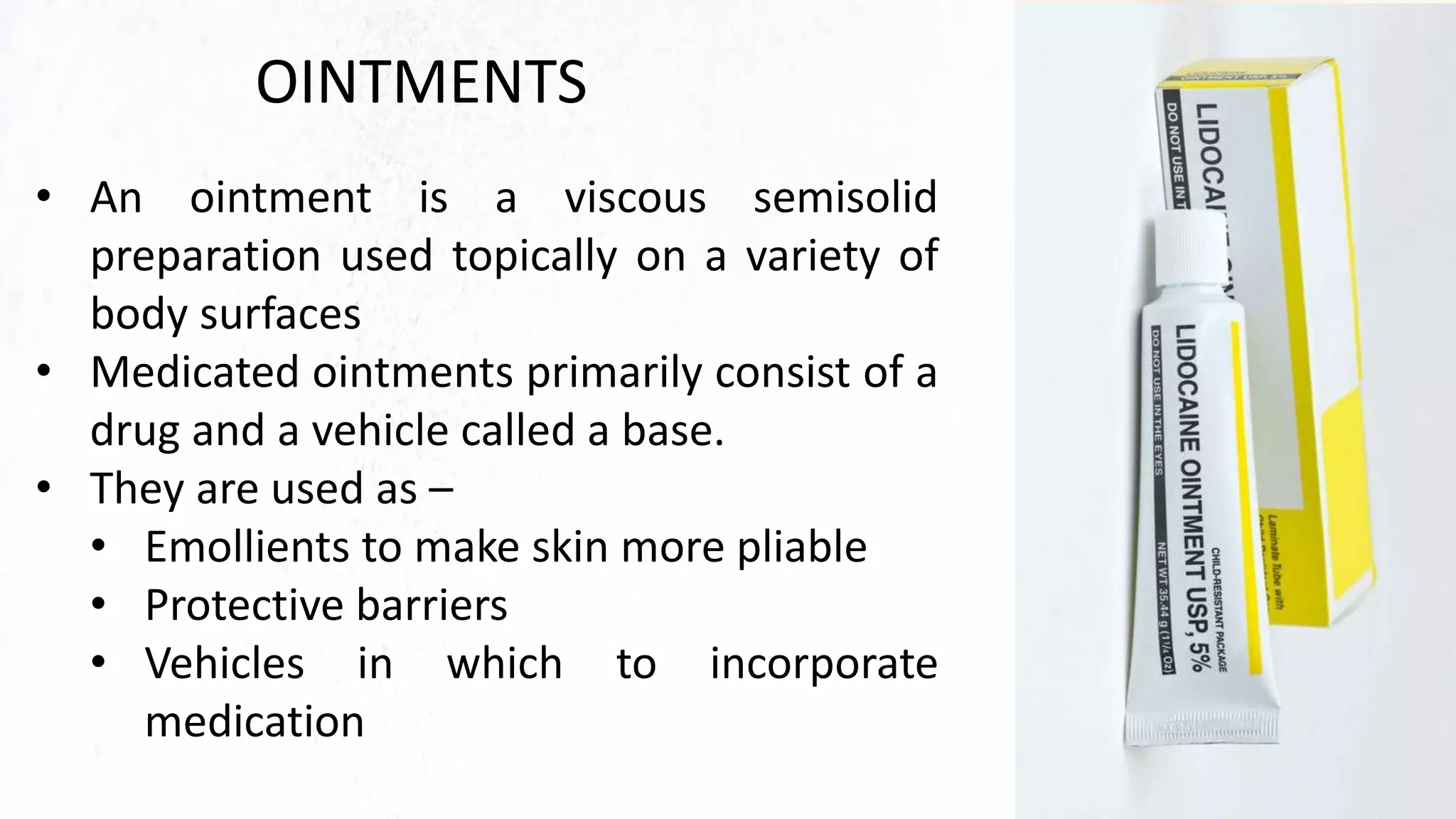
OINTMENTS
• An ointment is a viscous semisolid
preparation used topically on a variety of
body surfaces
• Medicated ointments primarily consist of a
drug and a vehicle called a base.
• They are used as –
• Emollients to make skin more pliable
• Protective barriers
• Vehicles in which to incorporate
medication
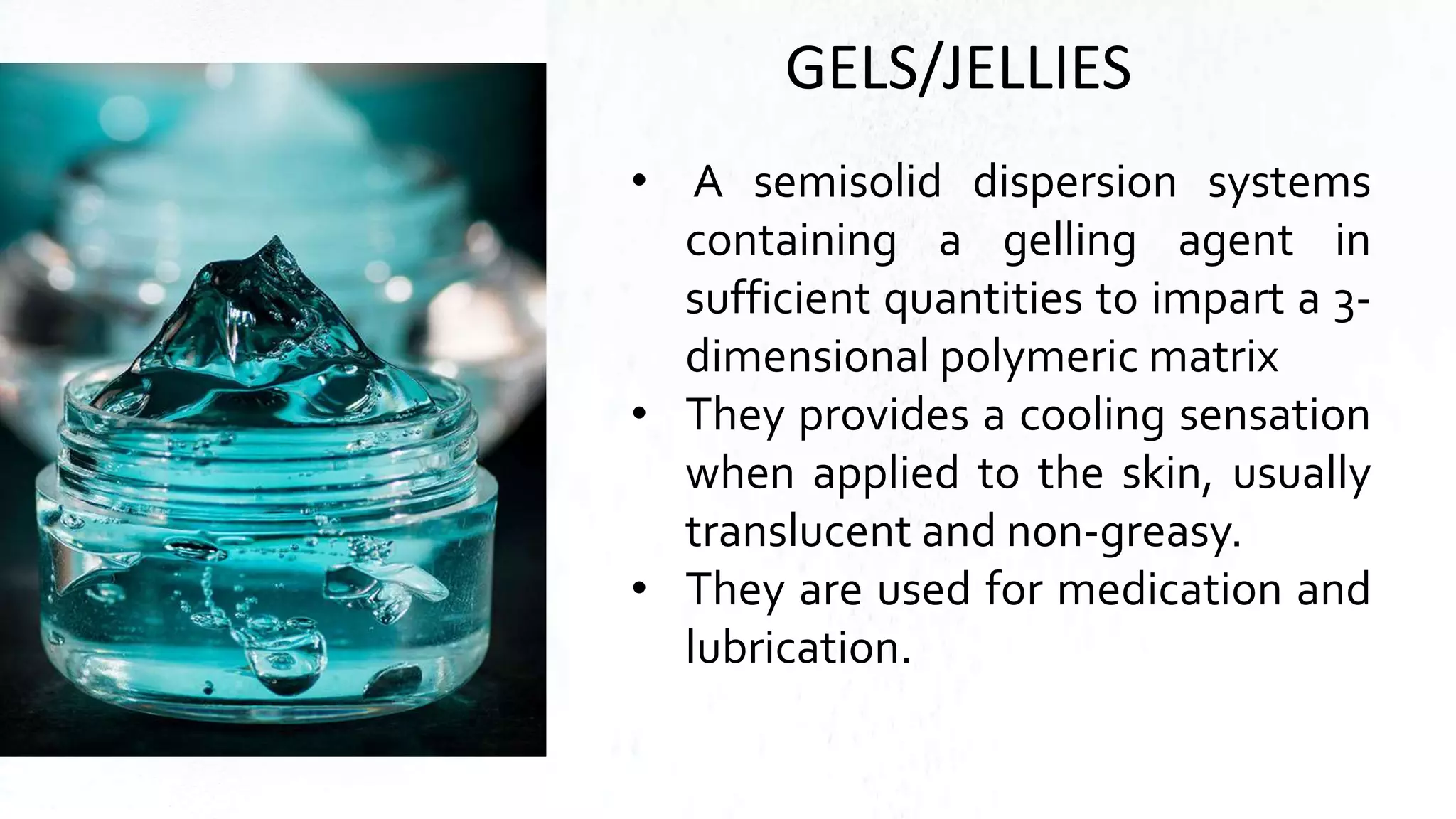
• A semisolid dispersion systems
containing a gelling agent in
sufficient quantities to impart a 3-
dimensional polymeric matrix
• They provides a cooling sensation
when applied to the skin, usually
translucent and non-greasy.
• They are used for medication and
lubrication.
GELS/JELLIES
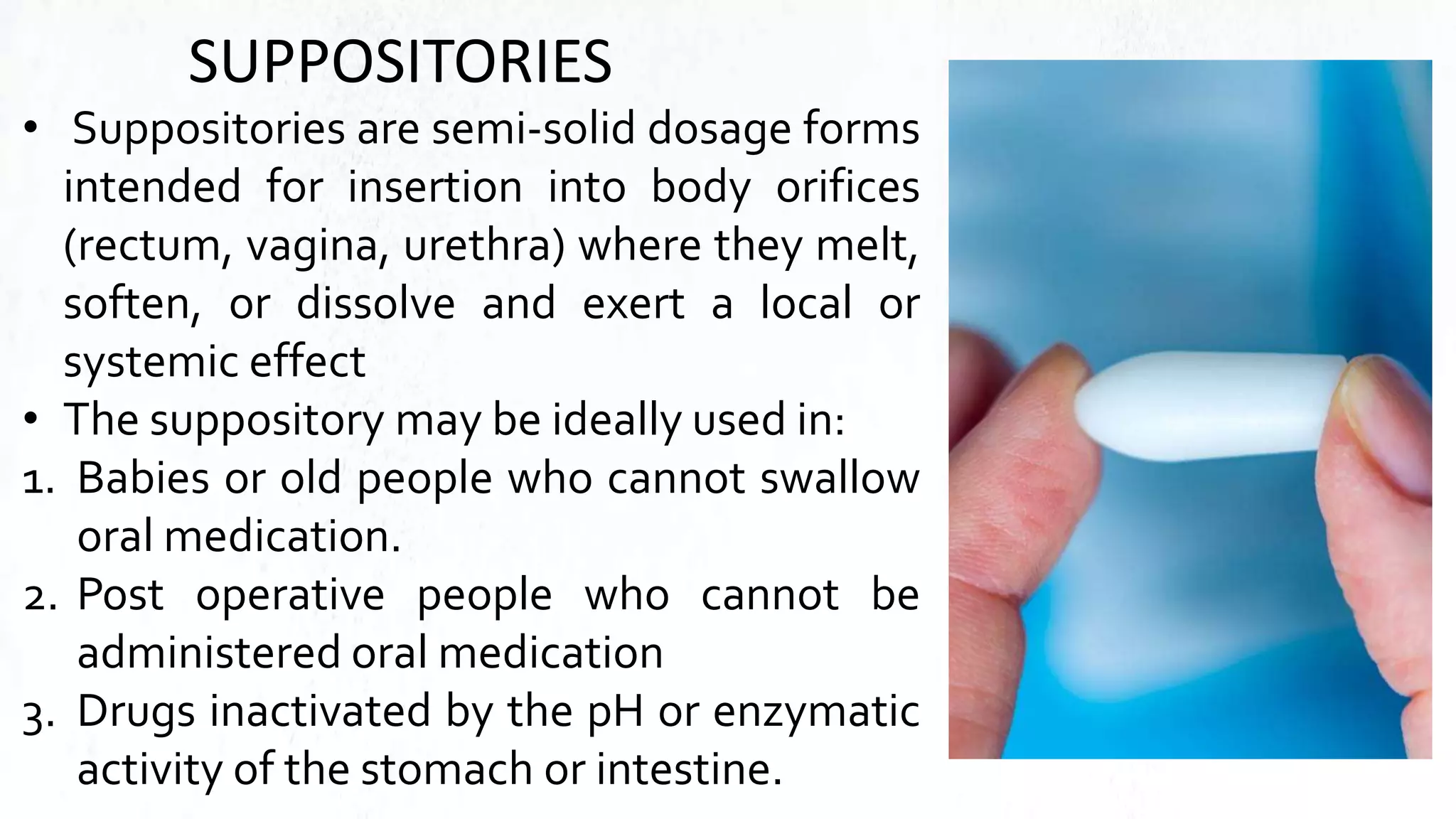
• Suppositories are semi-solid dosage forms
intended for insertion into body orifices
(rectum, vagina, urethra) where they melt,
soften, or dissolve and exert a local or
systemic effect
• The suppository may be ideally used in:
1. Babies or old people who cannot swallow
oral medication.
2. Post operative people who cannot be
administered oral medication
3. Drugs inactivated by the pH or enzymatic
activity of the stomach or intestine.
SUPPOSITORIES
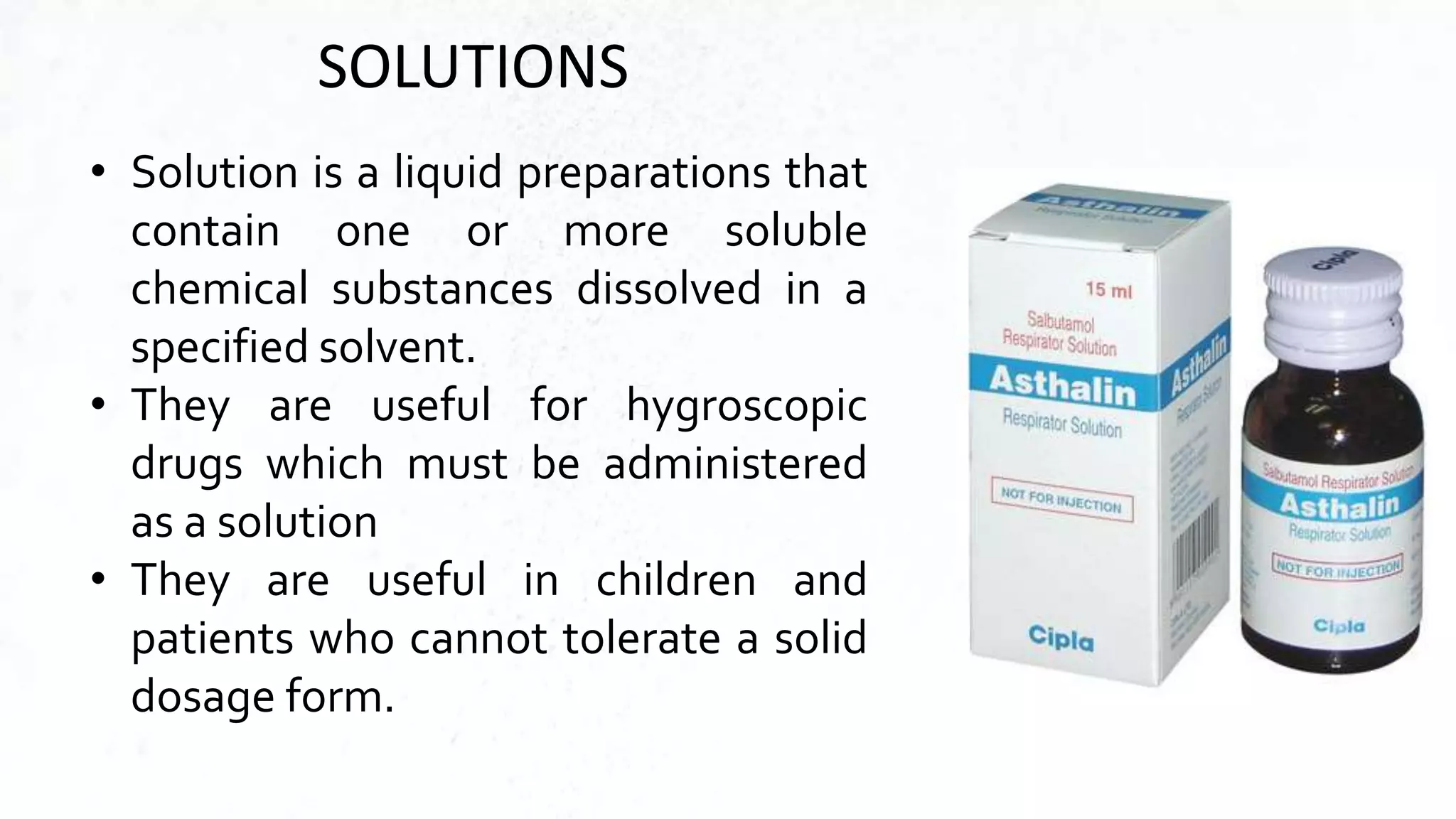
• Solution is a liquid preparations that
contain one or more soluble
chemical substances dissolved in a
specified solvent.
• They are useful for hygroscopic
drugs which must be administered
as a solution
• They are useful in children and
patients who cannot tolerate a solid
dosage form.
SOLUTIONS
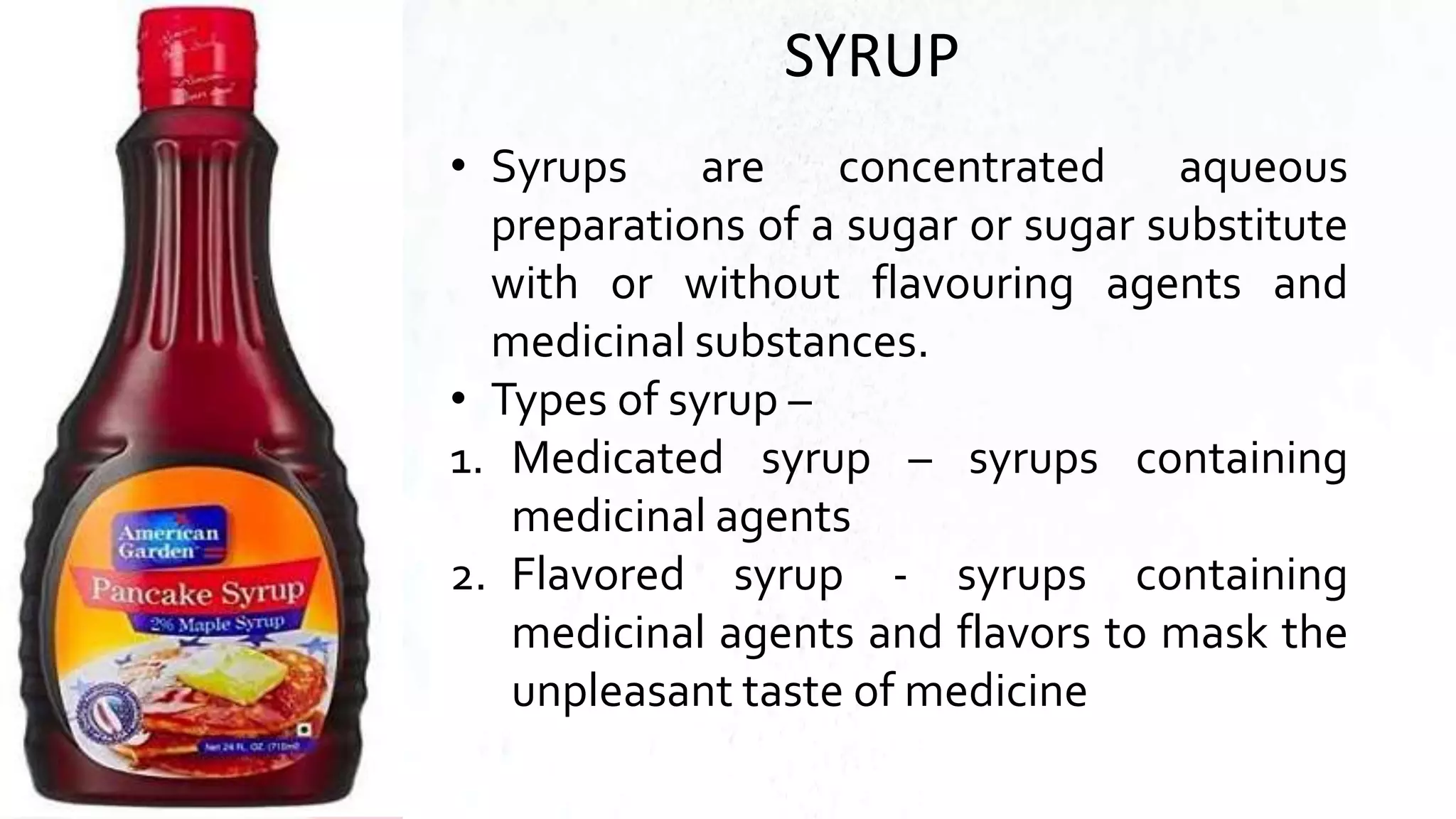
• Syrups are concentrated aqueous
preparations of a sugar or sugar substitute
with or without flavouring agents and
medicinal substances.
• Types of syrup –
1. Medicated syrup – syrups containing
medicinal agents
2. Flavored syrup - syrups containing
medicinal agents and flavors to mask the
unpleasant taste of medicine
SYRUP
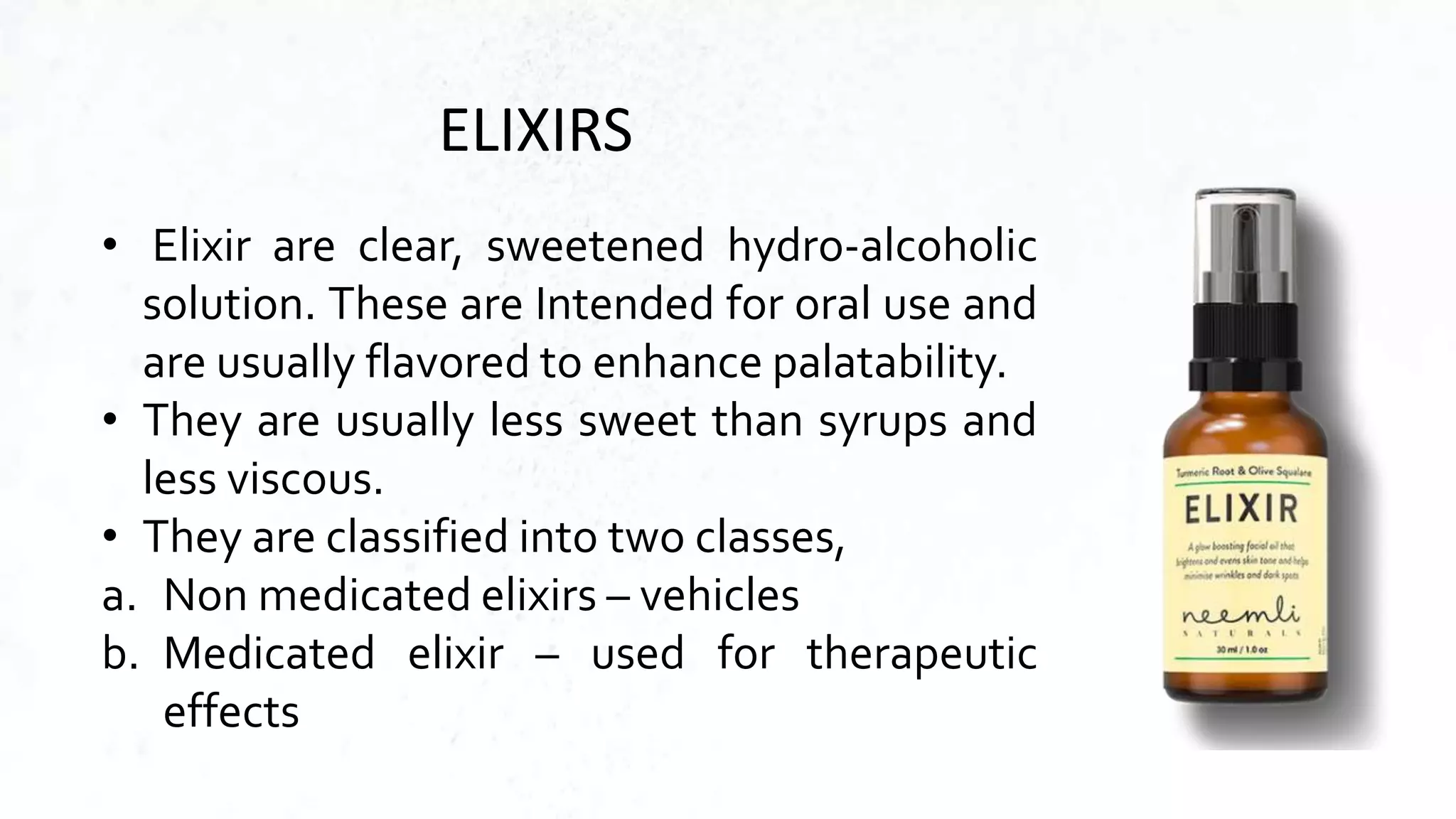
• Elixir are clear, sweetened hydro-alcoholic
solution. These are Intended for oral use and
are usually flavored to enhance palatability.
• They are usually less sweet than syrups and
less viscous.
• They are classified into two classes,
a. Non medicated elixirs – vehicles
b. Medicated elixir – used for therapeutic
effects
ELIXIRS
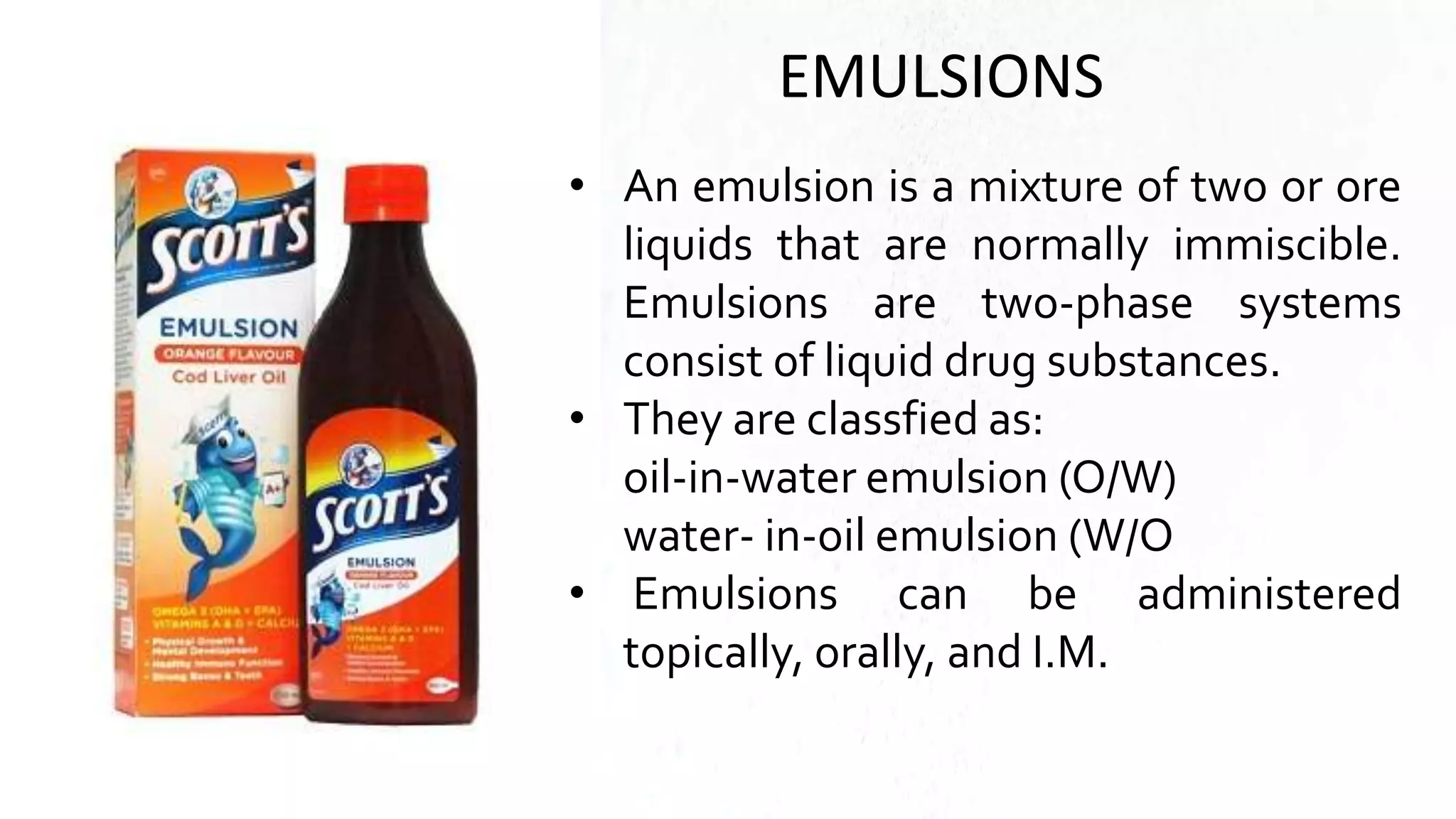
EMULSIONS
• An emulsion is a mixture of two or ore
liquids that are normally immiscible.
Emulsions are two-phase systems
consist of liquid drug substances.
• They are classfied as:
oil-in-water emulsion (O/W)
water- in-oil emulsion (W/O
• Emulsions can be administered
topically, orally, and I.M.
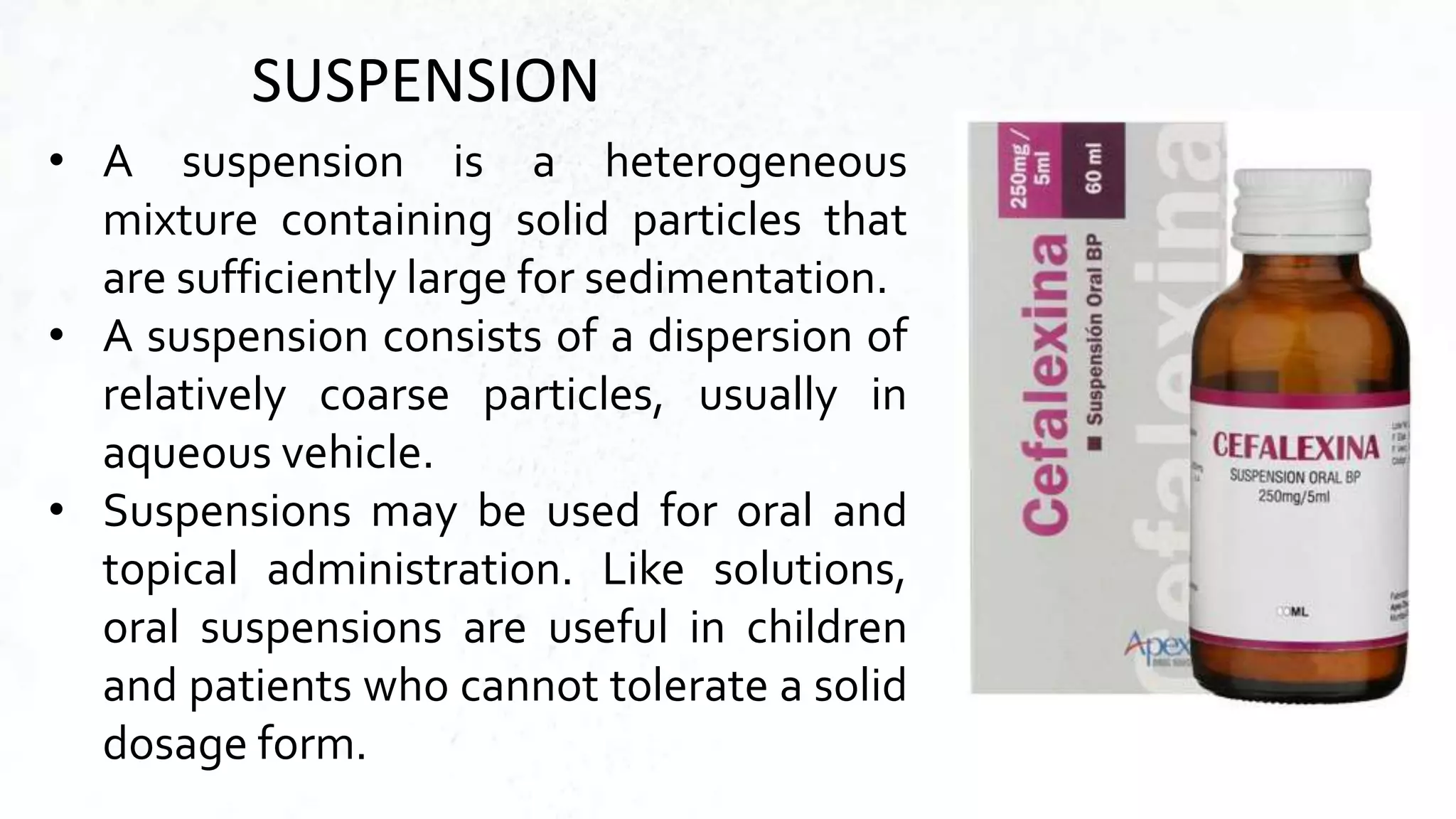
SUSPENSION
• A suspension is a heterogeneous
mixture containing solid particles that
are sufficiently large for sedimentation.
• A suspension consists of a dispersion of
relatively coarse particles, usually in
aqueous vehicle.
• Suspensions may be used for oral and
topical administration. Like solutions,
oral suspensions are useful in children
and patients who cannot tolerate a solid
dosage form.
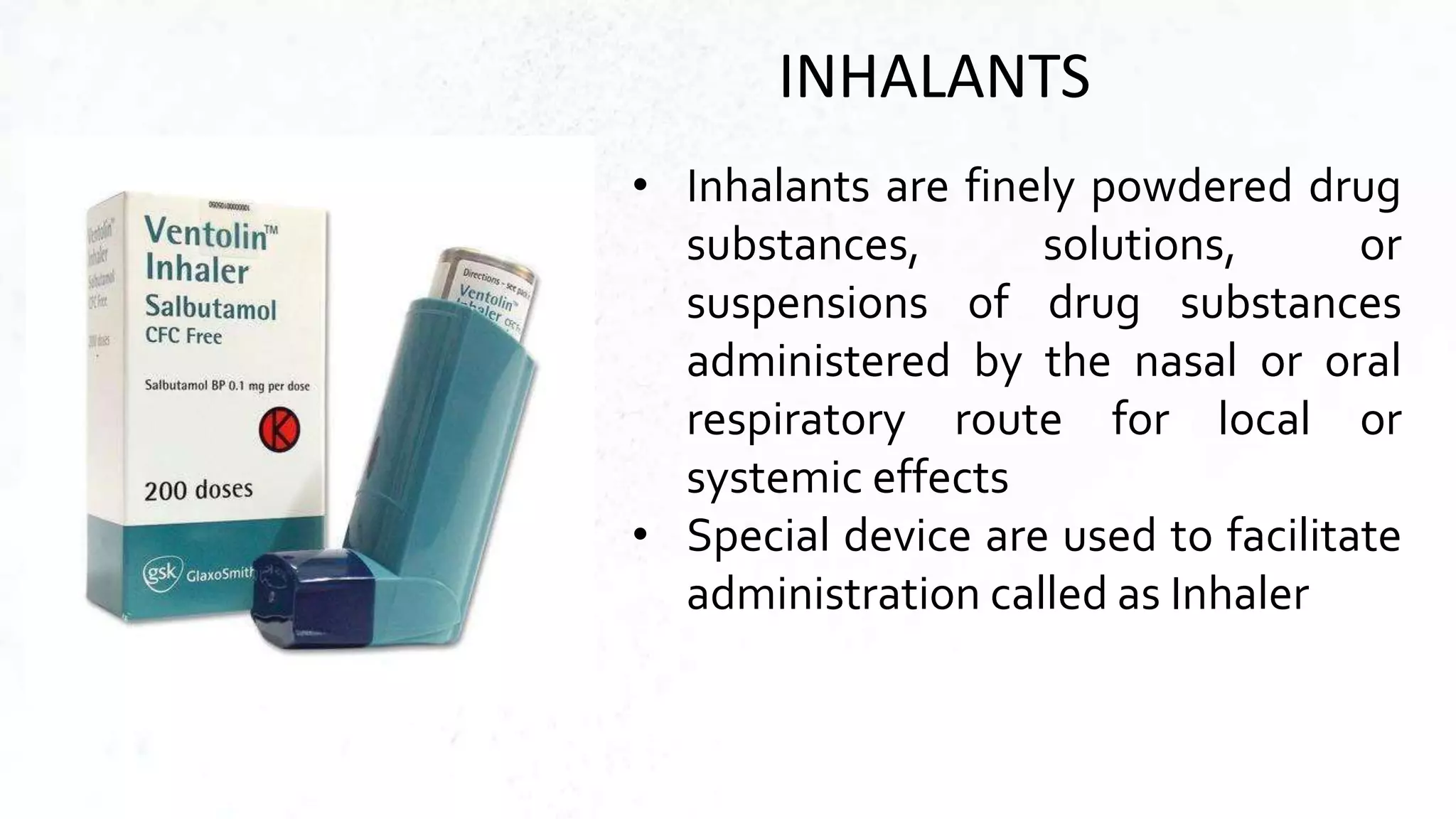
INHALANTS
• Inhalants are finely powdered drug
substances, solutions, or
suspensions of drug substances
administered by the nasal or oral
respiratory route for local or
systemic effects
• Special device are used to facilitate
administration called as Inhaler
• Aerosol is defined as a system that depends
on the power of a compressed gas or
liquefied gas to expel the contents from the
container.
• Pharmaceutical Aerosol is defined as
aerosol product containing active
ingredients dissolved ,suspended or
emulsified in a propellant or a mixture of
solvent and propellant and intended for oral
or topical administration or for
administration into the eye, nose ,ear,
rectum and vagina
AEROSOLS
any questions?

Pharmaceutical Dosage Forms - Classification

  • 1.
    PHARMACEUTICAL DOSAGE FORMS: ConceptandClassification PRESENTED BY: MDALTAMASHAHMAD PHARM. D 3RDYEAR 1850951001 CHITKARACOLLEGE OF PHARMACY,CHITKARA UNIVERSITY
  • 2.
    Drug (API) –Drug is defined as a chemical compound or Active Pharmaceutical Ingredient (API) intended for use in diagnosis, treatment or prevention of diseases. Excipients – They are chemical compounds also known as inactive pharmaceutical ingredient used as diluents, binders, lubricants, disintegrants, coatings, preservants, stabilizers, colorants and flavouring agents Dosage form = Drugs(API) + Excipients • Dosage form comprises of API and suitable excipients prepared in any of solid, semi-solid, liquid or gaseous form
  • 3.
    Pharmaceutical dosage formsrefers to pharmaceutical preparations or formulations in which one or more Drugs (active pharmaceutical ingredients - API) and Excipients (inactive components) are presented in a particular configuration or form (solid, semi-solid, liquid or gaseous form) to facilitate easy and accurate administration and delivery of active drug substances through various routes into the body
  • 4.
    CLASSIFICATION OF PHARMACEUTICAL DOSAGE FORM SOLIDDOSAGE FORM 1. Unit dosage form- - Tablets - Capsules - Lozenges 2. Bulk dosage form- - Powder - Dusting powder SEMI-SOLID DOSAGE FORM - Cream - Paste - Gel - Suppositories LIQUID DOSAGE FORM 1. Monophasic liquid- - Syrup - Elixir - Solution 2. Biphasic liquid – - Emulsion - Suspension GASEOUS FORM - Inhalants - Aerosols
  • 6.
    1. UNIT DOSAGEFORM - TABLET - CAPSULE - LOZENGES 2. BULK DOSAGE FORM - POWDER TWO TYPES :
  • 7.
    TABLETS • They areunit solid dosage forms consisting of Active Pharmaceutical Ingredient (API) and suitable excipients • They are prepared by compression or moulding methods and intended for oral administration for local and systemic effects • They may vary in shape, size and weight depending upon the medicament and excipients used and also on its mode of administration 1. UNIT SOLID DOSAGE FORM
  • 8.
  • 9.
    CAPSULES • They areunit solid dosage forms containing Active Pharmaceutical Ingredient (API) enclosed in a water soluble gelatin shell or envelope. • The drug is released when capsule is swallowed and shell breaks open after reaching specific area in GIT. • There are two types of capsule- 1. Soft gelatin capsule 2. Hard gelatin capsule
  • 10.
    • Soft gelatincapsule – They are soft and made from gelatin, glycerine and sorbitol. Drug in liquid form is filled in body and then it is sealed over with heat. • Eg. – fat soluble vitamins • Hard gelatin capsule – They are hard and are made from gelatin and titanium dioxide and comprises of cap and body. Drug in powdered or granular form is placed in body and then cap is placed over it.
  • 11.
    LOZENGES • Lozenges aretablets formed from hardened base of sugar and water containing drug (API) and other flavors. • They are designed to dissolve slowly in the mouth and release the drug topically to the tissues of mouth and throat • They are not to be swallowed
  • 12.
    2. BULK SOLIDDOSAGE FORM POWDER • Powders are bulk solid dosage form containing two or more medicament in dry and finely divided powdered form intended for oral, parenteral or external administration • They can be intended for single dose use or can be used for topical application • The size of particle range from 10,000 microns to 0.1 microns. • Size of the powder determine the effectiveness of physiological properties.
  • 13.
    GRANULES • Granules areaggregations of fine particles of powders in a mass of about spherical shape • They are prepared to enhance the flow of powder as higher flowability gives better filling of the dies or containers, during a volumetric dosage
  • 14.
    • Semisolids containboth semi-liquids and semi-solid. • Dosage forms that are too soft in structure to qualify for solids but too thick to be considered liquid. • They are meant for topical application.
  • 15.
    CREAMS • Creams aresemi-solid preparations, containing one or more medicinal agents dissolved in either an oil in water or water in oil emulsion or in another type of water- washable base • They have low viscosity and appears “creamy white” due to the scattering of light. • They are of two types- 1. Oil in water 2. Water in oil
  • 16.
    TYPES OF CREAMS •Oil-in-water creams are composed of small droplets of oil dispersed in a continuous aqueous phase • They are used in cosmetics as they are less greasy and more easily washed off using water. • Water-in-oil creams are composed of small droplets of water dispersed in a continuous oily phase • They are moisturising as they provide an oily barrier which reduces water loss from the stratum corneum, the outermost layer of the skin
  • 17.
    OINTMENTS • An ointmentis a viscous semisolid preparation used topically on a variety of body surfaces • Medicated ointments primarily consist of a drug and a vehicle called a base. • They are used as – • Emollients to make skin more pliable • Protective barriers • Vehicles in which to incorporate medication
  • 18.
    • A semisoliddispersion systems containing a gelling agent in sufficient quantities to impart a 3- dimensional polymeric matrix • They provides a cooling sensation when applied to the skin, usually translucent and non-greasy. • They are used for medication and lubrication. GELS/JELLIES
  • 19.
    • Suppositories aresemi-solid dosage forms intended for insertion into body orifices (rectum, vagina, urethra) where they melt, soften, or dissolve and exert a local or systemic effect • The suppository may be ideally used in: 1. Babies or old people who cannot swallow oral medication. 2. Post operative people who cannot be administered oral medication 3. Drugs inactivated by the pH or enzymatic activity of the stomach or intestine. SUPPOSITORIES
  • 21.
    • Solution isa liquid preparations that contain one or more soluble chemical substances dissolved in a specified solvent. • They are useful for hygroscopic drugs which must be administered as a solution • They are useful in children and patients who cannot tolerate a solid dosage form. SOLUTIONS
  • 22.
    • Syrups areconcentrated aqueous preparations of a sugar or sugar substitute with or without flavouring agents and medicinal substances. • Types of syrup – 1. Medicated syrup – syrups containing medicinal agents 2. Flavored syrup - syrups containing medicinal agents and flavors to mask the unpleasant taste of medicine SYRUP
  • 23.
    • Elixir areclear, sweetened hydro-alcoholic solution. These are Intended for oral use and are usually flavored to enhance palatability. • They are usually less sweet than syrups and less viscous. • They are classified into two classes, a. Non medicated elixirs – vehicles b. Medicated elixir – used for therapeutic effects ELIXIRS
  • 24.
    EMULSIONS • An emulsionis a mixture of two or ore liquids that are normally immiscible. Emulsions are two-phase systems consist of liquid drug substances. • They are classfied as: oil-in-water emulsion (O/W) water- in-oil emulsion (W/O • Emulsions can be administered topically, orally, and I.M.
  • 25.
    SUSPENSION • A suspensionis a heterogeneous mixture containing solid particles that are sufficiently large for sedimentation. • A suspension consists of a dispersion of relatively coarse particles, usually in aqueous vehicle. • Suspensions may be used for oral and topical administration. Like solutions, oral suspensions are useful in children and patients who cannot tolerate a solid dosage form.
  • 27.
    INHALANTS • Inhalants arefinely powdered drug substances, solutions, or suspensions of drug substances administered by the nasal or oral respiratory route for local or systemic effects • Special device are used to facilitate administration called as Inhaler
  • 28.
    • Aerosol isdefined as a system that depends on the power of a compressed gas or liquefied gas to expel the contents from the container. • Pharmaceutical Aerosol is defined as aerosol product containing active ingredients dissolved ,suspended or emulsified in a propellant or a mixture of solvent and propellant and intended for oral or topical administration or for administration into the eye, nose ,ear, rectum and vagina AEROSOLS
  • 29.