POSOLOGY
POSOLOGY
INTRODUCTION
• This word is derived from Greek word posos – how
much and logos means science.
• Posology is a branch of medical science which
deals with dose & quantity of drugs which can be
administered to a patient to get a desired action.
• The dose is usually expressed as a range.
• The minimum dose or the lower limit of the dose is
essential for eliciting an intended therapeutic response.
• Maximum dose or the higher limit of the dose is the
amount of the drug substance that can be tolerated by an
average individual.
• The actual dose of the drug is to be decided by the
prescriber depending on patients age, sex, symptoms,
medication history and the factors like tolerance,
idiosycrasy, route of administration etc.
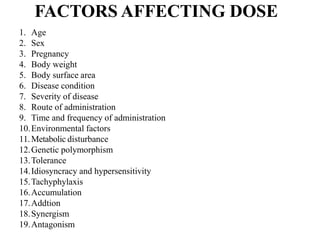
FACTORS AFFECTING DOSE
1. Age
2. Sex
3. Pregnancy
4. Body weight
5. Body surface area
6. Disease condition
7. Severity of disease
8. Route of administration
9. Time and frequency of administration
10.Environmental factors
11.Metabolic disturbance
12.Genetic polymorphism
13.Tolerance
14.Idiosyncracy and hypersensitivity
15.Tachyphylaxis
16.Accumulation
17.Addtion
18.Synergism
19.Antagonism
1. AGE
• The pharmacokinetics of many drugs changes with age.
• Newborn infants (pediatric) are abnormally sensitive to certain drugs
because of the immature state of their hepatic and renal function by which
drugs are inactivated and eliminated from the body.
• The drug dosage of new born is low because gastric acid secretion are not
adequate ( GIT absorption of ampicillin, amoxicillin is greater in neonates due
to decreased gastric acidity).
• Failure to detoxify and eliminate drugs results in their accumulation in
the tissues to a toxic level ( chloramphenicol- blue baby syndrome because
inadequate liver microsomal enzymes like glucuronyl transferase).
• Due immaturity in BBB sulfonamides may lead to hyper bilirubinemia
and kernicterus.
• Immature renal tubular transport system penicillin, streptomycin and
glycosides are not administered.
• Tetracyclines may cause permanent teeth staining, corticosteroids may
lead to growth and development retardation and antihistamines may cause
hyperactivity.
• Geriatric patients require less doses than adult because special
consideration such as reduced body weight, reduced body fat, reduced
intestinal motility, mesenteric blood flow, reduced renal and hepatic
functions and altered mental functions.
2. SEX
• Women do not always respond to the action of drug in the same manner as it
done in men. Special care should be taken when drugs are administered during
menstruation, pregnancy & lactation.
• Female adults generally require smaller doses than males due to the presence of
more fat ( testosterone increases the rate of biotransformation).
• Strong purgative, salicylates should be avoided during menstruation may
increase bleeding.
• Female more susceptible to autonomic drugs ( estrogen inhibit choline esterases).
• During lactation drugs may excreted through milk and may affect the infant
(penicillin, some purgatives, cloramphenenicol, oral anti coagulants)
• Morphine normally depresses CNS but may produce excitation in some womens.
3. PREGNANCY
• In pregnancy cardiac output, glomerular filtration, renal elimination
of drugs volume of distribution and metabolic rate of some drugs are
taken into consideration.
• Lipophilic drugs cross placental barrier and slowly excreted.
• Uterine stimulant, strong purgatives, drugs likely to have teratogenic
effects that should be avoided, especially during first trimester .
• During labor morphine should be avoided as it crosses placental
barrier and depresses respiration in newborn.
4. BODY WEIGHT
• Relative proportion of muscular and adipose tissue in individual is
responsible for the differences observed in the distribution and
clearance of drugs in different individuals.
• The average dose is mentioned either in terms of mg per kg body
weight.
• Average muscular weight between 70kg.
• The drug concentration at site of action is based on the ratio
between the amount of drug administered and size of the body.
• In case of obese patients, children & malnourished patients dose
should be calculated according to body weight
5. BODY SURFACE AREA
• Many physiological factors such as plasma volume, oxygen
consumption, requirement of body fluid electrolytes, calories and
glomerular filtration are proportional to the surface area.
• The surface area is also used to calculate dose because some drugs
like methotrexate anticancer drug is administered on mg per sq.
meter of body surface area.
• The average body surface area of 70 kg adult is about
1.7 – 1.8 sq, m.
6. PRESENCE OF DISEASE
• Presence of disease may alter the requirement of dose.
• Drugs like barbiturates & chlorpromazine may produce unusually
prolonged effect in patient having liver cirrhosis because they are
mainly inactivated by liver.
• Streptomycin, morphine produce toxic effect on these patient their
kidney function is not working properly because streptomycin
excreted through kidney.
7. SEVERITY OF DISEASE
• Severity of disease may affect the requirement of dose.
• In common, dull headache may be relived by single tablet of aspirin
where as severe headache may need to administration of 2-3 tablets of
same drug.
• But this is not true in all the cases.
• In iron deficiency anemia the dose of iron salt administered orally
remains same irrespective of severity because there is a limit to which
iron can be absorbed from the intestine daily and incorporated in
hemoglobin.
8. ROUTE OFADMINISTRATION
• I.V doses of drug are usually smaller than the oral doses.
• Intravenous route this might enhance the chances of drug toxicity.
• The effectiveness of drug formulation is generally controlled by the
route of administration.
• Ergotamine dose for oral route is 2-5mg, I.M route is 1mg, for IV route
is 0.25mg
9. TIME AND FREQUENCY OFADMINISTARTION
• Absorption proceeds more rapidly if stomach and upper portion of the
intestinal tract are empty. The presence of food in the stomach delay the
absorption of drug.
• Several physiological functions are altered during bed rest as compared to the
upright position, including reduction in gastric emptying rate, increase cardiac
out put, renal flow.
• Ferrous sulphate if administered in between meals is more effective than
effect produced by same administered after meals.
• Iron, arsenic & cod-liver oil should be given after meal & antacid drugs taken
before meal.
• Amount of drug absorption also governed by circadian. E.g: Ibuprofen have
more absorption in morning than any other time.
10. ENVIROMENTALFACTORS
• The personality & behavior of a patient may influence the effect
of drug especially the drugs which are intended for use in a
psychosomatic disorders.
• The females are more emotional than male & required less dose
of certain drugs. Inert dosage forms called placebos which
resemble the actual medicament in the physical properties are
known to produce therapeutic benefit in disease like angina
pectoris & bronchial asthma.
11. METABOLIC DISTURBANCE
• Changes in water electrolyte balance & acid base balance, body
temperature & other physiological factor may modify the effect
of drug.
E.g. salicylates reduce body temperature in only in case an
individual has rise in body temperature. They have no antipyretic
effect if the body temperature is normal.
12. GENETIC POLYMORPHISM
• Enzymes, mainly cytochrome 450(CYP450) is responsible for
biotransformation of the drug that mostly results in reduction in
effective drug concentration in the body.
• Genetic mutation of such enzymes alters the rate of biotransfermation
is called genetic polymorphism.
• Due this some individuals shows toxicity to the given dose where as
others need increment in dose to produce therapeutic effect.
• Hyperactivity of such enzymes increases rate of inactivation or
elimination of drug where the given dose becomes insufficient
• Smoking, alcohol, drugs like isoniazide, pheytoin inducers of
CYP450, whereas cimetidine, grapefruit juice enzymes inhibitors.
13. TOLERANCE
• When an unusually large dose of a drug is required to elicit an
affect ordinarily produced by the normal therapeutic dose of the
drug, the phenomenon is called as drug tolerance.
• E.g. smokers can tolerate nicotine, alcoholic can tolerate large
quantity of alcohol.
• The drug tolerance is of two types:
 True tolerance, which is produced by oral & parenteral
administration of the drug.
 Pseudo tolerance, which is produced only to the oral route of
administration.
14. IDIOSYNCRASY AND HYPERSENSITIVITY
• Idiosyncrasy is defined as a genetically determined
abnormal or unusual response to drugs occurs in a small
proportion of individuals.
• An extraordinary response to a drug which is different from its
characteristic pharmacological action is called idiosyncrasy.
E.g. small quantity of aspirin may cause gastric hemorrhage.
• Hypersensitivity or drug allergy is an adverse reaction to a
particular chemical resulting from a previous exposure to the
substance, occurring in only small fraction of all people receiving
the particular drug.
E.g: some persons are sensitive to penicillin &
sulphonamide because they produce severe toxic effect.
15. TACHYPHYLAXIS
• When some drugs administered repeatedly at short intervals, the
cell receptors get blocked up & pharmacological response to that
drug decreased.
• The decreased response cannot be reversed by increasing the dose
this phenomenon is called tachyphylaxis or acute tolerance.
• E.g. ephedrine given repeated dose at short intervals in the
treatment of bronchial asthma may produce very less response due
to tachyphylaxis.
16. ACCUMULA
TION
Some drugs produces the toxic effect if it is repeatedly
administered for long time
E.g. digitalis, emetine, heavy metals because these drugs
excreted slowly. This occurs due to accumulative effect
of the drug.
17. ADDITIVE EFFECT
• When two or more drugs administered
together is equivalent to sum of their
individual pharmacological action, the
phenomenon is called as additive effect.
E.g Ephedrine & aminophylline in the treatment
of bronchial ashtma.
18. SYNERGISM
• When two or more drugs used in the
combination form, their action is increased. The
phenomenon is called synergism.
E.g: Aspirin and paracetamol.
• When desired therapeutic result needed is
difficult to achieve with single drug at that time two
or more drugs are used in the combination form for
increasing their action.
E.g.
1. procaine & adrenaline combination, increase the
duration of action of procaine.
19. ANTOGONISM
• When the action of one drug is opposed by the other drug on the
same physiological system is known as drug antagonism.
• The use of antagonistic response to drugs is valuable in the
treatment of poisoning.
• E.g. milk of magnesia is given in acid poisoning where alkaline
effect of milk of magnesia neutralise the effect of acid poisoning.
• When adrenaline & acetylcholine are given together, they
neutralise the effect of each other due to antagonism because
adrenaline is vasoconstrictor & acetylcholine is vasodilator.
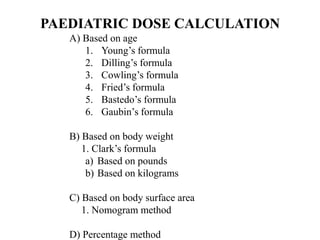
PAEDIATRIC DOSE CALCULATION
A) Based on age
1. Young’s formula
2. Dilling’s formula
3. Cowling’s formula
4. Fried’s formula
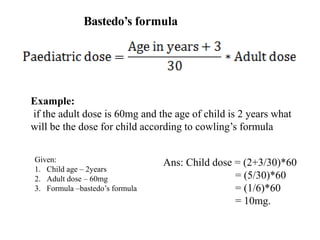
5. Bastedo’s formula
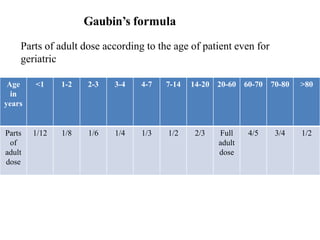
6. Gaubin’s formula
B) Based on body weight
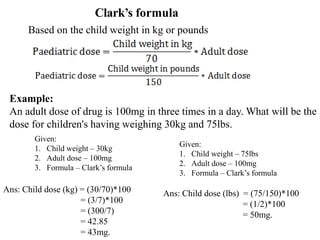
1. Clark’s formula
a) Based on pounds
b) Based on kilograms
C) Based on body surface area
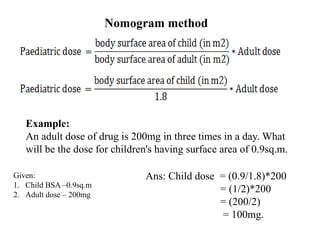
1. Nomogram method
D) Percentage method
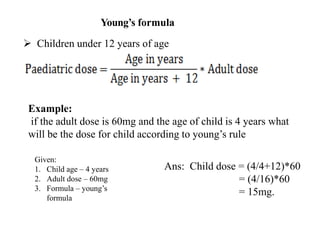
Young’s formula
 Children under 12 years of age
Example:
if the adult dose is 60mg and the age of child is 4 years what
will be the dose for child according to young’s rule
Ans: Child dose = (4/4+12)*60
= (4/16)*60
= 15mg.
Given:
1. Child age – 4 years
2. Adult dose – 60mg
3. Formula – young’s
formula
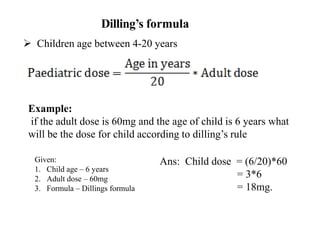
Dilling’s formula
 Children age between 4-20 years
Example:
if the adult dose is 60mg and the age of child is 6 years what
will be the dose for child according to dilling’s rule
Ans: Child dose = (6/20)*60
= 3*6
= 18mg.
Given:
1. Child age – 6 years
2. Adult dose – 60mg
3. Formula – Dillings formula
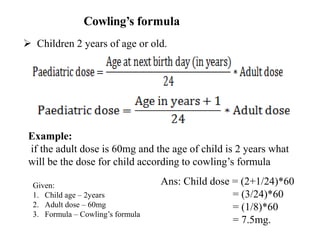
Cowling’s formula
 Children 2 years of age or old.
Example:
if the adult dose is 60mg and the age of child is 2 years what
will be the dose for child according to cowling’s formula
Ans: Child dose = (2+1/24)*60
= (3/24)*60
= (1/8)*60
= 7.5mg.
Given:
1. Child age – 2years
2. Adult dose – 60mg
3. Formula – Cowling’s formula
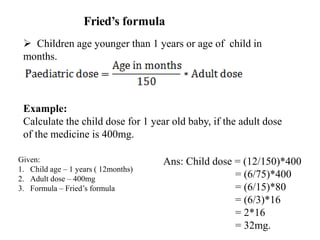
Fried’s formula
 Children age younger than 1 years or age of child in
months.
Example:
Calculate the child dose for 1 year old baby, if the adult dose
of the medicine is 400mg.
Ans: Child dose = (12/150)*400
= (6/75)*400
= (6/15)*80
= (6/3)*16
= 2*16
= 32mg.
Given:
1. Child age – 1 years ( 12months)
2. Adult dose – 400mg
3. Formula – Fried’s formula
Bastedo’s formula
Example:
if the adult dose is 60mg and the age of child is 2 years what
will be the dose for child according to cowling’s formula
Ans: Child dose = (2+3/30)*60
= (5/30)*60
= (1/6)*60
= 10mg.
Given:
1. Child age – 2years
2. Adult dose – 60mg
3. Formula –bastedo’s formula
Gaubin’s formula
Age
in
years
<1 1-2 2-3 3-4 4-7 7-14 14-20 20-60 60-70 70-80 >80
Parts
of
adult
dose
1/12 1/8 1/6 1/4 1/3 1/2 2/3 Full
adult
dose
4/5 3/4 1/2
Parts of adult dose according to the age of patient even for
geriatric
Clark’s formula
Example:
An adult dose of drug is 100mg in three times in a day. What will be the
dose for children's having weighing 30kg and 75lbs.
Ans: Child dose (kg) = (30/70)*100
= (3/7)*100
= (300/7)
= 42.85
= 43mg.
Based on the child weight in kg or pounds
Ans: Child dose (lbs) = (75/150)*100
= (1/2)*100
= 50mg.
Given:
1. Child weight – 30kg
2. Adult dose – 100mg
3. Formula – Clark’s formula
Given:
1. Child weight – 75lbs
2. Adult dose – 100mg
3. Formula – Clark’s formula
Nomogram method
Example:
An adult dose of drug is 200mg in three times in a day. What
will be the dose for children's having surface area of 0.9sq.m.
Ans: Child dose = (0.9/1.8)*200
= (1/2)*200
= (200/2)
= 100mg.
Given:
1. Child BSA –0.9sq.m
2. Adult dose – 200mg
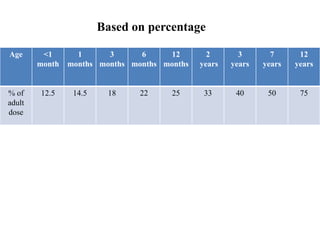
Based on percentage
Age <1
month
1
months
3
months
6
months
12
months
2
years
3
years
7
years
12
years
% of
adult
dose
12.5 14.5 18 22 25 33 40 50 75
THANK YOU

Posology.pptx

  • 1.
  • 2.
    INTRODUCTION • This wordis derived from Greek word posos – how much and logos means science. • Posology is a branch of medical science which deals with dose & quantity of drugs which can be administered to a patient to get a desired action.
  • 3.
    • The doseis usually expressed as a range. • The minimum dose or the lower limit of the dose is essential for eliciting an intended therapeutic response. • Maximum dose or the higher limit of the dose is the amount of the drug substance that can be tolerated by an average individual. • The actual dose of the drug is to be decided by the prescriber depending on patients age, sex, symptoms, medication history and the factors like tolerance, idiosycrasy, route of administration etc.
  • 4.
    FACTORS AFFECTING DOSE 1.Age 2. Sex 3. Pregnancy 4. Body weight 5. Body surface area 6. Disease condition 7. Severity of disease 8. Route of administration 9. Time and frequency of administration 10.Environmental factors 11.Metabolic disturbance 12.Genetic polymorphism 13.Tolerance 14.Idiosyncracy and hypersensitivity 15.Tachyphylaxis 16.Accumulation 17.Addtion 18.Synergism 19.Antagonism
  • 5.
    1. AGE • Thepharmacokinetics of many drugs changes with age. • Newborn infants (pediatric) are abnormally sensitive to certain drugs because of the immature state of their hepatic and renal function by which drugs are inactivated and eliminated from the body. • The drug dosage of new born is low because gastric acid secretion are not adequate ( GIT absorption of ampicillin, amoxicillin is greater in neonates due to decreased gastric acidity). • Failure to detoxify and eliminate drugs results in their accumulation in the tissues to a toxic level ( chloramphenicol- blue baby syndrome because inadequate liver microsomal enzymes like glucuronyl transferase).
  • 6.
    • Due immaturityin BBB sulfonamides may lead to hyper bilirubinemia and kernicterus. • Immature renal tubular transport system penicillin, streptomycin and glycosides are not administered. • Tetracyclines may cause permanent teeth staining, corticosteroids may lead to growth and development retardation and antihistamines may cause hyperactivity. • Geriatric patients require less doses than adult because special consideration such as reduced body weight, reduced body fat, reduced intestinal motility, mesenteric blood flow, reduced renal and hepatic functions and altered mental functions.
  • 7.
    2. SEX • Womendo not always respond to the action of drug in the same manner as it done in men. Special care should be taken when drugs are administered during menstruation, pregnancy & lactation. • Female adults generally require smaller doses than males due to the presence of more fat ( testosterone increases the rate of biotransformation). • Strong purgative, salicylates should be avoided during menstruation may increase bleeding. • Female more susceptible to autonomic drugs ( estrogen inhibit choline esterases). • During lactation drugs may excreted through milk and may affect the infant (penicillin, some purgatives, cloramphenenicol, oral anti coagulants) • Morphine normally depresses CNS but may produce excitation in some womens.
  • 8.
    3. PREGNANCY • Inpregnancy cardiac output, glomerular filtration, renal elimination of drugs volume of distribution and metabolic rate of some drugs are taken into consideration. • Lipophilic drugs cross placental barrier and slowly excreted. • Uterine stimulant, strong purgatives, drugs likely to have teratogenic effects that should be avoided, especially during first trimester . • During labor morphine should be avoided as it crosses placental barrier and depresses respiration in newborn.
  • 9.
    4. BODY WEIGHT •Relative proportion of muscular and adipose tissue in individual is responsible for the differences observed in the distribution and clearance of drugs in different individuals. • The average dose is mentioned either in terms of mg per kg body weight. • Average muscular weight between 70kg. • The drug concentration at site of action is based on the ratio between the amount of drug administered and size of the body. • In case of obese patients, children & malnourished patients dose should be calculated according to body weight
  • 10.
    5. BODY SURFACEAREA • Many physiological factors such as plasma volume, oxygen consumption, requirement of body fluid electrolytes, calories and glomerular filtration are proportional to the surface area. • The surface area is also used to calculate dose because some drugs like methotrexate anticancer drug is administered on mg per sq. meter of body surface area. • The average body surface area of 70 kg adult is about 1.7 – 1.8 sq, m.
  • 11.
    6. PRESENCE OFDISEASE • Presence of disease may alter the requirement of dose. • Drugs like barbiturates & chlorpromazine may produce unusually prolonged effect in patient having liver cirrhosis because they are mainly inactivated by liver. • Streptomycin, morphine produce toxic effect on these patient their kidney function is not working properly because streptomycin excreted through kidney.
  • 12.
    7. SEVERITY OFDISEASE • Severity of disease may affect the requirement of dose. • In common, dull headache may be relived by single tablet of aspirin where as severe headache may need to administration of 2-3 tablets of same drug. • But this is not true in all the cases. • In iron deficiency anemia the dose of iron salt administered orally remains same irrespective of severity because there is a limit to which iron can be absorbed from the intestine daily and incorporated in hemoglobin.
  • 13.
    8. ROUTE OFADMINISTRATION •I.V doses of drug are usually smaller than the oral doses. • Intravenous route this might enhance the chances of drug toxicity. • The effectiveness of drug formulation is generally controlled by the route of administration. • Ergotamine dose for oral route is 2-5mg, I.M route is 1mg, for IV route is 0.25mg
  • 14.
    9. TIME ANDFREQUENCY OFADMINISTARTION • Absorption proceeds more rapidly if stomach and upper portion of the intestinal tract are empty. The presence of food in the stomach delay the absorption of drug. • Several physiological functions are altered during bed rest as compared to the upright position, including reduction in gastric emptying rate, increase cardiac out put, renal flow. • Ferrous sulphate if administered in between meals is more effective than effect produced by same administered after meals. • Iron, arsenic & cod-liver oil should be given after meal & antacid drugs taken before meal. • Amount of drug absorption also governed by circadian. E.g: Ibuprofen have more absorption in morning than any other time.
  • 15.
    10. ENVIROMENTALFACTORS • Thepersonality & behavior of a patient may influence the effect of drug especially the drugs which are intended for use in a psychosomatic disorders. • The females are more emotional than male & required less dose of certain drugs. Inert dosage forms called placebos which resemble the actual medicament in the physical properties are known to produce therapeutic benefit in disease like angina pectoris & bronchial asthma.
  • 16.
    11. METABOLIC DISTURBANCE •Changes in water electrolyte balance & acid base balance, body temperature & other physiological factor may modify the effect of drug. E.g. salicylates reduce body temperature in only in case an individual has rise in body temperature. They have no antipyretic effect if the body temperature is normal.
  • 17.
    12. GENETIC POLYMORPHISM •Enzymes, mainly cytochrome 450(CYP450) is responsible for biotransformation of the drug that mostly results in reduction in effective drug concentration in the body. • Genetic mutation of such enzymes alters the rate of biotransfermation is called genetic polymorphism. • Due this some individuals shows toxicity to the given dose where as others need increment in dose to produce therapeutic effect. • Hyperactivity of such enzymes increases rate of inactivation or elimination of drug where the given dose becomes insufficient • Smoking, alcohol, drugs like isoniazide, pheytoin inducers of CYP450, whereas cimetidine, grapefruit juice enzymes inhibitors.
  • 18.
    13. TOLERANCE • Whenan unusually large dose of a drug is required to elicit an affect ordinarily produced by the normal therapeutic dose of the drug, the phenomenon is called as drug tolerance. • E.g. smokers can tolerate nicotine, alcoholic can tolerate large quantity of alcohol. • The drug tolerance is of two types:  True tolerance, which is produced by oral & parenteral administration of the drug.  Pseudo tolerance, which is produced only to the oral route of administration.
  • 19.
    14. IDIOSYNCRASY ANDHYPERSENSITIVITY • Idiosyncrasy is defined as a genetically determined abnormal or unusual response to drugs occurs in a small proportion of individuals. • An extraordinary response to a drug which is different from its characteristic pharmacological action is called idiosyncrasy. E.g. small quantity of aspirin may cause gastric hemorrhage. • Hypersensitivity or drug allergy is an adverse reaction to a particular chemical resulting from a previous exposure to the substance, occurring in only small fraction of all people receiving the particular drug. E.g: some persons are sensitive to penicillin & sulphonamide because they produce severe toxic effect.
  • 20.
    15. TACHYPHYLAXIS • Whensome drugs administered repeatedly at short intervals, the cell receptors get blocked up & pharmacological response to that drug decreased. • The decreased response cannot be reversed by increasing the dose this phenomenon is called tachyphylaxis or acute tolerance. • E.g. ephedrine given repeated dose at short intervals in the treatment of bronchial asthma may produce very less response due to tachyphylaxis.
  • 21.
    16. ACCUMULA TION Some drugsproduces the toxic effect if it is repeatedly administered for long time E.g. digitalis, emetine, heavy metals because these drugs excreted slowly. This occurs due to accumulative effect of the drug.
  • 22.
    17. ADDITIVE EFFECT •When two or more drugs administered together is equivalent to sum of their individual pharmacological action, the phenomenon is called as additive effect. E.g Ephedrine & aminophylline in the treatment of bronchial ashtma.
  • 23.
    18. SYNERGISM • Whentwo or more drugs used in the combination form, their action is increased. The phenomenon is called synergism. E.g: Aspirin and paracetamol. • When desired therapeutic result needed is difficult to achieve with single drug at that time two or more drugs are used in the combination form for increasing their action. E.g. 1. procaine & adrenaline combination, increase the duration of action of procaine.
  • 24.
    19. ANTOGONISM • Whenthe action of one drug is opposed by the other drug on the same physiological system is known as drug antagonism. • The use of antagonistic response to drugs is valuable in the treatment of poisoning. • E.g. milk of magnesia is given in acid poisoning where alkaline effect of milk of magnesia neutralise the effect of acid poisoning. • When adrenaline & acetylcholine are given together, they neutralise the effect of each other due to antagonism because adrenaline is vasoconstrictor & acetylcholine is vasodilator.
  • 25.
    PAEDIATRIC DOSE CALCULATION A)Based on age 1. Young’s formula 2. Dilling’s formula 3. Cowling’s formula 4. Fried’s formula 5. Bastedo’s formula 6. Gaubin’s formula B) Based on body weight 1. Clark’s formula a) Based on pounds b) Based on kilograms C) Based on body surface area 1. Nomogram method D) Percentage method
  • 26.
    Young’s formula  Childrenunder 12 years of age Example: if the adult dose is 60mg and the age of child is 4 years what will be the dose for child according to young’s rule Ans: Child dose = (4/4+12)*60 = (4/16)*60 = 15mg. Given: 1. Child age – 4 years 2. Adult dose – 60mg 3. Formula – young’s formula
  • 27.
    Dilling’s formula  Childrenage between 4-20 years Example: if the adult dose is 60mg and the age of child is 6 years what will be the dose for child according to dilling’s rule Ans: Child dose = (6/20)*60 = 3*6 = 18mg. Given: 1. Child age – 6 years 2. Adult dose – 60mg 3. Formula – Dillings formula
  • 28.
    Cowling’s formula  Children2 years of age or old. Example: if the adult dose is 60mg and the age of child is 2 years what will be the dose for child according to cowling’s formula Ans: Child dose = (2+1/24)*60 = (3/24)*60 = (1/8)*60 = 7.5mg. Given: 1. Child age – 2years 2. Adult dose – 60mg 3. Formula – Cowling’s formula
  • 29.
    Fried’s formula  Childrenage younger than 1 years or age of child in months. Example: Calculate the child dose for 1 year old baby, if the adult dose of the medicine is 400mg. Ans: Child dose = (12/150)*400 = (6/75)*400 = (6/15)*80 = (6/3)*16 = 2*16 = 32mg. Given: 1. Child age – 1 years ( 12months) 2. Adult dose – 400mg 3. Formula – Fried’s formula
  • 30.
    Bastedo’s formula Example: if theadult dose is 60mg and the age of child is 2 years what will be the dose for child according to cowling’s formula Ans: Child dose = (2+3/30)*60 = (5/30)*60 = (1/6)*60 = 10mg. Given: 1. Child age – 2years 2. Adult dose – 60mg 3. Formula –bastedo’s formula
  • 31.
    Gaubin’s formula Age in years <1 1-22-3 3-4 4-7 7-14 14-20 20-60 60-70 70-80 >80 Parts of adult dose 1/12 1/8 1/6 1/4 1/3 1/2 2/3 Full adult dose 4/5 3/4 1/2 Parts of adult dose according to the age of patient even for geriatric
  • 32.
    Clark’s formula Example: An adultdose of drug is 100mg in three times in a day. What will be the dose for children's having weighing 30kg and 75lbs. Ans: Child dose (kg) = (30/70)*100 = (3/7)*100 = (300/7) = 42.85 = 43mg. Based on the child weight in kg or pounds Ans: Child dose (lbs) = (75/150)*100 = (1/2)*100 = 50mg. Given: 1. Child weight – 30kg 2. Adult dose – 100mg 3. Formula – Clark’s formula Given: 1. Child weight – 75lbs 2. Adult dose – 100mg 3. Formula – Clark’s formula
  • 33.
    Nomogram method Example: An adultdose of drug is 200mg in three times in a day. What will be the dose for children's having surface area of 0.9sq.m. Ans: Child dose = (0.9/1.8)*200 = (1/2)*200 = (200/2) = 100mg. Given: 1. Child BSA –0.9sq.m 2. Adult dose – 200mg
  • 34.
    Based on percentage Age<1 month 1 months 3 months 6 months 12 months 2 years 3 years 7 years 12 years % of adult dose 12.5 14.5 18 22 25 33 40 50 75
  • 35.