Population
What is meant by population?
A population is a summation of all the
organisms of the same group or species, who
live in the same geographical area, and have
the capability of interbreeding.
In sociology, population refers to a collection
of human beings.
 Demography is a social science which entails
the statistical study of human populations and
make predictions about how a population will
change .
Population Growth

The worlds population is growing rapidly
The population of the world is growing at an exponential
rate- its growing faster and faster.
There are two things that affect the population size of
the world: Birth rate- the number of live babies born per
thousand of the population per year.
Death rate-the number of deaths per
thousand of the population per year.

When the birth rate is higher than the
death rate, more people are being born
than are dying so the population grows this
is called Natural increase whereas when
the death rate is higher than the birth
rate it is called the Natural decrease.
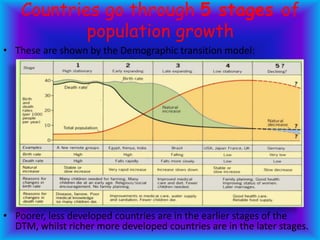
Countries go through 5 stages of
population growth
• These are shown by the Demographic transition model:

• Poorer, less developed countries are in the earlier stages of the
DTM, whilst richer more developed countries are in the later stages.
Managing rapid population growth
Social

Rapid population growth has
social, economic and political
impacts.

• Services like healthcare and
education cant cope with the rapid
increase in population , so not
everyone has access to them.
• Children have to work to help
support their large families , so they
miss out on education.
• There aren't enough houses for
everyone, so people are forced to
live in makeshift houses in
overcrowded settlements. This
leads to health problems because
the houses aren't always connected
to sewers or they don’t have access
to clean water.
• There are food shortages if the
country cant grow or import
enough food for the population.

Political
• Most of the population is made up
of young people so the
government focuses on policies
that are important to young
people e.g. education and
provision of things such as
childcare.
• There are fewer older people so
the government doesn’t have to
focus on policies that are
important to older people e.g.
pensions.
• The government has to make
policies to bring population growth
under control so the social and
economic impacts of rapid
population growth don’t get any
worse.

Economic
• There aren't
enough jobs for
the number of
people in the
country so
unemployment
increases.
• There is increased
poverty because
more people are
born into families
that are already
poor.
Population Growth in India
India has more than 50% of its
population below the age of 25
and more than 65% below the
age of 35. India occupies 2.4%
of the world's land area and
supports over 17.5% of the
world's population. Per the
2001 census 72.2% of the
population lives in about
638,000 villages and the
remaining 27.8% lives in more
than 5,100 towns and over
380urban agglomerations.

The demographics of
India are inclusive of
the second most
populous country in the
world, with over 1.21
billion people, more than
a sixth of the world's
population. Its population
growth rate is 1.41%.
Problems aroused due to over
population and its Impacts on:
Environment
Pollution –
increase in
cars and
emission of
greenhouse
gases into
atmosphere

Deforestatio
n – increase
in paved
areas to
house
increasing
population

Freshwater
Availability
– increase in
waste
production
and
contaminati
on of water

Natural
Resources –
increase
burning of
fossil
fuels, excess
ive use of
coal

Global
Warming –
overall
increase in
temperature
and chances
of natural
disasters

Habitat
Loss –
change in
ecosystems
affecting
tropic
levels
Problems aroused due to over
population and its Impacts on:
Forest and Freshwater
Freshwater Availability
• Misconception of Oceans as freshwater
• Human Bodies – 60% water
• Sewage deposited in water
• Health problems
• Per Capita Water Use

Forests Area
• Urbanization – more paved areas
• Less parks and nature
• Lack of Oxygen production
• Increase Quantity of Carbon Dioxide
(Greenhouse Gases)
• Global Warming
The different strategies to control rapid
population growth
• Countries need to control rapid population growth and they also need to
develop in a way that allows people of today to get the things they need
without stopping people in the future getting what they need. And here
are some ways or policies and how they help to achieve sustainable
development.
Birth control programmes
Birth control programmes aim to reduce the
birth rate. Some governments do this by
having law about how many children couples
are allowed to have.

Governments also help couples to plan ( and
limit) how many children they have by
offering free contraception and sex
education.
This helps towards sustainable development
because it means the population wont get
much bigger.

Immigration laws
Immigration laws aim to control
immigration (people moving to a
country to live there permanently).
Governments can limit the number of
people that are allowed to immigrate.
They can also be selective about who
they let in e.g. letting in fewer people of
child bearing age means there will be
fewer immigrants having children.
Take Home a Message
• Because this is an inevitable
problem we must raise
people’s awareness and
environmental stewardship to
lessen the effects of
overpopulation.
• Focus on the present, but
have in mind the future, thus
we must start changing our
actions now to foresee the
future we want!
Efforts by :
NIHARIKA JAIN – 25

AYUSHI JINDAL – 7
RADHIKA ARORA – 30
ALL OF 8th A

Population a concerned topic

  • 1.
  • 2.
    What is meantby population? A population is a summation of all the organisms of the same group or species, who live in the same geographical area, and have the capability of interbreeding. In sociology, population refers to a collection of human beings.  Demography is a social science which entails the statistical study of human populations and make predictions about how a population will change .
  • 3.
    Population Growth The worldspopulation is growing rapidly The population of the world is growing at an exponential rate- its growing faster and faster. There are two things that affect the population size of the world: Birth rate- the number of live babies born per thousand of the population per year. Death rate-the number of deaths per thousand of the population per year. When the birth rate is higher than the death rate, more people are being born than are dying so the population grows this is called Natural increase whereas when the death rate is higher than the birth rate it is called the Natural decrease.
  • 4.
    Countries go through5 stages of population growth • These are shown by the Demographic transition model: • Poorer, less developed countries are in the earlier stages of the DTM, whilst richer more developed countries are in the later stages.
  • 5.
    Managing rapid populationgrowth Social Rapid population growth has social, economic and political impacts. • Services like healthcare and education cant cope with the rapid increase in population , so not everyone has access to them. • Children have to work to help support their large families , so they miss out on education. • There aren't enough houses for everyone, so people are forced to live in makeshift houses in overcrowded settlements. This leads to health problems because the houses aren't always connected to sewers or they don’t have access to clean water. • There are food shortages if the country cant grow or import enough food for the population. Political • Most of the population is made up of young people so the government focuses on policies that are important to young people e.g. education and provision of things such as childcare. • There are fewer older people so the government doesn’t have to focus on policies that are important to older people e.g. pensions. • The government has to make policies to bring population growth under control so the social and economic impacts of rapid population growth don’t get any worse. Economic • There aren't enough jobs for the number of people in the country so unemployment increases. • There is increased poverty because more people are born into families that are already poor.
  • 6.
    Population Growth inIndia India has more than 50% of its population below the age of 25 and more than 65% below the age of 35. India occupies 2.4% of the world's land area and supports over 17.5% of the world's population. Per the 2001 census 72.2% of the population lives in about 638,000 villages and the remaining 27.8% lives in more than 5,100 towns and over 380urban agglomerations. The demographics of India are inclusive of the second most populous country in the world, with over 1.21 billion people, more than a sixth of the world's population. Its population growth rate is 1.41%.
  • 7.
    Problems aroused dueto over population and its Impacts on: Environment Pollution – increase in cars and emission of greenhouse gases into atmosphere Deforestatio n – increase in paved areas to house increasing population Freshwater Availability – increase in waste production and contaminati on of water Natural Resources – increase burning of fossil fuels, excess ive use of coal Global Warming – overall increase in temperature and chances of natural disasters Habitat Loss – change in ecosystems affecting tropic levels
  • 8.
    Problems aroused dueto over population and its Impacts on: Forest and Freshwater Freshwater Availability • Misconception of Oceans as freshwater • Human Bodies – 60% water • Sewage deposited in water • Health problems • Per Capita Water Use Forests Area • Urbanization – more paved areas • Less parks and nature • Lack of Oxygen production • Increase Quantity of Carbon Dioxide (Greenhouse Gases) • Global Warming
  • 9.
    The different strategiesto control rapid population growth • Countries need to control rapid population growth and they also need to develop in a way that allows people of today to get the things they need without stopping people in the future getting what they need. And here are some ways or policies and how they help to achieve sustainable development. Birth control programmes Birth control programmes aim to reduce the birth rate. Some governments do this by having law about how many children couples are allowed to have. Governments also help couples to plan ( and limit) how many children they have by offering free contraception and sex education. This helps towards sustainable development because it means the population wont get much bigger. Immigration laws Immigration laws aim to control immigration (people moving to a country to live there permanently). Governments can limit the number of people that are allowed to immigrate. They can also be selective about who they let in e.g. letting in fewer people of child bearing age means there will be fewer immigrants having children.
  • 10.
    Take Home aMessage • Because this is an inevitable problem we must raise people’s awareness and environmental stewardship to lessen the effects of overpopulation. • Focus on the present, but have in mind the future, thus we must start changing our actions now to foresee the future we want!
  • 11.
    Efforts by : NIHARIKAJAIN – 25 AYUSHI JINDAL – 7 RADHIKA ARORA – 30 ALL OF 8th A