Presented By:
Amenah Gondal
Presented To:
Ma’am Mehwish
Class:
B.S.Ed (I)
Topic:
Composition of Forces
 Composition of forces
 Components of Forces
 Composition of Concurrent Forces
 Geometrical Methods
 Analytical Method
 (𝜆, 𝜇) Theorem
 Examples
The basic problem of statics consists in the reduction of a
given system of forces to the simplest system which will be
equivalent to the original system. Such a reduction is called
composition of forces.
 When two forces 𝑃 and 𝑄 act on a particle then their
resultant 𝑅 can be find out by using Law of Parallelogram.
The forces 𝑃 and 𝑄 are called components of the resultant.
O
𝑃
𝑄
R
 Forces whose lines of actions intersect at one point called
concurrent forces.
 Such forces always have a resultant through the point of
concurrence.
 This resultant can be found either geometrically or
analytically.
 The two methods are:
 Geometrical method
 Analytical method
It consists of three types of forces:
 Two Forces
 Three non-coplanar Forces
 System of Forces
 Two Forces 𝑃1 𝑎𝑛𝑑 𝑃2
 Find Resultant 𝑅 using
parallelogram law of forces
 From figure
𝑂𝐶 = 𝑂𝐴 + 𝐴𝐶
∴ 𝑅 = 𝑃1 + 𝑃2
 i.e., the resultant of two concurrent forces is given by their
vector sum
𝑅
𝑃1
𝑃2
O A
C
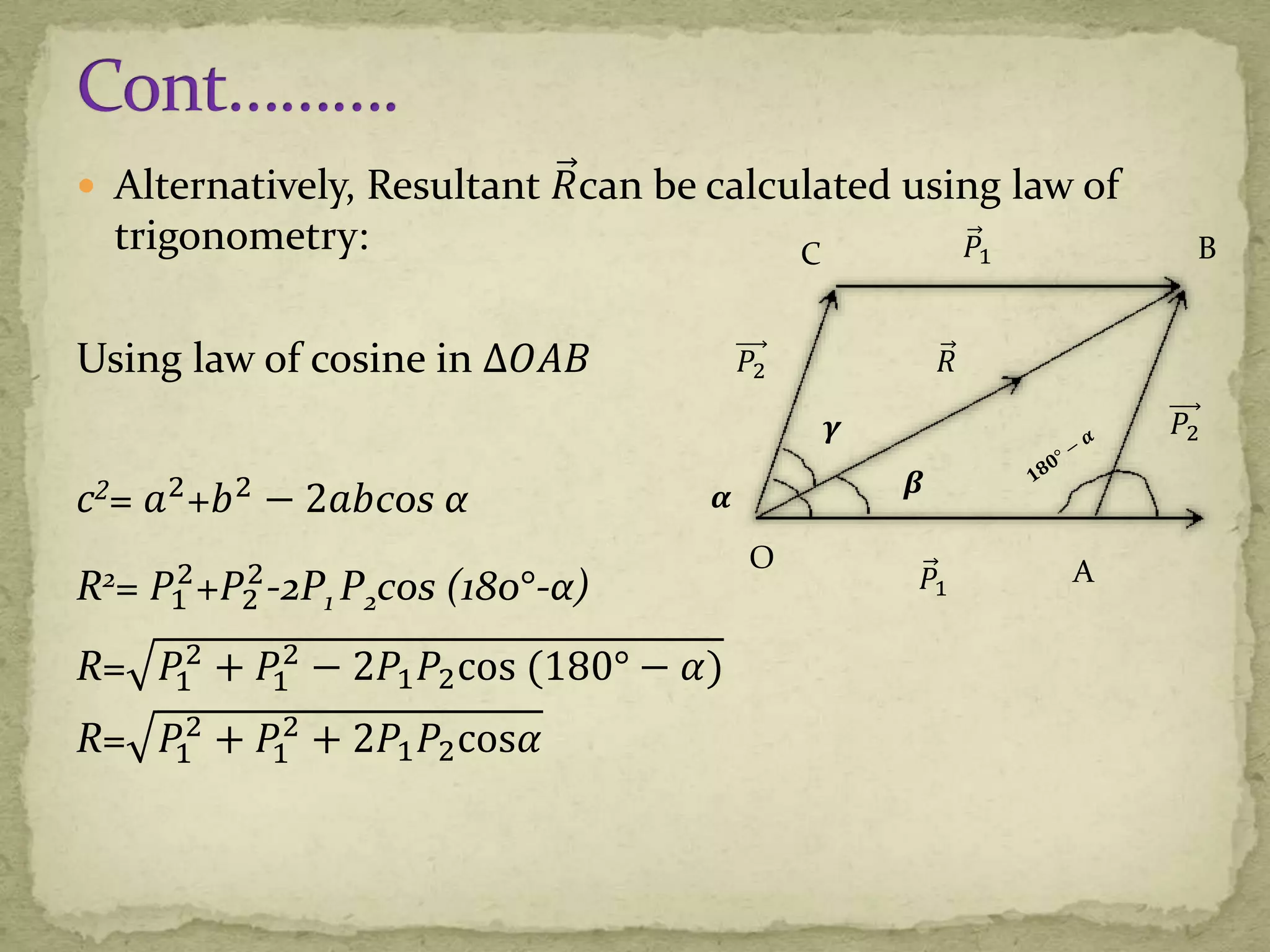
 Alternatively, Resultant 𝑅can be calculated using law of
trigonometry:
Using law of cosine in ∆𝑂𝐴𝐵
c2= 𝑎2+𝑏2 − 2𝑎𝑏cos α
R2= 𝑃1
2
+𝑃2
2
-2P1 P2cos (180°-α)
R= 𝑃1
2
+ 𝑃1
2
− 2𝑃1 𝑃2cos (180° − 𝛼)
R= 𝑃1
2
+ 𝑃1
2
+ 2𝑃1 𝑃2cos𝛼
𝑅
𝑃1
𝑃1
𝑃2
𝑃2
O A
BC
𝜶 𝜷
𝜸
The angles 𝛾 𝑎𝑛𝑑 𝛽 which the resultant makes with
component forces are found by the law of sine. In ∆𝑂𝐴𝐵
𝒂
𝒔𝒊𝒏𝜶
=
𝒃
𝒔𝒊𝒏𝜷
=
𝒄
𝒔𝒊𝒏𝜸
𝑷 𝟏
𝒔𝒊𝒏𝜸
=
𝑷 𝟐
𝒔𝒊𝒏𝜷
=
𝑹
𝒔𝒊𝒏(𝟏𝟖𝟎° − 𝜶)
⇒
𝑷 𝟏
𝒔𝒊𝒏𝜸
=
𝑷 𝟐
𝒔𝒊𝒏𝜷
=
𝑹
𝒔𝒊𝒏𝜶
 Non-coplanar Forces are 𝑃1, 𝑃2 𝑎𝑛𝑑 𝑃3.
 To find Resultant construct parallelepiped whose edges are
𝑂𝐴,𝑂𝐵 𝑎𝑛𝑑 𝑂𝐶.
 By the law of parallelogram
of Forces
𝑂𝐴 + 𝑂𝐵=𝑂𝐸
And applying the same law again
𝑂𝐸 + 𝑂𝐶= 𝑂𝐷
𝑃1
𝑃2
𝑃3
A
B
C
D
E
O
𝑅
Put value of 𝑂𝐸
𝑂𝐴 + 𝑂𝐵+𝑂𝐶=𝑂𝐷
⇒ 𝑃1 + 𝑃2+𝑃3= diagonal
of the parallelepiped through O.
Hence the resultant 𝑅 of three concurrent non-coplanar
forces, acting at O, is represented by the diagonal, drawn
through O, of a parallelepiped with the given forces.
We can express the resultant of construction for the resultant
by the vector equation
𝑖=1
3
𝑃𝑖 = 𝑅
 For more than two forces say n .
 The resultant will be obtained by repeated application of
parallelogram law of forces.
𝑖=1
𝑛
𝑃𝑖 = 𝑅
where i= 1,2,3,…………….,n
O
𝑃3
𝑃1
𝑃2
𝑃4
The analytical method is based on the following
theorem:
“If R is the resultant of the forces 𝑃1, 𝑃2, 𝑃3……………..𝑃𝑛
then the component of R in any direction is equal to the
algebraic sum of the components of 𝑃1 +
𝑃2+𝑃3……………..𝑃𝑛 𝑖𝑛 𝑡ℎ𝑒 𝑠𝑎𝑚𝑒
𝑑𝑖𝑟𝑒𝑐𝑡𝑖𝑜𝑛.”
O y
x
z
𝑃1
𝑃2
𝑃𝑛
𝑃3
𝑃4
R
To prove the theorem we take a unit vector 𝑢 along the
direction in which the components are taken. Since
R= 𝑖=1
𝑛
𝑃𝑖
We multiply this equation scalarly by 𝑢
R. 𝑢=(𝑃1 + 𝑃2 + 𝑃3……………..+𝑃𝑛). 𝑢
By using distributive property of vectors
R. 𝑢=𝑃1. 𝑢 + 𝑃2. 𝑢 + 𝑃3. 𝑢+……………..+𝑃𝑛. 𝑢
=(sum of components of component vectors along 𝑢)
R . 𝑢 = ( 𝑖=1
𝑛
𝑃𝑖). 𝑢 = 𝑖=1
𝑛
𝑃𝑖 𝑢
which completes the proof.
 x-component of 𝑅= sum of x-components of forces 𝑃1 +
𝑃2+𝑃3……………..𝑃𝑛
Rcos𝛼 =X = 𝑖=0
𝑛
𝑃𝑖 𝑐𝑜𝑠𝛼𝑖 (i)
 y-component of 𝑅= sum of y-components of forces 𝑃1 +
𝑃2+𝑃3……………..𝑃𝑛
Rcos𝛽 =Y = 𝑖=0
𝑛
𝑃𝑖 𝑐𝑜𝑠𝛽𝑖(ii)
 z-component of 𝑅= sum of z-components of forces 𝑃1 +
𝑃2+𝑃3……………..𝑃𝑛
Rcos𝛾 =Z = 𝑖=0
𝑛
𝑃𝑖 𝑐𝑜𝑠𝛾𝑖(iii)
Squaring and adding eq. i. ,ii and iii
 R2cos𝛼 + 𝑅2 𝑐𝑜𝑠𝛽+ 𝑅2cos𝛾
=( 𝑖=0
𝑛
𝑃𝑖 𝑐𝑜𝑠𝛼𝑖)2+( 𝑖=0
𝑛
𝑃 𝑖 𝑐𝑜𝑠𝛽𝑖)2+( 𝑖=0
𝑛
𝑃𝑖 𝑐𝑜𝑠𝛾𝑖)2
 R2(cos𝛼 + 𝑐𝑜𝑠𝛽+ cos𝛾)
= ( 𝑖=0
𝑛
𝑃𝑖 𝑐𝑜𝑠𝛼𝑖)2+( 𝑖=0
𝑛
𝑃 𝑖 𝑐𝑜𝑠𝛽𝑖)2+( 𝑖=0
𝑛
𝑃𝑖 𝑐𝑜𝑠𝛾𝑖)2
 R2=X2+Y2+Z2
 R= 𝑋2 + 𝑌2 + 𝑍2
which determine the magnitude of the resultant R.
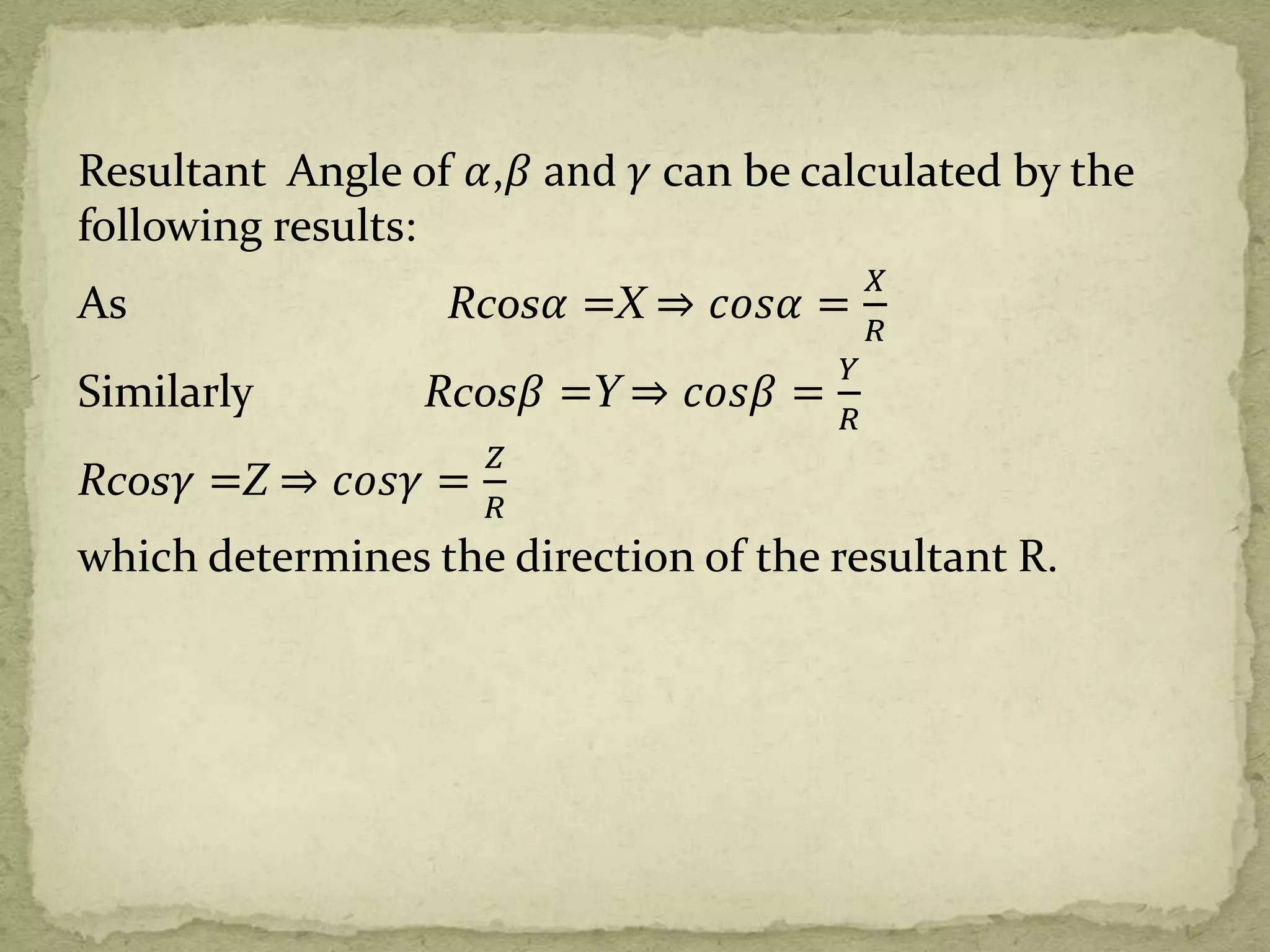
Resultant Angle of 𝛼,𝛽 and 𝛾 can be calculated by the
following results:
As Rcos𝛼 =X ⇒ 𝑐𝑜𝑠𝛼 =
𝑋
𝑅
Similarly Rcos𝛽 =Y ⇒ 𝑐𝑜𝑠𝛽 =
𝑌
𝑅
Rcos𝛾 =Z ⇒ 𝑐𝑜𝑠𝛾 =
𝑍
𝑅
which determines the direction of the resultant R.
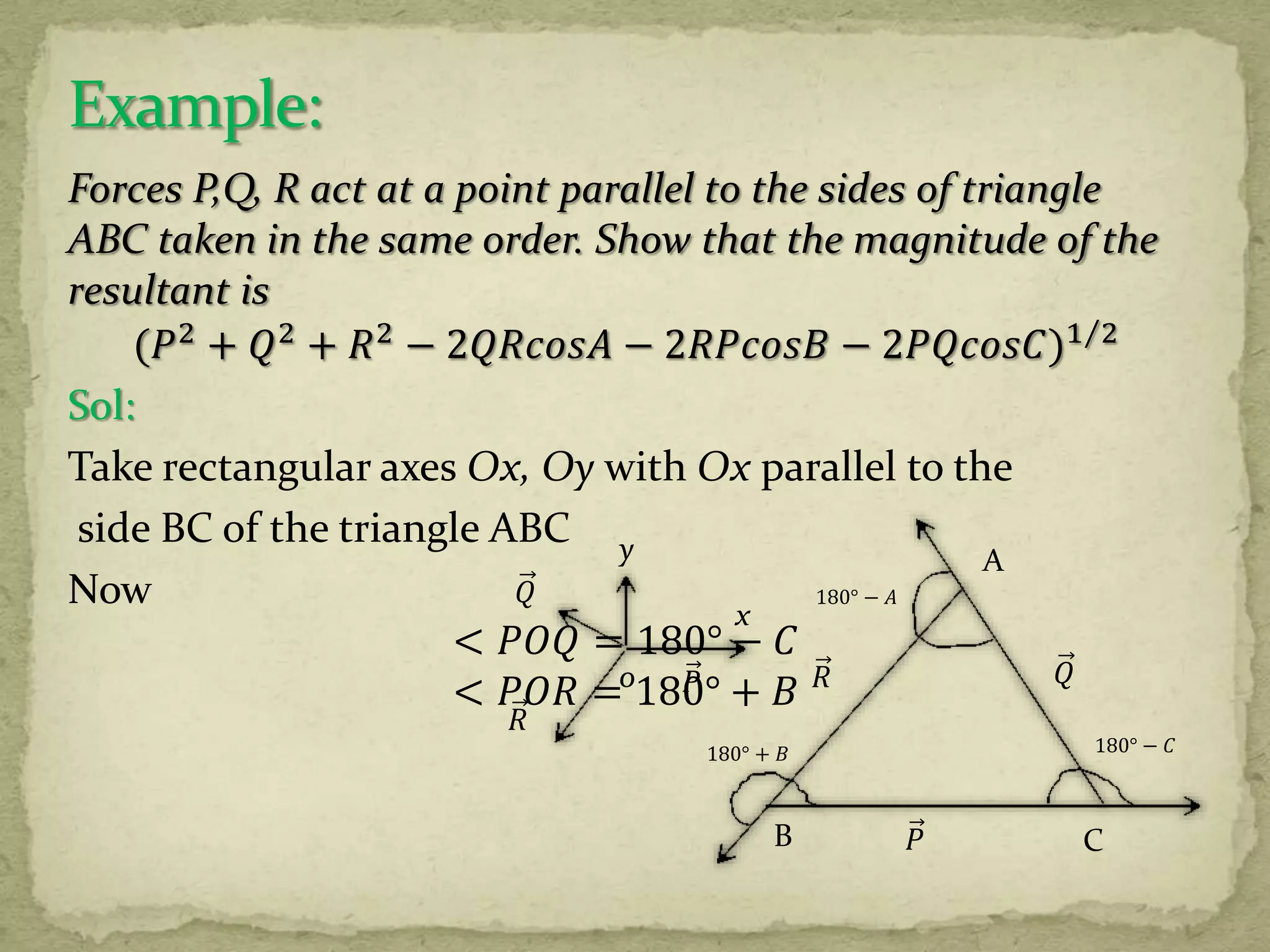
Forces P,Q, R act at a point parallel to the sides of triangle
ABC taken in the same order. Show that the magnitude of the
resultant is
(𝑃2
+ 𝑄2
+ 𝑅2
− 2𝑄𝑅𝑐𝑜𝑠𝐴 − 2𝑅𝑃𝑐𝑜𝑠𝐵 − 2𝑃𝑄𝑐𝑜𝑠𝐶)1 2
Sol:
Take rectangular axes Ox, Oy with Ox parallel to the
side BC of the triangle ABC
Now
< 𝑃𝑂𝑄 = 180° − 𝐶
< 𝑃𝑂𝑅 = 180° + 𝐵
180° − 𝐶180° + 𝐵
180° − 𝐴
𝑃
A
𝑄𝑅
CB
x
o
y
𝑃
𝑅
𝑄
If X and Y are the components of the resultant along axes,
X=P + Q cos(180° − 𝐶) + 𝑅𝑐𝑜𝑠(180° + 𝐵)
= P−Q cos𝐶 − 𝑅𝑐𝑜𝑠𝐵---------- I
Y=Q sin(180° − 𝐶) + 𝑅𝑠𝑖𝑛(180° + 𝐵)
= Qsin𝐶 − 𝑅𝑠𝑖𝑛𝐵---------------II
Hence squaring and adding I and II
𝑋2 + 𝑌2 =
(𝑃 − 𝑄 𝑐𝑜𝑠𝐶 − 𝑅𝑐𝑜𝑠𝐵)2+(𝑄𝑠𝑖𝑛𝐶 − 𝑅𝑠𝑖𝑛𝐵)2= 𝑃2 +
𝑄2 𝑐𝑜𝑠2 𝐶 + 𝑅2 𝑐𝑜𝑠2 𝐵 − 2𝑃𝑄𝑐𝑜𝑠𝐶 + 2𝑄𝑅( 𝑐𝑜𝑠𝐵𝑐𝑜𝑠𝐶 −
= 𝑃2+𝑄2 + 𝑅2 + 2𝑄𝑅𝑐𝑜𝑠(180° − 𝐴) − 2𝑅𝑃𝑐𝑜𝑠𝐵 − 2𝑃𝑄𝑐𝑜𝑠𝐶
= 𝑃2+𝑄2 + 𝑅2 + 2𝑄𝑅𝑐𝑜𝑠𝐴 − 2𝑅𝑃𝑐𝑜𝑠𝐵 − 2𝑃𝑄𝑐𝑜𝑠𝐶
Taking square root on both sides
𝑋2 + 𝑌2
= 𝑃2+𝑄2 + 𝑅2 + 2𝑄𝑅𝑐𝑜𝑠𝐴 − 2𝑅𝑃𝑐𝑜𝑠𝐵 − 2𝑃𝑄𝑐𝑜𝑠𝐶
= (𝑃2
+ 𝑄2
+ 𝑅2
− 2𝑄𝑅𝑐𝑜𝑠𝐴 − 2𝑅𝑃𝑐𝑜𝑠𝐵 − 2𝑃𝑄𝑐𝑜𝑠𝐶)1 2
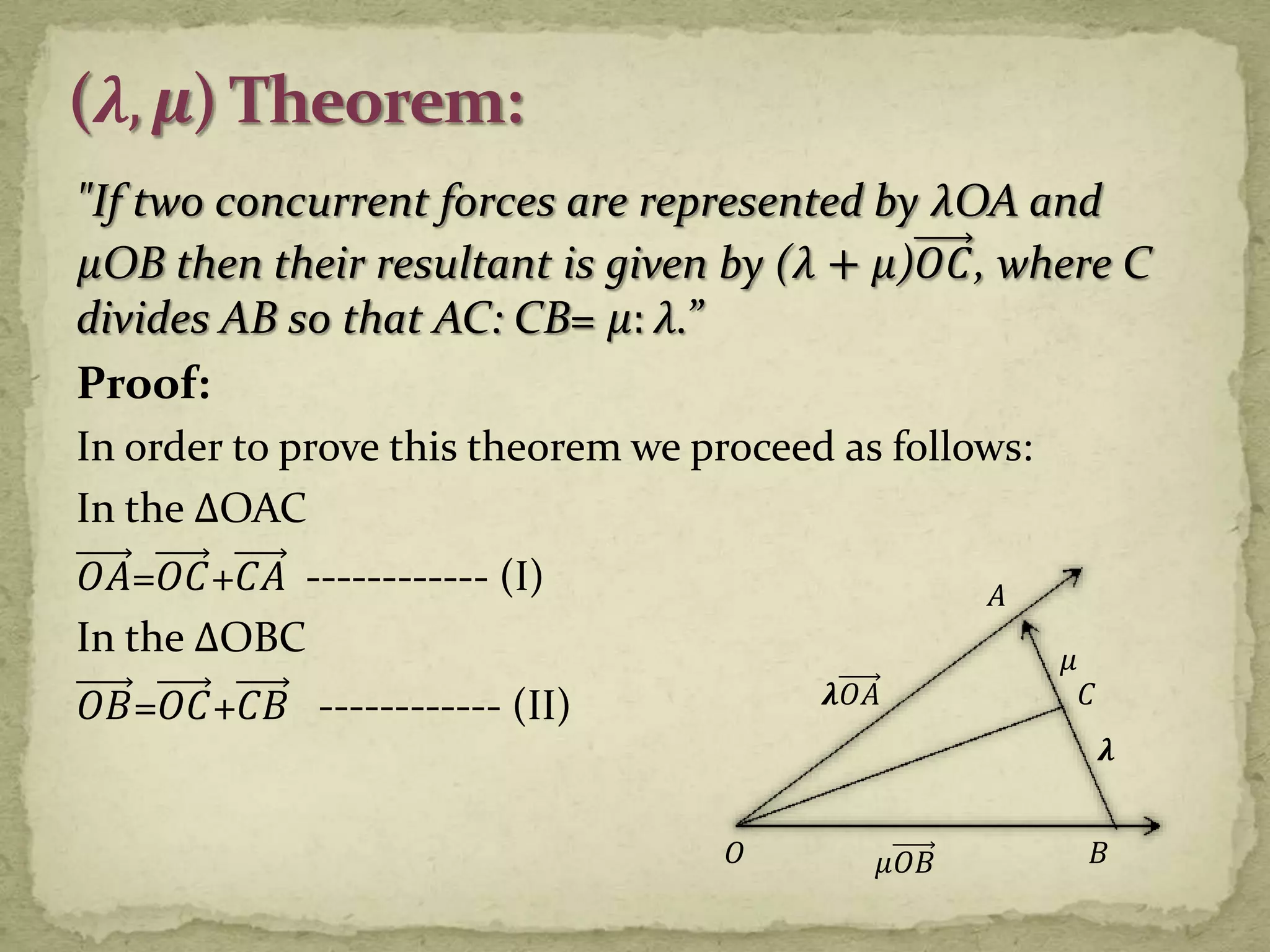
"If two concurrent forces are represented by 𝜆OA and
𝜇OB then their resultant is given by (𝜆 + 𝜇)𝑂𝐶, where C
divides AB so that AC: CB= 𝜇: 𝜆.”
Proof:
In order to prove this theorem we proceed as follows:
In the ΔOAC
𝑂𝐴=𝑂𝐶+𝐶𝐴 ------------ (I)
In the ΔOBC
𝑂𝐵=𝑂𝐶+𝐶𝐵 ------------ (II)
𝐵
𝐴
𝑂
𝐶𝝀𝑂𝐴
𝜇𝑂𝐵
𝜇
𝝀
Multiplying (I) by 𝝀 and (II) by 𝝁
𝜆𝑂𝐴=𝜆𝑂𝐶+𝜆𝐶𝐴 ---------------- (III)
𝜇𝑂𝐵=𝜇𝑂𝐶+𝜇𝐶𝐵 ----------------- (IV)
Now adding (III) and (IV)
𝜆𝑂𝐴 + 𝜇𝑂𝐵= (𝜆𝑂𝐶+𝜆𝐶𝐴 ) + (𝜇𝑂𝐶 + 𝜇𝐶𝐵) ----------- (V)
𝜆𝑂𝐴 + 𝜇𝑂𝐵=(𝜆 + 𝜇)𝑂𝐶+ 𝜆𝐶𝐴 + 𝜇𝐶𝐵-------------- (VI)
As , it is given that AC:CB=𝜇: 𝜆
𝐴𝐶
𝐶𝐵
=
𝜇
𝜆
⟹ 𝜆𝐴𝐶=𝜇𝐶𝐵
𝜇𝐶𝐵 − 𝜆𝐴𝐶=0
𝜇𝐶𝐵 + 𝜆𝐶𝐴=0
∴ 𝑠𝑖𝑛𝑐𝑒 − 𝜆𝐴𝐶 = 𝜆𝐶𝐴
Then eq (VI) becomes
𝝀𝑶𝑨 + 𝝁𝑶𝑩=(𝝀 + 𝝁)𝑶𝑪
which completes a theorem
In case
𝜆 = 𝜇 = 1
Then (𝜆, 𝜇) theorem becomes
𝑂𝐴 + 𝑂𝐵= 2𝑂𝐶
Where C is the middle point of AB .This in fact the result
given by the parallelogram of forces since OC is half of the
diagonal of the parallelogram.
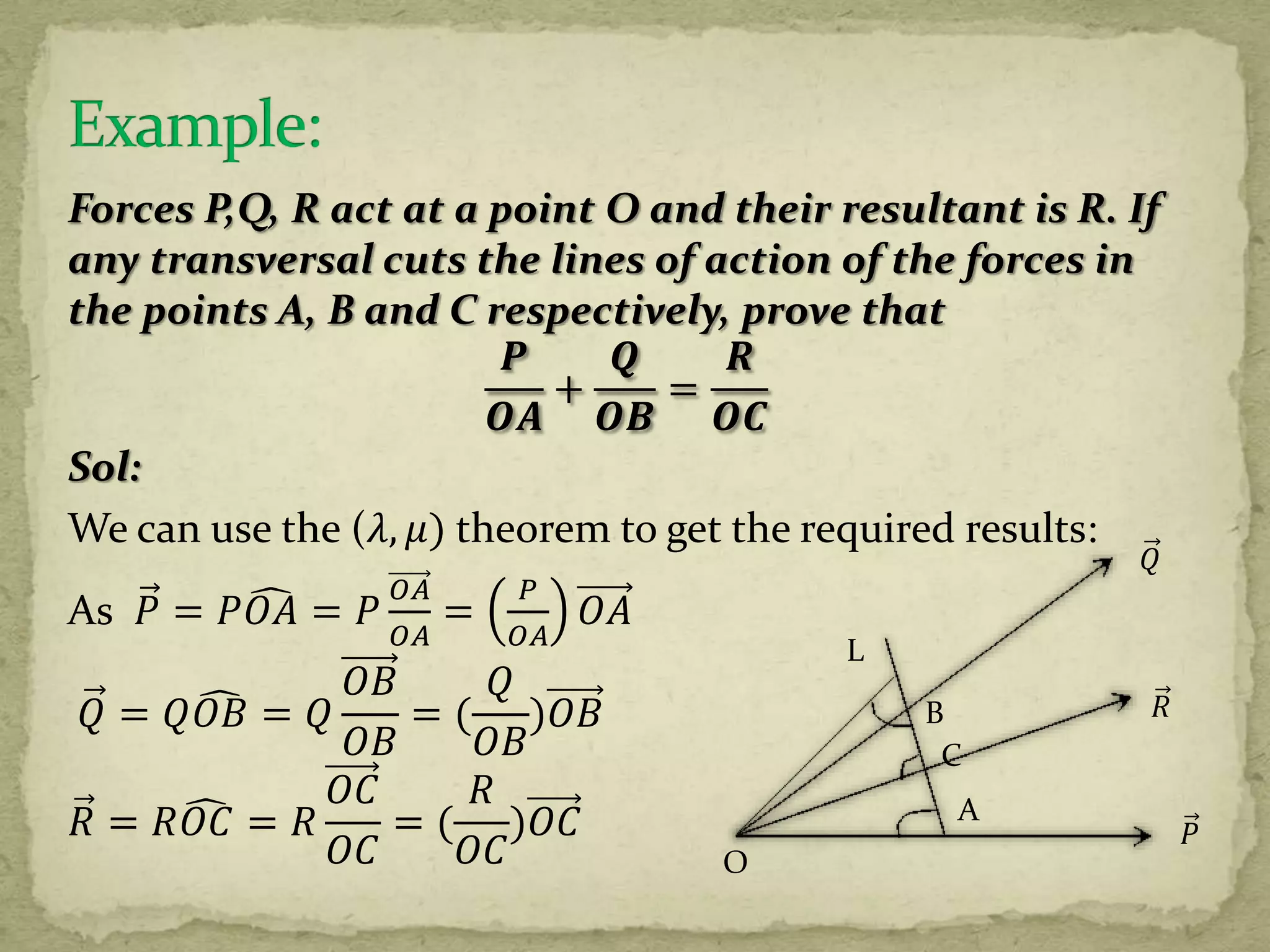
Forces P,Q, R act at a point O and their resultant is R. If
any transversal cuts the lines of action of the forces in
the points A, B and C respectively, prove that
𝑷
𝑶𝑨
+
𝑸
𝑶𝑩
=
𝑹
𝑶𝑪
Sol:
We can use the (𝜆, 𝜇) theorem to get the required results:
As 𝑃 = 𝑃 𝑂𝐴 = 𝑃
𝑂𝐴
𝑂𝐴
=
𝑃
𝑂𝐴
𝑂𝐴
𝑄 = 𝑄 𝑂𝐵 = 𝑄
𝑂𝐵
𝑂𝐵
= (
𝑄
𝑂𝐵
)𝑂𝐵
𝑅 = 𝑅 𝑂𝐶 = 𝑅
𝑂𝐶
𝑂𝐶
= (
𝑅
𝑂𝐶
)𝑂𝐶
B
C
A
O
𝑄
𝑃
𝑅
L
Using the (𝜆, 𝜇) theorem, we have
𝑃 + 𝑄 =
𝑃
𝑂𝐴
𝑂𝐴 +
𝑄
𝑂𝐵
𝑂𝐵
=(
𝑃
𝑂𝐴
+
𝑄
𝑂𝐵
) 𝑂𝐴 + 𝑂𝐵
= (
𝑃
𝑂𝐴
+
𝑄
𝑂𝐵
) 𝑂𝐶
∴ (𝑂𝐴 + 𝑂𝐵 = 𝑂𝐶)
Where C is a point lie on AB such that
AC: CB =
𝑄
𝑂𝐵
:
𝑃
𝑂𝐴
As we know that
𝑃 + 𝑄 = 𝑅
Then
𝑃
𝑂𝐴
+
𝑄
𝑂𝐵
𝑂𝐶 = (
𝑅
𝑂𝐶
)𝑂𝐶
which gives
𝑃
𝑂𝐴
+
𝑄
𝑂𝐵
= (
𝑅
𝑂𝐶
)
Hence proved
𝑃
𝑂𝐴
+
𝑄
𝑂𝐵
=
𝑅
𝑂𝐶
Composition of Forces

Composition of Forces

  • 2.
    Presented By: Amenah Gondal PresentedTo: Ma’am Mehwish Class: B.S.Ed (I) Topic: Composition of Forces
  • 4.
     Composition offorces  Components of Forces  Composition of Concurrent Forces  Geometrical Methods  Analytical Method  (𝜆, 𝜇) Theorem  Examples
  • 5.
    The basic problemof statics consists in the reduction of a given system of forces to the simplest system which will be equivalent to the original system. Such a reduction is called composition of forces.
  • 6.
     When twoforces 𝑃 and 𝑄 act on a particle then their resultant 𝑅 can be find out by using Law of Parallelogram. The forces 𝑃 and 𝑄 are called components of the resultant. O 𝑃 𝑄 R
  • 7.
     Forces whoselines of actions intersect at one point called concurrent forces.  Such forces always have a resultant through the point of concurrence.  This resultant can be found either geometrically or analytically.  The two methods are:  Geometrical method  Analytical method
  • 8.
    It consists ofthree types of forces:  Two Forces  Three non-coplanar Forces  System of Forces
  • 9.
     Two Forces𝑃1 𝑎𝑛𝑑 𝑃2  Find Resultant 𝑅 using parallelogram law of forces  From figure 𝑂𝐶 = 𝑂𝐴 + 𝐴𝐶 ∴ 𝑅 = 𝑃1 + 𝑃2  i.e., the resultant of two concurrent forces is given by their vector sum 𝑅 𝑃1 𝑃2 O A C
  • 10.
     Alternatively, Resultant𝑅can be calculated using law of trigonometry: Using law of cosine in ∆𝑂𝐴𝐵 c2= 𝑎2+𝑏2 − 2𝑎𝑏cos α R2= 𝑃1 2 +𝑃2 2 -2P1 P2cos (180°-α) R= 𝑃1 2 + 𝑃1 2 − 2𝑃1 𝑃2cos (180° − 𝛼) R= 𝑃1 2 + 𝑃1 2 + 2𝑃1 𝑃2cos𝛼 𝑅 𝑃1 𝑃1 𝑃2 𝑃2 O A BC 𝜶 𝜷 𝜸
  • 11.
    The angles 𝛾𝑎𝑛𝑑 𝛽 which the resultant makes with component forces are found by the law of sine. In ∆𝑂𝐴𝐵 𝒂 𝒔𝒊𝒏𝜶 = 𝒃 𝒔𝒊𝒏𝜷 = 𝒄 𝒔𝒊𝒏𝜸 𝑷 𝟏 𝒔𝒊𝒏𝜸 = 𝑷 𝟐 𝒔𝒊𝒏𝜷 = 𝑹 𝒔𝒊𝒏(𝟏𝟖𝟎° − 𝜶) ⇒ 𝑷 𝟏 𝒔𝒊𝒏𝜸 = 𝑷 𝟐 𝒔𝒊𝒏𝜷 = 𝑹 𝒔𝒊𝒏𝜶
  • 12.
     Non-coplanar Forcesare 𝑃1, 𝑃2 𝑎𝑛𝑑 𝑃3.  To find Resultant construct parallelepiped whose edges are 𝑂𝐴,𝑂𝐵 𝑎𝑛𝑑 𝑂𝐶.  By the law of parallelogram of Forces 𝑂𝐴 + 𝑂𝐵=𝑂𝐸 And applying the same law again 𝑂𝐸 + 𝑂𝐶= 𝑂𝐷 𝑃1 𝑃2 𝑃3 A B C D E O 𝑅
  • 13.
    Put value of𝑂𝐸 𝑂𝐴 + 𝑂𝐵+𝑂𝐶=𝑂𝐷 ⇒ 𝑃1 + 𝑃2+𝑃3= diagonal of the parallelepiped through O. Hence the resultant 𝑅 of three concurrent non-coplanar forces, acting at O, is represented by the diagonal, drawn through O, of a parallelepiped with the given forces. We can express the resultant of construction for the resultant by the vector equation 𝑖=1 3 𝑃𝑖 = 𝑅
  • 14.
     For morethan two forces say n .  The resultant will be obtained by repeated application of parallelogram law of forces. 𝑖=1 𝑛 𝑃𝑖 = 𝑅 where i= 1,2,3,…………….,n O 𝑃3 𝑃1 𝑃2 𝑃4
  • 15.
    The analytical methodis based on the following theorem: “If R is the resultant of the forces 𝑃1, 𝑃2, 𝑃3……………..𝑃𝑛 then the component of R in any direction is equal to the algebraic sum of the components of 𝑃1 + 𝑃2+𝑃3……………..𝑃𝑛 𝑖𝑛 𝑡ℎ𝑒 𝑠𝑎𝑚𝑒 𝑑𝑖𝑟𝑒𝑐𝑡𝑖𝑜𝑛.” O y x z 𝑃1 𝑃2 𝑃𝑛 𝑃3 𝑃4 R
  • 16.
    To prove thetheorem we take a unit vector 𝑢 along the direction in which the components are taken. Since R= 𝑖=1 𝑛 𝑃𝑖 We multiply this equation scalarly by 𝑢 R. 𝑢=(𝑃1 + 𝑃2 + 𝑃3……………..+𝑃𝑛). 𝑢 By using distributive property of vectors R. 𝑢=𝑃1. 𝑢 + 𝑃2. 𝑢 + 𝑃3. 𝑢+……………..+𝑃𝑛. 𝑢 =(sum of components of component vectors along 𝑢) R . 𝑢 = ( 𝑖=1 𝑛 𝑃𝑖). 𝑢 = 𝑖=1 𝑛 𝑃𝑖 𝑢 which completes the proof.
  • 17.
     x-component of𝑅= sum of x-components of forces 𝑃1 + 𝑃2+𝑃3……………..𝑃𝑛 Rcos𝛼 =X = 𝑖=0 𝑛 𝑃𝑖 𝑐𝑜𝑠𝛼𝑖 (i)  y-component of 𝑅= sum of y-components of forces 𝑃1 + 𝑃2+𝑃3……………..𝑃𝑛 Rcos𝛽 =Y = 𝑖=0 𝑛 𝑃𝑖 𝑐𝑜𝑠𝛽𝑖(ii)  z-component of 𝑅= sum of z-components of forces 𝑃1 + 𝑃2+𝑃3……………..𝑃𝑛 Rcos𝛾 =Z = 𝑖=0 𝑛 𝑃𝑖 𝑐𝑜𝑠𝛾𝑖(iii)
  • 18.
    Squaring and addingeq. i. ,ii and iii  R2cos𝛼 + 𝑅2 𝑐𝑜𝑠𝛽+ 𝑅2cos𝛾 =( 𝑖=0 𝑛 𝑃𝑖 𝑐𝑜𝑠𝛼𝑖)2+( 𝑖=0 𝑛 𝑃 𝑖 𝑐𝑜𝑠𝛽𝑖)2+( 𝑖=0 𝑛 𝑃𝑖 𝑐𝑜𝑠𝛾𝑖)2  R2(cos𝛼 + 𝑐𝑜𝑠𝛽+ cos𝛾) = ( 𝑖=0 𝑛 𝑃𝑖 𝑐𝑜𝑠𝛼𝑖)2+( 𝑖=0 𝑛 𝑃 𝑖 𝑐𝑜𝑠𝛽𝑖)2+( 𝑖=0 𝑛 𝑃𝑖 𝑐𝑜𝑠𝛾𝑖)2  R2=X2+Y2+Z2  R= 𝑋2 + 𝑌2 + 𝑍2 which determine the magnitude of the resultant R.
  • 19.
    Resultant Angle of𝛼,𝛽 and 𝛾 can be calculated by the following results: As Rcos𝛼 =X ⇒ 𝑐𝑜𝑠𝛼 = 𝑋 𝑅 Similarly Rcos𝛽 =Y ⇒ 𝑐𝑜𝑠𝛽 = 𝑌 𝑅 Rcos𝛾 =Z ⇒ 𝑐𝑜𝑠𝛾 = 𝑍 𝑅 which determines the direction of the resultant R.
  • 20.
    Forces P,Q, Ract at a point parallel to the sides of triangle ABC taken in the same order. Show that the magnitude of the resultant is (𝑃2 + 𝑄2 + 𝑅2 − 2𝑄𝑅𝑐𝑜𝑠𝐴 − 2𝑅𝑃𝑐𝑜𝑠𝐵 − 2𝑃𝑄𝑐𝑜𝑠𝐶)1 2 Sol: Take rectangular axes Ox, Oy with Ox parallel to the side BC of the triangle ABC Now < 𝑃𝑂𝑄 = 180° − 𝐶 < 𝑃𝑂𝑅 = 180° + 𝐵 180° − 𝐶180° + 𝐵 180° − 𝐴 𝑃 A 𝑄𝑅 CB x o y 𝑃 𝑅 𝑄
  • 21.
    If X andY are the components of the resultant along axes, X=P + Q cos(180° − 𝐶) + 𝑅𝑐𝑜𝑠(180° + 𝐵) = P−Q cos𝐶 − 𝑅𝑐𝑜𝑠𝐵---------- I Y=Q sin(180° − 𝐶) + 𝑅𝑠𝑖𝑛(180° + 𝐵) = Qsin𝐶 − 𝑅𝑠𝑖𝑛𝐵---------------II Hence squaring and adding I and II 𝑋2 + 𝑌2 = (𝑃 − 𝑄 𝑐𝑜𝑠𝐶 − 𝑅𝑐𝑜𝑠𝐵)2+(𝑄𝑠𝑖𝑛𝐶 − 𝑅𝑠𝑖𝑛𝐵)2= 𝑃2 + 𝑄2 𝑐𝑜𝑠2 𝐶 + 𝑅2 𝑐𝑜𝑠2 𝐵 − 2𝑃𝑄𝑐𝑜𝑠𝐶 + 2𝑄𝑅( 𝑐𝑜𝑠𝐵𝑐𝑜𝑠𝐶 −
  • 22.
    = 𝑃2+𝑄2 +𝑅2 + 2𝑄𝑅𝑐𝑜𝑠(180° − 𝐴) − 2𝑅𝑃𝑐𝑜𝑠𝐵 − 2𝑃𝑄𝑐𝑜𝑠𝐶 = 𝑃2+𝑄2 + 𝑅2 + 2𝑄𝑅𝑐𝑜𝑠𝐴 − 2𝑅𝑃𝑐𝑜𝑠𝐵 − 2𝑃𝑄𝑐𝑜𝑠𝐶 Taking square root on both sides 𝑋2 + 𝑌2 = 𝑃2+𝑄2 + 𝑅2 + 2𝑄𝑅𝑐𝑜𝑠𝐴 − 2𝑅𝑃𝑐𝑜𝑠𝐵 − 2𝑃𝑄𝑐𝑜𝑠𝐶 = (𝑃2 + 𝑄2 + 𝑅2 − 2𝑄𝑅𝑐𝑜𝑠𝐴 − 2𝑅𝑃𝑐𝑜𝑠𝐵 − 2𝑃𝑄𝑐𝑜𝑠𝐶)1 2
  • 23.
    "If two concurrentforces are represented by 𝜆OA and 𝜇OB then their resultant is given by (𝜆 + 𝜇)𝑂𝐶, where C divides AB so that AC: CB= 𝜇: 𝜆.” Proof: In order to prove this theorem we proceed as follows: In the ΔOAC 𝑂𝐴=𝑂𝐶+𝐶𝐴 ------------ (I) In the ΔOBC 𝑂𝐵=𝑂𝐶+𝐶𝐵 ------------ (II) 𝐵 𝐴 𝑂 𝐶𝝀𝑂𝐴 𝜇𝑂𝐵 𝜇 𝝀
  • 24.
    Multiplying (I) by𝝀 and (II) by 𝝁 𝜆𝑂𝐴=𝜆𝑂𝐶+𝜆𝐶𝐴 ---------------- (III) 𝜇𝑂𝐵=𝜇𝑂𝐶+𝜇𝐶𝐵 ----------------- (IV) Now adding (III) and (IV) 𝜆𝑂𝐴 + 𝜇𝑂𝐵= (𝜆𝑂𝐶+𝜆𝐶𝐴 ) + (𝜇𝑂𝐶 + 𝜇𝐶𝐵) ----------- (V) 𝜆𝑂𝐴 + 𝜇𝑂𝐵=(𝜆 + 𝜇)𝑂𝐶+ 𝜆𝐶𝐴 + 𝜇𝐶𝐵-------------- (VI) As , it is given that AC:CB=𝜇: 𝜆 𝐴𝐶 𝐶𝐵 = 𝜇 𝜆 ⟹ 𝜆𝐴𝐶=𝜇𝐶𝐵 𝜇𝐶𝐵 − 𝜆𝐴𝐶=0 𝜇𝐶𝐵 + 𝜆𝐶𝐴=0 ∴ 𝑠𝑖𝑛𝑐𝑒 − 𝜆𝐴𝐶 = 𝜆𝐶𝐴
  • 25.
    Then eq (VI)becomes 𝝀𝑶𝑨 + 𝝁𝑶𝑩=(𝝀 + 𝝁)𝑶𝑪 which completes a theorem In case 𝜆 = 𝜇 = 1 Then (𝜆, 𝜇) theorem becomes 𝑂𝐴 + 𝑂𝐵= 2𝑂𝐶 Where C is the middle point of AB .This in fact the result given by the parallelogram of forces since OC is half of the diagonal of the parallelogram.
  • 26.
    Forces P,Q, Ract at a point O and their resultant is R. If any transversal cuts the lines of action of the forces in the points A, B and C respectively, prove that 𝑷 𝑶𝑨 + 𝑸 𝑶𝑩 = 𝑹 𝑶𝑪 Sol: We can use the (𝜆, 𝜇) theorem to get the required results: As 𝑃 = 𝑃 𝑂𝐴 = 𝑃 𝑂𝐴 𝑂𝐴 = 𝑃 𝑂𝐴 𝑂𝐴 𝑄 = 𝑄 𝑂𝐵 = 𝑄 𝑂𝐵 𝑂𝐵 = ( 𝑄 𝑂𝐵 )𝑂𝐵 𝑅 = 𝑅 𝑂𝐶 = 𝑅 𝑂𝐶 𝑂𝐶 = ( 𝑅 𝑂𝐶 )𝑂𝐶 B C A O 𝑄 𝑃 𝑅 L
  • 27.
    Using the (𝜆,𝜇) theorem, we have 𝑃 + 𝑄 = 𝑃 𝑂𝐴 𝑂𝐴 + 𝑄 𝑂𝐵 𝑂𝐵 =( 𝑃 𝑂𝐴 + 𝑄 𝑂𝐵 ) 𝑂𝐴 + 𝑂𝐵 = ( 𝑃 𝑂𝐴 + 𝑄 𝑂𝐵 ) 𝑂𝐶 ∴ (𝑂𝐴 + 𝑂𝐵 = 𝑂𝐶) Where C is a point lie on AB such that AC: CB = 𝑄 𝑂𝐵 : 𝑃 𝑂𝐴 As we know that 𝑃 + 𝑄 = 𝑅 Then 𝑃 𝑂𝐴 + 𝑄 𝑂𝐵 𝑂𝐶 = ( 𝑅 𝑂𝐶 )𝑂𝐶
  • 28.
    which gives 𝑃 𝑂𝐴 + 𝑄 𝑂𝐵 = ( 𝑅 𝑂𝐶 ) Henceproved 𝑃 𝑂𝐴 + 𝑄 𝑂𝐵 = 𝑅 𝑂𝐶