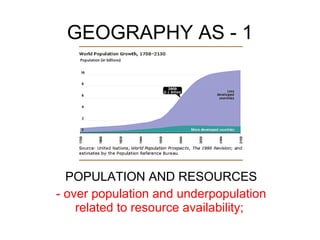
GEOGRAPHY AS - 1 POPULATION AND RESOURCES - over population and underpopulation related to resource availability;
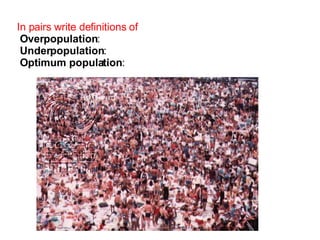
In pairs write definitions of   Overpopulation : Underpopulation : Optimum population :
Overpopulation : Occurs when the resources and technology of a country are not sufficient to maintain an adequate standard of living for the people of that country. A reduction in the total population would lead to an improvement in the standard of living for the remaining population. Underpopulation : Occurs when there are far more resources in an area, than can be used by the number of people living there. A increase in the total population would lead to an improvement in the standard of living for the remaining population. Optimum population : In theory, this is where the population of a country, when working with all the available resources, produces the highest per capita economic return, so giving the highest possible standard of living RECORD THESE DEFINITIONS – LEARN THEM BY HEART
Over population and underpopulation related to resource availability Resources : Features that are needed and used by people. Consists of both natural resources (e.g. raw materials) and human resources (e.g. people and capital). These may be renewable (eg Solar) or Non-renewable (eg Oil). Birth rate : Number of births per 1000 people per year. Death rate : Number of deaths per 1000 people per year. Natural increase : The population change of a country if it were not for migration. It takes into account birth and death rates only.  RECORD THESE DEFINITIONS – LEARN THEM BY HEART
Over population and underpopulation related to resource availability Gross Domestic Product  (GDP) is the monetary value of all goods and services produced in a country divided by the total population. i.e. per capita Gross National Product  (GNP). Is the Gross Domestic Product plus the value of goods and services produced by companies abroad, such as Multinational Companies. i.e. per capita. Fertility.  A broad term used to cover all aspects of the reproductive performance of a population of a country. It is the average number of children each woman will bear in her fertile years (normally taken to be between 15 and 50). If fertility rate is 2.1 then a population is stable and replacing itself. RECORD THESE DEFINITIONS – LEARN THEM BY HEART

Population definitions

  • 1.
    GEOGRAPHY AS -1 POPULATION AND RESOURCES - over population and underpopulation related to resource availability;
  • 2.
    In pairs writedefinitions of Overpopulation : Underpopulation : Optimum population :
  • 3.
    Overpopulation : Occurswhen the resources and technology of a country are not sufficient to maintain an adequate standard of living for the people of that country. A reduction in the total population would lead to an improvement in the standard of living for the remaining population. Underpopulation : Occurs when there are far more resources in an area, than can be used by the number of people living there. A increase in the total population would lead to an improvement in the standard of living for the remaining population. Optimum population : In theory, this is where the population of a country, when working with all the available resources, produces the highest per capita economic return, so giving the highest possible standard of living RECORD THESE DEFINITIONS – LEARN THEM BY HEART
  • 4.
    Over population andunderpopulation related to resource availability Resources : Features that are needed and used by people. Consists of both natural resources (e.g. raw materials) and human resources (e.g. people and capital). These may be renewable (eg Solar) or Non-renewable (eg Oil). Birth rate : Number of births per 1000 people per year. Death rate : Number of deaths per 1000 people per year. Natural increase : The population change of a country if it were not for migration. It takes into account birth and death rates only. RECORD THESE DEFINITIONS – LEARN THEM BY HEART
  • 5.
    Over population andunderpopulation related to resource availability Gross Domestic Product (GDP) is the monetary value of all goods and services produced in a country divided by the total population. i.e. per capita Gross National Product (GNP). Is the Gross Domestic Product plus the value of goods and services produced by companies abroad, such as Multinational Companies. i.e. per capita. Fertility. A broad term used to cover all aspects of the reproductive performance of a population of a country. It is the average number of children each woman will bear in her fertile years (normally taken to be between 15 and 50). If fertility rate is 2.1 then a population is stable and replacing itself. RECORD THESE DEFINITIONS – LEARN THEM BY HEART