Presentation for
parents of Primary School
children
2015 by Denis Ramplin
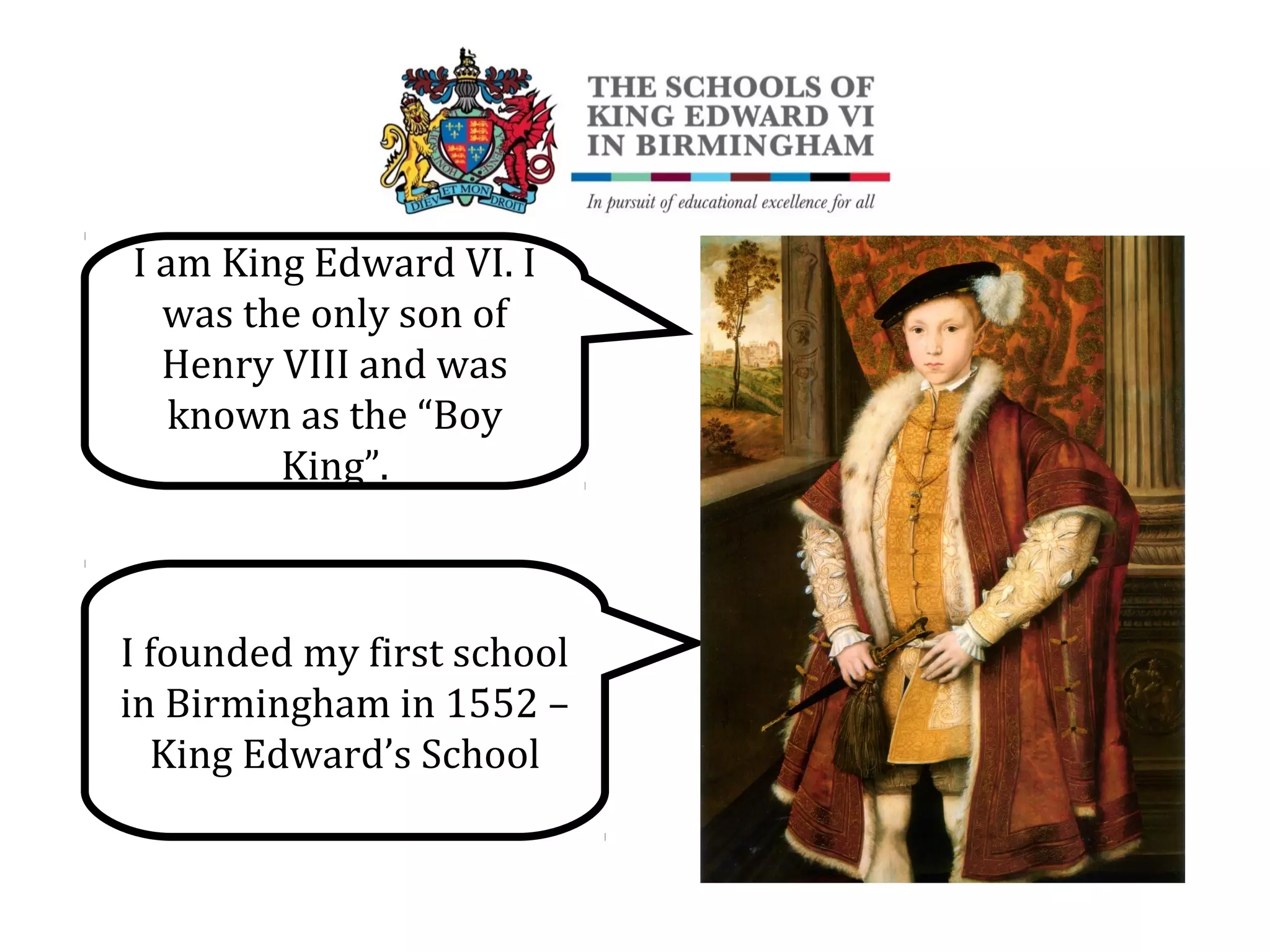
I am King Edward VI. I
was the only son of
Henry VIII and was
known as the “Boy
King”.
I founded my first school
in Birmingham in 1552 –
King Edward’s School
We are now a charity
which supports 8 schools
across the City.
There are 3 types of
schools and they are:
5 Free Grammar Schools
2 Independent Schools,
which are fee paying
and a Sponsored
Academy.
Our 2 Independent Schools are:
King Edward’s School (for Boys) and
King Edward VI High School for Girls.
Although they are fee paying they do offer free
and assisted places for children
who pass their test.
Our five free Grammar Schools are:
King Edward VI Aston (for Boys),
King Edward VI Camp Hill Boys,
King Edward VI Camp Hill Girls,
King Edward VI Five Ways (Mixed) and
King Edward VI Handsworth School for Girls.
Entrance to these schools is via a test (11+).
Our sponsored Academy is:
King Edward VI Sheldon Heath -
The school serves its community and is a
multi-ability school with Sixth Form which
does
not require its pupils to pass a test.
Last year we piloted a scheme where
a selection of primary schools from
across the City sent their able, gifted
and talented pupils to spend 5 x 2 hour
sessions at our grammar schools.
Nearly 600 children took part.
We called the
scheme
“Familiarisation”
We wanted the
children to be
familiar with our
schools, their
locations and...
To find out information about
the schools
To be confident and happy
about the application process
And to learn about the 11+exam
So what is a grammar
school?
• It is a selective school for able, gifted and talented
children who have achieved a level of excellence in
the 11+ test.
• They are free.
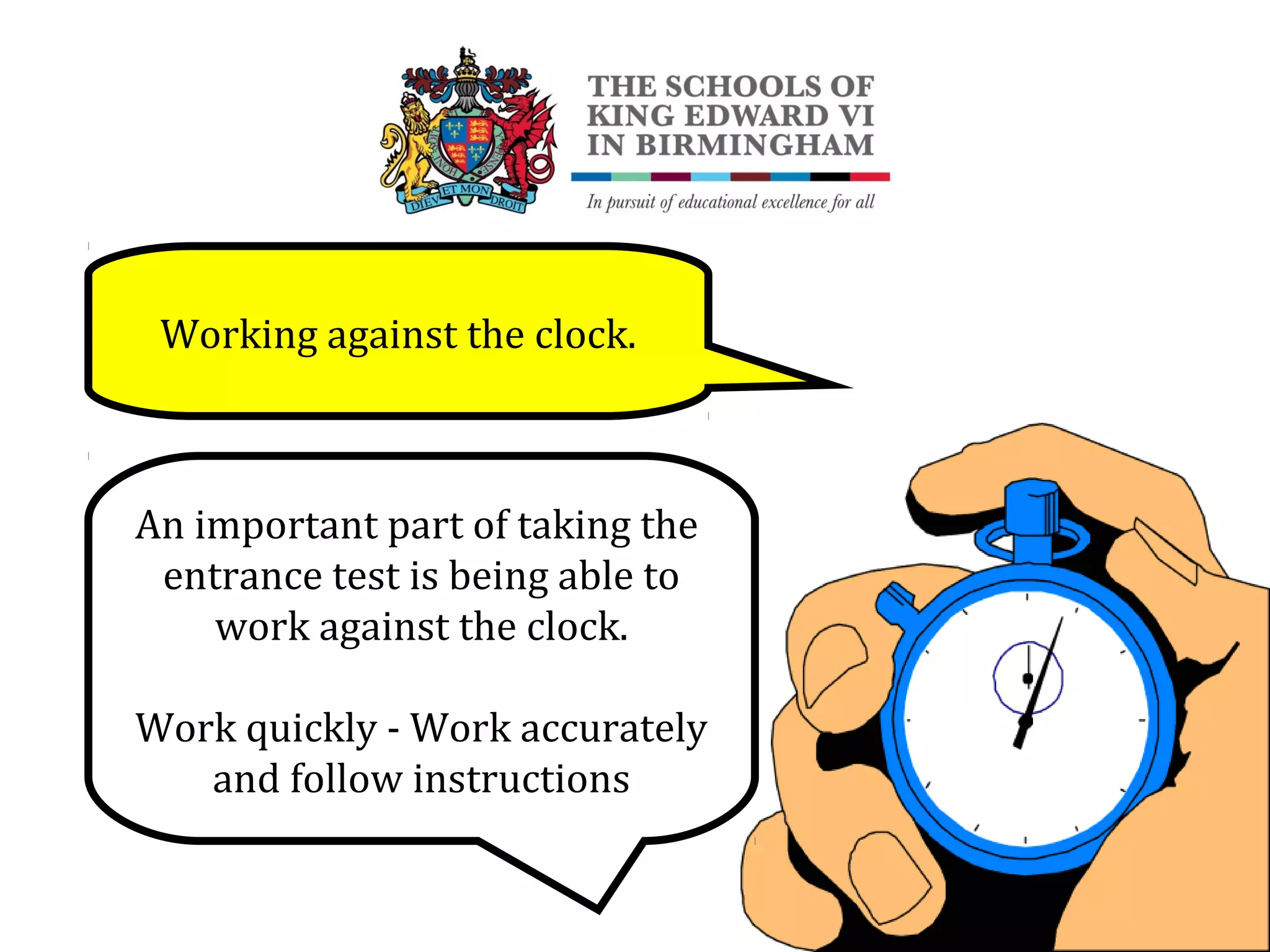
Working against the clock.
An important part of taking the
entrance test is being able to
work against the clock.
Work quickly - Work accurately
and follow instructions
Remember the time that is
allowed for each test 45
minutes for test 1 and 45
minutes for test 2. Work your way through
the test – do not take too
much time on any one
question. If you cannot do
a question, move on to the
next one.
YOU ARE THE MOST
IMPORTANT PERSON
IN THE ROOM! TRY
YOUR VERY BEST.
It is important for you
to do well in the test
to be offered a place.
What is it like to sit the test?
You will meet Boys (and
girls) from our schools who
have
sat the test.
Write down questions that
you would like to ask them.
Do this on a post it note.
What are the types of
questions in the 11+ test?
There are four main types of question
which may be included in the test:
1. Questions which test English skills.
2. Questions which test numerical
reasoning (Maths).
3. Questions which test puzzle solving
(also called non-verbal reasoning)
4. Questions which test verbal reasoning.
The questions in the 11+ Entrance test will
be based on topics that are taught in school.
It is not easy to say exactly which topics will
be included but, here are some ideas:
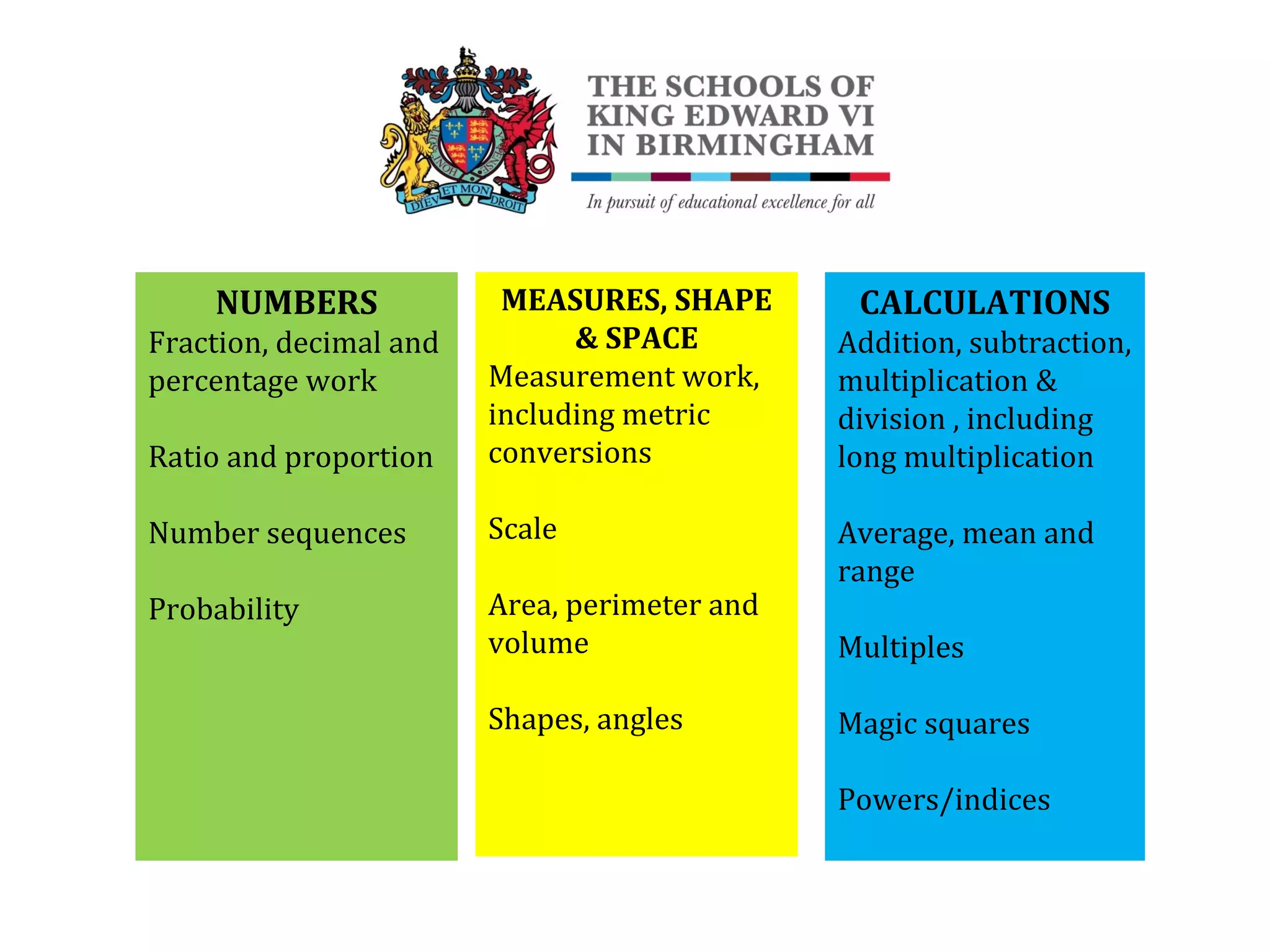
NUMBERS
Fraction, decimal and
percentage work
Ratio and proportion
Number sequences
Probability
MEASURES, SHAPE
& SPACE
Measurement work,
including metric
conversions
Scale
Area, perimeter and
volume
Shapes, angles
CALCULATIONS
Addition, subtraction,
multiplication &
division , including
long multiplication
Average, mean and
range
Multiples
Magic squares
Powers/indices
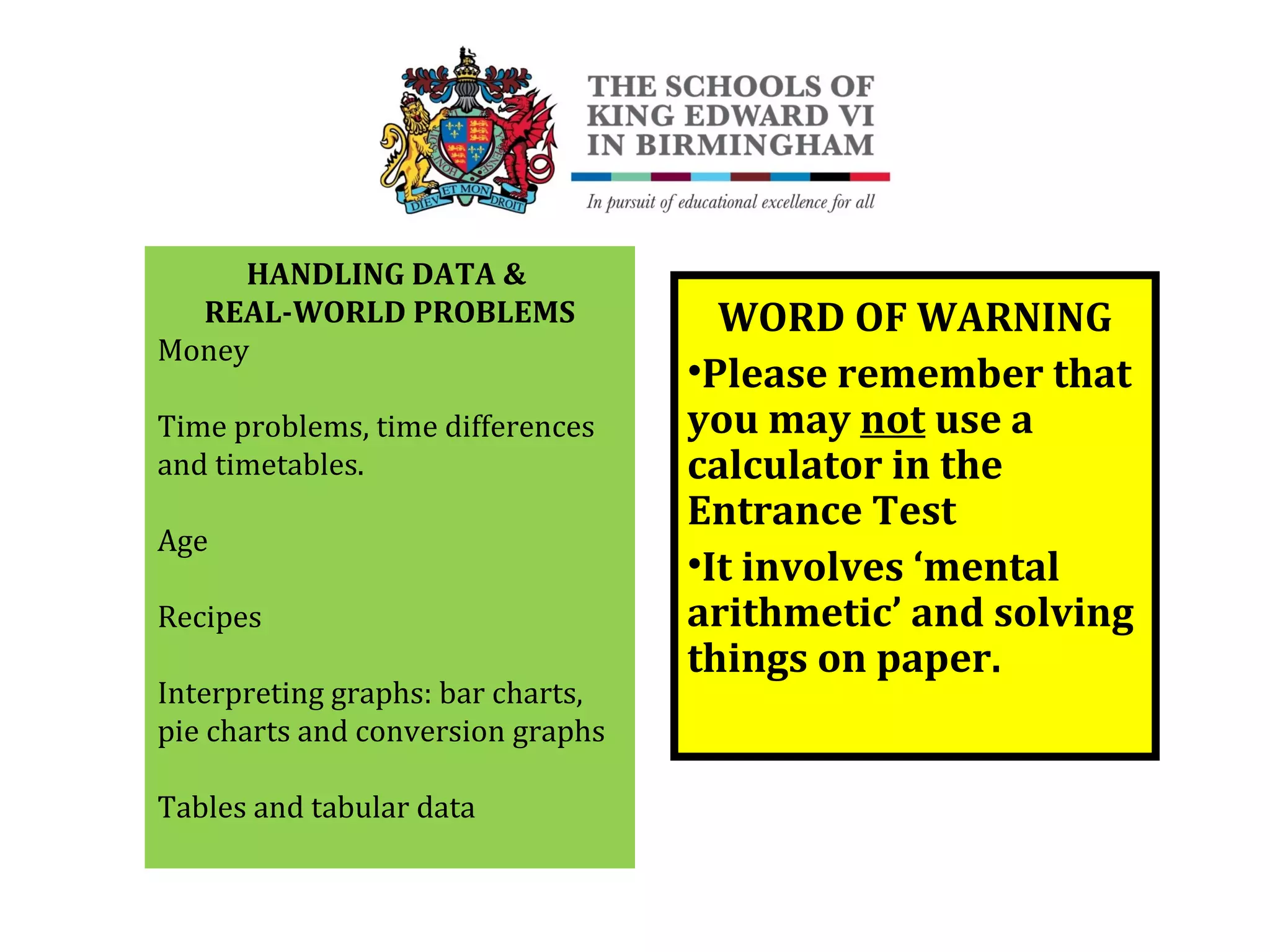
HANDLING DATA &
REAL-WORLD PROBLEMS
Money
Time problems, time differences
and timetables.
Age
Recipes
Interpreting graphs: bar charts,
pie charts and conversion graphs
Tables and tabular data
WORD OF WARNING
•Please remember that
you may not use a
calculator in the
Entrance Test
•It involves ‘mental
arithmetic’ and solving
things on paper.
Puzzles
OR NON-VERBAL REASONING
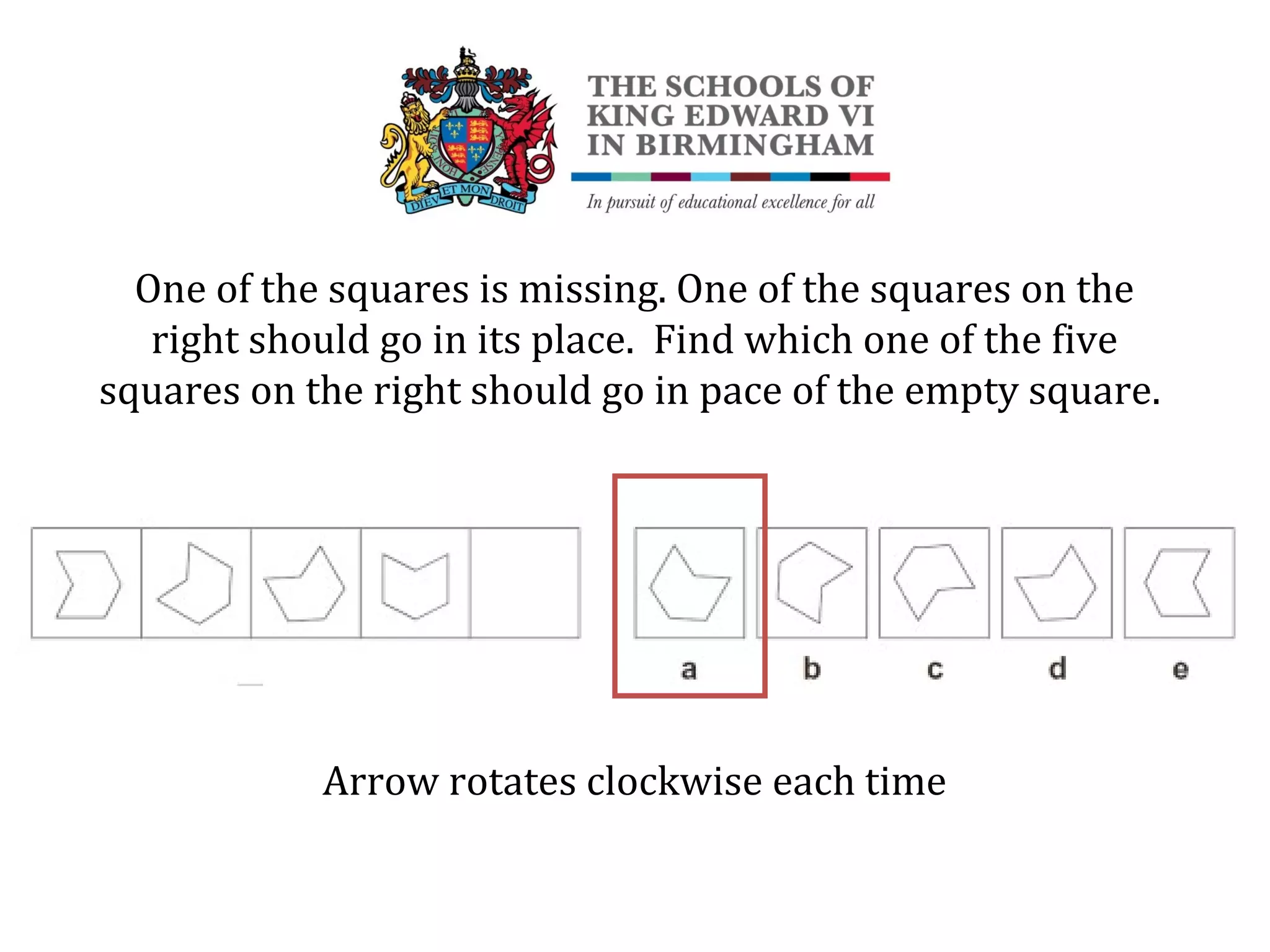
One of the squares is missing. One of the squares on the
right should go in its place. Find which one of the five
squares on the right should go in pace of the empty square.
Arrow rotates clockwise each time
ENGLISH AND VERBAL REASONING
The best way to prepare for English and Verbal
Reasoning questions is to:
1. Try answering a range of questions.
There are many books in WHSmith that will help with
this way of working and...
2. Read!
Reading is very important as it will increase the
number of words that you understand.
ENGLISH AND VERBAL REASONING
3. Practice doing comprehension exercises -
read a passage and answer questions on it
4. The questions will be based on topics you
learn in the national curriculum at levels 4 and 5.
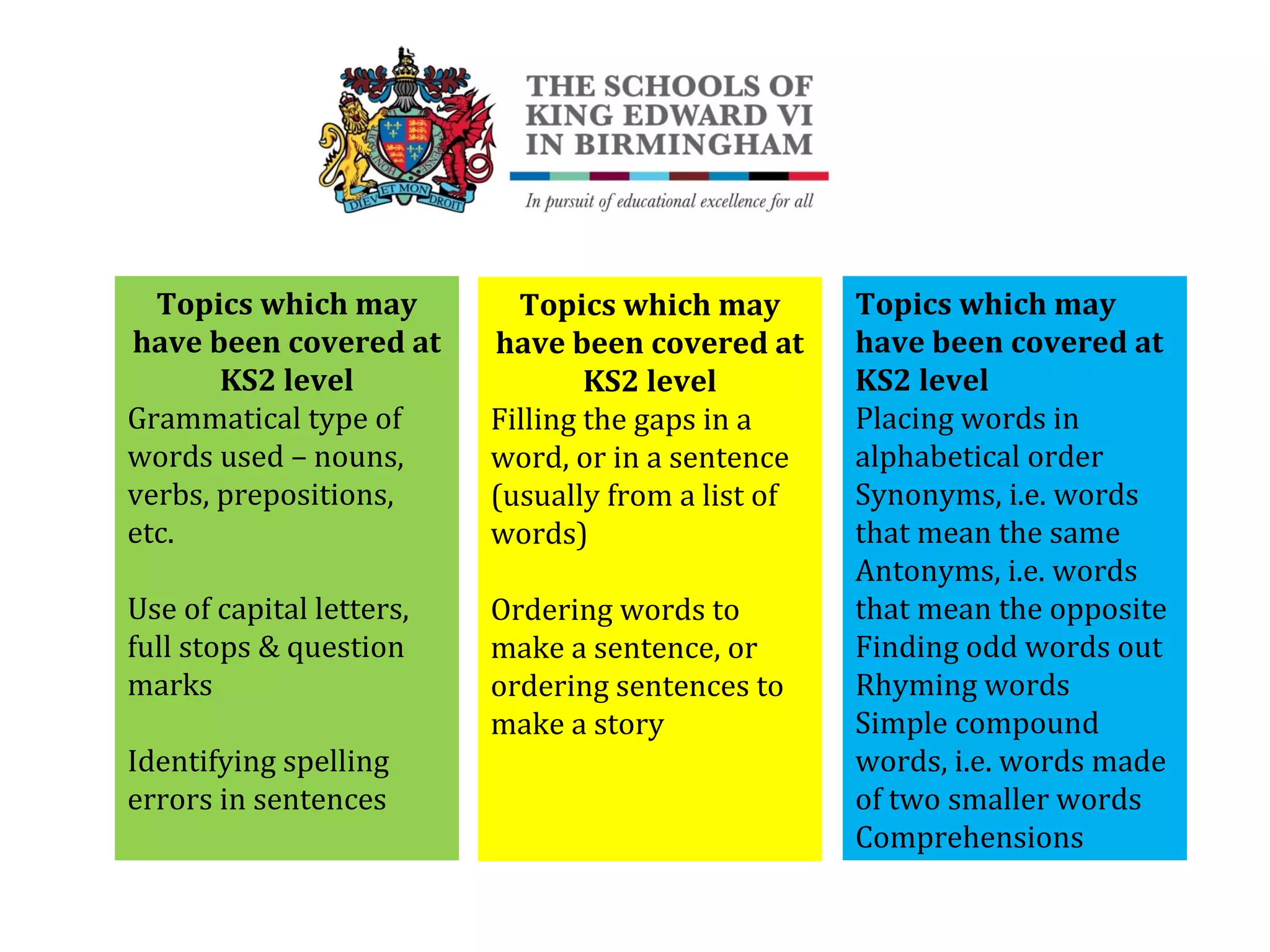
Topics which may
have been covered at
KS2 level
Grammatical type of
words used – nouns,
verbs, prepositions,
etc.
Use of capital letters,
full stops & question
marks
Identifying spelling
errors in sentences
Topics which may
have been covered at
KS2 level
Filling the gaps in a
word, or in a sentence
(usually from a list of
words)
Ordering words to
make a sentence, or
ordering sentences to
make a story
Topics which may
have been covered at
KS2 level
Placing words in
alphabetical order
Synonyms, i.e. words
that mean the same
Antonyms, i.e. words
that mean the opposite
Finding odd words out
Rhyming words
Simple compound
words, i.e. words made
of two smaller words
Comprehensions
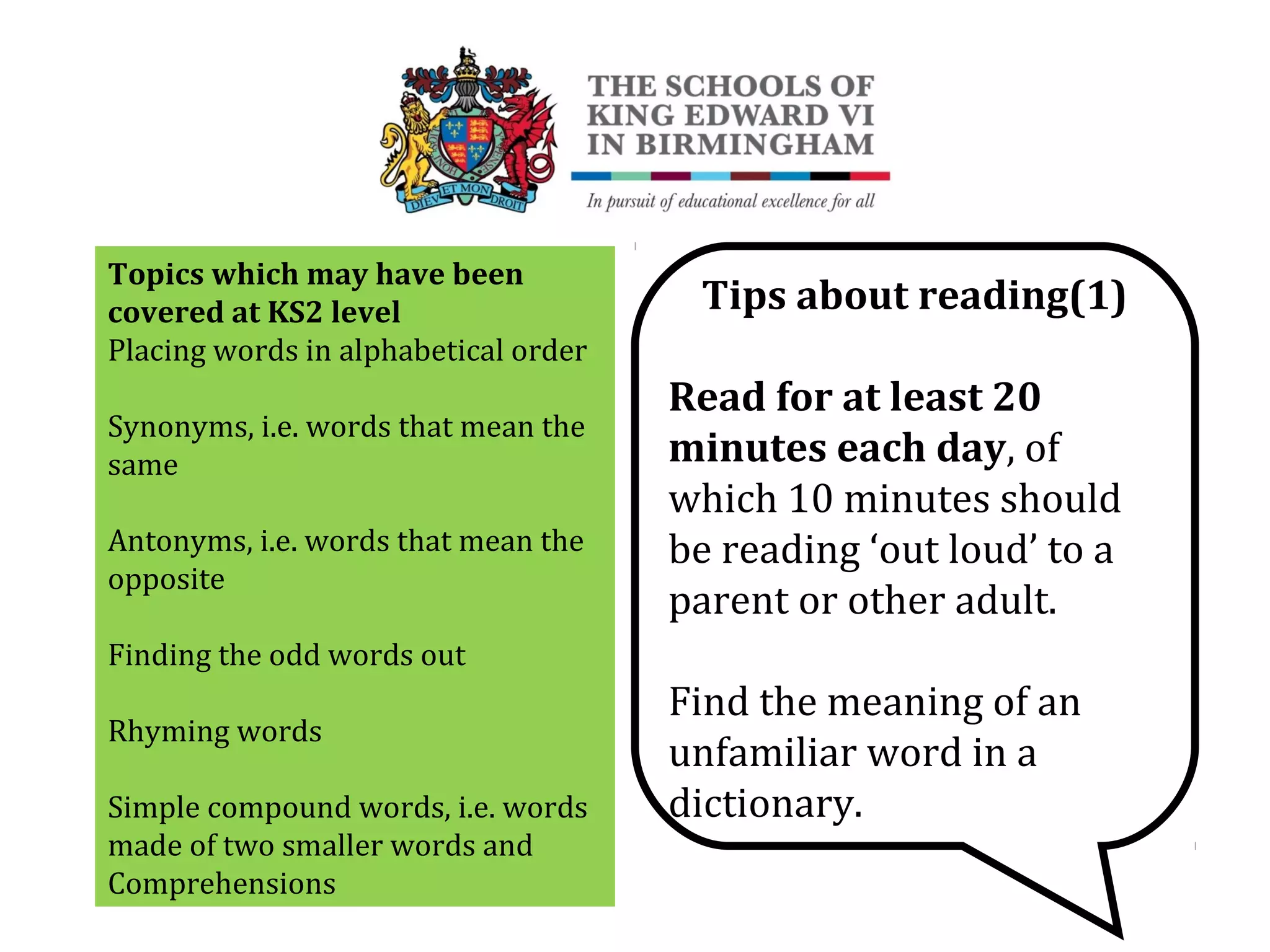
Topics which may have been
covered at KS2 level
Placing words in alphabetical order
Synonyms, i.e. words that mean the
same
Antonyms, i.e. words that mean the
opposite
Finding the odd words out
Rhyming words
Simple compound words, i.e. words
made of two smaller words and
Comprehensions
Tips about reading(1)
Read for at least 20
minutes each day, of
which 10 minutes should
be reading ‘out loud’ to a
parent or other adult.
Find the meaning of an
unfamiliar word in a
dictionary.
Some useful tips about reading (2)
What should you read?
Read books that you like and feel happy reading.
But, also please try to read a variety of FICTION AND NON-FICTION
BOOKS (like the ‘Horrible Histories’) and books by a variety of
authors. This all helps to widen your vocabulary
Read books from different eras, for example reading a book such
as a ‘Christmas Carol’ by Charles Dickens, ‘Carrie’s War’ by Nina
Bawden and ‘The Diary of a Young Girl’ by Anne Frank.
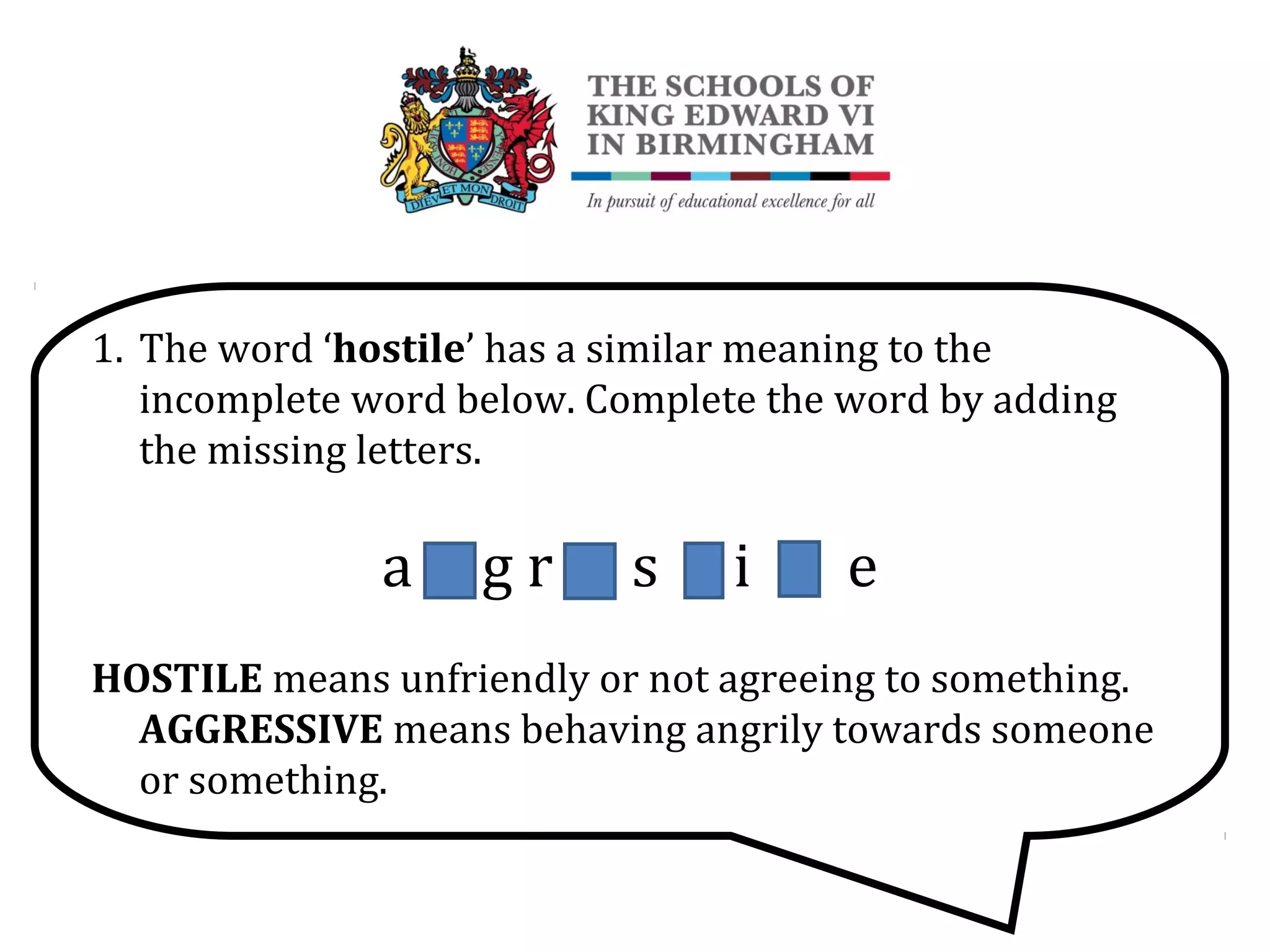
1. The word ‘hostile’ has a similar meaning to the
incomplete word below. Complete the word by adding
the missing letters.
a G g r E s S i V e
HOSTILE means unfriendly or not agreeing to something.
AGGRESSIVE means behaving angrily towards someone
or something.
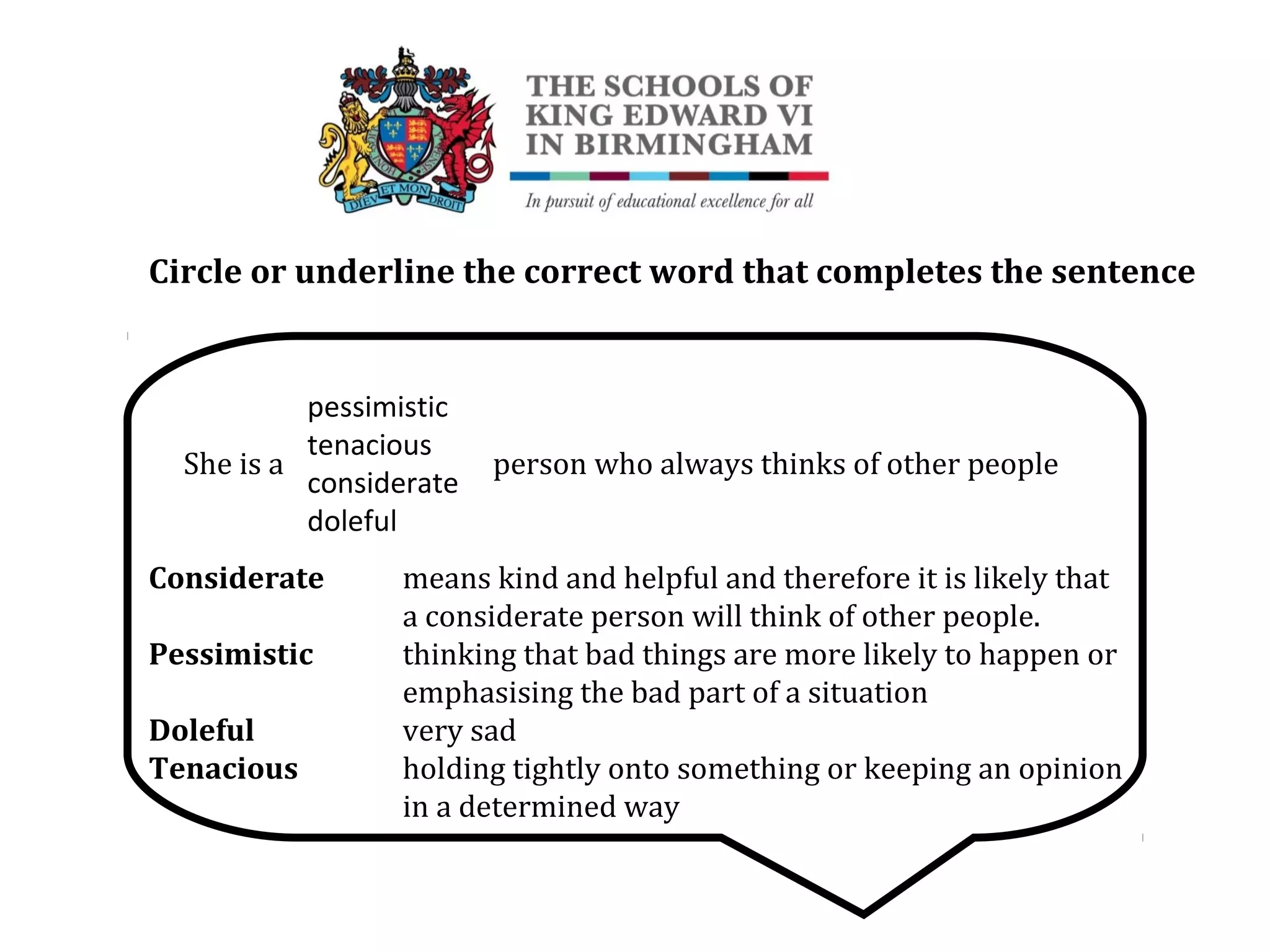
Circle or underline the correct word that completes the sentence
She is a person who always thinks of other people
Considerate means kind and helpful and therefore it is likely that
a considerate person will think of other people.
Pessimistic thinking that bad things are more likely to happen or
emphasising the bad part of a situation
Doleful very sad
Tenacious holding tightly onto something or keeping an opinion
in a determined way
pessimistic
tenacious
considerate
doleful
Carefully read through the passage of
writing, then answer the questions that
follow.
Mother’s Day probably has its origins in Greek or Roman
times. In more recent centuries, it has marked occasions
when servants were granted an afternoon off work to
visit their mothers. A commercial element has added a
contemporary twist to the tradition with the advent of
Mother’s Day cards.  
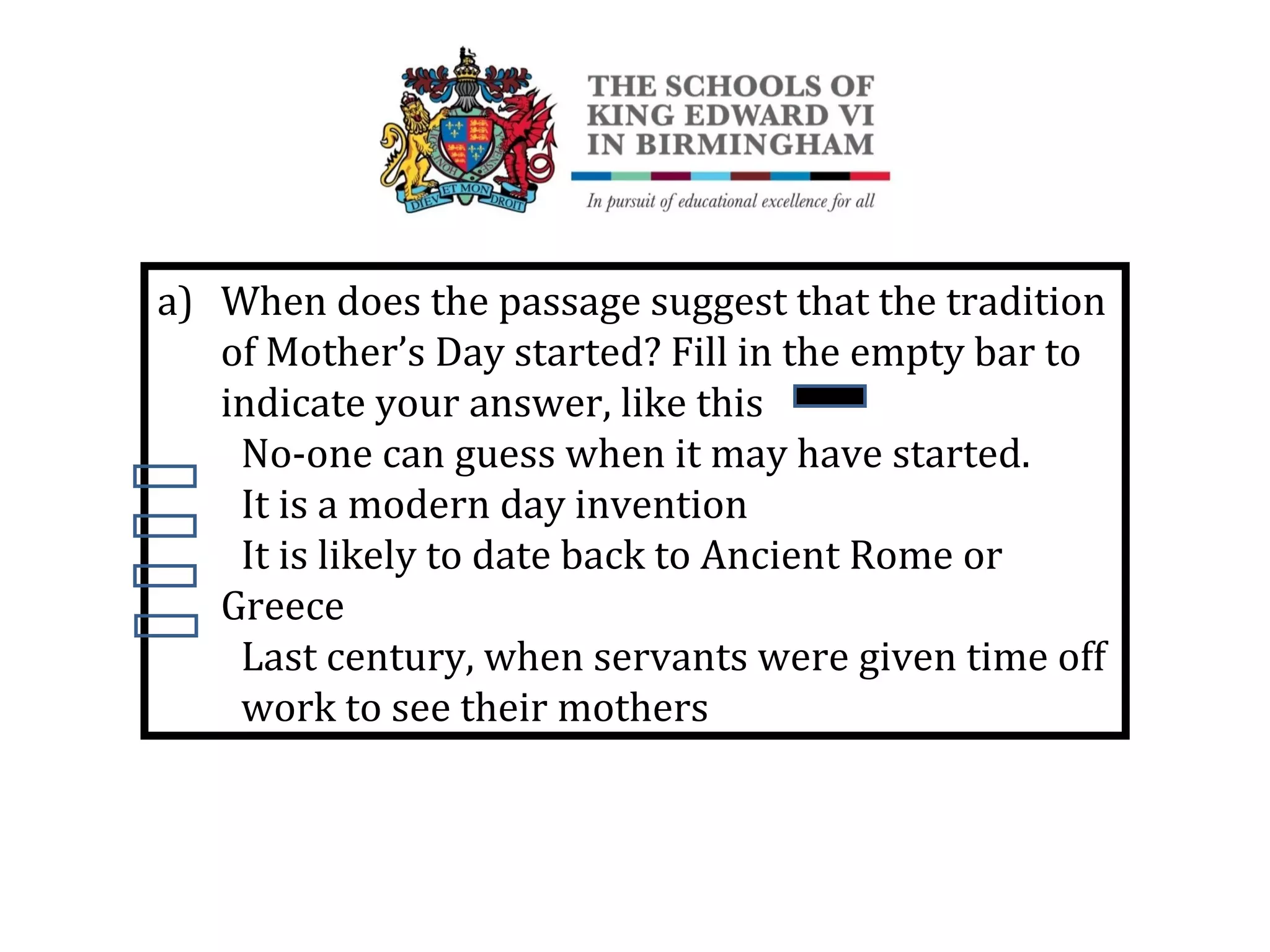
a) When does the passage suggest that the tradition
of Mother’s Day started? Fill in the empty bar to
indicate your answer, like this
No-one can guess when it may have started.
It is a modern day invention
It is likely to date back to Ancient Rome or
Greece
Last century, when servants were given time off
work to see their mothers
Carefully read through
the passage of writing,
then answer the
questions that follow.
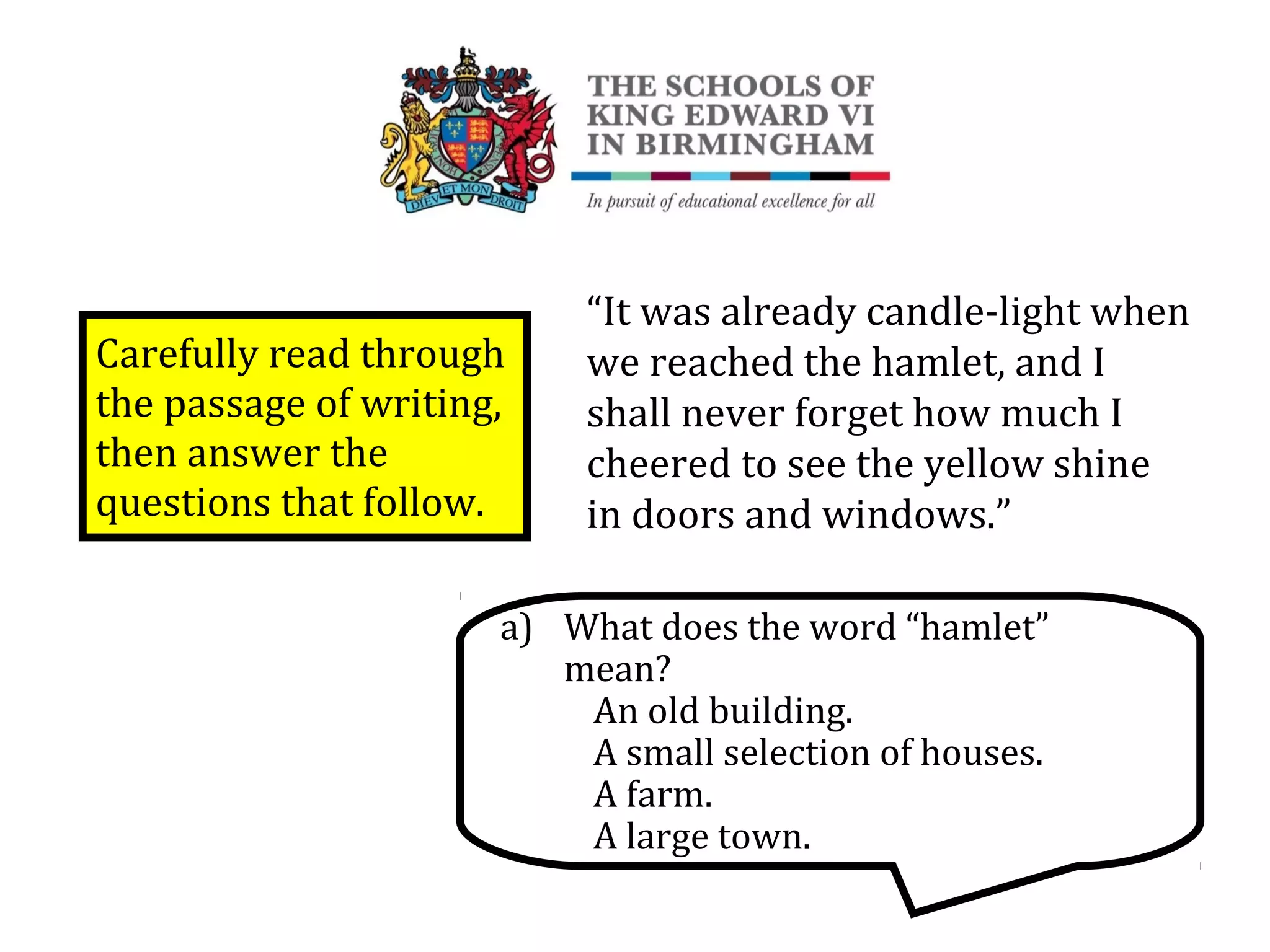
“It was already candle-light when
we reached the hamlet, and I
shall never forget how much I
cheered to see the yellow shine
in doors and windows.”
a) What does the word “hamlet”
mean?
An old building.
A small selection of houses.
A farm.
A large town.
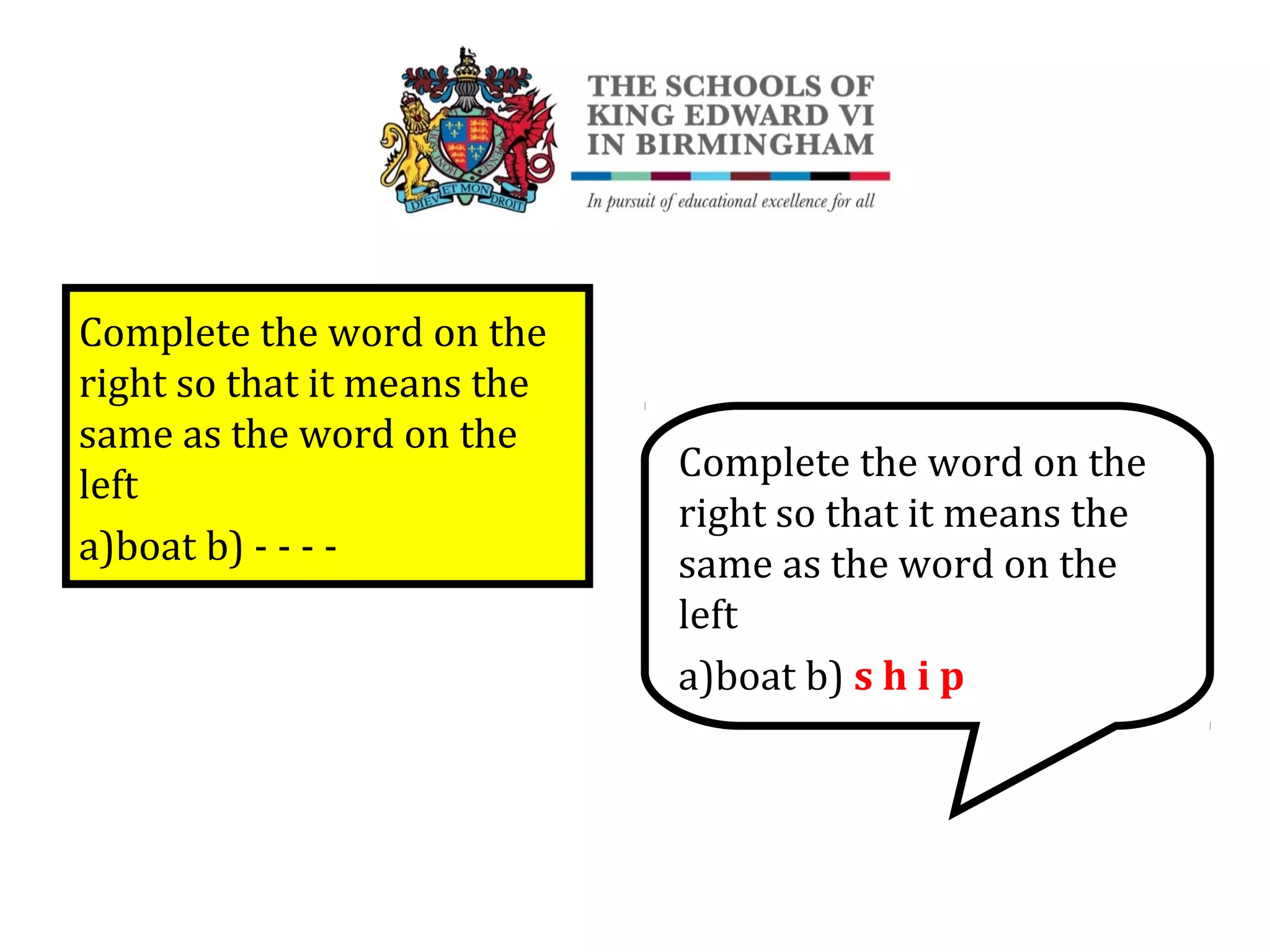
Complete the word on the
right so that it means the
same as the word on the
left
a)boat b) - - - -
Complete the word on the
right so that it means the
same as the word on the
left
a)boat b) s h i p
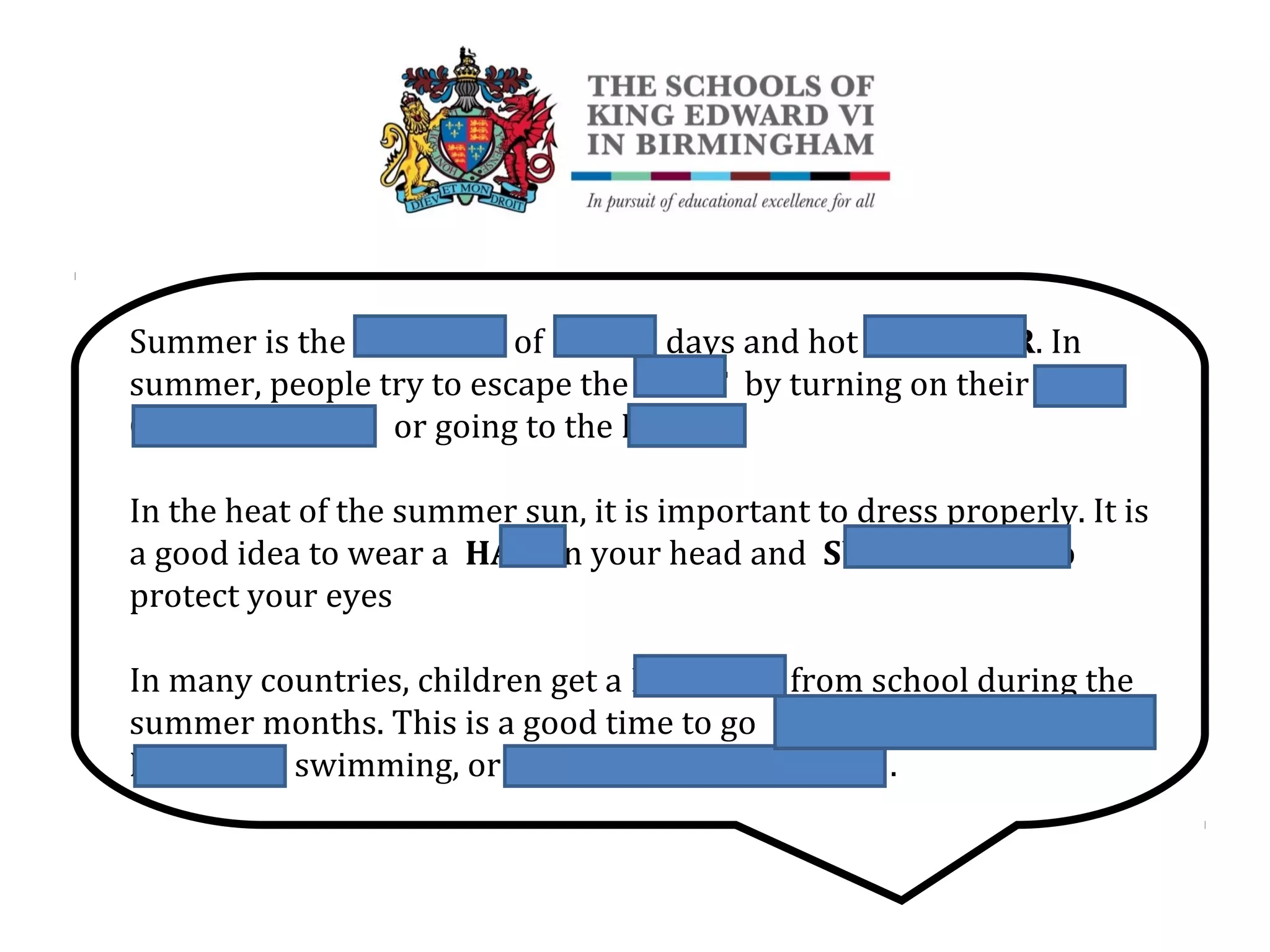
Summer is the SEASON of LONG days and hot WEATHER. In
summer, people try to escape the HEAT by turning on their AIR
CONDITIONING or going to the BEACH
In the heat of the summer sun, it is important to dress properly. It is
a good idea to wear a HAT on your head and SUNGLASSES to
protect your eyes
In many countries, children get a HOLIDAY from school during the
summer months. This is a good time to go CAMPING (OR
FISHING), swimming, or FISHING (OR CAMPING).
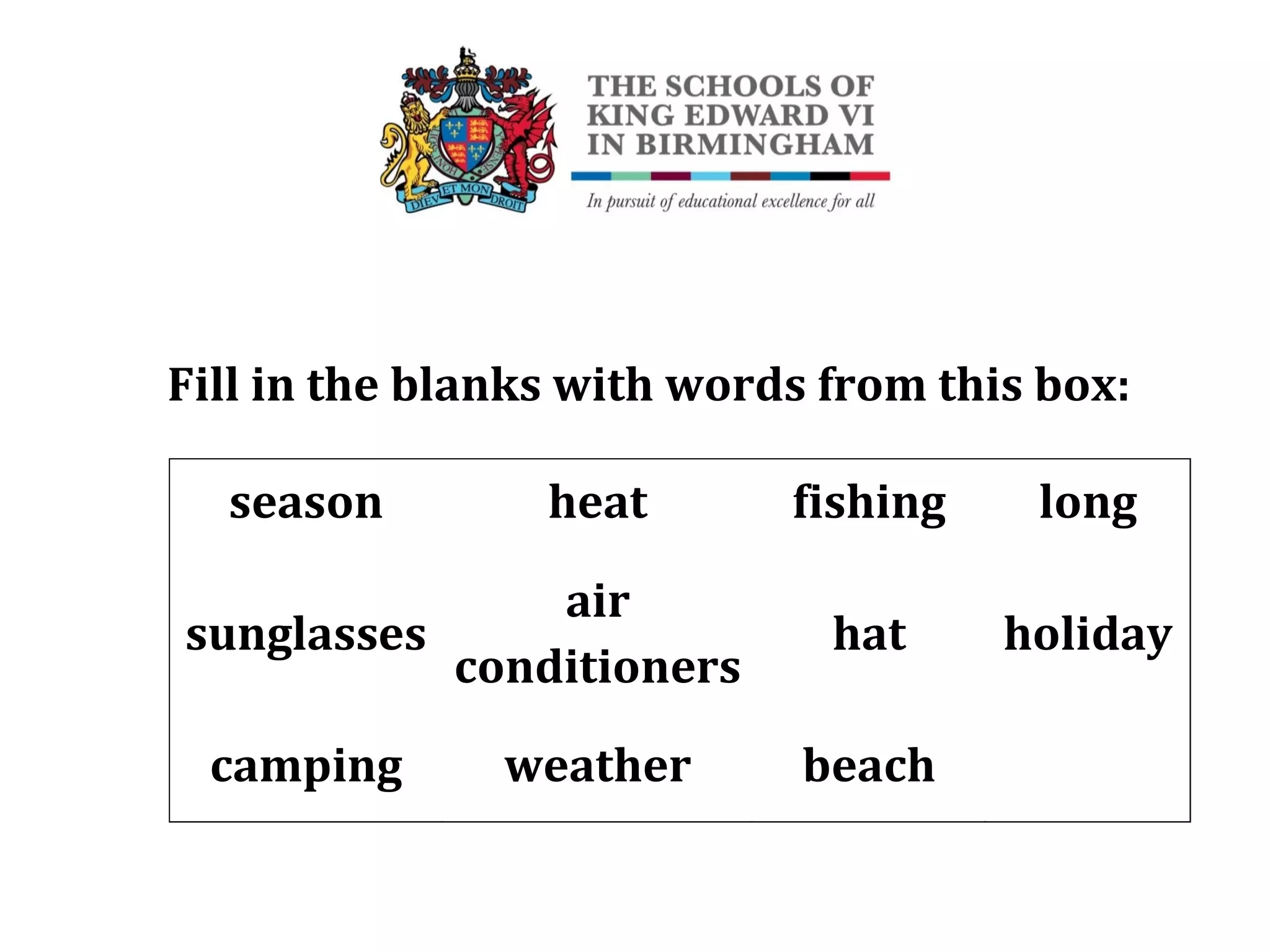
Fill in the blanks with words from this box:
season heat fishing long
sunglasses
air
conditioners
hat holiday
camping weather beach
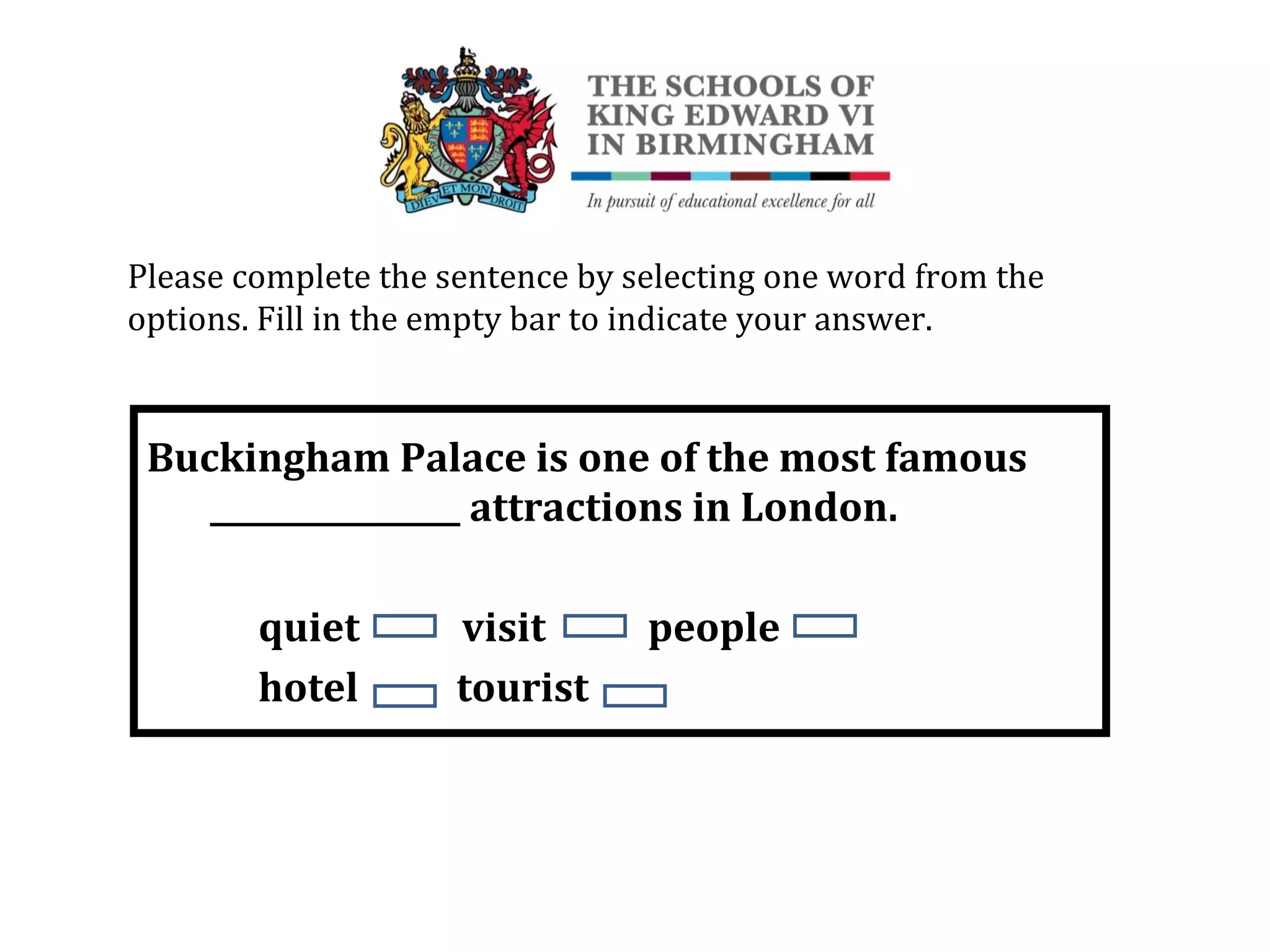
Buckingham Palace is one of the most famous
________________ attractions in London.
quiet visit people
hotel tourist
Please complete the sentence by selecting one word from the
options. Fill in the empty bar to indicate your answer.
After “familiarisation we hope that your
children will have the confidence and
that they will give you the confidence to
let them apply to sit the 11+ test.
“Thank you”

Parent presentation

  • 1.
    Presentation for parents ofPrimary School children 2015 by Denis Ramplin
  • 2.
    I am KingEdward VI. I was the only son of Henry VIII and was known as the “Boy King”. I founded my first school in Birmingham in 1552 – King Edward’s School
  • 3.
    We are nowa charity which supports 8 schools across the City. There are 3 types of schools and they are: 5 Free Grammar Schools 2 Independent Schools, which are fee paying and a Sponsored Academy.
  • 4.
    Our 2 IndependentSchools are: King Edward’s School (for Boys) and King Edward VI High School for Girls. Although they are fee paying they do offer free and assisted places for children who pass their test.
  • 5.
    Our five freeGrammar Schools are: King Edward VI Aston (for Boys), King Edward VI Camp Hill Boys, King Edward VI Camp Hill Girls, King Edward VI Five Ways (Mixed) and King Edward VI Handsworth School for Girls. Entrance to these schools is via a test (11+).
  • 6.
    Our sponsored Academyis: King Edward VI Sheldon Heath - The school serves its community and is a multi-ability school with Sixth Form which does not require its pupils to pass a test.
  • 7.
    Last year wepiloted a scheme where a selection of primary schools from across the City sent their able, gifted and talented pupils to spend 5 x 2 hour sessions at our grammar schools. Nearly 600 children took part.
  • 8.
    We called the scheme “Familiarisation” Wewanted the children to be familiar with our schools, their locations and... To find out information about the schools To be confident and happy about the application process And to learn about the 11+exam
  • 10.
    So what isa grammar school? • It is a selective school for able, gifted and talented children who have achieved a level of excellence in the 11+ test. • They are free.
  • 11.
    Working against theclock. An important part of taking the entrance test is being able to work against the clock. Work quickly - Work accurately and follow instructions
  • 12.
    Remember the timethat is allowed for each test 45 minutes for test 1 and 45 minutes for test 2. Work your way through the test – do not take too much time on any one question. If you cannot do a question, move on to the next one.
  • 13.
    YOU ARE THEMOST IMPORTANT PERSON IN THE ROOM! TRY YOUR VERY BEST. It is important for you to do well in the test to be offered a place. What is it like to sit the test? You will meet Boys (and girls) from our schools who have sat the test. Write down questions that you would like to ask them. Do this on a post it note.
  • 14.
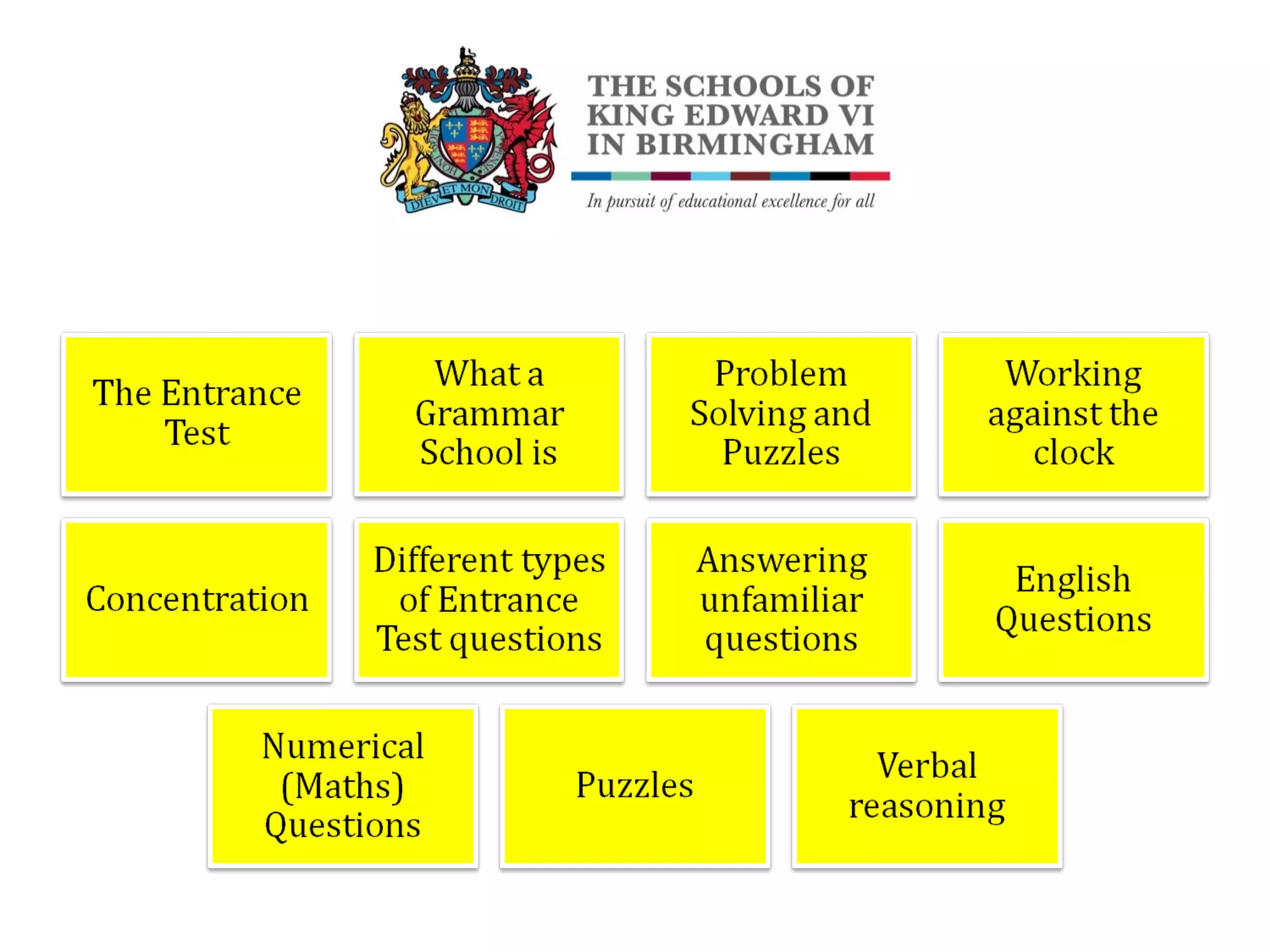
    What are thetypes of questions in the 11+ test?
  • 15.
    There are fourmain types of question which may be included in the test: 1. Questions which test English skills. 2. Questions which test numerical reasoning (Maths). 3. Questions which test puzzle solving (also called non-verbal reasoning) 4. Questions which test verbal reasoning.
  • 16.
    The questions inthe 11+ Entrance test will be based on topics that are taught in school. It is not easy to say exactly which topics will be included but, here are some ideas:
  • 17.
    NUMBERS Fraction, decimal and percentagework Ratio and proportion Number sequences Probability MEASURES, SHAPE & SPACE Measurement work, including metric conversions Scale Area, perimeter and volume Shapes, angles CALCULATIONS Addition, subtraction, multiplication & division , including long multiplication Average, mean and range Multiples Magic squares Powers/indices
  • 18.
    HANDLING DATA & REAL-WORLDPROBLEMS Money Time problems, time differences and timetables. Age Recipes Interpreting graphs: bar charts, pie charts and conversion graphs Tables and tabular data WORD OF WARNING •Please remember that you may not use a calculator in the Entrance Test •It involves ‘mental arithmetic’ and solving things on paper.
  • 19.
  • 20.
    One of thesquares is missing. One of the squares on the right should go in its place. Find which one of the five squares on the right should go in pace of the empty square. Arrow rotates clockwise each time
  • 21.
    ENGLISH AND VERBALREASONING The best way to prepare for English and Verbal Reasoning questions is to: 1. Try answering a range of questions. There are many books in WHSmith that will help with this way of working and... 2. Read! Reading is very important as it will increase the number of words that you understand.
  • 22.
    ENGLISH AND VERBALREASONING 3. Practice doing comprehension exercises - read a passage and answer questions on it 4. The questions will be based on topics you learn in the national curriculum at levels 4 and 5.
  • 23.
    Topics which may havebeen covered at KS2 level Grammatical type of words used – nouns, verbs, prepositions, etc. Use of capital letters, full stops & question marks Identifying spelling errors in sentences Topics which may have been covered at KS2 level Filling the gaps in a word, or in a sentence (usually from a list of words) Ordering words to make a sentence, or ordering sentences to make a story Topics which may have been covered at KS2 level Placing words in alphabetical order Synonyms, i.e. words that mean the same Antonyms, i.e. words that mean the opposite Finding odd words out Rhyming words Simple compound words, i.e. words made of two smaller words Comprehensions
  • 24.
    Topics which mayhave been covered at KS2 level Placing words in alphabetical order Synonyms, i.e. words that mean the same Antonyms, i.e. words that mean the opposite Finding the odd words out Rhyming words Simple compound words, i.e. words made of two smaller words and Comprehensions Tips about reading(1) Read for at least 20 minutes each day, of which 10 minutes should be reading ‘out loud’ to a parent or other adult. Find the meaning of an unfamiliar word in a dictionary.
  • 25.
    Some useful tipsabout reading (2) What should you read? Read books that you like and feel happy reading. But, also please try to read a variety of FICTION AND NON-FICTION BOOKS (like the ‘Horrible Histories’) and books by a variety of authors. This all helps to widen your vocabulary Read books from different eras, for example reading a book such as a ‘Christmas Carol’ by Charles Dickens, ‘Carrie’s War’ by Nina Bawden and ‘The Diary of a Young Girl’ by Anne Frank.
  • 26.
    1. The word‘hostile’ has a similar meaning to the incomplete word below. Complete the word by adding the missing letters. a G g r E s S i V e HOSTILE means unfriendly or not agreeing to something. AGGRESSIVE means behaving angrily towards someone or something.
  • 27.
    Circle or underlinethe correct word that completes the sentence She is a person who always thinks of other people Considerate means kind and helpful and therefore it is likely that a considerate person will think of other people. Pessimistic thinking that bad things are more likely to happen or emphasising the bad part of a situation Doleful very sad Tenacious holding tightly onto something or keeping an opinion in a determined way pessimistic tenacious considerate doleful
  • 28.
    Carefully read throughthe passage of writing, then answer the questions that follow. Mother’s Day probably has its origins in Greek or Roman times. In more recent centuries, it has marked occasions when servants were granted an afternoon off work to visit their mothers. A commercial element has added a contemporary twist to the tradition with the advent of Mother’s Day cards.  
  • 29.
    a) When doesthe passage suggest that the tradition of Mother’s Day started? Fill in the empty bar to indicate your answer, like this No-one can guess when it may have started. It is a modern day invention It is likely to date back to Ancient Rome or Greece Last century, when servants were given time off work to see their mothers
  • 30.
    Carefully read through thepassage of writing, then answer the questions that follow. “It was already candle-light when we reached the hamlet, and I shall never forget how much I cheered to see the yellow shine in doors and windows.” a) What does the word “hamlet” mean? An old building. A small selection of houses. A farm. A large town.
  • 31.
    Complete the wordon the right so that it means the same as the word on the left a)boat b) - - - - Complete the word on the right so that it means the same as the word on the left a)boat b) s h i p
  • 32.
    Summer is theSEASON of LONG days and hot WEATHER. In summer, people try to escape the HEAT by turning on their AIR CONDITIONING or going to the BEACH In the heat of the summer sun, it is important to dress properly. It is a good idea to wear a HAT on your head and SUNGLASSES to protect your eyes In many countries, children get a HOLIDAY from school during the summer months. This is a good time to go CAMPING (OR FISHING), swimming, or FISHING (OR CAMPING).
  • 33.
    Fill in theblanks with words from this box: season heat fishing long sunglasses air conditioners hat holiday camping weather beach
  • 34.
    Buckingham Palace isone of the most famous ________________ attractions in London. quiet visit people hotel tourist Please complete the sentence by selecting one word from the options. Fill in the empty bar to indicate your answer.
  • 35.
    After “familiarisation wehope that your children will have the confidence and that they will give you the confidence to let them apply to sit the 11+ test.
  • 36.