 People make and use resources. They are also considered as resources having
different quality.
 Population (total number of persons inhabiting a particular place like city, state,
country etc.) is the central element in social studies. It is the point of reference
from which all other elements are observed.
 Human beings are producers as well as consumers of the resources so
information about population of a country such as their size, distribution are
important.
 A census is an official enumeration of population done periodically. In India the
first census was held in the year 1872.
 The census of India provides us with information regarding the population of our
country. The data provided by the census cover below three major questions about
the population:
→ Population size and distribution
→ Population growth and processes of population change
→ Characteristics or qualities of the population
1.Population Size And Distribution: How
many people are there and where are they
located?
2.Population growth and process of population
change: How has the population grown and
changed through time?
3.Characterstics or qualities of the population
: What are there age,sex composition
,literacy level ,occupational structure and
health conditions?
•
1.India’s population size and distribution by
numbers:
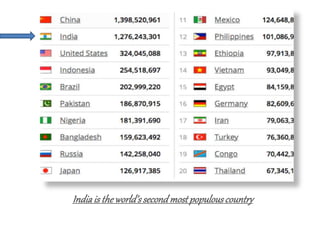
• As per March 2001, India’s population stood
at 1,028 million, which account for 16.7 percent
of the world’s population.
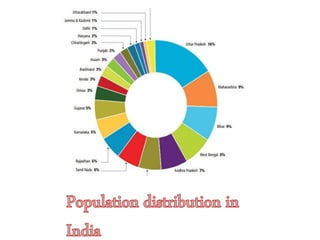
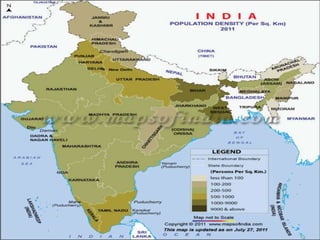
• According to the data, Uttar Pradesh is the most
populous state of India with a population size
of 166 million, which account for 16 percent of
total India's population.
• Sikkim's population - 0.5 million (5 lakhs) while
Lakshadweep has 60 thousand people.
• The five states Uttar Pradesh, Maharashtra,
Bihar, West Bengal, and Andhra Pradesh.
 Population Growth refers to the change in
the number of inhabitants of a country or
territory during a specific period of time, say
during the last ten years.
 The change can be expressed in two ways
→ in terms of absolute numbers
→ in terms of percentage change per year
 The absolute number is calculated by simply
subtracting the earlier population (e.g. that of
1991) from the later population (e.g. that of
2001). It is referred to as the absolute increase.
 The rate of population is studied in per cent per annum, e.g.
a rate of increase of 2 per cent per annum means that in a
given year, there was an increase of two persons for every
100 persons in the base population. This is referred to as
the annual growth rate.
 India’s population has been steadily increasing from 361
million in 1951 to 1028 million in 2001.
 Since 1981, however, the rate of growth started declining
gradually as birth rates declined rapidly. But India has a
very large population so when a low annual rate is applied
to a very large population, it yields a large absolute
increase.
 At this growth rate, India may overtake China in 2045 to
become the most populous country in the world.
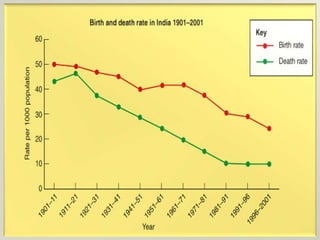
 There are three main processes of change of population : Birth Rates,
death rates and migration.
 Birth rate is the number of live births per thousand persons in a year.
In India, birth rates have always been higher than death rates.
 Death rate is the number of deaths per thousand persons in a year.
In India, there is rapid decline in death rates which is the main cause
of growth of the Indian population.
 Till 1980, high birth rates and declining death rates resulted in higher
rate of population growth but since 1981, birth rates have also started
declining gradually, resulting in a gradual decline in the rate of
population growth.
Migration is the movement of people across regions and territories.
This can be internal (within the country) or international (between
the countries).
Internal migration does not change the size of the population,
but changes the distribution of population within the nation.
 In India, most migrations have been from rural to urban areas
because of adverse conditions of poverty and unemployment
in the rural areas and increased employment opportunities
and better living conditions in city.
Effects of Migrations:
→ It changes the population size.
→ It also changes the population composition of urban and
rural populations in terms of age and sex composition.
 In India, the rural-urban migration has resulted in a steady
increase in the percentage of population in cities and towns.
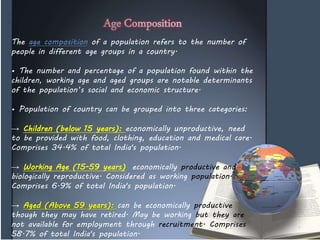
The age composition of a population refers to the number of
people in different age groups in a country.
• The number and percentage of a population found within the
children, working age and aged groups are notable determinants
of the population’s social and economic structure.
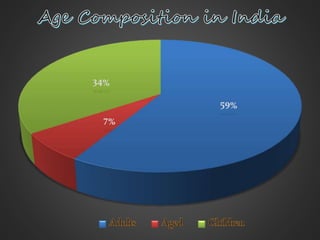
• Population of country can be grouped into three categories:
→ Children (below 15 years): economically unproductive, need
to be provided with food, clothing, education and medical care.
Comprises 34.4% of total India's population.
→ Working Age (15-59 years): economically productive and
biologically reproductive. Considered as working population.
Comprises 6.9% of total India's population.
→ Aged (Above 59 years): can be economically productive
though they may have retired. May be working but they are
not available for employment through recruitment. Comprises
58.7% of total India's population.
59%
7%
34%
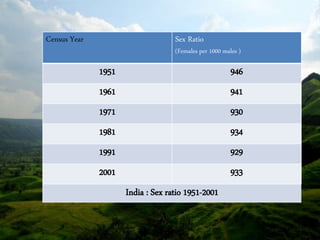
• Sex ratio is defined as the no. of females per 1000 males in
the population.
• This information is an important social indicator to
measure the extent of equality between males and females in
a society at a given time.
Census Year Sex Ratio
(Females per 1000 males )
1951 946
1961 941
1971 930
1981 934
1991 929
2001 933
India : Sex ratio 1951-2001
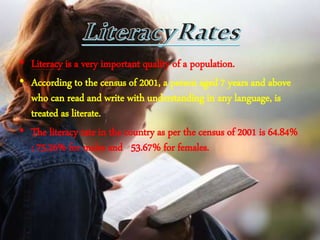
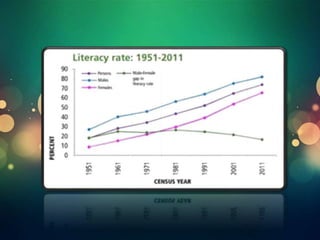
• Literacy is a very important quality of a population.
• According to the census of 2001, a person aged 7 years and above
who can read and write with understanding in any language, is
treated as literate.
• The literacy rate in the country as per the census of 2001 is 64.84%
; 75.26% for males and 53.67% for females.
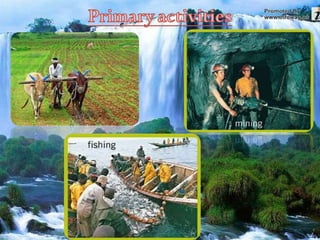
The distribution of the population according to different types of
occupation is referred to as the occupational structure.
Occupations are generally classified as :
1. Primary activities include agriculture, animal husbandry, forestry,
fishing, mining and quarrying, etc.
2. Secondary activities include manufacturing industry, building and
construction work, etc.
3. Tertiary activities include transport, communications, commerce,
administration and other services.
Developed nations have a high proportion of people in secondary, and
tertiary activities. Developing countries tend to have a higher
proportion of their workforce engaged in primary activities. In India,
India, about 64% of the population is engaged only in agriculture.
While the proportion of population dependent on secondary and
tertiary sectors is about 13% and 20% respectively.
Tertiary activities
Health
 Health is an important component of population composition, which affects
the process of development.
 Death rates have declined from 25/1000 population in 1951 to 8.1/1000 in
2001 and life expectancy at birth has increased from 36.7 years in 1951 to
64.6 years in 2001.
 In India the per capita calorie consumption is much below the recommended
levels.
 Safe drinking water & basic sanitation amenities are available to only 1/3rd of
the rural population.
Adolescent Population
National Population Policy
 Government of India initiated the comprehensive Family Planning
Programme in 1952.
 This programme has sought to promote responsible & planned
parenthood on a voluntary basis.
The NPP 2000 provides a policy framework for :
1. Imparting free & compulsory school
education up to 14 yrs of age.
2. Reducing infant mortality rate to below 30 per 1000
live births.
3. Achieving universal immunisation of children against
various diseases.
4. Promoting delayed marriage for girls.
NPP 2000 And Adolescents
ᵹ NPP 2000 identified adolescents as one of the major
sections of the population that need greater attention.
ᵹ The policy also puts greater emphasis on other imp.
Needs including protection from unwanted
pregnancies & sexually transmitted disease (STD).
Population ( class 9 )

Population ( class 9 )

  • 2.
     People makeand use resources. They are also considered as resources having different quality.  Population (total number of persons inhabiting a particular place like city, state, country etc.) is the central element in social studies. It is the point of reference from which all other elements are observed.  Human beings are producers as well as consumers of the resources so information about population of a country such as their size, distribution are important.  A census is an official enumeration of population done periodically. In India the first census was held in the year 1872.  The census of India provides us with information regarding the population of our country. The data provided by the census cover below three major questions about the population: → Population size and distribution → Population growth and processes of population change → Characteristics or qualities of the population
  • 3.
    1.Population Size AndDistribution: How many people are there and where are they located? 2.Population growth and process of population change: How has the population grown and changed through time? 3.Characterstics or qualities of the population : What are there age,sex composition ,literacy level ,occupational structure and health conditions?
  • 4.
    • 1.India’s population sizeand distribution by numbers: • As per March 2001, India’s population stood at 1,028 million, which account for 16.7 percent of the world’s population. • According to the data, Uttar Pradesh is the most populous state of India with a population size of 166 million, which account for 16 percent of total India's population. • Sikkim's population - 0.5 million (5 lakhs) while Lakshadweep has 60 thousand people. • The five states Uttar Pradesh, Maharashtra, Bihar, West Bengal, and Andhra Pradesh.
  • 8.
     Population Growthrefers to the change in the number of inhabitants of a country or territory during a specific period of time, say during the last ten years.  The change can be expressed in two ways → in terms of absolute numbers → in terms of percentage change per year  The absolute number is calculated by simply subtracting the earlier population (e.g. that of 1991) from the later population (e.g. that of 2001). It is referred to as the absolute increase.
  • 9.
     The rateof population is studied in per cent per annum, e.g. a rate of increase of 2 per cent per annum means that in a given year, there was an increase of two persons for every 100 persons in the base population. This is referred to as the annual growth rate.  India’s population has been steadily increasing from 361 million in 1951 to 1028 million in 2001.  Since 1981, however, the rate of growth started declining gradually as birth rates declined rapidly. But India has a very large population so when a low annual rate is applied to a very large population, it yields a large absolute increase.  At this growth rate, India may overtake China in 2045 to become the most populous country in the world.
  • 11.
     There arethree main processes of change of population : Birth Rates, death rates and migration.  Birth rate is the number of live births per thousand persons in a year. In India, birth rates have always been higher than death rates.  Death rate is the number of deaths per thousand persons in a year. In India, there is rapid decline in death rates which is the main cause of growth of the Indian population.  Till 1980, high birth rates and declining death rates resulted in higher rate of population growth but since 1981, birth rates have also started declining gradually, resulting in a gradual decline in the rate of population growth. Migration is the movement of people across regions and territories. This can be internal (within the country) or international (between the countries).
  • 12.
    Internal migration doesnot change the size of the population, but changes the distribution of population within the nation.  In India, most migrations have been from rural to urban areas because of adverse conditions of poverty and unemployment in the rural areas and increased employment opportunities and better living conditions in city. Effects of Migrations: → It changes the population size. → It also changes the population composition of urban and rural populations in terms of age and sex composition.  In India, the rural-urban migration has resulted in a steady increase in the percentage of population in cities and towns.
  • 14.
    The age compositionof a population refers to the number of people in different age groups in a country. • The number and percentage of a population found within the children, working age and aged groups are notable determinants of the population’s social and economic structure. • Population of country can be grouped into three categories: → Children (below 15 years): economically unproductive, need to be provided with food, clothing, education and medical care. Comprises 34.4% of total India's population. → Working Age (15-59 years): economically productive and biologically reproductive. Considered as working population. Comprises 6.9% of total India's population. → Aged (Above 59 years): can be economically productive though they may have retired. May be working but they are not available for employment through recruitment. Comprises 58.7% of total India's population.
  • 15.
  • 16.
    • Sex ratiois defined as the no. of females per 1000 males in the population. • This information is an important social indicator to measure the extent of equality between males and females in a society at a given time.
  • 17.
    Census Year SexRatio (Females per 1000 males ) 1951 946 1961 941 1971 930 1981 934 1991 929 2001 933 India : Sex ratio 1951-2001
  • 18.
    • Literacy isa very important quality of a population. • According to the census of 2001, a person aged 7 years and above who can read and write with understanding in any language, is treated as literate. • The literacy rate in the country as per the census of 2001 is 64.84% ; 75.26% for males and 53.67% for females.
  • 20.
    The distribution ofthe population according to different types of occupation is referred to as the occupational structure. Occupations are generally classified as : 1. Primary activities include agriculture, animal husbandry, forestry, fishing, mining and quarrying, etc. 2. Secondary activities include manufacturing industry, building and construction work, etc.
  • 21.
    3. Tertiary activitiesinclude transport, communications, commerce, administration and other services. Developed nations have a high proportion of people in secondary, and tertiary activities. Developing countries tend to have a higher proportion of their workforce engaged in primary activities. In India, India, about 64% of the population is engaged only in agriculture. While the proportion of population dependent on secondary and tertiary sectors is about 13% and 20% respectively.
  • 24.
  • 25.
    Health  Health isan important component of population composition, which affects the process of development.  Death rates have declined from 25/1000 population in 1951 to 8.1/1000 in 2001 and life expectancy at birth has increased from 36.7 years in 1951 to 64.6 years in 2001.  In India the per capita calorie consumption is much below the recommended levels.  Safe drinking water & basic sanitation amenities are available to only 1/3rd of the rural population.
  • 26.
  • 27.
    National Population Policy Government of India initiated the comprehensive Family Planning Programme in 1952.  This programme has sought to promote responsible & planned parenthood on a voluntary basis. The NPP 2000 provides a policy framework for :
  • 28.
    1. Imparting free& compulsory school education up to 14 yrs of age. 2. Reducing infant mortality rate to below 30 per 1000 live births. 3. Achieving universal immunisation of children against various diseases. 4. Promoting delayed marriage for girls.
  • 29.
    NPP 2000 AndAdolescents ᵹ NPP 2000 identified adolescents as one of the major sections of the population that need greater attention. ᵹ The policy also puts greater emphasis on other imp. Needs including protection from unwanted pregnancies & sexually transmitted disease (STD).