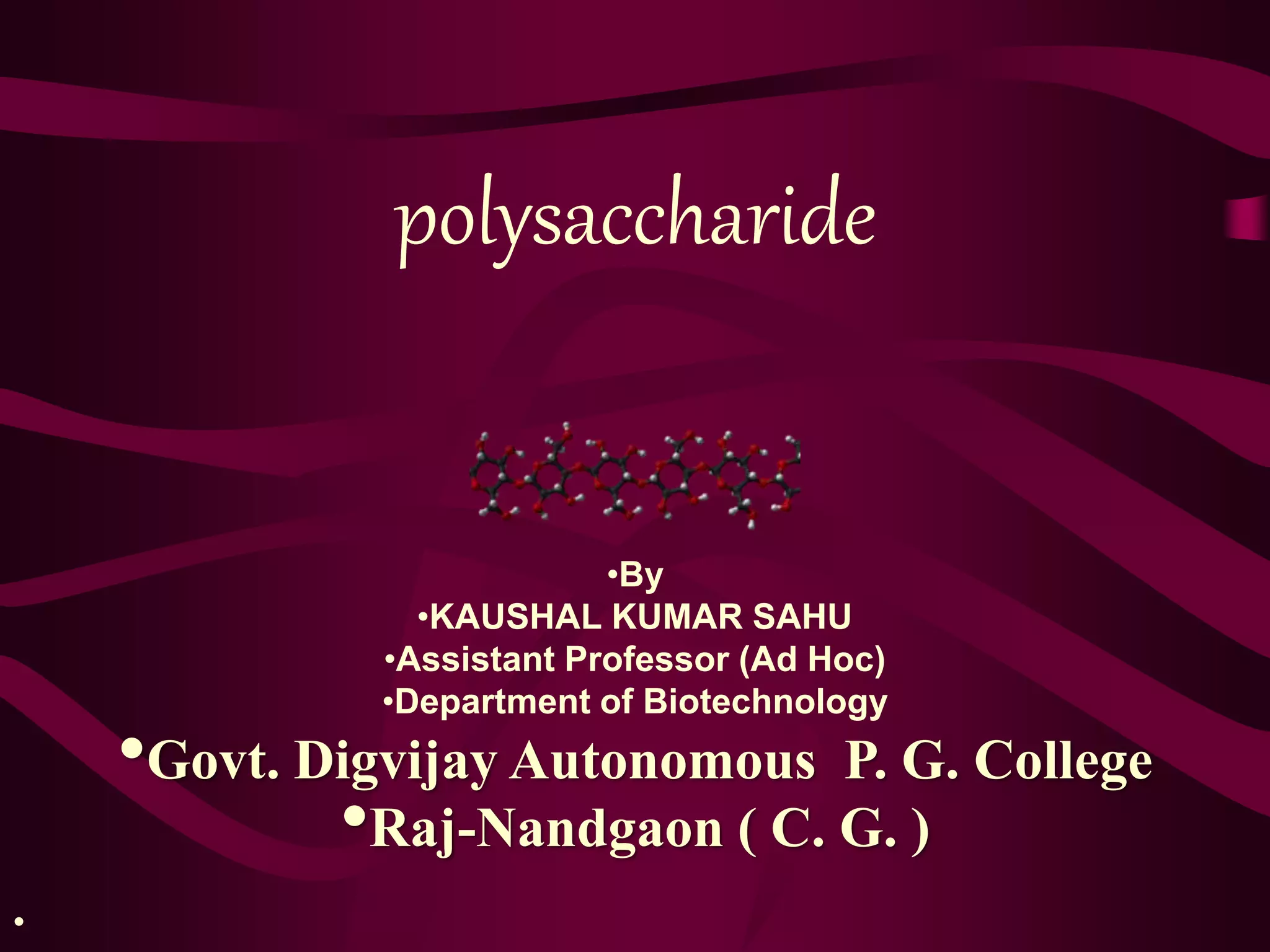
polysaccharide
•By
•KAUSHAL KUMAR SAHU
•Assistant Professor (Ad Hoc)
•Department of Biotechnology
•Govt. Digvijay Autonomous P. G. College
•Raj-Nandgaon ( C. G. )
•
Solubility
Source
Classification
Important polysaccharide
Starch
Glycogen
Cellulose
Xantham
Pectin
Agar
Introduction
Inulin
Chitin
Function of polysaccharide
Conclusion
Introduction
Carbohydrates are the major type of Fuel molecules that chiefly help in
supplying the energy to the living cells. these are the polyhydroxy
aldehyde's or ketones or there derivatives.Carbohydrates are also called
as "Saccharides", as the lower members of these are highly sweet to
taste. Based on the chemical composition the carbohydrates are divided
in to three types as follows;
1.Mono saccharides--These are simplest sugars which can not be further
hydrolyzed. EX-- Glucose, galactose, mannose.
2.Oligosaccharides-- These on hydrolysis yield 2 to 10 mono saccharides .
Depending on the number of hydrolytic products resulted the oligo saccharides are
further divided in to Di, Tri, Tetra. etc.. Ex-- Lactose(Glucose+galactose),
Sucrose(Glucose+Fructose).
3.Polysaccharidesare complex carbohydrates made up of multiplemonosaccharides
combined with other structures. Polysaccharides are sometimes called glycans because
the monosaccharides are joined together with glycosidic linkages. These molecules tend
to be very large and are often branched; most are insoluble in water and amorphous.
solubility
•Strong interaction with water = solubility
•Strong, extended interaction with polymer = insolubility
•Local, limited interaction with polymer = gelation
Cross links – covalent, ion pairing
Sources of Polysaccharide
•Higher plants
–seeds,
–tree extrudates,
–marine plants,
•Microbial fermentation
Chemical modification of other polymers
Classification
Polysaccharides are classified on two criteria namely; Based on
chemical composition
Homoplysaccharides- They are made up of single type of mono
saccharides.Ex- Glycogen, Starch, Cellulose. all made up of Glucose
molecules.
Heteropolysaccharides- They are composed of more than one type of
monosaccharide, Ex- Chondroitin sulphate, Hyaluronic acid, Keratan sulfate,
Dermatan sulfate.
Based on the functionality the polysaccharides are classified in to two types
viz,,
Storage polysaccharides-Which help-s in storing food materials in
plants(Ex-starch) and animals(Ex-Glycogen)
Structural polysaccharides-These helps in maintaining mechanical
shape and rigidity of the living cell in plants(Ex cellulose
Starch
•Starch-- It is found in plants like millet's, Tubers of potato,
tomato.
• It is made up of Two major components namely: (a). Amy
lose- water soluble fraction, constitutes about 20%.
• It is linear polymer with high molecular weight in the range of
1,50,000-6,00,000 Dalton.
• Amy lose is made up of α1→4 linked glucose molecules. It
produces deep blue color with iodine. Amylose on hydrolysis
by the enzyme Amylase Yields Glucose and maltose.
• (b). Amylopectin- It is the water insoluble fraction which
constitutes about 80%
•
•.It is a branched chain polysaccharide With α1→4 linkage
andα1→6 branching , which is very rare and occurs at every
24-30 glucose units. Amylopectin on partial hydrolysis yields
Glucose, Maltose, Isomaltose.
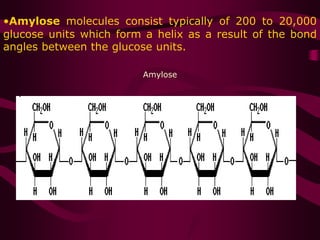
•Amylose molecules consist typically of 200 to 20,000
glucose units which form a helix as a result of the bond
angles between the glucose units.
Amylose
•
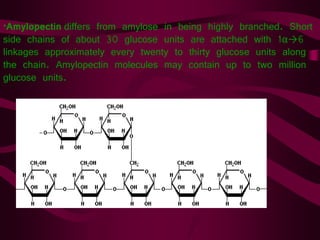
•Amylopectin differs from amylose in being highly branched. Short
side chains of about 30 glucose units are attached with 1α→6
linkages approximately every twenty to thirty glucose units along
the chain. Amylopectin molecules may contain up to two million
glucose units.
Glycogen
•Glycogen- It is the Storage polysaccharide found in animal
tissues like liver and Muscle
•, hence it is commonly known as "Animal starch“
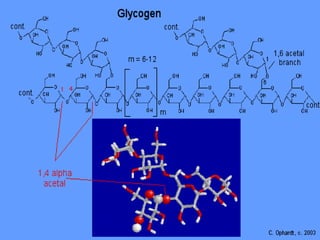
•. It is structurally similar to that of Amylopectin of starch,
except the difference being frequency of branching
•,In glycogen the branching occurs at every 8-10 glucose units.
•It produces red color with Iodine.
Glycogen
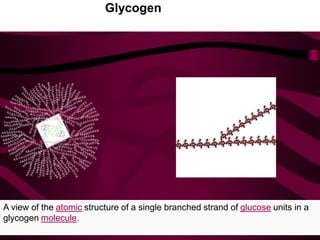
A view of the atomic structure of a single branched strand of glucose units in a
glycogen molecule.
Cellulose
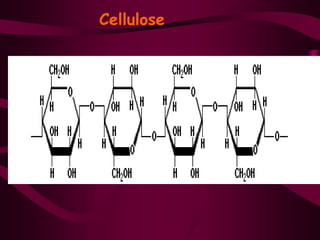
•Cellulose- It is the major Structural polysaccharide found
in plant cell wall.
• It is a linear polymer made up of β 1→4 linked glucose
molecules
•, which on hydrolysis by the enzyme Cellulase, yields Glucose
and Cellobiose.
• Cellulose can not be used as a source of energy by humans
as their digestive system lacks the enzyme Cellulase,
• While the Ruminants have this enzyme in there gut hence
they can utilize the cellulose as source of food.
Cellulose
•
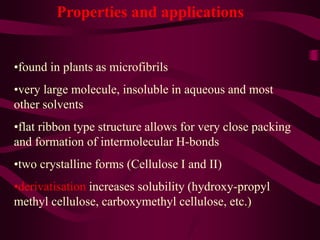
Properties and applications
•found in plants as microfibrils
•very large molecule, insoluble in aqueous and most
other solvents
•flat ribbon type structure allows for very close packing
and formation of intermolecular H-bonds
•two crystalline forms (Cellulose I and II)
•derivatisation increases solubility (hydroxy-propyl
methyl cellulose, carboxymethyl cellulose, etc.)
Xanthan
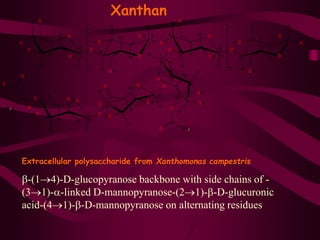
Extracellular polysaccharide from Xanthomonas campestris
b-(14)-D-glucopyranose backbone with side chains of -
(31)-a-linked D-mannopyranose-(21)-b-D-glucuronic
acid-(41)-b-D-mannopyranose on alternating residues
Properties and applications
double helical conformation
•thickener
•stabilizer
•emulsifier
•foaming agent
. Pectin
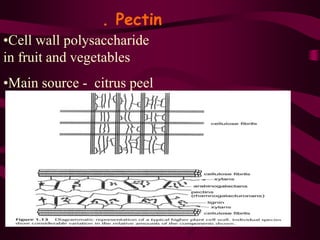
•Cell wall polysaccharide
in fruit and vegetables
•Main source - citrus peel
•Pectin is the methylated ester of
polygalacturonic acid, which consists of chains of
300 to 1000 galacturonic acid units joined with
1α→4 linkages. Pectin is an important ingredient
of fruit preserves, jellies, and jams.
•
•
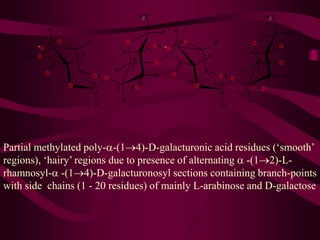
Pectin is a polymer of α-Galacturonic acid with a
variable number of methyl ester groups.
Partial methylated poly-a-(14)-D-galacturonic acid residues (‘smooth’
regions), ‘hairy’ regions due to presence of alternating a -(12)-L-
rhamnosyl-a -(14)-D-galacturonosyl sections containing branch-points
with side chains (1 - 20 residues) of mainly L-arabinose and D-galactose
Agar
. Agar or agar-agar is a gelatinous substance derived
from a polysaccharide
Used as a solid substrate to contain culture
medium for microbiological work.
Agar is an unbranched polysaccharide obtained from the
cell walls of some species of red algae, primarily from
the genera Gelidium and Gracilaria,
or seaweed (Sphaerococcus euchema). For commercial
purposes, it is derived primarily from Gelidium amansii.
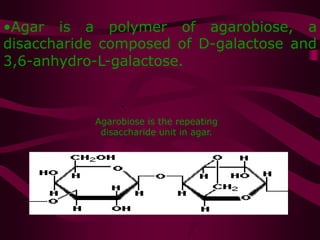
•Agar is a polymer of agarobiose, a
disaccharide composed of D-galactose and
3,6-anhydro-L-galactose.
•
Agarobiose is the repeating
disaccharide unit in agar.
Agar (agar-agar) can be used as a laxative,
a vegetarian gelatin substitute, a thickener for soups,
in jellies, ice cream, and other desserts, as a clarifying
agent in brewing, and for sizing paper and fabrics
.
In chemical terms, agar is a polymer made up of
subunits of the sugar galactose. Agar polysaccharides
serve as the primary structural support for the algae's
cell walls.
Agar exhibits , melting at 85 °C (358 K, 185 °F) and
solidifying from 32-40 °C (305-313 K, 90-104 °F)
This property lends a suitable balance between easy
melting and good gel stability at relatively high
temperatures.
Since many scientific applications require incubation at
temperatures close to human body temperature (37 °C),
agar is more appropriate than other solidifying agents
that melt at this temperature, such as gelatin.
Properties
Inulin
Inulins are a group of naturally
occurring polysaccharides
produced by many types of plants
They belong to a class of fibersknown as fructans.
Inulin is used by some plants as a means of storing
energy
and is typically found in roots or rhizomes.
Most plants that synthesize and store inulin do not store
other materials such as starch.
Uses
It can be used to replace sugar, fat, and flour.
This is advantageous because inulin contains 25-35% of the food
energy of carbohydrates (starch, sugar).
[
. it considered suitable for diabetics
It is also used for rehydration and remineralization following
important loss of water, like diarrhea
Biochemistry
Inulins are polymers composed mainly of fructose units,
and typically have a terminal glucose.
The fructose units in inulins are joined by a β(2→1) glycosidic
bond
. In general, plant inulins contain between 20 and several
thousand fructose units.
Smaller compounds are called fructooligosaccharides,
Chitin
•
•. It is a linear polymer of β1→4 linked N-acetyl
glucosamine. It is acted up on by the enzyme
Chitinase.
•Chitin(C5H13O5N)n--It is a Structural Polysaccharide
•It is found in fungi and is the principal
component of arthropod and lower animal
exoskeletons, e.g., insect, crab, and shrimp
shells.
STRUCTURE
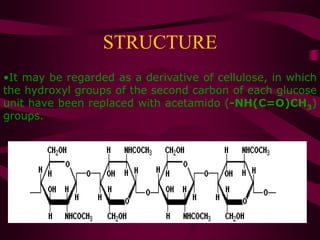
•It may be regarded as a derivative of cellulose, in which
the hydroxyl groups of the second carbon of each glucose
unit have been replaced with acetamido (-NH(C=O)CH3)
groups.
•
Chitin
Function of polysaccharide
Polysaccharides are common sources of energy
. Many organisms can easily break down starches into glucose,
however, most organisms cannot metabolize cellulose or other
polysaccharides like chitin and arabinoxylans.
These carbohydrates types can be metabolized by some bacteria
and protists. Ruminants and termites, for example, use
microorganisms to process cellulose.
Even though these complex carbohydrates are not very digestible,
they may comprise important dietary elements for humans.
Called dietary fiber, these carbohydrates enhance digestion
among other benefits.
Advantages
Amylopectin
Polysaccharides can also act as an anticoagulant. It
reduces the stickiness of platelets making it harder for
them to build up in artery walls. It (they) have anti-
thrombotic effects and blood lipids are reduced.
Polysaccharides help to regulate immune function with T
and B lymphocyte activation. It promotes Interferon, a
white cell medium and tumor necrosis (death).
Tea polysaccharides have the following effects. They
lower blood pressure and increase coronary artery
capacity. Blood sugar levels are reduced which is a
benefit in treating Diabetics. There is improved Beta cell
function in the pancreas, as well as anti-diabetic
properties. Anti-radiation effects may be noted, and free
radicals can be all but eliminated. There is anti-viral
activity, and it improves blood reproduction and
maintenance.
Benefits of Polysaccharides
Conclusion
•.Polysaccharides are complex carbohydrates made up
of multiplemonosaccharides combined with other
structures. Polysaccharides are sometimes called
glycans because the monosaccharides are joined
together with glycosidic linkages.
Polysaccharides help to regulate immune function with T
and B lymphocyte activation. It promotes Interferon, a
white cell medium and tumor necrosis (death).
There is anti-viral activity, and it improves blood
reproduction and maintenance.
References
Nelson &cox 5th edition
Albert lehninger 2th editio
Lubert stryer 6th edition
Internet source

Polysaccharide by kk sahu sir

  • 1.
    polysaccharide •By •KAUSHAL KUMAR SAHU •AssistantProfessor (Ad Hoc) •Department of Biotechnology •Govt. Digvijay Autonomous P. G. College •Raj-Nandgaon ( C. G. ) •
  • 2.
  • 3.
    Introduction Carbohydrates are themajor type of Fuel molecules that chiefly help in supplying the energy to the living cells. these are the polyhydroxy aldehyde's or ketones or there derivatives.Carbohydrates are also called as "Saccharides", as the lower members of these are highly sweet to taste. Based on the chemical composition the carbohydrates are divided in to three types as follows; 1.Mono saccharides--These are simplest sugars which can not be further hydrolyzed. EX-- Glucose, galactose, mannose. 2.Oligosaccharides-- These on hydrolysis yield 2 to 10 mono saccharides . Depending on the number of hydrolytic products resulted the oligo saccharides are further divided in to Di, Tri, Tetra. etc.. Ex-- Lactose(Glucose+galactose), Sucrose(Glucose+Fructose). 3.Polysaccharidesare complex carbohydrates made up of multiplemonosaccharides combined with other structures. Polysaccharides are sometimes called glycans because the monosaccharides are joined together with glycosidic linkages. These molecules tend to be very large and are often branched; most are insoluble in water and amorphous.
  • 4.
    solubility •Strong interaction withwater = solubility •Strong, extended interaction with polymer = insolubility •Local, limited interaction with polymer = gelation Cross links – covalent, ion pairing Sources of Polysaccharide •Higher plants –seeds, –tree extrudates, –marine plants, •Microbial fermentation Chemical modification of other polymers
  • 5.
    Classification Polysaccharides are classifiedon two criteria namely; Based on chemical composition Homoplysaccharides- They are made up of single type of mono saccharides.Ex- Glycogen, Starch, Cellulose. all made up of Glucose molecules. Heteropolysaccharides- They are composed of more than one type of monosaccharide, Ex- Chondroitin sulphate, Hyaluronic acid, Keratan sulfate, Dermatan sulfate. Based on the functionality the polysaccharides are classified in to two types viz,, Storage polysaccharides-Which help-s in storing food materials in plants(Ex-starch) and animals(Ex-Glycogen) Structural polysaccharides-These helps in maintaining mechanical shape and rigidity of the living cell in plants(Ex cellulose
  • 6.
    Starch •Starch-- It isfound in plants like millet's, Tubers of potato, tomato. • It is made up of Two major components namely: (a). Amy lose- water soluble fraction, constitutes about 20%. • It is linear polymer with high molecular weight in the range of 1,50,000-6,00,000 Dalton. • Amy lose is made up of α1→4 linked glucose molecules. It produces deep blue color with iodine. Amylose on hydrolysis by the enzyme Amylase Yields Glucose and maltose. • (b). Amylopectin- It is the water insoluble fraction which constitutes about 80% • •.It is a branched chain polysaccharide With α1→4 linkage andα1→6 branching , which is very rare and occurs at every 24-30 glucose units. Amylopectin on partial hydrolysis yields Glucose, Maltose, Isomaltose.
  • 7.
    •Amylose molecules consisttypically of 200 to 20,000 glucose units which form a helix as a result of the bond angles between the glucose units. Amylose •
  • 8.
    •Amylopectin differs fromamylose in being highly branched. Short side chains of about 30 glucose units are attached with 1α→6 linkages approximately every twenty to thirty glucose units along the chain. Amylopectin molecules may contain up to two million glucose units.
  • 9.
    Glycogen •Glycogen- It isthe Storage polysaccharide found in animal tissues like liver and Muscle •, hence it is commonly known as "Animal starch“ •. It is structurally similar to that of Amylopectin of starch, except the difference being frequency of branching •,In glycogen the branching occurs at every 8-10 glucose units. •It produces red color with Iodine.
  • 11.
    Glycogen A view ofthe atomic structure of a single branched strand of glucose units in a glycogen molecule.
  • 12.
    Cellulose •Cellulose- It isthe major Structural polysaccharide found in plant cell wall. • It is a linear polymer made up of β 1→4 linked glucose molecules •, which on hydrolysis by the enzyme Cellulase, yields Glucose and Cellobiose. • Cellulose can not be used as a source of energy by humans as their digestive system lacks the enzyme Cellulase, • While the Ruminants have this enzyme in there gut hence they can utilize the cellulose as source of food.
  • 13.
  • 14.
    Properties and applications •foundin plants as microfibrils •very large molecule, insoluble in aqueous and most other solvents •flat ribbon type structure allows for very close packing and formation of intermolecular H-bonds •two crystalline forms (Cellulose I and II) •derivatisation increases solubility (hydroxy-propyl methyl cellulose, carboxymethyl cellulose, etc.)
  • 15.
    Xanthan Extracellular polysaccharide fromXanthomonas campestris b-(14)-D-glucopyranose backbone with side chains of - (31)-a-linked D-mannopyranose-(21)-b-D-glucuronic acid-(41)-b-D-mannopyranose on alternating residues
  • 16.
    Properties and applications doublehelical conformation •thickener •stabilizer •emulsifier •foaming agent
  • 17.
    . Pectin •Cell wallpolysaccharide in fruit and vegetables •Main source - citrus peel
  • 18.
    •Pectin is themethylated ester of polygalacturonic acid, which consists of chains of 300 to 1000 galacturonic acid units joined with 1α→4 linkages. Pectin is an important ingredient of fruit preserves, jellies, and jams. • • Pectin is a polymer of α-Galacturonic acid with a variable number of methyl ester groups.
  • 19.
    Partial methylated poly-a-(14)-D-galacturonicacid residues (‘smooth’ regions), ‘hairy’ regions due to presence of alternating a -(12)-L- rhamnosyl-a -(14)-D-galacturonosyl sections containing branch-points with side chains (1 - 20 residues) of mainly L-arabinose and D-galactose
  • 20.
    Agar . Agar oragar-agar is a gelatinous substance derived from a polysaccharide Used as a solid substrate to contain culture medium for microbiological work. Agar is an unbranched polysaccharide obtained from the cell walls of some species of red algae, primarily from the genera Gelidium and Gracilaria, or seaweed (Sphaerococcus euchema). For commercial purposes, it is derived primarily from Gelidium amansii.
  • 21.
    •Agar is apolymer of agarobiose, a disaccharide composed of D-galactose and 3,6-anhydro-L-galactose. • Agarobiose is the repeating disaccharide unit in agar.
  • 22.
    Agar (agar-agar) canbe used as a laxative, a vegetarian gelatin substitute, a thickener for soups, in jellies, ice cream, and other desserts, as a clarifying agent in brewing, and for sizing paper and fabrics . In chemical terms, agar is a polymer made up of subunits of the sugar galactose. Agar polysaccharides serve as the primary structural support for the algae's cell walls.
  • 23.
    Agar exhibits ,melting at 85 °C (358 K, 185 °F) and solidifying from 32-40 °C (305-313 K, 90-104 °F) This property lends a suitable balance between easy melting and good gel stability at relatively high temperatures. Since many scientific applications require incubation at temperatures close to human body temperature (37 °C), agar is more appropriate than other solidifying agents that melt at this temperature, such as gelatin. Properties
  • 24.
    Inulin Inulins are agroup of naturally occurring polysaccharides produced by many types of plants They belong to a class of fibersknown as fructans. Inulin is used by some plants as a means of storing energy and is typically found in roots or rhizomes. Most plants that synthesize and store inulin do not store other materials such as starch.
  • 25.
    Uses It can beused to replace sugar, fat, and flour. This is advantageous because inulin contains 25-35% of the food energy of carbohydrates (starch, sugar). [ . it considered suitable for diabetics It is also used for rehydration and remineralization following important loss of water, like diarrhea
  • 26.
    Biochemistry Inulins are polymerscomposed mainly of fructose units, and typically have a terminal glucose. The fructose units in inulins are joined by a β(2→1) glycosidic bond . In general, plant inulins contain between 20 and several thousand fructose units. Smaller compounds are called fructooligosaccharides,
  • 27.
    Chitin • •. It isa linear polymer of β1→4 linked N-acetyl glucosamine. It is acted up on by the enzyme Chitinase. •Chitin(C5H13O5N)n--It is a Structural Polysaccharide •It is found in fungi and is the principal component of arthropod and lower animal exoskeletons, e.g., insect, crab, and shrimp shells.
  • 28.
    STRUCTURE •It may beregarded as a derivative of cellulose, in which the hydroxyl groups of the second carbon of each glucose unit have been replaced with acetamido (-NH(C=O)CH3) groups. • Chitin
  • 29.
    Function of polysaccharide Polysaccharidesare common sources of energy . Many organisms can easily break down starches into glucose, however, most organisms cannot metabolize cellulose or other polysaccharides like chitin and arabinoxylans. These carbohydrates types can be metabolized by some bacteria and protists. Ruminants and termites, for example, use microorganisms to process cellulose. Even though these complex carbohydrates are not very digestible, they may comprise important dietary elements for humans. Called dietary fiber, these carbohydrates enhance digestion among other benefits.
  • 30.
    Advantages Amylopectin Polysaccharides can alsoact as an anticoagulant. It reduces the stickiness of platelets making it harder for them to build up in artery walls. It (they) have anti- thrombotic effects and blood lipids are reduced. Polysaccharides help to regulate immune function with T and B lymphocyte activation. It promotes Interferon, a white cell medium and tumor necrosis (death).
  • 31.
    Tea polysaccharides havethe following effects. They lower blood pressure and increase coronary artery capacity. Blood sugar levels are reduced which is a benefit in treating Diabetics. There is improved Beta cell function in the pancreas, as well as anti-diabetic properties. Anti-radiation effects may be noted, and free radicals can be all but eliminated. There is anti-viral activity, and it improves blood reproduction and maintenance. Benefits of Polysaccharides
  • 32.
    Conclusion •.Polysaccharides are complexcarbohydrates made up of multiplemonosaccharides combined with other structures. Polysaccharides are sometimes called glycans because the monosaccharides are joined together with glycosidic linkages. Polysaccharides help to regulate immune function with T and B lymphocyte activation. It promotes Interferon, a white cell medium and tumor necrosis (death). There is anti-viral activity, and it improves blood reproduction and maintenance.
  • 33.
    References Nelson &cox 5thedition Albert lehninger 2th editio Lubert stryer 6th edition Internet source