Biodegradable Polymeric Delivery System 
PPrreesseenntteedd BByy:: 
Sunil Kamboj 
Roll No: 1211533 
DEPARTMENT OF CHEMICAL ENGINEERING 
JMIT, Radaur- 135133
 A large number of the carriers have been designed for delivery of 
proteins and peptides via liposome, niosome, polymeric nanoparticles, 
solid lipid nanoparticles etc. 
 Polymer based carriers have taken much attention of the scientific 
community for safe and effective delivery of proteins. 
 Biodegradable polymers is used through slight modifications of their 
structures. 
 Biodegradable polymers have a great applications in pharmaceutical, 
medical and biomedical engineering. 
 Biodegradable polymers are not limited to release of drugs, peptides or 
proteins but are also extended to medical devices and wound dressing.
Polymer? 
• Large molecule composed of a number of sub-units 
- Natural e.g. alginates, 
- synthetic e.g. poly(HMPA) 
- Function governed by number and arrangement of constitutional repeat 
units e.g. –[A-]n, -[A-B-]n, -[A-A] n-[B-B] m , --A-A-B-A-B-B-A- 
• How are they made? 
- Processing of natural products – alginates from seaweeds, celluloses 
from plants 
- Synthesis from chemical feedstocks – poly(olefins), nylons, poly(esters) 
• How can they help? 
- Protection of therapeutic compound during passage through body, as 
encapsulant or carrier. 
- Mediator or activator of controlled release
CHARACTERISTICS OF IDEAL POLYMER 
Should be inert and compatible with the 
environment. 
Should be non-toxic. 
Should be easily administered. 
Should be easy and inexpensive to 
fabricate. 
Should have good mechanical strength.
Criteria Followed In Polymer 
Selection 
It must be soluble and easy to synthesize; 
must have a finite molecular wt. 
Should provide drug attachment and 
release sites for drug polymer linkages. 
Should be compatible with biological 
environment, i.e. non-toxic and non-antigenic. 
Should be biodegradable or be eliminated 
from body after its function is over.
Biodegradable polymers 
- Polymer degrades in vivo to release the drug 
- Simple release mechanism, but difficult to obtain fine control 
over degradation 
- Does not invoke an inflammatory or toxic response. 
- It is metabolized in the body after fulfilling its purpose, leaving 
no trace 
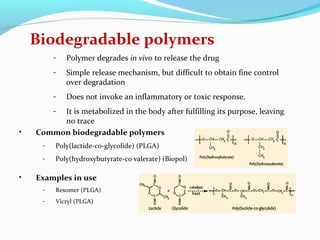
• Common biodegradable polymers 
- Poly(lactide-co-glycolide) (PLGA) 
- Poly(hydroxybutyrate-co valerate) (Biopol) 
• Examples in use 
- Resomer (PLGA) 
- Vicryl (PLGA)
List of Biodegradable Polymers used in Drug Delivery 
Natural polymers 
Protein-based polymers Collagen, albumin, gelatin 
Polysaccharides Agarose, alginate, carrageenan, 
hyaluronic acid, dextran, 
chitosan, 
Cyclodextrins 
Synthetic polymers 
Polyesters Poly(lactic acid), poly(glycolic 
acid), 
poly(hydroxy butyrate), poly(ε- 
caprolactone), 
poly(α-malic acid), 
poly(dioxanones) 
Polyesters 
Polyanhydrides Poly(sebacic acid), poly(adipic 
acid), 
Continues......
Polyamides Poly(imino carbonates), polyamino acids 
Phosphorous-based 
polymers 
Polyphosphates, polyphosphonates, 
polyphosphazenes 
Others Poly(cyano acrylates), polyurethanes, 
polyortho 
esters, 
polydihydropyrans, polyacetals
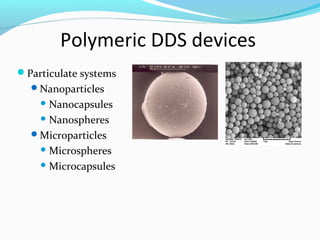
Polymeric DDS devices 
Particulate systems 
Nanoparticles 
Nanocapsules 
Nanospheres 
Microparticles 
Microspheres 
Microcapsules
Controlled Release Systems 
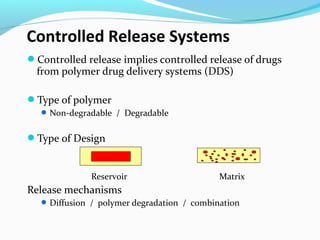
Controlled release implies controlled release of drugs 
from polymer drug delivery systems (DDS) 
Type of polymer 
Non-degradable / Degradable 
Type of Design 
Reservoir Matrix 
Release mechanisms 
Diffusion / polymer degradation / combination
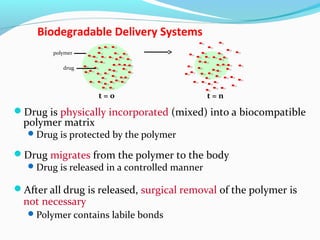
Biodegradable Delivery Systems 
t = 0 t = n 
polymer 
drug 
Drug is physically incorporated (mixed) into a biocompatible 
polymer matrix 
Drug is protected by the polymer 
Drug migrates from the polymer to the body 
Drug is released in a controlled manner 
After all drug is released, surgical removal of the polymer is 
not necessary 
Polymer contains labile bonds
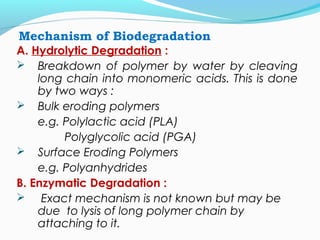
Mechanism of Biodegradation 
A. Hydrolytic Degradation : 
 Breakdown of polymer by water by cleaving 
long chain into monomeric acids. This is done 
by two ways : 
 Bulk eroding polymers 
e.g. Polylactic acid (PLA) 
Polyglycolic acid (PGA) 
 Surface Eroding Polymers 
e.g. Polyanhydrides 
B. Enzymatic Degradation : 
 Exact mechanism is not known but may be 
due to lysis of long polymer chain by 
attaching to it.
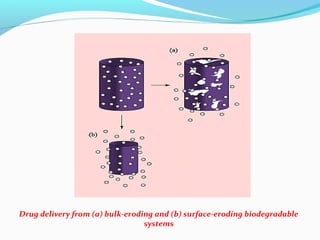
Drug delivery from (a) bulk-eroding and (b) surface-eroding biodegradable 
systems
Biodegradable Delivery Systems 
Physical incorporation of a drug in a polymer-based 
delivery systems are an improvement to conventional 
administration 
Drawbacks: 
Incorporate low percentages of drug 
High potential for drug separation (accidental or 
intentional) 
Drug is released with a burst
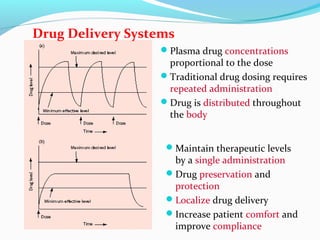
Drug Delivery Systems 
Plasma drug concentrations 
proportional to the dose 
Traditional drug dosing requires 
repeated administration 
Drug is distributed throughout 
the body 
Maintain therapeutic levels 
by a single administration 
Drug preservation and 
protection 
Localize drug delivery 
Increase patient comfort and 
improve compliance
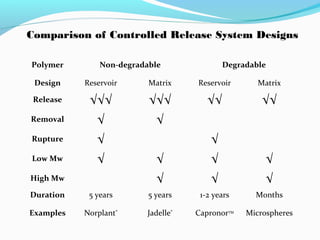
Comparison of Controlled Release System Designs 
Polymer Non-degradable Degradable 
Design Reservoir Matrix Reservoir Matrix 
Release √√√ √√√ √√ √√ 
Removal √ √ 
Rupture √ √ 
Low Mw √ √ √ √ 
High Mw √ √ √ 
Duration 5 years 5 years 1-2 years Months 
Examples Norplant® Jadelle® CapronorTM Microspheres
References
Neeraj Mishra, Amit Goyal, Kapil Khatri, Bhuvaneshwar Vaidya, Rishi Paliwal, 
Shivani Rai, Abhinav Mehta, Shailja Tiwari, Shiva Vyas and Suresh Vyas. 
Biodegradable polymer based particulate carrier(s) for the delivery of proteins and 
peptides. Anti-Inflammatory and Anti-Allergy Agents in Medicinal Chemistry, 2008, 7: 
240-251. 
•Gemma Vilar, Judit Tulla-Puche and Fernando Albericio. Polymers and drug delivery 
systems. Current Drug Delivery, 2012, 9: 1-28. 
•Kumaresh Soppimatha, Tejraj Aminabhavia, Anandrao Kulkarnia and Walter 
Rudzinski. Biodegradable polymeric nanoparticles as drug delivery devices. Journal of 
Controlled Release, 2001, 70: 1–20. 
• Avnesh Kumari, Sudesh Yadav and Subhash Yadav. Biodegradable polymeric 
nanoparticles based drug delivery systems. Colloids and Surfaces B: Biointerfaces, 
2010, 75: 1–18. 
• Yulia Chernysheva, Valery Babak, Natalia Kildeeva, Franck Boury, Jean Benoit, 
Nathalie Ubrichd and Philippe Maincent. Effect of the type of hydrophobic polymers 
on the size of nanoparticles obtained by emulsification solvent evaporation. Mendeleev 
Communication, 2003, 13(2), 65–67.
Biodegradable Polymers

Biodegradable Polymers

  • 1.
    Biodegradable Polymeric DeliverySystem PPrreesseenntteedd BByy:: Sunil Kamboj Roll No: 1211533 DEPARTMENT OF CHEMICAL ENGINEERING JMIT, Radaur- 135133
  • 2.
     A largenumber of the carriers have been designed for delivery of proteins and peptides via liposome, niosome, polymeric nanoparticles, solid lipid nanoparticles etc.  Polymer based carriers have taken much attention of the scientific community for safe and effective delivery of proteins.  Biodegradable polymers is used through slight modifications of their structures.  Biodegradable polymers have a great applications in pharmaceutical, medical and biomedical engineering.  Biodegradable polymers are not limited to release of drugs, peptides or proteins but are also extended to medical devices and wound dressing.
  • 3.
    Polymer? • Largemolecule composed of a number of sub-units - Natural e.g. alginates, - synthetic e.g. poly(HMPA) - Function governed by number and arrangement of constitutional repeat units e.g. –[A-]n, -[A-B-]n, -[A-A] n-[B-B] m , --A-A-B-A-B-B-A- • How are they made? - Processing of natural products – alginates from seaweeds, celluloses from plants - Synthesis from chemical feedstocks – poly(olefins), nylons, poly(esters) • How can they help? - Protection of therapeutic compound during passage through body, as encapsulant or carrier. - Mediator or activator of controlled release
  • 4.
    CHARACTERISTICS OF IDEALPOLYMER Should be inert and compatible with the environment. Should be non-toxic. Should be easily administered. Should be easy and inexpensive to fabricate. Should have good mechanical strength.
  • 5.
    Criteria Followed InPolymer Selection It must be soluble and easy to synthesize; must have a finite molecular wt. Should provide drug attachment and release sites for drug polymer linkages. Should be compatible with biological environment, i.e. non-toxic and non-antigenic. Should be biodegradable or be eliminated from body after its function is over.
  • 6.
    Biodegradable polymers -Polymer degrades in vivo to release the drug - Simple release mechanism, but difficult to obtain fine control over degradation - Does not invoke an inflammatory or toxic response. - It is metabolized in the body after fulfilling its purpose, leaving no trace • Common biodegradable polymers - Poly(lactide-co-glycolide) (PLGA) - Poly(hydroxybutyrate-co valerate) (Biopol) • Examples in use - Resomer (PLGA) - Vicryl (PLGA)
  • 7.
    List of BiodegradablePolymers used in Drug Delivery Natural polymers Protein-based polymers Collagen, albumin, gelatin Polysaccharides Agarose, alginate, carrageenan, hyaluronic acid, dextran, chitosan, Cyclodextrins Synthetic polymers Polyesters Poly(lactic acid), poly(glycolic acid), poly(hydroxy butyrate), poly(ε- caprolactone), poly(α-malic acid), poly(dioxanones) Polyesters Polyanhydrides Poly(sebacic acid), poly(adipic acid), Continues......
  • 8.
    Polyamides Poly(imino carbonates),polyamino acids Phosphorous-based polymers Polyphosphates, polyphosphonates, polyphosphazenes Others Poly(cyano acrylates), polyurethanes, polyortho esters, polydihydropyrans, polyacetals
  • 9.
    Polymeric DDS devices Particulate systems Nanoparticles Nanocapsules Nanospheres Microparticles Microspheres Microcapsules
  • 10.
    Controlled Release Systems Controlled release implies controlled release of drugs from polymer drug delivery systems (DDS) Type of polymer Non-degradable / Degradable Type of Design Reservoir Matrix Release mechanisms Diffusion / polymer degradation / combination
  • 11.
    Biodegradable Delivery Systems t = 0 t = n polymer drug Drug is physically incorporated (mixed) into a biocompatible polymer matrix Drug is protected by the polymer Drug migrates from the polymer to the body Drug is released in a controlled manner After all drug is released, surgical removal of the polymer is not necessary Polymer contains labile bonds
  • 12.
    Mechanism of Biodegradation A. Hydrolytic Degradation :  Breakdown of polymer by water by cleaving long chain into monomeric acids. This is done by two ways :  Bulk eroding polymers e.g. Polylactic acid (PLA) Polyglycolic acid (PGA)  Surface Eroding Polymers e.g. Polyanhydrides B. Enzymatic Degradation :  Exact mechanism is not known but may be due to lysis of long polymer chain by attaching to it.
  • 13.
    Drug delivery from(a) bulk-eroding and (b) surface-eroding biodegradable systems
  • 14.
    Biodegradable Delivery Systems Physical incorporation of a drug in a polymer-based delivery systems are an improvement to conventional administration Drawbacks: Incorporate low percentages of drug High potential for drug separation (accidental or intentional) Drug is released with a burst
  • 15.
    Drug Delivery Systems Plasma drug concentrations proportional to the dose Traditional drug dosing requires repeated administration Drug is distributed throughout the body Maintain therapeutic levels by a single administration Drug preservation and protection Localize drug delivery Increase patient comfort and improve compliance
  • 16.
    Comparison of ControlledRelease System Designs Polymer Non-degradable Degradable Design Reservoir Matrix Reservoir Matrix Release √√√ √√√ √√ √√ Removal √ √ Rupture √ √ Low Mw √ √ √ √ High Mw √ √ √ Duration 5 years 5 years 1-2 years Months Examples Norplant® Jadelle® CapronorTM Microspheres
  • 17.
  • 18.
    Neeraj Mishra, AmitGoyal, Kapil Khatri, Bhuvaneshwar Vaidya, Rishi Paliwal, Shivani Rai, Abhinav Mehta, Shailja Tiwari, Shiva Vyas and Suresh Vyas. Biodegradable polymer based particulate carrier(s) for the delivery of proteins and peptides. Anti-Inflammatory and Anti-Allergy Agents in Medicinal Chemistry, 2008, 7: 240-251. •Gemma Vilar, Judit Tulla-Puche and Fernando Albericio. Polymers and drug delivery systems. Current Drug Delivery, 2012, 9: 1-28. •Kumaresh Soppimatha, Tejraj Aminabhavia, Anandrao Kulkarnia and Walter Rudzinski. Biodegradable polymeric nanoparticles as drug delivery devices. Journal of Controlled Release, 2001, 70: 1–20. • Avnesh Kumari, Sudesh Yadav and Subhash Yadav. Biodegradable polymeric nanoparticles based drug delivery systems. Colloids and Surfaces B: Biointerfaces, 2010, 75: 1–18. • Yulia Chernysheva, Valery Babak, Natalia Kildeeva, Franck Boury, Jean Benoit, Nathalie Ubrichd and Philippe Maincent. Effect of the type of hydrophobic polymers on the size of nanoparticles obtained by emulsification solvent evaporation. Mendeleev Communication, 2003, 13(2), 65–67.

Editor's Notes

  • #14 Drug delivery from (a) bulk-eroding and (b) surface-eroding biodegradable systems