Polymers in controlled release Drug Delivery System.pptx
The document explores the role of polymers in controlled drug delivery systems, detailing their definitions, types, advantages, and applications. It highlights various mechanisms for drug release, including diffusion, swelling, and biodegradation, as well as classifications of drug delivery systems such as sustained-release, targeted, and pH-sensitive systems. The text emphasizes the benefits of using polymers, including precise drug release control, minimized side effects, improved patient compliance, and potential for combination therapies.
DEFINITIONOFPOLYMER
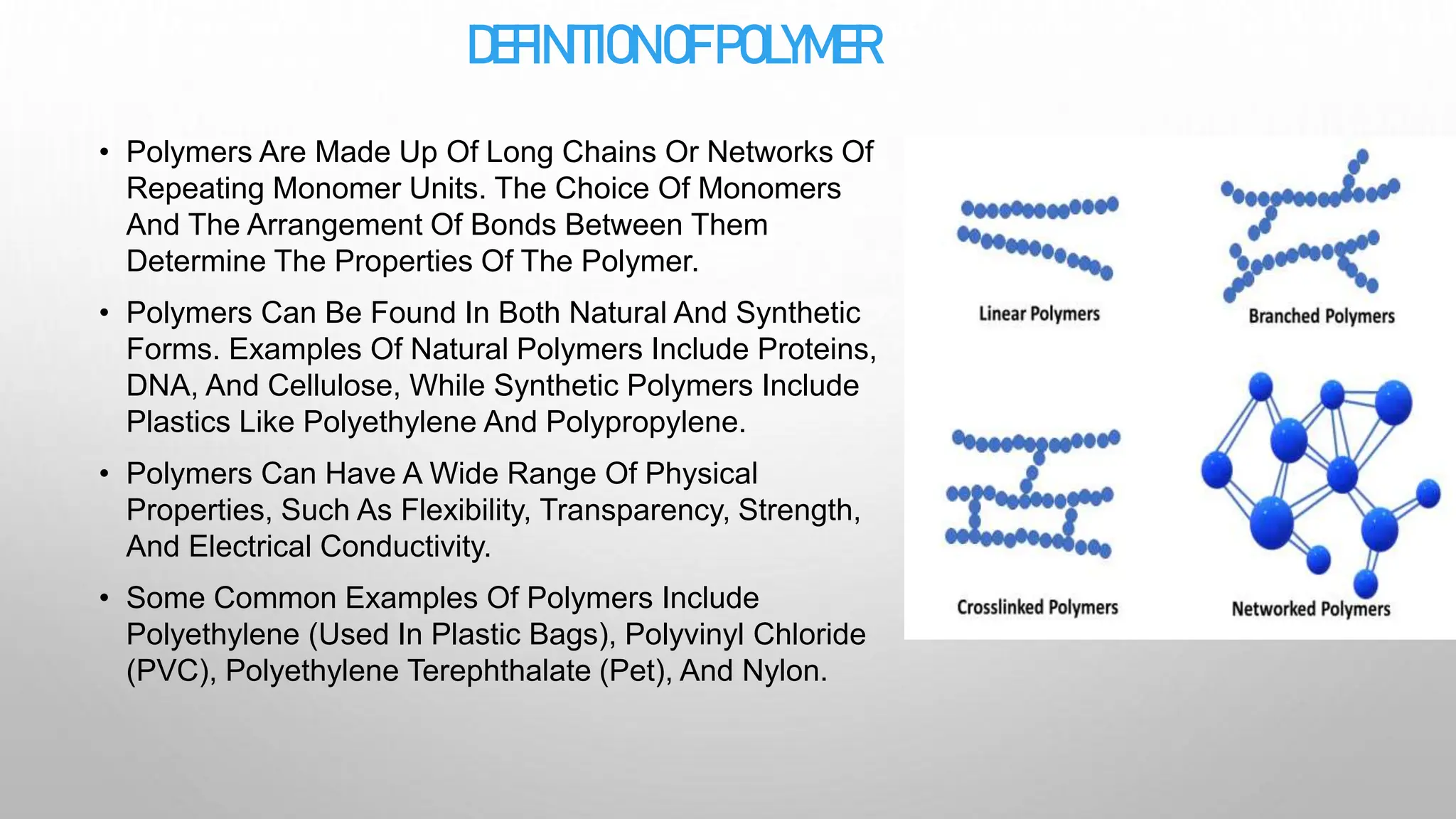
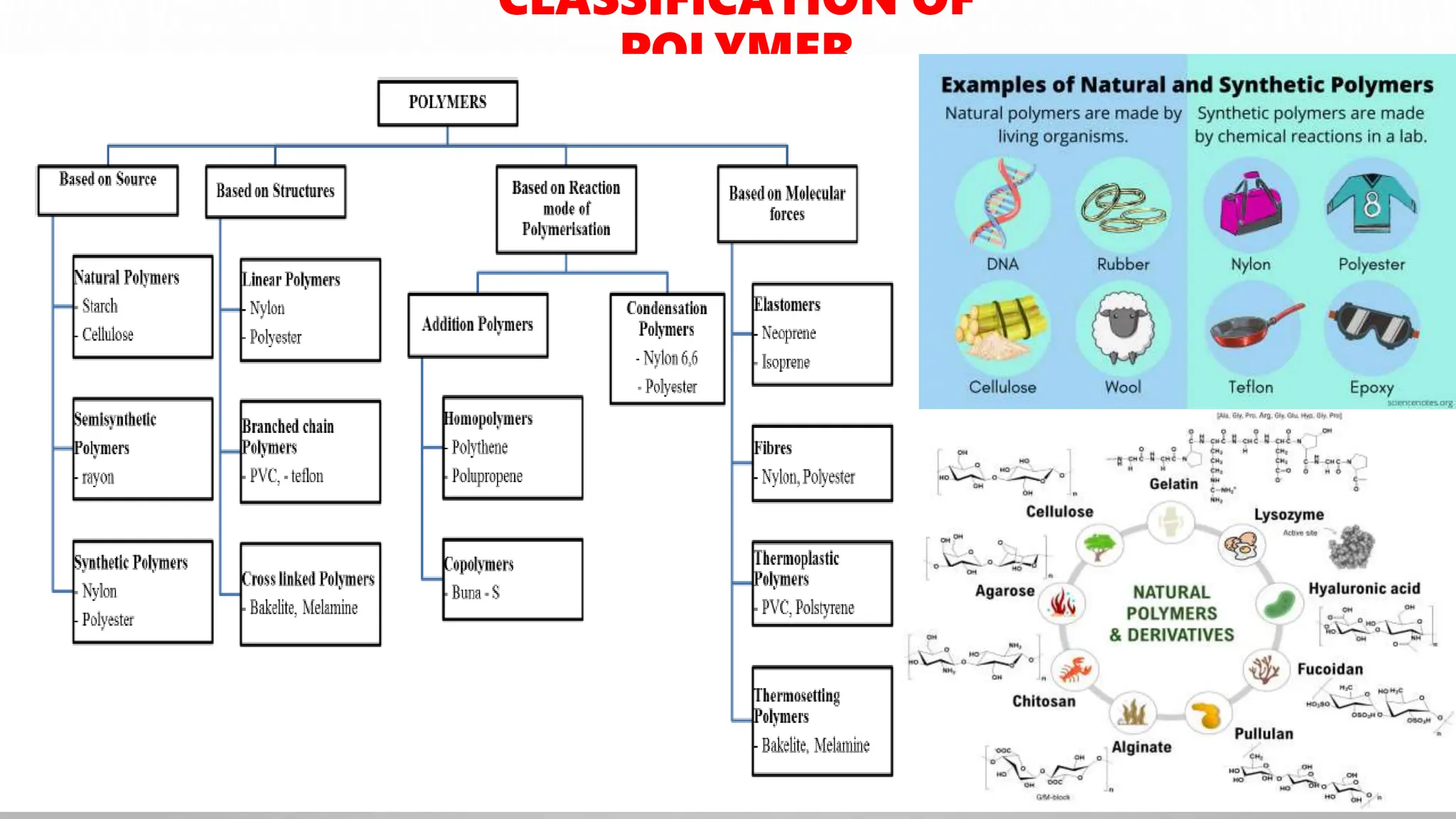
• Polymers AreMade Up Of Long Chains Or Networks Of
Repeating Monomer Units. The Choice Of Monomers
And The Arrangement Of Bonds Between Them
Determine The Properties Of The Polymer.
• Polymers Can Be Found In Both Natural And Synthetic
Forms. Examples Of Natural Polymers Include Proteins,
DNA, And Cellulose, While Synthetic Polymers Include
Plastics Like Polyethylene And Polypropylene.
• Polymers Can Have A Wide Range Of Physical
Properties, Such As Flexibility, Transparency, Strength,
And Electrical Conductivity.
• Some Common Examples Of Polymers Include
Polyethylene (Used In Plastic Bags), Polyvinyl Chloride
(PVC), Polyethylene Terephthalate (Pet), And Nylon.
4.
CONTROLLED DRUGDELIVERYSYSTEM
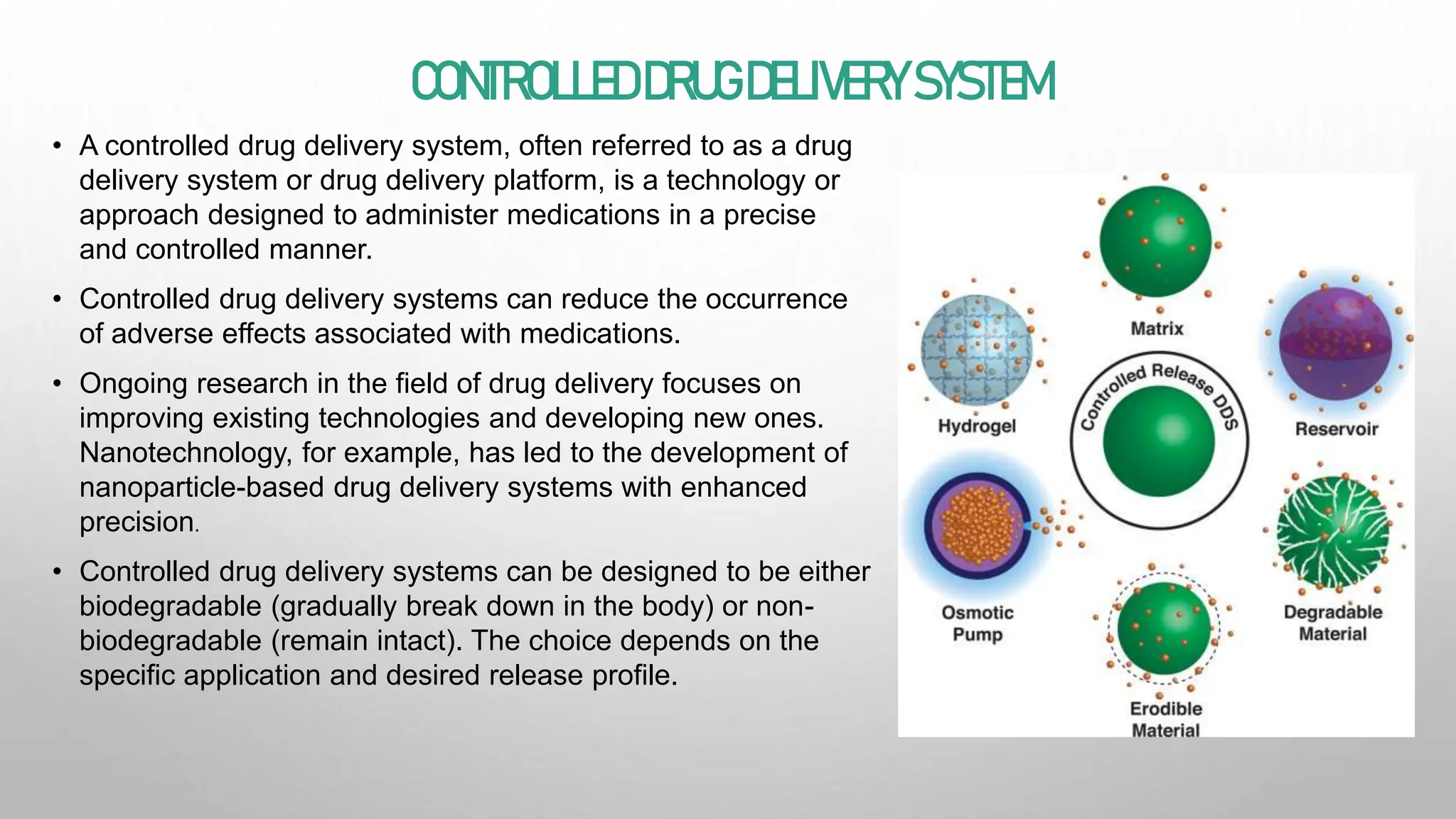
• Acontrolled drug delivery system, often referred to as a drug
delivery system or drug delivery platform, is a technology or
approach designed to administer medications in a precise
and controlled manner.
• Controlled drug delivery systems can reduce the occurrence
of adverse effects associated with medications.
• Ongoing research in the field of drug delivery focuses on
improving existing technologies and developing new ones.
Nanotechnology, for example, has led to the development of
nanoparticle-based drug delivery systems with enhanced
precision.
• Controlled drug delivery systems can be designed to be either
biodegradable (gradually break down in the body) or non-
biodegradable (remain intact). The choice depends on the
specific application and desired release profile.
5.
DRUG RELEASE FROM
POLYMERS
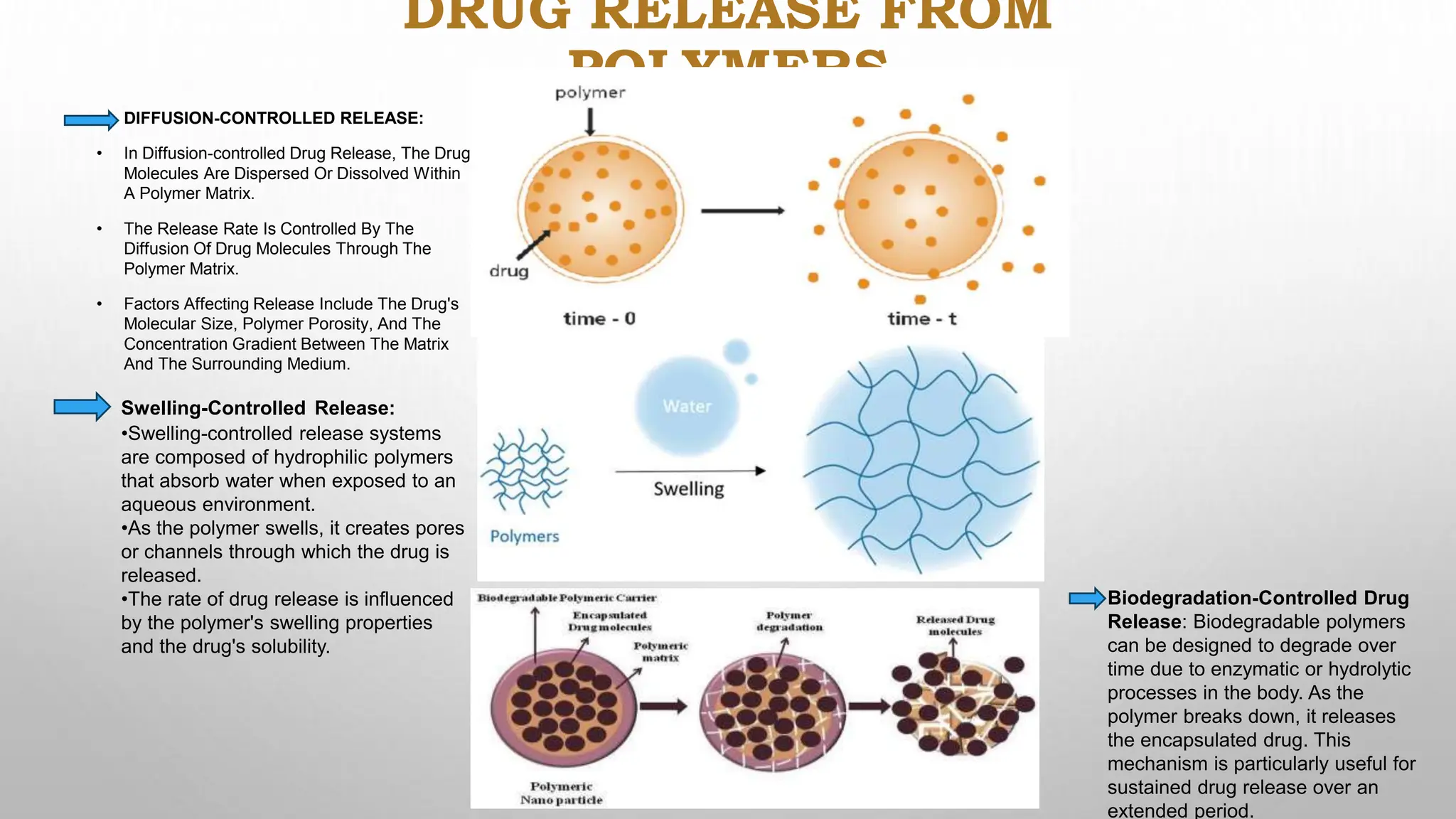
•DIFFUSION-CONTROLLED RELEASE:
• In Diffusion-controlled Drug Release, The Drug
Molecules Are Dispersed Or Dissolved Within
A Polymer Matrix.
• The Release Rate Is Controlled By The
Diffusion Of Drug Molecules Through The
Polymer Matrix.
• Factors Affecting Release Include The Drug's
Molecular Size, Polymer Porosity, And The
Concentration Gradient Between The Matrix
And The Surrounding Medium.
Swelling-Controlled Release:
•Swelling-controlled release systems
are composed of hydrophilic polymers
that absorb water when exposed to an
aqueous environment.
•As the polymer swells, it creates pores
or channels through which the drug is
released.
•The rate of drug release is influenced
by the polymer's swelling properties
and the drug's solubility.
Biodegradation-Controlled Drug
Release: Biodegradable polymers
can be designed to degrade over
time due to enzymatic or hydrolytic
processes in the body. As the
polymer breaks down, it releases
the encapsulated drug. This
mechanism is particularly useful for
sustained drug release over an
extended period.
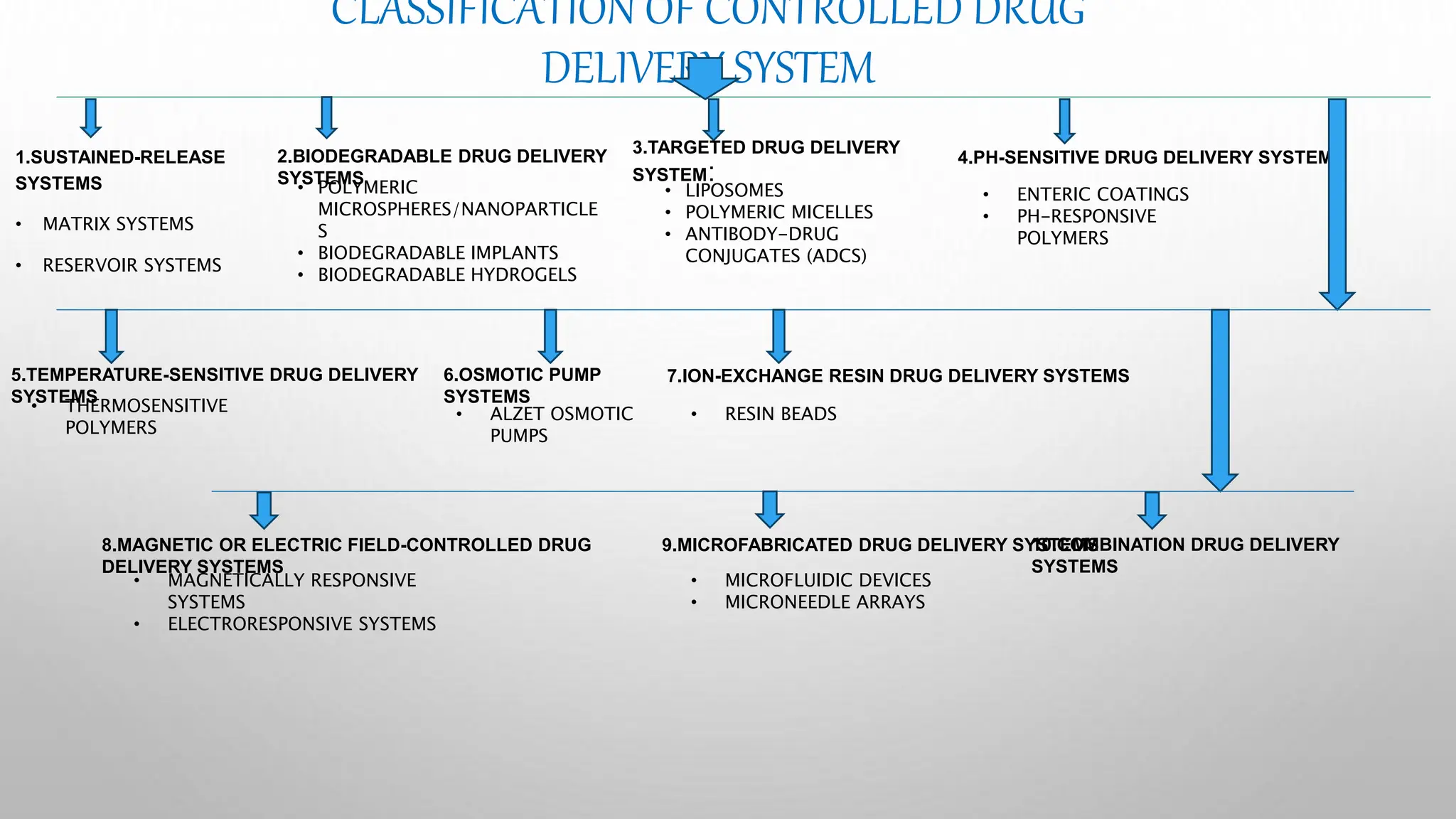
CLASSIFICATION OF CONTROLLEDDRUG
DELIVERY SYSTEM
1.SUSTAINED-RELEASE
SYSTEMS
• MATRIX SYSTEMS
• RESERVOIR SYSTEMS
2.BIODEGRADABLE DRUG DELIVERY
SYSTEMS
• POLYMERIC
MICROSPHERES/NANOPARTICLE
S
• BIODEGRADABLE IMPLANTS
• BIODEGRADABLE HYDROGELS
3.TARGETED DRUG DELIVERY
SYSTEM:
• LIPOSOMES
• POLYMERIC MICELLES
• ANTIBODY-DRUG
CONJUGATES (ADCS)
4.PH-SENSITIVE DRUG DELIVERY SYSTEMS
• ENTERIC COATINGS
• PH-RESPONSIVE
POLYMERS
5.TEMPERATURE-SENSITIVE DRUG DELIVERY
SYSTEMS
• THERMOSENSITIVE
POLYMERS
6.OSMOTIC PUMP
SYSTEMS
• ALZET OSMOTIC
PUMPS
7.ION-EXCHANGE RESIN DRUG DELIVERY SYSTEMS
• RESIN BEADS
8.MAGNETIC OR ELECTRIC FIELD-CONTROLLED DRUG
DELIVERY SYSTEMS
• MAGNETICALLY RESPONSIVE
SYSTEMS
• ELECTRORESPONSIVE SYSTEMS
9.MICROFABRICATED DRUG DELIVERY SYSTEMS
• MICROFLUIDIC DEVICES
• MICRONEEDLE ARRAYS
10.COMBINATION DRUG DELIVERY
SYSTEMS
8.
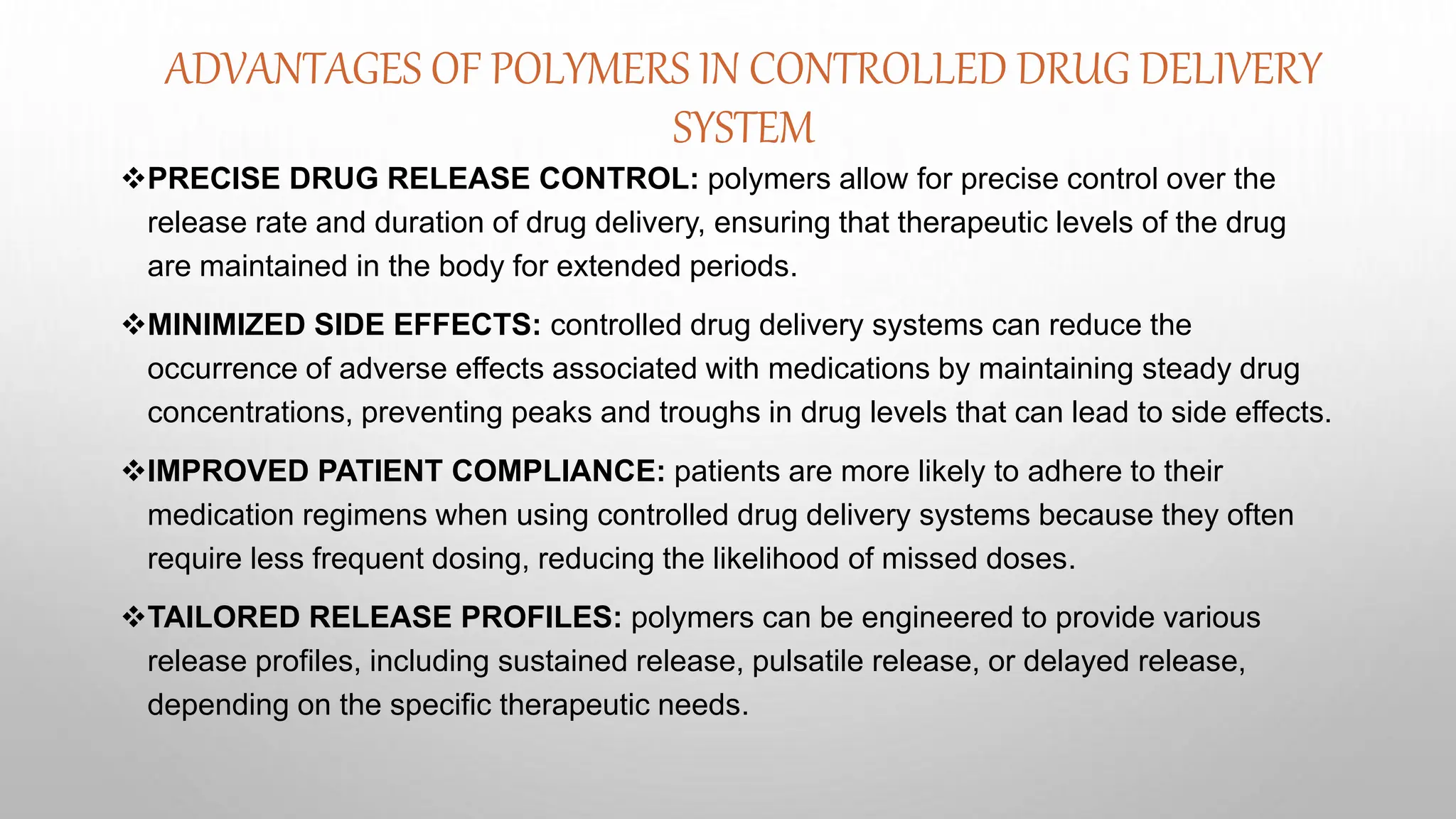
ADVANTAGES OF POLYMERSIN CONTROLLED DRUG DELIVERY
SYSTEM
PRECISE DRUG RELEASE CONTROL: polymers allow for precise control over the
release rate and duration of drug delivery, ensuring that therapeutic levels of the drug
are maintained in the body for extended periods.
MINIMIZED SIDE EFFECTS: controlled drug delivery systems can reduce the
occurrence of adverse effects associated with medications by maintaining steady drug
concentrations, preventing peaks and troughs in drug levels that can lead to side effects.
IMPROVED PATIENT COMPLIANCE: patients are more likely to adhere to their
medication regimens when using controlled drug delivery systems because they often
require less frequent dosing, reducing the likelihood of missed doses.
TAILORED RELEASE PROFILES: polymers can be engineered to provide various
release profiles, including sustained release, pulsatile release, or delayed release,
depending on the specific therapeutic needs.
9.
ADVANTAGES OF POLYMERSIN CONTROLLED DRUG DELIVERY
SYSTEM
ENHANCED BIOAVAILABILITY: some poorly soluble drugs can be encapsulated or
dispersed within polymers to improve their solubility, bioavailability, and absorption in the
body.
PROTECTION OF LABILE DRUGS: polymers can protect sensitive or labile drugs from
degradation due to environmental factors, such as light, heat, or moisture.
LOCALIZED DRUG DELIVERY: polymers can be designed for targeted or localized drug
delivery, minimizing systemic exposure and delivering drugs directly to specific tissues or
organs, reducing off-target effects.
REDUCED FREQUENCY OF ADMINISTRATION: long-acting controlled drug delivery
systems, such as implants or depot injections, can extend the time between administrations,
improving patient convenience and reducing the risk of medication errors.
STABILITY AND SHELF LIFE: controlled drug delivery systems can enhance the stability
and shelf life of drugs, reducing the need for frequent product replacement and waste.
REDUCED TOXICITY: by maintaining drug concentrations within the therapeutic range,
controlled drug delivery systems can reduce the risk of toxicity associated with high drug
10.
ADVANTAGES OF POLYMERSIN CONTROLLED DRUG DELIVERY
SYSTEM
CUSTOMIZABLE FORMULATIONS: polymers offer versatility, allowing for the development
of customized drug delivery formulations that can accommodate various drugs and patient
needs.
LONG-LASTING EFFECTS: certain polymers, such as biodegradable ones, can be
designed to release drugs gradually and then degrade, leaving no residue in the body once
their purpose is fulfilled.
MINIMIZED FIRST-PASS EFFECT: for oral drug delivery, polymers can protect drugs from
the liver's first-pass effect, allowing a greater proportion of the drug to reach the systemic
circulation intact.
REDUCED NEED FOR FREQUENT INJECTIONS: for injectable drug delivery, polymer-
based sustained-release formulations can reduce the frequency of injections required for
chronic conditions.
POTENTIAL FOR COMBINATION THERAPIES: polymers can be used to encapsulate
multiple drugs or therapeutic agents in a single delivery system, enabling combination
11.
APPLICATIONS OF POLYMERIN CONTROLLED
RELEASED DRUG DELIVERY SYSTEM
ORAL DRUG DELIVERY:
1. polymers can be used in oral drug delivery systems to control the release of medications, ensuring
prolonged drug release and improved patient compliance.
2. examples include sustained-release tablets, capsules, and multiparticulate systems like beads or
pellets.
TRANSDERMAL DRUG DELIVERY:
1. polymers are used in transdermal patches to deliver drugs through the skin. they control the rate
of drug diffusion into the bloodstream, providing continuous drug release over an extended period.
2. transdermal patches are commonly used for pain management (e.g., fentanyl patches) and
hormone replacement therapy.
IMPLANTABLE DRUG DELIVERY SYSTEMS:
1. biodegradable polymers are employed in implantable devices, such as drug-eluting implants or
rods, for long-term drug delivery.
2. these systems are used for contraception, hormone therapy, and the treatment of chronic
conditions like diabetes and pain management.
12.
APPLICATIONS OF POLYMERIN CONTROLLED
RELEASED DRUG DELIVERY SYSTEM
PULMONARY DRUG DELIVERY:
1. inhalable polymers are used to encapsulate drugs for controlled release in the lungs. these
systems are suitable for treating respiratory conditions like asthma and chronic obstructive
pulmonary disease (copd).
2. inhalable polymeric microparticles and nanoparticles can improve drug deposition and lung
retention.
NASAL AND OCULAR DRUG DELIVERY:
1. polymers can be used to create gel-forming nasal and ocular drug delivery systems, which adhere
to mucosal surfaces and provide prolonged drug release.
2. these systems are used for conditions like allergic rhinitis and glaucoma.
INTRA-ARTICULAR DRUG DELIVERY:
1. polymers can be incorporated into injectable formulations for targeted drug delivery to joints,
reducing systemic exposure and side effects.
2. used in the management of conditions like osteoarthritis.
INTRAVENOUS AND PARENTERAL DRUG DELIVERY:
1. polymers can be used in nanoscale drug delivery systems, such as liposomes or nanoparticles, to
improve drug solubility and stability for intravenous administration.
13.
REFERENCE
• BIOPHARMACEUTICS ANDPHARMACOKINETICS
-(DM. BRAHMANKAR , SUNIL.B.JAISWAL)
• NOVEL DRUG DELIVERY SYSTEM
-(Y.W.CHIEN)
• HTTPS://WWW.TANDFONLINE.COM/DOI/FULL/10.1080/17425247.2023.22190
53