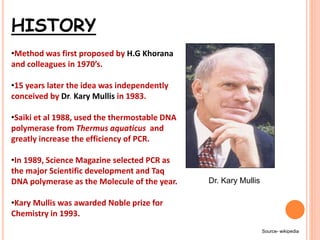
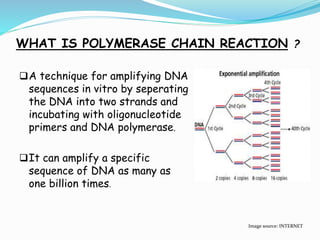
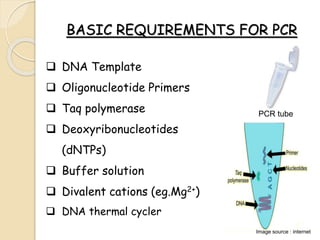
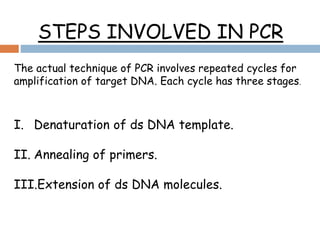
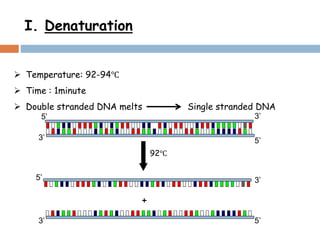
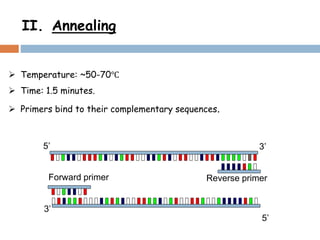
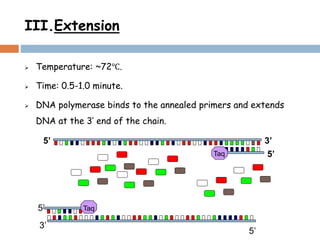
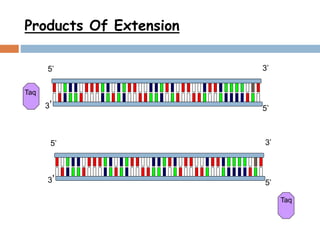
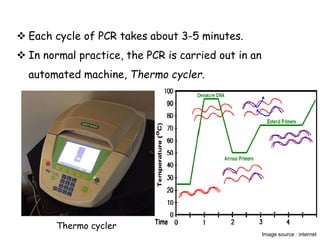
Polymerase chain reaction (PCR) is a technique for amplifying DNA sequences in vitro. It involves repeated cycles of separating DNA strands through heating and cooling, and using DNA polymerase to make copies of the target sequence. PCR was first proposed in the 1970s and developed in the 1980s by Kary Mullis, who received the Nobel Prize in Chemistry for his work. PCR uses DNA polymerase, primers, nucleotides, and repeated heating and cooling to amplify a specific DNA sequence over a billion-fold, allowing for easy detection and analysis.