CONTENTS
• What isPCR?
• History of PCR
• Principles of PCR
• Components of PCR
• Steps in PCR
• Applications of PCR
• Advantages of PCR
3.
What is PCR
History
•Polymerase Chain Reaction
(PCR) is a molecular biology
technique used to amplify
DNA — meaning it produces
millions of copies of a
specific DNA segment in a
short time.
• Invitro technique
1983: Dr. Kary Mullis developed PCR
1985: First publication of PCR by Cetus
Corporation appears in Science.
1986: Purified Taq polymerase is first used
in PCR
1988: PerkinElmer introduces the
automated thermal Cycler t1993:Dr. Kary
1993: Dr Kary Mullis won Nobel Prize in
Chemistry for conceiving PCR technology.
4.
Principle of PCR
PCRworks on the principle of in vitro enzymatic replication of DNA,
mimicking the natural DNA replication process inside cells. The key
concept is to amplify a target DNA region exponentially through cycles
of:
• Denaturation: Unwinding the double-stranded DNA into single strands
• Annealing: Binding of specific primers to complementary sequences on
the template
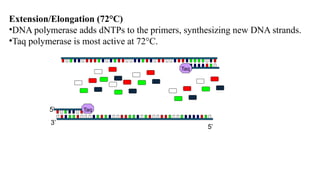
• Extension: Synthesizing new DNA strands by adding nucleotides to the
primer using a heat-stable DNA polymerase
• Each cycle doubles the amount of target DNA, leading to exponential
amplification. This allows for rapid and highly specific amplification of
even trace amounts of DNA.
5.
Components of PCR
1.DNATemplate – The DNA sample containing the target region to be amplified.
2.Primers – Short, single-stranded sequences of nucleotides that are complementary
to the target region. Two primers are used: forward and reverse.
3.DNA Polymerase – A heat-stable enzyme (commonly Taq polymerase) that
synthesizes new DNA strands.
4.dNTPs (deoxynucleotide triphosphates) – The building blocks (A, T, G, C) for
DNA synthesis.
5.Buffer Solution – Maintains optimal pH and salt conditions for enzyme activity.
6.MgCl2 – Magnesium ions act as essential cofactors for the DNA polymerase
6.
Steps in PCR
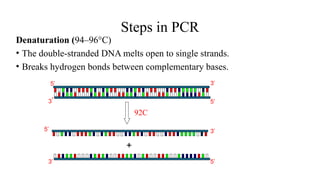
Denaturation(94–96°C)
• The double-stranded DNA melts open to single strands.
• Breaks hydrogen bonds between complementary bases.
92C
3’
5’
3’ 5’5’
+
5’
3’
5’ 3’
7.
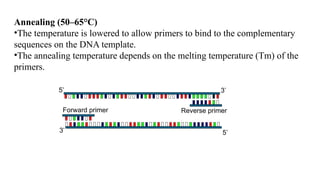
Annealing (50–65°C)
•The temperatureis lowered to allow primers to bind to the complementary
sequences on the DNA template.
•The annealing temperature depends on the melting temperature (Tm) of the
primers.
5’
3’
5’ 3’
Forward primer Reverse primer
Applications of PCR
1.MedicalDiagnostics
1. Detection of infectious diseases (HIV, TB, COVID-19)
2. Identification of genetic mutations (e.g., BRCA1/2 in breast cancer)
2.Forensic Science
1. DNA fingerprinting
2. Paternity testing
3. Crime scene investigations
3.Agricultural and Environmental Sciences
1. GMO detection
2. Plant pathogen identification
3. Soil and water microbiome studies
10.
4. Food Safetyand Quality Control
1. Detection of microbial contaminants (e.g., Salmonella, Listeria, E. coli)
2. Authentication of meat and dairy products
5. Biotechnology and Research
3. Cloning of genes
4. Site-directed mutagenesis
5. Gene expression analysis
11.
Advantages of PCR
•Highlysensitive – can detect minute amounts of DNA
•Extremely specific – targets unique DNA sequences
•Rapid – results within a few hours
•Requires only a small sample
•Versatile – applicable in many fields