. Username Password Forgot your password?                                                                                                                                                                                                                                                                                                                                                                  
Ayurveda - A Complete Science  Of  Life Sunaina Dhawan Qualifications Bachelor in Ayurvedic Medicine & Surgery (B.A.M.S.) Master in Alternative Medicine (Yoga & Acupressure) Panchkarma Therapist Email : sunainadhawan_23@yahoo.com Phone : 706-413-3833 Username Password Forgot your password? Disclaimer:  All information provided in this presentation is provided for  information and educational purposes only; statements contained here are reported in an effort to preserve traditional cultural lore and information. Nothing here should be construed as an attempt to diagnose, prescribe, or recommend treatment for any disease or condition. Please consult your physician for medical advice regarding any medical condition and do not use any of the historical information on this presentation without your physicians approval.                                                                                                                                                                                                                                                                                                                 
ORIGIN OF AYURVEDA Texts written in India between 3,500 and 5,000 years ago The oldest healing science in existence, from which all other systems emerged
AYURVEDA Ayurveda  =  Ayu  +  Veda Ayu is life Veda  is  knowledge or science Ayurveda   THE  SCIENCE OF LIFE
AYURVEDA – A Way Of Life Ayurveda  is a science dealing not only with  treatment  of some diseases but is a complete  way of life
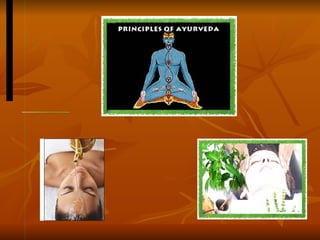
PRINCIPLES   OF AYURVEDA DOSHAS  D HATUS - Tissues M ALAS -  Waste products
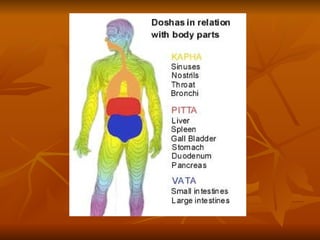
DOSHAS VATA  (Air & Space ) PITTA (Fire & Water) KAPHA (Water & Earth)
VATA - The Air Vata is dry, light, cold, mobile, active, clear, astringent, and it is dispersing. Vata season is autumn  Time of day is afternoon and early morning
VATA -Types & Their Functions Prana Vata : Governs the senses, creative thinking, reasoning, enthusiasm,  Udana Vata : Governs quality of voice, memory, movements of thought  Samana Vata : Governs movement of food through digestive tract  Apana Vata : Elimination of wastes, sexual function, menstrual cycle  Vyana Vata : Governs blood flow, heart rhythm, perspiration, sense of touch
Useful Tips To Balance Vata Dosha  Abhyanga (ayurvedic massage) Stay warm in cold and windy weather  Consume warm and cooked foods (less raw foods)  Go to bed early and have lot of rest and sleep. Favor oily and heavy food with sweet, sour, and salty tastes.
DON'Ts For Vata Dosha  Avoid light, dry, cold, pungent, bitter and astringent foods  Avoid raw foods, juices, fasting Avoid stimulants ,smoking ,alcohol  Refrain from excessive aerobic activity
PITTA - The Fire Pitta has hot, sharp, light, liquid, sour, oily and spreading qualities.  Strong smell, like a fleshy odor Liking for sour or bitter taste.
Pitta -Types & Their Functions  Alochaka Pitta : Controls functioning of the eyes  Bhrajaka Pitta : Responsible for healthy glow of the skin  Sadhaka Pitta : Controls desire, drive, decisiveness, spirituality  Pachaka Pitta : Responsible for digestion, assimilation, metabolism for healthy nutrients and tissues  Ranjaka Pitta : Responsible for healthy, toxin-free blood
Useful Tips To Balance Pitta Dosha  Keep cool Favor cool, heavy, dry, sweet, bitter and astringent foods  Keep activities in moderation Keep regular mealtimes, especially at noon
DON'Ts For Pitta Dosha  Avoid sesame and mustard oils, fish, buttermilk, mutton, acidic fruits, alcohol, meat and fatty, oily foods.  Restrict pungent, sour, salty, warm, oily and light foods  Avoid over work  Avoid fasting
KAPHA -The Water Heavy, slow, cool, oily, liquid, dense, thick,  static and cloudy qualities.
Kapha - Types & Their Functions Tarpaka Kapha : Responsible for moisture for nose, mouth, eyes and brain  Bhodaka Kapha : Governs Sense of taste, which is essential for good digestion  Kledaka Kapha : Controls moisture of the stomach and intestinal mucosal lining  Avalambaka Kapha : Protects the heart, strong muscles, healthy lungs  Sleshaka Kapha : Lubricates the joints,Keeps skin soft and supple.
Useful Tips To Balance  Kapha Dosha Do regular exercise, Begin with Sooryanamaskara to warm up your body, which should be followed by a Vigorous activity  Prefer warm temperatures, Stay warm and dry in cold, damp weather  Use Fresh fruits, vegetables and legumes  Favor pungent, bitter, astringent, light, dry and warm foods
DON'Ts For Kapha Dosha Reduce heavy, oily, cold, sweet, sour and salty foods  Avoid heavy meals.  Sleep promotes Kapha hence avoid excessive sleep,  All frozen desserts are to be avoided.
 
DHATUS -  Tissues RASA  (Plasma) RAKTA  (Blood) MAS  (Muscle tissue) MED  (Adipose tissue) ASTHI  (Bone) MAJJA  (Bone marrow tissue) SHUKRA  (Reproductive fluid)
MALAS – Waste Products Purisa  (Faeces) Mutra  (Urine) Sweda  (Sweat)
PHARMACOLOGY OF AYURVEDA The materia medica of the Ayurveda, composed of the five basic elements Taste ( rasa ) Potency ( virya )  Taste of the digestion product ( vipaka ) Properties ( guna ) Specific properties ( prabhava )
PATHOLOGY OF AYURVEDA Under normal conditions, the  doshas, dhatus and malas  correspond to certain standards. Every disease is related to an  imbalance of the doshas.   Other coherent factors can be: The disturbance of the biological factors ( agnis ) The formation and accumulation of undigested nutrients( ama ),  Obstruction of the body channels ( shrotorodha )  Disturbed assimilation in the tissues.
THERAPIES Taste : Herbal medicines given according to there taste (rasa) Touch : Massage (abhyañga), yoga, and exercise Smell : Aromatherapy
THERAPIES Sight : Color therapy Hearing : Music therapy, mantra meditation, chanting. Spiritual : Include meditation, living ethically and working in a career that one loves or is purposeful.
UNIQUENESS OF AYURVEDA This spiritual science offers numerous unique benefits: It looks at people as individuals, not as a generic group It heals from the root-cause of an illness, not merely treating the symptoms. Natural therapies &  Inexpensive  No side effects and therapies are effective
THANK YOU

Ayurveda

  • 1.
                             . Username Password Forgot your password?                                                                                                                                                                                                                                                                                                                             
  • 2.
    Ayurveda - AComplete Science Of Life Sunaina Dhawan Qualifications Bachelor in Ayurvedic Medicine & Surgery (B.A.M.S.) Master in Alternative Medicine (Yoga & Acupressure) Panchkarma Therapist Email : sunainadhawan_23@yahoo.com Phone : 706-413-3833 Username Password Forgot your password? Disclaimer: All information provided in this presentation is provided for information and educational purposes only; statements contained here are reported in an effort to preserve traditional cultural lore and information. Nothing here should be construed as an attempt to diagnose, prescribe, or recommend treatment for any disease or condition. Please consult your physician for medical advice regarding any medical condition and do not use any of the historical information on this presentation without your physicians approval.                                                                                                                                                                                                                                                                         
  • 3.
    ORIGIN OF AYURVEDATexts written in India between 3,500 and 5,000 years ago The oldest healing science in existence, from which all other systems emerged
  • 4.
    AYURVEDA Ayurveda = Ayu + Veda Ayu is life Veda is knowledge or science Ayurveda THE SCIENCE OF LIFE
  • 5.
    AYURVEDA – AWay Of Life Ayurveda is a science dealing not only with treatment of some diseases but is a complete way of life
  • 6.
    PRINCIPLES OF AYURVEDA DOSHAS D HATUS - Tissues M ALAS - Waste products
  • 7.
    DOSHAS VATA (Air & Space ) PITTA (Fire & Water) KAPHA (Water & Earth)
  • 8.
    VATA - TheAir Vata is dry, light, cold, mobile, active, clear, astringent, and it is dispersing. Vata season is autumn Time of day is afternoon and early morning
  • 9.
    VATA -Types &Their Functions Prana Vata : Governs the senses, creative thinking, reasoning, enthusiasm, Udana Vata : Governs quality of voice, memory, movements of thought Samana Vata : Governs movement of food through digestive tract Apana Vata : Elimination of wastes, sexual function, menstrual cycle Vyana Vata : Governs blood flow, heart rhythm, perspiration, sense of touch
  • 10.
    Useful Tips ToBalance Vata Dosha Abhyanga (ayurvedic massage) Stay warm in cold and windy weather Consume warm and cooked foods (less raw foods) Go to bed early and have lot of rest and sleep. Favor oily and heavy food with sweet, sour, and salty tastes.
  • 11.
    DON'Ts For VataDosha Avoid light, dry, cold, pungent, bitter and astringent foods Avoid raw foods, juices, fasting Avoid stimulants ,smoking ,alcohol Refrain from excessive aerobic activity
  • 12.
    PITTA - TheFire Pitta has hot, sharp, light, liquid, sour, oily and spreading qualities. Strong smell, like a fleshy odor Liking for sour or bitter taste.
  • 13.
    Pitta -Types &Their Functions Alochaka Pitta : Controls functioning of the eyes Bhrajaka Pitta : Responsible for healthy glow of the skin Sadhaka Pitta : Controls desire, drive, decisiveness, spirituality Pachaka Pitta : Responsible for digestion, assimilation, metabolism for healthy nutrients and tissues Ranjaka Pitta : Responsible for healthy, toxin-free blood
  • 14.
    Useful Tips ToBalance Pitta Dosha Keep cool Favor cool, heavy, dry, sweet, bitter and astringent foods Keep activities in moderation Keep regular mealtimes, especially at noon
  • 15.
    DON'Ts For PittaDosha Avoid sesame and mustard oils, fish, buttermilk, mutton, acidic fruits, alcohol, meat and fatty, oily foods. Restrict pungent, sour, salty, warm, oily and light foods Avoid over work Avoid fasting
  • 16.
    KAPHA -The WaterHeavy, slow, cool, oily, liquid, dense, thick, static and cloudy qualities.
  • 17.
    Kapha - Types& Their Functions Tarpaka Kapha : Responsible for moisture for nose, mouth, eyes and brain Bhodaka Kapha : Governs Sense of taste, which is essential for good digestion Kledaka Kapha : Controls moisture of the stomach and intestinal mucosal lining Avalambaka Kapha : Protects the heart, strong muscles, healthy lungs Sleshaka Kapha : Lubricates the joints,Keeps skin soft and supple.
  • 18.
    Useful Tips ToBalance Kapha Dosha Do regular exercise, Begin with Sooryanamaskara to warm up your body, which should be followed by a Vigorous activity Prefer warm temperatures, Stay warm and dry in cold, damp weather Use Fresh fruits, vegetables and legumes Favor pungent, bitter, astringent, light, dry and warm foods
  • 19.
    DON'Ts For KaphaDosha Reduce heavy, oily, cold, sweet, sour and salty foods Avoid heavy meals. Sleep promotes Kapha hence avoid excessive sleep, All frozen desserts are to be avoided.
  • 20.
  • 21.
    DHATUS - Tissues RASA (Plasma) RAKTA (Blood) MAS (Muscle tissue) MED (Adipose tissue) ASTHI (Bone) MAJJA (Bone marrow tissue) SHUKRA (Reproductive fluid)
  • 22.
    MALAS – WasteProducts Purisa (Faeces) Mutra (Urine) Sweda (Sweat)
  • 23.
    PHARMACOLOGY OF AYURVEDAThe materia medica of the Ayurveda, composed of the five basic elements Taste ( rasa ) Potency ( virya ) Taste of the digestion product ( vipaka ) Properties ( guna ) Specific properties ( prabhava )
  • 24.
    PATHOLOGY OF AYURVEDAUnder normal conditions, the doshas, dhatus and malas correspond to certain standards. Every disease is related to an imbalance of the doshas. Other coherent factors can be: The disturbance of the biological factors ( agnis ) The formation and accumulation of undigested nutrients( ama ), Obstruction of the body channels ( shrotorodha ) Disturbed assimilation in the tissues.
  • 25.
    THERAPIES Taste :Herbal medicines given according to there taste (rasa) Touch : Massage (abhyañga), yoga, and exercise Smell : Aromatherapy
  • 26.
    THERAPIES Sight :Color therapy Hearing : Music therapy, mantra meditation, chanting. Spiritual : Include meditation, living ethically and working in a career that one loves or is purposeful.
  • 27.
    UNIQUENESS OF AYURVEDAThis spiritual science offers numerous unique benefits: It looks at people as individuals, not as a generic group It heals from the root-cause of an illness, not merely treating the symptoms. Natural therapies & Inexpensive No side effects and therapies are effective
  • 28.

Editor's Notes

  • #4 texts were written in India between 3,500 and 5,000 years ago, though some suggest an even longer history. IT is believed to be the oldest healing science in existence, from which all other systems emerged
  • #8 The most fundamental and characteristic principle of Ayurveda is called "Tridosha" or the Three Humors. All matter is thought to he composed of five basic elements ( panchamahabhutas ) which exhibit the properties of earth (prithvi), water (jala), fire (tejas), wind (vayu) and space (akasha). The structural aspect of our body is made up of five elements, but the functional aspect of the body is governed by three biological humors. Ether and air together constitute VATA; fire and water,PITTA; and water and earth, KAPHA. They govern psycho-biological changes in the body and physio-pathological changes too. Vata-pitta-kapha are present in every cell, tissue and organ. Doshas are to be seen as all pervasive, subtle entities, Vata regulates movement and is represented by the nervous system. Pitta is the principle of biotransformation and is the cause of all metabolic processes in the body. Kapha is the principle of cohesion and functions through the body fluids. In every person these three doshas differ in permutations and combinations and thereby determine the physiologic constitution (Prakriti) of an individual. Vata, pitta and kapha are distinctly present in every individual and express in each human being differently according to predominance of their different qualities (gunas). VATA -- The Air or Nerve System Humor vata is dry, light, cold, mobile, active, clear, astringent, and it is dispersing. Vata season is autumn, time of day is afternoon and early morning. VATA -Types and their Functions: Vatadosha is further divided into 5 types according to it's seat and the different functions it carries Prana Vata : Governs the senses, creative thinking, reasoning, enthusiasm, Udana Vata : Governs quality of voice, memory, movements of thought Samana Vata : Governs movement of food through digestive tract Apana Vata : Elimination of wastes, sexual function, menstrual cycle Vyana Vata : Governs blood flow, heart rhythm, perspiration, sense of touch Useful Tips to Balance Vatadosha DO's: Abhyanga (ayurvedic massage with sesame oil) Stay warm in cold, windy weather Consume warm, cooked foods (less raw foods) Go to bed early have lot of rest and sleep. Favor warm, oily, heavy food with sweet, sour, and salty tastes. DON'Ts: Avoid light, dry, cold, pungent, bitter and astringent foods Avoid raw foods, juices, fasting Avoid stimulants ,smoking ,alcohol Refrain from excessive aerobic activity Medication for Vata Medicines and herbs that are demulcent, emollient, warmly diaphoretic, nervines, antispasmodic, warming and carminative are appropriate for treating Air imbalances. They are also particularly amenable to the internal and external application of herbal medicated oils. Castor oil because of its thick viscosity, is considered the strongest oil for treating excess vata conditions. Herbs and substances that are bitter and astringent such as cascara bark and bayberry bark, increase Air, while those that are sweet and demulcent, such as slippery elm, marshmallow root and comfrey, ameliorate it. The primary Panchkarma therapy for vata derangement is the use of medicated oils usually applied externally. PITTA - The Fire Humor Pitta has hot, sharp, light, liquid, sour, oily and spreading qualities. Pitta has a strong smell, like a fleshy smell, and has a sour or bitter taste. Pitta -Types and their Functions Alochaka Pitta : Controls functioning of the eyes Bhrajaka Pitta : Responsible for healthy glow of the skin Sadhaka Pitta : Controls desire, drive, decisiveness, spirituality Pachaka Pitta : Responsible for digestion, assimilation, metabolism for healthy nutrients and tissues Ranjaka Pitta : Responsible for healthy, toxin-free blood Useful Tips to Balance Pitta dosha DO's: Keep cool. Avoid hot temperatures and hot food Favor cool, heavy, dry, sweet, bitter and astringent foods Keep activities in Moderation. Keep regular mealtimes, especially at noon DON'Ts Avoid sesame and mustard oils, fish, buttermilk, mutton, acidic fruits, alcohol, meat and fatty, oily foods. Restrict pungent, sour, salty, warm, oily and light foods Avoid ovr work Avoid fasting Medication for Pitta Medicines and herbs that are cooling, purging, laxative, antipyretic and blood detoxifying, cholagogic (releasing bile) are appropriate for treating Fire imbalances. Laxative herbs such as cascara bark, rhubarb and senna are used to clear excess Fire. When there is no constipation, one can use alterative or cholagogic herbs such as red clover, sarsaparilla, oregon grape root, barberry root and dandelion root. The major Panchkarma therapy for excess Fire is bleeding. Generally such patients who are not predisposed to anemia should make it a point to regularly donate blood at a local blood bank. KAPHA -The Water Humor Heavy, slow, cool, oily, liquid, dense, thick, static and cloudy qualities. These are the important qualities of kapha, and kapha is sweet and salty. Kapha - Types and their Functions : Tarpaka Kapha : Responsible for moisture for nose, mouth, eyes and brain Bhodaka Kapha : Governs Sense of taste, which is essential for good digestion Kledaka Kapha : Controls moisture of the stomach and intestinal mucosal lining Avalambaka Kapha : Protects the heart, strong muscles, healthy lungs Sleshaka Kapha : Lubricates the joints,Keeps skin soft and supple. Useful Tips to Balance Kapha DO's Do regular exercise, Begin with Sooryanamaskara to warm up your body, which should be followed by a Vigorous activity Prefer warm temperatures, Stay warm and dry in cold, damp weather Use Fresh fruits, vegetables and legumes Favor pungent, bitter, astringent, light, dry and warm foods DON'Ts Reduce heavy, oily, cold, sweet, sour and salty foods Avoid heavy meals. Sleep promotes Kapha hence avoid excessive sleep, All frozen desserts are to be avoided. Medication for Kapha Medicines and herbs that are diuretic, warming diaphoretic, warming stimulant, expectorant, carminative and aperient (mildly laxative) are appropriate for treating Kapha imbalance
  • #22 Rasa (fluid) Dhatu –Derived from the digested food, it nourishes each and every tissue and cell of the body and is analogous to the plasma. Rakta (blood) Dhatu – Regarded as the basic of life, it is analogous to the circulating blood cells. It not only nourishes the body tissues, but provides physical strength and colour to the body. Masma Dhatu – The muscle tissue, its main function is to provide physical strength and support for the meda dhatu . Meda (fat) Dhatu – Consists of adipose tissue providing support to ashti dhatu . It also lubricates the body. Ashti Dhatu – Comprising of bone tissues, including cartilages, its main function is to give support to the majja dhatu and provide support to the masma dhatu . Majja Dhatu – Denoting the yellow and red bone marrow tissue, its main function is to fill up the ashti and to oleate the body. Shukra Dhatu – The main aim of this reproductive tissue is to help reproduction and strengthen the body.
  • #29 Disclaimer: All information provided in this website is provided for historical and educational purposes only; statements contained here are reported in an effort to preserve traditional cultural lore and information. Nothing here should be construed as an attempt to diagnose, prescribe, or recommend treatment for any disease or condition. Please consult your physician for medical advice regarding any medical condition and do not use any of the historical information on this site without your physicians approval.