Paediatric Septic Shock
1:15am: 3 year old female arrives at Triage with HR 180,
RR 35, looks tired. Has had URTI symptoms for past couple
of days.
1:25am: ICU/Paeds Reg called by ED doctor saying can you
come and have a look
135am:You make your first assessment
 HR 180
 Quiet, tired, opens eyes
 Mod respiratory distress
 Cap refill 4 seconds
WHAT DO YOU DO?
Introduction
 Still remains significant cause of morbidity and
mortality
 5-30% of paediatric patients with sepsis will develop
septic shock.
 Mortality rates in septic shock are 20-30% (up to 50% in
some countries).
Recognition
 Most people don’t recognise shock
 Resuscitation must be done in a proactive time-sensitive
manner
 Every minute counts – “golden hour”
 Every hour without appropriate resuscitation and
restoration of blood pressure increases mortality risk by
40%
How do we define it
 Systemic Inflammatory Response Syndrome
 Infection
 Sepsis
 Severe Sepsis
 Septic Shock
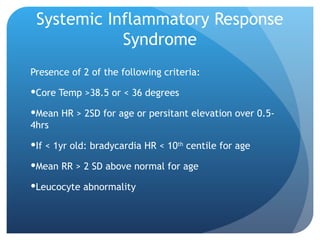
Systemic Inflammatory Response
Syndrome
Presence of 2 of the following criteria:
Core Temp >38.5 or < 36 degrees
Mean HR > 2SD for age or persitant elevation over 0.5-
4hrs
If < 1yr old: bradycardia HR < 10th
centile for age
Mean RR > 2 SD above normal for age
Leucocyte abnormality
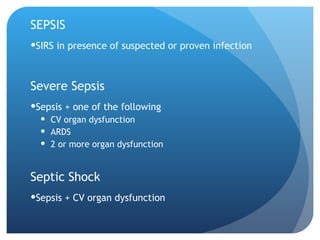
SEPSIS
SIRS in presence of suspected or proven infection
Severe Sepsis
Sepsis + one of the following
 CV organ dysfunction
 ARDS
 2 or more organ dysfunction
Septic Shock
Sepsis + CV organ dysfunction
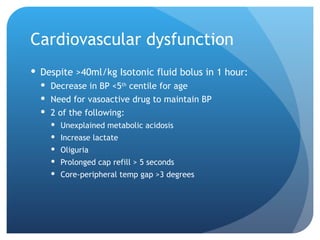
Cardiovascular dysfunction
 Despite >40ml/kg Isotonic fluid bolus in 1 hour:
 Decrease in BP <5th
centile for age
 Need for vasoactive drug to maintain BP
 2 of the following:
 Unexplained metabolic acidosis
 Increase lactate
 Oliguria
 Prolonged cap refill > 5 seconds
 Core-peripheral temp gap >3 degrees
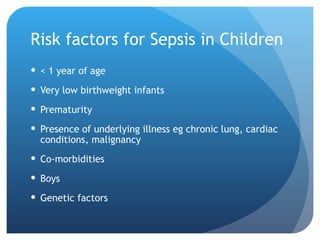
Risk factors for Sepsis in Children
 < 1 year of age
 Very low birthweight infants
 Prematurity
 Presence of underlying illness eg chronic lung, cardiac
conditions, malignancy
 Co-morbidities
 Boys
 Genetic factors
What makes you suspect shock?
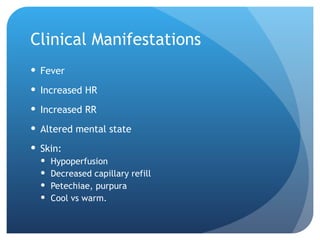
Clinical Manifestations
 Fever
 Increased HR
 Increased RR
 Altered mental state
 Skin:
 Hypoperfusion
 Decreased capillary refill
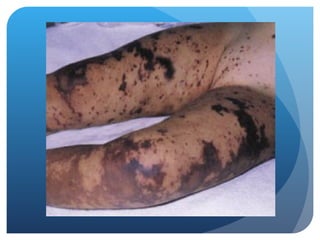
 Petechiae, purpura
 Cool vs warm.
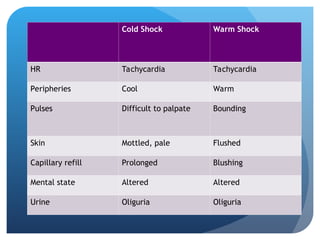
Cold Shock Warm Shock
HR Tachycardia Tachycardia
Peripheries Cool Warm
Pulses Difficult to palpate Bounding
Skin Mottled, pale Flushed
Capillary refill Prolonged Blushing
Mental state Altered Altered
Urine Oliguria Oliguria
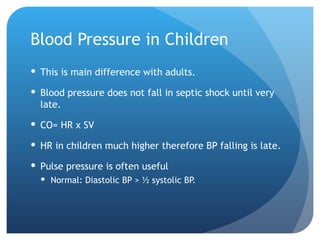
Blood Pressure in Children
 This is main difference with adults.
 Blood pressure does not fall in septic shock until very
late.
 CO= HR x SV
 HR in children much higher therefore BP falling is late.
 Pulse pressure is often useful
 Normal: Diastolic BP > ½ systolic BP.
Investigations
 Basic bloods:
 FBC, EUC, LFT, CMP, Coags, Glucose
 Inflammatory markers: PCT, CRP
 Acid- Base status
 Venous or arterial blood gas:
 Lactate
 Base deficit
Investigations
 Septic Work up
 Urine, blood, sputum cultures
 Viral cultures: throat, NPA, faeces,
 Never do CSF in shocked patient
 Imaging:
 CXR, CT, MRI, PET scan, ECHO, Ultrasound
Management
General Principles
 Early Recognition
 Early and appropriate antimicrobials
 Early and aggressive therapy to restore balance
between oxygen delivery and demand
 Early and goal directed therapy
What is Goal Directed Therapy?
 Based on studies in adults initially
 Use fluid resuscitation, vasoactive infusions, oxygen to
aim to restore balance between oxygen delivery and
demand
 Goals:
 Capillary refill < 2 seconds
 Urine ouptut > 1ml/kg/hr
 Normal pulses
 Improved mental state
 Decreased lactate and base deficits
 Perfusion pressures appropriate for age
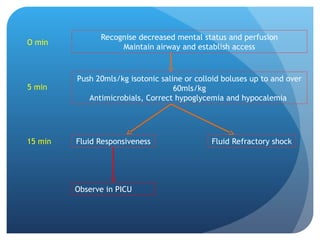
Recognise decreased mental status and perfusion
Maintain airway and establish access
Push 20mls/kg isotonic saline or colloid boluses up to and over
60mls/kg
Antimicrobials, Correct hypoglycemia and hypocalemia
Fluid Responsiveness Fluid Refractory shock
O min
5 min
15 min
Observe in PICU
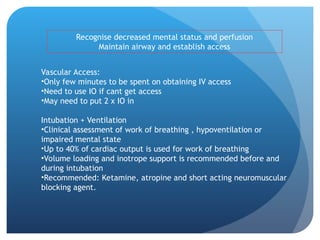
Recognise decreased mental status and perfusion
Maintain airway and establish access
Vascular Access:
•Only few minutes to be spent on obtaining IV access
•Need to use IO if cant get access
•May need to put 2 x IO in
Intubation + Ventilation
•Clinical assessment of work of breathing , hypoventilation or
impaired mental state
•Up to 40% of cardiac output is used for work of breathing
•Volume loading and inotrope support is recommended before and
during intubation
•Recommended: Ketamine, atropine and short acting neuromuscular
blocking agent.
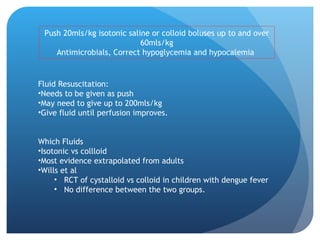
Push 20mls/kg isotonic saline or colloid boluses up to and over
60mls/kg
Antimicrobials, Correct hypoglycemia and hypocalemia
Fluid Resuscitation:
•Needs to be given as push
•May need to give up to 200mls/kg
•Give fluid until perfusion improves.
Which Fluids
•Isotonic vs collloid
•Most evidence extrapolated from adults
•Wills et al
• RCT of cystalloid vs colloid in children with dengue fever
• No difference between the two groups.
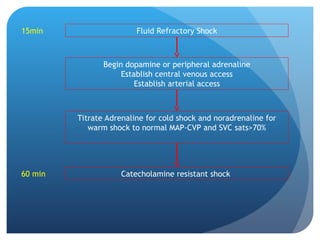
Fluid Refractory Shock
15min
Begin dopamine or peripheral adrenaline
Establish central venous access
Establish arterial access
Titrate Adrenaline for cold shock and noradrenaline for
warm shock to normal MAP-CVP and SVC sats>70%
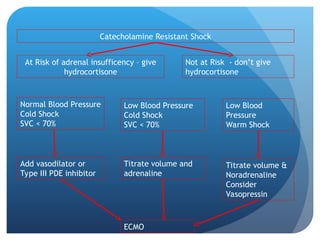
Catecholamine resistant shock
60 min
Catecholamine Resistant Shock
At Risk of adrenal insufficency – give
hydrocortisone
Not at Risk - don’t give
hydrocortisone
Normal Blood Pressure
Cold Shock
SVC < 70%
Low Blood Pressure
Cold Shock
SVC < 70%
Low Blood
Pressure
Warm Shock
Add vasodilator or
Type III PDE inhibitor
Titrate volume and
adrenaline
Titrate volume &
Noradrenaline
Consider
Vasopressin
ECMO
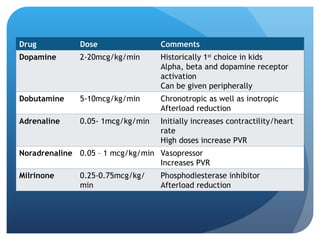
Drug Dose Comments
Dopamine 2-20mcg/kg/min Historically 1st
choice in kids
Alpha, beta and dopamine receptor
activation
Can be given peripherally
Dobutamine 5-10mcg/kg/min Chronotropic as well as inotropic
Afterload reduction
Adrenaline 0.05- 1mcg/kg/min Initially increases contractility/heart
rate
High doses increase PVR
Noradrenaline 0.05 – 1 mcg/kg/min Vasopressor
Increases PVR
Milrinone 0.25-0.75mcg/kg/
min
Phosphodiesterase inhibitor
Afterload reduction
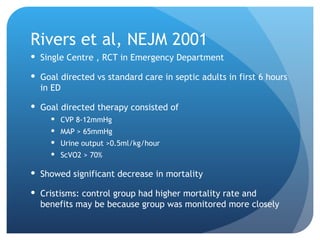
Rivers et al, NEJM 2001
 Single Centre , RCT in Emergency Department
 Goal directed vs standard care in septic adults in first 6 hours
in ED
 Goal directed therapy consisted of
 CVP 8-12mmHg
 MAP > 65mmHg
 Urine output >0.5ml/kg/hour
 ScVO2 > 70%
 Showed significant decrease in mortality
 Cristisms: control group had higher mortality rate and
benefits may be because group was monitored more closely
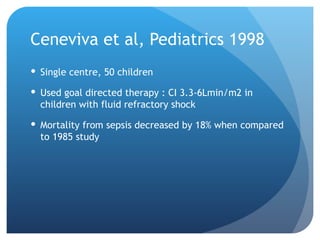
Ceneviva et al, Pediatrics 1998
 Single centre, 50 children
 Used goal directed therapy : CI 3.3-6Lmin/m2 in
children with fluid refractory shock
 Mortality from sepsis decreased by 18% when compared
to 1985 study
De Oliveira ICM 2008
 RCT , single centre
 Use of 2002 guidelines with continous central venous O2
saturation monitoring and therapy directed to maintain
ScVO2 > 70%
 Mortality decreased from 39% to 12 %,
 Number needed to treat 3.6
Brierley and Carcillo CCM 2009
 Update of 2002 guidelines for goal directed therapy
 Look at all studies who had adopted 2002 guidelines and
their success.
 Reported studies that showed decrease in mortality with
adoption of 2002 guidelines.
 New changes :
 Inotrope via peripheral access
 Fluid removal considered early
What about Hydrocortisone?
 Controversial
 Rational is that there is hypothalamic-pituitary adrenal
axis dyfunction in patients with septic shock
 Current recommendations:
 If child is at risk of adrenal insufficency and remains in
shock should receive hydrocortisone
 At risk defined as purpura fulminans, congenital adrenal
hyperplasia, recent steroid exposure,
hypothalamic/pituitary abnormality
Evidence – Controversial
 Annane D JAMA 2002
 Multicentre , RCT looked at use of hydrocortisone and
fludrocortisone in septic shock.
 Corticus Trial, NEJM 2008
 Mutlicentre, RCT
 Hydrocortisone vs placebo in septic shock
 No significant difference in mortality
 Many criticisms
 Inadequate power
 Selection bias
Evidence- paediatrics
 No RCT in paediatric patients with sepsis
 Markovitz : PCCM 2005
 Retrospective cohort study , 6000 paediatric patients
 Systemic steriods associated with increased mortality
 But no control in place for severity of illness or for dose.
Other treatment
 Maintain Glucose control
 Nutrition
 Maintain Hb > 10g/dL
 GI protection
 Early CVVH
Activated Protein C
 Inhibits factors Va and VIIIa – prevent generation of
thrombin
 Decreased inflammation through inhibition of platelet
activation, neutrophil recruitment
 Initially had popularity as possible treatment option in
septic shock
 Concern with it is risk of serious haemorrhage
RESOLVE Study, Lancet 2007
 RCT, multicentre, international study in 477 children
with severe sepsis.
 Compared APC to placebo for 96 hrs
 Primary end point: time to complete organ failure
resolution
 Study stopped early as interim analysis showed no
benefit
 More bleeding in APC group but not significantly
different
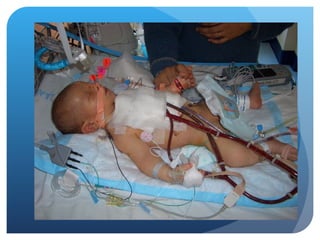
ECMO
 Study published this month from RCH Melbourne
 Looked at ECMO use in paediatric septic shock
 96% had at least 3 organ failure and 35% had a cardiac arrest
prior to ECMO
 23 patients with refractory septic shock received central
ECMO
 17 (74%) patients survived to be discharged from hospital.
paediatric-septic-shock power point presentation

paediatric-septic-shock power point presentation

  • 1.
  • 2.
    1:15am: 3 yearold female arrives at Triage with HR 180, RR 35, looks tired. Has had URTI symptoms for past couple of days. 1:25am: ICU/Paeds Reg called by ED doctor saying can you come and have a look 135am:You make your first assessment  HR 180  Quiet, tired, opens eyes  Mod respiratory distress  Cap refill 4 seconds WHAT DO YOU DO?
  • 3.
    Introduction  Still remainssignificant cause of morbidity and mortality  5-30% of paediatric patients with sepsis will develop septic shock.  Mortality rates in septic shock are 20-30% (up to 50% in some countries).
  • 4.
    Recognition  Most peopledon’t recognise shock  Resuscitation must be done in a proactive time-sensitive manner  Every minute counts – “golden hour”  Every hour without appropriate resuscitation and restoration of blood pressure increases mortality risk by 40%
  • 5.
    How do wedefine it  Systemic Inflammatory Response Syndrome  Infection  Sepsis  Severe Sepsis  Septic Shock
  • 6.
    Systemic Inflammatory Response Syndrome Presenceof 2 of the following criteria: Core Temp >38.5 or < 36 degrees Mean HR > 2SD for age or persitant elevation over 0.5- 4hrs If < 1yr old: bradycardia HR < 10th centile for age Mean RR > 2 SD above normal for age Leucocyte abnormality
  • 7.
    SEPSIS SIRS in presenceof suspected or proven infection Severe Sepsis Sepsis + one of the following  CV organ dysfunction  ARDS  2 or more organ dysfunction Septic Shock Sepsis + CV organ dysfunction
  • 8.
    Cardiovascular dysfunction  Despite>40ml/kg Isotonic fluid bolus in 1 hour:  Decrease in BP <5th centile for age  Need for vasoactive drug to maintain BP  2 of the following:  Unexplained metabolic acidosis  Increase lactate  Oliguria  Prolonged cap refill > 5 seconds  Core-peripheral temp gap >3 degrees
  • 9.
    Risk factors forSepsis in Children  < 1 year of age  Very low birthweight infants  Prematurity  Presence of underlying illness eg chronic lung, cardiac conditions, malignancy  Co-morbidities  Boys  Genetic factors
  • 10.
    What makes yoususpect shock?
  • 11.
    Clinical Manifestations  Fever Increased HR  Increased RR  Altered mental state  Skin:  Hypoperfusion  Decreased capillary refill  Petechiae, purpura  Cool vs warm.
  • 12.
    Cold Shock WarmShock HR Tachycardia Tachycardia Peripheries Cool Warm Pulses Difficult to palpate Bounding Skin Mottled, pale Flushed Capillary refill Prolonged Blushing Mental state Altered Altered Urine Oliguria Oliguria
  • 13.
    Blood Pressure inChildren  This is main difference with adults.  Blood pressure does not fall in septic shock until very late.  CO= HR x SV  HR in children much higher therefore BP falling is late.  Pulse pressure is often useful  Normal: Diastolic BP > ½ systolic BP.
  • 14.
    Investigations  Basic bloods: FBC, EUC, LFT, CMP, Coags, Glucose  Inflammatory markers: PCT, CRP  Acid- Base status  Venous or arterial blood gas:  Lactate  Base deficit
  • 15.
    Investigations  Septic Workup  Urine, blood, sputum cultures  Viral cultures: throat, NPA, faeces,  Never do CSF in shocked patient  Imaging:  CXR, CT, MRI, PET scan, ECHO, Ultrasound
  • 16.
  • 17.
    General Principles  EarlyRecognition  Early and appropriate antimicrobials  Early and aggressive therapy to restore balance between oxygen delivery and demand  Early and goal directed therapy
  • 18.
    What is GoalDirected Therapy?  Based on studies in adults initially  Use fluid resuscitation, vasoactive infusions, oxygen to aim to restore balance between oxygen delivery and demand  Goals:  Capillary refill < 2 seconds  Urine ouptut > 1ml/kg/hr  Normal pulses  Improved mental state  Decreased lactate and base deficits  Perfusion pressures appropriate for age
  • 19.
    Recognise decreased mentalstatus and perfusion Maintain airway and establish access Push 20mls/kg isotonic saline or colloid boluses up to and over 60mls/kg Antimicrobials, Correct hypoglycemia and hypocalemia Fluid Responsiveness Fluid Refractory shock O min 5 min 15 min Observe in PICU
  • 20.
    Recognise decreased mentalstatus and perfusion Maintain airway and establish access Vascular Access: •Only few minutes to be spent on obtaining IV access •Need to use IO if cant get access •May need to put 2 x IO in Intubation + Ventilation •Clinical assessment of work of breathing , hypoventilation or impaired mental state •Up to 40% of cardiac output is used for work of breathing •Volume loading and inotrope support is recommended before and during intubation •Recommended: Ketamine, atropine and short acting neuromuscular blocking agent.
  • 21.
    Push 20mls/kg isotonicsaline or colloid boluses up to and over 60mls/kg Antimicrobials, Correct hypoglycemia and hypocalemia Fluid Resuscitation: •Needs to be given as push •May need to give up to 200mls/kg •Give fluid until perfusion improves. Which Fluids •Isotonic vs collloid •Most evidence extrapolated from adults •Wills et al • RCT of cystalloid vs colloid in children with dengue fever • No difference between the two groups.
  • 22.
    Fluid Refractory Shock 15min Begindopamine or peripheral adrenaline Establish central venous access Establish arterial access Titrate Adrenaline for cold shock and noradrenaline for warm shock to normal MAP-CVP and SVC sats>70% Catecholamine resistant shock 60 min
  • 23.
    Catecholamine Resistant Shock AtRisk of adrenal insufficency – give hydrocortisone Not at Risk - don’t give hydrocortisone Normal Blood Pressure Cold Shock SVC < 70% Low Blood Pressure Cold Shock SVC < 70% Low Blood Pressure Warm Shock Add vasodilator or Type III PDE inhibitor Titrate volume and adrenaline Titrate volume & Noradrenaline Consider Vasopressin ECMO
  • 24.
    Drug Dose Comments Dopamine2-20mcg/kg/min Historically 1st choice in kids Alpha, beta and dopamine receptor activation Can be given peripherally Dobutamine 5-10mcg/kg/min Chronotropic as well as inotropic Afterload reduction Adrenaline 0.05- 1mcg/kg/min Initially increases contractility/heart rate High doses increase PVR Noradrenaline 0.05 – 1 mcg/kg/min Vasopressor Increases PVR Milrinone 0.25-0.75mcg/kg/ min Phosphodiesterase inhibitor Afterload reduction
  • 25.
    Rivers et al,NEJM 2001  Single Centre , RCT in Emergency Department  Goal directed vs standard care in septic adults in first 6 hours in ED  Goal directed therapy consisted of  CVP 8-12mmHg  MAP > 65mmHg  Urine output >0.5ml/kg/hour  ScVO2 > 70%  Showed significant decrease in mortality  Cristisms: control group had higher mortality rate and benefits may be because group was monitored more closely
  • 26.
    Ceneviva et al,Pediatrics 1998  Single centre, 50 children  Used goal directed therapy : CI 3.3-6Lmin/m2 in children with fluid refractory shock  Mortality from sepsis decreased by 18% when compared to 1985 study
  • 27.
    De Oliveira ICM2008  RCT , single centre  Use of 2002 guidelines with continous central venous O2 saturation monitoring and therapy directed to maintain ScVO2 > 70%  Mortality decreased from 39% to 12 %,  Number needed to treat 3.6
  • 28.
    Brierley and CarcilloCCM 2009  Update of 2002 guidelines for goal directed therapy  Look at all studies who had adopted 2002 guidelines and their success.  Reported studies that showed decrease in mortality with adoption of 2002 guidelines.  New changes :  Inotrope via peripheral access  Fluid removal considered early
  • 29.
    What about Hydrocortisone? Controversial  Rational is that there is hypothalamic-pituitary adrenal axis dyfunction in patients with septic shock  Current recommendations:  If child is at risk of adrenal insufficency and remains in shock should receive hydrocortisone  At risk defined as purpura fulminans, congenital adrenal hyperplasia, recent steroid exposure, hypothalamic/pituitary abnormality
  • 30.
    Evidence – Controversial Annane D JAMA 2002  Multicentre , RCT looked at use of hydrocortisone and fludrocortisone in septic shock.  Corticus Trial, NEJM 2008  Mutlicentre, RCT  Hydrocortisone vs placebo in septic shock  No significant difference in mortality  Many criticisms  Inadequate power  Selection bias
  • 31.
    Evidence- paediatrics  NoRCT in paediatric patients with sepsis  Markovitz : PCCM 2005  Retrospective cohort study , 6000 paediatric patients  Systemic steriods associated with increased mortality  But no control in place for severity of illness or for dose.
  • 32.
    Other treatment  MaintainGlucose control  Nutrition  Maintain Hb > 10g/dL  GI protection  Early CVVH
  • 33.
    Activated Protein C Inhibits factors Va and VIIIa – prevent generation of thrombin  Decreased inflammation through inhibition of platelet activation, neutrophil recruitment  Initially had popularity as possible treatment option in septic shock  Concern with it is risk of serious haemorrhage
  • 34.
    RESOLVE Study, Lancet2007  RCT, multicentre, international study in 477 children with severe sepsis.  Compared APC to placebo for 96 hrs  Primary end point: time to complete organ failure resolution  Study stopped early as interim analysis showed no benefit  More bleeding in APC group but not significantly different
  • 35.
    ECMO  Study publishedthis month from RCH Melbourne  Looked at ECMO use in paediatric septic shock  96% had at least 3 organ failure and 35% had a cardiac arrest prior to ECMO  23 patients with refractory septic shock received central ECMO  17 (74%) patients survived to be discharged from hospital.