Herd Immunity
Dr. Archit Khardenavis
Herd Immunity
Herd - A large group of animals/people that live together.
Immunity- Protection against specific infection due to the presence of protective antibodies or cellular immunity
either due to previous infection or due to immunization
• Community Immunity / Population immunity / Herd effect
• Term coined in 1923 , A.W. Hedrich first recognized it as a naturally
occurring phenomenon.
• Definition-It is a type of immunity that occurs when immunization of a
portion of population (or herd) provides protection to unprotected
individuals.
• Importance -Disease elimination or eradication programmes. If the herd
effect reduces the risk of infection among the uninfected sufficiently
then the infection may no longer be sustainable within the population
and the infection may be eliminated.
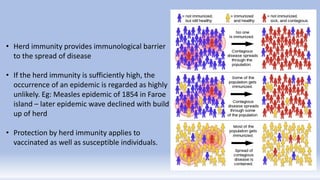
• Herd immunity provides immunological barrier
to the spread of disease
• If the herd immunity is sufficiently high, the
occurrence of an epidemic is regarded as highly
unlikely. Eg: Measles epidemic of 1854 in Faroe
island – later epidemic wave declined with build
up of herd
• Protection by herd immunity applies to
vaccinated as well as susceptible individuals.
• Protection of those without
immunity.
• Serotype replacement
• Elimination/Eradication of disease
Effects of
Herd
Immunity
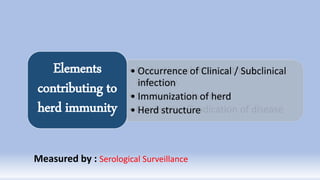
• Occurrence of Clinical / Subclinical
infection
• Immunization of herd
• Herd structure
Elements
contributing to
herd immunity
Measured by : Serological Surveillance
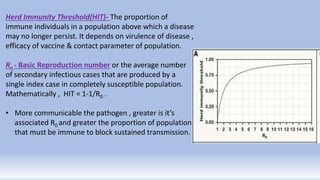
Herd Immunity Threshold(HIT)- The proportion of
immune individuals in a population above which a disease
may no longer persist. It depends on virulence of disease ,
efficacy of vaccine & contact parameter of population.
Ro - Basic Reproduction number or the average number
of secondary infectious cases that are produced by a
single index case in completely susceptible population.
Mathematically , HIT = 1-1/R0 .
• More communicable the pathogen , greater is it’s
associated R0 and greater the proportion of population
that must be immune to block sustained transmission.
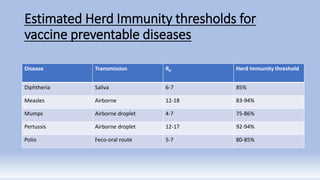
Estimated Herd Immunity thresholds for
vaccine preventable diseases
Disease Transmission R0 Herd Immunity threshold
Diphtheria Saliva 6-7 85%
Measles Airborne 12-18 83-94%
Mumps Airborne droplet 4-7 75-86%
Pertussis Airborne droplet 12-17 92-94%
Polio Feco-oral route 5-7 80-85%
Limitations of Herd Immunity
• The concept of Herd immunity is usually applicable to contagious
diseases only.
• Studies have shown that it is not possible to achieve 100% herd
immunity in a population to halt an epidemic or control disease.
• In some diseases like Rabies & Tetanus , herd immunity does not
protect the individual.
• Without an ongoing immunization program , achieving herd
immunity by natural infection is a very time consuming process.
Hence , it can never be a substitute to vaccination.
Herd Immunity & COVID-19
• With no vaccine available currently , some people argue that the best
way to end this pandemic is to allow the disease to spread until the
threshold is reached in a given population , and the spread drops
naturally thereafter.
Reason for argument :
-Reducing collateral costs of attempting to limit the
disease.
-Minimizing the wastage of resources.
Objections to herd immunity approach:
-Attempts to reach herd immunity through natural infection are not just scientifically
problematic but also unethical.
-Our current knowledge about COVID reinfection is very limited.
-‘Long COVID’ or COVID infections with longer-lasting symptoms make it hard to
assess the consequences of such a course.
Status of Herd Immunity in India :
• India’s COVID 19 epidemic may have crossed a peak , but only 6.6% of
people were found to have antibodies against it ( Seroprevalence
survey Aug-Sep ).
• R0 of SARS COV is still not known, but assuming R0 = 1.5-2 , the HIT
for COVID 19 will be around 50-60%.
• So, It seems unlikely that India has reached Herd Immunity Threshold
for COVID-19.
References
1. ‘Herd Immunity’ : A Rough Guide. Vaccines CID 2011:52
2. Park’s Textbook of Preventive And Social Medicine 25th/Edition
3. Textbook of Epidemiology by Leon Gordis
4. www.who.int : Situation Update Report- 38 (India)
5. Randolph HE, Barreiro LB. Herd Immunity: Understanding
COVID-19. Immunity. 2020 May 19;52(5):737-741. doi:
10.1016/j.immuni.2020.04.012. PMID: 32433946; PMCID:
PMC7236739.
Herd immunity

Herd immunity

  • 1.
  • 2.
    Herd Immunity Herd -A large group of animals/people that live together. Immunity- Protection against specific infection due to the presence of protective antibodies or cellular immunity either due to previous infection or due to immunization • Community Immunity / Population immunity / Herd effect • Term coined in 1923 , A.W. Hedrich first recognized it as a naturally occurring phenomenon. • Definition-It is a type of immunity that occurs when immunization of a portion of population (or herd) provides protection to unprotected individuals. • Importance -Disease elimination or eradication programmes. If the herd effect reduces the risk of infection among the uninfected sufficiently then the infection may no longer be sustainable within the population and the infection may be eliminated.
  • 3.
    • Herd immunityprovides immunological barrier to the spread of disease • If the herd immunity is sufficiently high, the occurrence of an epidemic is regarded as highly unlikely. Eg: Measles epidemic of 1854 in Faroe island – later epidemic wave declined with build up of herd • Protection by herd immunity applies to vaccinated as well as susceptible individuals.
  • 4.
    • Protection ofthose without immunity. • Serotype replacement • Elimination/Eradication of disease Effects of Herd Immunity • Occurrence of Clinical / Subclinical infection • Immunization of herd • Herd structure Elements contributing to herd immunity Measured by : Serological Surveillance
  • 5.
    Herd Immunity Threshold(HIT)-The proportion of immune individuals in a population above which a disease may no longer persist. It depends on virulence of disease , efficacy of vaccine & contact parameter of population. Ro - Basic Reproduction number or the average number of secondary infectious cases that are produced by a single index case in completely susceptible population. Mathematically , HIT = 1-1/R0 . • More communicable the pathogen , greater is it’s associated R0 and greater the proportion of population that must be immune to block sustained transmission.
  • 6.
    Estimated Herd Immunitythresholds for vaccine preventable diseases Disease Transmission R0 Herd Immunity threshold Diphtheria Saliva 6-7 85% Measles Airborne 12-18 83-94% Mumps Airborne droplet 4-7 75-86% Pertussis Airborne droplet 12-17 92-94% Polio Feco-oral route 5-7 80-85%
  • 7.
    Limitations of HerdImmunity • The concept of Herd immunity is usually applicable to contagious diseases only. • Studies have shown that it is not possible to achieve 100% herd immunity in a population to halt an epidemic or control disease. • In some diseases like Rabies & Tetanus , herd immunity does not protect the individual. • Without an ongoing immunization program , achieving herd immunity by natural infection is a very time consuming process. Hence , it can never be a substitute to vaccination.
  • 8.
    Herd Immunity &COVID-19 • With no vaccine available currently , some people argue that the best way to end this pandemic is to allow the disease to spread until the threshold is reached in a given population , and the spread drops naturally thereafter. Reason for argument : -Reducing collateral costs of attempting to limit the disease. -Minimizing the wastage of resources. Objections to herd immunity approach: -Attempts to reach herd immunity through natural infection are not just scientifically problematic but also unethical. -Our current knowledge about COVID reinfection is very limited. -‘Long COVID’ or COVID infections with longer-lasting symptoms make it hard to assess the consequences of such a course.
  • 9.
    Status of HerdImmunity in India : • India’s COVID 19 epidemic may have crossed a peak , but only 6.6% of people were found to have antibodies against it ( Seroprevalence survey Aug-Sep ). • R0 of SARS COV is still not known, but assuming R0 = 1.5-2 , the HIT for COVID 19 will be around 50-60%. • So, It seems unlikely that India has reached Herd Immunity Threshold for COVID-19.
  • 10.
    References 1. ‘Herd Immunity’: A Rough Guide. Vaccines CID 2011:52 2. Park’s Textbook of Preventive And Social Medicine 25th/Edition 3. Textbook of Epidemiology by Leon Gordis 4. www.who.int : Situation Update Report- 38 (India) 5. Randolph HE, Barreiro LB. Herd Immunity: Understanding COVID-19. Immunity. 2020 May 19;52(5):737-741. doi: 10.1016/j.immuni.2020.04.012. PMID: 32433946; PMCID: PMC7236739.