OCCUPATIONAL LUNG DISEASES
DEFINITION:
OCCUPATIONAL LUNG DISEASE ARE USUALLY
DEFINED AS DISEASES ARISING OUT OF OR IN THE
COURSE OF EMPLOYMENT.
(or)
Damage to the lung caused by dust or fumes or noxious
substances inhaled by the workers in certain specific
occupations is known as “occupational lung diseases”.
CLASSIFICATION
Occupational disease are grouped as under;
Diseases due to physical agents ( heat, cold, light,
pressure, noise)
Diseases due to chemical agents ( Gases, dusts)
Diseases due to biological agents (anthrax, encephalitis,
fungal infections)
Diseases of psychological origin (hypertension, peptic
ulcer)
Occupational cancer (cancer of skin, lung and bladder)
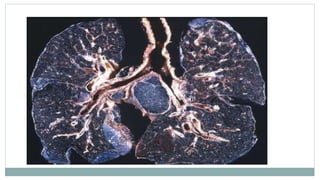
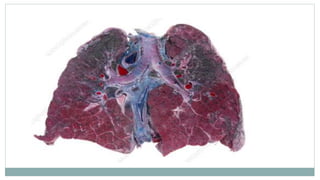
PNEUMOCONIOSIS
 Pneumoconiosis can be defined as the non- neoplastic
reaction of lungs to inhaled minerals or organic dust
and the resultant alteration in their structure excluding
asthma, bronchitis and emphysema.
 It is also known as “ Black lung disease”
TYPES
 SILICOSIS – From silica dust
 ASBESTOSIS – From asbestos dust
 COAL WORKER – From coal dust
 BYSSINOSIS – From cotton dust
 BAGASSOSIS – From sugarcane dust
 FARMER’S LUNG – From mold spores or other
agricultural products
 BERYLLIOSIS – From beryllium
SILICOSIS Among the occupational diseases, silicosis is the major
cause of permanent disability and mortality. It is caused by
inhalation of dust containing free silica or silicon dioxide.
 Particles between 0.5 to 3 micron are the most dangerous
because they reach the interior of the lungs with case.
 The particles are ingested by the phagocytes which
accumulate and block the lymph channels.
 Pathologically, silicosis is characterized by a dense
“nodular” fibrosis, the nodules ranging from 3 to 4 mm in
diameter.
Clinical Features
 Chronic cough
 Dyspnea on exertion
 Fatigue
 Loss of appetite
 Chest pain
 Acute silicosis patients may also have fever and experience
rapid, unintended weight loss
 Impairment of total lung capacity(TLC)
 Shortness of breath
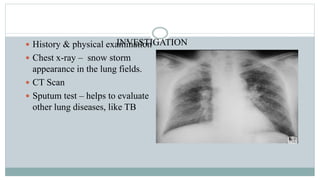
INVESTIGATION History & physical examination
 Chest x-ray – snow storm
appearance in the lung fields.
 CT Scan
 Sputum test – helps to evaluate
other lung diseases, like TB
TREATMENT
There is no cure for silicosis right now.
Treatments can help to reduce symptoms.
 Medications
- inhaled steroids reduce lung mucus.
- Bronchodilators help to relax breathing
passages.
 Oxygen therapy
 Lung transplant – if you have advanced lung damage.
PREVENTIONLimit the time exposed to silica.
Use respirators that protect you from inhaling silica
Wear a mask or other protective clothing while you work
around it.
Stop smoking.
Avoid secondhand smoke and areas with lot of dust, air
pollution and allergens.
COMPLICATION
 SILICOTUBERCULOSIS – Silica is cytotoxic to alveolar
macrophages so patients are at risk of tuberculosis.
 Autoimmune disorder – rheumatoid arthritis, scleroderma.
 Malignancy
ASBESTOSIS
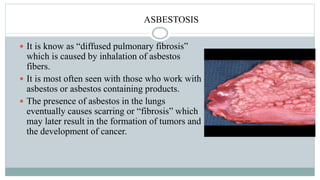
 It is know as “diffused pulmonary fibrosis”
which is caused by inhalation of asbestos
fibers.
 It is most often seen with those who work with
asbestos or asbestos containing products.
 The presence of asbestos in the lungs
eventually causes scarring or “fibrosis” which
may later result in the formation of tumors and
the development of cancer.
SYMPTOMS OF ASBESTOSIS
 Asbestosis do not appear quickly.
 It take as long as to begin to recognize symptoms that
indicate a problem with the lungs.
 Shortness of breath
 Dyspnea
 Persistent dry cough
 Blood in the sputum.
 Chest tightness
 Loss of appetite.
 Difficulty in swallowing.
 Clubbing of fingers.
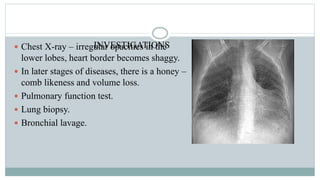
INVESTIGATIONS Chest X-ray – irregular opacities in the
lower lobes, heart border becomes shaggy.
 In later stages of diseases, there is a honey –
comb likeness and volume loss.
 Pulmonary function test.
 Lung biopsy.
 Bronchial lavage.
Asbestosis – Related pleural abnormalities
Four types of abnormalities:
 Pleural plaques
 Benign asbestos pleural effusions
 Diffuse pleural thickening
 Pleural disease puts patient at risk for other asbestos related diseases – 10%get interstitial fibrosis within 10yrs.
 Mostly asymptomatic though some can cause dyspnea, cough
 Latency periods: 10-30yrs.
 No specific treatment
 Pleurectomy in severe cases
MESOTHELIOMAS Both pleural and peritoneal are also associated with
asbestos exposure
 In contrast to lung cancer, these tumors do not appear to be
associated with smoking. Relatively short term asbestos
exposure of 1-2yrs, occurring up to 40yrs in the past, have
been associated with the development of mesotheliomas.
 >80% of mesotheliomas are associated with asbestos
exposure.
TREATMENT
 Removal of any ongoing asbestos exposure.
 Quit smoking.
 Immunizations against pneumococcal pneumonia and
influenza.
 Patients may require home oxygen therapy.
 Corticosteroids and immunosuppressive drugs do not
alter the disease.
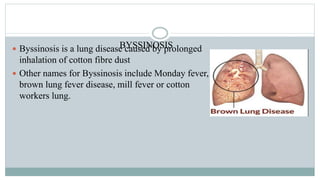
BYSSINOSIS Byssinosis is a lung disease caused by prolonged
inhalation of cotton fibre dust
 Other names for Byssinosis include Monday fever,
brown lung fever disease, mill fever or cotton
workers lung.

RISK FACTORS
 SMOKING
 IMPAIRED LUNG FUNCTION
 BRONCHITIS
 ASTHMA
 INFECTIONS
 HISTORY OF RESPIRATOEY ALLERGY.
SYMPTOMS Tightness in the chest
 Wheezing
 Coughing
 Dyspnea
 Fever
 Shivering
 Tiredness
GRADING OF BYSSINOSIS
 Grade 0 – No symptoms on first day of work
 Grade ½ - Occasional chest tightness or irritation of
respiratory tract on every the first workday of week
 Grade 1 – Chest tightness on every first day of work week.
 Grade 2 – Chest tightness on first and other days of work
week.
 Grade 3 – Chest tightness on first and other days of work
week and physiological evidence of permanent disability.
DIAGNOSIS
 Detailed medical history.
 Physical examination.
 Pulmonary function test.
 Chest X- ray
 CT
 Spirometry.
PREVENTION Enclosure of processing of cotton.
 Quit smoking.
 Wear protective gears.
 Increase ventilation.
 Avoid long term exposure.
BAGASSOSIS
 Bagassosis is the lung disease caused by inhalation of
sugarcane dust.
 This is the form of hypersensitivity pneumonitis.
SYMPTOMS Shortness of breath.
 Cough.
 Coughing blood
 Low grade fever
DIAGNOSIS
 A Chest is enough for a confirmatory diagnosis of
bagassosis as it will show mottling of lungs or may show a
shadow.
FARMER’S LUNG
 Farmer’s lung is a disease caused by an allergy to the mold
in certain crops.
 It is usually caused by breathing in dust from hay, corn,
grass of animal feed, tobacco or some pesticides.
SYMPTOMS Dry irritating cough
 Fever and chills
 Rapid breathing
 Rapid heart rate
 Shortness of breath
 Sudden feeling that you’re sick
DIAGNOSIS
 Pulmonary function test
 Bronchoscopy
 Lung biopsy
TREATMENT
 Avoid dusty work
 Wear a mask or other protective equipment
 Avoid exposure to the offending allergen.
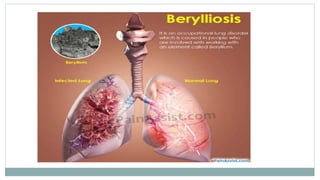
BERYLLIOSIS
 Berylliosis or chronic beryllium disease is a chronic
allergic type lung , response and exposure to beryllium and
its compounds, a form of beryllium poisoning.
SYMPTOMS Cough
 Shortness of breath
 Chest pain
 Joint aches
 Weight loss
 Fever
DIAGNOSIS
 Complete medical history
 Physical examination – abnormal lung sounds may be heard.
 Chest X-ray
 Pulmonary function test
 Lung biopsy
TREAMENT
 Minimize exposure in the workplace.
 Corticosteroid drugs
 Breathing support such as use of ventilators.
 Regular monitoring and appropriate treatment should be
done.
Occupational lung diseases

Occupational lung diseases

  • 1.
  • 2.
    DEFINITION: OCCUPATIONAL LUNG DISEASEARE USUALLY DEFINED AS DISEASES ARISING OUT OF OR IN THE COURSE OF EMPLOYMENT. (or) Damage to the lung caused by dust or fumes or noxious substances inhaled by the workers in certain specific occupations is known as “occupational lung diseases”.
  • 3.
    CLASSIFICATION Occupational disease aregrouped as under; Diseases due to physical agents ( heat, cold, light, pressure, noise) Diseases due to chemical agents ( Gases, dusts) Diseases due to biological agents (anthrax, encephalitis, fungal infections) Diseases of psychological origin (hypertension, peptic ulcer) Occupational cancer (cancer of skin, lung and bladder)
  • 4.
    PNEUMOCONIOSIS  Pneumoconiosis canbe defined as the non- neoplastic reaction of lungs to inhaled minerals or organic dust and the resultant alteration in their structure excluding asthma, bronchitis and emphysema.  It is also known as “ Black lung disease”
  • 6.
    TYPES  SILICOSIS –From silica dust  ASBESTOSIS – From asbestos dust  COAL WORKER – From coal dust  BYSSINOSIS – From cotton dust  BAGASSOSIS – From sugarcane dust  FARMER’S LUNG – From mold spores or other agricultural products  BERYLLIOSIS – From beryllium
  • 7.
    SILICOSIS Among theoccupational diseases, silicosis is the major cause of permanent disability and mortality. It is caused by inhalation of dust containing free silica or silicon dioxide.  Particles between 0.5 to 3 micron are the most dangerous because they reach the interior of the lungs with case.  The particles are ingested by the phagocytes which accumulate and block the lymph channels.  Pathologically, silicosis is characterized by a dense “nodular” fibrosis, the nodules ranging from 3 to 4 mm in diameter.
  • 9.
    Clinical Features  Chroniccough  Dyspnea on exertion  Fatigue  Loss of appetite  Chest pain  Acute silicosis patients may also have fever and experience rapid, unintended weight loss  Impairment of total lung capacity(TLC)  Shortness of breath
  • 10.
    INVESTIGATION History &physical examination  Chest x-ray – snow storm appearance in the lung fields.  CT Scan  Sputum test – helps to evaluate other lung diseases, like TB
  • 11.
    TREATMENT There is nocure for silicosis right now. Treatments can help to reduce symptoms.  Medications - inhaled steroids reduce lung mucus. - Bronchodilators help to relax breathing passages.  Oxygen therapy  Lung transplant – if you have advanced lung damage.
  • 13.
    PREVENTIONLimit the timeexposed to silica. Use respirators that protect you from inhaling silica Wear a mask or other protective clothing while you work around it. Stop smoking. Avoid secondhand smoke and areas with lot of dust, air pollution and allergens.
  • 14.
    COMPLICATION  SILICOTUBERCULOSIS –Silica is cytotoxic to alveolar macrophages so patients are at risk of tuberculosis.  Autoimmune disorder – rheumatoid arthritis, scleroderma.  Malignancy
  • 15.
    ASBESTOSIS  It isknow as “diffused pulmonary fibrosis” which is caused by inhalation of asbestos fibers.  It is most often seen with those who work with asbestos or asbestos containing products.  The presence of asbestos in the lungs eventually causes scarring or “fibrosis” which may later result in the formation of tumors and the development of cancer.
  • 16.
    SYMPTOMS OF ASBESTOSIS Asbestosis do not appear quickly.  It take as long as to begin to recognize symptoms that indicate a problem with the lungs.  Shortness of breath  Dyspnea  Persistent dry cough  Blood in the sputum.  Chest tightness  Loss of appetite.  Difficulty in swallowing.  Clubbing of fingers.
  • 17.
    INVESTIGATIONS Chest X-ray– irregular opacities in the lower lobes, heart border becomes shaggy.  In later stages of diseases, there is a honey – comb likeness and volume loss.  Pulmonary function test.  Lung biopsy.  Bronchial lavage.
  • 18.
    Asbestosis – Relatedpleural abnormalities Four types of abnormalities:  Pleural plaques  Benign asbestos pleural effusions  Diffuse pleural thickening  Pleural disease puts patient at risk for other asbestos related diseases – 10%get interstitial fibrosis within 10yrs.  Mostly asymptomatic though some can cause dyspnea, cough  Latency periods: 10-30yrs.  No specific treatment  Pleurectomy in severe cases
  • 19.
    MESOTHELIOMAS Both pleuraland peritoneal are also associated with asbestos exposure  In contrast to lung cancer, these tumors do not appear to be associated with smoking. Relatively short term asbestos exposure of 1-2yrs, occurring up to 40yrs in the past, have been associated with the development of mesotheliomas.  >80% of mesotheliomas are associated with asbestos exposure.
  • 20.
    TREATMENT  Removal ofany ongoing asbestos exposure.  Quit smoking.  Immunizations against pneumococcal pneumonia and influenza.  Patients may require home oxygen therapy.  Corticosteroids and immunosuppressive drugs do not alter the disease.
  • 21.
    BYSSINOSIS Byssinosis isa lung disease caused by prolonged inhalation of cotton fibre dust  Other names for Byssinosis include Monday fever, brown lung fever disease, mill fever or cotton workers lung.
  • 22.
    RISK FACTORS  SMOKING IMPAIRED LUNG FUNCTION  BRONCHITIS  ASTHMA  INFECTIONS  HISTORY OF RESPIRATOEY ALLERGY.
  • 23.
    SYMPTOMS Tightness inthe chest  Wheezing  Coughing  Dyspnea  Fever  Shivering  Tiredness
  • 24.
    GRADING OF BYSSINOSIS Grade 0 – No symptoms on first day of work  Grade ½ - Occasional chest tightness or irritation of respiratory tract on every the first workday of week  Grade 1 – Chest tightness on every first day of work week.  Grade 2 – Chest tightness on first and other days of work week.  Grade 3 – Chest tightness on first and other days of work week and physiological evidence of permanent disability.
  • 25.
    DIAGNOSIS  Detailed medicalhistory.  Physical examination.  Pulmonary function test.  Chest X- ray  CT  Spirometry.
  • 26.
    PREVENTION Enclosure ofprocessing of cotton.  Quit smoking.  Wear protective gears.  Increase ventilation.  Avoid long term exposure.
  • 27.
    BAGASSOSIS  Bagassosis isthe lung disease caused by inhalation of sugarcane dust.  This is the form of hypersensitivity pneumonitis.
  • 28.
    SYMPTOMS Shortness ofbreath.  Cough.  Coughing blood  Low grade fever
  • 29.
    DIAGNOSIS  A Chestis enough for a confirmatory diagnosis of bagassosis as it will show mottling of lungs or may show a shadow.
  • 30.
    FARMER’S LUNG  Farmer’slung is a disease caused by an allergy to the mold in certain crops.  It is usually caused by breathing in dust from hay, corn, grass of animal feed, tobacco or some pesticides.
  • 31.
    SYMPTOMS Dry irritatingcough  Fever and chills  Rapid breathing  Rapid heart rate  Shortness of breath  Sudden feeling that you’re sick
  • 32.
    DIAGNOSIS  Pulmonary functiontest  Bronchoscopy  Lung biopsy TREATMENT  Avoid dusty work  Wear a mask or other protective equipment  Avoid exposure to the offending allergen.
  • 33.
    BERYLLIOSIS  Berylliosis orchronic beryllium disease is a chronic allergic type lung , response and exposure to beryllium and its compounds, a form of beryllium poisoning.
  • 35.
    SYMPTOMS Cough  Shortnessof breath  Chest pain  Joint aches  Weight loss  Fever
  • 36.
    DIAGNOSIS  Complete medicalhistory  Physical examination – abnormal lung sounds may be heard.  Chest X-ray  Pulmonary function test  Lung biopsy
  • 37.
    TREAMENT  Minimize exposurein the workplace.  Corticosteroid drugs  Breathing support such as use of ventilators.  Regular monitoring and appropriate treatment should be done.