Warehousing
By Himani N. Chauhan
M.Pharm ,1st sem
Contents
 Definition
 Objective
 Function
 Purpose
 General guidelines of warehousing
 Types
 Finished product warehousing
 Layout of pharmaceutical warehousing
 SOP for warehousing
 Design and construction
 Maintenance
 Sanitation
 GWP
Definition:-
 What is Warehousing?
 It refers to the activities involving storage of goods on a large scale
in a systemic and orderly manner and making them available
conveniently when needed.
 What is warehouse?
 It is a part of pharmacy industiries,where the process of holding or
preserving goods is carried out in huge quantities, from time of the
production to their purchase.
Objective:-
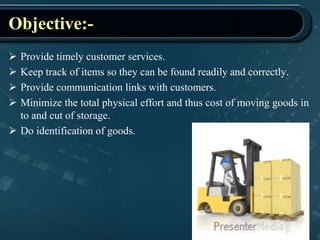
 Provide timely customer services.
 Keep track of items so they can be found readily and correctly.
 Provide communication links with customers.
 Minimize the total physical effort and thus cost of moving goods in
to and cut of storage.
 Do identification of goods.
Purpose:-
 To enable the fastest and cheapest transport of drugs and medical
equipment from suppliers to beneficiaries.
 There are mainly 3 stages:
1. Purchase of pharmaceutical products.
2. Storage of ordered products.
3. Distribution of stocked products
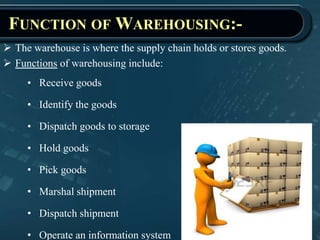
FUNCTION OF WAREHOUSING:-
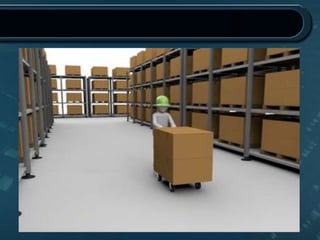
 The warehouse is where the supply chain holds or stores goods.
 Functions of warehousing include:
• Receive goods
• Identify the goods
• Dispatch goods to storage
• Hold goods
• Pick goods
• Marshal shipment
• Dispatch shipment
• Operate an information system
PRINCIPLES OF WAREHOUSE
Use one-story
facilities
Move goods in
a straight line
Use efficient
materials-
handling
equipment
Use an
effective
storage plan
9
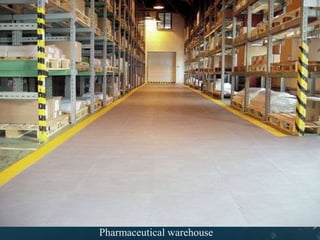
Pharmaceutical warehouse
Warehousing:-
 Written procedures describing the warehousing of drug products
shall be established and followed.This written procedure adopted as ‘
Best practice', which provides step by step guidelines on how to
manage each aspect of warehousing and it may cover following steps.
 They shall include:
 Receiving of goods.
 Quality control or verification.
 Storage of goods.
 How to control stock movement.
 Documentation flow.
 How to detect and deal with stock losses.
 How rejected material will be managed and how to deal with
unwanted material, obsolete and scrap, disposal.
General guidelines of warehousing:-
 Materials received against specific supply devices
 Each such consignment have written documents (delivery Chalan)
 All materials received by responsible persons
 materials to be checked for cleanliness & package integrity
 Damaged container separated & reporting immediately
 Check for proper container labeling
 i.e. status of materials ―UNDER TEST,
 ―A Waiting for APPROVAL
 General guideline for warehousing should include following
subparts:
1. Premises
2. Receiving
3. Sampling
4. Release or reject
5. Dispensing &issuing
6. Packaging material
7. Returned goods or returned material
8. Warehousing of finished product
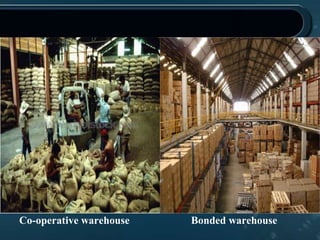
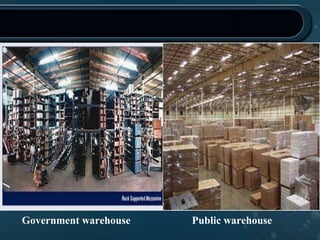
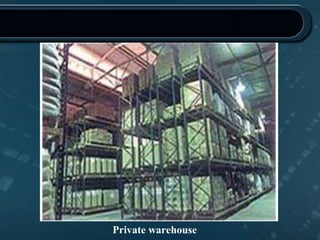
Types of Warehouses:-
Warehouses have been classified as under:
 Private Warehouses
 Public Warehouses
 Government Warehouses
 Bonded Warehouses
 Co-operative Warehouses
Co-operative warehouse Bonded warehouse
Government warehouse Public warehouse
Private warehouse
Warehousing of finished product:-
 —requirements:-
 safe , orderly & dispatch of all products
 cold storage area have temperature monitoring & recording devices.
 racking & shelving system should have good mechanical strength.
 —Procedure:-stock received from factory with proper documentation
(name, batch number, date of dispatch)
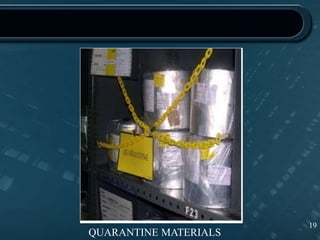
 —Finished products which are ―under test" must be quarantined &
segregated from ―passed stocks”
 —Stock should be stored product wise to enable quick identification &
controlled stock movement
 —Store rotation should be on ―first in ,first out basis.
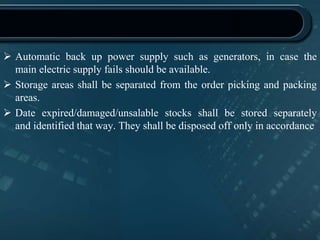
 Automatic back up power supply such as generators, in case the
main electric supply fails should be available.
 Storage areas shall be separated from the order picking and packing
areas.
 Date expired/damaged/unsalable stocks shall be stored separately
and identified that way. They shall be disposed off only in accordance
19
QUARANTINE MATERIALS
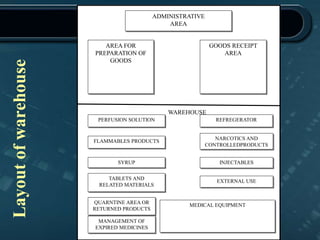
ADMINISTRATIVE
AREA
AREA FOR
PREPARATION OF
GOODS
GOODS RECEIPT
AREA
WAREHOUSE
PERFUSION SOLUTION
FLAMMABLES PRODUCTS
SYRUP
TABLETS AND
RELATED MATERIALS
REFREGERATOR
NARCOTICS AND
CONTROLLEDPRODUCTS
INJECTABLES
EXTERNAL USE
MEDICAL EQUIPMENT
QUARNTINE AREA OR
RETURNED PRODUCTS
MANAGEMENT OF
EXPIRED MEDICINES
Layoutofwarehouse
Warehouse flow system:-
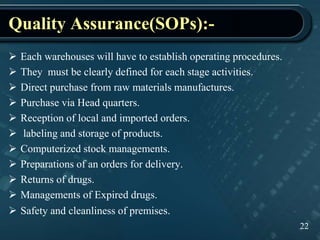
Quality Assurance(SOPs):-
 Each warehouses will have to establish operating procedures.
 They must be clearly defined for each stage activities.
 Direct purchase from raw materials manufactures.
 Purchase via Head quarters.
 Reception of local and imported orders.
 labeling and storage of products.
 Computerized stock managements.
 Preparations of an orders for delivery.
 Returns of drugs.
 Managements of Expired drugs.
 Safety and cleanliness of premises.
22
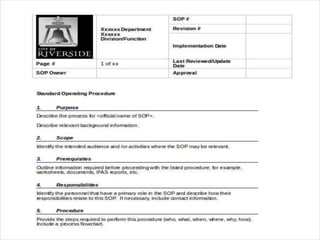
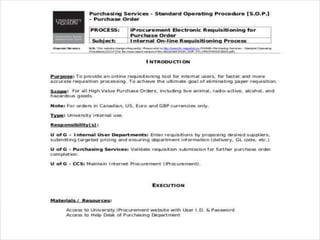
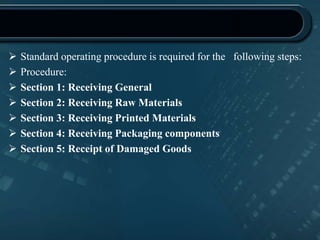
 Standard operating procedure is required for the following steps:
 Procedure:
 Section 1: Receiving General
 Section 2: Receiving Raw Materials
 Section 3: Receiving Printed Materials
 Section 4: Receiving Packaging components
 Section 5: Receipt of Damaged Goods
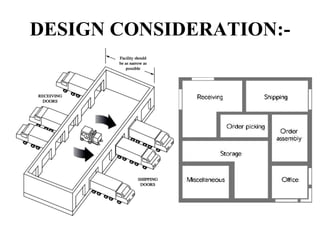
DESIGN CONSIDERATION:-
Ideal Facility for Pure Supplier
Consolidation
Warehouse Space
Requirements
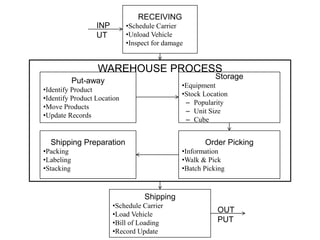
WAREHOUSE PROCESS
Put-away
•Identify Product
•Identify Product Location
•Move Products
•Update Records
Storage
•Equipment
•Stock Location
– Popularity
– Unit Size
– Cube
Shipping Preparation
•Packing
•Labeling
•Stacking
Order Picking
•Information
•Walk & Pick
•Batch Picking
Shipping
•Schedule Carrier
•Load Vehicle
•Bill of Loading
•Record Update
RECEIVING
•Schedule Carrier
•Unload Vehicle
•Inspect for damage
INP
UT
OUT
PUT
Sanitation:-
28
 —Written sanitation programs should be available. These should include
validated cleaning procedures for premises and equipment, a quality
standard for water, instructions for hygiene when manufacturing and
handling goods, and instructions relating to the health, hygienic practi-
ces, and clothing of personnel and the disposal procedures for waste
materials and unusable residues.
 Eating, smoking, and unhygienic practices should not be permitted in
manufacturing areas.
 There shall be written procedures for use of suitable rodenticides,
insecticides, fungicides, fumigating agents and cleaning and sanitizing
agents.
 cleaning procedure to be followed, including equipment and materials
.
Maintenance:-
30
 Any building used in the manufacture, processing, packing, or
holding of a drug product shall be maintained in a good state of
repair.
 Deterioration of buildings not only presents a poor image of the
facility, it can also impact on product quality.
 Cracks and holes in walls, floors, or ceilings can provide access for
insects, rodents, birds, dirt, or microorganisms.
 They can also hinder cleaning and sanitation, thereby increasing the
potential for cross contamination or microbial multiplication.
 Floor cracks can also become a safety hazard for people or even
dislodge materials from trucks.
 The ingress of water from roof leaks can cause significant damage
to materials and equipment, give rise to electrical failures and fires
and result in damage to the basic structure of the building.
 Additionally, holes in the roof or near the tops of buildings provide
ready access to birds, which may then be encouraged to nest within
the building.
31
Good warehousing practice(GWP):-
32
 Factory Stock which should be received with proper documents
detailing the names of product ,the batch number ,the number of
units of final packs of each batch ,the date of dispatch and the
quality control status of the batches.
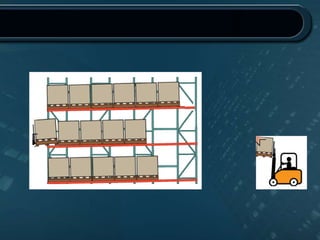
 The stock control system must be such that only passed batches of
products are issued for distribution. Stocks should be stored, product
wise to enable quick identification and control of stock movement .
Stocks should therefore be racked and stored in a manner that earlier
stocks are more early accessible than the later ones.
 The picking and assembling areas should be so arranged as to
minimize the distance travelled by warehouse operators. Picking
stocks should be located on shelves at convenient heights and with
proper labels which clearly identify the products.
 Assembled products should be checked for accuracy of quantities
and identities of products ordered. Batch details should be
recorded in relevant documents.
 Finished product should be packed in the containers and
dispatched for the transportation.
 The unit product packs should be not contaminated by other
products. Vehicles which carry the final packaged stocks of
products should be so selected that-
1) They are clear, dry and sufficiently protected from rain and other
weather factors .
2) They are free from infestation .
3) They do not give off strong odors which may contaminate the
products .
4) They are suitable to withstand the weight of the load they carry .
33
STOCK MANAGEMENT
Objectives:-
 To ensure continuity of supplies.
 To avoid over stocking.
 monitor stock levels
 monitor consumption
 anticipate delivery time for order activation.
 Issuing of material:-
 store should issue raw and packaging materials on the basis of FIFO
(first come first out) basis. Entry and exit of every consignment of
materials should be entered on the stock card.
 Issuing of materials should do on the basis of raw and packaging
materials required in manufacturing process. while issuing hazardous
and explosive materials, the operation should be supervised to prevent
any mistake.
Warehouse process:-
 warehousing[1]

warehousing[1]

  • 1.
    Warehousing By Himani N.Chauhan M.Pharm ,1st sem
  • 2.
    Contents  Definition  Objective Function  Purpose  General guidelines of warehousing  Types  Finished product warehousing  Layout of pharmaceutical warehousing  SOP for warehousing  Design and construction  Maintenance  Sanitation  GWP
  • 3.
    Definition:-  What isWarehousing?  It refers to the activities involving storage of goods on a large scale in a systemic and orderly manner and making them available conveniently when needed.  What is warehouse?  It is a part of pharmacy industiries,where the process of holding or preserving goods is carried out in huge quantities, from time of the production to their purchase.
  • 5.
    Objective:-  Provide timelycustomer services.  Keep track of items so they can be found readily and correctly.  Provide communication links with customers.  Minimize the total physical effort and thus cost of moving goods in to and cut of storage.  Do identification of goods.
  • 6.
    Purpose:-  To enablethe fastest and cheapest transport of drugs and medical equipment from suppliers to beneficiaries.  There are mainly 3 stages: 1. Purchase of pharmaceutical products. 2. Storage of ordered products. 3. Distribution of stocked products
  • 7.
    FUNCTION OF WAREHOUSING:- The warehouse is where the supply chain holds or stores goods.  Functions of warehousing include: • Receive goods • Identify the goods • Dispatch goods to storage • Hold goods • Pick goods • Marshal shipment • Dispatch shipment • Operate an information system
  • 8.
    PRINCIPLES OF WAREHOUSE Useone-story facilities Move goods in a straight line Use efficient materials- handling equipment Use an effective storage plan
  • 9.
  • 10.
    Warehousing:-  Written proceduresdescribing the warehousing of drug products shall be established and followed.This written procedure adopted as ‘ Best practice', which provides step by step guidelines on how to manage each aspect of warehousing and it may cover following steps.  They shall include:  Receiving of goods.  Quality control or verification.  Storage of goods.  How to control stock movement.  Documentation flow.  How to detect and deal with stock losses.  How rejected material will be managed and how to deal with unwanted material, obsolete and scrap, disposal.
  • 11.
    General guidelines ofwarehousing:-  Materials received against specific supply devices  Each such consignment have written documents (delivery Chalan)  All materials received by responsible persons  materials to be checked for cleanliness & package integrity  Damaged container separated & reporting immediately  Check for proper container labeling  i.e. status of materials ―UNDER TEST,  ―A Waiting for APPROVAL
  • 12.
     General guidelinefor warehousing should include following subparts: 1. Premises 2. Receiving 3. Sampling 4. Release or reject 5. Dispensing &issuing 6. Packaging material 7. Returned goods or returned material 8. Warehousing of finished product
  • 13.
    Types of Warehouses:- Warehouseshave been classified as under:  Private Warehouses  Public Warehouses  Government Warehouses  Bonded Warehouses  Co-operative Warehouses
  • 14.
  • 15.
  • 16.
  • 17.
    Warehousing of finishedproduct:-  —requirements:-  safe , orderly & dispatch of all products  cold storage area have temperature monitoring & recording devices.  racking & shelving system should have good mechanical strength.  —Procedure:-stock received from factory with proper documentation (name, batch number, date of dispatch)  —Finished products which are ―under test" must be quarantined & segregated from ―passed stocks”  —Stock should be stored product wise to enable quick identification & controlled stock movement  —Store rotation should be on ―first in ,first out basis.
  • 18.
     Automatic backup power supply such as generators, in case the main electric supply fails should be available.  Storage areas shall be separated from the order picking and packing areas.  Date expired/damaged/unsalable stocks shall be stored separately and identified that way. They shall be disposed off only in accordance
  • 19.
  • 20.
    ADMINISTRATIVE AREA AREA FOR PREPARATION OF GOODS GOODSRECEIPT AREA WAREHOUSE PERFUSION SOLUTION FLAMMABLES PRODUCTS SYRUP TABLETS AND RELATED MATERIALS REFREGERATOR NARCOTICS AND CONTROLLEDPRODUCTS INJECTABLES EXTERNAL USE MEDICAL EQUIPMENT QUARNTINE AREA OR RETURNED PRODUCTS MANAGEMENT OF EXPIRED MEDICINES Layoutofwarehouse
  • 21.
  • 22.
    Quality Assurance(SOPs):-  Eachwarehouses will have to establish operating procedures.  They must be clearly defined for each stage activities.  Direct purchase from raw materials manufactures.  Purchase via Head quarters.  Reception of local and imported orders.  labeling and storage of products.  Computerized stock managements.  Preparations of an orders for delivery.  Returns of drugs.  Managements of Expired drugs.  Safety and cleanliness of premises. 22
  • 25.
     Standard operatingprocedure is required for the following steps:  Procedure:  Section 1: Receiving General  Section 2: Receiving Raw Materials  Section 3: Receiving Printed Materials  Section 4: Receiving Packaging components  Section 5: Receipt of Damaged Goods
  • 26.
    DESIGN CONSIDERATION:- Ideal Facilityfor Pure Supplier Consolidation Warehouse Space Requirements
  • 27.
    WAREHOUSE PROCESS Put-away •Identify Product •IdentifyProduct Location •Move Products •Update Records Storage •Equipment •Stock Location – Popularity – Unit Size – Cube Shipping Preparation •Packing •Labeling •Stacking Order Picking •Information •Walk & Pick •Batch Picking Shipping •Schedule Carrier •Load Vehicle •Bill of Loading •Record Update RECEIVING •Schedule Carrier •Unload Vehicle •Inspect for damage INP UT OUT PUT
  • 28.
    Sanitation:- 28  —Written sanitationprograms should be available. These should include validated cleaning procedures for premises and equipment, a quality standard for water, instructions for hygiene when manufacturing and handling goods, and instructions relating to the health, hygienic practi- ces, and clothing of personnel and the disposal procedures for waste materials and unusable residues.  Eating, smoking, and unhygienic practices should not be permitted in manufacturing areas.  There shall be written procedures for use of suitable rodenticides, insecticides, fungicides, fumigating agents and cleaning and sanitizing agents.  cleaning procedure to be followed, including equipment and materials .
  • 30.
    Maintenance:- 30  Any buildingused in the manufacture, processing, packing, or holding of a drug product shall be maintained in a good state of repair.  Deterioration of buildings not only presents a poor image of the facility, it can also impact on product quality.  Cracks and holes in walls, floors, or ceilings can provide access for insects, rodents, birds, dirt, or microorganisms.  They can also hinder cleaning and sanitation, thereby increasing the potential for cross contamination or microbial multiplication.  Floor cracks can also become a safety hazard for people or even dislodge materials from trucks.
  • 31.
     The ingressof water from roof leaks can cause significant damage to materials and equipment, give rise to electrical failures and fires and result in damage to the basic structure of the building.  Additionally, holes in the roof or near the tops of buildings provide ready access to birds, which may then be encouraged to nest within the building. 31
  • 32.
    Good warehousing practice(GWP):- 32 Factory Stock which should be received with proper documents detailing the names of product ,the batch number ,the number of units of final packs of each batch ,the date of dispatch and the quality control status of the batches.  The stock control system must be such that only passed batches of products are issued for distribution. Stocks should be stored, product wise to enable quick identification and control of stock movement . Stocks should therefore be racked and stored in a manner that earlier stocks are more early accessible than the later ones.  The picking and assembling areas should be so arranged as to minimize the distance travelled by warehouse operators. Picking stocks should be located on shelves at convenient heights and with proper labels which clearly identify the products.
  • 33.
     Assembled productsshould be checked for accuracy of quantities and identities of products ordered. Batch details should be recorded in relevant documents.  Finished product should be packed in the containers and dispatched for the transportation.  The unit product packs should be not contaminated by other products. Vehicles which carry the final packaged stocks of products should be so selected that- 1) They are clear, dry and sufficiently protected from rain and other weather factors . 2) They are free from infestation . 3) They do not give off strong odors which may contaminate the products . 4) They are suitable to withstand the weight of the load they carry . 33
  • 35.
    STOCK MANAGEMENT Objectives:-  Toensure continuity of supplies.  To avoid over stocking.  monitor stock levels  monitor consumption  anticipate delivery time for order activation.  Issuing of material:-  store should issue raw and packaging materials on the basis of FIFO (first come first out) basis. Entry and exit of every consignment of materials should be entered on the stock card.  Issuing of materials should do on the basis of raw and packaging materials required in manufacturing process. while issuing hazardous and explosive materials, the operation should be supervised to prevent any mistake.
  • 36.