SCM-
Logistics
Function
Chapter Objectives
Be able to:
Describe why logistics is important and discuss the major decision
areas that make up logistics.
List the strengths and weaknesses of the various modes of
transportation and discuss the role of multimodal solutions.
Identify the major types of warehousing solutions and their benefits.
Discuss the purpose of a logistics strategy and give examples of how
logistics can support the overall business strategy.
Calculate the percentage of perfect orders.
Calculate landed costs.
Explain what reverse logistics systems are, and describe some of the
unique challenges they create for firms.
Use the weighted center of gravity method to identify a potential
location for a business.
Develop and then solve, using Microsoft Excel’s Solver function, an
assignment problem.
Logistics Management
 Logistics management – That part
of supply chain management that
plans, implements, and controls
the efficient, effective forward and
reverse flow and storage of goods,
services, and related information
between the point of origin and
the point of consumption in order
to meet customers’ requirements.
© CSCMP – Council of Supply Chain Management Professionals
Logistics Management
 Transportation
 Warehousing
 Material handling
 Packaging
 Inventory management
 Logistics information systems
Why Logistics Is Critical
 Impact on cost, flexibility, and
delivery performance
 Advances in information systems
 Globalization of markets
 Push toward sustainability
Transportation
 Highway
 Water
 Air
 Rail
 Pipeline
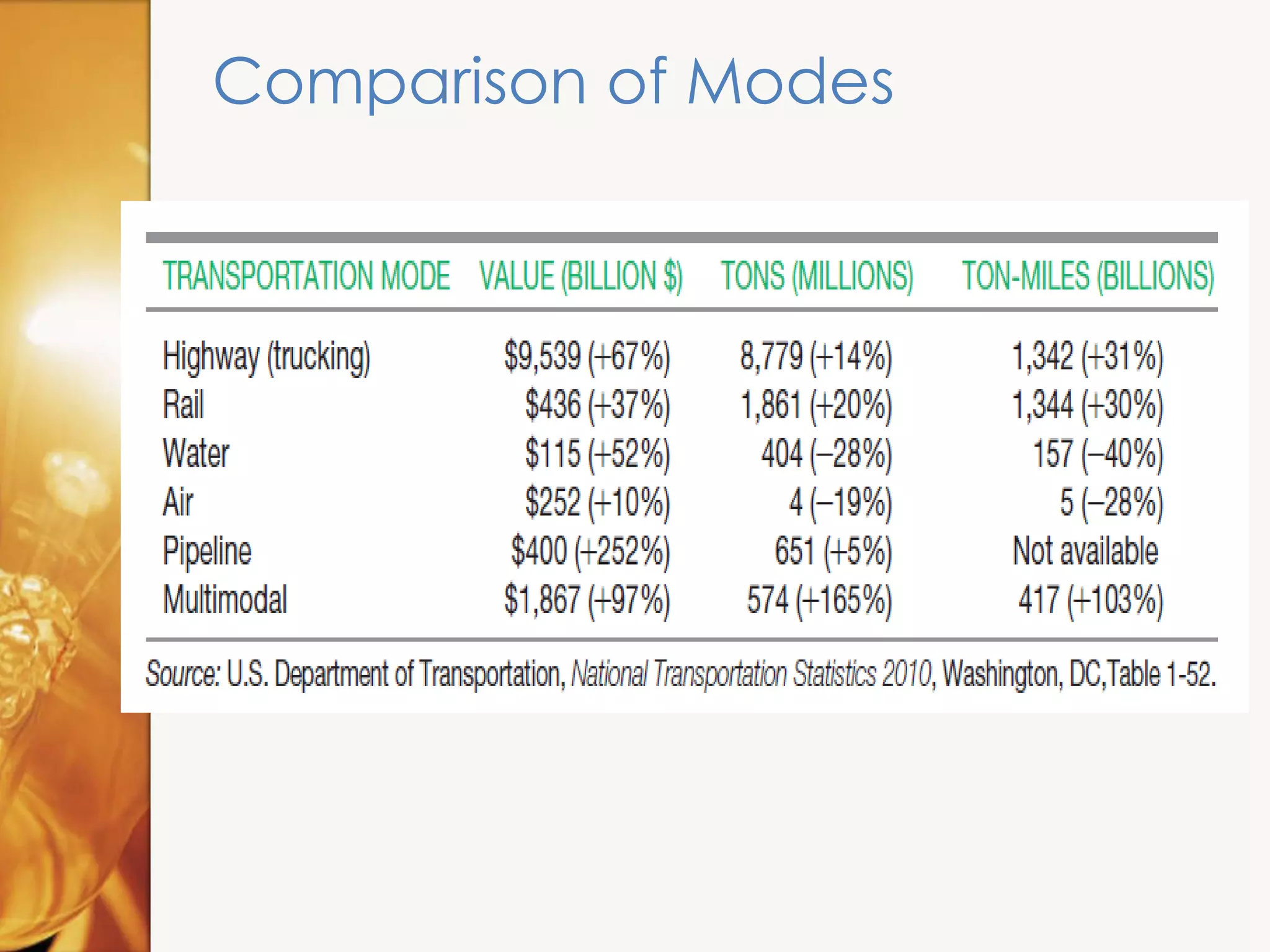
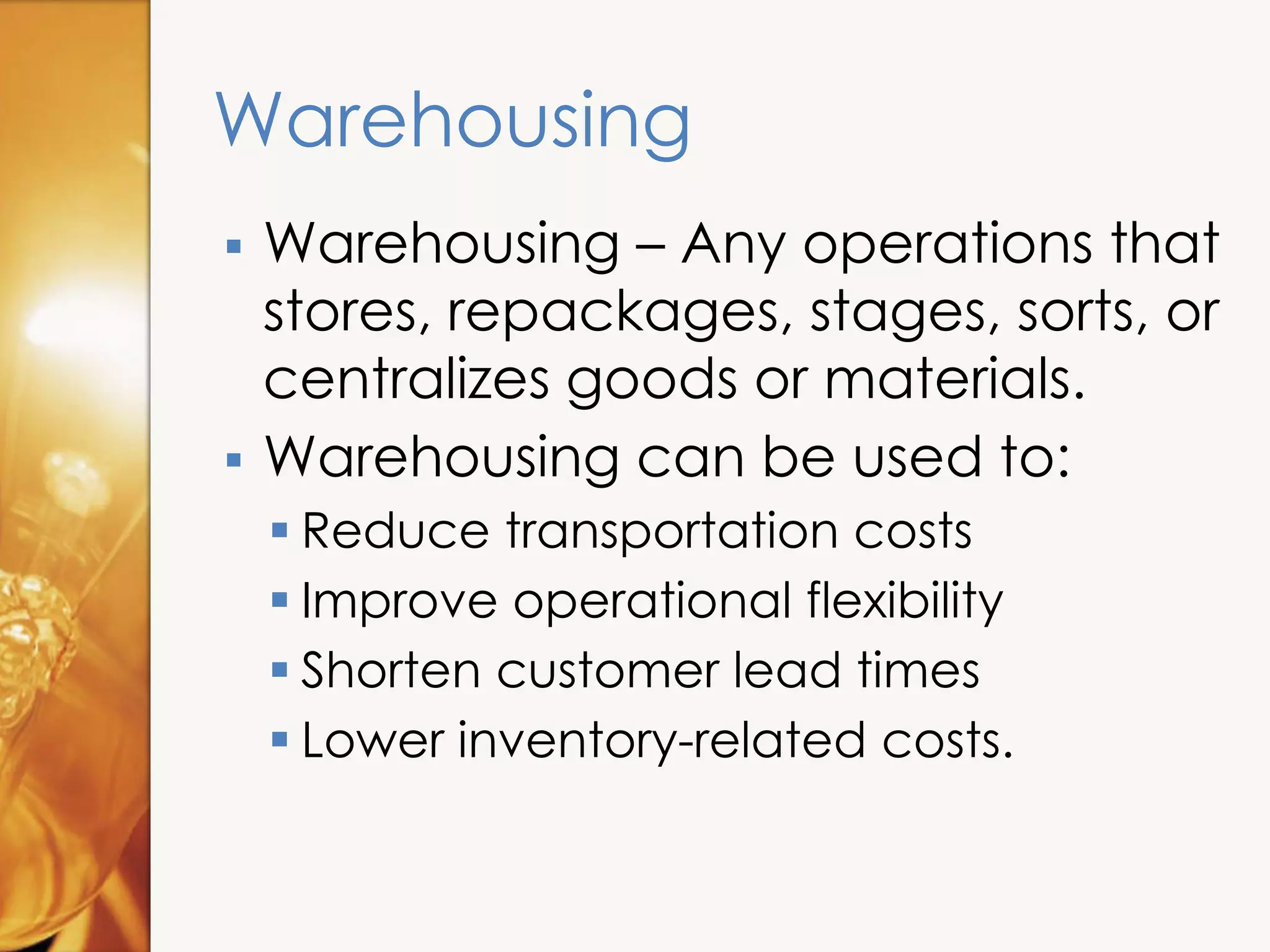
Comparison of Modes
Table 8.1
Highway
 Dominates the logistics infrastructure due to:
 Geographic extension of supply chains
 Greater emphasis on delivery speed and flexibility
 Has become more cost effective over time due to:
 Better scheduling and use of vehicle capacity
 More efficient and reliable vehicles
 Increased cost competition due to deregulation
 Involves different types of shipments
 Direct truck – Shipment made with no stops
 Less than truckload (LTL) – Smaller shipment combined
with other loads
Water
 Ideal for materials with high
weight-to-value ratio, especially if
delivery speed is not critical.
 Examples: farm produce, timber,
petroleum-based products.
Air
 Ideal for customers with a low weight-
to-value ratio, especially if delivery
speed or delivery reliability is critical.
 Higher shipping costs and improvement
in other modes have reversed the rise in
air growth over the past decade.
Rail
 Characteristics similar to Water but
more flexible.
 To accommodate growth, rail carriers
have doubled the number of lines
along busy corridors, changed the
physical configuration of the trains, and
utilized multimodal solutions.
Selecting a Transportation Mode
Multimodal Solutions
 Multimodal solution – A transportation
solution that seeks to exploit the
strengths of multiple transportation
modes through physical, information,
and monetary flows that are as
seamless as possible
 Roadrailer – A specialized rail car the size of
a standard truck trailer that can be quickly
switched from rail to ground transportation
without changing the wheels.
Warehousing
 Warehousing – Any operations that
stores, repackages, stages, sorts, or
centralizes goods or materials.
 Warehousing can be used to:
 Reduce transportation costs
 Improve operational flexibility
 Shorten customer lead times
 Lower inventory-related costs.
Consolidation Warehousing
 Consolidation warehousing – A
form of warehousing that pulls
together shipments from a number
of sources in the same geographic
area and combines them into
larger and more economical loads
 Cross-docking
 Break-bulk
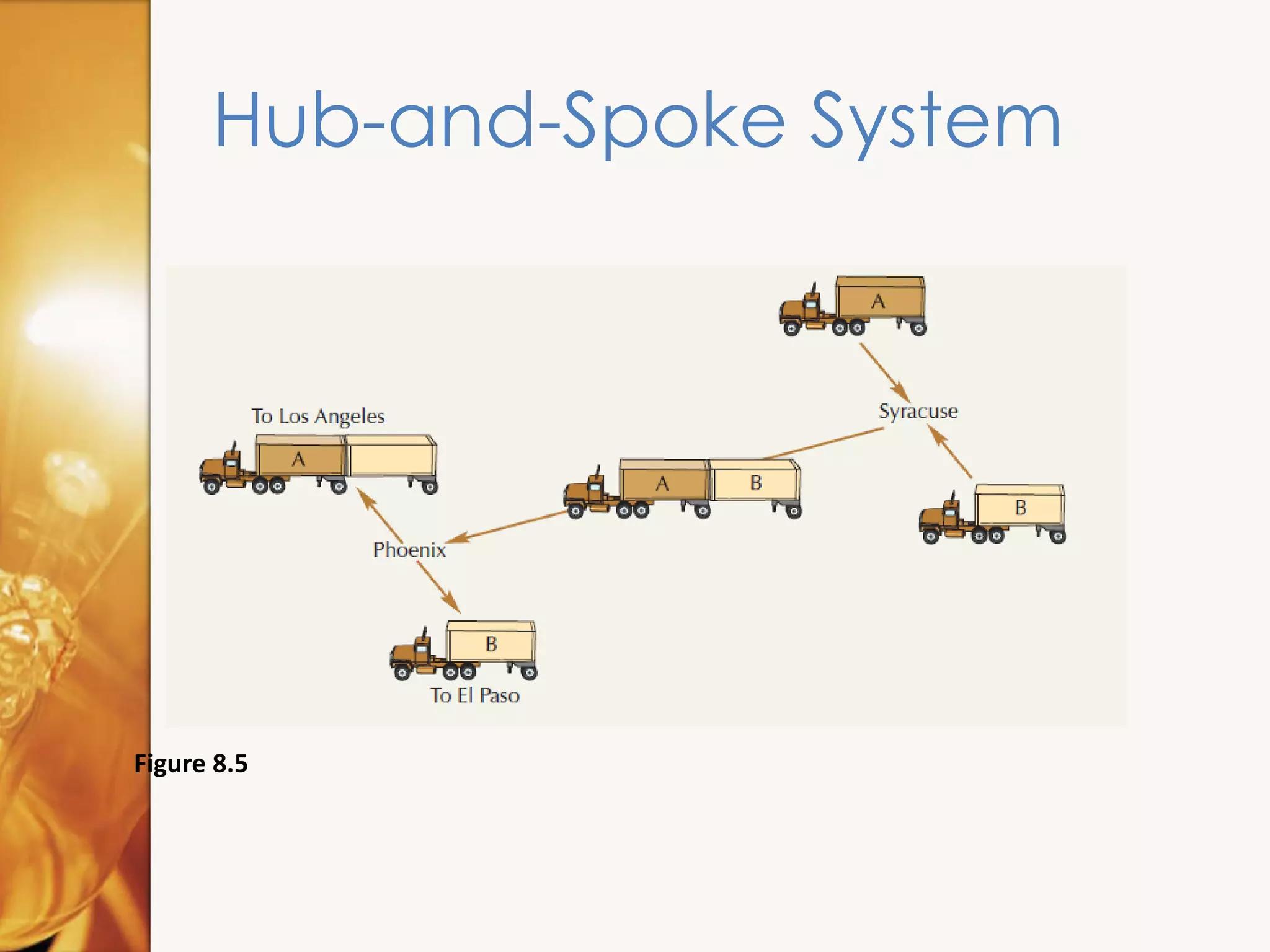
 Hub-and-spoke system
Consolidation Warehousing
Figure 8.2
Cross-Docking
Figure 8.3
Hub-and-Spoke System
Figure 8.5
Postponement Warehousing
 Postponement warehousing – A
form of warehousing that
combines classic warehouse
operations with light
manufacturing and packaging
duties to allow firms to put off final
assembly or packaging of goods
until the last possible moment.
Types of Warehouses
 Assortment warehouses – A form of
warehouses in which a wide array of
goods is held close to the source of
demand in order to assure short
customer lead times.
 Spot stock warehouses – A form of
warehouses that attempts to position
seasonal goods close to the
marketplace.
Logistics Information Systems
 Decision support tools
◦ Real-time simulation and optimization
◦ Cost estimations
 Planning systems
◦ Carrier selection
◦ Scheduling deliveries
 Execution systems
◦ RFID
Material Handling and
Packaging
 Material handling system – A system that
includes the equipment and procedures
needed to move goods within a facility,
between a facility and a transportation mode,
and between different transportation modes.
 Packaging – The way goods and materials are
packed in order to facilitate physical,
informational, and monetary flows through the
supply chain.
Inventory Management
 Implications for transportation:
 Using slower and cheaper transportation
modes will cause inventory levels within the
supply chain to rise.
 Using faster and more expensive
transportation modes will enable firms to
lower inventory levels.
 Implication for warehousing:
 Warehousing and inventory managers must
work closely to achieve the desired business
outcome.
Logistics Strategy
 Logistics strategy – A functional
strategy which ensures that an
organization’s logistics choices are
consistent with its overall business
strategy and support the
performance dimensions that
targeted customers most value.
Owning vs. Outsourcing
 Does the firm have the volume needed to
justify a private logistics system?
 Would owning a logistics system limit the firm’s
ability to respond to changes in the
marketplace or supply chain?
 Is logistics a core competency for the firm?
 Outsourcing options:
 Common carriers
 Contract carriers
 Third-party logistics providers (3PL)
Making Transportation/Warehousing
Decisions Based on Order Winners
Table 8.3
Measuring Logistics Performance
 The perfect order
 Delivered on time (according to
buyer’s delivery dates)
 Shipped complete
 Invoiced correctly
 Undamaged in transit
Perfect order – Example 8.4
Landed Costs
 Landed cost – The cost of a
product plus all costs driven by
logistics activities, such as
transportation, warehousing,
handling, customs fees, etc.
Reverse Logistics Systems
 Reverse logistics system – A
complete supply chain dedicated
to the reverse flow of products and
materials for the purpose of returns,
repair, remanufacture, and/or
recycling.
© 2010 APICS Dictionary
Reverse Logistics Systems
 Challenges:
 Firms have less control over the timing,
transportation modes used, and packaging
for goods flowing back up the supply chain.
 Goods can flow back up the supply chain
for a variety of reasons and a reverse
logistics system needs to be able to sort and
handle these different flows.
 Forward logistics systems typically aren’t set
up to handle reverse logistics flows.
Weighted Center
of Gravity Method
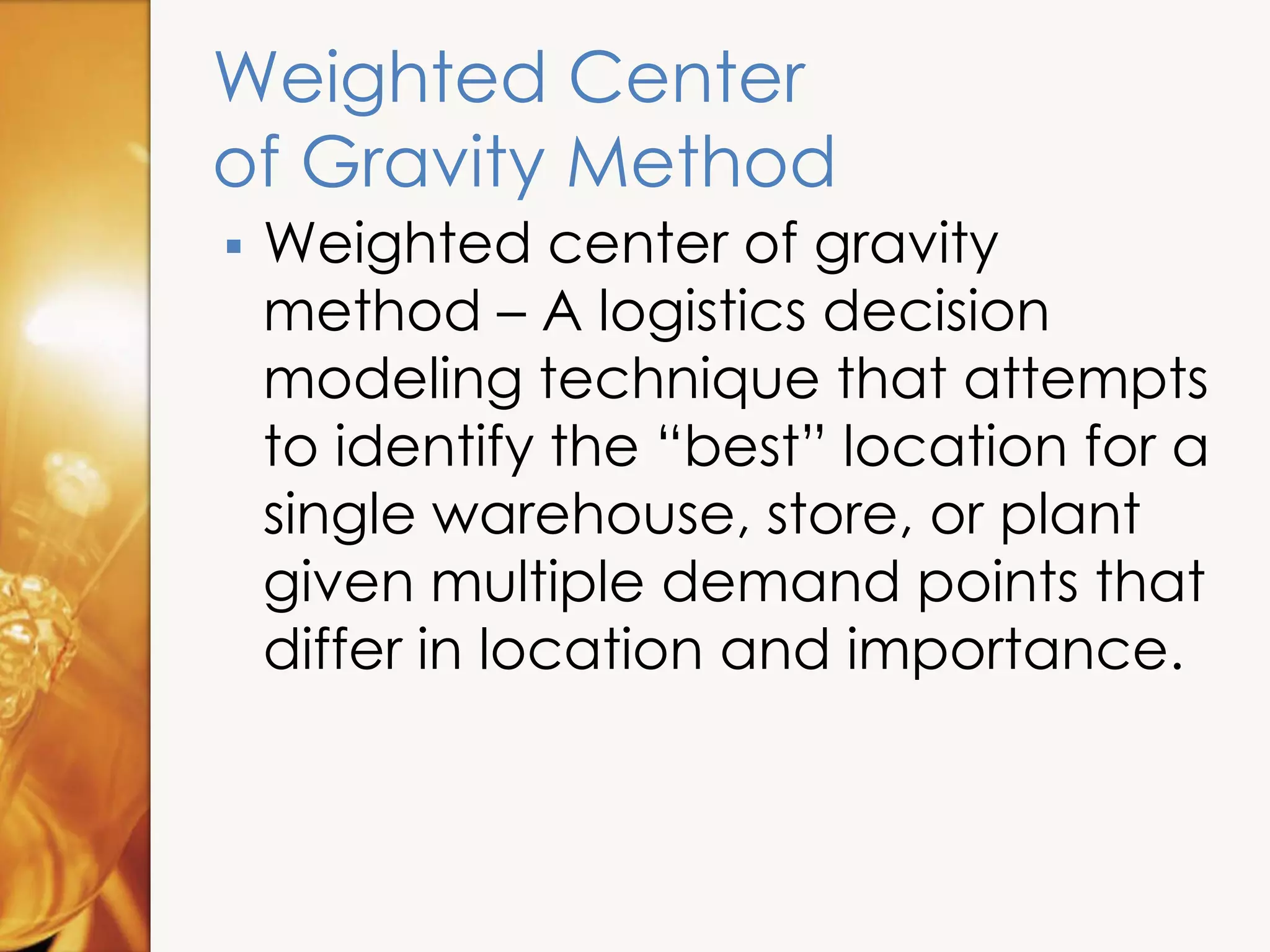
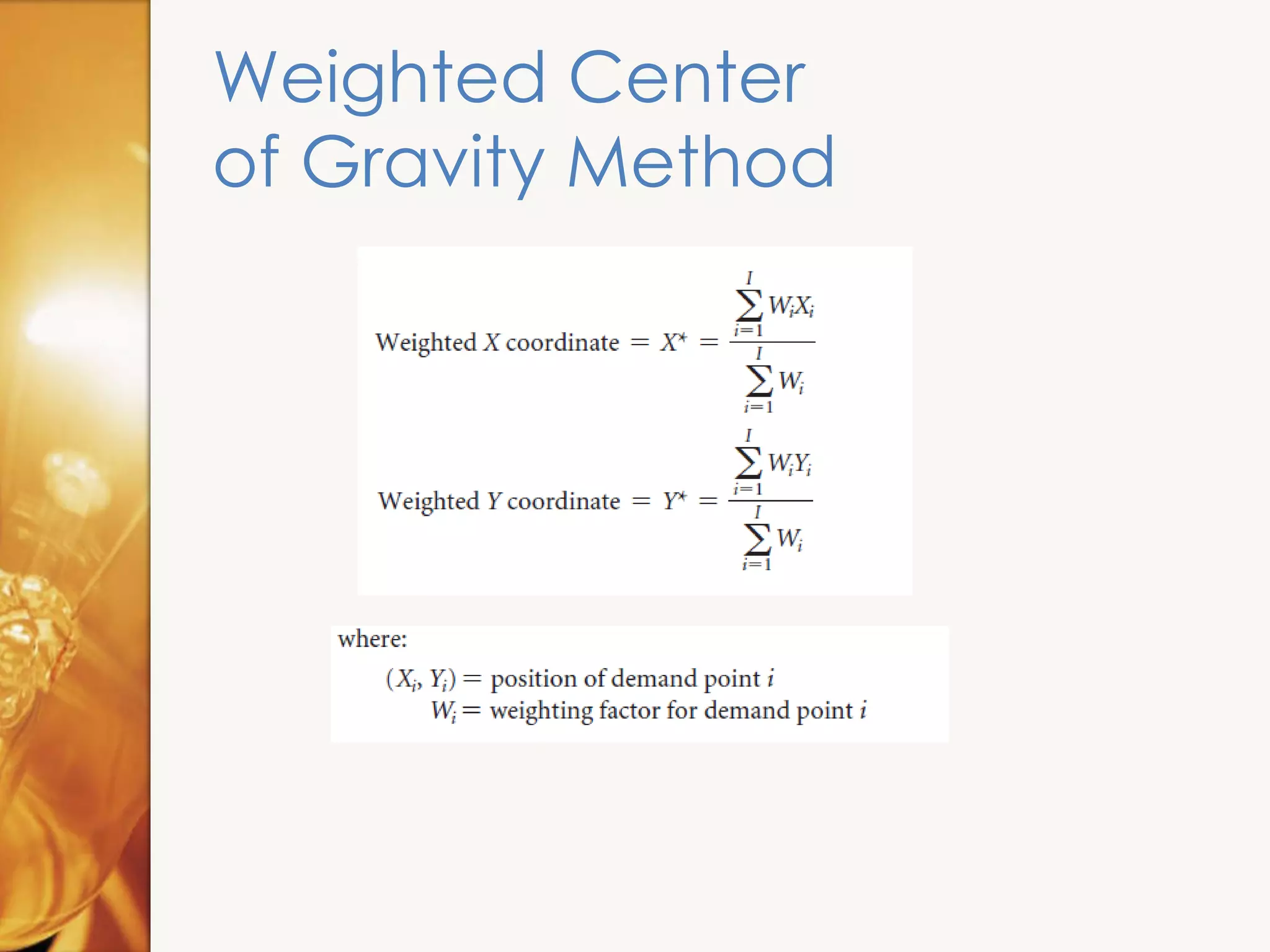
 Weighted center of gravity
method – A logistics decision
modeling technique that attempts
to identify the “best” location for a
single warehouse, store, or plant
given multiple demand points that
differ in location and importance.
Weighted Center
of Gravity Method
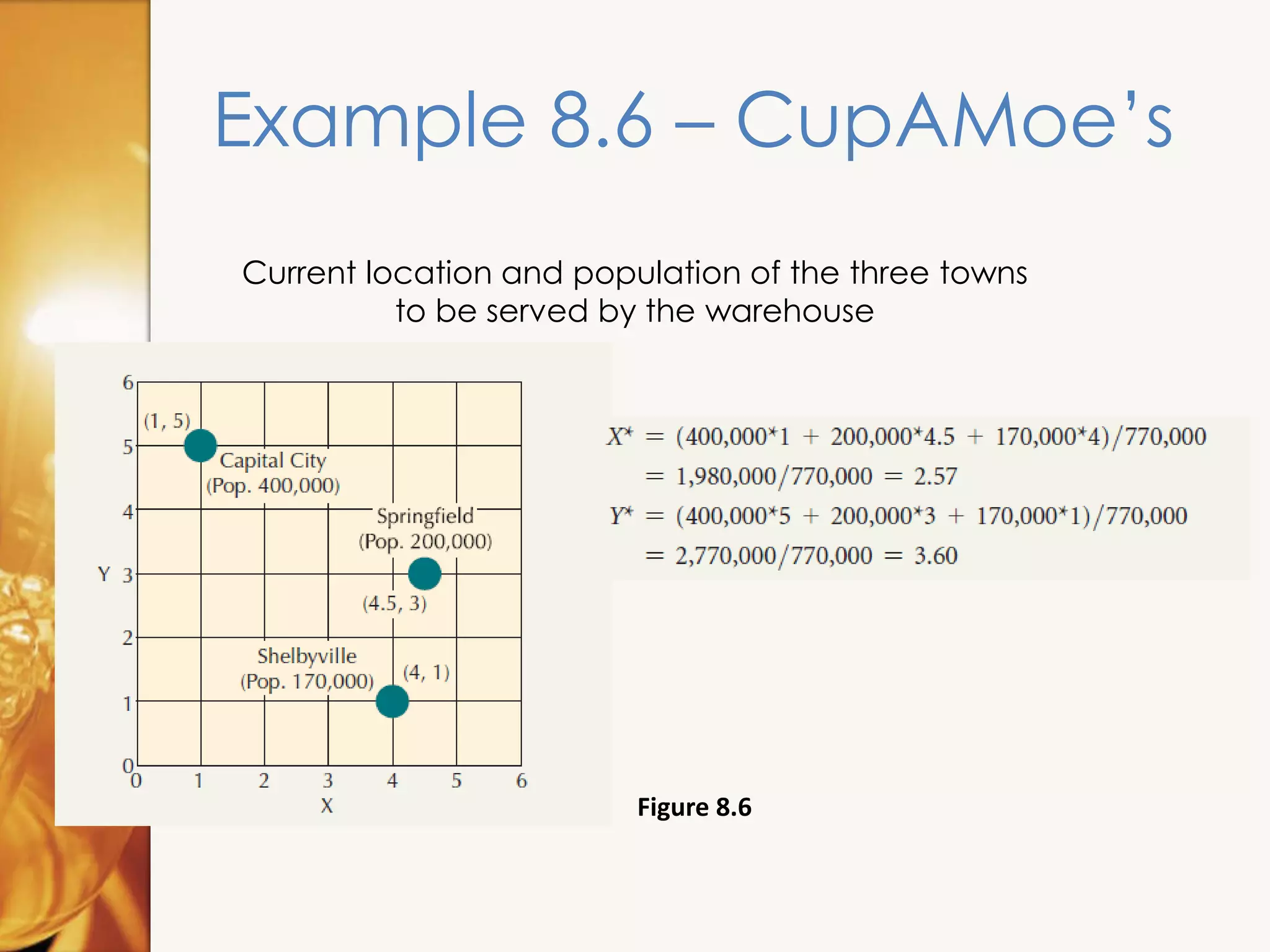
Example 8.6 – CupAMoe’s
Current location and population of the three towns
to be served by the warehouse
Figure 8.6
Example 8.6 – CupAMoe’s
Suggested location for the new warehouse
Figure 8.7
Optimization
 Optimization model – A type of
mathematical model used when the
decision maker seeks to optimize some
objective function subject to some
constraints.
 Objective function – A quantitative function
that an optimization model seeks to optimize
(minimize or maximize).
 Constraint – A quantifiable condition that
places limitations on the set of possible
solutions.
Optimization
Business problems that can be
addressed through optimization
modeling:
Table 8.5

Scm logistics

  • 1.
  • 2.
    Chapter Objectives Be ableto: Describe why logistics is important and discuss the major decision areas that make up logistics. List the strengths and weaknesses of the various modes of transportation and discuss the role of multimodal solutions. Identify the major types of warehousing solutions and their benefits. Discuss the purpose of a logistics strategy and give examples of how logistics can support the overall business strategy. Calculate the percentage of perfect orders. Calculate landed costs. Explain what reverse logistics systems are, and describe some of the unique challenges they create for firms. Use the weighted center of gravity method to identify a potential location for a business. Develop and then solve, using Microsoft Excel’s Solver function, an assignment problem.
  • 3.
    Logistics Management  Logisticsmanagement – That part of supply chain management that plans, implements, and controls the efficient, effective forward and reverse flow and storage of goods, services, and related information between the point of origin and the point of consumption in order to meet customers’ requirements. © CSCMP – Council of Supply Chain Management Professionals
  • 4.
    Logistics Management  Transportation Warehousing  Material handling  Packaging  Inventory management  Logistics information systems
  • 5.
    Why Logistics IsCritical  Impact on cost, flexibility, and delivery performance  Advances in information systems  Globalization of markets  Push toward sustainability
  • 6.
  • 7.
  • 8.
    Highway  Dominates thelogistics infrastructure due to:  Geographic extension of supply chains  Greater emphasis on delivery speed and flexibility  Has become more cost effective over time due to:  Better scheduling and use of vehicle capacity  More efficient and reliable vehicles  Increased cost competition due to deregulation  Involves different types of shipments  Direct truck – Shipment made with no stops  Less than truckload (LTL) – Smaller shipment combined with other loads
  • 9.
    Water  Ideal formaterials with high weight-to-value ratio, especially if delivery speed is not critical.  Examples: farm produce, timber, petroleum-based products.
  • 10.
    Air  Ideal forcustomers with a low weight- to-value ratio, especially if delivery speed or delivery reliability is critical.  Higher shipping costs and improvement in other modes have reversed the rise in air growth over the past decade.
  • 11.
    Rail  Characteristics similarto Water but more flexible.  To accommodate growth, rail carriers have doubled the number of lines along busy corridors, changed the physical configuration of the trains, and utilized multimodal solutions.
  • 12.
  • 13.
    Multimodal Solutions  Multimodalsolution – A transportation solution that seeks to exploit the strengths of multiple transportation modes through physical, information, and monetary flows that are as seamless as possible  Roadrailer – A specialized rail car the size of a standard truck trailer that can be quickly switched from rail to ground transportation without changing the wheels.
  • 14.
    Warehousing  Warehousing –Any operations that stores, repackages, stages, sorts, or centralizes goods or materials.  Warehousing can be used to:  Reduce transportation costs  Improve operational flexibility  Shorten customer lead times  Lower inventory-related costs.
  • 15.
    Consolidation Warehousing  Consolidationwarehousing – A form of warehousing that pulls together shipments from a number of sources in the same geographic area and combines them into larger and more economical loads  Cross-docking  Break-bulk  Hub-and-spoke system
  • 16.
  • 17.
  • 18.
  • 19.
    Postponement Warehousing  Postponementwarehousing – A form of warehousing that combines classic warehouse operations with light manufacturing and packaging duties to allow firms to put off final assembly or packaging of goods until the last possible moment.
  • 20.
    Types of Warehouses Assortment warehouses – A form of warehouses in which a wide array of goods is held close to the source of demand in order to assure short customer lead times.  Spot stock warehouses – A form of warehouses that attempts to position seasonal goods close to the marketplace.
  • 21.
    Logistics Information Systems Decision support tools ◦ Real-time simulation and optimization ◦ Cost estimations  Planning systems ◦ Carrier selection ◦ Scheduling deliveries  Execution systems ◦ RFID
  • 22.
    Material Handling and Packaging Material handling system – A system that includes the equipment and procedures needed to move goods within a facility, between a facility and a transportation mode, and between different transportation modes.  Packaging – The way goods and materials are packed in order to facilitate physical, informational, and monetary flows through the supply chain.
  • 23.
    Inventory Management  Implicationsfor transportation:  Using slower and cheaper transportation modes will cause inventory levels within the supply chain to rise.  Using faster and more expensive transportation modes will enable firms to lower inventory levels.  Implication for warehousing:  Warehousing and inventory managers must work closely to achieve the desired business outcome.
  • 24.
    Logistics Strategy  Logisticsstrategy – A functional strategy which ensures that an organization’s logistics choices are consistent with its overall business strategy and support the performance dimensions that targeted customers most value.
  • 25.
    Owning vs. Outsourcing Does the firm have the volume needed to justify a private logistics system?  Would owning a logistics system limit the firm’s ability to respond to changes in the marketplace or supply chain?  Is logistics a core competency for the firm?  Outsourcing options:  Common carriers  Contract carriers  Third-party logistics providers (3PL)
  • 26.
  • 27.
    Measuring Logistics Performance The perfect order  Delivered on time (according to buyer’s delivery dates)  Shipped complete  Invoiced correctly  Undamaged in transit
  • 28.
    Perfect order –Example 8.4
  • 29.
    Landed Costs  Landedcost – The cost of a product plus all costs driven by logistics activities, such as transportation, warehousing, handling, customs fees, etc.
  • 30.
    Reverse Logistics Systems Reverse logistics system – A complete supply chain dedicated to the reverse flow of products and materials for the purpose of returns, repair, remanufacture, and/or recycling. © 2010 APICS Dictionary
  • 31.
    Reverse Logistics Systems Challenges:  Firms have less control over the timing, transportation modes used, and packaging for goods flowing back up the supply chain.  Goods can flow back up the supply chain for a variety of reasons and a reverse logistics system needs to be able to sort and handle these different flows.  Forward logistics systems typically aren’t set up to handle reverse logistics flows.
  • 32.
    Weighted Center of GravityMethod  Weighted center of gravity method – A logistics decision modeling technique that attempts to identify the “best” location for a single warehouse, store, or plant given multiple demand points that differ in location and importance.
  • 33.
  • 34.
    Example 8.6 –CupAMoe’s Current location and population of the three towns to be served by the warehouse Figure 8.6
  • 35.
    Example 8.6 –CupAMoe’s Suggested location for the new warehouse Figure 8.7
  • 36.
    Optimization  Optimization model– A type of mathematical model used when the decision maker seeks to optimize some objective function subject to some constraints.  Objective function – A quantitative function that an optimization model seeks to optimize (minimize or maximize).  Constraint – A quantifiable condition that places limitations on the set of possible solutions.
  • 37.
    Optimization Business problems thatcan be addressed through optimization modeling: Table 8.5